


 |
市場調查報告書
商品編碼
1851657
服務提供自動化:市場佔有率分析、產業趨勢、統計數據和成長預測(2025-2030 年)Service Delivery Automation - Market Share Analysis, Industry Trends & Statistics, Growth Forecasts (2025 - 2030) |
||||||

※ 本網頁內容可能與最新版本有所差異。詳細情況請與我們聯繫。
預計到 2025 年,服務提供自動化市場規模將達到 390 億美元,到 2030 年將達到 1,301.3 億美元,年複合成長率為 27.25%。
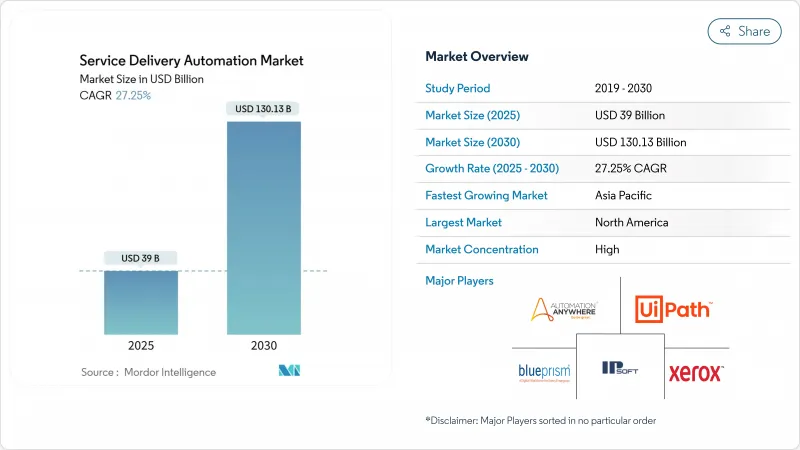
企業尋求降低營運成本、縮短週期時間並提高面向客戶和後勤部門流程的準確性,是推動市場需求的主要因素。超自動化(RPA、AI 和低程式碼工具的結合)的應用場景正從執行簡單任務擴展到認知決策,推動其從最初的試點階段發展到企業級推廣。隨著主流平台整合生成式 AI、降低整體擁有成本並轉向基於使用量的雲端交付模式,供應商之間的競爭日益激烈。北美地區的投資額最高,而亞太地區則呈現最強勁的成長勢頭,當地服務中心和數位化優先的中小企業正在大規模採用雲端自動化。
全球服務提供自動化市場趨勢與洞察
需要削減成本
隨著企業不斷推動勞力密集、高容量工作流程的自動化,每個流程的平均成本節省可達 30% 至 40%。採用 RPA 的銀行通常在第一年就能獲得 3 至 10 倍的投資報酬率,且異常處理錯誤顯著減少。一家平台供應商的內部調查顯示,88% 的員工表示,在重複性任務自動化後,他們的工作滿意度有所提高,這表明成本節約與員工體驗提升之間存在著密切的聯繫。這種趨勢在銀行、金融服務和保險 (BFSI)、通訊以及共享服務中心等行業尤其明顯,這些行業的薪資差距通常較大。
營運效率和服務等級協定 (SLA) 要求
日益嚴格的服務水準目標迫使企業加快流程週期,同時減少返工。實施服務提供自動化的財務管理團隊報告稱,報告錯誤減少了 90%,結帳速度比傳統人工方法快 85 倍。依賴快速問題解決的訂閱制企業也能從客戶回應指標中獲益,因為自動化分診機器人可以在幾分鐘內解決服務工單。
熟練的自動化架構師短缺
認知自動化計劃需要多學科人才,包括程式工程、資料科學和風險控制。然而,由於需求遠超培訓能力,高階架構師仍供不應求,導致高價值配置延遲,迫使企業聘請昂貴的顧問。低程式碼公民開發人員工具有所幫助,但複雜的跨系統編配仍然依賴經驗豐富的架構師。
細分市場分析
在完善的運作手冊腳本和清晰的投資報酬率 (ROI) 基準的驅動下,IT 流程自動化將在 2024 年佔據服務提供自動化市場 56% 的佔有率。服務台團隊若能實現密碼重設、備份檢查和事件路由的自動化,可將平均解決時間縮短高達 40%。同時,認知/人工智慧自動化領域正以 40.20% 的複合年成長率 (CAGR) 高速成長,這得益於大規模語言模型和影像分析技術的進步,這些技術使機器人能夠解讀非結構化輸入。保險公司目前正在部署認知機器人來評估理賠文件並即時標記異常情況,從而提高效率並開拓新的收入來源。隨著企業將人工智慧疊加到其底層 RPA 資產上,服務提供自動化市場預測將出現一個以智慧編配為中心的平台更新周期。
這種演進正在改變採購標準。買家現在尋求的是能夠在單一授權下整合任務自動化、決策支援和持續學習的解決方案。供應商透過整合原生人工智慧或與超大規模人工智慧服務商合作來應對這一需求,從而形成一種融合趨勢,將支出從僅包含腳本的小眾工具轉向整合套件。因此,服務提供自動化市場正朝著更少但涵蓋範圍更廣的配置,在單一管治框架下同時滿足IT和業務營運的需求。
到2024年,軟體平台將佔總收入的61.56%。這些平台目前整合了電腦視覺、流程挖掘和管治主機等功能,以加速價值驗證的建構。然而,預計服務將以15.00%的複合年成長率超越軟體。隨著自動化擴展到數百個流程,企業需要藍圖設計、變更管理、機器人健康監控和持續改進計劃,而這些內容內部團隊難以應對。因此,顧問公司和系統整合商正在整合價值評估框架、公民開發人員賦能框架和卓越中心營運框架。由此,服務提供自動化市場的預算結構正穩步從純粹的授權轉向持續的託管服務。
託管服務領域的服務提供自動化市場規模正在迅速擴張,尤其是在那些持續合規性測試和審核日誌記錄必不可少的監管行業。供應商現在提供「自動化即服務」模式,並制定了涵蓋服務等級協定 (SLA) 合規性、版本升級和安全性修補程式的責任共用矩陣。這種訂閱式服務對缺乏內部 IT 維運團隊但仍需要企業級可靠性的中小型企業極具吸引力。
服務提供自動化市場報告按類型(IT流程自動化、業務流程自動化、其他)、組件(軟體平台、服務)、部署模式(本地部署、雲端部署)、組織規模(大型企業、中小企業)、最終用戶垂直行業(銀行、金融服務和保險、IT服務、通訊和媒體、其他)和地區對產業進行分類。
區域分析
北美仍然是服務提供自動化市場最大的中心,這得益於其高昂的人事費用、成熟的雲端基礎設施以及主要平台供應商的總部所在地。金融機構和醫療保健系統引領這一趨勢,它們通常會整合認知機器人和分析技術來預測異常情況,並在服務等級協定 (SLA) 違約發生之前加以預防。生成式人工智慧實驗十分普遍,一些公司正在試行大規模語言模型,用於撰寫法律摘要和合規性說明。
亞太地區是成長最快的區域。印度和菲律賓正在建立全球服務中心,試圖透過利用數位化員工來降低人事費用;與此同時,中國保險公司正在推動理賠自動化,以應對保單數量的激增。政府對智慧製造和物流數位化的獎勵策略正在推動倉庫自動化,而倉庫自動化依賴編配機器人來調度自動導引車(AGV)。本地供應商正在提供價格敏感型捆綁產品,以加速其在東協市場中型企業的滲透。
在歐洲,我們看到北歐和西方經濟體正在穩步採用自動化技術。歐盟的《一般資料保護規則)要求企業建立控制機制,記錄所有機器人操作,並將自動化流程與審核追蹤結合。德國和比荷盧經濟聯盟的製造企業集團正在實現現場報告的自動化,北歐公共機構正在部署聊天機器人,以多種語言處理公民諮詢。各方都在謹慎決策。 IT 支出方傾向於投資報酬率透明的計劃,推動分階段推廣,而分階段推廣仍是整體服務提供自動化市場的重要組成部分。
其他福利:
- Excel格式的市場預測(ME)表
- 3個月的分析師支持
目錄
第1章 引言
- 研究假設和市場定義
- 調查範圍
第2章調查方法
第3章執行摘要
第4章 市場情勢
- 市場概覽
- 市場促進因素
- 需要削減成本
- 對營運效率和服務水準協議的需求
- 數位優先和雲端優先轉型
- RPA平台成熟度和更低的整體擁有成本
- 超自動化融合(iPaaS+RPA+LCAP)
- 生成式人工智慧副駕駛賦能公民開發者
- 市場限制
- 熟練的自動化架構師短缺
- 高昂的初始整合和變更管理成本
- 多租戶工作流程中的安全性和合規性漏洞
- 自動化能耗的ESG審查
- 關鍵法規結構評估
- 價值鏈分析
- 技術展望
- 波特五力模型
- 供應商的議價能力
- 買方的議價能力
- 新進入者的威脅
- 替代品的威脅
- 競爭對手之間的競爭
- 關鍵相關人員影響評估
- 主要用例和案例研究
- 宏觀經濟因素對市場的影響
- 投資分析
第5章 市場區隔
- 按類型
- IT流程自動化
- 業務流程自動化
- 機器人流程自動化
- 基於認知/人工智慧的自動化
- 按組件
- 軟體平台
- 服務(諮詢、整合、支援)
- 透過部署模式
- 本地部署
- 雲
- 混合
- 按組織規模
- 主要企業
- 小型企業
- 按最終用戶行業分類
- 銀行、金融服務和保險(BFSI)
- 資訊科技服務
- 通訊與媒體
- 醫療保健和製藥
- 零售和消費品
- 製造與物流
- 飯店和交通運輸
- 其他行業
- 按地區
- 北美洲
- 美國
- 加拿大
- 墨西哥
- 南美洲
- 巴西
- 阿根廷
- 其他南美洲
- 歐洲
- 英國
- 德國
- 法國
- 義大利
- 西班牙
- 北歐國家
- 其他歐洲地區
- 中東和非洲
- 中東
- 沙烏地阿拉伯
- 阿拉伯聯合大公國
- 土耳其
- 其他中東地區
- 非洲
- 南非
- 埃及
- 奈及利亞
- 其他非洲地區
- 亞太地區
- 中國
- 印度
- 日本
- 韓國
- ASEAN
- 澳洲
- 紐西蘭
- 亞太其他地區
- 北美洲
第6章 競爭情勢
- 市場集中度
- 策略趨勢
- 市佔率分析
- 公司簡介
- UiPath SRL
- Automation Anywhere Inc.
- IBM Corporation
- Blue Prism Ltd
- NICE Ltd
- IPsoft Inc.
- Xerox Holdings Corporation
- Celaton Limited
- Arago GmbH
- Accenture plc
- AutomationEdge Technologies
- Pegasystems Inc.
- Microsoft Corporation
- SAP SE
- ServiceNow Inc.
- WorkFusion Inc.
- Kofax Inc.
- Cognizant Technology Solutions
- Infosys Ltd
- Tech Mahindra Ltd
第7章 市場機會與未來展望
The service delivery automation market is valued at USD 39 billion in 2025 and is projected to grow at a 27.25% CAGR, reaching USD 130.13 billion by 2030.
Demand stems from enterprises seeking lower operating costs, faster cycle times, and higher accuracy across customer-facing and back-office processes. Hyperautomation- the combination of RPA, AI, and low-code tools- is expanding use cases from simple task execution to cognitive decision making, pushing adoption beyond early pilots into enterprise-wide rollouts. Vendor competition is intensifying as leading platforms embed generative AI, reducing total cost of ownership,, and shifting to usage-based cloud delivery. North America accounts for the largest regional spend, yet Asia-Pacific shows the steepest growth curve as local service centers and digital-first SMEs embrace cloud automation at scale.
Global Service Delivery Automation Market Trends and Insights
Cost-reduction imperative
Enterprises continue to automate labor-intensive, high-volume workflows and record average savings of 30-40% per process. Banks that deploy RPA often earn 3-10 times ROI in year one and cut exception-handling errors markedly. Internal surveys by platform vendors reveal that 88% of employees experience higher job satisfaction after repetitive tasks are automated, signaling that cost savings align with workforce experience gains. This sentiment is strongest in BFSI, telecommunications and shared service centers where wage differentials are high.
Operational efficiency and SLA demand
Tighter service-level targets have forced organizations to accelerate process cycle times while reducing rework. Financial control teams that add service delivery automation report 90% fewer reporting errors and close books up to 85 times faster than previously manual workflows. Customer response metrics also benefit: automated triage bots resolve service tickets within minutes, boosting retention in subscription-based businesses where renewal hinges on rapid issue resolution.
Skilled automation architect scarcity
Cognitive automation projects require multi-disciplinary talent covering process engineering, data science and risk controls. Yet senior architects remain in short supply as demand outpaces training pipelines, delaying high-value deployments and forcing companies to contract premium-priced consultants. Low-code citizen-developer tooling helps, but complex cross-system orchestration still relies on experienced designers.
Other drivers and restraints analyzed in the detailed report include:
- Digital-first and cloud-first transformation
- RPA maturity and lower TCO
- High up-front integration and change-management cost
For complete list of drivers and restraints, kindly check the Table Of Contents.
Segment Analysis
IT Process Automation held 56% of service delivery automation market share in 2024 owing to well-defined run-book scripts and clear ROI benchmarks. Service desk teams that automate password resets, backup checks and incident routing cut mean-time-to-resolve by up to 40%. In parallel, the Cognitive/AI-based Automation segment is expanding at a 40.20% CAGR, fueled by advances in large language models and image analytics that let bots interpret unstructured inputs. Underwriters now deploy cognitive bots to assess claim documents and flag anomalies in real time, unlocking new revenue streams alongside efficiency wins. As firms layer AI onto foundational RPA estates, the service delivery automation market anticipates a platform refresh cycle centred on intelligent orchestration.
This evolution changes purchasing criteria. Buyers increasingly seek solutions that combine task automation, decision support and continuous learning inside one license. Vendors respond by embedding native AI or partnering with hyperscale AI services, creating a convergence that shifts spend away from niche script-only tools toward unified suites. The service delivery automation market is therefore tilting toward fewer but broader deployments that serve both IT and business operations under a single governance framework.
Software Platforms represented 61.56% of 2024 revenue because every automation journey begins with a licence. These platforms now ship with built-in computer vision, process mining and governance consoles that accelerate proof-of-value builds. However, Services are projected to outpace software at a 15.00% CAGR. As automation scales to hundreds of processes, enterprises need roadmap design, change management, bot health monitoring, and continuous improvement programs that internal teams struggle to absorb. Consulting firms and system integrators thus bundle frameworks for value assessment, citizen-developer enablement and center-of-excellence operation. The result is a steady shift in budget mix from pure licences toward ongoing managed services inside the service delivery automation market.
The service delivery automation market size for managed services is expanding particularly fast in regulated industries where continuous compliance testing and audit logs are mandatory. Vendors now offer "automation-as-a-service" models with shared responsibility matrices covering SLA adherence, version upgrades and security patching. This subscription-oriented delivery appeals to SMEs that lack an internal IT operations bench yet want enterprise-grade reliability.
The Service Delivery Automation Market Report Segments the Industry Into by Type (IT Process Automation, Business Process Automation, and More), Component (Software Platforms, and Services), Deployment Mode (On-Premise, and Cloud), Organization Size (Large Enterprises, and Small and Medium Enterprises), End-User Industry (BFSI, Information Technology Services, Telecommunications and Media, and More), and Geography.
Geography Analysis
North America remains the largest hub for the service delivery automation market, supported by high labor costs, mature cloud infrastructure and headquarters of leading platform vendors. Financial institutions and healthcare systems spearhead adoption, often integrating cognitive bots with analytics to predict exceptions and pre-empt SLA breaches. Generative AI experimentation is widespread, with firms piloting large language models to draft legal summaries and compliance narratives.
Asia-Pacific records the steepest growth trajectory. India and the Philippines host global service centers keen to reduce attrition costs through digital workers, while Chinese insurers automate claims to manage surging policy volumes. Government stimulus for smart manufacturing and logistics digitization fuels warehouse automation that relies on orchestration bots to schedule AGVs. Local vendors offer price-sensitive bundles, accelerating penetration into medium-sized enterprises across ASEAN markets.
Europe exhibits steady uptake across Northern and Western economies. The EU's General Data Protection Regulation prompts businesses to embed controls that log every bot action, aligning automation with audit trails. Manufacturing conglomerates in Germany and Benelux automate shop-floor reporting, while public agencies in the Nordics deploy chatbots to handle citizen queries in multiple languages. Decision making is cautious: IT spending favors projects with transparent payback, driving phased roll-outs that still contribute significant volume to the overall service delivery automation market.
- UiPath SRL
- Automation Anywhere Inc.
- IBM Corporation
- Blue Prism Ltd
- NICE Ltd
- IPsoft Inc.
- Xerox Holdings Corporation
- Celaton Limited
- Arago GmbH
- Accenture plc
- AutomationEdge Technologies
- Pegasystems Inc.
- Microsoft Corporation
- SAP SE
- ServiceNow Inc.
- WorkFusion Inc.
- Kofax Inc.
- Cognizant Technology Solutions
- Infosys Ltd
- Tech Mahindra Ltd
Additional Benefits:
- The market estimate (ME) sheet in Excel format
- 3 months of analyst support
TABLE OF CONTENTS
1 INTRODUCTION
- 1.1 Study Assumptions and Market Definition
- 1.2 Scope of the Study
2 RESEARCH METHODOLOGY
3 EXECUTIVE SUMMARY
4 MARKET LANDSCAPE
- 4.1 Market Overview
- 4.2 Market Drivers
- 4.2.1 Cost-reduction Imperative
- 4.2.2 Demand for Operational Efficiency and SLAs
- 4.2.3 Digital-First and Cloud-first Transformation
- 4.2.4 RPA Platform Maturity and Lower TCO
- 4.2.5 Hyperautomation Convergence (iPaaS + RPA + LCAP)
- 4.2.6 Generative-AI Copilots Enabling Citizen Developers
- 4.3 Market Restraints
- 4.3.1 Scarcity of Skilled Automation Architects
- 4.3.2 High Up-front Integration and Change-management Cost
- 4.3.3 Multitenant Workflow Security and Compliance Gaps
- 4.3.4 ESG Scrutiny on Automation Energy Footprint
- 4.4 Evaluation of Critical Regulatory Framework
- 4.5 Value Chain Analysis
- 4.6 Technological Outlook
- 4.7 Porter's Five Forces
- 4.7.1 Bargaining Power of Suppliers
- 4.7.2 Bargaining Power of Buyers
- 4.7.3 Threat of New Entrants
- 4.7.4 Threat of Substitutes
- 4.7.5 Competitive Rivalry
- 4.8 Impact Assessment of Key Stakeholders
- 4.9 Key Use Cases and Case Studies
- 4.10 Impact on Macroeconomic Factors of the Market
- 4.11 Investment Analysis
5 MARKET SEGMENTATION
- 5.1 By Type
- 5.1.1 IT Process Automation
- 5.1.2 Business Process Automation
- 5.1.3 Robotic Process Automation
- 5.1.4 Cognitive/AI-based Automation
- 5.2 By Component
- 5.2.1 Software Platforms
- 5.2.2 Services (Consulting, Integration, Support)
- 5.3 By Deployment Mode
- 5.3.1 On-premise
- 5.3.2 Cloud
- 5.3.3 Hybrid
- 5.4 By Organization Size
- 5.4.1 Large Enterprises
- 5.4.2 Small and Medium Enterprises
- 5.5 By End-user Industry
- 5.5.1 Banking, Financial Services and Insurance (BFSI)
- 5.5.2 Information Technology Services
- 5.5.3 Telecommunications and Media
- 5.5.4 Healthcare and Pharmaceuticals
- 5.5.5 Retail and Consumer Goods
- 5.5.6 Manufacturing and Logistics
- 5.5.7 Hospitality and Transportation
- 5.5.8 Other Industries
- 5.6 By Geography
- 5.6.1 North America
- 5.6.1.1 United States
- 5.6.1.2 Canada
- 5.6.1.3 Mexico
- 5.6.2 South America
- 5.6.2.1 Brazil
- 5.6.2.2 Argentina
- 5.6.2.3 Rest of South America
- 5.6.3 Europe
- 5.6.3.1 United Kingdom
- 5.6.3.2 Germany
- 5.6.3.3 France
- 5.6.3.4 Italy
- 5.6.3.5 Spain
- 5.6.3.6 Nordics
- 5.6.3.7 Rest of Europe
- 5.6.4 Middle East and Africa
- 5.6.4.1 Middle East
- 5.6.4.1.1 Saudi Arabia
- 5.6.4.1.2 United Arab Emirates
- 5.6.4.1.3 Turkey
- 5.6.4.1.4 Rest of Middle East
- 5.6.4.2 Africa
- 5.6.4.2.1 South Africa
- 5.6.4.2.2 Egypt
- 5.6.4.2.3 Nigeria
- 5.6.4.2.4 Rest of Africa
- 5.6.5 Asia-Pacific
- 5.6.5.1 China
- 5.6.5.2 India
- 5.6.5.3 Japan
- 5.6.5.4 South Korea
- 5.6.5.5 ASEAN
- 5.6.5.6 Australia
- 5.6.5.7 New Zealand
- 5.6.5.8 Rest of Asia-Pacific
- 5.6.1 North America
6 COMPETITIVE LANDSCAPE
- 6.1 Market Concentration
- 6.2 Strategic Moves
- 6.3 Market Share Analysis
- 6.4 Company Profiles (includes Global level Overview, Market level overview, Core Segments, Financials as available, Strategic Information, Market Rank/Share for key companies, Products and Services, and Recent Developments)
- 6.4.1 UiPath SRL
- 6.4.2 Automation Anywhere Inc.
- 6.4.3 IBM Corporation
- 6.4.4 Blue Prism Ltd
- 6.4.5 NICE Ltd
- 6.4.6 IPsoft Inc.
- 6.4.7 Xerox Holdings Corporation
- 6.4.8 Celaton Limited
- 6.4.9 Arago GmbH
- 6.4.10 Accenture plc
- 6.4.11 AutomationEdge Technologies
- 6.4.12 Pegasystems Inc.
- 6.4.13 Microsoft Corporation
- 6.4.14 SAP SE
- 6.4.15 ServiceNow Inc.
- 6.4.16 WorkFusion Inc.
- 6.4.17 Kofax Inc.
- 6.4.18 Cognizant Technology Solutions
- 6.4.19 Infosys Ltd
- 6.4.20 Tech Mahindra Ltd
7 MARKET OPPORTUNITIES AND FUTURE OUTLOOK
- 7.1 White-space and Unmet-need Assessment

 全球末端配送自動化市場預測(至2034年):按組件、技術、配送方式、應用、最終用戶和地區分類的分析
 人力資源服務配送平臺:市場佔有率分析、產業趨勢與統計、成長預測(2026-2031)北美人力資源服務配送平臺:市場佔有率分析、產業趨勢與統計及成長預測(2026-2031 年)
 2026年全球服務交付自動化市場報告
 服務提供自動化市場:按組件、產業、部署類型和組織規模分類 - 2026-2032 年全球預測
 全球服務提供自動化市場規模、佔有率、趨勢和成長分析報告(2026-2034年)
 服務提供自動化市場規模、佔有率和成長分析(按組件、類型、使用者類型、垂直產業和地區分類)-2026-2033年產業預測服務提供自動化市場預測至 2032 年:按類型、產品、組件、部署模式、應用、最終用戶和地區分類的全球分析服務提供平台:市場佔有率分析、產業趨勢、統計數據和成長預測(2025-2030 年)