


 |
市場調查報告書
商品編碼
1844559
北美太陽能控制窗膜:市場佔有率分析、行業趨勢、統計數據和成長預測(2025-2030 年)North America Solar Control Window Films - Market Share Analysis, Industry Trends & Statistics, Growth Forecasts (2025 - 2030) |
||||||

※ 本網頁內容可能與最新版本有所差異。詳細情況請與我們聯繫。
北美太陽能控制窗膜市場規模預計在 2025 年為 2.2767 億美元,預計到 2030 年將達到 3.2353 億美元,預測期內(2025-2030 年)的複合年成長率為 7.28%。
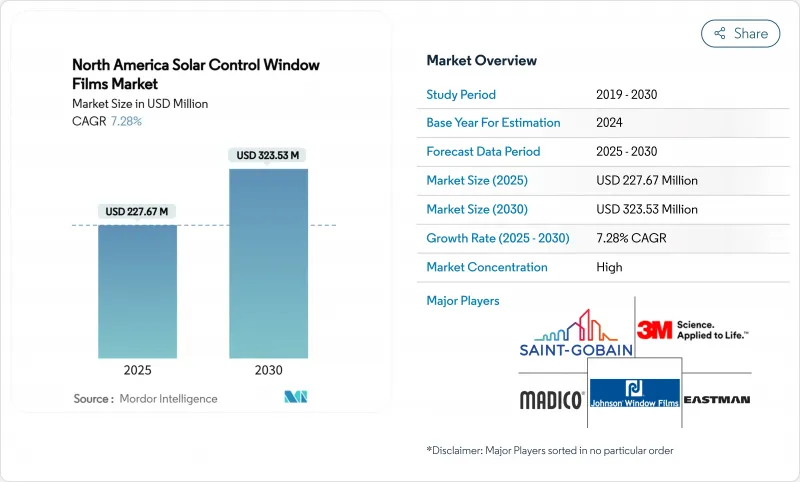
推動成長的因素包括:更嚴格的建築節能法規、聯邦和州政府的稅收優惠政策,以及汽車製造商為降低電動車空調負載而擴大使用太陽能控制膜。大眾對紫外線照射風險的認知日益增強,尤其是在陽光地帶,這為購買決策增添了健康保護的考量。企業在商業地產領域進行的ESG維修,透過升級現有建築幕牆而非完全更換結構玻璃系統,顯示出顯著的營運成本節約。同時,USMCA框架下的動態供應鏈整合將使北美生產商能夠有效地供應汽車和建築市場,從而增強該地區的需求韌性。
北美太陽能控制窗膜市場趨勢與洞察
嚴格的建築節能標準和稅收優惠
2024年《國際節能規範》將固定窗的允許空氣洩漏限值從0.40立方英尺/平方英尺(約0.40立方英尺/分鐘)降低至0.35立方英尺/平方英尺(約0.35立方英尺/分鐘),促使建築業主尋求高性能隔熱膜等經濟高效的維修解決方案。同時,《通貨膨脹削減法案》允許屋主在購買合格的隔熱膜時申請30%的抵扣(最高600美元),商業地產可以利用第179D條抵扣來抵消安裝成本。加州第24條和紐約市第97條地方法律強化了州一級的要求,制定了合規激勵措施,優先考慮隔熱膜維修,避免整個窗戶更換週期。
汽車製造商擴大採用該技術來減少空調負荷
透過在層壓過程中整合太陽熱控制層,汽車製造商可將車內熱增益降低約20%,從而延長電動車的續航里程。皮爾金頓的Galaxy 嵌裝玻璃可阻擋65%的太陽熱量和超過95%的紫外線,為工廠採用樹立了標竿。 《美墨加協定》(USMCA)簡化了跨國採購流程,墨西哥370億美元的零件進口市場為當地玻璃貼膜製造商提供了規模。電動車的需求尤其強勁,因為空調負荷的降低會延長電池壽命,並降低與熱劣化相關的保固成本。
智慧玻璃替代品的威脅
電致變色窗戶透過動態光熱控制,可實現17-23%的建築節能,在最佳化的管理系統中優於靜態薄膜。物聯網整合可實現自動色調調節,並增加了傳統薄膜所不具備的功能。生產規模效率正逐步縮小成本差距,智慧玻璃正逐漸成為商業預算的主流。儘管高昂的資本成本仍限制了其應用,但加速研發意味著未來十年高階建築領域將面臨競爭威脅。
細分分析
2024 年,真空鍍膜反射膜以 46.18% 的佔有率佔據北美太陽能控制窗膜市場首位,這要歸功於濺鍍沉澱的金屬層,它可以在不影響可見光的情況下減少紅外線增益。這些產品通常可實現低於 0.30 的太陽熱增益係數,幫助商業大樓滿足高冷卻負荷氣候下的能源法規。由於設施管理人員優先考慮營運節省而不是外部均勻性,因此需求依然強勁。然而,染色非反射產品正在迎頭趕上,以較低的價格提供中性美感,到 2030 年,受郊區屋主申請聯邦稅額扣抵的推動,其複合年成長率將達到 7.92%。透明非反射膜用於需要防紫外線同時適應日光的醫院和學校。高性能混合薄膜雖然仍佔據較小的市場佔有率,但其先進的陶瓷層為未來的產品開發指明了方向,這種陶瓷層在數十年的使用壽命內保持透明度和耐用性。
實驗室的進展凸顯了該領域的創新曲線。聖母大學報告了一種量子最佳化塗層,它可以將冷卻能量減少三分之一,同時保持外部可見度,這表明薄膜效率有可能提升到一個新的水平。伊士曼等製造商正在將專有的紅外線阻隔陶瓷塗層與壓敏黏著劑結合,以進一步增強熱反射。有機裝飾膜在室內設計中仍然很重要,但面臨預著色一體式Low-E低輻射鍍膜玻璃的競爭。儘管如此,改造膜的吸引力——快速安裝和對租戶的干擾最小——幫助北美太陽能控制窗膜市場保持強勁,即使在技術先進但昂貴的智慧玻璃解決方案爭奪未來規格的情況下。
其他福利:
- Excel 格式的市場預測 (ME) 表
- 3個月的分析師支持
目錄
第1章 引言
- 研究假設和市場定義
- 調查範圍
第2章調查方法
第3章執行摘要
第4章 市場狀況
- 市場概況
- 市場促進因素
- 嚴格的建築能源法規和稅收優惠
- 汽車原始設備製造商擴大採用該技術來減少空調負荷
- 提高對紫外線照射和皮膚癌的認知
- ESG 為企業現有玻璃建築幕牆改裝
- 使用混合辦公模式升級您的家庭辦公室,以控制眩光
- 市場限制
- 智慧玻璃替代品的威脅
- IGU 的耐久性和變色問題
- Low-E鍍膜嵌裝玻璃日益普及
- 價值鏈分析
- 五力分析
- 供應商的議價能力
- 買方的議價能力
- 新進入者的威脅
- 替代品的威脅
- 競爭對手之間的競爭
第5章市場規模及成長預測
- 按影片類型
- 透明(不反光)
- 染色(不反光)
- 真空鍍膜(反射型)
- 高性能薄膜
- 其他電影類型
- 按吸收劑類型
- 有機的
- 無機/陶瓷
- 金屬
- 按最終用戶產業
- 建造
- 車
- 海洋
- 設計
- 其他最終用戶產業
- 按地區
- 美國
- 加拿大
- 墨西哥
第6章 競爭態勢
- 市場集中度
- 策略舉措
- 市佔率分析
- 公司簡介
- 3M
- Avery Dennison Corporation
- Decorative Films, LLC
- Eastman Chemical Company
- Garware Hi-Tech Films
- HUPER OPTIK USA
- Johnson Window Films, Inc.
- Madico
- Maxpro Window Films
- Polytronix, Inc.
- Purlfrost
- Saint-Gobain
- SOLAR CONTROL FILMS INC
- Thermolite, LLC
- XPEL
第7章 市場機會與未來展望
The North America Solar Control Window Films Market size is estimated at USD 227.67 million in 2025, and is expected to reach USD 323.53 million by 2030, at a CAGR of 7.28% during the forecast period (2025-2030).
Growth is supported by tighter building-energy codes, federal and state tax incentives, and expanded use of solar control films by original-equipment automotive manufacturers seeking to reduce air-conditioning loads in electric vehicles. Heightened public awareness of ultraviolet exposure risks, particularly in the Sun Belt, adds a health-protection dimension to purchasing decisions. Corporate ESG retrofits across commercial real estate demonstrate clear operating-expense savings by upgrading existing facades rather than replacing glazing systems outright. Meanwhile, dynamic supply-chain integration under USMCA allows North American producers to serve automotive and construction markets efficiently, reinforcing regional demand resilience.
North America Solar Control Window Films Market Trends and Insights
Stringent Building-Energy Codes & Tax Incentives
The 2024 International Energy Conservation Code lowered allowable air leakage for fixed fenestration from 0.40 cfm/ft2 to 0.35 cfm/ft2, pushing building owners toward cost-effective retrofit solutions such as high-performance films. Concurrently, the Inflation Reduction Act enables homeowners to claim a 30% credit-capped at USD 600-for qualified film purchases, while commercial properties leverage Section 179D deductions to offset installation costs. California Title 24 and New York City Local Law 97 strengthen state-level demand, creating compliance drivers that bypass full window replacement cycles in favor of film retrofits.
Rising OEM Adoption in Automotive to Cut A/C Load
Automakers integrate solar control layers during lamination, lowering cabin heat gain by roughly 20% and extending electric-vehicle range. Pilkington's Galaxsee glazing blocks 65% of solar heat and more than 95% of UV radiation, setting baseline specifications for factory adoption. USMCA simplifies cross-border sourcing, and Mexico's USD 37 billion component-import market provides scale for regional glass and film producers. Demand is particularly strong in electric vehicles, where every reduction in A/C load extends battery range and reduces warranty costs related to thermal degradation.
Smart-Glass Substitution Threat
Electrochromic windows achieve 17-23% building-energy savings through dynamic light and heat control, outperforming static films in optimized management systems. Integration with IoT enables automated tint adjustment, adding functionality beyond the reach of conventional films. Manufacturing scale efficiencies are gradually narrowing cost gaps, bringing smart glass into mainstream commercial budgets. Although high capital costs still limit penetration, accelerating R&D suggests a competitive threat in premium construction segments over the next decade.
Other drivers and restraints analyzed in the detailed report include:
- Heightened UV-Exposure & Skin-Cancer Awareness
- Corporate ESG Retrofits of Existing Glass Facades
- Durability & Discoloration Issues on IGUs
For complete list of drivers and restraints, kindly check the Table Of Contents.
Segment Analysis
Vacuum-coated reflective films led the North America Solar Control Window Films market with a 46.18% share in 2024, thanks to sputter-deposited metallic layers that cut infrared gain without compromising visible light. These products routinely deliver Solar Heat Gain Coefficient values below 0.30, helping commercial towers meet energy codes in climate zones with high cooling loads. Demand is sustained by facility managers prioritizing operating-expense savings over exterior uniformity concerns. Dyed non-reflective products, however, are catching up by offering neutral aesthetics at lower price points and enjoying a 7.92% CAGR through 2030, propelled by suburban homeowners claiming federal tax credits. Clear non-reflective variants serve hospitals and schools that require daylighting compliance while still blocking ultraviolet exposure. High-performance hybrid films occupy a smaller revenue niche but showcase the direction of future product development through advanced ceramic layering that maintains clarity and durability over multidecade lifetimes.
Laboratory advances highlight the segment's innovation curve. The University of Notre Dame reported quantum-optimized coatings capable of reducing cooling energy by one-third while preserving outward views, signaling potential step-change improvements in film efficacy. Manufacturers such as Eastman deploy proprietary infrared-blocking ceramic coatings combined with pressure-sensitive adhesives to raise the thermal rejection bar further. Organic-based decorative films retain relevance in interior design, yet face mounting competition from integrated low-E glass that arrives pre-tinted from the factory. Still, the retrofit appeal of films-quick installation and minimal tenant disruption-keeps the North America Solar Control Window Films market firmly in play, even as technically superior yet costlier smart glass solutions vie for future specification.
The North America Solar Control Window Films Market Report is Segmented by Film Type (Clear, Dyed, Vacuum-Coated, High Performance Films, Other Film Types), Absorber Type (Organic, Inorganic/Ceramic, Metallic), End-User Industry (Construction, Automotive, Marine, Design, Other End-User Industry), and Geography (United States, Canada, Mexico). The Market Forecasts are Provided in Terms of Value (USD).
List of Companies Covered in this Report:
- 3M
- Avery Dennison Corporation
- Decorative Films, LLC
- Eastman Chemical Company
- Garware Hi-Tech Films
- HUPER OPTIK USA
- Johnson Window Films, Inc.
- Madico
- Maxpro Window Films
- Polytronix, Inc.
- Purlfrost
- Saint-Gobain
- SOLAR CONTROL FILMS INC
- Thermolite, LLC
- XPEL
Additional Benefits:
- The market estimate (ME) sheet in Excel format
- 3 months of analyst support
TABLE OF CONTENTS
1 Introduction
- 1.1 Study Assumptions and Market Definition
- 1.2 Scope of the Study
2 Research Methodology
3 Executive Summary
4 Market Landscape
- 4.1 Market Overview
- 4.2 Market Drivers
- 4.2.1 Stringent building-energy codes and tax incentives
- 4.2.2 Rising OEM adoption in automotive to cut A/C load
- 4.2.3 Heightened UV-exposure and skin-cancer awareness
- 4.2.4 Corporate ESG retrofits of existing glass facades
- 4.2.5 Hybrid-work home-office upgrades for glare control
- 4.3 Market Restraints
- 4.3.1 Smart-glass substitution threat
- 4.3.2 Durability and discoloration issues on IGUs
- 4.3.3 Growing prevalence of low-E coated glazing
- 4.4 Value Chain Analysis
- 4.5 Porter's Five Forces
- 4.5.1 Bargaining Power of Suppliers
- 4.5.2 Bargaining Power of Buyers
- 4.5.3 Threat of New Entrants
- 4.5.4 Threat of Substitutes
- 4.5.5 Competitive Rivalry
5 Market Size and Growth Forecasts (Value)
- 5.1 By Film Type
- 5.1.1 Clear (Non-reflective)
- 5.1.2 Dyed (Non-reflective)
- 5.1.3 Vacuum-Coated (Reflective)
- 5.1.4 High Performance Films
- 5.1.5 Other Film Types
- 5.2 By Absorber Type
- 5.2.1 Organic
- 5.2.2 Inorganic/Ceramic
- 5.2.3 Metallic
- 5.3 By End-user Industry
- 5.3.1 Construction
- 5.3.2 Automotive
- 5.3.3 Marine
- 5.3.4 Design
- 5.3.5 Other End-user Industry
- 5.4 By Geography
- 5.4.1 United States
- 5.4.2 Canada
- 5.4.3 Mexico
6 Competitive Landscape
- 6.1 Market Concentration
- 6.2 Strategic Moves
- 6.3 Market Share Analysis
- 6.4 Company Profiles (includes Global level Overview, Market level overview, Core Segments, Financials as available, Strategic Information, Market Rank/Share, Products and Services, Recent Developments)
- 6.4.1 3M
- 6.4.2 Avery Dennison Corporation
- 6.4.3 Decorative Films, LLC
- 6.4.4 Eastman Chemical Company
- 6.4.5 Garware Hi-Tech Films
- 6.4.6 HUPER OPTIK USA
- 6.4.7 Johnson Window Films, Inc.
- 6.4.8 Madico
- 6.4.9 Maxpro Window Films
- 6.4.10 Polytronix, Inc.
- 6.4.11 Purlfrost
- 6.4.12 Saint-Gobain
- 6.4.13 SOLAR CONTROL FILMS INC
- 6.4.14 Thermolite, LLC
- 6.4.15 XPEL
7 Market Opportunities and Future Outlook
- 7.1 White-space and Unmet-Need Assessment

 太陽輻射控制窗膜市場:依產品類型、應用和分銷管道分類-2026-2032年全球市場預測
 2026年全球太陽能隔熱窗膜市場報告
 太陽能控制窗膜市場-全球產業規模、佔有率、趨勢、機會和預測,按DWT、應用、類型、燃料、地區和競爭格局分類,2021-2031年預測
 太陽能控制窗膜:市場佔有率分析、行業趨勢、統計數據和成長預測(2025-2030 年)
 太陽能控制窗膜市場規模、佔有率、按產品類型、薄膜類型、吸收器類型、應用、地區分類的成長分析 - 2025 年至 2032 年產業預測
 太陽能控制窗膜市場機會、成長動力、產業趨勢分析與預測 2025 - 2034