


 |
市場調查報告書
商品編碼
1910809
聚異丁烯(PIB):市場佔有率分析、產業趨勢與統計、成長預測(2026-2031)Polyisobutylene (PIB) - Market Share Analysis, Industry Trends & Statistics, Growth Forecasts (2026 - 2031) |
||||||

※ 本網頁內容可能與最新版本有所差異。詳細情況請與我們聯繫。
預計到 2026 年,聚異丁烯市場規模將達到 112 萬噸。
這意味著產量將從 2025 年的 108 萬噸增加到 2031 年的 132 萬噸,2026 年至 2031 年的年複合成長率(CAGR)為 3.35%。
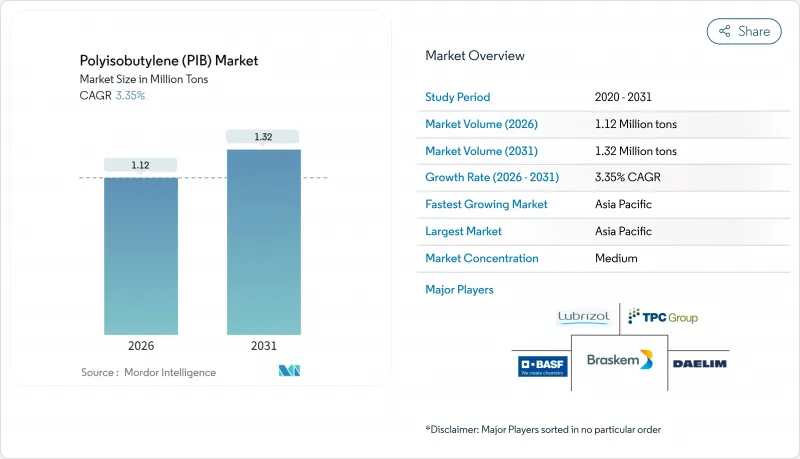
市場需求仍集中在高性能潤滑油添加劑、黏合劑系統和無內胎輪胎配方上,這些產品都依賴聚異丁烯聚合物固有的氣體滲透性、熱穩定性和化學惰性。車輛電氣化程度的不斷提高,對機油、傳動系統液和電池冷卻液的性能要求也隨之提高,從而進一步加劇了對黏度改性聚異丁烯的需求。同時,建築材料揮發性有機化合物(VOC)排放法規的日益嚴格,促使密封劑製造商轉向基於聚異丁烯的解決方案,以實現合規性而無需對配方進行妥協。亞太地區(尤其是中國和印度)的產能擴張,尤其是在綜合計劃的推動下,預計將緩解區域供應緊張的局面,同時增強該地區在全球聚異丁烯市場的成本優勢。
全球聚異丁烯(PIB)市場趨勢及展望
對黏合劑和密封劑領域的需求不斷成長
在強勁的建設活動和汽車輕量化計畫的推動下,配方師持續採用不含異氰酸酯和其他揮發性成分的聚異丁烯(PIB)基黏合劑系統。歐盟對二異氰酸酯含量超過0.1%的新限制,加速了向非聚氨酯結構性黏著劑的轉變。由於PIB化學品毒性低,且對多種基材具有優異的潤濕性,因此目前更受青睞。 PIB密封膠還具有持久的耐候性,使其成為帷幕牆玻璃、屋頂防水捲材和光伏安裝系統的理想選擇。不利於溶劑型替代品的永續性目標,也支撐了PIB的成長前景,進一步鞏固了聚異丁烯市場向環境友善材料發展的方向。
對內襯和無內胎輪胎配方的需求不斷成長
乘用車和商用車的無內胎輪胎依賴於聚異丁烯-異戊二烯橡膠(PIB)來維持輪胎整個使用壽命期間的胎壓。電動車平台為了降低滾動阻力、提高安全性,進一步強化了這項需求,從而推動了亞太地區輪胎製造地對高分子量等級聚異丁烯-異戊二烯橡膠的需求。經化學改性的聚異丁烯-異戊二烯橡膠,例如氯丁基和溴丁基,在保持低氣體滲透性的同時,擴展了共硫化性能,從而維持了聚異丁烯市場對高性能優質聚異丁烯橡膠的強勁需求。
固有的紫外線不穩定性需要昂貴的穩定劑
如果沒有抗氧化劑和紫外線吸收劑,聚異氰酸酯(PIB)在陽光照射下會發生表面開裂和變色。這導致外牆應用需要添加額外的添加劑,與本身俱有紫外線穩定性的替代品相比,增加了配方成本。雖然受阻胺類光穩定劑的進步降低了處理成本,但屋頂防水卷材和外牆密封劑的成本敏感性仍然限制了其在某些價格敏感地區的應用。
細分市場分析
到2025年,潤滑油將佔聚異丁烯市場規模的43.72%,預計到2031年將以3.66%的複合年成長率成長,這主要得益於多級引擎油、傳動系統油和油壓油對黏度指數增進劑的依賴性日益增強。聚異丁烯的增稠效率、低溫溶解性和剪切穩定性使其在競爭激烈的烯烴基共聚物市場中保持領先地位。燃油添加劑市場雖然規模不大,但具有重要的策略意義。在該市場中,聚異丁烯琥珀醯亞胺基產品用作清潔劑,用於保持火星點火式和壓燃式引擎高壓燃油噴射器的清潔。
聚異丁烯(PIB)應用範圍廣泛,使其市場受單一產業經濟週期的影響較小。在黏合劑和密封劑領域,由於綠色建築標準的廣泛應用鼓勵使用低揮發性有機化合物(VOC)材料,市場需求不斷成長。 PIB密封劑具有極低的透濕性,有助於延長雙層玻璃的使用壽命。安全法規的實施和電動車(EV)數量的成長,推動了對無內胎輪胎和防爆輪胎內襯化合物的強勁需求。塑化劑、電絕緣材料和特殊化學品應用領域也提供了額外的噸位來補充需求,而潤滑劑仍然是需求的主要來源,從而分散了全球供應商的風險。
聚異丁烯報告按應用領域(輪胎內胎、黏合劑和密封劑、潤滑劑、塑化劑、燃料添加劑等)、最終用途行業(汽車和運輸設備、工業機械、建築和建材、食品、藥品和個人護理、電氣和電子設備)以及地區(亞太地區、北美、歐洲、南美、中東和非洲)進行細分。
區域分析
亞太地區預計到2025年將佔據聚異丁烯市場39.20%的佔有率,並在2031年之前以3.98%的複合年成長率持續成長,這主要得益於產能的提升以及下游輪胎、潤滑油和黏合劑行業的持續成長。作為全球最大的汽車生產國,中國及其在電池製造領域的領先地位支撐著該地區的需求。印度正在迅速縮小差距,路博潤公司投資2億美元的奧蘭加巴德工廠建成後,預計將供應醫用級和高性能化學品聚異丁烯(PIB),這充分展現了印度本土市場成長的吸引力以及對中東和非洲的出口潛力。
北美擁有眾多營運一體化C4生產設施的公司,這些公司受惠於頁岩原料的經濟效益。美國墨西哥灣沿岸生產的聚異丁烯(PIB)供應中西部和墨西哥的汽車產業中心,而特種等級的PIB則供應給東西海岸的潤滑油調配商。歐洲持續致力於利用PIB技術生產高價值黏合劑、分散劑和符合REACH法規的高純度聚異丁烯(HR-PIB)衍生物。降低揮發性有機化合物(VOC)和碳足跡的法律要求正推動複合材料生產商向高性能PIB化學系統轉型,以減少添加劑的總用量。
南美洲和中東及非洲在聚異丁烯市場中所佔佔有率小規模,但正穩步成長。拉丁美洲的輪胎製造商和建築業正在刺激區域需求,而波灣合作理事會(GCC)正在推進聚異丁烯(PIB)計劃,該項目旨在將煉油廠的原料與高附加價值特種化學品整合。隨著基礎設施現代化進程在2030年前加速推進,非洲蓬勃發展的工業化和汽車組裝的投資預計將為聚異丁烯開闢新的銷售管道。
其他福利:
- Excel格式的市場預測(ME)表
- 3個月的分析師支持
目錄
第1章 引言
- 研究假設和市場定義
- 調查範圍
第2章調查方法
第3章執行摘要
第4章 市場情勢
- 市場概覽
- 市場促進因素
- 對黏合劑和密封劑行業的需求不斷成長
- 對內襯和無內胎輪胎配方的需求不斷成長
- 擴大其在新一代潤滑油中作為黏度調節劑的應用
- 向高反應性聚異丁烯(PIB)過渡,用於燃料和潤滑油添加劑
- 用於鋰離子電池負極的高矽PIB黏結劑
- 市場限制
- 異丁烯原料價格波動
- 固有的紫外線不穩定性需要昂貴的穩定劑
- 加強溶劑型聚異丁烯二苯甲酸酯(PIB)產品的VOC/REACH法規監管
- 價值鏈分析
- 波特五力模型
- 供應商的議價能力
- 買方的議價能力
- 新進入者的威脅
- 替代品的威脅
- 競爭程度
第5章 市場規模與成長預測
- 透過使用
- 輪胎內胎
- 黏合劑和密封劑
- 潤滑油
- 塑化劑
- 燃油添加劑
- 電氣絕緣
- 其他用途
- 按最終用途行業分類
- 汽車和運輸設備
- 工業機械
- 建材
- 食品、藥品和個人護理
- 電氣和電子設備
- 地區
- 亞太地區
- 中國
- 印度
- 日本
- 韓國
- 馬來西亞
- 泰國
- 印尼
- 越南
- 亞太其他地區
- 北美洲
- 美國
- 加拿大
- 墨西哥
- 歐洲
- 德國
- 英國
- 義大利
- 法國
- 俄羅斯
- 西班牙
- 土耳其
- 北歐國家
- 其他歐洲地區
- 南美洲
- 巴西
- 阿根廷
- 哥倫比亞
- 南美洲其他地區
- 中東和非洲
- 沙烏地阿拉伯
- 阿拉伯聯合大公國
- 卡達
- 埃及
- 奈及利亞
- 南非
- 其他中東和非洲地區
- 亞太地區
第6章 競爭情勢
- 市場集中度
- 策略趨勢
- 市佔率(%)/排名分析
- 公司簡介
- AO GC Titan
- BASF
- Braskem
- Chevron Oronite LLC
- Daelim Co., Ltd
- Dowpol Corporation
- ENEOS Corporation
- Infineum International Limited
- INOES
- Kemipex
- Lubrizol Corporation
- TPC Group
- Zhejiang Shunda New Material Co.
第7章 市場機會與未來展望
Polyisobutylene Market size in 2026 is estimated at 1.12 million tons, growing from 2025 value of 1.08 million tons with 2031 projections showing 1.32 million tons, growing at 3.35% CAGR over 2026-2031.
Demand continues to coalesce around high-performance lubricant additives, adhesive systems, and tubeless tire compounds, all of which rely on the polymer's inherent gas impermeability, thermal stability, and chemical inertness. Intensifying electrification of vehicles is widening the performance envelope for engine oils, driveline fluids, and battery-coolant formulations, deepening the need for viscosity-modifying grades of polyisobutylene. At the same time, regulatory pressure on volatile organic compound emissions in construction materials is steering sealant producers toward PIB-based solutions that offer compliance without reformulation trade-offs. Capacity expansions in Asia-Pacific, especially integrated projects in China and India, are expected to relieve localized supply tightness while reinforcing the region's cost advantage in the global polyisobutylene market.
Global Polyisobutylene (PIB) Market Trends and Insights
Growing Demand from Adhesives and Sealants
Robust construction activity and vehicle-lightweighting programs continue to push formulators toward PIB-based bonding systems that eliminate isocyanates and other volatile components. New European Union restrictions on diisocyanate content above 0.1% have accelerated the move to non-PU structural adhesives, with PIB chemistries now favored for their low toxicity profile and excellent wet-out on diverse substrates. PIB sealants also provide lasting weather resistance, making them attractive for curtain-wall glazing, rooftop membranes and photovoltaic mounting systems. Growth prospects are underpinned by sustainability targets that penalize solvent-borne alternatives, reinforcing the trajectory of the polyisobutylene market toward eco-compliant materials.
Rising Demand for Inner-Liner and Tubeless Tire Compounds
Tubeless passenger-car and commercial-vehicle tires rely on isobutylene-isoprene rubber derived from PIB to maintain inflation pressure over the service life of the tire. Electric-vehicle platforms intensify this requirement by targeting lower rolling resistance and augmented safety, which in turn lifts polymer grade demand in Asia-Pacific's tire manufacturing clusters. Chemically modified PIBs such as chlorobutyl and bromobutyl extend co-vulcanization capability while preserving low gas permeability, sustaining a strong pull for premium, performance-oriented grades in the polyisobutylene market.
Intrinsic UV Instability Requiring Costly Stabilizers
Without antioxidants and UV absorbers, PIB undergoes surface cracking and discoloration when exposed to sunlight. Outdoor applications therefore impose additional additive packages, raising formulation costs relative to inherently UV-stable alternatives. Advances in hindered-amine light stabilizers have trimmed treat-rates, but cost sensitivity in roofing membranes and exterior sealants still limits adoption in certain price-constrained regions.
Other drivers and restraints analyzed in the detailed report include:
- Expanding Use as Viscosity Modifier in Next-Gen Lubricants
- Shift Toward Highly-Reactive PIB for Fuel and Lube Additives
- Tightening VOC/REACH Rules on Solvent-Borne PIB Products
For complete list of drivers and restraints, kindly check the Table Of Contents.
Segment Analysis
Lubricants represented 43.72% of the polyisobutylene market size in 2025 while advancing at 3.66% CAGR through 2031 as multi-grade engine oils, driveline fluids and hydraulic oils intensify reliance on viscosity-index improvers. PIB's thickening efficiency, low-temperature solvency, and shear-stability underpin its continued dominance despite competing olefin copolymers. Fuel additives form a smaller yet strategic niche where PIB succinimides act as detergents, safeguarding high-pressure fuel-injector cleanliness in both spark-ignition and compression-ignition engines.
The broader application slate keeps the polyisobutylene market insulated from single-sector cyclicality. Adhesives and sealants gain momentum from green-building codes favoring low-VOC materials, with PIB sealants displaying negligible moisture migration that extends the service life of insulating-glass units. Inner-liner compounds for tubeless and run-flat tires remain robust thanks to safety regulations and growing electric-vehicle (EV) volumes. Plasticizer, electrical-insulation, and specialty-chemical outlets provide incremental tonnage that rounds out demand, making lubricants the lodestar while diversifying risk exposure for global suppliers.
The Polyisobutylene Report is Segmented by Application (Tire Tubes, Adhesive and Sealants, Lubricants, Plasticizers, Fuel Additives, and More), End-Use Industry (Automotive and Transportation, Industrial Machinery, Construction and Building Materials, Food/Pharma/Personal-Care, and Electrical and Electronics), and Geography (Asia-Pacific, North America, Europe, South America, and Middle-East and Africa).
Geography Analysis
Asia-Pacific accounted for 39.20% of polyisobutylene market share in 2025 and is expanding at a 3.98% CAGR to 2031 on the back of capacity additions and relentless growth in downstream tire, lubricant and adhesive industries. China anchors regional demand through its status as the world's largest vehicle producer and a front-runner in battery manufacturing. India is quickly narrowing the gap; Lubrizol's USD 200 million Aurangabad plant will deliver medical-grade and performance-chemical PIB variants once completed, demonstrating the draw of local market growth as well as export potential into the Middle East and Africa.
North America houses integrated C4 complex operators and benefits from shale-derived feedstock economics. PIB produced in the U.S. Gulf Coast supplies automotive hubs in the Midwest and Mexico, while specialty grades serve lubricant blenders on both coasts. Europe remains technology-focused, channeling PIB into high-value adhesives, dispersants, and HR-PIB derivatives that comply with REACH. Legislative mandates for lower VOC and carbon footprints are nudging formulators toward highly functional PIB chemistries that can reduce overall additive treat rates.
South America, the Middle East and Africa collectively absorb a modest yet rising share of polyisobutylene market volume. Latin American tire producers and construction sectors stimulate regional pull, whereas the Gulf Cooperation Council pursues PIB projects aimed at integrating refinery streams with specialty-chemical value addition. Africa's nascent industrialization and automotive assembly investments are expected to open new PIB sales corridors as infrastructure modernization accelerates through 2030.
- AO GC Titan
- BASF
- Braskem
- Chevron Oronite LLC
- Daelim Co., Ltd
- Dowpol Corporation
- ENEOS Corporation
- Infineum International Limited
- INOES
- Kemipex
- Lubrizol Corporation
- TPC Group
- Zhejiang Shunda New Material Co.
Additional Benefits:
- The market estimate (ME) sheet in Excel format
- 3 months of analyst support
TABLE OF CONTENTS
1 Introduction
- 1.1 Study Assumptions and Market Definition
- 1.2 Scope of the Study
2 Research Methodology
3 Executive Summary
4 Market Landscape
- 4.1 Market Overview
- 4.2 Market Drivers
- 4.2.1 Growing Demand from Adhesives and Sealants
- 4.2.2 Rising Demand for Inner-Liner and Tubeless Tire Compounds
- 4.2.3 Expanding Use as Viscosity Modifier in Next-Gen Lubricants
- 4.2.4 Shift Toward Highly-Reactive PIB for Fuel and Lube Additives
- 4.2.5 PIB-Based Binders for Si-Rich Li-Ion Battery Anodes
- 4.3 Market Restraints
- 4.3.1 Feedstock Isobutylene Price Volatility
- 4.3.2 Intrinsic UV Instability Requiring Costly Stabilizers
- 4.3.3 Tightening VOC/REACH Rules on Solvent-Borne PIB Products
- 4.4 Value Chain Analysis
- 4.5 Porter's Five Forces
- 4.5.1 Bargaining Power of Suppliers
- 4.5.2 Bargaining Power of Buyers
- 4.5.3 Threat of New Entrants
- 4.5.4 Threat of Substitutes
- 4.5.5 Degree of Competition
5 Market Size and Growth Forecasts (Volume)
- 5.1 By Application
- 5.1.1 Tire Tubes
- 5.1.2 Adhesive and Sealants
- 5.1.3 Lubricants
- 5.1.4 Plasticizers
- 5.1.5 Fuel Additives
- 5.1.6 Electrical Insulation
- 5.1.7 Other Applications
- 5.2 By End-Use Industry
- 5.2.1 Automotive and Transportation
- 5.2.2 Industrial Machinery
- 5.2.3 Construction and Building Materials
- 5.2.4 Food, Pharma and Personal-Care
- 5.2.5 Electrical and Electronics
- 5.3 Geography
- 5.3.1 Asia-Pacific
- 5.3.1.1 China
- 5.3.1.2 India
- 5.3.1.3 Japan
- 5.3.1.4 South Korea
- 5.3.1.5 Malaysia
- 5.3.1.6 Thailand
- 5.3.1.7 Indonesia
- 5.3.1.8 Vietnam
- 5.3.1.9 Rest of Asia-Pacific
- 5.3.2 North America
- 5.3.2.1 United States
- 5.3.2.2 Canada
- 5.3.2.3 Mexico
- 5.3.3 Europe
- 5.3.3.1 Germany
- 5.3.3.2 United Kingdom
- 5.3.3.3 Italy
- 5.3.3.4 France
- 5.3.3.5 Russia
- 5.3.3.6 Spain
- 5.3.3.7 Turkey
- 5.3.3.8 NORDIC Countries
- 5.3.3.9 Rest of Europe
- 5.3.4 South America
- 5.3.4.1 Brazil
- 5.3.4.2 Argentina
- 5.3.4.3 Colombia
- 5.3.4.4 Rest of South America
- 5.3.5 Middle-East and Africa
- 5.3.5.1 Saudi Arabia
- 5.3.5.2 United Arab Emirates
- 5.3.5.3 Qatar
- 5.3.5.4 Egypt
- 5.3.5.5 Nigeria
- 5.3.5.6 South Africa
- 5.3.5.7 Rest of Middle-East and Africa
- 5.3.1 Asia-Pacific
6 Competitive Landscape
- 6.1 Market Concentration
- 6.2 Strategic Moves
- 6.3 Market Share (%)/Ranking Analysis
- 6.4 Company Profiles (includes Global-level Overview, Market-level Overview, Core Segments, Financials as available, Strategic Information, Market Rank/Share, Products and Services, Recent Developments)
- 6.4.1 AO GC Titan
- 6.4.2 BASF
- 6.4.3 Braskem
- 6.4.4 Chevron Oronite LLC
- 6.4.5 Daelim Co., Ltd
- 6.4.6 Dowpol Corporation
- 6.4.7 ENEOS Corporation
- 6.4.8 Infineum International Limited
- 6.4.9 INOES
- 6.4.10 Kemipex
- 6.4.11 Lubrizol Corporation
- 6.4.12 TPC Group
- 6.4.13 Zhejiang Shunda New Material Co.
7 Market Opportunities and Future Outlook
- 7.1 PIB as substitute for wool-fat in leather stuffing agents
- 7.2 PIB-based binder technologies for next-gen battery anodes
- 7.3 White-space and Unmet-Need Assessment

 全球聚異丁烯市場規模、佔有率、趨勢和成長分析報告(2026-2034年)
 2026年全球聚異丁烯市場報告
 聚丁烯市場規模、佔有率及成長分析(按等級、應用和地區分類)-2026-2033年產業預測
 聚異丁烯市場規模、佔有率和成長分析(按產品類型、分子量、價格分佈範圍、應用、最終用戶、分銷管道和地區分類)—產業預測(2026-2033 年)
 聚異丁烯市場機會、成長要素、產業趨勢分析及預測(2026年至2035年)
 中等分子量聚異丁烯:全球市佔率和排名、總收入和需求預測(2025-2031年)
 聚異丁烯市場按應用、最終用途產業、形態、分子量和類型分類-2025-2032年全球預測
 聚丁烯的全球市場:等級·用途·各地區 (~2035年)
 2032年聚異丁烯市場預測:按產品、分子量、應用、最終用戶和地區進行的全球分析
 全球中分子量聚異丁烯市場