

 |
市場調查報告書
商品編碼
2183485
雲端金融維運市場:依產品、應用、服務模式、部署和地區分類-全球預測至2031年Cloud FinOps Market by Offering (Native & Third-party Platforms, Managed Services), Application (AI Cost Management, Cost Visibility, Anomaly Detection, Commitment & Workload Optimization), Service Model, Deployment, and Region - Global Forecast to 2031 |
||||||


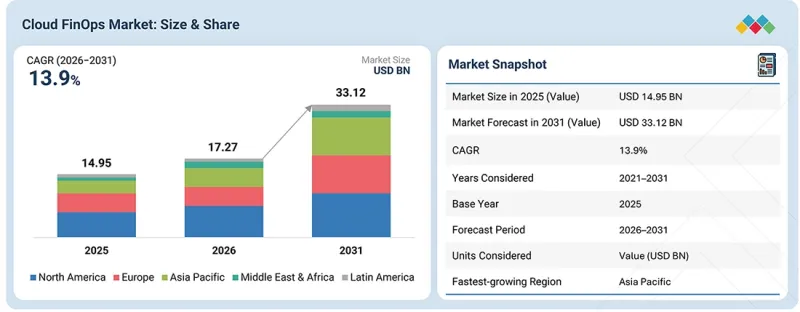
全球雲端 FinOps 市場預計將從 2026 年的 172.7 億美元成長到 2031 年的 331.2 億美元,複合年成長率為 13.9%。
這一成長主要受企業雲端支出增加、人工智慧基礎設施投資擴大以及對複雜雲端環境中財務課責日益成長的需求所驅動。各組織正在增強其財務營運 (FinOps) 能力,以改善其 IaaS、PaaS 和 SaaS 環境中的成本分配、支出預測、承諾利用率和資源最佳化。
| 調查範圍 | |
|---|---|
| 調查期 | 2021-2031 |
| 基準年 | 2025 |
| 預測期 | 2026-2031 |
| 計算單位 | 金額(10億美元) |
| 部分 | 可用性、用途、服務模型、部署和區域 |
| 目標區域 | 北美洲、歐洲、亞太地區、中東和非洲、拉丁美洲 |
人工智慧訓練和推理工作負載對GPU成本歸因、消耗監控和工作負載級財務分析提出了新的要求。 Kubernetes、微服務和多重雲端架構的日益普及進一步推動了對自動化最佳化和集中式財務管治的需求。企業也正在投資託管式FinOps服務,以加速提升營運效率並降低雲端成本。然而,分散的計費資料、不一致的成本分配、原生雲端管理解決方案以及複雜的承諾結構可能會阻礙FinOps的普及。儘管面臨這些挑戰,隨著企業關注點轉向財務透明度和雲端人工智慧驅動的自動化,FinOps作為企業技術財務管理的重要組成部分,其地位正在不斷鞏固。
“按服務模式分類,預計在整個預測期內,IaaS 將佔據最大的市場佔有率。”
預計在預測期內,基礎設施即服務 (IaaS) 將繼續佔據雲端 FinOps 市場最大的佔有率。企業正不斷增加對 FinOps 解決方案的投資,以最佳化運算實例、儲存資源、網路基礎設施和 GPU 密集型工作負載的支出。 IaaS 的按使用量計費模式顯著提升了對持續成本監控、資源最佳化和承諾最佳化的需求。企業正在部署先進的 FinOps 平台來管理預留實例、節省計劃、承諾折扣和未充分利用的基礎設施資源。 Kubernetes 叢集、雲端原生應用和 AI 基礎架構的日益普及,進一步加劇了對資源級細粒度收費分配和自動化最佳化的需求。詳細的基礎設施計費和利用率數據的可用性,也使得更精細的成本分析和可操作的建議成為可能。隨著企業在雲端環境中擴展其基礎設施使用,在巨大的最佳化機會和日益成長的財務管治要求的推動下,IaaS 預計將繼續成為 FinOps 採用的最大推動力。
“按部署環境分類,預計多重雲端在整個預測期內將佔據最大的市場佔有率。”
在整個預測期內,多重雲端預計將佔據雲端FinOps市場最大的佔有率。企業擴大跨多個雲端供應商運行工作負載,以提高基礎設施的柔軟性、利用專業服務並減少對單一雲端生態系的依賴。然而,收費模式、定價結構、折扣計劃和資源配置的差異顯著增加了財務管理的複雜性。企業正在採用集中式FinOps平台來整合雲端支出、標準化成本分配,並在異質環境中建立一致的財務管治。對跨雲端承諾最佳化、統一預算和應用層級成本可見度的需求不斷成長,正在推動對獨立FinOps解決方案的投資。人工智慧工作負載和分散式應用程式的擴展進一步增加了在滿足效能和營運要求的同時評估跨提供者基礎設施成本的需求。隨著企業優先考慮財務透明度、自動化最佳化和一致的支出課責,預計多重雲端環境將持續創造對高階雲端FinOps功能的需求。
“北美在雲端金融營運市場中處於領先地位,這得益於成熟的雲端技術應用和先進的財務管治實踐。”
北美預計將繼續佔據全球雲端FinOps市場最大佔有率,這得益於企業雲的廣泛應用、先進的數位基礎設施以及對雲端財務課責的強勁需求。美國和加拿大的企業管理著涉及多個帳戶、複雜合約條款和多樣化應用工作負載的大規模雲端環境。該地區受益於領先的雲端服務供應商、獨立的FinOps軟體供應商、託管服務專家以及投資於先進成本管理能力的技術密集型企業的存在。人工智慧推理、GPU基礎設施、Kubernetes環境和雲端原生應用的日益普及,推動了對精細化成本歸因和自動化財務最佳化的需求。企業也在優先考慮承諾組合管理、異常檢測、預測準確性以及財務和工程工作流程之間的整合。對可衡量的成本降低和企業級財務管治的日益重視,正在加速先進FinOps平台的採用。人工智慧驅動的成本分析和自動化糾正功能的開發,進一步加強了該地區的技術生態系統。隨著對人工智慧基礎設施、雲端現代化和金融自動化領域的持續投資,預計北美將在整個預測期內保持其領先地位。
主要調查主題細分
- 按公司規模分類:一級供應商 - 35%,二級供應商 - 45%,三級供應商 - 20%
- 按職位:董事 - 35%,經理 - 25%,其他 - 40%
- 按地區分類:北美 -45%,歐洲 -20%,亞太地區 -25%,中東和非洲 -5%,拉丁美洲 -5%
本研究報告根據交付模式將雲端FinOps市場分為解決方案和服務兩類。解決方案包括原生和第三方FinOps平台,服務包括託管雲端FinOps服務和專業服務。按應用領域分類,報告涵蓋雲端成本可見性、分配和報告、預算編制、預測和規劃、成本異常管理和管治、費率和承諾最佳化、工作負載和資源最佳化、扣回爭議帳款和業務價值管理以及其他雲端FinOps應用。報告也依服務模式(IaaS、PaaS、SaaS)、部署環境(單雲、多重雲端)、部署模式(本地部署、雲端部署)、組織規模(大型企業、中小企業)、產業(銀行、金融服務和保險(BFSI)、IT和電信、零售和消費品、醫療保健和生命科學、製造業、媒體和娛樂、政府和公共部門、能源和公共產業以及其他行業)和地區(北美、歐洲、亞太、中東和非洲以及拉丁美洲)對市場進行分類。
本報告詳細分析了影響產業發展的市場促進因素、限制因素、機會和挑戰。報告還評估了雲端財務管治、人工智慧驅動的成本智慧、Kubernetes 最佳化、基於承諾的採購策略、託管式 FinOps 的採用以及自動化能力。競爭分析涵蓋了供應商定位、產品差異化、經營模式、地理擴張、夥伴關係、收購以及近期發展動態。此外,本研究檢驗了不斷變化的企業採購需求、財務課責框架、新興的成本管理應用以及雲端支出與可衡量的業務成果之間的關係。
購買本報告的理由
本報告為市場領導、技術供應商和新興供應商提供全球雲端FinOps市場及其關鍵細分市場的詳細預測。這有助於企業評估競爭地位、識別高成長應用、評估客戶支出優先級,並制定產品創新、市場進入和區域擴張策略。該研究透過分析原生和第三方FinOps平台、託管服務、雲端部署環境和產業領域的機遇,幫助企業確定投資優先順序。此外,報告也檢驗了人工智慧工作負載經濟性、承諾最佳化、自動化財務管治和雲端成本分配等方面的新興需求。這些洞察有助於企業評估差異化產品功能、強化打入市場策略、確定技術夥伴關係的優先級,並尋找拓展其在雲端財務管理生態系統中影響力的機會。
本報告深入分析了以下幾點:
- 關鍵促進因素、限制因素、機會和挑戰分析:隨著企業對日益複雜的雲端環境中的財務課責、成本透明度和營運效率提出更高的要求,雲端 FinOps 市場正經歷重大變革。關鍵促進因素包括:在人工智慧和工作負載層面提高成本課責、持續雲端成本審查的日益普及,以及旨在提高資源利用率和支出管理的自動化最佳化策略的實施。阻礙因素包括:缺乏原生雲端成本管理工具、雲端供應商之間計費資料分散、資源標記不完整,以及難以準確預測共用成本和支出。機會源於金融級雲端成本報告、高級承諾組合智慧以及閉合迴路最佳化功能的引入,這些功能支援自動化補救和檢驗的成本降低,而這一切都得益於 FinOps 開放成本和使用規範 (FOCUS)。挑戰包括:在不影響工作負載效能的前提下證明淨成本節約、滿足自動化糾正措施的安全性和核准要求、維持服務等級合規性,以及確保整個雲端環境中財務報告的一致性。
- 產品開發/創新:深入洞察新興的 FinOps 技術、人工智慧驅動的財務運營、自動化異常調查、承諾最佳化、Kubernetes 成本管理、工作負載級成本歸因以及基於策略的資源最佳化。近期推出的 AWS FinOps Agent 和 FOCUS 1.4 等措施表明,人們越來越關注自動化、發票匹配和標準化財務智慧。這些創新正在拓展 FinOps 平台的功能,使其不再局限於成本報告,而是能夠執行持續的財務管理和工程。
- 市場趨勢:本報告全面分析了極具吸引力的區域和行業機遇,包括企業雲端現代化、人工智慧基礎設施的擴展、財務管治框架的採用以及託管式財務營運專業知識日益成長的需求。報告分析了主要區域、不同規模的組織、不同的服務模式和不同的應用能力的市場趨勢,揭示了在採用成熟度、支出需求和商業機會方面的差異。
- 市場多元化:本報告詳細介紹了新興的財務營運 (FinOps) 解決方案和服務、基於人工智慧和軟體即服務 (SaaS) 的財務管理部署、自動化承諾最佳化、策略夥伴關係、收購和地理擴張。該研究檢驗了與高階財務分析、專用工作負載最佳化、業務價值衡量和託管式財務營運交付模式相關的多元化機會。這些能力使供應商能夠滿足不斷變化的企業需求,超越傳統的雲端成本可見度和報告能力。
- 競爭評估:我們對主要參與者的市場佔有率、FinOps產品系列、服務能力、競爭策略、區域佈局、夥伴關係和市場定位進行詳細評估,尤其關注原生雲端財務管理工具、獨立 FinOps 平台、自主最佳化專家和託管服務供應商之間的差異。
目錄
第1章:引言
第2章執行摘要
第3章重要考察
- 雲端金融營運市場為企業帶來極具吸引力的機會
- 雲端 FinOps 市場:依產品/服務分類
- 雲端金融營運市場:依服務模式分類
- 雲端 FinOps 市場:按雲端環境分類
- 雲端金融營運市場:按地區分類
第4章 市場概覽
- 市場動態
- 促進因素
- 抑制因子
- 機會
- 任務
- 未滿足的需求和未開發的領域
- 雲端財務營運市場尚未滿足的需求
- 未開發的市場機遇
- 相互關聯的市場與跨產業機遇
- 跨產業機遇
- 新的經營模式與生態系轉型
- 新經營模式
- 生態系的轉變
- 1/2/3級玩家的策略舉措
第5章 產業趨勢
- 波特五力分析
- 新進入者的威脅
- 替代品的威脅
- 供應商的議價能力
- 買方的議價能力
- 競爭公司之間的競爭強度
- 總體經濟指標
- GDP趨勢與預測
- 雲端運算產業趨勢
- 可觀測性工具和平台產業的趨勢
- 價值鏈分析
- 生態系分析
- 2026-2027 年主要會議和活動
- 影響客戶業務的趨勢/顛覆性因素
- 案例研究分析
- 透過實施 CoreStack,IT1 透過整合 FINOPS 和雲端管治,成功將雲端支出減少了 35% 以上。
- 透過實施 CoreStack,CONRES 簡化了其在約 20 個客戶環境中的多重雲端FINOPS 和財務管治。
- IBM幫助飛利浦降低了10%的雲端成本,並完成了成本分配。
- CloudZero 幫助 PicPay 減少了每年 1,860 萬美元的雲端支出。
- 透過 CAST AI,Akamai 透過 Kubernetes 最佳化成功降低了 40-70% 的雲端成本。
- 2025年美國關稅對雲端FINOPS市場的影響
- 主要關稅稅率
- 價格影響分析
- 對國家和地區的影響
- 對終端用戶產業的影響
第6章:透過採用技術、專利、數位化和人工智慧實現策略轉型
- 技術分析
- 主要新興技術
- 互補技術
- 鄰近技術
- 技術藍圖
- 短期(2026-2028 年)| 人工智慧驅動的成本智慧、自動化最佳化和計費互通性
- 中期(2028-2031 年)| 自主最佳化、AI 驅動的工作負載經濟性分析和整合式多重雲端管治
- 長期(2031-2035 年)| 自主、策略驅動、以業務價值為導向的雲端金融營運
- 專利分析
- 未來應用
- AI訓練、推理與GPU成本經濟學
- 自主雲端最佳化與策略編配
- 基於雲端的預測性財務規劃與承諾智慧
- 整合式多重雲端成本分配與財務管治
- 衡量雲端運算的商業價值和經濟效益。
- 人工智慧/生成式人工智慧對雲端金融營運市場的影響
- 主要應用場景和市場潛力
- 雲端財務營運最佳實踐
- 雲端金融營運市場人工智慧應用案例研究
- 相互關聯的相鄰生態系及其對市場參與者的影響
- 雲端金融營運市場中客戶對人工智慧/生成式人工智慧採用的準備情況
- IBM Cloudability 增強了 NEXI 在多重雲端環境中的財務可見度與支出管理能力。
- CloudZero 讓 NinjaCat 能夠提高雲端支出效率和客戶層面的單位經濟效益。
第7章 監理情勢
- 監理情勢
- 監管機構、政府機構和其他組織
- 區域產業標準
第8章:顧客趨勢與購買行為
- 決策流程
- 買方相關人員和採購評估標準
- 採購過程中的關鍵相關人員
- 購買標準
- 實施障礙和內部挑戰
- 各終端用戶產業未滿足的需求
- 市場盈利
- 獲利潛力
- 成本趨勢
- 提高各終端用戶產業獲利能力的機會
第9章:雲端金融維運市場:依產品/服務分類
- 透過提供的服務
- 服務
第10章:雲端金融維運市場:依應用程式/功能分類
- 可視化、分配和報告雲端成本。
- 預算、預測與規劃
- 成本異常管理與管治
- 最佳化費用和承諾
- 工作負載和資源最佳化
- 扣回爭議帳款和業務價值管理
- 其他雲端財務運維應用
第11章 雲端金融營運市場:依服務模式分類
- INFRASTRUCTURE AS A SERVICE(IaaS)
- PLATFORM AS A SERVICE(PAAS)
- SOFTWARE AS A SERVICE(SaaS)
第12章 雲端金融維運市場:依部署方式分類
- 部署環境
- 部署環境
第13章 雲端財務營運市場:依組織規模分類
- 大公司
- 小型企業
第14章 雲端金融營運市場:依產業分類
- BFSI
- 資訊科技與科技
- 溝通
- 零售和消費品
- 醫療保健和生命科學
- 製造業
- 媒體與娛樂
- 政府/公共部門
- 能源公用事業
- 其他行業
第15章 雲端金融營運市場:依地區分類
- 北美洲
- 美國
- 加拿大
- 歐洲
- 英國
- 德國
- 法國
- 義大利
- 其他歐洲國家
- 亞太地區
- 中國
- 日本
- 印度
- 澳洲和紐西蘭(澳新銀行)
- 亞太其他地區
- 中東和非洲
- 海灣合作理事會國家
- 南非
- 其他中東和非洲地區
- 拉丁美洲
- 巴西
- 墨西哥
- 其他拉丁美洲
第16章 競爭格局
- 主要參與企業的策略/優勢,2023-2026 年
- 2021-2025年收入分析
- 市佔率分析(2026 年)
- 產品對比,2026
- 公司估值矩陣:主要公司,2026 年(雲端金融營運市場)
- 明星公司
- 新興領導者
- 玩家種類繁多
- 參與企業
- 企業企業發展:主要公司,2025 年
- 公司估值矩陣:新創企業/中小企業,2026 年
- 新創企業/中小企業評估矩陣:評估標準的權重
- 先進公司
- 應對力的公司
- 充滿活力的公司
- 起始點
- 競爭標竿分析:新創企業/中小企業,2025 年
- 企業估值與財務指標,2026 年
- 主要供應商的估值
- 主要供應商的財務指標
- 競爭格局
- 產品發布
- 交易
第17章:公司簡介
- 大公司
- AMAZON WEB SERVICES(AWS)
- MICROSOFT
- ORACLE
- IBM
- FLEXERA
- CORESTACK
- BROADCOM
- CLOUDZERO
- CAST AI
- DOIT
- 其他主要公司
- HARNESS
- SERVICENOW
- DATADOG
- FINOUT
- CLOUDBOLT SOFTWARE
- ZESTY
- CLOUDKEEPER
- NOPS
- VANTAGE
- ANODOT(UMBRELLA)
- VIRTANA
- ACCENTURE
- KION
- DELOITTE
- SOFTWAREONE
- CENTILYTICS
- DENSIFY
- OPENTEXT
- STACKLET
- TERNARY
- HCLTECH
- NORTH.CLOUD
- RACKSPACE TECHNOLOGY
- PEPPERDATA
- HYPERGLANCE
第18章:調查方法
第19章附錄
The global cloud FinOps market is projected to grow from USD 17.27 billion in 2026 to USD 33.12 billion by 2031, registering a CAGR of 13.9%. Growth is supported by increasing enterprise cloud expenditure, expanding AI infrastructure investments, and rising demand for financial accountability across complex cloud environments. Organizations are strengthening FinOps capabilities to improve cost allocation, expenditure forecasting, commitment utilization, and resource optimization across IaaS, PaaS, and SaaS environments.
| Scope of the Report | |
|---|---|
| Years Considered for the Study | 2021-2031 |
| Base Year | 2025 |
| Forecast Period | 2026-2031 |
| Units Considered | Value (USD Billion) |
| Segments | Offering, Application, Service Model, Deployment, and Region |
| Regions covered | North America, Europe, Asia Pacific, Middle East & Africa, Latin America |
AI training and inference workloads are creating additional requirements for GPU cost attribution, consumption monitoring, and workload-level financial intelligence. Increasing deployment of Kubernetes, microservices, and multi-cloud architectures further strengthens demand for automated optimization and centralized financial governance. Enterprises are also investing in managed FinOps services to improve operational efficiency and accelerate the realization of cloud cost savings. However, fragmented billing data, inconsistent cost allocation, native cloud management alternatives, and complex commitment structures can constrain adoption. Despite these challenges, increasing emphasis on cloud financial transparency and AI-driven automation is strengthening FinOps as an integral component of enterprise technology financial management.
"By service model, IaaS is expected to hold largest market share over forecast period"
Infrastructure as a Service (IaaS) is expected to account for the largest share of the cloud FinOps market throughout the forecast period. Enterprises increasingly invest in FinOps solutions to optimize spending across compute instances, storage resources, networking infrastructure, and GPU-intensive workloads. The consumption-based pricing structure of IaaS creates significant demand for continuous cost monitoring, resource rightsizing, and commitment optimization. Organizations are adopting advanced FinOps platforms to manage Reserved Instances, Savings Plans, committed-use discounts, and underutilized infrastructure resources. Increasing deployment of Kubernetes clusters, cloud-native applications, and AI infrastructure further strengthens demand for granular resource-level cost allocation and automated optimization. The availability of detailed infrastructure billing and utilization data also enables more sophisticated cost analytics and actionable recommendations. As enterprises expand infrastructure consumption across cloud environments, IaaS is expected to remain the largest contributor to FinOps adoption, supported by substantial optimization opportunities and increasing financial governance requirements.
"By deployment environment, multi-cloud to hold largest market share over forecast period."
Multi-cloud is expected to account for the largest share of the cloud FinOps market throughout the forecast period. Enterprises increasingly operate workloads across multiple cloud providers to improve infrastructure flexibility, access specialized services, and reduce dependence on individual cloud ecosystems. However, differences in billing formats, pricing structures, discount programs, and resource configurations create significant financial management complexity. Organizations are adopting centralized FinOps platforms to consolidate cloud expenditure, standardize cost allocation, and establish consistent financial governance across heterogeneous environments. Growing demand for cross-cloud commitment optimization, unified budgeting, and application-level cost visibility is strengthening investments in independent FinOps solutions. The expansion of AI workloads and distributed applications further increases the need to evaluate infrastructure costs across providers while maintaining performance and operational requirements. As enterprises prioritize financial transparency, automated optimization, and consistent spending accountability, multi-cloud environments are expected to generate sustained demand for advanced cloud FinOps capabilities.
"North America leads cloud FinOps market through mature cloud adoption and advanced financial governance practices."
North America is expected to retain the largest share of the global cloud FinOps market, supported by extensive enterprise cloud adoption, advanced digital infrastructure, and strong demand for cloud financial accountability. Organizations across the United States and Canada manage large cloud estates involving multiple accounts, complex commercial commitments, and diverse application workloads. The region benefits from the presence of major cloud providers, independent FinOps software vendors, managed service specialists, and technology-intensive enterprises investing in advanced cost management capabilities. Increasing adoption of AI inference, GPU infrastructure, Kubernetes environments, and cloud-native applications is strengthening demand for granular cost attribution and automated financial optimization. Enterprises are also prioritizing commitment portfolio management, anomaly detection, forecasting accuracy, and integration between financial and engineering workflows. Growing emphasis on measurable savings realization and enterprise-wide financial governance is encouraging adoption of advanced FinOps platforms. The development of AI-assisted cost investigation and automated remediation capabilities further strengthens the region's technology ecosystem. Continued investment in AI infrastructure, cloud modernization, and financial automation is expected to sustain North America's leading position throughout the forecast period.
Breakdown of Primaries
In-depth interviews with industry participants are used to gather insights from FinOps practice leaders, cloud infrastructure directors, technology finance managers, product leaders, cloud architects, system integrators, managed FinOps service providers, and executives from organizations operating across the cloud FinOps market.
- By Company: Tier I - 35%, Tier II - 45%, and Tier III - 20%
- By Designation: Directors - 35%, Managers - 25%, and Others - 40%
- By Region: North America - 45%, Europe - 20%, Asia Pacific - 25%, Middle East & Africa - 5%, and Latin America - 5%
The report includes a detailed study of leading participants in the cloud FinOps market. It profiles major vendors based on their business overview, FinOps solution portfolios, service capabilities, deployment models, geographic presence, partnerships, and strategic developments. Key market players include Amazon Web Services (US), Microsoft (US), Google Cloud (US), IBM (US), Broadcom - CloudHealth (US), Aquila Clouds (US), Archera (US), CAST AI (US), Certero (UK), CloudBolt Software (US), CloudKeeper (India), CloudZero (US), CoreStack (US), Datadog (US), DoiT (US), Finout (US), Flexera (US), Harness (US), Kion (US), Lucidity (India), nOps (US), OpsNow (South Korea), ScaleOps (US), Sedai (US), ServiceNow (US), Ternary (US), Vantage (US), Vega Cloud (US), Virtana (US), and Zesty (Israel).
Research Coverage
This research report categorizes the cloud FinOps market by offering into solutions and services. Solutions include native and third-party FinOps platforms, while services comprise managed cloud FinOps services and professional services. By application, the market covers cloud cost visibility, allocation & reporting; budgeting, forecasting & planning; cost anomaly management & governance; rate & commitment optimization; workload & resource optimization; chargeback & business value management; and other cloud FinOps applications. The study also segments the market by service model into IaaS, PaaS, and SaaS; by deployment environment into single-cloud and multi-cloud; by deployment mode into on-premises and cloud; by organization size into large enterprises and SMEs; by vertical into BFSI, IT & technology, telecommunications, retail & consumer goods, healthcare & life sciences, manufacturing, media & entertainment, government & public sector, energy & utilities, and other verticals; and by region into North America, Europe, Asia Pacific, Middle East & Africa, and Latin America.
The report provides detailed analysis of market drivers, restraints, opportunities, and challenges influencing industry development. It evaluates cloud financial governance, AI-driven cost intelligence, Kubernetes optimization, commitment purchasing strategies, managed FinOps adoption, and automation capabilities. Competitive analysis covers vendor positioning, product differentiation, commercial models, geographic expansion, partnerships, acquisitions, and recent product developments. The study also examines enterprise purchasing requirements, financial accountability frameworks, emerging cost management applications, and the changing relationship between cloud expenditure and measurable business outcomes.
Reasons to Buy This Report
The report provides market leaders, technology providers, and emerging vendors with detailed estimates of the global cloud FinOps market and its major segments. It enables organizations to assess competitive positioning, identify high-growth applications, evaluate customer spending priorities, and develop strategies for product innovation, market entry, and geographic expansion. The study supports investment prioritization by analyzing opportunities across native and third-party FinOps platforms, managed services, cloud deployment environments, and verticals. It also examines emerging requirements involving AI workload economics, commitment optimization, automated financial governance, and cloud cost allocation. These insights help organizations evaluate differentiated product capabilities, strengthen go-to-market strategies, prioritize technology partnerships, and identify opportunities for expanding their presence across the cloud financial management ecosystem.
The report provides insights on the following points:
- Analysis of key drivers, restraints, opportunities, and challenges: The cloud FinOps market is witnessing significant transformation as enterprises seek greater financial accountability, cost transparency, and operational efficiency across increasingly complex cloud environments. Key drivers include growing AI and workload-level cost accountability, increasing adoption of continuous cloud cost reviews, and implementation of automated optimization policies to improve resource utilization and expenditure control. Restraints include the availability of native cloud cost management tools, fragmented billing data across cloud providers, incomplete resource tagging, and difficulties in allocating shared costs and accurately forecasting expenditure. Opportunities are emerging from the adoption of finance-grade cloud cost reporting enabled by the FinOps Open Cost and Usage Specification (FOCUS), advanced commitment portfolio intelligence, and closed-loop optimization capabilities that support automated remediation and verifiable cost savings. Challenges include demonstrating realized net savings without compromising workload performance, meeting security and approval requirements for automated remediation, maintaining service-level compliance, and ensuring consistent financial reporting across cloud environments.
- Product Development/Innovation: Detailed insights into emerging FinOps technologies, AI-assisted financial operations, automated anomaly investigations, commitment optimization, Kubernetes cost management, workload-level cost attribution, and policy-based resource optimization. Recent developments, including the introduction of AWS FinOps Agent and the release of FOCUS 1.4, illustrate increasing emphasis on automation, invoice reconciliation, and standardized financial intelligence. These innovations are expanding the role of FinOps platforms from cost reporting toward continuous financial control and engineering execution.
- Market Development: Comprehensive information on attractive regional and industry opportunities, including enterprise cloud modernization, AI infrastructure expansion, adoption of financial governance frameworks, and growing demand for managed FinOps expertise. The report examines market development across major regions, organization sizes, service models, and application capabilities to identify differences in adoption maturity, spending requirements, and commercial opportunities.
- Market Diversification: Detailed information regarding emerging FinOps solutions and services, expansion into AI and SaaS financial management, automated commitment optimization, strategic partnerships, acquisitions, and geographic expansion. The study examines diversification opportunities involving advanced financial analytics, specialized workload optimization, business-value measurement, and managed FinOps delivery models. These capabilities enable vendors to address evolving enterprise requirements beyond conventional cloud cost visibility and reporting.
- Competitive Assessment: In-depth evaluation of market shares, FinOps product portfolios, service capabilities, competitive strategies, geographic presence, partnerships, and positioning of major players. The assessment covers Amazon Web Services (US), Microsoft (US), Google Cloud (US), IBM (US), Broadcom - CloudHealth (US), CoreStack (US), Datadog (US), Flexera (US), CloudZero (US), CAST AI (US), Finout (US), Harness (US), and other companies covered in the report. Particular attention is given to differentiation between native cloud financial management tools, independent FinOps platforms, autonomous optimization specialists, and managed service providers.
TABLE OF CONTENTS
1 INTRODUCTION
- 1.1 STUDY OBJECTIVES
- 1.2 MARKET DEFINITION
- 1.3 MARKET SCOPE
- 1.3.1 MARKET SEGMENTATION AND REGIONAL SCOPE
- 1.3.2 INCLUSIONS AND EXCLUSIONS
- 1.3.3 YEARS CONSIDERED
- 1.4 CURRENCY CONSIDERED
- 1.5 LIMITATIONS
- 1.6 STAKEHOLDERS
2 EXECUTIVE SUMMARY
- 2.1 MARKET HIGHLIGHTS AND KEY INSIGHTS
- 2.2 KEY MARKET PARTICIPANTS: MAPPING OF STRATEGIC DEVELOPMENTS
- 2.3 DISRUPTIVE TRENDS IN CLOUD FINOPS MARKET
- 2.4 HIGH-GROWTH SEGMENTS
- 2.5 REGIONAL SNAPSHOT: MARKET SIZE, GROWTH RATE, AND FORECAST
3 PREMIUM INSIGHTS
- 3.1 ATTRACTIVE OPPORTUNITIES FOR PLAYERS IN CLOUD FINOPS MARKET
- 3.2 CLOUD FINOPS MARKET, BY OFFERING
- 3.3 CLOUD FINOPS MARKET, BY SERVICE MODEL
- 3.4 CLOUD FINOPS MARKET, BY CLOUD ENVIRONMENT
- 3.5 CLOUD FINOPS MARKET, BY REGION
4 MARKET OVERVIEW
- 4.1 INTRODUCTION
- 4.2 MARKET DYNAMICS
- 4.2.1 DRIVERS
- 4.2.1.1 Rising cloud expenditure and persistent infrastructure waste accelerate demand for continuous FinOps optimization
- 4.2.1.2 Expanding hybrid and multicloud infrastructure increases demand for unified financial visibility and allocation
- 4.2.1.3 Rapid AI infrastructure consumption increases demand for specialized expenditure monitoring and FinOps controls
- 4.2.2 RESTRAINTS
- 4.2.2.1 Availability of bundled hyperscaler cost management tools limits standalone FinOps platform monetization
- 4.2.2.2 Limited cloud expenditure and implementation budgets restrict paid FinOps adoption among smaller enterprises
- 4.2.3 OPPORTUNITIES
- 4.2.3.1 Growing demand for AI unit economics creates opportunities for advanced financial intelligence platforms
- 4.2.3.2 Expanding FinOps coverage into SaaS and consumption-based platforms opens additional revenue opportunities
- 4.2.3.3 Advancements in policy-driven automation create opportunities for autonomous cloud FinOps optimization platforms
- 4.2.4 CHALLENGES
- 4.2.4.1 Inconsistent cloud billing structures complicate expenditure normalization and financial reconciliation across providers
- 4.2.4.2 Fragmented financial ownership across engineering and finance teams weakens FinOps accountability and execution
- 4.2.1 DRIVERS
- 4.3 UNMET NEEDS AND WHITE SPACES
- 4.3.1 UNMET NEEDS IN CLOUD FINOPS MARKET
- 4.3.2 WHITE SPACE OPPORTUNITIES
- 4.4 INTERCONNECTED MARKETS AND CROSS-SECTOR OPPORTUNITIES
- 4.4.1 CROSS-SECTOR OPPORTUNITIES
- 4.5 EMERGING BUSINESS MODELS AND ECOSYSTEM SHIFTS
- 4.5.1 EMERGING BUSINESS MODELS
- 4.5.1.1 Cloud FinOps Business Models
- 4.5.2 ECOSYSTEM SHIFTS
- 4.5.1 EMERGING BUSINESS MODELS
- 4.6 STRATEGIC MOVES BY TIER-1/2/3 PLAYERS
5 INDUSTRY TRENDS
- 5.1 PORTER'S FIVE FORCES ANALYSIS
- 5.1.1 THREAT OF NEW ENTRANTS
- 5.1.2 THREAT OF SUBSTITUTES
- 5.1.3 BARGAINING POWER OF SUPPLIERS
- 5.1.4 BARGAINING POWER OF BUYERS
- 5.1.5 INTENSITY OF COMPETITIVE RIVALRY
- 5.2 MACROECONOMIC INDICATORS
- 5.2.1 INTRODUCTION
- 5.2.2 GDP TRENDS AND FORECASTS
- 5.2.3 TRENDS IN CLOUD COMPUTING INDUSTRY
- 5.2.4 TRENDS IN OBSERVABILITY TOOLS AND PLATFORMS INDUSTRY
- 5.3 VALUE CHAIN ANALYSIS
- 5.4 ECOSYSTEM ANALYSIS
- 5.5 KEY CONFERENCES AND EVENTS, 2026-2027
- 5.6 TRENDS/DISRUPTIONS IMPACTING CUSTOMER BUSINESS
- 5.7 CASE STUDY ANALYSIS
- 5.7.1 CORESTACK ENABLED IT1 TO REDUCE CLOUD EXPENDITURE BY OVER 35% THROUGH UNIFIED FINOPS AND CLOUD GOVERNANCE
- 5.7.2 CORESTACK ENABLED CONRES TO STREAMLINE MULTICLOUD FINOPS AND FINANCIAL GOVERNANCE ACROSS APPROXIMATELY 20 CUSTOMER ENVIRONMENTS
- 5.7.3 IBM ENABLED PHILIPS TO ACHIEVE 10% CLOUD COST SAVINGS AND COMPLETE COST ALLOCATION
- 5.7.4 CLOUDZERO ENABLED PICPAY TO REDUCE ANNUAL CLOUD EXPENDITURE BY USD 18.6 MILLION
- 5.7.5 CAST AI ENABLED AKAMAI TO ACHIEVE 40-70% CLOUD COST SAVINGS THROUGH KUBERNETES OPTIMIZATION
- 5.8 IMPACT OF 2025 US TARIFFS ON CLOUD FINOPS MARKET
- 5.8.1 INTRODUCTION
- 5.8.2 KEY TARIFF RATES
- 5.8.3 PRICE IMPACT ANALYSIS
- 5.8.4 IMPACT ON COUNTRY/REGION
- 5.8.4.1 US
- 5.8.4.2 Europe
- 5.8.4.3 Asia Pacific
- 5.8.5 IMPACT ON END-USE INDUSTRIES
- 5.8.5.1 BFSI
- 5.8.5.2 IT & TECHNOLOGY
- 5.8.5.3 TELECOMMUNICATIONS
- 5.8.5.4 RETAIL & CONSUMER GOODS
- 5.8.5.5 HEALTHCARE & LIFE SCIENCES
- 5.8.5.6 MANUFACTURING
- 5.8.5.7 MEDIA & ENTERTAINMENT
- 5.8.5.8 GOVERNMENT & PUBLIC SECTOR
- 5.8.5.9 ENERGY & UTILITIES
- 5.8.5.10 OTHER VERTICALS
6 STRATEGIC DISRUPTION THROUGH TECHNOLOGY, PATENTS, DIGITAL, AND AI ADOPTION
- 6.1 TECHNOLOGY ANALYSIS
- 6.1.1 KEY EMERGING TECHNOLOGIES
- 6.1.1.1 AI-powered cloud cost intelligence and predictive analytics
- 6.1.1.2 Autonomous FinOps and agentic optimization
- 6.1.1.3 Standardized multicloud cost data and FOCUS interoperability
- 6.1.1.4 AI infrastructure and GPU cost optimization
- 6.1.2 COMPLEMENTARY TECHNOLOGIES
- 6.1.2.1 Kubernetes cost intelligence and automated resource optimization
- 6.1.2.2 Automated commitment and cloud rate optimization
- 6.1.2.3 Cloud-native observability and cost-performance locality
- 6.1.3 ADJACENT TECHNOLOGIES
- 6.1.3.1 IT financial management and technology business management
- 6.1.3.2 SaaS management and software asset optimization
- 6.1.3.3 Infrastructure as code and cloud governance automation
- 6.1.1 KEY EMERGING TECHNOLOGIES
- 6.2 TECHNOLOGY ROADMAP
- 6.2.1 SHORT-TERM (2026-2028) | AI-ASSISTED COST INTELLIGENCE, AUTOMATED OPTIMIZATION, AND BILLING INTEROPERABILITY
- 6.2.2 MID-TERM (2028-2031) | AUTONOMOUS OPTIMIZATION, AI WORKLOAD ECONOMICS, AND INTEGRATED MULTICLOUD GOVERNANCE
- 6.2.3 LONG-TERM (2031-2035) | AUTONOMOUS, POLICY-DRIVEN, AND BUSINESS-VALUE-ORIENTED CLOUD FINOPS
- 6.3 PATENT ANALYSIS
- 6.4 FUTURE APPLICATIONS
- 6.4.1 AI TRAINING, INFERENCE, AND GPU COST ECONOMICS
- 6.4.2 AUTONOMOUS CLOUD OPTIMIZATION AND POLICY ORCHESTRATION
- 6.4.3 PREDICTIVE CLOUD FINANCIAL PLANNING AND COMMITMENT INTELLIGENCE
- 6.4.4 UNIFIED MULTICLOUD COST ALLOCATION AND FINANCIAL GOVERNANCE
- 6.4.5 BUSINESS-VALUE MEASUREMENT AND CLOUD UNIT ECONOMICS
- 6.5 IMPACT OF AI/GENERATIVE AI ON CLOUD FINOPS MARKET
- 6.5.1 TOP USE CASES AND MARKET POTENTIAL
- 6.5.2 BEST PRACTICES IN CLOUD FINOPS
- 6.5.3 CASE STUDY OF AI IMPLEMENTATION IN CLOUD FINOPS MARKET
- 6.5.3.1 CloudZero enables Progress Software to strengthen AI cost control and product-level financial accountability
- 6.5.4 INTERCONNECTED ADJACENT ECOSYSTEMS AND IMPACT ON MARKET PLAYERS
- 6.5.5 CLIENT READINESS TO ADOPT AI/GENERATIVE AI IN CLOUD FINOPS MARKET
- 6.5.6 IBM CLOUDABILITY ENABLES NEXI TO STRENGTHEN MULTICLOUD FINANCIAL VISIBILITY AND EXPENDITURE CONTROL
- 6.5.7 CLOUDZERO ENABLES NINJACAT TO IMPROVE CLOUD EXPENDITURE EFFICIENCY AND CUSTOMER-LEVEL UNIT ECONOMICS
7 REGULATORY LANDSCAPE
- 7.1 REGULATORY LANDSCAPE
- 7.1.1 REGULATORY BODIES, GOVERNMENT AGENCIES, AND OTHER ORGANIZATIONS
- 7.1.2 INDUSTRY STANDARDS, BY REGION
- 7.1.2.1 North America
- 7.1.2.2 Europe
- 7.1.2.3 Asia Pacific
- 7.1.2.4 Middle East & Africa
- 7.1.2.5 Latin America
8 CUSTOMER LANDSCAPE AND BUYER BEHAVIOR
- 8.1 DECISION-MAKING PROCESS
- 8.2 BUYER STAKEHOLDERS AND BUYING EVALUATION CRITERIA
- 8.2.1 KEY STAKEHOLDERS IN BUYING PROCESS
- 8.2.2 BUYING CRITERIA
- 8.3 ADOPTION BARRIERS AND INTERNAL CHALLENGES
- 8.4 UNMET NEEDS ACROSS END-USE INDUSTRIES
- 8.5 MARKET PROFITABILITY
- 8.5.1 REVENUE POTENTIAL
- 8.5.2 COST DYNAMICS
- 8.5.3 MARGIN OPPORTUNITIES IN END-USE INDUSTRIES
9 CLOUD FINOPS MARKET, BY OFFERING
- 9.1 INTRODUCTION
- 9.1.1 OFFERING: CLOUD FINOPS MARKET DRIVERS
- 9.2 OFFERING
- 9.2.1 SOLUTIONS
- 9.2.1.1 Rising demand for automated financial intelligence accelerates FinOps software adoption
- 9.2.1.2 Native Solutions
- 9.2.1.2.1 Integrated provider tools strengthen cost visibility and accelerate optimization decisions
- 9.2.1.3 Third-Party Solutions
- 9.2.1.3.1 Increasing multicloud complexity accelerates adoption of unified financial intelligence platforms
- 9.2.1 SOLUTIONS
- 9.3 SERVICES
- 9.3.1 PROFESSIONAL SERVICES
- 9.3.1.1 Specialized consulting and implementation expertise accelerates FinOps capability development
- 9.3.2 MANAGED SERVICES
- 9.3.2.1 Continuous financial operations outsourcing enables cloud expenditure control and optimization
- 9.3.1 PROFESSIONAL SERVICES
10 CLOUD FINOPS MARKET, BY APPLICATION / CAPABILITY
- 10.1 INTRODUCTION
- 10.1.1 APPLICATION/CAPABILITY: CLOUD FINOPS MARKET DRIVERS
- 10.2 CLOUD COST VISIBILITY, ALLOCATION & REPORTING
- 10.2.1 GROWING DEMAND FOR EXPENDITURE TRANSPARENCY STRENGTHENS ADOPTION OF UNIFIED CLOUD FINANCIAL REPORTING
- 10.2.2 COST & USAGE VISIBILITY
- 10.2.3 COST ALLOCATION & TAGGING
- 10.2.4 SHOWBACK & COST REPORTING
- 10.2.5 REPORTING & ANALYTICS
- 10.3 BUDGETING, FORECASTING & PLANNING
- 10.3.1 INCREASING CLOUD EXPENDITURE VOLATILITY DRIVES ADOPTION OF INTEGRATED FINANCIAL PLANNING
- 10.3.2 CLOUD BUDGET MANAGEMENT
- 10.3.3 SPEND FORECASTING
- 10.3.4 PLANNING & ESTIMATION
- 10.3.5 BUDGET VARIANCE ANALYSIS
- 10.4 COST ANOMALY MANAGEMENT & GOVERNANCE
- 10.4.1 INCREASING EXPOSURE FROM UNEXPECTED CLOUD CONSUMPTION STRENGTHENS DEMAND FOR AUTOMATED EXPENDITURE GOVERNANCE
- 10.4.2 COST ANOMALY DETECTION
- 10.4.3 SPEND ALERTS & THRESHOLD MANAGEMENT
- 10.4.4 POLICY & BUDGET GUARDRAILS
- 10.4.5 COST GOVERNANCE & COMPLIANCE
- 10.5 RATE & COMMITMENT OPTIMIZATION
- 10.5.1 INCREASING CLOUD PURCHASING COMMITMENTS ACCELERATE ADOPTION OF PRICING AND DISCOUNT OPTIMIZATION
- 10.5.2 RESERVED INSTANCE & SAVINGS PLAN OPTIMIZATION
- 10.5.3 COMMITTED-USE DISCOUNT OPTIMIZATION
- 10.5.4 COMMITMENT PORTFOLIO MANAGEMENT
- 10.5.5 RATE & DISCOUNT OPTIMIZATION
- 10.6 WORKLOAD & RESOURCE OPTIMIZATION
- 10.6.1 INCREASING INFRASTRUCTURE INEFFICIENCIES ACCELERATE ADOPTION OF WORKLOAD AND RESOURCE OPTIMIZATION
- 10.6.2 RESOURCE RIGHTSIZING
- 10.6.3 IDLE & UNDERUTILIZED RESOURCE MANAGEMENT
- 10.6.4 KUBERNETES & CONTAINER COST OPTIMIZATION
- 10.6.5 AUTOMATED RESOURCE OPTIMIZATION
- 10.7 CHARGEBACK & BUSINESS VALUE MANAGEMENT
- 10.7.1 GROWING DEMAND FOR FINANCIAL ACCOUNTABILITY STRENGTHENS BUSINESS-ALIGNED CLOUD EXPENDITURE MANAGEMENT
- 10.7.2 CHARGEBACK & INTERNAL BILLING
- 10.7.3 COST-TO-PRODUCT/SERVICE MAPPING
- 10.7.4 BUSINESS VALUE & KPI MEASUREMENT
- 10.8 OTHER CLOUD FINOPS APPLICATIONS
11 CLOUD FINOPS MARKET, BY SERVICE MODEL
- 11.1 INTRODUCTION
- 11.1.1 SERVICE MODEL: CLOUD FINOPS MARKET DRIVERS
- 11.2 INFRASTRUCTURE AS A SERVICE (IAAS)
- 11.2.1 EXPANDING INFRASTRUCTURE CONSUMPTION ACCELERATES GRANULAR CLOUD RESOURCE FINANCIAL OPTIMIZATION
- 11.3 PLATFORM AS A SERVICE (PAAS)
- 11.3.1 GROWING MANAGED CLOUD PLATFORM ADOPTION INCREASES DEMAND FOR CONSUMPTION-BASED FINANCIAL OPTIMIZATION
- 11.4 SOFTWARE AS A SERVICE (SAAS)
- 11.4.1 EXPANDING SOFTWARE SUBSCRIPTIONS INCREASE DEMAND FOR LICENSE UTILIZATION AND EXPENDITURE OPTIMIZATION
12 CLOUD FINOPS MARKET, BY DEPLOYMENT
- 12.1 INTRODUCTION
- 12.1.1 DEPLOYMENT: CLOUD FINOPS MARKET DRIVERS
- 12.2 DEPLOYMENT ENVIRONMENT
- 12.2.1 SINGLE-CLOUD
- 12.2.1.1 Native provider integration supports streamlined financial management across single-cloud environments
- 12.2.2 MULTI-CLOUD
- 12.2.2.1 Increasing cross-provider complexity accelerates demand for unified multi-cloud financial intelligence
- 12.2.1 SINGLE-CLOUD
- 12.3 DEPLOYMENT ENVIRONMENT
- 12.3.1 ON-PREMISES
- 12.3.1.1 Stringent data control requirements sustain demand for internally hosted FinOps deployments
- 12.3.2 CLOUD
- 12.3.2.1 Growing preference for scalable hosted platforms accelerates cloud-deployed FinOps adoption
- 12.3.1 ON-PREMISES
13 CLOUD FINOPS MARKET, BY ORGANIZATION SIZE
- 13.1 INTRODUCTION
- 13.1.1 ORGANIZATION SIZE: CLOUD FINOPS MARKET DRIVERS
- 13.2 LARGE ENTERPRISES
- 13.2.1 COMPLEX TECHNOLOGY PORTFOLIOS ACCELERATE INVESTMENT IN CENTRALIZED FINOPS GOVERNANCE AND AUTOMATION
- 13.2.2 SMES
- 13.2.2.1 Increasing cloud adoption encourages SMEs to prioritize affordable, accessible FinOps solutions
14 CLOUD FINOPS MARKET, BY VERTICAL
- 14.1 INTRODUCTION
- 14.1.1 VERTICAL: CLOUD FINOPS MARKET DRIVERS
- 14.2 BFSI
- 14.2.1 INCREASING FINANCIAL WORKLOAD COMPLEXITY STRENGTHENS DEMAND FOR ACCOUNTABLE, RESILIENT CLOUD EXPENDITURE MANAGEMENT
- 14.3 IT & TECHNOLOGY
- 14.3.1 EXPANDING SAAS DELIVERY AND AI WORKLOADS ACCELERATE PRODUCT-CENTRIC FINOPS ADOPTION
- 14.4 TELECOMMUNICATIONS
- 14.4.1 EXPANDING CLOUD-NATIVE NETWORK OPERATIONS INCREASE DEMAND FOR SERVICE-LEVEL COST OPTIMIZATION
- 14.5 RETAIL & CONSUMER GOODS
- 14.5.1 GROWING OMNICHANNEL COMMERCE AND SEASONAL DEMAND FLUCTUATIONS ACCELERATE CLOUD EXPENDITURE OPTIMIZATION
- 14.6 HEALTHCARE & LIFE SCIENCES
- 14.6.1 EXPANDING CLINICAL DATA AND RESEARCH WORKLOADS INCREASE DEMAND FOR CONTROLLED CLOUD SPENDING
- 14.7 MANUFACTURING
- 14.7.1 INCREASING INDUSTRIAL DIGITIZATION DRIVES FINANCIAL OPTIMIZATION ACROSS MANUFACTURING AND ANALYTICS WORKLOADS
- 14.8 MEDIA & ENTERTAINMENT
- 14.8.1 INCREASING STREAMING CONSUMPTION DRIVES DEMAND FOR DYNAMIC MEDIA EXPENDITURE OPTIMIZATION
- 14.9 GOVERNMENT & PUBLIC SECTOR
- 14.9.1 GROWING DIGITAL PUBLIC SERVICES STRENGTHEN DEMAND FOR TRANSPARENT, ACCOUNTABLE CLOUD EXPENDITURE GOVERNANCE
- 14.10 ENERGY & UTILITIES
- 14.10.1 EXPANDING SMART GRID ANALYTICS INCREASES DEMAND FOR COST-EFFICIENT CLOUD DATA PROCESSING
- 14.11 OTHER VERTICALS
15 CLOUD FINOPS MARKET, BY REGION
- 15.1 INTRODUCTION
- 15.2 NORTH AMERICA
- 15.2.1 US
- 15.2.1.1 Expanding enterprise cloud investment and federal cost optimization strengthen US FinOps adoption
- 15.2.2 CANADA
- 15.2.2.1 Enterprise cloud consolidation and government financial governance drive FinOps adoption in Canada
- 15.2.1 US
- 15.3 EUROPE
- 15.3.1 UK
- 15.3.1.1 Increasing cloud adoption and public sector procurement reforms strengthen UK FinOps demand
- 15.3.2 GERMANY
- 15.3.2.1 Growing industrial cloud adoption and workload optimization strengthen Germany's FinOps market
- 15.3.3 FRANCE
- 15.3.3.1 Expanding enterprise cloud adoption and data sovereignty strengthen France's FinOps market
- 15.3.4 ITALY
- 15.3.4.1 Expanding enterprise cloud adoption and public sector modernization strengthen Italy's FinOps market
- 15.3.5 REST OF EUROPE
- 15.3.1 UK
- 15.4 ASIA PACIFIC
- 15.4.1 CHINA
- 15.4.1.1 Expanding AI computing infrastructure and resource utilization drive cloud cost optimization
- 15.4.2 JAPAN
- 15.4.2.1 Accelerating legacy system modernization and complex cloud operations drive financial accountability
- 15.4.3 INDIA
- 15.4.3.1 Expanding AI infrastructure and consumption-based cloud adoption drive cost optimization
- 15.4.4 AUSTRALIA AND NEW ZEALAND (ANZ)
- 15.4.4.1 Government cloud policies and mandatory cost optimization strengthen financial accountability across ANZ
- 15.4.5 REST OF ASIA PACIFIC
- 15.4.1 CHINA
- 15.5 MIDDLE EAST & AFRICA
- 15.5.1 GCC COUNTRIES
- 15.5.1.1 Saudi Arabia
- 15.5.1.1.1 Rising government cloud expenditure and digital transformation drive financial optimization
- 15.5.1.2 United Arab Emirates (UAE)
- 15.5.1.2.1 Sovereign cloud expansion and AI-driven government transformation accelerate financial optimization
- 15.5.1.3 Other GCC countries
- 15.5.1.1 Saudi Arabia
- 15.5.2 SOUTH AFRICA
- 15.5.2.1 Growing cloud investment across banking and telecommunications accelerates demand for cost optimization
- 15.5.3 REST OF MIDDLE EAST & AFRICA
- 15.5.1 GCC COUNTRIES
- 15.6 LATIN AMERICA
- 15.6.1 BRAZIL
- 15.6.1.1 Rising cloud processing consumption and federal procurement reforms reshape spending oversight
- 15.6.2 MEXICO
- 15.6.2.1 New cloud regions turn Mexico into strategic storage hub for regional workloads
- 15.6.3 REST OF LATIN AMERICA
- 15.6.1 BRAZIL
16 COMPETITIVE LANDSCAPE
- 16.1 INTRODUCTION
- 16.2 KEY PLAYER STRATEGIES/RIGHT TO WIN, 2023-2026
- 16.3 REVENUE ANALYSIS, 2021-2025
- 16.4 MARKET SHARE ANALYSIS, 2026
- 16.5 PRODUCT COMPARISON, 2026
- 16.6 COMPANY EVALUATION MATRIX: KEY PLAYERS, 2026 (CLOUD FINOPS MARKET)
- 16.6.1 STARS
- 16.6.2 EMERGING LEADERS
- 16.6.3 PERVASIVE PLAYERS
- 16.6.4 PARTICIPANTS
- 16.6.5 COMPANY FOOTPRINT: KEY PLAYERS, 2025
- 16.6.5.1 Company footprint
- 16.6.5.2 Region footprint
- 16.6.5.3 Services footprint
- 16.6.5.4 Application/Capability footprint
- 16.6.5.5 Vertical footprint
- 16.7 COMPANY EVALUATION MATRIX: STARTUPS/SMES, 2026
- 16.7.1 EVALUATION MATRIX FOR STARTUPS/SMES: CRITERIA WEIGHTAGE
- 16.7.2 PROGRESSIVE COMPANIES
- 16.7.3 RESPONSIVE COMPANIES
- 16.7.4 DYNAMIC COMPANIES
- 16.7.5 STARTING BLOCKS
- 16.7.6 COMPETITIVE BENCHMARKING: STARTUPS/SMES, 2025
- 16.7.6.1 Detailed list of key startups/SMEs
- 16.7.6.2 Competitive benchmarking of key startups/SMEs
- 16.8 COMPANY VALUATION AND FINANCIAL METRICS, 2026
- 16.8.1 COMPANY VALUATION OF KEY VENDORS
- 16.8.2 FINANCIAL METRICS OF KEY VENDORS
- 16.9 COMPETITIVE SCENARIO
- 16.9.1 PRODUCT LAUNCHES
- 16.9.2 DEALS
17 COMPANY PROFILES
- 17.1 INTRODUCTION
- 17.2 KEY PLAYERS
- 17.2.1 AMAZON WEB SERVICES (AWS)
- 17.2.1.1 Business overview
- 17.2.1.2 Products/Solutions/Services offered
- 17.2.1.3 Recent developments
- 17.2.1.3.1 Product launches and enhancements
- 17.2.1.3.2 Deals
- 17.2.1.4 MnM view
- 17.2.1.4.1 Right to win
- 17.2.1.4.2 Strategic choices
- 17.2.1.4.3 Weaknesses and competitive threats
- 17.2.2 MICROSOFT
- 17.2.2.1 Business overview
- 17.2.2.2 Products/Solutions/Services offered
- 17.2.2.3 Recent developments
- 17.2.2.3.1 Product launches and enhancements
- 17.2.2.3.2 Deals
- 17.2.2.4 MnM view
- 17.2.2.4.1 Right to win
- 17.2.2.4.2 Strategic choices
- 17.2.2.4.3 Weaknesses and competitive threats
- 17.2.3 GOOGLE
- 17.2.3.1 Business overview
- 17.2.3.2 Products/Solutions/Services offered
- 17.2.3.3 Recent developments
- 17.2.3.3.1 Product launches and enhancements
- 17.2.3.3.2 Deals
- 17.2.3.4 MnM view
- 17.2.3.4.1 Right to win
- 17.2.3.4.2 Strategic choices
- 17.2.3.4.3 Weaknesses and competitive threats
- 17.2.4 ORACLE
- 17.2.4.1 Business overview
- 17.2.4.2 Products/Solutions/Services offered
- 17.2.4.3 Recent developments
- 17.2.4.3.1 Product launches and enhancements
- 17.2.4.3.2 Deals
- 17.2.4.4 MnM view
- 17.2.4.4.1 Right to win
- 17.2.4.4.2 Strategic choices
- 17.2.4.4.3 Weaknesses and competitive threats
- 17.2.5 IBM
- 17.2.5.1 Business overview
- 17.2.5.2 Products/Solutions/Services offered
- 17.2.5.3 Recent developments
- 17.2.5.3.1 Product launches and enhancements
- 17.2.5.3.2 Deals
- 17.2.5.4 MnM view
- 17.2.5.4.1 Right to win
- 17.2.5.4.2 Strategic choices
- 17.2.5.4.3 Weaknesses and competitive threats
- 17.2.6 FLEXERA
- 17.2.6.1 Business overview
- 17.2.6.2 Products/Solutions/Services offered
- 17.2.6.3 Recent developments
- 17.2.6.3.1 Product launches and enhancements
- 17.2.6.3.2 Deals
- 17.2.7 CORESTACK
- 17.2.7.1 Business overview
- 17.2.7.2 Products/Solutions/Services offered
- 17.2.7.3 Recent developments
- 17.2.7.3.1 Product launches and enhancements
- 17.2.7.3.2 Deals
- 17.2.8 BROADCOM
- 17.2.8.1 Business overview
- 17.2.8.2 Products/Solutions/Services offered
- 17.2.8.3 Recent developments
- 17.2.8.3.1 Product launches and enhancements
- 17.2.8.3.2 Deals
- 17.2.9 CLOUDZERO
- 17.2.9.1 Business overview
- 17.2.9.2 Products/Solutions/Services offered
- 17.2.9.3 Recent developments
- 17.2.9.3.1 Product launches and enhancements
- 17.2.9.3.2 Deals
- 17.2.10 CAST AI
- 17.2.10.1 Business overview
- 17.2.10.2 Products/Solutions/Services offered
- 17.2.10.3 Recent developments
- 17.2.10.3.1 Product launches and enhancements
- 17.2.10.3.2 Deals
- 17.2.11 DOIT
- 17.2.11.1 Business overview
- 17.2.11.2 Products/Solutions/Services offered
- 17.2.11.3 Recent developments
- 17.2.11.3.1 Product launches and enhancements
- 17.2.11.3.2 Deals
- 17.2.1 AMAZON WEB SERVICES (AWS)
- 17.3 OTHER PLAYERS
- 17.3.1 HARNESS
- 17.3.2 SERVICENOW
- 17.3.3 DATADOG
- 17.3.4 FINOUT
- 17.3.5 CLOUDBOLT SOFTWARE
- 17.3.6 ZESTY
- 17.3.7 CLOUDKEEPER
- 17.3.8 NOPS
- 17.3.9 VANTAGE
- 17.3.10 ANODOT (UMBRELLA)
- 17.3.11 VIRTANA
- 17.3.12 ACCENTURE
- 17.3.13 KION
- 17.3.14 DELOITTE
- 17.3.15 SOFTWAREONE
- 17.3.16 CENTILYTICS
- 17.3.17 DENSIFY
- 17.3.18 OPENTEXT
- 17.3.19 STACKLET
- 17.3.20 TERNARY
- 17.3.21 HCLTECH
- 17.3.22 NORTH.CLOUD
- 17.3.23 RACKSPACE TECHNOLOGY
- 17.3.24 PEPPERDATA
- 17.3.25 HYPERGLANCE
18 RESEARCH METHODOLOGY
- 18.1 RESEARCH DATA
- 18.1.1 SECONDARY DATA
- 18.1.1.1 Data & list of key secondary sources
- 18.1.2 PRIMARY DATA
- 18.1.2.1 Breakdown of primary interviews
- 18.1.2.2 Key industry insights
- 18.1.3 MARKET SIZE ESTIMATION
- 18.1.4 DATA TRIANGULATION
- 18.1.5 FACTOR ANALYSIS
- 18.1.6 RESEARCH ASSUMPTIONS
- 18.1.1 SECONDARY DATA
19 APPENDIX
- 19.1 DISCUSSION GUIDE
- 19.2 KNOWLEDGESTORE: MARKETSANDMARKETS' SUBSCRIPTION PORTAL
- 19.3 CUSTOMIZATION OPTIONS
- 19.4 RELATED REPORTS
- 19.5 AUTHOR DETAILS
List of Tables
- TABLE 1 INCLUSIONS AND EXCLUSIONS
- TABLE 2 USD EXCHANGE RATES, 2020-2025
- TABLE 3 INTERCONNECTED MARKETS
- TABLE 4 KEY MOVES AND STRATEGIC FOCUS
- TABLE 5 IMPACT OF PORTER'S FIVE FORCES ON CLOUD FINOPS MARKET
- TABLE 6 GDP PERCENTAGE CHANGE, BY KEY COUNTRY, 2021-2029
- TABLE 7 CLOUD FINOPS MARKET: ROLE OF COMPANIES IN ECOSYSTEM
- TABLE 8 CLOUD FINOPS MARKET: LIST OF KEY CONFERENCES AND EVENTS, 2026-2027
- TABLE 9 US ADJUSTED RECIPROCAL TARIFF RATES
- TABLE 10 LIST OF GRANTED PATENTS IN CLOUD FINOPS MARKET
- TABLE 11 TOP USE CASES AND MARKET POTENTIAL
- TABLE 12 BEST PRACTICES: COMPANIES IMPLEMENTING USE CASES
- TABLE 13 INTERCONNECTED ADJACENT ECOSYSTEMS AND IMPLICATIONS FOR MARKET PLAYERS
- TABLE 14 NORTH AMERICA: REGULATORY BODIES, GOVERNMENT AGENCIES, AND OTHER ORGANIZATIONS
- TABLE 15 EUROPE: REGULATORY BODIES, GOVERNMENT AGENCIES, AND OTHER ORGANIZATIONS
- TABLE 16 ASIA PACIFIC: REGULATORY BODIES, GOVERNMENT AGENCIES, AND OTHER ORGANIZATIONS
- TABLE 17 OTHERS: REGULATORY BODIES, GOVERNMENT AGENCIES, AND OTHER ORGANIZATIONS
- TABLE 18 INFLUENCE OF STAKEHOLDERS ON BUYING PROCESS FOR TOP THREE VERTICALS (%)
- TABLE 19 KEY BUYING CRITERIA FOR TOP THREE VERTICALS
- TABLE 20 CLOUD FINOPS MARKET: UNMET NEEDS ACROSS END-USE INDUSTRIES
- TABLE 21 CLOUD FINOPS MARKET, BY OFFERING, 2021-2025 (USD MILLION)
- TABLE 22 CLOUD FINOPS MARKET, BY OFFERING, 2026-2031 (USD MILLION)
- TABLE 23 CLOUD FINOPS MARKET, BY SOLUTION, 2021-2025 (USD MILLION)
- TABLE 24 CLOUD FINOPS MARKET, BY SOLUTION, 2026-2031 (USD MILLION)
- TABLE 25 SOLUTIONS: CLOUD FINOPS MARKET, BY REGION, 2021-2025 (USD MILLION)
- TABLE 26 SOLUTIONS: CLOUD FINOPS MARKET, BY REGION, 2026-2031 (USD MILLION)
- TABLE 27 NATIVE SOLUTIONS: CLOUD FINOPS MARKET, BY REGION, 2021-2025 (USD MILLION)
- TABLE 28 NATIVE SOLUTIONS: CLOUD FINOPS MARKET, BY REGION, 2026-2031 (USD MILLION)
- TABLE 29 THIRD-PARTY SOLUTIONS: CLOUD FINOPS MARKET, BY REGION, 2021-2025 (USD MILLION)
- TABLE 30 THIRD-PARTY SOLUTIONS: CLOUD FINOPS MARKET, BY REGION, 2026-2031 (USD MILLION)
- TABLE 31 CLOUD FINOPS MARKET, BY SERVICE, 2021-2025 (USD MILLION)
- TABLE 32 CLOUD FINOPS MARKET, BY SERVICE, 2026-2031 (USD MILLION)
- TABLE 33 SERVICES: CLOUD FINOPS MARKET, BY REGION, 2021-2025 (USD MILLION)
- TABLE 34 SERVICES: CLOUD FINOPS MARKET, BY REGION, 2026-2031 (USD MILLION)
- TABLE 35 PROFESSIONAL SERVICES: CLOUD FINOPS MARKET, BY REGION, 2021-2025 (USD MILLION)
- TABLE 36 PROFESSIONAL SERVICES: CLOUD FINOPS MARKET, BY REGION, 2026-2031 (USD MILLION)
- TABLE 37 MANAGED SERVICES: CLOUD FINOPS MARKET, BY REGION, 2021-2025 (USD MILLION)
- TABLE 38 MANAGED SERVICES: CLOUD FINOPS MARKET, BY REGION, 2026-2031 (USD MILLION)
- TABLE 39 CLOUD FINOPS MARKET, BY APPLICATION / CAPABILITY, 2021-2025 (USD MILLION)
- TABLE 40 CLOUD FINOPS MARKET, BY APPLICATION / CAPABILITY, 2026-2031 (USD MILLION)
- TABLE 41 CLOUD COST VISIBILITY, ALLOCATION & REPORTING: CLOUD FINOPS MARKET, BY REGION, 2021-2025 (USD MILLION)
- TABLE 42 CLOUD COST VISIBILITY, ALLOCATION & REPORTING: CLOUD FINOPS MARKET, BY REGION, 2026-2031 (USD MILLION)
- TABLE 43 BUDGETING, FORECASTING & PLANNING: CLOUD FINOPS MARKET, BY REGION, 2021-2025 (USD MILLION)
- TABLE 44 BUDGETING, FORECASTING & PLANNING: CLOUD FINOPS MARKET, BY REGION, 2026-2031 (USD MILLION)
- TABLE 45 COST ANOMALY MANAGEMENT & GOVERNANCE: CLOUD FINOPS MARKET, BY REGION, 2021-2025 (USD MILLION)
- TABLE 46 COST ANOMALY MANAGEMENT & GOVERNANCE: CLOUD FINOPS MARKET, BY REGION, 2026-2031 (USD MILLION)
- TABLE 47 RATE & COMMITMENT OPTIMIZATION: CLOUD FINOPS MARKET, BY REGION, 2021-2025 (USD MILLION)
- TABLE 48 RATE & COMMITMENT OPTIMIZATION: CLOUD FINOPS MARKET, BY REGION, 2026-2031 (USD MILLION)
- TABLE 49 WORKLOAD & RESOURCE OPTIMIZATION: CLOUD FINOPS MARKET, BY REGION, 2021-2025 (USD MILLION)
- TABLE 50 WORKLOAD & RESOURCE OPTIMIZATION: CLOUD FINOPS MARKET, BY REGION, 2026-2031 (USD MILLION)
- TABLE 51 CHARGEBACK & BUSINESS VALUE MANAGEMENT: CLOUD FINOPS MARKET, BY REGION, 2021-2025 (USD MILLION)
- TABLE 52 CHARGEBACK & BUSINESS VALUE MANAGEMENT: CLOUD FINOPS MARKET, BY REGION, 2026-2031 (USD MILLION)
- TABLE 53 OTHER CLOUD FINOPS APPLICATIONS: CLOUD FINOPS MARKET, BY REGION, 2021-2025 (USD MILLION)
- TABLE 54 OTHER CLOUD FINOPS APPLICATIONS: CLOUD FINOPS MARKET, BY REGION, 2026-2031 (USD MILLION)
- TABLE 55 CLOUD FINOPS MARKET, BY SERVICE MODEL, 2021-2025 (USD MILLION)
- TABLE 56 CLOUD FINOPS MARKET, BY SERVICE MODEL, 2026-2031 (USD MILLION)
- TABLE 57 IAAS: CLOUD FINOPS MARKET, BY REGION, 2021-2025 (USD MILLION)
- TABLE 58 IAAS: CLOUD FINOPS MARKET, BY REGION, 2026-2031 (USD MILLION)
- TABLE 59 PAAS: CLOUD FINOPS MARKET, BY REGION, 2021-2025 (USD MILLION)
- TABLE 60 PAAS: CLOUD FINOPS MARKET, BY REGION, 2026-2031 (USD MILLION)
- TABLE 61 SAAS: CLOUD FINOPS MARKET, BY REGION, 2021-2025 (USD MILLION)
- TABLE 62 SAAS: CLOUD FINOPS MARKET, BY REGION, 2026-2031 (USD MILLION)
- TABLE 63 CLOUD FINOPS MARKET, BY DEPLOYMENT ENVIRONMENT, 2021-2025 (USD MILLION)
- TABLE 64 CLOUD FINOPS MARKET, BY DEPLOYMENT ENVIRONMENT, 2026-2031 (USD MILLION)
- TABLE 65 SINGLE-CLOUD: CLOUD FINOPS MARKET, BY REGION, 2021-2025 (USD MILLION)
- TABLE 66 SINGLE-CLOUD: CLOUD FINOPS MARKET, BY REGION, 2026-2031 (USD MILLION)
- TABLE 67 MULTI-CLOUD: CLOUD FINOPS MARKET, BY REGION, 2021-2025 (USD MILLION)
- TABLE 68 MULTI-CLOUD: CLOUD FINOPS MARKET, BY REGION, 2026-2031 (USD MILLION)
- TABLE 69 CLOUD FINOPS MARKET, BY DEPLOYMENT MODE, 2021-2025 (USD MILLION)
- TABLE 70 CLOUD FINOPS MARKET, BY DEPLOYMENT MODE, 2026-2031 (USD MILLION)
- TABLE 71 ON-PREMISES: CLOUD FINOPS MARKET, BY REGION, 2021-2025 (USD MILLION)
- TABLE 72 ON-PREMISES: CLOUD FINOPS MARKET, BY REGION, 2026-2031 (USD MILLION)
- TABLE 73 CLOUD: CLOUD FINOPS MARKET, BY REGION, 2021-2025 (USD MILLION)
- TABLE 74 CLOUD: CLOUD FINOPS MARKET, BY REGION, 2026-2031 (USD MILLION)
- TABLE 75 CLOUD FINOPS MARKET, BY ORGANIZATION SIZE, 2021-2025 (USD MILLION)
- TABLE 76 CLOUD FINOPS MARKET, BY ORGANIZATION SIZE, 2026-2031 (USD MILLION)
- TABLE 77 LARGE ENTERPRISES: CLOUD FINOPS MARKET, BY REGION, 2021-2025 (USD MILLION)
- TABLE 78 LARGE ENTERPRISES: CLOUD FINOPS MARKET, BY REGION, 2026-2031 (USD MILLION)
- TABLE 79 SMES: CLOUD FINOPS MARKET, BY REGION, 2021-2025 (USD MILLION)
- TABLE 80 SMES: CLOUD FINOPS MARKET, BY REGION, 2026-2031 (USD MILLION)
- TABLE 81 CLOUD FINOPS MARKET, BY VERTICAL, 2021-2025 (USD MILLION)
- TABLE 82 CLOUD FINOPS MARKET, BY VERTICAL, 2026-2031 (USD MILLION)
- TABLE 83 BFSI: CLOUD FINOPS MARKET, BY REGION, 2021-2025 (USD MILLION)
- TABLE 84 BFSI: CLOUD FINOPS MARKET, BY REGION, 2026-2031 (USD MILLION)
- TABLE 85 IT AND TECHNOLOGY: CLOUD FINOPS MARKET, BY REGION, 2021-2025 (USD MILLION)
- TABLE 86 IT AND TECHNOLOGY: CLOUD FINOPS MARKET, BY REGION, 2026-2031 (USD MILLION)
- TABLE 87 TELECOMMUNICATIONS: CLOUD FINOPS MARKET, BY REGION, 2021-2025 (USD MILLION)
- TABLE 88 TELECOMMUNICATIONS: CLOUD FINOPS MARKET, BY REGION, 2026-2031 (USD MILLION)
- TABLE 89 RETAIL AND CONSUMER GOODS: CLOUD FINOPS MARKET, BY REGION, 2021-2025 (USD MILLION)
- TABLE 90 RETAIL AND CONSUMER GOODS: CLOUD FINOPS MARKET, BY REGION, 2026-2031 (USD MILLION)
- TABLE 91 HEALTHCARE AND LIFE SCIENCES: CLOUD FINOPS MARKET, BY REGION, 2021-2025 (USD MILLION)
- TABLE 92 HEALTHCARE AND LIFE SCIENCES: CLOUD FINOPS MARKET, BY REGION, 2026-2031 (USD MILLION)
- TABLE 93 MANUFACTURING: CLOUD FINOPS MARKET, BY REGION, 2021-2025 (USD MILLION)
- TABLE 94 MANUFACTURING: CLOUD FINOPS MARKET, BY REGION, 2026-2031 (USD MILLION)
- TABLE 95 MEDIA AND ENTERTAINMENT: CLOUD FINOPS MARKET, BY REGION, 2021-2025 (USD MILLION)
- TABLE 96 MEDIA AND ENTERTAINMENT: CLOUD FINOPS MARKET, BY REGION, 2026-2031 (USD MILLION)
- TABLE 97 GOVERNMENT AND PUBLIC SECTOR: CLOUD FINOPS MARKET, BY REGION, 2021-2025 (USD MILLION)
- TABLE 98 GOVERNMENT AND PUBLIC SECTOR: CLOUD FINOPS MARKET, BY REGION, 2026-2031 (USD MILLION)
- TABLE 99 ENERGY AND UTILITIES: CLOUD FINOPS MARKET, BY REGION, 2021-2025 (USD MILLION)
- TABLE 100 ENERGY AND UTILITIES: CLOUD FINOPS MARKET, BY REGION, 2026-2031 (USD MILLION)
- TABLE 101 OTHER VERTICALS: CLOUD FINOPS MARKET, BY REGION, 2021-2025 (USD MILLION)
- TABLE 102 OTHER VERTICALS: CLOUD FINOPS MARKET, BY REGION, 2026-2031 (USD MILLION)
- TABLE 103 CLOUD FINOPS MARKET, BY REGION, 2021-2025 (USD MILLION)
- TABLE 104 CLOUD FINOPS MARKET, BY REGION, 2026-2031 (USD MILLION)
- TABLE 105 NORTH AMERICA: CLOUD FINOPS MARKET, BY OFFERING, 2021-2025 (USD MILLION)
- TABLE 106 NORTH AMERICA: CLOUD FINOPS MARKET, BY OFFERING, 2026-2031 (USD MILLION)
- TABLE 107 NORTH AMERICA: CLOUD FINOPS MARKET, BY SOLUTION, 2021-2025 (USD MILLION)
- TABLE 108 NORTH AMERICA: CLOUD FINOPS MARKET, BY SOLUTION, 2026-2031 (USD MILLION)
- TABLE 109 NORTH AMERICA: CLOUD FINOPS MARKET, BY SERVICE, 2021-2025 (USD MILLION)
- TABLE 110 NORTH AMERICA: CLOUD FINOPS MARKET, BY SERVICE, 2026-2031 (USD MILLION)
- TABLE 111 NORTH AMERICA: CLOUD FINOPS MARKET, BY APPLICATION / CAPABILITY, 2021-2025 (USD MILLION)
- TABLE 112 NORTH AMERICA: CLOUD FINOPS MARKET, BY APPLICATION / CAPABILITY, 2026-2031 (USD MILLION)
- TABLE 113 NORTH AMERICA: CLOUD FINOPS MARKET, BY SERVICE MODEL, 2021-2025 (USD MILLION)
- TABLE 114 NORTH AMERICA: CLOUD FINOPS MARKET, BY SERVICE MODEL, 2026-2031 (USD MILLION)
- TABLE 115 NORTH AMERICA: CLOUD FINOPS MARKET, BY DEPLOYMENT ENVIRONMENT, 2021-2025 (USD MILLION)
- TABLE 116 NORTH AMERICA: CLOUD FINOPS MARKET, BY DEPLOYMENT ENVIRONMENT, 2026-2031 (USD MILLION)
- TABLE 117 NORTH AMERICA: CLOUD FINOPS MARKET, BY DEPLOYMENT MODE, 2021-2025 (USD MILLION)
- TABLE 118 NORTH AMERICA: CLOUD FINOPS MARKET, BY DEPLOYMENT MODE, 2026-2031 (USD MILLION)
- TABLE 119 NORTH AMERICA: CLOUD FINOPS MARKET, BY ORGANIZATION SIZE, 2021-2025 (USD MILLION)
- TABLE 120 NORTH AMERICA: CLOUD FINOPS MARKET, BY ORGANIZATION SIZE, 2026-2031 (USD MILLION)
- TABLE 121 NORTH AMERICA: CLOUD FINOPS MARKET, BY VERTICAL, 2021-2025 (USD MILLION)
- TABLE 122 NORTH AMERICA: CLOUD FINOPS MARKET, BY VERTICAL, 2026-2031 (USD MILLION)
- TABLE 123 NORTH AMERICA: CLOUD FINOPS MARKET, BY COUNTRY, 2021-2025 (USD MILLION)
- TABLE 124 NORTH AMERICA: CLOUD FINOPS MARKET, BY COUNTRY, 2026-2031 (USD MILLION)
- TABLE 125 US: CLOUD FINOPS MARKET, BY OFFERING, 2021-2025 (USD MILLION)
- TABLE 126 US: CLOUD FINOPS MARKET, BY OFFERING, 2026-2031 (USD MILLION)
- TABLE 127 CANADA: CLOUD FINOPS MARKET, BY OFFERING, 2021-2025 (USD MILLION)
- TABLE 128 CANADA: CLOUD FINOPS MARKET, BY OFFERING, 2026-2031 (USD MILLION)
- TABLE 129 EUROPE: CLOUD FINOPS MARKET, BY OFFERING, 2021-2025 (USD MILLION)
- TABLE 130 EUROPE: CLOUD FINOPS MARKET, BY OFFERING, 2026-2031 (USD MILLION)
- TABLE 131 EUROPE: CLOUD FINOPS MARKET, BY SOLUTION, 2021-2025 (USD MILLION)
- TABLE 132 EUROPE: CLOUD FINOPS MARKET, BY SOLUTION, 2026-2031 (USD MILLION)
- TABLE 133 EUROPE: CLOUD FINOPS MARKET, BY SERVICE, 2021-2025 (USD MILLION)
- TABLE 134 EUROPE: CLOUD FINOPS MARKET, BY SERVICE, 2026-2031 (USD MILLION)
- TABLE 135 EUROPE: CLOUD FINOPS MARKET, BY APPLICATION / CAPABILITY, 2021-2025 (USD MILLION)
- TABLE 136 EUROPE: CLOUD FINOPS MARKET, BY APPLICATION / CAPABILITY, 2026-2031 (USD MILLION)
- TABLE 137 EUROPE: CLOUD FINOPS MARKET, BY SERVICE MODEL, 2021-2025 (USD MILLION)
- TABLE 138 EUROPE: CLOUD FINOPS MARKET, BY SERVICE MODEL, 2026-2031 (USD MILLION)
- TABLE 139 EUROPE: CLOUD FINOPS MARKET, BY DEPLOYMENT ENVIRONMENT, 2021-2025 (USD MILLION)
- TABLE 140 EUROPE: CLOUD FINOPS MARKET, BY DEPLOYMENT ENVIRONMENT, 2026-2031 (USD MILLION)
- TABLE 141 EUROPE: CLOUD FINOPS MARKET, BY DEPLOYMENT MODE, 2021-2025 (USD MILLION)
- TABLE 142 EUROPE: CLOUD FINOPS MARKET, BY DEPLOYMENT MODE, 2026-2031 (USD MILLION)
- TABLE 143 EUROPE: CLOUD FINOPS MARKET, BY ORGANIZATION SIZE, 2021-2025 (USD MILLION)
- TABLE 144 EUROPE: CLOUD FINOPS MARKET, BY ORGANIZATION SIZE, 2026-2031 (USD MILLION)
- TABLE 145 EUROPE: CLOUD FINOPS MARKET, BY VERTICAL, 2021-2025 (USD MILLION)
- TABLE 146 EUROPE: CLOUD FINOPS MARKET, BY VERTICAL, 2026-2031 (USD MILLION)
- TABLE 147 EUROPE: CLOUD FINOPS MARKET, BY COUNTRY, 2021-2025 (USD MILLION)
- TABLE 148 EUROPE: CLOUD FINOPS MARKET, BY COUNTRY, 2026-2031 (USD MILLION)
- TABLE 149 UK: CLOUD FINOPS MARKET, BY OFFERING, 2021-2025 (USD MILLION)
- TABLE 150 UK: CLOUD FINOPS MARKET, BY OFFERING, 2026-2031 (USD MILLION)
- TABLE 151 GERMANY: CLOUD FINOPS MARKET, BY OFFERING, 2021-2025 (USD MILLION)
- TABLE 152 GERMANY: CLOUD FINOPS MARKET, BY OFFERING, 2026-2031 (USD MILLION)
- TABLE 153 FRANCE: CLOUD FINOPS MARKET, BY OFFERING, 2021-2025 (USD MILLION)
- TABLE 154 FRANCE: CLOUD FINOPS MARKET, BY OFFERING, 2026-2031 (USD MILLION)
- TABLE 155 ITALY: CLOUD FINOPS MARKET, BY OFFERING, 2021-2025 (USD MILLION)
- TABLE 156 ITALY: CLOUD FINOPS MARKET, BY OFFERING, 2026-2031 (USD MILLION)
- TABLE 157 REST OF EUROPE: CLOUD FINOPS MARKET, BY OFFERING, 2021-2025 (USD MILLION)
- TABLE 158 REST OF EUROPE: CLOUD FINOPS MARKET, BY OFFERING, 2026-2031 (USD MILLION)
- TABLE 159 ASIA PACIFIC: CLOUD FINOPS MARKET, BY OFFERING, 2021-2025 (USD MILLION)
- TABLE 160 ASIA PACIFIC: CLOUD FINOPS MARKET, BY OFFERING, 2026-2031 (USD MILLION)
- TABLE 161 ASIA PACIFIC: CLOUD FINOPS MARKET, BY SOLUTION, 2021-2025 (USD MILLION)
- TABLE 162 ASIA PACIFIC: CLOUD FINOPS MARKET, BY SOLUTION, 2026-2031 (USD MILLION)
- TABLE 163 ASIA PACIFIC: CLOUD FINOPS MARKET, BY SERVICE, 2021-2025 (USD MILLION)
- TABLE 164 ASIA PACIFIC: CLOUD FINOPS MARKET, BY SERVICE, 2026-2031 (USD MILLION)
- TABLE 165 ASIA PACIFIC: CLOUD FINOPS MARKET, BY APPLICATION / CAPABILITY, 2021-2025 (USD MILLION)
- TABLE 166 ASIA PACIFIC: CLOUD FINOPS MARKET, BY APPLICATION / CAPABILITY, 2026-2031 (USD MILLION)
- TABLE 167 ASIA PACIFIC: CLOUD FINOPS MARKET, BY SERVICE MODEL, 2021-2025 (USD MILLION)
- TABLE 168 ASIA PACIFIC: CLOUD FINOPS MARKET, BY SERVICE MODEL, 2026-2031 (USD MILLION)
- TABLE 169 ASIA PACIFIC: CLOUD FINOPS MARKET, BY DEPLOYMENT ENVIRONMENT, 2021-2025 (USD MILLION)
- TABLE 170 ASIA PACIFIC: CLOUD FINOPS MARKET, BY DEPLOYMENT ENVIRONMENT, 2026-2031 (USD MILLION)
- TABLE 171 ASIA PACIFIC: CLOUD FINOPS MARKET, BY DEPLOYMENT MODE, 2021-2025 (USD MILLION)
- TABLE 172 ASIA PACIFIC: CLOUD FINOPS MARKET, BY DEPLOYMENT MODE, 2026-2031 (USD MILLION)
- TABLE 173 ASIA PACIFIC: CLOUD FINOPS MARKET, BY ORGANIZATION SIZE, 2021-2025 (USD MILLION)
- TABLE 174 ASIA PACIFIC: CLOUD FINOPS MARKET, BY ORGANIZATION SIZE, 2026-2031 (USD MILLION)
- TABLE 175 ASIA PACIFIC: CLOUD FINOPS MARKET, BY VERTICAL, 2021-2025 (USD MILLION)
- TABLE 176 ASIA PACIFIC: CLOUD FINOPS MARKET, BY VERTICAL, 2026-2031 (USD MILLION)
- TABLE 177 ASIA PACIFIC: CLOUD FINOPS MARKET, BY COUNTRY, 2021-2025 (USD MILLION)
- TABLE 178 ASIA PACIFIC: CLOUD FINOPS MARKET, BY COUNTRY, 2026-2031 (USD MILLION)
- TABLE 179 CHINA: CLOUD FINOPS MARKET, BY OFFERING, 2021-2025 (USD MILLION)
- TABLE 180 CHIINA: CLOUD FINOPS MARKET, BY OFFERING, 2026-2031 (USD MILLION)
- TABLE 181 JAPAN: CLOUD FINOPS MARKET, BY OFFERING, 2021-2025 (USD MILLION)
- TABLE 182 JAPAN: CLOUD FINOPS MARKET, BY OFFERING, 2026-2031 (USD MILLION)
- TABLE 183 INDIA: CLOUD FINOPS MARKET, BY OFFERING, 2021-2025 (USD MILLION)
- TABLE 184 INDIA: CLOUD FINOPS MARKET, BY OFFERING, 2026-2031 (USD MILLION)
- TABLE 185 AUSTRALIA & NEW ZEALAND (ANZ): CLOUD FINOPS MARKET, BY OFFERING, 2021-2025 (USD MILLION)
- TABLE 186 AUSTRALIA & NEW ZEALAND (ANZ): CLOUD FINOPS MARKET, BY OFFERING, 2026-2031 (USD MILLION)
- TABLE 187 REST OF ASIA PACIFIC: CLOUD FINOPS MARKET, BY OFFERING, 2021-2025 (USD MILLION)
- TABLE 188 REST OF ASIA PACIFIC: CLOUD FINOPS MARKET, BY OFFERING, 2026-2031 (USD MILLION)
- TABLE 189 MIDDLE EAST & AFRICA: CLOUD FINOPS MARKET, BY OFFERING, 2021-2025 (USD MILLION)
- TABLE 190 MIDDLE EAST & AFRICA: CLOUD FINOPS MARKET, BY OFFERING, 2026-2031 (USD MILLION)
- TABLE 191 MIDDLE EAST & AFRICA: CLOUD FINOPS MARKET, BY SOLUTION, 2021-2025 (USD MILLION)
- TABLE 192 MIDDLE EAST & AFRICA: CLOUD FINOPS MARKET, BY SOLUTION, 2026-2031 (USD MILLION)
- TABLE 193 MIDDLE EAST & AFRICA: CLOUD FINOPS MARKET, BY SERVICE, 2021-2025 (USD MILLION)
- TABLE 194 MIDDLE EAST & AFRICA: CLOUD FINOPS MARKET, BY SERVICE, 2026-2031 (USD MILLION)
- TABLE 195 MIDDLE EAST & AFRICA: CLOUD FINOPS MARKET, BY APPLICATION / CAPABILITY, 2021-2025 (USD MILLION)
- TABLE 196 MIDDLE EAST & AFRICA: CLOUD FINOPS MARKET, BY APPLICATION / CAPABILITY, 2026-2031 (USD MILLION)
- TABLE 197 MIDDLE EAST & AFRICA: CLOUD FINOPS MARKET, BY SERVICE MODEL, 2021-2025 (USD MILLION)
- TABLE 198 MIDDLE EAST & AFRICA: CLOUD FINOPS MARKET, BY SERVICE MODEL, 2026-2031 (USD MILLION)
- TABLE 199 MIDDLE EAST & AFRICA: CLOUD FINOPS MARKET, BY DEPLOYMENT ENVIRONMENT, 2021-2025 (USD MILLION)
- TABLE 200 MIDDLE EAST & AFRICA: CLOUD FINOPS MARKET, BY DEPLOYMENT ENVIRONMENT, 2026-2031 (USD MILLION)
- TABLE 201 MIDDLE EAST & AFRICA: CLOUD FINOPS MARKET, BY DEPLOYMENT MODE, 2021-2025 (USD MILLION)
- TABLE 202 MIDDLE EAST & AFRICA: CLOUD FINOPS MARKET, BY DEPLOYMENT MODE, 2026-2031 (USD MILLION)
- TABLE 203 MIDDLE EAST & AFRICA: CLOUD FINOPS MARKET, BY ORGANIZATION SIZE, 2021-2025 (USD MILLION)
- TABLE 204 MIDDLE EAST & AFRICA: CLOUD FINOPS MARKET, BY ORGANIZATION SIZE, 2026-2031 (USD MILLION)
- TABLE 205 MIDDLE EAST & AFRICA: CLOUD FINOPS MARKET, BY VERTICAL, 2021-2025 (USD MILLION)
- TABLE 206 MIDDLE EAST & AFRICA: CLOUD FINOPS MARKET, BY VERTICAL, 2026-2031 (USD MILLION)
- TABLE 207 MIDDLE EAST & AFRICA: CLOUD FINOPS MARKET, BY COUNTRY, 2021-2025 (USD MILLION)
- TABLE 208 MIDDLE EAST & AFRICA: CLOUD FINOPS MARKET, BY COUNTRY, 2026-2031 (USD MILLION)
- TABLE 209 GCC COUNTRIES: CLOUD FINOPS MARKET, BY COUNTRY, 2021-2025 (USD MILLION)
- TABLE 210 GCC COUNTRIES: CLOUD FINOPS MARKET, BY COUNTRY, 2026-2031 (USD MILLION)
- TABLE 211 SAUDI ARABIA: CLOUD FINOPS MARKET, BY OFFERING, 2021-2025 (USD MILLION)
- TABLE 212 SAUDI ARABIA: CLOUD FINOPS MARKET, BY OFFERING, 2026-2031 (USD MILLION)
- TABLE 213 UAE: CLOUD FINOPS MARKET, BY OFFERING, 2021-2025 (USD MILLION)
- TABLE 214 UAE: CLOUD FINOPS MARKET, BY OFFERING, 2026-2031 (USD MILLION)
- TABLE 215 REST OF GCC COUNTRIES: CLOUD FINOPS MARKET, BY OFFERING, 2021-2025 (USD MILLION)
- TABLE 216 REST OF GCC COUNTRIES: CLOUD FINOPS MARKET, BY OFFERING, 2026-2031 (USD MILLION)
- TABLE 217 SOUTH AFRICA: CLOUD FINOPS MARKET, BY OFFERING, 2021-2025 (USD MILLION)
- TABLE 218 SOUTH AFRICA: CLOUD FINOPS MARKET, BY OFFERING, 2026-2031 (USD MILLION)
- TABLE 219 REST OF MIDDLE EAST & AFRICA: CLOUD FINOPS MARKET, BY OFFERING, 2021-2025 (USD MILLION)
- TABLE 220 REST OF MIDDLE EAST & AFRICA: CLOUD FINOPS MARKET, BY OFFERING, 2026-2031 (USD MILLION)
- TABLE 221 LATIN AMERICA: CLOUD FINOPS MARKET, BY OFFERING, 2021-2025 (USD MILLION)
- TABLE 222 LATIN AMERICA: CLOUD FINOPS MARKET, BY OFFERING, 2026-2031 (USD MILLION)
- TABLE 223 LATIN AMERICA: CLOUD FINOPS MARKET, BY SOLUTION, 2021-2025 (USD MILLION)
- TABLE 224 LATIN AMERICA: CLOUD FINOPS MARKET, BY SOLUTION, 2026-2031 (USD MILLION)
- TABLE 225 LATIN AMERICA: CLOUD FINOPS MARKET, BY SERVICE, 2021-2025 (USD MILLION)
- TABLE 226 LATIN AMERICA: CLOUD FINOPS MARKET, BY SERVICE, 2026-2031 (USD MILLION)
- TABLE 227 LATIN AMERICA: CLOUD FINOPS MARKET, BY APPLICATION / CAPABILITY, 2021-2025 (USD MILLION)
- TABLE 228 LATIN AMERICA: CLOUD FINOPS MARKET, BY APPLICATION / CAPABILITY, 2026-2031 (USD MILLION)
- TABLE 229 LATIN AMERICA: CLOUD FINOPS MARKET, BY SERVICE MODEL, 2021-2025 (USD MILLION)
- TABLE 230 LATIN AMERICA: CLOUD FINOPS MARKET, BY SERVICE MODEL, 2026-2031 (USD MILLION)
- TABLE 231 LATIN AMERICA: CLOUD FINOPS MARKET, BY DEPLOYMENT ENVIRONMENT, 2021-2025 (USD MILLION)
- TABLE 232 LATIN AMERICA: CLOUD FINOPS MARKET, BY DEPLOYMENT ENVIRONMENT, 2026-2031 (USD MILLION)
- TABLE 233 LATIN AMERICA: CLOUD FINOPS MARKET, BY DEPLOYMENT MODE, 2021-2025 (USD MILLION)
- TABLE 234 LATIN AMERICA: CLOUD FINOPS MARKET, BY DEPLOYMENT MODE, 2026-2031 (USD MILLION)
- TABLE 235 LATIN AMERICA: CLOUD FINOPS MARKET, BY ORGANIZATION SIZE, 2021-2025 (USD MILLION)
- TABLE 236 LATIN AMERICA: CLOUD FINOPS MARKET, BY ORGANIZATION SIZE, 2026-2031 (USD MILLION)
- TABLE 237 LATIN AMERICA: CLOUD FINOPS MARKET, BY VERTICAL, 2021-2025 (USD MILLION)
- TABLE 238 LATIN AMERICA: CLOUD FINOPS MARKET, BY VERTICAL, 2026-2031 (USD MILLION)
- TABLE 239 LATIN AMERICA: CLOUD FINOPS MARKET, BY COUNTRY, 2021-2025 (USD MILLION)
- TABLE 240 LATIN AMERICA: CLOUD FINOPS MARKET, BY COUNTRY, 2026-2031 (USD MILLION)
- TABLE 241 BRAZIL: CLOUD FINOPS MARKET, BY OFFERING, 2021-2025 (USD MILLION)
- TABLE 242 BRAZIL: CLOUD FINOPS MARKET, BY OFFERING, 2026-2031 (USD MILLION)
- TABLE 243 MEXICO: CLOUD FINOPS MARKET, BY OFFERING, 2021-2025 (USD MILLION)
- TABLE 244 MEXICO: CLOUD FINOPS MARKET, BY OFFERING, 2026-2031 (USD MILLION)
- TABLE 245 REST OF LATIN AMERICA: CLOUD FINOPS MARKET, BY OFFERING, 2021-2025 (USD MILLION)
- TABLE 246 REST OF LATIN AMERICA: CLOUD FINOPS MARKET, BY OFFERING, 2026-2031 (USD MILLION)
- TABLE 247 CLOUD FINOPS MARKET: OVERVIEW OF STRATEGIES ADOPTED BY KEY PLAYERS, 2023-2026
- TABLE 248 MARKET SHARE OF KEY VENDORS, 2026
- TABLE 249 CLOUD FINOPS MARKET: REGION FOOTPRINT
- TABLE 250 CLOUD FINOPS MARKET: SERVICES FOOTPRINT
- TABLE 251 CLOUD FINOPS MARKET: SERVICES FOOTPRINT
- TABLE 252 CLOUD FINOPS MARKET: VERTICAL FOOTPRINT
- TABLE 253 CLOUD FINOPS MARKET: LIST OF KEY STARTUPS/SMES
- TABLE 254 CLOUD FINOPS MARKET: COMPETITIVE BENCHMARKING OF KEY STARTUPS/SMES
- TABLE 255 CLOUD FINOPS MARKET: PRODUCT LAUNCHES/ENHANCEMENTS, APRIL 2024- OCTOBER 2026
- TABLE 256 CLOUD FINOPS MARKET: DEALS, OCTOBER 2023 - MARCH 2026
- TABLE 257 AMAZON WEB SERVICES (AWS): COMPANY OVERVIEW
- TABLE 258 AMAZON WEB SERVICES (AWS): PRODUCTS/SOLUTIONS/SERVICES OFFERED
- TABLE 259 AMAZON WEB SERVICES (AWS): PRODUCT LAUNCHES AND ENHANCEMENTS
- TABLE 260 AMAZON WEB SERVICES (AWS): DEALS
- TABLE 261 MICROSOFT: COMPANY OVERVIEW
- TABLE 262 MICROSOFT: PRODUCTS/SOLUTIONS/SERVICES OFFERED
- TABLE 263 MICROSOFT: PRODUCT LAUNCHES AND ENHANCEMENTS
- TABLE 264 MICROSOFT: DEALS
- TABLE 265 GOOGLE: COMPANY OVERVIEW
- TABLE 266 GOOGLE: PRODUCTS/SOLUTIONS/SERVICES OFFERED
- TABLE 267 GOOGLE: PRODUCT LAUNCHES AND ENHANCEMENTS
- TABLE 268 GOOGLE: DEALS
- TABLE 269 ORACLE: COMPANY OVERVIEW
- TABLE 270 ORACLE: PRODUCTS/SOLUTIONS/SERVICES OFFERED
- TABLE 271 ORACLE: PRODUCT LAUNCHES AND ENHANCEMENTS
- TABLE 272 ORACLE: DEALS
- TABLE 273 IBM: COMPANY OVERVIEW
- TABLE 274 IBM: PRODUCTS/SOLUTIONS/SERVICES OFFERED
- TABLE 275 IBM: PRODUCT LAUNCHES AND ENHANCEMENTS
- TABLE 276 IBM: DEALS
- TABLE 277 FLEXERA: COMPANY OVERVIEW
- TABLE 278 FLEXERA: PRODUCTS/SOLUTIONS/SERVICES OFFERED
- TABLE 279 FLEXERA: PRODUCT LAUNCHES AND ENHANCEMENTS
- TABLE 280 FLEXERA: DEALS
- TABLE 281 CORESTACK: COMPANY OVERVIEW
- TABLE 282 CORESTACK: PRODUCTS/SOLUTIONS/SERVICES OFFERED
- TABLE 283 CORESTACK: PRODUCT LAUNCHES AND ENHANCEMENTS
- TABLE 284 CORESTACK: DEALS
- TABLE 285 BROADCOM: COMPANY OVERVIEW
- TABLE 286 BROADCOM: PRODUCTS/SOLUTIONS/SERVICES OFFERED
- TABLE 287 BROADCOM: PRODUCT LAUNCHES AND ENHANCEMENTS
- TABLE 288 BROADCOM: DEALS
- TABLE 289 CLOUDZERO: COMPANY OVERVIEW
- TABLE 290 CLOUDZERO: PRODUCTS/SOLUTIONS/SERVICES OFFERED
- TABLE 291 CLOUDZERO: PRODUCT LAUNCHES AND ENHANCEMENTS
- TABLE 292 CLOUDZERO: DEALS
- TABLE 293 CAST AI: COMPANY OVERVIEW
- TABLE 294 CAST AI: PRODUCTS/SOLUTIONS/SERVICES OFFERED
- TABLE 295 CAST AI: PRODUCT LAUNCHES AND ENHANCEMENTS
- TABLE 296 CAST AI: DEALS
- TABLE 297 DOIT: COMPANY OVERVIEW
- TABLE 298 DOIT: PRODUCTS/SOLUTIONS/SERVICES OFFERED
- TABLE 299 DIGITALOCEAN: PRODUCT LAUNCHES AND ENHANCEMENTS
- TABLE 300 DOIT: DEALS
- TABLE 301 FACTOR ANALYSIS
List of Figures
- FIGURE 1 CLOUD FINOPS MARKET SEGMENTATION AND REGIONAL SCOPE
- FIGURE 2 STUDY PERIOD CONSIDERED
- FIGURE 3 MARKET SCENARIO
- FIGURE 4 GLOBAL CLOUD FINOPS MARKET, 2021-2031 (USD MILLION)
- FIGURE 5 MAJOR STRATEGIES ADOPTED BY KEY PLAYERS IN CLOUD FINOPS MARKET, 2023-2026
- FIGURE 6 DISRUPTIONS INFLUENCING GROWTH OF CLOUD FINOPS MARKET
- FIGURE 7 HIGH-GROWTH SEGMENTS IN CLOUD FINOPS MARKET, 2026-2031
- FIGURE 8 ASIA PACIFIC TO REGISTER HIGHEST CAGR IN CLOUD FINOPS MARKET DURING FORECAST PERIOD
- FIGURE 9 RISING AI INFRASTRUCTURE EXPENDITURE, MULTICLOUD ADOPTION, AND GROWING FINANCIAL ACCOUNTABILITY TO ACCELERATE CLOUD FINOPS MARKET GROWTH
- FIGURE 10 SOLUTIONS SEGMENT TO ACCOUNT FOR LARGEST MARKET SHARE
- FIGURE 11 SAAS TO ACCOUNT FOR LARGEST MARKET SHARE
- FIGURE 12 CLOUD DEPLOYMENT TO HOLD LARGEST MARKET SHARE
- FIGURE 13 NORTH AMERICA TO EMERGE AS MOST SIGNIFICANT MARKET IN NEXT FIVE YEARS
- FIGURE 14 CLOUD FINOPS: MARKET DYNAMICS
- FIGURE 15 CLOUD FINOPS MARKET: PORTER'S FIVE FORCES ANALYSIS
- FIGURE 16 CLOUD FINOPS MARKET: VALUE CHAIN ANALYSIS
- FIGURE 17 CLOUD FINOPS MARKET: ECOSYSTEM ANALYSIS
- FIGURE 18 TRENDS/DISRUPTIONS IMPACTING CUSTOMER BUSINESS
- FIGURE 19 PATENTS APPLIED AND GRANTED, 2015-2025
- FIGURE 20 FUTURE APPLICATIONS OF CLOUD FINOPS
- FIGURE 21 SUCCESS STORIES AND REAL-WORLD APPLICATIONS
- FIGURE 22 CLOUD FINOPS MARKET DECISION-MAKING FACTORS
- FIGURE 23 KEY BUYING CRITERIA FOR MAJOR CLOUD FINOPS STAKEHOLDER GROUPS
- FIGURE 24 KEY BUYING CRITERIA FOR TOP THREE VERTICALS
- FIGURE 25 ADOPTION BARRIERS AND INTERNAL CHALLENGES
- FIGURE 26 SOLUTIONS TO DOMINATE MARKET DURING FORECAST PERIOD
- FIGURE 27 CLOUD COST VISIBILITY, ALLOCATION & REPORTING APPLICATIONS TO DOMINATE MARKET DURING FORECAST PERIOD
- FIGURE 28 SAAS TO DOMINATE MARKET DURING FORECAST PERIOD
- FIGURE 29 MULTI-CLOUD DEPLOYMENT ENVIRONMENT TO DOMINATE MARKET DURING FORECAST PERIOD
- FIGURE 30 LARGE ENTERPRISES TO DOMINATE MARKET DURING FORECAST PERIOD
- FIGURE 31 IT & TECHNOLOGY TO DOMINATE MARKET DURING FORECAST PERIOD
- FIGURE 32 NORTH AMERICA TO ACCOUNT FOR LARGEST SHARE DURING FORECAST PERIOD
- FIGURE 33 NORTH AMERICA: CLOUD FINOPS MARKET SNAPSHOT
- FIGURE 34 ASIA PACIFIC: CLOUD FINOPS MARKET SNAPSHOT
- FIGURE 35 CLOUD FINOPS MARKET: REVENUE ANALYSIS OF KEY VENDORS, 2021-2025
- FIGURE 36 CLOUD FINOPS MARKET: MARKET SHARE ANALYSIS, 2026
- FIGURE 37 CLOUD FINOPS MARKET: COMPETITIVE BENCHMARKING OF KEY VENDORS
- FIGURE 38 COMPANY EVALUATION MATRIX FOR KEY PLAYERS: CRITERIA WEIGHTAGE
- FIGURE 39 CLOUD FINOPS MARKET: COMPANY EVALUATION MATRIX (KEY PLAYERS), 2026
- FIGURE 40 CLOUD FINOPS MARKET: COMPANY FOOTPRINT
- FIGURE 41 COMPANY EVALUATION MATRIX FOR STARTUPS/SMES: CRITERIA WEIGHTAGE
- FIGURE 42 CLOUD FINOPS MARKET: COMPANY EVALUATION MATRIX (STARTUPS/SMES), 2026
- FIGURE 43 COMPANY VALUATION OF KEY VENDORS
- FIGURE 44 EV/EBITDA ANALYSIS OF KEY VENDORS
- FIGURE 45 YEAR-TO-DATE (YTD) PRICE TOTAL RETURN AND 5-YEAR STOCK BETA OF KEY VENDORS
- FIGURE 46 AMAZON WEB SERVICES (AWS): COMPANY SNAPSHOT
- FIGURE 47 MICROSOFT: COMPANY SNAPSHOT
- FIGURE 48 GOOGLE: COMPANY SNAPSHOT
- FIGURE 49 ORACLE: COMPANY SNAPSHOT
- FIGURE 50 IBM: COMPANY SNAPSHOT
- FIGURE 51 BROADCOM: COMPANY SNAPSHOT
- FIGURE 52 CLOUD FINOPS MARKET: RESEARCH DESIGN
- FIGURE 53 CLOUD FINOPS MARKET: KEY SECONDARY SOURCES
- FIGURE 54 CLOUD FINOPS MARKET: BREAKDOWN OF PRIMARY INTERVIEWS
- FIGURE 55 CLOUD FINOPS MARKET: KEY INDUSTRY INSIGHTS
- FIGURE 56 CLOUD FINOPS MARKET: TOP-DOWN AND BOTTOM-UP APPROACHES
- FIGURE 57 MARKET SIZE ESTIMATION METHODOLOGY - APPROACH 1 (SUPPLY SIDE)
- FIGURE 58 MARKET SIZE ESTIMATION METHODOLOGY - APPROACH 2 (DEMAND SIDE): REVENUE GENERATED FROM SOLUTIONS AND SERVICES
- FIGURE 59 MARKET SIZE ESTIMATION METHODOLOGY - APPROACH 2 (DEMAND SIDE): CLOUD FINOPS MARKET
- FIGURE 60 CLOUD FINOPS MARKET: DATA TRIANGULATION
- FIGURE 61 CLOUD FINOPS MARKET: RESEARCH ASSUMPTIONS

 雲端財務維運市場:按組件、應用、部署方式、組織規模、最終用戶、國家和地區分類 - 全球產業分析、市場規模與佔有率及未來預測(2026-2033 年)
 全球雲端財務營運和成本最佳化軟體市場規模、佔有率、趨勢和成長分析報告(2026-2034年)
 雲端 FinOps 市場預測至 2034 年—按組件、部署類型、組織規模、最終用戶和地區分類的全球分析雲端財務運維最佳化市場預測至2034年:按組件、部署類型、企業規模、最終用戶和地區分類的全球分析
 雲端財務營運:市場佔有率分析、產業趨勢與統計、成長預測(2026-2031 年)
 雲端財務維運市場:2026-2032年全球市場預測(依服務產品、組織規模、服務供應商類型、部署模式及產業分類)
 2026-2030年全球雲端FinOps市場
 雲端金融營運市場 - 全球產業規模、佔有率、趨勢、機會和預測(按產品、部署類型、垂直產業、地區和競爭情況,2020-2030 年預測)
 雲端金融營運市場規模、佔有率、趨勢分析報告:按組件、應用、部署類型、組織模式、最終用途、地區和細分市場預測,2025 年至 2033 年