


 |
市場調查報告書
商品編碼
2172844
矽酸鈉市場:依形態、應用和地區分類-全球預測至2031年Sodium Silicate Market by Form (Liquid, Solid), Application (Detergent & Cleaning Agents, Precipitated Silica, Pulp & Paper, Water Treatment, Other Application), and Region - Global Forecast to 2031 |
||||||


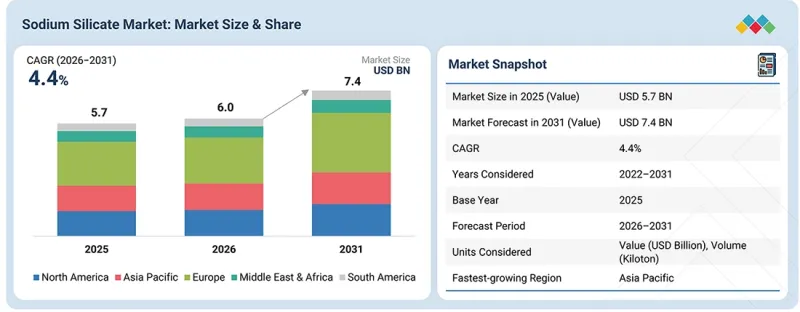
預計矽酸鈉市場將從 2026 年的 60 億美元成長到 2031 年的 74 億美元,預測期內複合年成長率為 4.4%。
| 調查範圍 | |
|---|---|
| 調查期 | 2022-2031 |
| 基準年 | 2025 |
| 預測期 | 2026-2031 |
| 計算單位 | 金額(10億美元) 數量(千噸) |
| 部分 | 形式、用途和區域 |
| 目標區域 | 北美洲、亞太地區、歐洲、中東和非洲、南美洲 |
矽酸鈉,俗稱“水玻璃”,是一種無機鹼性化合物,根據氧化鈉與二氧化矽的比例不同,可分為多種類型。這種化學物質用於配製洗滌劑和清潔劑、製造紙張和紙板、黏合劑、建築材料(包括混凝土)、矽基產品以及水處理應用。在水處理中,它用於防止腐蝕、作為絮凝劑以及穩定鐵和錳。其他工業應用包括土壤穩定、混凝土製造、鑽井和井筒穩定、油漆和塗料以及矽膠及相關產品的製造。在清潔劑配方中,這種化學物質可以提高洗滌劑的性能並防止成分腐蝕。在造紙和包裝行業,它是一種重要的原料。矽酸鈉也是矽膠、沉澱二氧化矽、沸石和分子篩的原料。
“到2025年,液態矽酸鈉將佔據最大的市場佔有率。”
液態矽酸鈉廣泛應用於清潔劑、紙漿和造紙、黏合劑等領域,預計到2025年將佔據整個矽酸鈉市場最大的佔有率。液態矽酸鈉以水溶液的形式供應。其鹼性和黏結性能使其適用於清潔劑和清潔劑的配方。其耐腐蝕性也使其在水處理應用中發揮作用。在建設產業,它在特定應用中可用作固化劑、粘合劑和密封劑。液態矽酸鈉可用於黏合劑和塗料的生產、地基穩定和水井處理過程。透過改變液態矽酸鈉生產過程中二氧化矽與氧化鈉的比例,可以為每種製程選擇最佳的產品等級。
“到2025年,清潔劑和清潔劑領域將在矽酸鈉市場中佔據最大的市場佔有率。”
清潔劑和清潔劑領域是矽酸鈉最大的應用領域。矽酸鈉被添加到洗衣精、清潔劑、家用清潔劑和工業清潔劑。矽酸鈉可以保護洗衣機和洗碗機中的金屬零件免受腐蝕。
“到2025年,亞太地區將主導全球矽酸鈉市場。”
預計到2025年,亞太地區將憑藉其強大的製造業基礎,佔據全球矽酸鈉市場最大佔有率。中國、印度、日本和其他東南亞國家在清潔劑和清潔劑、紙漿和造紙、建築、化學和水處理等領域擁有蓬勃發展的產業。根據經合組織的數據,中國和其他一些亞洲國家在全球矽酸鹽相關產品的供應鏈中扮演著至關重要的角色。因此,該地區強大的製造業和下游加工基礎確保了矽酸鈉生產商擁有廣泛的客戶群。
依公司類型分類:一級供應商:25%,二級供應商:42%,三級供應商:33%
按職位:首席級別主管:20%,總監:30%,其他職位:50%
按地區分類:北美:20%,歐洲:10%,亞太地區:40%,南美:10%,中東和非洲:20%
註:其他職位包括銷售、行銷和產品經理。
第一級:超過10億美元;第二級:5億美元至10億美元;第三級:低於5億美元。
本研究對矽酸鈉市場的主要參與者進行了詳細的競爭分析,包括公司簡介、近期發展和主要市場策略。
調查範圍
本研究報告根據形態(液態、固體)、應用(清潔劑和清潔劑、沉澱二氧化矽、紙漿和造紙、水處理及其他應用)和地區(亞太地區、北美、歐洲、南美以及中東和非洲)對矽酸鈉市場進行細分。報告詳細分析了影響矽酸鈉市場成長的促進因素、阻礙因素、挑戰和機會。該報告還對主要行業參與者進行了深入分析,包括其業務夥伴關係、產品供應以及與矽酸鈉市場相關的關鍵策略,例如合作、聯盟、併購、產品發布和業務擴張。此外,報告也對矽酸鈉市場生態系統中新興的新創公司進行了競爭考察。
購買本報告的理由
本報告為市場領導和新參與企業提供最準確的矽酸鈉市場及其各細分市場的收入估算。它幫助相關人員了解競爭格局,獲得更深入的洞察以更好地定位自身業務,並制定合適的打入市場策略。此外,報告還提供有關市場趨勢、關鍵市場促進因素、限制因素、挑戰和機會的資訊。
本報告深入分析了以下幾點:
- 本報告深入分析了關鍵促進因素(清潔劑生產需求增加、建設活動擴大、紙漿和造紙行業需求增加以及促進水處理的環境法規)、阻礙因素(原料價格波動、健康和環境問題)、機遇(應用於綠色輪胎製造、非洲和亞洲的快速都市化、鋰離子電池的回收利用以及先進石油回收技術的發展)和挑戰(環境和監管合規性)。
- 產品開發/創新:對矽酸鈉市場的未來技術、研發活動和產品/服務發布進行詳細分析。
- 市場發展:盈利市場的全面資訊-本報告分析了各個地區的矽酸鈉市場。
- 市場多元化:有關矽酸鈉市場的新產品和服務、未開發的地區、近期趨勢和投資的全面資訊。
- 競爭評估:對主要公司的市場佔有率、成長策略和服務產品進行詳細評估。
目錄
第1章:引言
第2章執行摘要
第3章重要考察
- 對於矽酸鈉市場的主要參與者而言,這是一個極具吸引力的商機。
- 矽酸鈉市場:依形態分類
- 矽酸鈉市場:依應用領域分類
- 亞太地區矽酸鈉市場:按應用和國家分類
- 矽酸鈉市場:依國家分類
第4章 市場概覽
- 市場動態
- 促進因素
- 抑制因子
- 機會
- 任務
第5章 產業趨勢
- 影響客戶業務的趨勢/顛覆性因素
- 價格分析
- 主要公司依產品類型分類的矽酸鈉平均售價(2025 年)
- 2022-2025年各地區矽酸鈉平均售價趨勢
- 價值鏈分析
- 生態系分析
- 通用人工智慧對矽酸鈉市場的影響
- 技術分析
- 主要技術
- 互補技術
- 專利分析
- 貿易分析
- 出口方案(HS編碼283919)
- 進口方案(HS編碼283919)
- 2026-2027 年主要會議和活動
- 關稅和監管情勢
- 關稅分析
- 監管機構、政府機構和其他組織
- 法律規範
- 波特五力分析
- 新進入者的威脅
- 替代品的威脅
- 供應商的議價能力
- 買方的議價能力
- 競爭公司之間的競爭
- 採購過程中的關鍵相關人員及其評估標準
- 採購過程中涉及的關鍵相關人員
- 採購標準
- 案例研究分析
- 利用矽酸鈉改善土壤質量
- 提高油井鑽井效率
- 提高石油、天然氣和地熱井的運作效率
- 宏觀經濟展望
- GDP趨勢與預測
- 投資和資金籌措場景
第6章:矽酸鈉市場:依形態分類
- 液體
- 固體的
第7章:矽酸鈉市場:依應用領域分類
- 清潔劑和清潔劑
- 黏合劑
- 水處理
- 紙漿和造紙業
- 沉澱二氧化矽
- 其他用途
第8章:矽酸鈉市場:依地區分類
- 亞太地區
- 中國
- 印度
- 日本
- 韓國
- 印尼
- 亞太其他地區
- 北美洲
- 美國
- 加拿大
- 墨西哥
- 歐洲
- 德國
- 英國
- 法國
- 波蘭
- 義大利
- 西班牙
- 荷蘭
- 其他歐洲國家
- 中東和非洲
- GCC
- 南非
- 其他中東和非洲地區
- 南美洲
- 巴西
- 阿根廷
- 南美洲其他地區
第9章 競爭情勢
- 概述
- 主要參與企業的策略/優勢,2023-2026 年
- 2021-2025年收入分析
- 市佔率分析(2025 年)
- 企業估值和財務指標
- 品牌和產品對比
- 企業估值矩陣:主要公司,2025 年
- 明星公司
- 新興領導者
- 業務範圍廣泛的公司
- 參與企業
- 企業企業發展:主要公司,2025 年
- 公司估值矩陣:新創企業/中小企業,2025 年
- 先進公司
- 應對力的公司
- 充滿活力的公司
- 起始點
- 競爭標竿分析:新創企業/中小企業,2025 年
- 競爭格局
- 交易
- 業務拓展
- 其他趨勢
第10章:公司簡介
- 大公司
- PQ CORPORATION
- QEMETICA
- NIPPON CHEMICAL INDUSTRIAL CO., LTD.
- OCCIDENTAL CHEMICAL CORPORATION(OXYCHEM)
- TOKUYAMA CORPORATION
- FUJI CHEMICAL CO., LTD.
- IQE GROUP
- ORIENTAL SILICAS CORPORATION
- EVONIK INDUSTRIES AG
- METRO CHEM INDUSTRIES
- 其他主要公司
- STPP GROUP
- SINCHEM SILICA GEL CO., LTD.
- SILMACO NV
- KIRAN GLOBAL CHEM LIMITED
- JAM GROUP COMPANY
- MERCK KGAA
- ANKIT SILICATE
- SUN SILICATES(PTY)LTD.
- HINDCON CHEMICALS LTD.
- IXOM
- CHEMSUPPLY AUSTRALIA
- HAWKINS
- DUBI CHEM MARINE INTERNATIONAL
- SAHAJANAND INDUSTRIES LIMITED
- ADWAN CHEMICAL INDUSTRIES CO., LTD.
第11章:調查方法
第12章附錄
The sodium silicate market is expected to grow from USD 6.0 billion in 2026 to USD 7.4 billion by 2031, at a CAGR of 4.4% during the forecast period.
| Scope of the Report | |
|---|---|
| Years Considered for the Study | 2022-2031 |
| Base Year | 2025 |
| Forecast Period | 2026-2031 |
| Units Considered | Value (USD Billion) Volume (Kilotons) |
| Segments | Form, Application, and Region |
| Regions covered | North America, Asia Pacific, Europe, Middle East & Africa, and South America |
Sodium silicate, commonly known as water glass, is an inorganic alkaline compound with various types depending on the ratio of sodium oxide to silica. This chemical is used in cleaning & detergent formulation, paper & cardboard making, adhesives, construction materials (including concrete), silica-based products, and water treatment applications. In water treatment, the product is used for corrosion control, as a coagulant aid, and to stabilize iron and manganese. Other industrial uses include soil stabilization, concrete manufacturing, drilling and well stabilization, paints and coatings and silica gel manufacture and related products. In detergent formulations, the chemical enhances performance and prevents corrosion of components. In the paper and packaging industries, it acts as an essential input chemical. Sodium silicate is also used as a raw material for silica gels, precipitated silica, zeolites, and molecular sieves.
"The liquid segment accounted for the largest share of the sodium silicates market in 2025."
The liquid form holds the largest share of the overall sodium silicate market in 2025 because of its wide applications in detergents, pulp & paper, adhesives, and other sectors. Liquid sodium silicate is supplied as an aqueous solution. The product's alkalinity and binding properties make it suitable for detergent and cleaning product formulations; its corrosion-resistant properties are also valuable in water treatment applications. In the building & construction industry, the product acts as a hardener, binder, and sealant for certain types of applications. Liquid sodium silicate can be used in adhesives and coatings production, soil stabilization, and well treatment processes. Producing liquid sodium silicate with diverse silica-to-sodium oxide ratios allows selection of the most suitable product grade for the process.
"Detergents & cleaning agents segment accounted for the largest share of the sodium silicate market in 2025."
The detergents & cleaning agents segment is the largest application of sodium silicate. Sodium silicate is added to laundry detergents, automatic dishwashing detergents, household cleaners, and industrial cleaning formulations. Sodium silicate protects metal parts in washing machines and dishwashing equipment from corrosion.
"Asia Pacific dominated the global market for sodium silicate in 2025."
Asia Pacific is estimated to account for the largest share of the global sodium silicate market in 2025 because of the region's strong manufacturing base. China, India, Japan, and other Southeast Asian countries have strong detergents & cleaning products, pulp & paper, construction, chemicals, and water treatment industries. According to the OECD, China and some Asian countries are key players in the global supply chain for silicate-related products. Thus, the region's strong manufacturing and downstream processing base ensures a wide range of customers for sodium silicate companies.
By Company Type: Tier 1: 25%, Tier 2: 42%, and Tier 3: 33%
By Designation: C-level Executives: 20%, Directors: 30%, and Other Designations: 50%
By Region: North America: 20%, Europe: 10%, Asia Pacific: 40%, South America: 10%, and Middle East & Africa 20%
Notes: Other designations include sales, marketing, and product managers.
Tier 1: >USD 1 Billion; Tier 2: USD 500 million-1 Billion; and Tier 3: <USD 500 million
Companies Covered: PQ Corporation (US), Qemetica (Poland), Nippon Chemical Industrial Co. Ltd. (Japan), Occidental Chemical Corporation (US), Tokuyama Corporation (Japan), Fuji Chemical Co. Ltd. (Japan), IQE Group (Spain), Oriental Silicas Corporation (Taiwan), Evonik Industries AG (Germany), and Metro Chem Industries (India) are covered in the report.
The study includes an in-depth competitive analysis of these key players in the sodium silicate market, with their company profiles, recent developments, and key market strategies.
Research Coverage
This research report categorizes the sodium silicate market based on form (Liquid, Solid), application (Detergent & Cleaning Agents, Precipitated Silica, Pulp & Paper, Water Treatment, Other Applications), and region (Asia Pacific, North America, Europe, South America, and Middle East & Africa). The report covers detailed information on the drivers, restraints, challenges, and opportunities influencing sodium silicate market growth. A detailed analysis of the key industry players has been done to provide insights into their business overview, products offered, and key strategies, such as partnerships, collaborations, mergers, acquisitions, product launches, and expansions, associated with the sodium silicate market. This report covers a competitive analysis of upcoming startups in the sodium silicate market ecosystem.
Reasons to Buy the Report
The report will offer market leaders/new entrants information on the closest approximations of the revenue numbers for the overall sodium silicate market and the subsegments. This report will help stakeholders understand the competitive landscape, gain more insights into positioning their businesses better, and plan suitable go-to-market strategies. The report will help stakeholders understand the pulse of the market and provide them with information on key market drivers, restraints, challenges, and opportunities.
The report provides insights into the following points:
- Analysis of key drivers (Growing demand in detergent production, Expansion in construction activities, Rising demand from pulp & paper industry, and Environmental regulations favoring water treatment), restraints (Fluctuating raw material prices and health & environmental concerns), opportunities (Application in green tire manufacturing, Rapid urbanization in Africa & Asia, Use in lithium-ion-battery recycling, Development of advanced oil recovery techniques), and challenges (Environmental and regulatory compliance, Competition from alternative materials).
- Product Development/Innovation: Detailed insights into upcoming technologies, research & development activities, and product & service launches in the sodium silicate market
- Market Development: Comprehensive information about profitable markets - the report analyzes the sodium silicate market across varied regions.
- Market Diversification: Exhaustive information about new products & services, untapped geographies, recent developments, and investments in the sodium silicate market
- Competitive Assessment: In-depth assessment of market shares, growth strategies, and service offerings of leading players such as PQ Corporation (US), Qemetica (Poland), Nippon Chemical Industrial Co. Ltd. (Japan), Occidental Chemical Corporation (US), Tokuyama Corporation (Japan), Fuji Chemical Co. Ltd. (Japan), IQE Group (Spain), Oriental Silicas Corporation (Taiwan), Evonik Industries AG (Germany), and Metro Chem Industries (India), among others.
TABLE OF CONTENTS
1 INTRODUCTION
- 1.1 STUDY OBJECTIVES
- 1.2 MARKET DEFINITION
- 1.3 STUDY SCOPE
- 1.3.1 MARKETS COVERED AND REGIONAL SCOPE
- 1.3.2 INCLUSIONS AND EXCLUSIONS
- 1.3.3 YEARS CONSIDERED
- 1.3.4 CURRENCY CONSIDERED
- 1.3.5 UNIT CONSIDERED
- 1.3.6 STAKEHOLDERS
- 1.4 SUMMARY OF CHANGES
2 EXECUTIVE SUMMARY
- 2.1 KEY INSIGHTS AND MARKET HIGHLIGHTS
- 2.2 KEY MARKET PARTICIPANTS: SHARE INSIGHTS AND STRATEGIC DEVELOPMENTS
- 2.3 DISRUPTIVE TRENDS SHAPING THE MARKET
- 2.4 HIGH-GROWTH SEGMENTS & EMERGING FRONTIERS
- 2.5 SNAPSHOT: GLOBAL MARKET SIZE, GROWTH RATE, AND FORECAST
3 PREMIUM INSIGHTS
- 3.1 ATTRACTIVE OPPORTUNITIES FOR KEY PLAYERS IN SODIUM SILICATE MARKET
- 3.2 SODIUM SILICATE MARKET, BY FORM
- 3.3 SODIUM SILICATE MARKET, BY APPLICATION
- 3.4 SODIUM SILICATE MARKET IN ASIA PACIFIC, BY APPLICATION AND COUNTRY
- 3.5 SODIUM SILICATE MARKET, BY COUNTRY
4 MARKET OVERVIEW
- 4.1 INTRODUCTION
- 4.2 MARKET DYNAMICS
- 4.2.1 DRIVERS
- 4.2.1.1 Rapid expansion of washing and cleaning products industry
- 4.2.1.2 Increasing construction activities
- 4.2.1.3 Escalating pulp and paper production
- 4.2.1.4 Rising implementation of environmental regulations favoring water treatment
- 4.2.2 RESTRAINTS
- 4.2.2.1 Fluctuating raw material prices
- 4.2.2.2 Health and environmental concerns
- 4.2.3 OPPORTUNITIES
- 4.2.3.1 Applications in green tire manufacturing
- 4.2.3.2 Rapid urbanization in Africa and Asia
- 4.2.3.3 Use in lithium-ion battery recycling
- 4.2.3.4 Development of advanced oil recovery techniques
- 4.2.4 CHALLENGES
- 4.2.4.1 Environmental and regulatory compliance
- 4.2.4.2 Competition from alternative materials
- 4.2.1 DRIVERS
5 INDUSTRY TRENDS
- 5.1 TRENDS/DISRUPTIONS IMPACTING CUSTOMER BUSINESS
- 5.2 PRICING ANALYSIS
- 5.2.1 AVERAGE SELLING PRICE OF SODIUM SILICATES OFFERED BY KEY PLAYERS, BY FORM, 2025
- 5.2.2 AVERAGE SELLING PRICE TREND OF SODIUM SILICATES, BY REGION, 2022-2025
- 5.3 VALUE CHAIN ANALYSIS
- 5.4 ECOSYSTEM ANALYSIS
- 5.5 IMPACT OF GEN AI ON SODIUM SILICATE MARKET
- 5.6 TECHNOLOGY ANALYSIS
- 5.6.1 KEY TECHNOLOGIES
- 5.6.1.1 Hydrothermal synthesis optimization
- 5.6.1.2 Fluidized bed reactor
- 5.6.2 COMPLEMENTARY TECHNOLOGIES
- 5.6.2.1 Waste-based raw material
- 5.6.2.2 Low-carbon furnace
- 5.6.1 KEY TECHNOLOGIES
- 5.7 PATENT ANALYSIS
- 5.8 TRADE ANALYSIS
- 5.8.1 EXPORT SCENARIO (HS CODE 283919)
- 5.8.2 IMPORT SCENARIO (HS CODE 283919)
- 5.9 KEY CONFERENCES AND EVENTS, 2026-2027
- 5.10 TARIFF AND REGULATORY LANDSCAPE
- 5.10.1 TARIFF ANALYSIS
- 5.10.2 REGULATORY BODIES, GOVERNMENT AGENCIES, AND OTHER ORGANIZATIONS
- 5.10.3 REGULATORY FRAMEWORK
- 5.11 PORTER'S FIVE FORCES ANALYSIS
- 5.11.1 THREAT OF NEW ENTRANTS
- 5.11.2 THREAT OF SUBSTITUTES
- 5.11.3 BARGAINING POWER OF SUPPLIERS
- 5.11.4 BARGAINING POWER OF BUYERS
- 5.11.5 INTENSITY OF COMPETITIVE RIVALRY
- 5.12 KEY STAKEHOLDERS INVOLVED IN BUYING PROCESS AND THEIR EVALUATION CRITERIA
- 5.12.1 KEY STAKEHOLDERS IN BUYING PROCESS
- 5.12.2 BUYING CRITERIA
- 5.13 CASE STUDY ANALYSIS
- 5.13.1 ENHANCEMENT OF SOIL QUALITY WITH SODIUM SILICATE
- 5.13.2 IMPROVED DRILLING EFFICIENCY IN WELLS
- 5.13.3 ENHANCING OIL, GAS, AND GEOTHERMAL WELL OPERATIONS
- 5.14 MACROECONOMIC OUTLOOK
- 5.14.1 INTRODUCTION
- 5.14.2 GDP TRENDS AND FORECASTS
- 5.15 INVESTMENT AND FUNDING SCENARIO
6 SODIUM SILICATE MARKET, BY FORM
- 6.1 INTRODUCTION
- 6.2 LIQUID
- 6.2.1 VERSATILE APPLICATIONS AND CUSTOMIZABLE PROPERTIES TO DRIVE DEMAND
- 6.2.2 ALKALINE
- 6.2.3 NEUTRAL
- 6.3 SOLID
- 6.3.1 STABILITY, EASE OF STORAGE, AND ROLE IN ENHANCING EFFICIENCY TO BOOST ADOPTION
- 6.3.2 ALKALINE
- 6.3.3 NEUTRAL
7 SODIUM SILICATE MARKET, BY APPLICATION
- 7.1 INTRODUCTION
- 7.2 DETERGENTS & CLEANING AGENTS
- 7.2.1 HIGH PREFERENCE FOR ECO-FRIENDLY AND BIODEGRADABLE CLEANING SOLUTIONS TO FUEL SEGMENTAL GROWTH
- 7.3 ADHESIVES
- 7.3.1 THRIVING PACKAGING, CONSTRUCTION, AUTOMOTIVE, AND WOODWORKING INDUSTRIES TO BOOST SEGMENTAL GROWTH
- 7.4 WATER TREATMENT
- 7.4.1 STRONG FOCUS ON SANITIZATION AND INVESTMENT IN WATER INFRASTRUCTURE TO EXPEDITE SEGMENTAL GROWTH
- 7.5 PULP & PAPER INDUSTRY
- 7.5.1 INCREASING USE IN PAPER RECYCLING, RETENTION, AND COATING APPLICATIONS TO DRIVE MARKET
- 7.6 PRECIPITATED SILICA
- 7.6.1 BOOMING AUTOMOTIVE, RUBBER, AND FOOTWEAR INDUSTRIES TO ACCELERATE SEGMENTAL GROWTH
- 7.7 OTHER APPLICATIONS
8 SODIUM SILICATE MARKET, BY REGION
- 8.1 INTRODUCTION
- 8.2 ASIA PACIFIC
- 8.2.1 CHINA
- 8.2.1.1 Increasing infrastructure investments and large-scale industrial activities to drive market
- 8.2.2 INDIA
- 8.2.2.1 Rapid economic growth, industrial expansion, and large-scale infrastructure investments to boost market growth
- 8.2.3 JAPAN
- 8.2.3.1 Booming construction sector to contribute to market growth
- 8.2.4 SOUTH KOREA
- 8.2.4.1 Increasing wastewater treatment initiatives to drive market
- 8.2.5 INDONESIA
- 8.2.5.1 Rising urbanization and expanding exports of sodium silicate and paper products to augment market growth
- 8.2.6 REST OF ASIA PACIFIC
- 8.2.1 CHINA
- 8.3 NORTH AMERICA
- 8.3.1 US
- 8.3.1.1 Increasing wastewater treatment requirements and infrastructure investments to foster market growth
- 8.3.2 CANADA
- 8.3.2.1 Recycling initiatives and wastewater projects to expedite market growth
- 8.3.3 MEXICO
- 8.3.3.1 Thriving recycling and paper-production sectors to support market growth
- 8.3.1 US
- 8.4 EUROPE
- 8.4.1 GERMANY
- 8.4.1.1 Rising commercial vehicle sales and green tire manufacturing to boost market growth
- 8.4.2 UK
- 8.4.2.1 Booming detergents industry and economic growth to contribute to market growth
- 8.4.3 FRANCE
- 8.4.3.1 Growth in EV production and turnkey projects to boost market growth
- 8.4.4 POLAND
- 8.4.4.1 Increase in wastewater treatment initiatives to expedite market growth
- 8.4.5 ITALY
- 8.4.5.1 Thriving automotive sector and wastewater treatment initiatives to bolster market growth
- 8.4.6 SPAIN
- 8.4.6.1 Increasing consumer spending and vehicle production to drive market
- 8.4.7 NETHERLANDS
- 8.4.7.1 Well-established chemical industry and demand for detergents & cleaning products to support market growth
- 8.4.8 REST OF EUROPE
- 8.4.1 GERMANY
- 8.5 MIDDLE EAST & AFRICA
- 8.5.1 GCC
- 8.5.1.1 Saudi Arabia
- 8.5.1.1.1 Growth in EV production and construction industry to foster market growth
- 8.5.1.2 UAE
- 8.5.1.2.1 Increased investments in manufacturing and construction industries to boost market growth
- 8.5.1.3 Rest of GCC
- 8.5.1.1 Saudi Arabia
- 8.5.2 SOUTH AFRICA
- 8.5.2.1 High investment in water and wastewater infrastructure and pulp & paper industry growth to drive market
- 8.5.3 REST OF MIDDLE EAST & AFRICA
- 8.5.1 GCC
- 8.6 SOUTH AMERICA
- 8.6.1 BRAZIL
- 8.6.1.1 Escalating pulp and paper production to augment market growth
- 8.6.2 ARGENTINA
- 8.6.2.1 Increasing exports of washing and cleaning preparations and infrastructure investments to fuel market growth
- 8.6.3 REST OF SOUTH AMERICA
- 8.6.1 BRAZIL
9 COMPETITIVE LANDSCAPE
- 9.1 OVERVIEW
- 9.2 KEY PLAYER COMPETITIVE STRATEGIES/RIGHT TO WIN, 2023-2026
- 9.3 REVENUE ANALYSIS, 2021-2025
- 9.4 MARKET SHARE ANALYSIS, 2025
- 9.5 COMPANY VALUATION AND FINANCIAL METRICS
- 9.6 BRAND/PRODUCT COMPARISON
- 9.7 COMPANY EVALUATION MATRIX: KEY PLAYERS, 2025
- 9.7.1 STARS
- 9.7.2 EMERGING LEADERS
- 9.7.3 PERVASIVE PLAYERS
- 9.7.4 PARTICIPANTS
- 9.7.5 COMPANY FOOTPRINT: KEY PLAYERS, 2025
- 9.7.5.1 Company footprint
- 9.7.5.2 Region footprint
- 9.7.5.3 Form footprint
- 9.7.5.4 Application footprint
- 9.8 COMPANY EVALUATION MATRIX: STARTUPS/SMES, 2025
- 9.8.1 PROGRESSIVE COMPANIES
- 9.8.2 RESPONSIVE COMPANIES
- 9.8.3 DYNAMIC COMPANIES
- 9.8.4 STARTING BLOCKS
- 9.8.5 COMPETITIVE BENCHMARKING: STARTUPS/SMES, 2025
- 9.8.5.1 Detailed list of key startups/SMEs
- 9.8.5.2 Competitive benchmarking of key startups/SMEs
- 9.9 COMPETITIVE SCENARIO
- 9.9.1 DEALS
- 9.9.2 EXPANSIONS
- 9.9.3 OTHER DEVELOPMENTS
10 COMPANY PROFILES
- 10.1 KEY PLAYERS
- 10.1.1 PQ CORPORATION
- 10.1.1.1 Business overview
- 10.1.1.2 Products offered
- 10.1.1.3 Recent developments
- 10.1.1.3.1 Deals
- 10.1.1.3.2 Expansions
- 10.1.1.4 MnM view
- 10.1.1.4.1 Key strengths
- 10.1.1.4.2 Strategic choices
- 10.1.1.4.3 Weaknesses and competitive threats
- 10.1.2 QEMETICA
- 10.1.2.1 Business overview
- 10.1.2.2 Products offered
- 10.1.2.3 Recent developments
- 10.1.2.3.1 Deals
- 10.1.2.3.2 Expansions
- 10.1.2.4 MnM view
- 10.1.2.4.1 Key strengths
- 10.1.2.4.2 Strategic choices
- 10.1.2.4.3 Weaknesses and competitive threats
- 10.1.3 NIPPON CHEMICAL INDUSTRIAL CO., LTD.
- 10.1.3.1 Business overview
- 10.1.3.2 Products offered
- 10.1.3.3 Recent developments
- 10.1.3.3.1 Expansions
- 10.1.3.4 MnM view
- 10.1.3.4.1 Key strengths
- 10.1.3.4.2 Strategic choices
- 10.1.3.4.3 Weaknesses and competitive threats
- 10.1.4 OCCIDENTAL CHEMICAL CORPORATION (OXYCHEM)
- 10.1.4.1 Business overview
- 10.1.4.2 Products offered
- 10.1.4.3 Recent developments
- 10.1.4.3.1 Developments
- 10.1.4.4 MnM view
- 10.1.4.4.1 Key strengths
- 10.1.4.4.2 Strategic choices
- 10.1.4.4.3 Weaknesses and competitive threats
- 10.1.5 TOKUYAMA CORPORATION
- 10.1.5.1 Business overview
- 10.1.5.2 Products offered
- 10.1.5.3 Recent developments
- 10.1.5.3.1 Expansions
- 10.1.5.3.2 Other developments
- 10.1.5.4 MnM view
- 10.1.5.4.1 Key strengths
- 10.1.5.4.2 Strategic choices
- 10.1.5.4.3 Weaknesses and competitive threats
- 10.1.6 FUJI CHEMICAL CO., LTD.
- 10.1.6.1 Business overview
- 10.1.6.2 Products offered
- 10.1.6.3 MnM view
- 10.1.7 IQE GROUP
- 10.1.7.1 Business overview
- 10.1.7.2 Products offered
- 10.1.7.3 MnM view
- 10.1.8 ORIENTAL SILICAS CORPORATION
- 10.1.8.1 Business overview
- 10.1.8.2 Products offered
- 10.1.8.3 MnM view
- 10.1.9 EVONIK INDUSTRIES AG
- 10.1.9.1 Business overview
- 10.1.9.2 Products offered
- 10.1.9.3 Recent developments
- 10.1.9.3.1 Deals
- 10.1.9.3.2 Expansions
- 10.1.9.4 MnM view
- 10.1.10 METRO CHEM INDUSTRIES
- 10.1.10.1 Business overview
- 10.1.10.2 Products offered
- 10.1.10.3 MnM view
- 10.1.1 PQ CORPORATION
- 10.2 OTHER PLAYERS
- 10.2.1 STPP GROUP
- 10.2.2 SINCHEM SILICA GEL CO., LTD.
- 10.2.3 SILMACO NV
- 10.2.4 KIRAN GLOBAL CHEM LIMITED
- 10.2.5 JAM GROUP COMPANY
- 10.2.6 MERCK KGAA
- 10.2.7 ANKIT SILICATE
- 10.2.8 SUN SILICATES (PTY) LTD.
- 10.2.9 HINDCON CHEMICALS LTD.
- 10.2.10 IXOM
- 10.2.11 CHEMSUPPLY AUSTRALIA
- 10.2.12 HAWKINS
- 10.2.13 DUBI CHEM MARINE INTERNATIONAL
- 10.2.14 SAHAJANAND INDUSTRIES LIMITED
- 10.2.15 ADWAN CHEMICAL INDUSTRIES CO., LTD.
11 RESEARCH METHODOLOGY
- 11.1 RESEARCH DATA
- 11.1.1 SECONDARY DATA
- 11.1.1.1 Key data from secondary sources
- 11.1.2 PRIMARY DATA
- 11.1.2.1 Key data from primary sources
- 11.1.2.2 Key industry insights
- 11.1.1 SECONDARY DATA
- 11.2 MARKET SIZE ESTIMATION
- 11.3 MARKET SIZE CALCULATION FOR BASE YEAR
- 11.3.1 DEMAND-SIDE APPROACH
- 11.3.2 SUPPLY-SIDE APPROACH
- 11.4 MARKET FORECAST APPROACH
- 11.4.1 SUPPLY SIDE
- 11.4.2 DEMAND SIDE
- 11.5 DATA TRIANGULATION
- 11.6 FACTOR ANALYSIS
- 11.7 RESEARCH ASSUMPTIONS
- 11.8 RESEARCH LIMITATIONS AND RISK ANALYSIS
12 APPENDIX
- 12.1 DISCUSSION GUIDE
- 12.2 KNOWLEDGE STORE: MARKETSANDMARKETS' SUBSCRIPTION PORTAL
- 12.3 CUSTOMIZATION OPTIONS
- 12.4 RELATED REPORTS
- 12.5 AUTHOR DETAILS
List of Tables
- TABLE 1 AVERAGE SELLING PRICE OF SODIUM SILICATES OFFERED BY KEY PLAYERS, BY FORM, 2025 (USD/KG)
- TABLE 2 AVERAGE SELLING PRICE TREND OF SODIUM SILICATES, BY REGION, 2022-2025 (USD/KG)
- TABLE 3 ROLE OF COMPANIES IN SODIUM SILICATE ECOSYSTEM
- TABLE 4 LIST OF PATENTS, 2016-2025
- TABLE 5 LIST OF KEY CONFERENCES AND EVENTS, 2026-2027
- TABLE 6 TARIFF RELATED TO SILICATES OF SODIUM, INCLUDING COMMERCIAL SILICATES (EXCLUDING SODIUM METASILICATES)
- TABLE 7 NORTH AMERICA: LIST OF REGULATORY BODIES, GOVERNMENT AGENCIES, AND OTHER ORGANIZATIONS
- TABLE 8 SOUTH AMERICA: LIST OF REGULATORY BODIES, GOVERNMENT AGENCIES, AND OTHER ORGANIZATIONS
- TABLE 9 EUROPE: LIST OF REGULATORY BODIES, GOVERNMENT AGENCIES, AND OTHER ORGANIZATIONS
- TABLE 10 ASIA PACIFIC: LIST OF REGULATORY BODIES, GOVERNMENT AGENCIES, AND OTHER ORGANIZATIONS
- TABLE 11 MIDDLE EAST & AFRICA: LIST OF REGULATORY BODIES, GOVERNMENT AGENCIES, AND OTHER ORGANIZATIONS
- TABLE 12 IMPACT OF PORTER'S FIVE FORCES ANALYSIS
- TABLE 13 INFLUENCE OF STAKEHOLDERS IN BUYING PROCESS FOR THREE MAJOR APPLICATIONS
- TABLE 14 BUYING CRITERIA FOR TOP THREE APPLICATIONS
- TABLE 15 GLOBAL GDP GROWTH PROJECTION, 2021-2028 (USD TRILLION)
- TABLE 16 SODIUM SILICATE MARKET, BY FORM, 2022-2024 (USD MILLION)
- TABLE 17 SODIUM SILICATE MARKET, BY FORM, 2025-2031 (USD MILLION)
- TABLE 18 SODIUM SILICATE MARKET, BY FORM, 2022-2024 (KILOTON)
- TABLE 19 SODIUM SILICATE MARKET, BY FORM, 2025-2031 (KILOTON)
- TABLE 20 SODIUM SILICATE MARKET, BY APPLICATION, 2022-2024 (USD MILLION)
- TABLE 21 SODIUM SILICATE MARKET, BY APPLICATION, 2025-2031 (USD MILLION)
- TABLE 22 SODIUM SILICATE MARKET, BY APPLICATION, 2022-2024 (KILOTON)
- TABLE 23 SODIUM SILICATE MARKET, BY APPLICATION, 2025-2031 (KILOTON)
- TABLE 24 SODIUM SILICATE MARKET, BY REGION, 2022-2024 (USD MILLION)
- TABLE 25 SODIUM SILICATE MARKET, BY REGION, 2025-2031 (USD MILLION)
- TABLE 26 SODIUM SILICATE MARKET, BY REGION, 2022-2024 (KILOTON)
- TABLE 27 SODIUM SILICATE MARKET, BY REGION, 2025-2031 (KILOTON)
- TABLE 28 ASIA PACIFIC: SODIUM SILICATE MARKET, BY COUNTRY, 2022-2024 (USD MILLION)
- TABLE 29 ASIA PACIFIC: SODIUM SILICATE MARKET, BY COUNTRY, 2025-2031 (USD MILLION)
- TABLE 30 ASIA PACIFIC: SODIUM SILICATE MARKET, BY COUNTRY, 2022-2024 (KILOTON)
- TABLE 31 ASIA PACIFIC: SODIUM SILICATE MARKET, BY COUNTRY, 2025-2031 (KILOTON)
- TABLE 32 ASIA PACIFIC: SODIUM SILICATE MARKET, BY FORM, 2022-2024 (USD MILLION)
- TABLE 33 ASIA PACIFIC: SODIUM SILICATE MARKET, BY FORM, 2025-2031 (USD MILLION)
- TABLE 34 ASIA PACIFIC: SODIUM SILICATE MARKET, BY FORM, 2022-2024 (KILOTON)
- TABLE 35 ASIA PACIFIC: SODIUM SILICATE MARKET, BY FORM, 2025-2031 (KILOTON)
- TABLE 36 ASIA PACIFIC: SODIUM SILICATE MARKET, BY APPLICATION, 2022-2024 (USD MILLION)
- TABLE 37 ASIA PACIFIC: SODIUM SILICATE MARKET, BY APPLICATION, 2025-2031 (USD MILLION)
- TABLE 38 ASIA PACIFIC: SODIUM SILICATE MARKET, BY APPLICATION, 2022-2024 (KILOTON)
- TABLE 39 ASIA PACIFIC: SODIUM SILICATE MARKET, BY APPLICATION, 2025-2031 (KILOTON)
- TABLE 40 CHINA: SODIUM SILICATE MARKET, BY FORM, 2022-2024 (USD MILLION)
- TABLE 41 CHINA: SODIUM SILICATE MARKET, BY FORM, 2025-2031 (USD MILLION)
- TABLE 42 CHINA: SODIUM SILICATE MARKET, BY FORM, 2022-2024 (KILOTON)
- TABLE 43 CHINA: SODIUM SILICATE MARKET, BY FORM, 2025-2031 (KILOTON)
- TABLE 44 CHINA: SODIUM SILICATE MARKET, BY APPLICATION, 2022-2024 (USD MILLION)
- TABLE 45 CHINA: SODIUM SILICATE MARKET, BY APPLICATION, 2025-2031 (USD MILLION)
- TABLE 46 CHINA: SODIUM SILICATE MARKET, BY APPLICATION, 2022-2024 (KILOTON)
- TABLE 47 CHINA: SODIUM SILICATE MARKET, BY APPLICATION, 2025-2031 (KILOTON)
- TABLE 48 INDIA: SODIUM SILICATE MARKET, BY FORM, 2022-2024 (USD MILLION)
- TABLE 49 INDIA: SODIUM SILICATE MARKET, BY FORM, 2025-2031 (USD MILLION)
- TABLE 50 INDIA: SODIUM SILICATE MARKET, BY FORM, 2022-2024 (KILOTON)
- TABLE 51 INDIA: SODIUM SILICATE MARKET, BY FORM, 2025-2031 (KILOTON)
- TABLE 52 INDIA: SODIUM SILICATE MARKET, BY APPLICATION, 2022-2024 (USD MILLION)
- TABLE 53 INDIA: SODIUM SILICATE MARKET, BY APPLICATION, 2025-2031 (USD MILLION)
- TABLE 54 INDIA: SODIUM SILICATE MARKET, BY APPLICATION, 2022-2024 (KILOTON)
- TABLE 55 INDIA: SODIUM SILICATE MARKET, BY APPLICATION, 2025-2031 (KILOTON)
- TABLE 56 JAPAN: SODIUM SILICATE MARKET, BY FORM, 2022-2024 (USD MILLION)
- TABLE 57 JAPAN: SODIUM SILICATE MARKET, BY FORM, 2025-2031 (USD MILLION)
- TABLE 58 JAPAN: SODIUM SILICATE MARKET, BY FORM, 2022-2024 (KILOTON)
- TABLE 59 JAPAN: SODIUM SILICATE MARKET, BY FORM, 2025-2031 (KILOTON)
- TABLE 60 JAPAN: SODIUM SILICATE MARKET, BY APPLICATION, 2022-2024 (USD MILLION)
- TABLE 61 JAPAN: SODIUM SILICATE MARKET, BY APPLICATION, 2025-2031 (USD MILLION)
- TABLE 62 JAPAN: SODIUM SILICATE MARKET, BY APPLICATION, 2022-2024 (KILOTON)
- TABLE 63 JAPAN: SODIUM SILICATE MARKET, BY APPLICATION, 2025-2031 (KILOTON)
- TABLE 64 SOUTH KOREA: SODIUM SILICATE MARKET, BY FORM, 2022-2024 (USD MILLION)
- TABLE 65 SOUTH KOREA: SODIUM SILICATE MARKET, BY FORM, 2025-2031 (USD MILLION)
- TABLE 66 SOUTH KOREA: SODIUM SILICATE MARKET, BY FORM, 2022-2024 (KILOTON)
- TABLE 67 SOUTH KOREA: SODIUM SILICATE MARKET, BY FORM, 2025-2031 (KILOTON)
- TABLE 68 SOUTH KOREA: SODIUM SILICATE MARKET, BY APPLICATION, 2022-2024 (USD MILLION)
- TABLE 69 SOUTH KOREA: SODIUM SILICATE MARKET, BY APPLICATION, 2025-2031 (USD MILLION)
- TABLE 70 SOUTH KOREA: SODIUM SILICATE MARKET, BY APPLICATION, 2022-2024 (KILOTON)
- TABLE 71 SOUTH KOREA: SODIUM SILICATE MARKET, BY APPLICATION, 2025-2031 (KILOTON)
- TABLE 72 INDONESIA: SODIUM SILICATE MARKET, BY FORM, 2022-2024 (USD MILLION)
- TABLE 73 INDONESIA: SODIUM SILICATE MARKET, BY FORM, 2025-2031 (USD MILLION)
- TABLE 74 INDONESIA: SODIUM SILICATE MARKET, BY FORM, 2022-2024 (KILOTON)
- TABLE 75 INDONESIA: SODIUM SILICATE MARKET, BY FORM, 2025-2031 (KILOTON)
- TABLE 76 INDONESIA: SODIUM SILICATE MARKET, BY APPLICATION, 2022-2024 (USD MILLION)
- TABLE 77 INDONESIA: SODIUM SILICATE MARKET, BY APPLICATION, 2025-2031 (USD MILLION)
- TABLE 78 INDONESIA: SODIUM SILICATE MARKET, BY APPLICATION, 2022-2024 (KILOTON)
- TABLE 79 INDONESIA: SODIUM SILICATE MARKET, BY APPLICATION, 2025-2031 (KILOTON)
- TABLE 80 REST OF ASIA PACIFIC: SODIUM SILICATE MARKET, BY FORM, 2022-2024 (USD MILLION)
- TABLE 81 REST OF ASIA PACIFIC: SODIUM SILICATE MARKET, BY FORM, 2025-2031 (USD MILLION)
- TABLE 82 REST OF ASIA PACIFIC: SODIUM SILICATE MARKET, BY FORM, 2022-2024 (KILOTON)
- TABLE 83 REST OF ASIA PACIFIC: SODIUM SILICATE MARKET, BY FORM, 2025-2031 (KILOTON)
- TABLE 84 REST OF ASIA PACIFIC: SODIUM SILICATE MARKET, BY APPLICATION, 2022-2024 (USD MILLION)
- TABLE 85 REST OF ASIA PACIFIC: SODIUM SILICATE MARKET, BY APPLICATION, 2025-2031 (USD MILLION)
- TABLE 86 REST OF ASIA PACIFIC: SODIUM SILICATE MARKET, BY APPLICATION, 2022-2024 (KILOTON)
- TABLE 87 REST OF ASIA PACIFIC: SODIUM SILICATE MARKET, BY APPLICATION, 2025-2031 (KILOTON)
- TABLE 88 NORTH AMERICA: SODIUM SILICATE MARKET, BY COUNTRY, 2022-2024 (USD MILLION)
- TABLE 89 NORTH AMERICA: SODIUM SILICATE MARKET, BY COUNTRY, 2025-2031 (USD MILLION)
- TABLE 90 NORTH AMERICA: SODIUM SILICATE MARKET, BY COUNTRY, 2022-2024 (KILOTON)
- TABLE 91 NORTH AMERICA: SODIUM SILICATE MARKET, BY COUNTRY, 2025-2031 (KILOTON)
- TABLE 92 NORTH AMERICA: SODIUM SILICATE MARKET, BY FORM, 2022-2024 (USD MILLION)
- TABLE 93 NORTH AMERICA: SODIUM SILICATE MARKET, BY FORM, 2025-2031 (USD MILLION)
- TABLE 94 NORTH AMERICA: SODIUM SILICATE MARKET, BY FORM, 2022-2024 (KILOTON)
- TABLE 95 NORTH AMERICA: SODIUM SILICATE MARKET, BY FORM, 2025-2031 (KILOTON)
- TABLE 96 NORTH AMERICA: SODIUM SILICATE MARKET, BY APPLICATION, 2022-2024 (USD MILLION)
- TABLE 97 NORTH AMERICA: SODIUM SILICATE MARKET, BY APPLICATION, 2025-2031 (USD MILLION)
- TABLE 98 NORTH AMERICA: SODIUM SILICATE MARKET, BY APPLICATION, 2022-2024 (KILOTON)
- TABLE 99 NORTH AMERICA: SODIUM SILICATE MARKET, BY APPLICATION, 2025-2031 (KILOTON)
- TABLE 100 US: SODIUM SILICATE MARKET, BY FORM, 2022-2024 (USD MILLION)
- TABLE 101 US: SODIUM SILICATE MARKET, BY FORM, 2025-2031 (USD MILLION)
- TABLE 102 US: SODIUM SILICATE MARKET, BY FORM, 2022-2024 (KILOTON)
- TABLE 103 US: SODIUM SILICATE MARKET, BY FORM, 2025-2031 (KILOTON)
- TABLE 104 US: SODIUM SILICATE MARKET, BY APPLICATION, 2022-2024 (USD MILLION)
- TABLE 105 US: SODIUM SILICATE MARKET, BY APPLICATION, 2025-2031 (USD MILLION)
- TABLE 106 US: SODIUM SILICATE MARKET, BY APPLICATION, 2022-2024 (KILOTON)
- TABLE 107 US: SODIUM SILICATE MARKET, BY APPLICATION, 2025-2031 (KILOTON)
- TABLE 108 CANADA: SODIUM SILICATE MARKET, BY FORM, 2022-2024 (USD MILLION)
- TABLE 109 CANADA: SODIUM SILICATE MARKET, BY FORM, 2025-2031 (USD MILLION)
- TABLE 110 CANADA: SODIUM SILICATE MARKET, BY FORM, 2022-2024 (KILOTON)
- TABLE 111 CANADA: SODIUM SILICATE MARKET, BY FORM, 2025-2031 (KILOTON)
- TABLE 112 CANADA: SODIUM SILICATE MARKET, BY APPLICATION, 2022-2024 (USD MILLION)
- TABLE 113 CANADA: SODIUM SILICATE MARKET, BY APPLICATION, 2025-2031 (USD MILLION)
- TABLE 114 CANADA: SODIUM SILICATE MARKET, BY APPLICATION, 2022-2024 (KILOTON)
- TABLE 115 CANADA: SODIUM SILICATE MARKET, BY APPLICATION, 2025-2031 (KILOTON)
- TABLE 116 MEXICO: SODIUM SILICATE MARKET, BY FORM, 2022-2024 (USD MILLION)
- TABLE 117 MEXICO: SODIUM SILICATE MARKET, BY FORM, 2025-2031 (USD MILLION)
- TABLE 118 MEXICO: SODIUM SILICATE MARKET, BY FORM, 2022-2024 (KILOTON)
- TABLE 119 MEXICO: SODIUM SILICATE MARKET, BY FORM, 2025-2031 (KILOTON)
- TABLE 120 MEXICO: SODIUM SILICATE MARKET, BY APPLICATION, 2022-2024 (USD MILLION)
- TABLE 121 MEXICO: SODIUM SILICATE MARKET, BY APPLICATION, 2025-2031 (USD MILLION)
- TABLE 122 MEXICO: SODIUM SILICATE MARKET, BY APPLICATION, 2022-2024 (KILOTON)
- TABLE 123 MEXICO: SODIUM SILICATE MARKET, BY APPLICATION, 2025-2031 (KILOTON)
- TABLE 124 EUROPE: SODIUM SILICATE MARKET, BY COUNTRY, 2022-2024 (USD MILLION)
- TABLE 125 EUROPE: SODIUM SILICATE MARKET, BY COUNTRY, 2025-2031 (USD MILLION)
- TABLE 126 EUROPE: SODIUM SILICATE MARKET, BY COUNTRY, 2022-2024 (KILOTON)
- TABLE 127 EUROPE: SODIUM SILICATE MARKET, BY COUNTRY, 2025-2031 (KILOTON)
- TABLE 128 EUROPE: SODIUM SILICATE MARKET, BY FORM, 2022-2024 (USD MILLION)
- TABLE 129 EUROPE: SODIUM SILICATE MARKET, BY FORM, 2025-2031 (USD MILLION)
- TABLE 130 EUROPE: SODIUM SILICATE MARKET, BY FORM, 2022-2024 (KILOTON)
- TABLE 131 EUROPE: SODIUM SILICATE MARKET, BY FORM, 2025-2031 (KILOTON)
- TABLE 132 EUROPE: SODIUM SILICATE MARKET, BY APPLICATION, 2022-2024 (USD MILLION)
- TABLE 133 EUROPE: SODIUM SILICATE MARKET, BY APPLICATION, 2025-2031 (USD MILLION)
- TABLE 134 EUROPE: SODIUM SILICATE MARKET, BY APPLICATION, 2022-2024 (KILOTON)
- TABLE 135 EUROPE: SODIUM SILICATE MARKET, BY APPLICATION, 2025-2031 (KILOTON)
- TABLE 136 GERMANY: SODIUM SILICATE MARKET, BY FORM, 2022-2024 (USD MILLION)
- TABLE 137 GERMANY: SODIUM SILICATE MARKET, BY FORM, 2025-2031 (USD MILLION)
- TABLE 138 GERMANY: SODIUM SILICATE MARKET, BY FORM, 2022-2024 (KILOTON)
- TABLE 139 GERMANY: SODIUM SILICATE MARKET, BY FORM, 2025-2031 (KILOTON)
- TABLE 140 GERMANY: SODIUM SILICATE MARKET, BY APPLICATION, 2022-2024 (USD MILLION)
- TABLE 141 GERMANY: SODIUM SILICATE MARKET, BY APPLICATION, 2025-2031 (USD MILLION)
- TABLE 142 GERMANY: SODIUM SILICATE MARKET, BY APPLICATION, 2022-2024 (KILOTON)
- TABLE 143 GERMANY: SODIUM SILICATE MARKET, BY APPLICATION, 2025-2031 (KILOTON)
- TABLE 144 UK: SODIUM SILICATE MARKET, BY FORM, 2022-2024 (USD MILLION)
- TABLE 145 UK: SODIUM SILICATE MARKET, BY FORM, 2025-2031 (USD MILLION)
- TABLE 146 UK: SODIUM SILICATE MARKET, BY FORM, 2022-2024 (KILOTON)
- TABLE 147 UK: SODIUM SILICATE MARKET, BY FORM, 2025-2031 (KILOTON)
- TABLE 148 UK: SODIUM SILICATE MARKET, BY APPLICATION, 2022-2024 (USD MILLION)
- TABLE 149 UK: SODIUM SILICATE MARKET, BY APPLICATION, 2025-2031 (USD MILLION)
- TABLE 150 UK: SODIUM SILICATE MARKET, BY APPLICATION, 2022-2024 (KILOTON)
- TABLE 151 UK: SODIUM SILICATE MARKET, BY APPLICATION, 2025-2031 (KILOTON)
- TABLE 152 FRANCE: SODIUM SILICATE MARKET, BY FORM, 2022-2024 (USD MILLION)
- TABLE 153 FRANCE: SODIUM SILICATE MARKET, BY FORM, 2025-2031 (USD MILLION)
- TABLE 154 FRANCE: SODIUM SILICATE MARKET, BY FORM, 2022-2024 (KILOTON)
- TABLE 155 FRANCE: SODIUM SILICATE MARKET, BY FORM, 2025-2031 (KILOTON)
- TABLE 156 FRANCE: SODIUM SILICATE MARKET, BY APPLICATION, 2022-2024 (USD MILLION)
- TABLE 157 FRANCE: SODIUM SILICATE MARKET, BY APPLICATION, 2025-2031 (USD MILLION)
- TABLE 158 FRANCE: SODIUM SILICATE MARKET, BY APPLICATION, 2022-2024 (KILOTON)
- TABLE 159 FRANCE: SODIUM SILICATE MARKET, BY APPLICATION, 2025-2031 (KILOTON)
- TABLE 160 POLAND: SODIUM SILICATE MARKET, BY FORM, 2022-2024 (USD MILLION)
- TABLE 161 POLAND: SODIUM SILICATE MARKET, BY FORM, 2025-2031 (USD MILLION)
- TABLE 162 POLAND: SODIUM SILICATE MARKET, BY FORM, 2022-2024 (KILOTON)
- TABLE 163 POLAND: SODIUM SILICATE MARKET, BY FORM, 2025-2031 (KILOTON)
- TABLE 164 POLAND: SODIUM SILICATE MARKET, BY APPLICATION, 2022-2024 (USD MILLION)
- TABLE 165 POLAND: SODIUM SILICATE MARKET, BY APPLICATION, 2025-2031 (USD MILLION)
- TABLE 166 POLAND: SODIUM SILICATE MARKET, BY APPLICATION, 2022-2024 (KILOTON)
- TABLE 167 POLAND: SODIUM SILICATE MARKET, BY APPLICATION, 2025-2031 (KILOTON)
- TABLE 168 ITALY: SODIUM SILICATE MARKET, BY FORM, 2022-2024 (USD MILLION)
- TABLE 169 ITALY: SODIUM SILICATE MARKET, BY FORM, 2025-2031 (USD MILLION)
- TABLE 170 ITALY: SODIUM SILICATE MARKET, BY FORM, 2022-2024 (KILOTON)
- TABLE 171 ITALY: SODIUM SILICATE MARKET, BY FORM, 2025-2031 (KILOTON)
- TABLE 172 ITALY: SODIUM SILICATE MARKET, BY APPLICATION, 2022-2024 (USD MILLION)
- TABLE 173 ITALY: SODIUM SILICATE MARKET, BY APPLICATION, 2025-2031 (USD MILLION)
- TABLE 174 ITALY: SODIUM SILICATE MARKET, BY APPLICATION, 2022-2024 (KILOTON)
- TABLE 175 ITALY: SODIUM SILICATE MARKET, BY APPLICATION, 2025-2031 (KILOTON)
- TABLE 176 SPAIN: SODIUM SILICATE MARKET, BY FORM, 2022-2024 (USD MILLION)
- TABLE 177 SPAIN: SODIUM SILICATE MARKET, BY FORM, 2025-2031 (USD MILLION)
- TABLE 178 SPAIN: SODIUM SILICATE MARKET, BY FORM, 2022-2024 (KILOTON)
- TABLE 179 SPAIN: SODIUM SILICATE MARKET, BY FORM, 2025-2031 (KILOTON)
- TABLE 180 SPAIN: SODIUM SILICATE MARKET, BY APPLICATION, 2022-2024 (USD MILLION)
- TABLE 181 SPAIN: SODIUM SILICATE MARKET, BY APPLICATION, 2025-2031 (USD MILLION)
- TABLE 182 SPAIN: SODIUM SILICATE MARKET, BY APPLICATION, 2022-2024 (KILOTON)
- TABLE 183 SPAIN: SODIUM SILICATE MARKET, BY APPLICATION, 2025-2031 (KILOTON)
- TABLE 184 NETHERLANDS: SODIUM SILICATE MARKET, BY FORM, 2022-2024 (USD MILLION)
- TABLE 185 NETHERLANDS: SODIUM SILICATE MARKET, BY FORM, 2025-2031 (USD MILLION)
- TABLE 186 NETHERLANDS: SODIUM SILICATE MARKET, BY FORM, 2022-2024 (KILOTON)
- TABLE 187 NETHERLANDS: SODIUM SILICATE MARKET, BY FORM, 2025-2031 (KILOTON)
- TABLE 188 NETHERLANDS: SODIUM SILICATE MARKET, BY APPLICATION, 2022-2024 (USD MILLION)
- TABLE 189 NETHERLANDS: SODIUM SILICATE MARKET, BY APPLICATION, 2025-2031 (USD MILLION)
- TABLE 190 NETHERLANDS: SODIUM SILICATE MARKET, BY APPLICATION, 2022-2024 (KILOTON)
- TABLE 191 NETHERLANDS: SODIUM SILICATE MARKET, BY APPLICATION, 2025-2031 (KILOTON)
- TABLE 192 REST OF EUROPE: SODIUM SILICATE MARKET, BY FORM, 2022-2024 (USD MILLION)
- TABLE 193 REST OF EUROPE: SODIUM SILICATE MARKET, BY FORM, 2025-2031 (USD MILLION)
- TABLE 194 REST OF EUROPE: SODIUM SILICATE MARKET, BY FORM, 2022-2024 (KILOTON)
- TABLE 195 REST OF EUROPE: SODIUM SILICATE MARKET, BY FORM, 2025-2031 (KILOTON)
- TABLE 196 REST OF EUROPE: SODIUM SILICATE MARKET, BY APPLICATION, 2022-2024 (USD MILLION)
- TABLE 197 REST OF EUROPE: SODIUM SILICATE MARKET, BY APPLICATION, 2025-2031 (USD MILLION)
- TABLE 198 REST OF EUROPE: SODIUM SILICATE MARKET, BY APPLICATION, 2022-2024 (KILOTON)
- TABLE 199 REST OF EUROPE: SODIUM SILICATE MARKET, BY APPLICATION, 2025-2031 (KILOTON)
- TABLE 200 MIDDLE EAST & AFRICA: SODIUM SILICATE MARKET, BY COUNTRY, 2022-2024 (USD MILLION)
- TABLE 201 MIDDLE EAST & AFRICA: SODIUM SILICATE MARKET, BY COUNTRY, 2025-2031 (USD MILLION)
- TABLE 202 MIDDLE EAST & AFRICA: SODIUM SILICATE MARKET, BY COUNTRY, 2022-2024 (KILOTON)
- TABLE 203 MIDDLE EAST & AFRICA: SODIUM SILICATE MARKET, BY COUNTRY, 2025-2031 (KILOTON)
- TABLE 204 MIDDLE EAST & AFRICA: SODIUM SILICATE MARKET, BY FORM, 2022-2024 (USD MILLION)
- TABLE 205 MIDDLE EAST & AFRICA: SODIUM SILICATE MARKET, BY FORM, 2025-2031 (USD MILLION)
- TABLE 206 MIDDLE EAST & AFRICA: SODIUM SILICATE MARKET, BY FORM, 2022-2024 (KILOTON)
- TABLE 207 MIDDLE EAST & AFRICA: SODIUM SILICATE MARKET, BY FORM, 2025-2031 (KILOTON)
- TABLE 208 MIDDLE EAST & AFRICA: SODIUM SILICATE MARKET, BY APPLICATION, 2022-2024 (USD MILLION)
- TABLE 209 MIDDLE EAST & AFRICA: SODIUM SILICATE MARKET, BY APPLICATION, 2025-2031 (USD MILLION)
- TABLE 210 MIDDLE EAST & AFRICA: SODIUM SILICATE MARKET, BY APPLICATION, 2022-2024 (KILOTON)
- TABLE 211 MIDDLE EAST & AFRICA: SODIUM SILICATE MARKET, BY APPLICATION, 2025-2031 (KILOTON)
- TABLE 212 GCC: SODIUM SILICATE MARKET, BY FORM, 2022-2024 (USD MILLION)
- TABLE 213 GCC: SODIUM SILICATE MARKET, BY FORM, 2025-2031 (USD MILLION)
- TABLE 214 GCC: SODIUM SILICATE MARKET, BY FORM, 2022-2024 (KILOTON)
- TABLE 215 GCC: SODIUM SILICATE MARKET, BY FORM, 2025-2031 (KILOTON)
- TABLE 216 GCC: SODIUM SILICATE MARKET, BY APPLICATION, 2022-2024 (USD MILLION)
- TABLE 217 GCC: SODIUM SILICATE MARKET, BY APPLICATION, 2025-2031 (USD MILLION)
- TABLE 218 GCC: SODIUM SILICATE MARKET, BY APPLICATION, 2022-2024 (KILOTON)
- TABLE 219 GCC: SODIUM SILICATE MARKET, BY APPLICATION, 2025-2031 (KILOTON)
- TABLE 220 SAUDI ARABIA: SODIUM SILICATE MARKET, BY FORM, 2022-2024 (USD MILLION)
- TABLE 221 SAUDI ARABIA: SODIUM SILICATE MARKET, BY FORM, 2025-2031 (USD MILLION)
- TABLE 222 SAUDI ARABIA: SODIUM SILICATE MARKET, BY FORM, 2022-2024 (KILOTON)
- TABLE 223 SAUDI ARABIA: SODIUM SILICATE MARKET, BY FORM, 2025-2031 (KILOTON)
- TABLE 224 SAUDI ARABIA: SODIUM SILICATE MARKET, BY APPLICATION, 2022-2024 (USD MILLION)
- TABLE 225 SAUDI ARABIA: SODIUM SILICATE MARKET, BY APPLICATION, 2025-2031 (USD MILLION)
- TABLE 226 SAUDI ARABIA: SODIUM SILICATE MARKET, BY APPLICATION, 2022-2024 (KILOTON)
- TABLE 227 SAUDI ARABIA: SODIUM SILICATE MARKET, BY APPLICATION, 2025-2031 (KILOTON)
- TABLE 228 UAE: SODIUM SILICATE MARKET, BY FORM, 2022-2024 (USD MILLION)
- TABLE 229 UAE: SODIUM SILICATE MARKET, BY FORM, 2025-2031 (USD MILLION)
- TABLE 230 UAE: SODIUM SILICATE MARKET, BY FORM, 2022-2024 (KILOTON)
- TABLE 231 UAE: SODIUM SILICATE MARKET, BY FORM, 2025-2031 (KILOTON)
- TABLE 232 UAE: SODIUM SILICATE MARKET, BY APPLICATION, 2022-2024 (USD MILLION)
- TABLE 233 UAE: SODIUM SILICATE MARKET, BY APPLICATION, 2025-2031 (USD MILLION)
- TABLE 234 UAE: SODIUM SILICATE MARKET, BY APPLICATION, 2022-2024 (KILOTON)
- TABLE 235 UAE: SODIUM SILICATE MARKET, BY APPLICATION, 2025-2031 (KILOTON)
- TABLE 236 REST OF GCC: SODIUM SILICATE MARKET, BY FORM, 2022-2024 (USD MILLION)
- TABLE 237 REST OF GCC: SODIUM SILICATE MARKET, BY FORM, 2025-2031 (USD MILLION)
- TABLE 238 REST OF GCC: SODIUM SILICATE MARKET, BY FORM, 2022-2024 (KILOTON)
- TABLE 239 REST OF GCC: SODIUM SILICATE MARKET, BY FORM, 2025-2031 (KILOTON)
- TABLE 240 REST OF GCC: SODIUM SILICATE MARKET, BY APPLICATION, 2022-2024 (USD MILLION)
- TABLE 241 REST OF GCC: SODIUM SILICATE MARKET, BY APPLICATION, 2025-2031 (USD MILLION)
- TABLE 242 REST OF GCC: SODIUM SILICATE MARKET, BY APPLICATION, 2022-2024 (KILOTON)
- TABLE 243 REST OF GCC: SODIUM SILICATE MARKET, BY APPLICATION, 2025-2031 (KILOTON)
- TABLE 244 SOUTH AFRICA: SODIUM SILICATE MARKET, BY FORM, 2022-2024 (USD MILLION)
- TABLE 245 SOUTH AFRICA: SODIUM SILICATE MARKET, BY FORM, 2025-2031 (USD MILLION)
- TABLE 246 SOUTH AFRICA: SODIUM SILICATE MARKET, BY FORM, 2022-2024 (KILOTON)
- TABLE 247 SOUTH AFRICA: SODIUM SILICATE MARKET, BY FORM, 2025-2031 (KILOTON)
- TABLE 248 SOUTH AFRICA: SODIUM SILICATE MARKET, BY APPLICATION, 2022-2024 (USD MILLION)
- TABLE 249 SOUTH AFRICA: SODIUM SILICATE MARKET, BY APPLICATION, 2025-2031 (USD MILLION)
- TABLE 250 SOUTH AFRICA: SODIUM SILICATE MARKET, BY APPLICATION, 2022-2024 (KILOTON)
- TABLE 251 SOUTH AFRICA: SODIUM SILICATE MARKET, BY APPLICATION, 2025-2031 (KILOTON)
- TABLE 252 REST OF MIDDLE EAST & AFRICA: SODIUM SILICATE MARKET, BY FORM, 2022-2024 (USD MILLION)
- TABLE 253 REST OF MIDDLE EAST & AFRICA: SODIUM SILICATE MARKET, BY FORM, 2025-2031 (USD MILLION)
- TABLE 254 REST OF MIDDLE EAST & AFRICA: SODIUM SILICATE MARKET, BY FORM, 2022-2024 (KILOTON)
- TABLE 255 REST OF MIDDLE EAST & AFRICA: SODIUM SILICATE MARKET, BY FORM, 2025-2031 (KILOTON)
- TABLE 256 REST OF MIDDLE EAST & AFRICA: SODIUM SILICATE MARKET, BY APPLICATION, 2022-2024 (USD MILLION)
- TABLE 257 REST OF MIDDLE EAST & AFRICA: SODIUM SILICATE MARKET, BY APPLICATION, 2025-2031 (USD MILLION)
- TABLE 258 REST OF MIDDLE EAST & AFRICA: SODIUM SILICATE MARKET, BY APPLICATION, 2022-2024 (KILOTON)
- TABLE 259 REST OF MIDDLE EAST & AFRICA: SODIUM SILICATE MARKET, BY APPLICATION, 2025-2031 (KILOTON)
- TABLE 260 SOUTH AMERICA: SODIUM SILICATE MARKET, BY COUNTRY, 2022-2024 (USD MILLION)
- TABLE 261 SOUTH AMERICA: SODIUM SILICATE MARKET, BY COUNTRY, 2025-2031 (USD MILLION)
- TABLE 262 SOUTH AMERICA: SODIUM SILICATE MARKET, BY COUNTRY, 2022-2024 (KILOTON)
- TABLE 263 SOUTH AMERICA: SODIUM SILICATE MARKET, BY COUNTRY, 2025-2031 (KILOTON)
- TABLE 264 SOUTH AMERICA: SODIUM SILICATE MARKET, BY FORM, 2022-2024 (USD MILLION)
- TABLE 265 SOUTH AMERICA: SODIUM SILICATE MARKET, BY FORM, 2025-2031 (USD MILLION)
- TABLE 266 SOUTH AMERICA: SODIUM SILICATE MARKET, BY FORM, 2022-2024 (KILOTON)
- TABLE 267 SOUTH AMERICA: SODIUM SILICATE MARKET, BY FORM, 2025-2031 (KILOTON)
- TABLE 268 SOUTH AMERICA: SODIUM SILICATE MARKET, BY APPLICATION, 2022-2024 (USD MILLION)
- TABLE 269 SOUTH AMERICA: SODIUM SILICATE MARKET, BY APPLICATION, 2025-2031 (USD MILLION)
- TABLE 270 SOUTH AMERICA: SODIUM SILICATE MARKET, BY APPLICATION, 2022-2024 (KILOTON)
- TABLE 271 SOUTH AMERICA: SODIUM SILICATE MARKET, BY APPLICATION, 2025-2031 (KILOTON)
- TABLE 272 BRAZIL: SODIUM SILICATE MARKET, BY FORM, 2022-2024 (USD MILLION)
- TABLE 273 BRAZIL: SODIUM SILICATE MARKET, BY FORM, 2025-2031 (USD MILLION)
- TABLE 274 BRAZIL: SODIUM SILICATE MARKET, BY FORM, 2022-2024 (KILOTON)
- TABLE 275 BRAZIL: SODIUM SILICATE MARKET, BY FORM, 2025-2031 (KILOTON)
- TABLE 276 BRAZIL: SODIUM SILICATE MARKET, BY APPLICATION, 2022-2024 (USD MILLION)
- TABLE 277 BRAZIL: SODIUM SILICATE MARKET, BY APPLICATION, 2025-2031 (USD MILLION)
- TABLE 278 BRAZIL: SODIUM SILICATE MARKET, BY APPLICATION, 2022-2024 (KILOTON)
- TABLE 279 BRAZIL: SODIUM SILICATE MARKET, BY APPLICATION, 2025-2031 (KILOTON)
- TABLE 280 ARGENTINA: SODIUM SILICATE MARKET, BY FORM, 2022-2024 (USD MILLION)
- TABLE 281 ARGENTINA: SODIUM SILICATE MARKET, BY FORM, 2025-2031 (USD MILLION)
- TABLE 282 ARGENTINA: SODIUM SILICATE MARKET, BY FORM, 2022-2024 (KILOTON)
- TABLE 283 ARGENTINA: SODIUM SILICATE MARKET, BY FORM, 2025-2031 (KILOTON)
- TABLE 284 ARGENTINA: SODIUM SILICATE MARKET, BY APPLICATION, 2022-2024 (USD MILLION)
- TABLE 285 ARGENTINA: SODIUM SILICATE MARKET, BY APPLICATION, 2025-2031 (USD MILLION)
- TABLE 286 ARGENTINA: SODIUM SILICATE MARKET, BY APPLICATION, 2022-2024 (KILOTON)
- TABLE 287 ARGENTINA: SODIUM SILICATE MARKET, BY APPLICATION, 2025-2031 (KILOTON)
- TABLE 288 REST OF SOUTH AMERICA: SODIUM SILICATE MARKET, BY FORM, 2022-2024 (USD MILLION)
- TABLE 289 REST OF SOUTH AMERICA: SODIUM SILICATE MARKET, BY FORM, 2025-2031 (USD MILLION)
- TABLE 290 REST OF SOUTH AMERICA: SODIUM SILICATE MARKET, BY FORM, 2022-2024 (KILOTON)
- TABLE 291 REST OF SOUTH AMERICA: SODIUM SILICATE MARKET, BY FORM, 2025-2031 (KILOTON)
- TABLE 292 REST OF SOUTH AMERICA: SODIUM SILICATE MARKET, BY APPLICATION, 2022-2024 (USD MILLION)
- TABLE 293 REST OF SOUTH AMERICA: SODIUM SILICATE MARKET, BY APPLICATION, 2025-2031 (USD MILLION)
- TABLE 294 REST OF SOUTH AMERICA: SODIUM SILICATE MARKET, BY APPLICATION, 2022-2024 (KILOTON)
- TABLE 295 REST OF SOUTH AMERICA: SODIUM SILICATE MARKET, BY APPLICATION, 2025-2031 (KILOTON)
- TABLE 296 SODIUM SILICATE MARKET: OVERVIEW OF STRATEGIES ADOPTED BY KEY PLAYERS, JANUARY 2023-SEPTEMBER 2026
- TABLE 297 SODIUM SILICATE MARKET: DEGREE OF COMPETITION
- TABLE 298 SODIUM SILICATE MARKET: REGION FOOTPRINT
- TABLE 299 SODIUM SILICATE MARKET: FORM FOOTPRINT
- TABLE 300 SODIUM SILICATE MARKET: APPLICATION FOOTPRINT
- TABLE 301 SODIUM SILICATE MARKET: DETAILED LIST OF KEY STARTUPS/SMES
- TABLE 302 SODIUM SILICATE MARKET: COMPETITIVE BENCHMARKING OF KEY STARTUPS/SMES
- TABLE 303 SODIUM SILICATE MARKET: DEALS, JANUARY 2023-SEPTEMBER 2026
- TABLE 304 SODIUM SILICATE MARKET: EXPANSIONS, JANUARY 2023-SEPTEMBER 2026
- TABLE 305 SODIUM SILICATE MARKET: OTHER DEVELOPMENTS, JANUARY 2023-SEPTEMBER 2026
- TABLE 306 PQ CORPORATION: COMPANY OVERVIEW
- TABLE 307 PQ CORPORATION: PRODUCTS OFFERED
- TABLE 308 PQ CORPORATION: DEALS, JANUARY 2021-SEPTEMBER 2026
- TABLE 309 PQ CORPORATION: EXPANSIONS, JANUARY 2023-SEPTEMBER 2026
- TABLE 310 QEMETICA: COMPANY OVERVIEW
- TABLE 311 QEMETICA: PRODUCTS OFFERED
- TABLE 312 QEMETICA: DEALS, JANUARY 2023-SEPTEMBER 2026
- TABLE 313 QEMETICA: EXPANSIONS, JANUARY 2023-SEPTEMBER 2026
- TABLE 314 NIPPON CHEMICAL INDUSTRIAL CO., LTD.: COMPANY OVERVIEW
- TABLE 315 NIPPON CHEMICAL INDUSTRIAL CO., LTD.: PRODUCTS OFFERED
- TABLE 316 NIPPON CHEMICAL INDUSTRIAL CO., LTD.: EXPANSIONS, JANUARY 2023-SEPTEMBER 2026
- TABLE 317 OCCIDENTAL CHEMICAL CORPORATION: COMPANY OVERVIEW
- TABLE 318 OCCIDENTAL CHEMICAL CORPORATION: PRODUCTS OFFERED
- TABLE 319 OCCIDENTAL CHEMICAL CORPORATION: DEVELOPMENTS, JANUARY 2023-SEPTEMBER 2026
- TABLE 320 TOKUYAMA CORPORATION: COMPANY OVERVIEW
- TABLE 321 TOKUYAMA CORPORATION: PRODUCTS OFFERED
- TABLE 322 TOKUYAMA CORPORATION: EXPANSIONS, JANUARY 2023-SEPTEMBER 2026
- TABLE 323 TOKUYAMA CORPORATION: OTHER DEVELOPMENTS, JANUARY 2023-SEPTEMBER 2026
- TABLE 324 FUJI CHEMICAL CO., LTD.: COMPANY OVERVIEW
- TABLE 325 FUJI CHEMICAL CO., LTD.: PRODUCTS OFFERED
- TABLE 326 IQE GROUP: COMPANY OVERVIEW
- TABLE 327 IQE GROUP: PRODUCTS OFFERED
- TABLE 328 ORIENTAL SILICAS CORPORATION: COMPANY OVERVIEW
- TABLE 329 ORIENTAL SILICAS CORPORATION: PRODUCTS OFFERED
- TABLE 330 EVONIK INDUSTRIES AG: COMPANY OVERVIEW
- TABLE 331 EVONIK INDUSTRIES AG: PRODUCTS OFFERED
- TABLE 332 EVONIK INDUSTRIES AG: DEALS, JANUARY 2023-SEPTEMBER 2026
- TABLE 333 EVONIK INDUSTRIES AG: EXPANSIONS, JANUARY 2023-SEPTEMBER 2026
- TABLE 334 METRO CHEM INDUSTRIES: COMPANY OVERVIEW
- TABLE 335 METRO CHEM INDUSTRIES: PRODUCTS OFFERED
- TABLE 336 STPP GROUP: COMPANY OVERVIEW
- TABLE 337 SINCHEM SILICA GEL CO., LTD.: COMPANY OVERVIEW
- TABLE 338 SILMACO NV: COMPANY OVERVIEW
- TABLE 339 KIRAN GLOBAL CHEM LIMITED: COMPANY OVERVIEW
- TABLE 340 JAM GROUP COMPANY: COMPANY OVERVIEW
- TABLE 341 MERCK KGAA: COMPANY OVERVIEW
- TABLE 342 ANKIT SILICATE: COMPANY OVERVIEW
- TABLE 343 SUN SILICATES (PTY) LTD.: COMPANY OVERVIEW
- TABLE 344 HINDCON CHEMICALS LTD.: COMPANY OVERVIEW
- TABLE 345 IXOM: COMPANY OVERVIEW
- TABLE 346 CHEMSUPPLY AUSTRALIA: COMPANY OVERVIEW
- TABLE 347 HAWKINS: COMPANY OVERVIEW
- TABLE 348 DUBI CHEM MARINE INTERNATIONAL: COMPANY OVERVIEW
- TABLE 349 SAHAJANAND INDUSTRIES LIMITED: COMPANY OVERVIEW
- TABLE 350 ADWAN CHEMICAL INDUSTRIES CO., LTD.: COMPANY OVERVIEW
List of Figures
- FIGURE 1 SODIUM SILICATE MARKET SEGMENTATION AND REGIONAL SCOPE
- FIGURE 2 KEY INSIGHTS AND MARKET HIGHLIGHTS
- FIGURE 3 SODIUM SILICATE MARKET, 2022 - 2031
- FIGURE 4 MAJOR STRATEGIES ADOPTED BY KEY PLAYERS IN THE SODIUM SILICATE MARKET (2021-2025)
- FIGURE 5 DISRUPTIVE TRENDS IMPACTING THE GROWTH OF SODIUM SILICATE MARKET DURING THE FORECAST PERIOD
- FIGURE 6 HIGH-GROWTH SEGMENTS AND EMERGING FRONTIERS IN THE SODIUM SILICATE MARKET, 2026-2031
- FIGURE 7 ASIA PACIFIC TO REGISTER THE HIGHEST GROWTH DURING THE FORECAST PERIOD
- FIGURE 8 INCREASING INFRASTRUCTURE DEVELOPMENT AND INDUSTRIALIZATION TO DRIVE MARKET
- FIGURE 9 LIQUID SEGMENT TO CAPTURE LARGER MARKET SHARE IN 2025
- FIGURE 10 DETERGENTS & CLEANING AGENTS SEGMENT TO HOLD LARGEST MARKET SHARE IN 2025
- FIGURE 11 DETERGENTS & CLEANING AGENTS SEGMENT AND CHINA ACCOUNTED FOR LARGEST SHARES OF ASIA PACIFIC MARKET IN 2025
- FIGURE 12 CHINA TO REGISTER HIGHEST CAGR DURING FORECAST PERIOD
- FIGURE 13 DRIVERS, RESTRAINTS, OPPORTUNITIES, AND CHALLENGES
- FIGURE 14 EXPORT DATA ON WASHING AND CLEANING PREPARATIONS, BY COUNTRY, 2025
- FIGURE 15 TRENDS AND PATTERNS OF URBANIZATION IN ASIA AND AFRICA
- FIGURE 16 TRENDS/DISRUPTIONS INFLUENCING CUSTOMER BUSINESS
- FIGURE 17 ASP OF SODIUM SILICATES OFFERED BY KEY PLAYERS, BY FORM, 2025
- FIGURE 18 ASP TREND OF SODIUM SILICATES, BY REGION, 2022-2025
- FIGURE 19 SODIUM SILICATE VALUE CHAIN ANALYSIS
- FIGURE 20 SODIUM SILICATE ECOSYSTEM ANALYSIS
- FIGURE 21 PATENTS APPLIED AND GRANTED, 2016-2025
- FIGURE 22 REGIONAL ANALYSIS OF PATENTS GRANTED, 2016-2025
- FIGURE 23 EXPORT DATA RELATED TO HS CODE 283919, BY COUNTRY, 2021-2025 (USD MILLION)
- FIGURE 24 IMPORT DATA RELATED TO HS CODE 283919, BY COUNTRY, 2021-2025 (USD MILLION)
- FIGURE 25 PORTER'S FIVE FORCES
- FIGURE 26 INFLUENCE OF STAKEHOLDERS ON BUYING PROCESS FOR TOP THREE APPLICATIONS
- FIGURE 27 KEY BUYING CRITERIA FOR TOP THREE APPLICATIONS
- FIGURE 28 INVESTOR DEAL AND FUNDING TREND, 2018-2025 (USD MILLION)
- FIGURE 29 SODIUM SILICATE MARKET, BY FORM, 2026 VS. 2031
- FIGURE 30 SODIUM SILICATE MARKET, BY APPLICATION, 2026 VS. 2031
- FIGURE 31 CHINA TO BE FASTEST-GROWING MARKET DURING FORECAST PERIOD
- FIGURE 32 SODIUM SILICATE MARKET, BY REGION, 2026 VS. 2031
- FIGURE 33 ASIA PACIFIC: SODIUM SILICATE MARKET SNAPSHOT
- FIGURE 34 NORTH AMERICA: SODIUM SILICATE MARKET SNAPSHOT
- FIGURE 35 NUMBER OF VEHICLES IN GERMANY, 2020-2024
- FIGURE 36 SODIUM SILICATE MARKET: REVENUE ANALYSIS OF KEY PLAYERS, 2021-2025
- FIGURE 37 COMPANY VALUATION
- FIGURE 38 FINANCIAL METRICS (EV/EBITDA)
- FIGURE 39 BRAND/PRODUCT COMPARATIVE ANALYSIS
- FIGURE 40 SODIUM SILICATE MARKET: COMPANY EVALUATION MATRIX (KEY PLAYERS), 2025
- FIGURE 41 SODIUM SILICATE MARKET: COMPANY FOOTPRINT
- FIGURE 42 SODIUM SILICATE MARKET: COMPANY EVALUATION MATRIX (STARTUPS/SMES), 2025
- FIGURE 43 NIPPON CHEMICAL INDUSTRIAL CO., LTD.: COMPANY SNAPSHOT
- FIGURE 44 TOKUYAMA CORPORATION: COMPANY SNAPSHOT
- FIGURE 45 EVONIK INDUSTRIES AG: COMPANY SNAPSHOT
- FIGURE 46 SODIUM SILICATE MARKET: RESEARCH DESIGN
- FIGURE 47 BREAKDOWN OF PRIMARY INTERVIEWS
- FIGURE 48 MARKET SIZE ESTIMATION: BOTTOM-UP APPROACH
- FIGURE 49 MARKET SIZE ESTIMATION: TOP-DOWN APPROACH
- FIGURE 50 SODIUM SILICATE MARKET: APPROACH 1
- FIGURE 51 SODIUM SILICATE MARKET
- FIGURE 52 SODIUM SILICATE MARKET: DATA TRIANGULATION

 矽酸鈉:市場佔有率分析、產業趨勢與統計、成長預測(2026-2031)
 矽酸鈉市場報告:按類型、等級、形態、應用、最終用戶和地區分類(2026-2034 年)
 矽酸鈉市場規模、佔有率、成長及全球產業分析:按類型和應用分類,區域洞察及2026-2034年預測
 全球矽酸鈉市場:市場規模、佔有率和趨勢分析(按應用和地區分類),細分市場預測(2026-2033 年)
 矽酸鈉市場-全球產業規模、佔有率、趨勢、機會及按州、應用、地區和競爭格局分類的預測(2021-2031年)
 按形態、應用和最終用途產業結晶質層狀矽酸鈉市場-全球預測,2026-2032年
 矽酸鈉市場規模、佔有率及成長分析(依形態、類型、等級、應用、最終用途及地區分類)-2026-2033年產業預測
 矽酸鈉:全球市佔率及排名、總收入及需求預測(2025-2031年)
 全球矽酸鈉市場(2025-2029)
 五水偏矽酸鈉市場機會、成長動力、產業趨勢分析與預測 2025 - 2034