


 |
市場調查報告書
商品編碼
2172842
資料中心冷卻液分配設備市場:按類型、冷卻方式、最終用戶和地區分類-全球預測至2033年Data Center Coolant Distribution Units Market by Type (In-Row, In-Rack, FDU), Cooling Type (Direct to Chip Cooling, Immersion Cooling), End User (Colocation Providers, Enterprises, Hyperscale), and Region Global Forecast to 2033 |
||||||


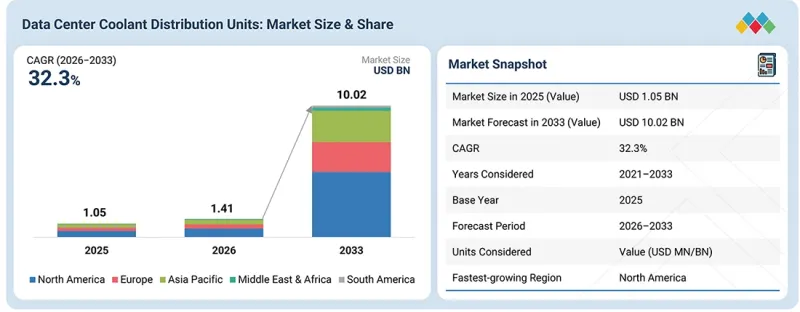
全球資料中心冷卻液分配設備市場預計將從 2026 年的 14.1 億美元成長到 2033 年的 100.2 億美元,預測期內複合年成長率為 32.3%。
| 調查範圍 | |
|---|---|
| 調查期 | 2021-2033 |
| 基準年 | 2025 |
| 預測期 | 2026-2033 |
| 計算單位 | 金額(百萬/十億美元) |
| 部分 | 類型、冷卻方式、製程、容量、資料中心類型、最終用戶和區域 |
| 目標區域 | 亞太地區、歐洲、北美、中東和非洲、南美 |
冷卻液分配器是液冷系統中的關鍵組件,它透過連接設施級冷卻基礎設施和IT設備,有效地從源頭去除熱量。它們支援精準冷卻、提高機架密度並最佳化能源利用,使其成為下一代資料中心的首選解決方案。因此,全球冷卻液分配器市場在超大規模、託管、企業級和邊緣運算等領域正經歷快速成長。
“預計在預測期內,FDU(燃料分配單元)細分市場將實現最高的複合年成長率。”
預計在預測期內,落地式配電單元 (FDU) 細分市場將以最高的複合年成長率成長,這主要得益於超大規模和企業級資料中心高密度機架部署的不斷增加。 FDU 具有高冷卻能力、擴充性以及處理大規模IT 負載的能力,使其成為處理人工智慧、高效能運算和雲端密集型工作負載的設施的理想選擇。 FDU 旨在與設施級冷凍水系統緊密配合,從而實現精準可靠的散熱。北美、歐洲和亞太地區資料中心的大規模投資,以及向節能環保永續冷卻解決方案的轉變,正在推動 FDU 的普及。
“預計在預測期內,晶片直接冷卻細分市場將實現最高的複合年成長率。”
預計在預測期內,晶片級直接冷卻 (DTC) 細分市場將以最高的複合年成長率成長,這主要得益於其能夠直接從用於人工智慧工作負載、高效能運算 (HPC) 和高級雲端運算環境的高效能處理器和 GPU 中移除熱量。 DTC 解決方案在源溫度控管優於傳統的空氣冷卻,從而提升了高密度機架和整個系統的性能。該細分市場的成長主要受人工智慧資料中心、大規模HPC 部署和企業數位轉型計畫的推動。隨著超大規模資料中心和託管服務供應商對液冷基礎設施的大力投資,北美、歐洲和亞太等地區的部署正在加速。 DTC 冷卻技術符合全球永續性和能源效率目標。除了降低能耗外,DTC 冷卻還能提高運作可靠性,使其成為新一代資料中心最熱門的冷卻技術之一。
“預計在預測期內,超大規模資料中心將實現最高的複合年成長率。”
受人工智慧、高效能運算和巨量資料應用快速發展以及全球雲端服務供應商的大量投資推動,超大規模資料中心領域預計將在預測期內實現最高的複合年成長率。由於超大規模資料中心運作在高機架密度和高電力需求下,傳統的空氣冷卻方式已無法滿足需求。因此,超大規模資料中心營運商正在部署更多的冷卻液分配單元 (CDU),以實現高效的液冷、最佳化能源利用並確保數千台伺服器的可靠溫度控管。北美、歐洲和亞太地區在部署方面處於領先,營運商希望在實現永續性目標的同時擴大規模。冷卻液分配單元正成為下一代超大規模資料中心的關鍵技術,能夠提高散熱效率並降低營運成本。
“預計在預測期內,北美將佔據最大的市場佔有率。”
預計在預測期內,北美將佔據資料中心冷卻液分銷市場最大的佔有率,這主要得益於其成熟的超大規模、託管和企業級資料中心生態系統。美國是雲端運算和人工智慧驅動型基礎設施的領先市場,也是Google、微軟、亞馬遜和Meta等主要液冷公司的總部所在地。這些公司正大力投資液冷技術的研發和部署,以滿足對機架密度和能源效率要求更高的應用需求。此外,監管機構對永續性和碳減排的高度重視,以及先進冷卻技術的普及和完善的基礎設施,進一步鞏固了北美在該市場的地位。憑藉強勁的投資趨勢、產業的快速數字轉型以及對下一代液冷技術的早期應用,北美必將在整個預測期內繼續引領資料中心冷卻液分銷市場。
本報告主要參與公司名單如下:
- 按公司類型分類:一級供應商 - 45%,二級供應商 - 22%,三級供應商 - 33%
- 依職位等級分類:C級主管 -50%,總監級主管 -10%,其他 -40%
- 區域細分:北美 -17%,歐洲 -33%,亞太地區 -17%,南美 -25%,中東和非洲 -8%
資料中心冷卻液分配設備市場的主要參與者正在採用新產品發布、收購、合作和業務擴張等策略來提高市場佔有率和收入。
調查範圍
本報告根據類型、冷卻方式、最終用戶和地區,對資料中心冷卻液分配設備市場進行定義、細分和估算。報告建立了主要參與者的策略概況,並深入分析了他們的市場佔有率和核心競爭優勢。此外,報告還監測和檢驗了市場競爭趨勢,包括新產品開發、聯盟、夥伴關係、收購和業務擴張。
購買本報告的理由
本報告旨在透過提供資料中心冷卻液分配系統及其各細分市場的精確銷售預測,為市場領導者和新參與企業提供支援。報告力求幫助相關人員了解競爭格局,取得洞察以鞏固業務基礎,並制定有效的打入市場策略。此外,報告還幫助相關人員了解市場趨勢,並提供有關關鍵促進因素、限制因素、挑戰和機會的資訊。
本報告深入分析了以下幾點:
- 影響資料中心冷卻劑分配系統發展的關鍵促進因素(高密度人工智慧和高效能運算工作負載的增加)、阻礙因素(高額資本投資)、機會(基於人工智慧的冷卻控制和預測最佳化)以及挑戰(精確控制和流量管理的複雜性)分析。
- 產品開發/創新:深入了解資料中心冷卻劑分配單元的未來技術趨勢和研發活動。
- 市場趨勢:盈利市場的全面資訊-本報告分析了各個地區資料中心的冷卻劑分配裝置。
- 市場多元化:提供關於資料中心冷卻劑分配系統的新產品、各種類型、未開發的市場、最新趨勢和投資的全面資訊。
- 競爭格局分析:對資料中心冷卻液分配設備市場主要參與者的市場佔有率、成長策略和產品線進行全面分析。
目錄
第1章:引言
第2章執行摘要
第3章重要考察
- 資料中心冷卻液分配設備市場為營運商提供了極具吸引力的機會。
- 資料中心冷卻液經銷商市場:按類型分類
- 資料中心冷卻液分配設備市場:依冷卻方式分類
- 資料中心冷卻液經銷商市場:依最終用途分類
- 資料中心冷卻液經銷商市場:按地區分類
- 資料中心冷卻液經銷商市場:按國家/地區分類
第4章 市場概覽
- 市場動態
- 促進因素
- 抑制因子
- 機會
- 任務
- 未滿足的需求和未開發的領域
- 資料中心冷卻劑分配設備市場尚未滿足的需求
- 未開發市場中的機遇
- 相互關聯的市場與跨產業機遇
- 相互關聯的市場
- 跨產業機遇
- 新的經營模式與生態系轉型
- 新經營模式
- 生態系的轉變
- 1/2/3級玩家的策略舉措
- 主要進展和戰略重點
第5章 產業趨勢
- 波特五力分析
- 新進入者的威脅
- 替代品的威脅
- 買方的議價能力
- 供應商的議價能力
- 競爭公司之間的競爭強度
- 全球宏觀經濟展望
- GDP
- 資料中心產業
- 製造業
- 超大規模和人工智慧資料中心產業的全球趨勢
- 價值鏈分析
- 生態系分析
- 2026-2027 年主要會議和活動
- 影響客戶業務的趨勢和顛覆性因素
- 投資和資金籌措場景
- 案例研究分析
- 冷卻劑分配設計對資料中心伺服器級溫度控管的影響。
- 資料中心內用於晶片直接冷卻的液冷-空冷分配單元的試運行。
第6章:技術進步、人工智慧的影響、專利、創新與未來應用
- 主要技術
- 直接冷卻(D2C)
- 兩相液冷
- 相關技術
- 浸沒式冷卻系統
- 後門熱交換器(RDHX)
- 互補技術
- 熱界面材料(TIMS)
- 專利分析
- 調查方法
- 未來應用
- AI 驅動的預測性 CDU 控制:一種機器學習控制系統,利用冷卻液供應/回流溫度、流量和壓力差的即時偵測值,動態調節泵速和閥門位置。
- 模組化和可擴展的 CDU 架構:滑座式、機架式和低位 CDU 單元,具有標準化的管道、電源和通訊介面。
- 液液式和液氣混合式CDU:基於熱交換器的CDU將設施水循環與技術冷卻循環隔離。液氣式CDU也允許對現有的風冷資料孔進行改造,實現晶片直接冷卻。
- 冗餘和熱彈性系統:泵浦、熱交換器和緩衝槽採用 N+1 和 2N 冗餘配置。自動容錯移轉功能即使在斷電、幫浦故障或負載激增的情況下也能維持冷卻液流量,確保關鍵人工智慧工作負載的持續冷卻。
- 浸沒式和高密度機架冷卻:我們的 CDU(冷卻分配單元)專為直接到晶片和單相/雙相浸沒系統而設計,可高效地向超過 100 kW 的 GPU 機架輸送精確控制的冷卻劑,用於 AI 訓練和 HPC 集群。
- 人工智慧對資料中心冷卻液分配設備市場的影響
- 主要應用場景和市場潛力
- 最佳實務:企業與機構中的應用案例
- 資料中心冷卻劑分配單元市場案例研究
- 相互關聯的相鄰生態系及其對市場參與者的影響
- 客戶對資料中心冷卻液分配設備市場引進新一代人工智慧的準備。
第7章永續性和監管情勢
- 監管機構、政府機構和其他組織
- 業界標準
- 永續發展計劃
- 資料中心冷卻液分配系統的碳排放影響及環保應用
- 對永續性和監管政策措施的影響
- 認證、標籤和環境標準
第8章:顧客趨勢與購買行為
- 決策流程
- 主要相關人員和採購標準
- 採購過程中的關鍵相關人員
- 購買標準
- 實施障礙和內部挑戰
- 各個資料中心尚未滿足的需求
- 市場盈利
- 獲利潛力
- 成本趨勢
- 透過主要應用提高利潤率的機會
第9章:資料中心冷卻液經銷商市場:按類型分類
- 嵌入式冷卻液分配單元
- 機架內部冷卻液分配單元
- 設施配送單元
第10章:資料中心冷卻液分配設備市場:依冷卻方式分類
- 直接冷卻至尖端
- 浸沒式冷卻
第11章:資料中心冷卻液分配設備市場:依最終用途分類
- 託管服務提供者
- 企業資料中心
- 超大規模資料中心
第12章:資料中心冷卻液分配設備市場:依製程分類
- 液-液冷卻劑分配單元
- 液氣冷卻劑分配裝置
第13章:資料中心冷卻液經銷商市場:依容量分類
- 小規模冷卻劑分配裝置
- 中型冷卻劑分配裝置
- 大型冷卻劑分配裝置
第14章:資料中心冷卻液經銷商市場:依資料中心類型分類
- 小規模資料中心
- 大型資料中心
第15章:資料中心冷卻液分配設備市場:依地區分類
- 北美洲
- 對人工智慧驅動的資料中心和高密度運算的投資增加,正在推動市場成長。
- 美國
- 加拿大
- 墨西哥
- 亞太地區
- 中國
- 韓國
- 日本
- 印度
- 馬來西亞
- 新加坡
- 澳洲
- 亞太其他地區
- 歐洲
- 德國
- 英國
- 法國
- 義大利
- 西班牙
- 其他歐洲國家
- 中東和非洲
- 海灣合作理事會國家
- 南非
- 其他中東和非洲地區
- 南美洲
- 巴西
- 南美洲其他地區
第16章 競爭格局
- 主要參與企業的策略/優勢
- 收入分析
- 市佔率分析(2025 年)
- 市佔率分析
- 主要市場參與者排名(2025 年)
- 企業估值和財務指標
- 品牌/產品對比
- 企業估值矩陣:主要公司,2025 年
- 明星公司
- 新興領導者
- 業務範圍廣泛的公司
- 參與企業
- 企業企業發展:主要公司,2025 年
- 公司估值矩陣:新創企業/中小企業,2025 年
- 先進公司
- 應對力的公司
- 充滿活力的公司
- 起始點
- 競爭標竿分析:新創企業/中小企業,2025 年
- 競爭格局
- 產品發布
- 交易
- 業務拓展
第17章:公司簡介
- 大公司
- DCX LIQUID COOLING SYSTEMS
- NVENT
- SCHNEIDER ELECTRIC
- VERTIV GROUP CORP.
- DELTA ELECTRONICS, INC.
- NIDEC CORPORATION
- KAORI HEAT TREATMENT CO., LTD.
- SHENZHEN ENVICOOL TECHNOLOGY CO., LTD.
- EATON
- COOLCENTRIC
- HEWLETT PACKARD ENTERPRISE DEVELOPMENT LP
- SHANGHAI VENTTECH REFRIGERATION EQUIPMENT CO., LTD.
- DAIKIN INDUSTRIES LTD.
- COOLIT SYSTEMS(ECOLAB)
- MUNTERS GROUP AB
- TRANE
- SUPER MICRO COMPUTER, INC.
- LENOVO
- STULZ GMBH
- RITTAL GMBH &CO. KG
- LITEON TECHNOLOGY CORPORATION
- SAMSUNG ELECTRONICS
- NAUTILUS DATA TECHNOLOGIES
- FLEX LTD.
- MODINE
- 其他主要公司
- NORTEK AIR SOLUTIONS, LLC
- ENVIRONMENTAL AIR SYSTEMS
- LFB GROUP
- EXCOOL LTD.
- ATTOM TECHNOLOGY
- LNEYA THERMO REFRIGERATION CO., LTD.
- CANATEC PTE LTD.
第18章:調查方法
第19章附錄
The global data center coolant distribution units market is projected to grow from USD 1.41 billion in 2026 to USD 10.02 billion by 2033, at a CAGR of 32.3% during the forecast period.
| Scope of the Report | |
|---|---|
| Years Considered for the Study | 2021-2033 |
| Base Year | 2025 |
| Forecast Period | 2026-2033 |
| Units Considered | Value (USD Million/Billion) |
| Segments | Type, Cooling Type, Process, Capacity, Data Center Type, End User, and Region |
| Regions covered | Asia Pacific, Europe, North America, the Middle East & Africa, and South America |
Coolant distribution units act as an important component in liquid cooling systems, connecting the facility-level cooling infrastructure with the IT equipment to efficiently remove heat at the source. They support the delivery of precision cooling, higher rack densities, and optimized energy use. This makes them a preferred solution in next-generation data centers. Consequently, this fuels the rapid growth of the global coolant distribution units market in hyperscale, colocation, enterprise, and edge facilities.
"FDU segment to register highest CAGR during the forecast period"
The Floor-Mounted Distribution Unit (FDU) segment is expected to grow at the fastest CAGR during the forecast period due to increasing deployments of high-density racks in hyperscale and enterprise data centers. FDUs offer high cooling capacity, scalability, and the ability to support large IT loads, making them ideal for facilities that perform AI, HPC, and cloud-intensive workloads. They are designed to connect closely with facility-level chilled water systems, making them well-suited for precise, reliable heat removal. Large investments in data centers across North America, Europe, and Asia Pacific, combined with a shift toward energy-efficient and sustainable cooling solutions, have driven the adoption of FDUs.
"Direct-to-Chip Cooling segment to record highest CAGR during the forecast period"
The direct-to-chip cooling segment is projected to grow at the highest CAGR during the forecast period, driven by its ability to remove heat directly from high-performance processors and GPUs used in AI workloads, HPC, and advanced cloud computing setups. The efficiency of direct-to-chip cooling solutions surpasses traditional air cooling for thermal management at the source, supporting higher-density racks and overall system performance. The growth of this segment is largely due to the rise of AI-powered data centers, large-scale HPC deployments, and digital transformation initiatives by enterprises. Regions such as North America, Europe, and Asia-Pacific are further boosting adoption, with hyperscale and colocation providers investing heavily in liquid-cooling infrastructure. Direct-to-chip cooling technologies align with global sustainability and energy-efficiency goals. Besides reducing power consumption, DTC cooling improves operational reliability, making it one of the most in-demand cooling technologies in next-generation data centers.
"Hyperscale data centers to record highest CAGR during the forecast period"
The hyperscale data center segment is expected to grow at the highest CAGR during the forecast period, driven by rapid expansion in AI, HPC, big data applications, and significant investments from global cloud providers. Traditional air-cooling methods are proving inadequate as hyperscale data centers operate with high rack densities and power demands. As a result, hyperscale operators are adopting more coolant distribution units to enable efficient liquid cooling, optimize energy use, and ensure reliable heat management for thousands of servers. Regions such as North America, Europe, and Asia-Pacific are leading the way in adoption, as operators aim to scale up while meeting sustainability goals. Coolant distribution units are becoming a crucial technology for next-generation hyperscale data centers, improving thermal efficiency and lowering operating costs.
"North America to account for maximum market share during the forecast period"
North America is expected to hold the largest share of the data center coolant distribution units market during the forecast period, mainly because of its well-established ecosystem of hyperscale, colocation, and enterprise data centers. The US is a top market for cloud adoption and AI-driven infrastructure and hosts major liquid-cooling companies such as Google, Microsoft, Amazon, and Meta, which invest heavily in developing and adopting liquid-cooling technologies for applications requiring higher rack densities and energy efficiency. Additionally, the strong regulatory focus on sustainability and carbon reduction, along with the availability of advanced cooling technologies and robust infrastructure, further strengthens North America's position in this market. Favorable investment trends, rapid sector digitalization, and early adoption of next-generation liquid-cooling technology ensure North America will continue to dominate the data center coolant distribution units market throughout the forecast period.
Profile breakdown of primary participants for the report:
- By Company Type: Tier 1 - 45%, Tier 2 - 22%, and Tier 3 - 33%
- By Designation: C-level - 50%, Director Level - 10%, and Others - 40%
- By Region: North America - 17%, Europe - 33%, Asia Pacific - 17%, South America - 25%, and Middle East & Africa - 8%
Schneider Electric (France), Vertiv Group Corp. (US), Delta Electronics, Inc. (Taiwan), nVent (US), and DCX Liquid Cooling Systems (Poland) are major players in the data center coolant distribution units market. These companies have adopted strategies such as product launches, acquisitions, collaborations, and expansion to grow their market share and revenue.
Research Coverage
The report defines, segments, and estimates the size of the data center coolant distribution units market based on type, cooling type, end user, and region. It strategically profiles key players and thoroughly analyzes their market share and core competencies. It also monitors and examines competitive developments, such as new product development, collaborations, partnerships, acquisitions, and expansions undertaken in the market.
Reasons to Buy the Report
The report is intended to help both market leaders and new entrants by providing close estimates of revenue figures for the data center coolant distribution units and their segments. It aims to help stakeholders understand the market's competitive landscape, gain insights to strengthen their business positions, and develop effective go-to-market strategies. It also helps stakeholders understand market trends and provides information on key drivers, restraints, challenges, and opportunities.
The report provides insights into the following points:
- Analysis of critical drivers (Growth of high-density AI & HPC workloads), restraints (High capital investments), opportunities (AI-based cooling control and predictive optimization), and challenges (precision control and flow management complexity) influencing the growth of the data center coolant distribution units.
- Product Development/Innovation: Detailed insights into upcoming technologies, research & development activities in the data center coolant distribution units.
- Market Development: Comprehensive information about lucrative markets - the report analyzes the data center coolant distribution units across varied regions.
- Market Diversification: Exhaustive information about new products, various types, untapped geographies, recent developments, and investments in the data center coolant distribution units.
- Competitive Assessment: Comprehensive analysis of market shares, growth strategies, and product offerings of leading companies such as Schneider Electric (France), Vertiv Group Corp. (US), Delta Electronics, Inc. (Taiwan), nVent (US), and DCX Liquid Cooling Systems (Poland) in the data center coolant distribution units.
TABLE OF CONTENTS
1 INTRODUCTION
- 1.1 STUDY OBJECTIVES
- 1.2 MARKET DEFINITION
- 1.3 STUDY SCOPE
- 1.3.1 MARKETS COVERED AND REGIONAL SCOPE
- 1.3.2 INCLUSIONS & EXCLUSIONS
- 1.3.3 YEARS CONSIDERED
- 1.3.4 CURRENCY CONSIDERED
- 1.4 LIMITATIONS
- 1.5 STAKEHOLDERS
- 1.6 SUMMARY OF CHANGES
2 EXECUTIVE SUMMARY
- 2.1 KEY INSIGHTS AND MARKET HIGHLIGHTS
- 2.2 KEY MARKET PARTICIPANTS: SHARE INSIGHTS AND STRATEGIC DEVELOPMENTS
- 2.3 DISRUPTIVE TRENDS IN DATA CENTER COOLANT DISTRIBUTION UNITS MARKET
- 2.4 HIGH-GROWTH SEGMENTS
- 2.5 REGIONAL SNAPSHOT: MARKET SIZE, GROWTH RATE, AND FORECAST
3 PREMIUM INSIGHTS
- 3.1 ATTRACTIVE OPPORTUNITIES FOR PLAYERS IN DATA CENTER COOLANT DISTRIBUTION UNITS MARKET
- 3.2 DATA CENTER COOLANT DISTRIBUTION UNITS MARKET, BY TYPE
- 3.3 DATA CENTER COOLANT DISTRIBUTION UNITS MARKET, BY COOLING TYPE
- 3.4 DATA CENTER COOLANT DISTRIBUTION UNITS MARKET, BY END-USE
- 3.5 DATA CENTER COOLANT DISTRIBUTION UNITS MARKET, BY REGION
- 3.6 DATA CENTER COOLANT DISTRIBUTION UNITS MARKET, BY COUNTRY
4 MARKET OVERVIEW
- 4.1 MARKET DYNAMICS
- 4.1.1 DRIVERS
- 4.1.1.1 Growth of high-density AI & HPC workloads
- 4.1.1.2 Demand for modular and edge data centers
- 4.1.1.3 Sustainability and energy efficiency mandates
- 4.1.2 RESTRAINTS
- 4.1.2.1 High capital investment
- 4.1.2.2 Incompatibility with legacy data center infrastructure
- 4.1.3 OPPORTUNITIES
- 4.1.3.1 Integration with waste heat recovery systems
- 4.1.3.2 Innovation in nanofluids and next-generation coolants
- 4.1.3.3 AI-based cooling control and predictive optimization
- 4.1.4 CHALLENGES
- 4.1.4.1 Precision control and flow management complexity
- 4.1.4.2 Integration with diverse cooling architectures
- 4.1.1 DRIVERS
- 4.2 UNMET NEEDS AND WHITE SPACES
- 4.2.1 UNMET NEEDS IN DATA CENTER COOLANT DISTRIBUTION UNITS MARKET
- 4.2.2 WHITE SPACE OPPORTUNITIES
- 4.3 INTERCONNECTED MARKETS AND CROSS-SECTOR OPPORTUNITIES
- 4.3.1 INTERCONNECTED MARKETS
- 4.3.2 CROSS-SECTOR OPPORTUNITIES
- 4.4 EMERGING BUSINESS MODELS AND ECOSYSTEM SHIFTS
- 4.4.1 EMERGING BUSINESS MODELS
- 4.4.2 ECOSYSTEM SHIFTS
- 4.5 STRATEGIC MOVES BY TIER-1/2/3 PLAYERS
- 4.5.1 KEY MOVES AND STRATEGIC FOCUS
5 INDUSTRY TRENDS
- 5.1 PORTER'S FIVE FORCES ANALYSIS
- 5.1.1 THREAT OF NEW ENTRANTS
- 5.1.2 THREAT OF SUBSTITUTES
- 5.1.3 BARGAINING POWER OF BUYERS
- 5.1.4 BARGAINING POWER OF SUPPLIERS
- 5.1.5 INTENSITY OF COMPETITIVE RIVALRY
- 5.2 GLOBAL MACROECONOMIC OUTLOOK
- 5.2.1 GDP
- 5.2.2 DATA CENTER INDUSTRY
- 5.2.3 MANUFACTURING INDUSTRY
- 5.2.4 TRENDS IN GLOBAL HYPERSCALE AND AI DATA CENTER INDUSTRY
- 5.3 VALUE CHAIN ANALYSIS
- 5.4 ECOSYSTEM ANALYSIS
- 5.5 KEY CONFERENCES & EVENTS IN 2026-2027
- 5.6 TRENDS/DISRUPTIONS IMPACTING CUSTOMERS' BUSINESSES
- 5.7 INVESTMENT AND FUNDING SCENARIOS
- 5.8 CASE STUDY ANALYSIS
- 5.8.1 IMPACT OF COOLANT DISTRIBUTION DESIGN ON SERVER-LEVEL THERMAL MANAGEMENT IN DATA CENTERS
- 5.8.1.1 Objective
- 5.8.1.2 Solution Statement
- 5.8.2 COMMISSIONING OF LIQUID-TO-AIR COOLANT DISTRIBUTION UNITS FOR DIRECT-TO-CHIP DATA CENTER COOLING
- 5.8.2.1 Objective
- 5.8.2.2 Solution Statement
- 5.8.1 IMPACT OF COOLANT DISTRIBUTION DESIGN ON SERVER-LEVEL THERMAL MANAGEMENT IN DATA CENTERS
6 TECHNOLOGICAL ADVANCEMENTS, AI-DRIVEN IMPACT, PATENTS, INNOVATIONS, AND FUTURE APPLICATIONS
- 6.1 KEY TECHNOLOGIES
- 6.1.1 DIRECT-TO-CHIP COOLING (D2C)
- 6.1.2 TWO-PHASE LIQUID COOLING
- 6.2 ADJACENT TECHNOLOGY
- 6.2.1 IMMERSION COOLING SYSTEMS
- 6.2.2 REAR DOOR HEAT EXCHANGERS (RDHX)
- 6.3 COMPLEMENTARY TECHNOLOGY
- 6.3.1 THERMAL INTERFACE MATERIALS (TIMS)
- 6.4 PATENT ANALYSIS
- 6.4.1 METHODOLOGY
- 6.5 FUTURE APPLICATIONS
- 6.5.1 AI-DRIVEN PREDICTIVE CDU CONTROL: MACHINE-LEARNING CONTROL SYSTEMS THAT USE REAL-TIME COOLANT SUPPLY/RETURN TEMPERATURE, FLOW, AND DIFFERENTIAL-PRESSURE SENSING TO DYNAMICALLY ADJUST PUMP SPEED AND VALVE POSITION
- 6.5.2 MODULAR & SCALABLE CDU ARCHITECTURES: SKID-MOUNTED, RACK-LEVEL, AND ROW-LEVEL CDU UNITS WITH STANDARDIZED PIPING, POWER, AND COMMUNICATION INTERFACES
- 6.5.3 LIQUID-TO-LIQUID & HYBRID LIQUID-TO-AIR CDUS: HEAT-EXCHANGER-BASED CDUS THAT ISOLATE THE FACILITY WATER LOOP FROM THE TECHNOLOGY COOLING LOOP, WITH LIQUID-TO-AIR VARIANTS ENABLING RETROFIT OF DIRECT-TO-CHIP COOLING IN EXISTING AIR-COOLED DATA HALLS
- 6.5.4 REDUNDANCY & THERMAL RESILIENCE SYSTEMS: N+1 AND 2N REDUNDANT PUMPS, HEAT EXCHANGERS, AND BUFFER TANKS WITH AUTOMATIC FAILOVER THAT MAINTAIN COOLANT FLOW DURING POWER OUTAGES, PUMP FAILURES, OR LOAD SPIKES, ENSURING CONTINUOUS COOLING FOR MISSION-CRITICAL AI WORKLOADS
- 6.5.5 IMMERSION & HIGH-DENSITY RACK COOLING: CDUS ENGINEERED FOR DIRECT-TO-CHIP AND SINGLE/TWO-PHASE IMMERSION SYSTEMS, DELIVERING PRECISELY CONTROLLED COOLANT TO 100 KW+ GPU RACKS FOR AI TRAINING AND HPC CLUSTERS EFFICIENTLY
- 6.6 IMPACT OF AI ON DATA CENTER COOLANT DISTRIBUTION UNITS MARKET
- 6.6.1 TOP USE CASES AND MARKET POTENTIAL
- 6.6.2 BEST PRACTICES: COMPANIES/INSTITUTIONS USE CASES
- 6.6.3 CASE STUDIES OF DATA CENTER COOLANT DISTRIBUTION UNITS MARKET
- 6.6.4 INTERCONNECTED ADJACENT ECOSYSTEM AND IMPACT ON MARKET PLAYERS
- 6.6.5 CLIENTS' READINESS TO ADOPT GENERATIVE AI IN DATA CENTER COOLANT DISTRIBUTION UNITS MARKET
- 6.6.5.1 CoolIT Systems: How GWDG Leverages CoolIT's DLC to Meet High-Performance Computing Demands, Germany
- 6.6.5.2 DCX: Liquid Cooling Reinvented, Poland
7 SUSTAINABILITY AND REGULATORY LANDSCAPE
- 7.1 REGULATORY BODIES, GOVERNMENT AGENCIES, AND OTHER ORGANIZATIONS
- 7.1.1 INDUSTRY STANDARDS
- 7.2 SUSTAINABILITY INITIATIVES
- 7.2.1 CARBON IMPACT AND ECO APPLICATIONS OF DATA CENTER COOLANT DISTRIBUTION UNITS
- 7.3 SUSTAINABILITY IMPACT AND REGULATORY POLICY INITIATIVES
- 7.4 CERTIFICATIONS, LABELING, AND ECO STANDARDS
8 CUSTOMER LANDSCAPE & BUYER BEHAVIOR
- 8.1 DECISION-MAKING PROCESS
- 8.2 KEY STAKEHOLDERS AND BUYING CRITERIA
- 8.2.1 KEY STAKEHOLDERS IN BUYING PROCESS
- 8.2.2 BUYING CRITERIA
- 8.3 ADOPTION BARRIERS & INTERNAL CHALLENGES
- 8.4 UNMET NEEDS IN VARIOUS DATA CENTER TYPES
- 8.5 MARKET PROFITABILITY
- 8.5.1 REVENUE POTENTIAL
- 8.5.2 COST DYNAMICS
- 8.5.3 MARGIN OPPORTUNITIES, BY KEY END-USES
9 DATA CENTER COOLANT DISTRIBUTION UNITS MARKET, BY TYPE
- 9.1 INTRODUCTION
- 9.2 IN-ROW COOLANT DISTRIBUTION UNITS
- 9.2.1 SPACE-SAVING COOLING SOLUTION WITH TARGETED EFFICIENCY TO SUPPORT HIGH-DENSITY DATA CENTER GROWTH
- 9.3 IN-RACK COOLANT DISTRIBUTION UNITS
- 9.3.1 RACK-INTEGRATED COOLING FOR PRECISION FLOW CONTROL IN HIGH- DENSITY DATA CENTERS
- 9.4 FACILITY DISTRIBUTION UNITS
- 9.4.1 HIGH-CAPACITY COOLING INFRASTRUCTURE FOR FACILITY-WIDE LIQUID-COOLED DATA CENTERS
10 DATA CENTER COOLANT DISTRIBUTION UNITS MARKET, BY COOLING TYPE
- 10.1 INTRODUCTION
- 10.2 DIRECT-TO-CHIP COOLING
- 10.2.1 COMPACT COOLING ARCHITECTURE ACCELERATES INTEGRATION IN HIGH-DENSITY RACKS
- 10.3 IMMERSION COOLING
- 10.3.1 ACCELERATING DEPLOYMENT IN HIGH-DENSITY COMPUTE ENVIRONMENTS TO DRIVE MARKET
11 DATA CENTER COOLANT DISTRIBUTION UNITS MARKET, BY END-USE
- 11.1 INTRODUCTION
- 11.2 COLOCATION PROVIDERS
- 11.2.1 ENABLES FLEXIBLE COOLING FOR MULTI-TENANT HIGH-DENSITY ENVIRONMENTS
- 11.3 ENTERPRISE DATA CENTERS
- 11.3.1 TRANSITION TO HYBRID COOLING ACCELERATING ADOPTION
- 11.4 HYPERSCALE DATA CENTERS
- 11.4.1 IMMERSION AND DIRECT-TO-CHIP ARCHITECTURES ACCELERATING DEMAND
12 DATA CENTER COOLANT DISTRIBUTION UNITS MARKET, BY PROCESS
- 12.1 INTRODUCTION
- 12.2 LIQUID-TO-LIQUID COOLANT DISTRIBUTION UNITS
- 12.2.1 RISING ADOPTION OF IMMERSION AND DIRECT LIQUID COOLING TECHNOLOGIES TO DRIVE DEMAND
- 12.3 LIQUID-TO-AIR COOLANT DISTRIBUTION UNITS
- 12.3.1 INCREASING NEED FOR FLEXIBLE AND MODULAR COOLING IN EDGE COMPUTING AND COLOCATION FACILITIES TO DRIVE GROWTH
13 DATA CENTER COOLANT DISTRIBUTION UNITS MARKET, BY CAPACITY
- 13.1 INTRODUCTION
- 13.2 SMALL-SCALE COOLANT DISTRIBUTION UNITS
- 13.2.1 RISE OF EDGE COMPUTING AND IOT EXPANSION TO DRIVE MARKET
- 13.3 MEDIUM-SCALE COOLANT DISTRIBUTION UNITS
- 13.3.1 RISING ADOPTION OF HYBRID IT AND CLOUD-FIRST STRATEGIES TO FUEL MARKET GROWTH
- 13.4 LARGE-SCALE COOLANT DISTRIBUTION UNITS
- 13.4.1 INCREASING DEMAND FOR AI PROCESSING, CLOUD EXPANSION, AND HPC WORKLOADS SUPPORTING MARKET GROWTH
14 DATA CENTER COOLANT DISTRIBUTION UNITS MARKET, BY DATA CENTER TYPE
- 14.1 INTRODUCTION
- 14.2 SMALL & MID-SIZED DATA CENTERS
- 14.2.1 INCREASING ADOPTION OF EDGE DATA CENTERS, CLOUD SERVICES BY SMES, AND RISING DEPLOYMENT OF MODULAR DATA CENTERS TO DRIVE DEMAND
- 14.3 LARGE DATA CENTERS
- 14.3.1 GROWTH OF HYPERSCALE CLOUD PROVIDERS, AI-DRIVEN WORKLOADS, AND 5G NETWORK EXPANSIONS DRIVING GROWTH
15 DATA CENTER COOLANT DISTRIBUTION UNITS MARKET, BY REGION
- 15.1 INTRODUCTION
- 15.2 NORTH AMERICA
- 15.2.1 RISING AI-DRIVEN DATA CENTER INVESTMENTS AND HIGH-DENSITY COMPUTING TO DRIVE MARKET GROWTH
- 15.2.2 US
- 15.2.2.1 AI infrastructure and sustainability mandates driving growth
- 15.2.3 CANADA
- 15.2.3.1 Sustainability policies and modern data center design to drive market
- 15.2.4 MEXICO
- 15.2.4.1 Rising infrastructure demands and policy initiatives propelling market
- 15.3 ASIA PACIFIC
- 15.3.1 CHINA
- 15.3.1.1 Policy pressure and infrastructure demands driving market
- 15.3.2 SOUTH KOREA
- 15.3.2.1 Digital infrastructure growth and green policies to propel market
- 15.3.3 JAPAN
- 15.3.3.1 Urban space constraints and rising demand for high-power servers to drive growth
- 15.3.4 INDIA
- 15.3.4.1 Power constraints and digital growth accelerating market expansion
- 15.3.5 MALAYSIA
- 15.3.5.1 Digital economy growth and government initiatives to support market growth
- 15.3.6 SINGAPORE
- 15.3.6.1 Strategic policy and land constraints accelerating coolant distribution unit adoption
- 15.3.7 AUSTRALIA
- 15.3.7.1 Need for addressing energy and climate challenges to support market growth
- 15.3.8 REST OF ASIA PACIFIC
- 15.3.1 CHINA
- 15.4 EUROPE
- 15.4.1 GERMANY
- 15.4.1.1 Stringent regulations and high energy costs to accelerate adoption
- 15.4.2 UK
- 15.4.2.1 Digital infrastructure growth and green policies to propel market
- 15.4.3 FRANCE
- 15.4.3.1 Thermal regulation policies and low-carbon infrastructure regulations driving market
- 15.4.4 ITALY
- 15.4.4.1 Smart energy policies and development of new data centers to drive market
- 15.4.5 SPAIN
- 15.4.5.1 Digital expansion and climate goals supporting market growth
- 15.4.6 REST OF EUROPE
- 15.4.1 GERMANY
- 15.5 MIDDLE EAST & AFRICA
- 15.5.1 GCC COUNTRIES
- 15.5.1.1 Saudi Arabia
- 15.5.1.1.1 Mega projects and digital transformation fueling growth
- 15.5.1.2 Rest of GCC countries
- 15.5.1.1 Saudi Arabia
- 15.5.2 SOUTH AFRICA
- 15.5.2.1 Data center expansions accelerating market growth
- 15.5.3 REST OF MIDDLE EAST & AFRICA
- 15.5.1 GCC COUNTRIES
- 15.6 SOUTH AMERICA
- 15.6.1 BRAZIL
- 15.6.1.1 Data center growth and green innovation driving market
- 15.6.2 REST OF SOUTH AMERICA
- 15.6.1 BRAZIL
16 COMPETITIVE LANDSCAPE
- 16.1 INTRODUCTION
- 16.2 KEY PLAYERS' STRATEGIES/RIGHT TO WIN
- 16.3 REVENUE ANALYSIS
- 16.4 MARKET SHARE ANALYSIS, 2025
- 16.4.1 MARKET SHARE ANALYSIS
- 16.4.2 RANKING OF KEY MARKET PLAYERS, 2025
- 16.5 COMPANY VALUATION AND FINANCIAL METRICS
- 16.6 BRAND/PRODUCT COMPARISON
- 16.7 COMPANY EVALUATION MATRIX: KEY PLAYERS, 2025
- 16.7.1 STARS
- 16.7.2 EMERGING LEADERS
- 16.7.3 PERVASIVE PLAYERS
- 16.7.4 PARTICIPANTS
- 16.7.5 COMPANY FOOTPRINT: KEY PLAYERS, 2025
- 16.7.5.1 Company footprint
- 16.7.5.2 Region footprint
- 16.7.5.3 Type footprint
- 16.7.5.4 Data center type footprint
- 16.7.5.5 Cooling type footprint
- 16.7.5.6 End-use footprint
- 16.8 COMPANY EVALUATION MATRIX: STARTUPS/SMES, 2025
- 16.8.1 PROGRESSIVE COMPANIES
- 16.8.2 RESPONSIVE COMPANIES
- 16.8.3 DYNAMIC COMPANIES
- 16.8.4 STARTING BLOCKS
- 16.8.5 COMPETITIVE BENCHMARKING: STARTUPS/SMES, 2025
- 16.8.5.1 Detailed list of key startups/SMES
- 16.8.5.2 Competitive benchmarking of key startups/SMEs
- 16.9 COMPETITIVE SCENARIO
- 16.9.1 PRODUCT LAUNCHES
- 16.9.2 DEALS
- 16.9.3 EXPANSIONS
17 COMPANY PROFILES
- 17.1 MAJOR PLAYERS
- 17.1.1 DCX LIQUID COOLING SYSTEMS
- 17.1.1.1 Business overview
- 17.1.1.2 Products offered
- 17.1.1.3 Recent developments
- 17.1.1.3.1 Deals
- 17.1.1.4 MnM view
- 17.1.1.4.1 Right to win
- 17.1.1.4.2 Strategic choices
- 17.1.1.4.3 Weaknesses and competitive threats
- 17.1.2 NVENT
- 17.1.2.1 Business overview
- 17.1.2.2 Products offered
- 17.1.2.3 Recent developments
- 17.1.2.3.1 Product launches
- 17.1.2.3.2 Deals
- 17.1.2.3.3 Expansions
- 17.1.2.4 MnM view
- 17.1.2.4.1 Right to win
- 17.1.2.4.2 Strategic choices
- 17.1.2.4.3 Weaknesses and competitive threats
- 17.1.3 SCHNEIDER ELECTRIC
- 17.1.3.1 Business overview
- 17.1.3.2 Products offered
- 17.1.3.3 Recent developments
- 17.1.3.3.1 Product Launches
- 17.1.3.3.2 Deals
- 17.1.3.3.3 Expansions
- 17.1.3.4 MnM view
- 17.1.3.4.1 Key strengths
- 17.1.3.4.2 Strategic choices
- 17.1.3.4.3 Weaknesses and competitive threats
- 17.1.4 VERTIV GROUP CORP.
- 17.1.4.1 Business overview
- 17.1.4.2 Products offered
- 17.1.4.3 Recent developments
- 17.1.4.3.1 Product launches
- 17.1.4.3.2 Deals
- 17.1.4.3.3 Expansions
- 17.1.4.4 MnM view
- 17.1.4.4.1 Key strengths
- 17.1.4.4.2 Strategic choices
- 17.1.4.4.3 Weaknesses and competitive threats
- 17.1.5 DELTA ELECTRONICS, INC.
- 17.1.5.1 Business overview
- 17.1.5.2 Products offered
- 17.1.5.2.1 Deals
- 17.1.5.3 MnM view
- 17.1.5.3.1 Key strengths
- 17.1.5.3.2 Strategic choices
- 17.1.5.3.3 Weaknesses and competitive threats
- 17.1.6 NIDEC CORPORATION
- 17.1.6.1 Business overview
- 17.1.6.2 Products offered
- 17.1.6.3 Recent developments
- 17.1.6.3.1 Product launches
- 17.1.6.3.2 Expansions
- 17.1.7 KAORI HEAT TREATMENT CO., LTD.
- 17.1.7.1 Business overview
- 17.1.7.2 Products offered
- 17.1.7.3 Recent Developments
- 17.1.7.3.1 Product launches
- 17.1.8 SHENZHEN ENVICOOL TECHNOLOGY CO., LTD.
- 17.1.8.1 Business overview
- 17.1.8.2 Products offered
- 17.1.8.3 Recent developments
- 17.1.8.3.1 Deals
- 17.1.9 EATON
- 17.1.9.1 Business overview
- 17.1.9.2 Products offered
- 17.1.9.3 Recent developments
- 17.1.9.3.1 Product launches
- 17.1.9.3.2 Deals
- 17.1.10 COOLCENTRIC
- 17.1.10.1 Business overview
- 17.1.10.2 Products offered
- 17.1.11 HEWLETT PACKARD ENTERPRISE DEVELOPMENT LP
- 17.1.11.1 Business overview
- 17.1.11.2 Products offered
- 17.1.12 SHANGHAI VENTTECH REFRIGERATION EQUIPMENT CO., LTD.
- 17.1.12.1 Business overview
- 17.1.12.2 Products offered
- 17.1.13 DAIKIN INDUSTRIES LTD.
- 17.1.13.1 Business overview
- 17.1.13.2 Products offered
- 17.1.13.3 Recent developments
- 17.1.13.3.1 Deals
- 17.1.14 COOLIT SYSTEMS (ECOLAB)
- 17.1.14.1 Business overview
- 17.1.14.2 Products offered
- 17.1.14.3 Recent developments
- 17.1.14.3.1 Product launches
- 17.1.14.3.2 Deals
- 17.1.14.3.3 Expansions
- 17.1.15 MUNTERS GROUP AB
- 17.1.15.1 Business overview
- 17.1.15.2 Products offered
- 17.1.15.3 Recent developments
- 17.1.15.3.1 Deals
- 17.1.15.3.2 Expansions
- 17.1.16 TRANE
- 17.1.16.1 Business overview
- 17.1.16.2 Products offered
- 17.1.16.3 Recent developments
- 17.1.16.3.1 Product launches
- 17.1.16.3.2 Deals
- 17.1.16.3.3 Expansions
- 17.1.17 SUPER MICRO COMPUTER, INC.
- 17.1.17.1 Business overview
- 17.1.17.2 Products offered
- 17.1.18 LENOVO
- 17.1.18.1 Business overview
- 17.1.18.2 Products offered
- 17.1.18.3 Recent developments
- 17.1.18.3.1 Deals
- 17.1.19 STULZ GMBH
- 17.1.19.1 Business overview
- 17.1.19.2 Products offered
- 17.1.19.3 Recent developments
- 17.1.19.3.1 Product launches
- 17.1.19.3.2 Expansions
- 17.1.20 RITTAL GMBH & CO. KG
- 17.1.20.1 Business overview
- 17.1.20.2 Products offered
- 17.1.20.3 Recent developments
- 17.1.20.3.1 Product launches
- 17.1.21 LITEON TECHNOLOGY CORPORATION
- 17.1.21.1 Business overview
- 17.1.21.2 Products offered
- 17.1.21.3 Recent developments
- 17.1.21.3.1 Product launches
- 17.1.21.3.2 Deals
- 17.1.22 SAMSUNG ELECTRONICS
- 17.1.22.1 Business overview
- 17.1.22.2 Products offered
- 17.1.22.3 Recent developments
- 17.1.22.3.1 Product launches
- 17.1.22.3.2 Deals
- 17.1.23 NAUTILUS DATA TECHNOLOGIES
- 17.1.23.1 Business overview
- 17.1.23.2 Products offered
- 17.1.23.3 Recent developments
- 17.1.23.3.1 Product launches
- 17.1.24 FLEX LTD.
- 17.1.24.1 Business overview
- 17.1.24.2 Products offered
- 17.1.24.3 Recent developments
- 17.1.24.3.1 Product launches
- 17.1.25 MODINE
- 17.1.25.1 Business overview
- 17.1.25.2 Products offered
- 17.1.25.3 Recent developments
- 17.1.25.3.1 Product launches
- 17.1.1 DCX LIQUID COOLING SYSTEMS
- 17.2 OTHER PLAYERS
- 17.2.1 NORTEK AIR SOLUTIONS, LLC
- 17.2.1.1 Product launches
- 17.2.2 ENVIRONMENTAL AIR SYSTEMS
- 17.2.3 LFB GROUP
- 17.2.4 EXCOOL LTD.
- 17.2.5 ATTOM TECHNOLOGY
- 17.2.6 LNEYA THERMO REFRIGERATION CO., LTD.
- 17.2.7 CANATEC PTE LTD.
- 17.2.1 NORTEK AIR SOLUTIONS, LLC
18 RESEARCH METHODOLOGY
- 18.1 RESEARCH DATA
- 18.1.1 SECONDARY DATA
- 18.1.1.1 Key data from secondary sources
- 18.1.2 PRIMARY DATA
- 18.1.2.1 Key data from primary sources
- 18.1.2.2 Breakdown of interviews with experts
- 18.1.1 SECONDARY DATA
- 18.2 MATRIX CONSIDERED FOR DEMAND-SIDE ANALYSIS
- 18.3 MARKET SIZE ESTIMATION
- 18.3.1 BOTTOM-UP APPROACH
- 18.3.2 TOP-DOWN APPROACH
- 18.4 CALCULATION FOR SUPPLY-SIDE ANALYSIS
- 18.5 GROWTH FORECAST
- 18.6 DATA TRIANGULATION
- 18.7 RESEARCH ASSUMPTIONS
- 18.8 RESEARCH LIMITATIONS
- 18.9 RISK ASSESSMENT
19 APPENDIX
- 19.1 DISCUSSION GUIDE
- 19.2 KNOWLEDGESTORE: MARKETSANDMARKETS' SUBSCRIPTION PORTAL
- 19.3 CUSTOMIZATION OPTIONS
- 19.4 RELATED REPORTS
- 19.5 AUTHOR DETAILS
List of Tables
- TABLE 1 DATA CENTER COOLANT DISTRIBUTION UNITS MARKET: PORTER'S FIVE FORCES ANALYSIS
- TABLE 2 REAL GDP GROWTH (ANNUAL PERCENTAGE CHANGE), BY COUNTRY, 2021-2029
- TABLE 3 DATA CENTER COOLANT DISTRIBUTION UNITS MARKET: ROLE OF COMPANIES IN ECOSYSTEM
- TABLE 4 DATA CENTER COOLANT DISTRIBUTION UNITS MARKET: LIST OF CONFERENCES AND EVENTS, 2026-2027
- TABLE 5 MAJOR PATENTS RELATED TO DATA CENTER COOLANT DISTRIBUTION UNITS, 2015-2025
- TABLE 6 TOP USE CASES AND MARKET POTENTIAL
- TABLE 7 BEST PRACTICES: COMPANIES IMPLEMENTING USE CASES
- TABLE 8 DATA CENTER COOLANT DISTRIBUTION UNITS MARKET: CASE STUDIES RELATED TO GEN AI IMPLEMENTATION
- TABLE 9 INTERCONNECTED ADJACENT ECOSYSTEM AND IMPACT ON MARKET PLAYERS
- TABLE 10 NORTH AMERICA: REGULATORY BODIES, GOVERNMENT AGENCIES, AND OTHER ORGANIZATIONS
- TABLE 11 EUROPE: REGULATORY BODIES, GOVERNMENT AGENCIES, AND OTHER ORGANIZATIONS
- TABLE 12 ASIA PACIFIC: REGULATORY BODIES, GOVERNMENT AGENCIES, AND OTHER ORGANIZATIONS
- TABLE 13 MIDDLE EAST & AFRICA: REGULATORY BODIES, GOVERNMENT AGENCIES, AND OTHER ORGANIZATIONS
- TABLE 14 SOUTH AMERICA: REGULATORY BODIES, GOVERNMENT AGENCIES, AND OTHER ORGANIZATIONS
- TABLE 15 STANDARDS FOR DATA CENTER COOLANT DISTRIBUTION UNITS
- TABLE 16 SUSTAINABILITY IMPACT OF DATA CENTER COOLANT DISTRIBUTION UNITS
- TABLE 17 REGULATORY POLICY INITIATIVES AFFECTING DATA CENTER COOLANT DISTRIBUTION UNITS MARKET
- TABLE 18 CERTIFICATIONS, LABELING, AND ECO STANDARDS IN DATA CENTER COOLANT DISTRIBUTION UNITS MARKET
- TABLE 19 INFLUENCE OF STAKEHOLDERS ON BUYING PROCESS FOR KEY END-USES (%)
- TABLE 20 KEY BUYING CRITERIA FOR KEY END-USES
- TABLE 21 DATA CENTER COOLANT DISTRIBUTION UNITS MARKET, BY TYPE, 2022-2025 (USD MILLION)
- TABLE 22 DATA CENTER COOLANT DISTRIBUTION UNITS MARKET, BY TYPE, 2026-2033 (USD MILLION)
- TABLE 23 IN-ROW: DATA CENTER COOLANT DISTRIBUTION UNITS MARKET, BY REGION, 2022-2025 (USD MILLION)
- TABLE 24 IN-ROW: DATA CENTER COOLANT DISTRIBUTION UNITS MARKET, BY REGION, 2026-2033 (USD MILLION)
- TABLE 25 IN-RACK: DATA CENTER COOLANT DISTRIBUTION UNITS MARKET, BY REGION, 2022-2025 (USD MILLION)
- TABLE 26 IN-RACK: DATA CENTER COOLANT DISTRIBUTION UNITS MARKET, BY REGION, 2026-2033 (USD MILLION)
- TABLE 27 FACILITY DISTRIBUTION UNITS: DATA CENTER COOLANT DISTRIBUTION UNITS MARKET, BY REGION, 2022-2025 (USD MILLION)
- TABLE 28 FACILITY DISTRIBUTION UNITS: DATA CENTER COOLANT DISTRIBUTION UNITS MARKET, BY REGION, 2026-2033 (USD MILLION)
- TABLE 29 DATA CENTER COOLANT DISTRIBUTION UNITS MARKET, BY COOLING TYPE, 2022-2025 (USD MILLION)
- TABLE 30 DATA CENTER COOLANT DISTRIBUTION UNITS MARKET, BY COOLING TYPE, 2026-2033 (USD MILLION)
- TABLE 31 DIRECT-TO-CHIP COOLING: DATA CENTER COOLANT DISTRIBUTION UNITS MARKET, BY REGION, 2022-2025 (USD MILLION)
- TABLE 32 DIRECT-TO-CHIP COOLING: DATA CENTER COOLANT DISTRIBUTION UNITS MARKET, BY REGION, 2026-2033 (USD MILLION)
- TABLE 33 IMMERSION COOLING: DATA CENTER COOLANT DISTRIBUTION UNITS MARKET, BY REGION, 2022-2025 (USD MILLION)
- TABLE 34 IMMERSION COOLING: DATA CENTER COOLANT DISTRIBUTION UNITS MARKET, BY REGION, 2026-2033 (USD MILLION)
- TABLE 35 DATA CENTER COOLANT DISTRIBUTION UNITS MARKET, BY END-USE, 2022-2025 (USD MILLION)
- TABLE 36 DATA CENTER COOLANT DISTRIBUTION UNITS MARKET, BY END-USE, 2026-2033 (USD MILLION)
- TABLE 37 COLOCATION PROVIDERS: DATA CENTER COOLANT DISTRIBUTION UNITS MARKET, BY REGION, 2022-2025 (USD MILLION)
- TABLE 38 COLOCATION PROVIDERS: DATA CENTER COOLANT DISTRIBUTION UNITS MARKET, BY REGION, 2026-2033 (USD MILLION)
- TABLE 39 ENTERPRISE DATA CENTERS: DATA CENTER COOLANT DISTRIBUTION UNITS MARKET, BY REGION, 2022-2025 (USD MILLION)
- TABLE 40 ENTERPRISE DATA CENTERS: DATA CENTER COOLANT DISTRIBUTION UNITS MARKET, BY REGION, 2026-2033 (USD MILLION)
- TABLE 41 HYPERSCALE DATA CENTERS: DATA CENTER COOLANT DISTRIBUTION UNITS MARKET, BY REGION, 2022-2025 (USD MILLION)
- TABLE 42 HYPERSCALE DATA CENTERS: DATA CENTER COOLANT DISTRIBUTION UNITS MARKET, BY REGION, 2026-2033 (USD MILLION)
- TABLE 43 DATA CENTER COOLANT DISTRIBUTION UNITS MARKET, BY REGION, 2022-2025 (USD MILLION)
- TABLE 44 DATA CENTER COOLANT DISTRIBUTION UNITS MARKET, BY REGION, 2026-2033 (USD MILLION)
- TABLE 45 NORTH AMERICA: DATA CENTER COOLANT DISTRIBUTION UNITS MARKET, BY COUNTRY, 2022-2025 (USD MILLION)
- TABLE 46 NORTH AMERICA: DATA CENTER COOLANT DISTRIBUTION UNITS MARKET, BY COUNTRY, 2026-2033 (USD MILLION)
- TABLE 47 NORTH AMERICA: DATA CENTER COOLANT DISTRIBUTION UNITS MARKET, BY TYPE, 2022-2025 (USD MILLION)
- TABLE 48 NORTH AMERICA: DATA CENTER COOLANT DISTRIBUTION UNITS MARKET, BY TYPE, 2026-2033 (USD MILLION)
- TABLE 49 NORTH AMERICA: DATA CENTER COOLANT DISTRIBUTION UNITS MARKET, BY COOLING TYPE, 2022-2025 (USD MILLION)
- TABLE 50 NORTH AMERICA: DATA CENTER COOLANT DISTRIBUTION UNITS MARKET, BY COOLING TYPE, 2026-2033 (USD MILLION)
- TABLE 51 NORTH AMERICA: DATA CENTER COOLANT DISTRIBUTION UNITS MARKET, BY END-USE, 2022-2025 (USD MILLION)
- TABLE 52 NORTH AMERICA: DATA CENTER COOLANT DISTRIBUTION UNITS MARKET, BY END-USE, 2026-2033 (USD MILLION)
- TABLE 53 US: DATA CENTER COOLANT DISTRIBUTION UNITS MARKET, BY TYPE, 2022-2025 (USD MILLION)
- TABLE 54 US: DATA CENTER COOLANT DISTRIBUTION UNITS MARKET, BY TYPE, 2026-2033 (USD MILLION)
- TABLE 55 CANADA: DATA CENTER COOLANT DISTRIBUTION UNITS MARKET, BY TYPE, 2022-2025 (USD MILLION)
- TABLE 56 CANADA: DATA CENTER COOLANT DISTRIBUTION UNITS MARKET, BY TYPE, 2026-2033 (USD MILLION)
- TABLE 57 MEXICO: DATA CENTER COOLANT DISTRIBUTION UNITS MARKET, BY TYPE, 2022-2025 (USD MILLION)
- TABLE 58 MEXICO: DATA CENTER COOLANT DISTRIBUTION UNITS MARKET, BY TYPE, 2026-2033 (USD MILLION)
- TABLE 59 ASIA PACIFIC: DATA CENTER COOLANT DISTRIBUTION UNITS MARKET, BY COUNTRY, 2022-2025 (USD MILLION)
- TABLE 60 ASIA PACIFIC: DATA CENTER COOLANT DISTRIBUTION UNITS MARKET, BY COUNTRY, 2026-2033 (USD MILLION)
- TABLE 61 ASIA PACIFIC: DATA CENTER COOLANT DISTRIBUTION UNITS MARKET, BY TYPE, 2022-2025 (USD MILLION)
- TABLE 62 ASIA PACIFIC: DATA CENTER COOLANT DISTRIBUTION UNITS MARKET, BY TYPE, 2026-2033 (USD MILLION)
- TABLE 63 ASIA PACIFIC: DATA CENTER COOLANT DISTRIBUTION UNITS MARKET, BY COOLING TYPE, 2022-2025 (USD MILLION)
- TABLE 64 ASIA PACIFIC: DATA CENTER COOLANT DISTRIBUTION UNITS MARKET, BY COOLING TYPE, 2026-2033 (USD MILLION)
- TABLE 65 ASIA PACIFIC: DATA CENTER COOLANT DISTRIBUTION UNITS MARKET, BY END-USE, 2022-2025 (USD MILLION)
- TABLE 66 ASIA PACIFIC: DATA CENTER COOLANT DISTRIBUTION UNITS MARKET, BY END-USE, 2026-2033 (USD MILLION)
- TABLE 67 CHINA: DATA CENTER COOLANT DISTRIBUTION UNITS MARKET, BY TYPE, 2022-2025 (USD MILLION)
- TABLE 68 CHINA: DATA CENTER COOLANT DISTRIBUTION UNITS MARKET, BY TYPE, 2026-2033 (USD MILLION)
- TABLE 69 SOUTH KOREA: DATA CENTER COOLANT DISTRIBUTION UNITS MARKET, BY TYPE, 2022-2025 (USD MILLION)
- TABLE 70 SOUTH KOREA: DATA CENTER COOLANT DISTRIBUTION UNITS MARKET, BY TYPE, 2026-2033 (USD MILLION)
- TABLE 71 JAPAN: DATA CENTER COOLANT DISTRIBUTION UNITS MARKET, BY TYPE, 2022-2025 (USD MILLION)
- TABLE 72 JAPAN: DATA CENTER COOLANT DISTRIBUTION UNITS MARKET, BY TYPE, 2026-2033 (USD MILLION)
- TABLE 73 INDIA: DATA CENTER COOLANT DISTRIBUTION UNITS MARKET, BY TYPE, 2022-2025 (USD MILLION)
- TABLE 74 INDIA: DATA CENTER COOLANT DISTRIBUTION UNITS MARKET, BY TYPE, 2026-2033 (USD MILLION)
- TABLE 75 MALAYSIA: DATA CENTER COOLANT DISTRIBUTION UNITS MARKET, BY TYPE, 2022-2025 (USD MILLION)
- TABLE 76 MALAYSIA: DATA CENTER COOLANT DISTRIBUTION UNITS MARKET, BY TYPE, 2026-2033 (USD MILLION)
- TABLE 77 SINGAPORE: DATA CENTER COOLANT DISTRIBUTION UNITS MARKET, BY TYPE, 2022-2025 (USD MILLION)
- TABLE 78 SINGAPORE: DATA CENTER COOLANT DISTRIBUTION UNITS MARKET, BY TYPE, 2026-2033 (USD MILLION)
- TABLE 79 AUSTRALIA: DATA CENTER COOLANT DISTRIBUTION UNITS MARKET, BY TYPE, 2022-2025 (USD MILLION)
- TABLE 80 AUSTRALIA: DATA CENTER COOLANT DISTRIBUTION UNITS MARKET, BY TYPE, 2026-2033 (USD MILLION)
- TABLE 81 REST OF ASIA PACIFIC: DATA CENTER COOLANT DISTRIBUTION UNITS MARKET, BY TYPE, 2022-2025 (USD MILLION)
- TABLE 82 REST OF ASIA PACIFIC: DATA CENTER COOLANT DISTRIBUTION UNITS MARKET, BY TYPE, 2026-2033 (USD MILLION)
- TABLE 83 EUROPE: DATA CENTER COOLANT DISTRIBUTION UNITS, BY COUNTRY, 2022-2025 (USD MILLION)
- TABLE 84 EUROPE: DATA CENTER COOLANT DISTRIBUTION UNITS MARKET, BY COUNTRY, 2026-2033 (USD MILLION)
- TABLE 85 EUROPE: DATA CENTER COOLANT DISTRIBUTION UNITS MARKET, BY TYPE, 2022-2025 (USD MILLION)
- TABLE 86 EUROPE: DATA CENTER COOLANT DISTRIBUTION UNITS MARKET, BY TYPE, 2026-2033 (USD MILLION)
- TABLE 87 EUROPE: DATA CENTER COOLANT DISTRIBUTION UNITS MARKET, BY COOLING TYPE, 2022-2025 (USD MILLION)
- TABLE 88 EUROPE: DATA CENTER COOLANT DISTRIBUTION UNITS MARKET, BY COOLING TYPE, 2026-2033 (USD MILLION)
- TABLE 89 EUROPE: DATA CENTER COOLANT DISTRIBUTION UNITS MARKET, BY END-USE, 2022-2025 (USD MILLION)
- TABLE 90 EUROPE: DATA CENTER COOLANT DISTRIBUTION UNITS MARKET, BY END-USE, 2026-2033 (USD MILLION)
- TABLE 91 GERMANY: DATA CENTER COOLANT DISTRIBUTION UNITS MARKET, BY TYPE, 2022-2025 (USD MILLION)
- TABLE 92 GERMANY: DATA CENTER COOLANT DISTRIBUTION UNITS MARKET, BY TYPE, 2026-2033 (USD MILLION)
- TABLE 93 UK: DATA CENTER COOLANT DISTRIBUTION UNITS MARKET, BY TYPE, 2022-2025 (USD MILLION)
- TABLE 94 UK: DATA CENTER COOLANT DISTRIBUTION UNITS MARKET, BY TYPE, 2026-2033 (USD MILLION)
- TABLE 95 FRANCE: DATA CENTER COOLANT DISTRIBUTION UNITS MARKET, BY TYPE, 2022-2025 (USD MILLION)
- TABLE 96 FRANCE: DATA CENTER COOLANT DISTRIBUTION UNITS MARKET, BY TYPE, 2026-2033 (USD MILLION)
- TABLE 97 ITALY: DATA CENTER COOLANT DISTRIBUTION UNITS MARKET, BY TYPE, 2022-2025 (USD MILLION)
- TABLE 98 ITALY: DATA CENTER COOLANT DISTRIBUTION UNITS MARKET, BY TYPE, 2026-2033 (USD MILLION)
- TABLE 99 SPAIN: DATA CENTER COOLANT DISTRIBUTION UNITS MARKET, BY TYPE, 2022-2025 (USD MILLION)
- TABLE 100 SPAIN: DATA CENTER COOLANT DISTRIBUTION UNITS MARKET, BY TYPE, 2026-2033 (USD MILLION)
- TABLE 101 REST OF EUROPE: DATA CENTER COOLANT DISTRIBUTION UNITS MARKET, BY TYPE, 2022-2025 (USD MILLION)
- TABLE 102 REST OF EUROPE: DATA CENTER COOLANT DISTRIBUTION UNITS MARKET, BY TYPE, 2026-2033 (USD MILLION)
- TABLE 103 MIDDLE EAST & AFRICA: DATA CENTER COOLANT DISTRIBUTION UNITS, BY COUNTRY, 2022-2025 (USD MILLION)
- TABLE 104 MIDDLE EAST & AFRICA: DATA CENTER COOLANT DISTRIBUTION UNITS MARKET, BY COUNTRY, 2026-2033 (USD MILLION)
- TABLE 105 MIDDLE EAST & AFRICA: DATA CENTER COOLANT DISTRIBUTION UNITS MARKET, BY TYPE, 2022-2025 (USD MILLION)
- TABLE 106 MIDDLE EAST & AFRICA: DATA CENTER COOLANT DISTRIBUTION UNITS MARKET, BY TYPE, 2026-2033 (USD MILLION)
- TABLE 107 MIDDLE EAST & AFRICA: DATA CENTER COOLANT DISTRIBUTION UNITS MARKET, BY COOLING TYPE, 2022-2025 (USD MILLION)
- TABLE 108 MIDDLE EAST & AFRICA: DATA CENTER COOLANT DISTRIBUTION UNITS MARKET, BY COOLING TYPE, 2026-2033 (USD MILLION)
- TABLE 109 MIDDLE EAST & AFRICA: DATA CENTER COOLANT DISTRIBUTION UNITS MARKET, BY END-USE, 2022-2025 (USD MILLION)
- TABLE 110 MIDDLE EAST & AFRICA: DATA CENTER COOLANT DISTRIBUTION UNITS MARKET, BY END-USE, 2026-2033 (USD MILLION)
- TABLE 111 SAUDI ARABIA: DATA CENTER COOLANT DISTRIBUTION UNITS MARKET, BY TYPE, 2022-2025 (USD MILLION)
- TABLE 112 SAUDI ARABIA: DATA CENTER COOLANT DISTRIBUTION UNITS MARKET, BY TYPE, 2026-2033 (USD MILLION)
- TABLE 113 REST OF GCC COUNTRIES: DATA CENTER COOLANT DISTRIBUTION UNITS MARKET, BY TYPE, 2022-2025 (USD MILLION)
- TABLE 114 REST OF GCC COUNTRIES: DATA CENTER COOLANT DISTRIBUTION UNITS MARKET, BY TYPE, 2026-2033 (USD MILLION)
- TABLE 115 SOUTH AFRICA: DATA CENTER COOLANT DISTRIBUTION UNITS MARKET, BY TYPE, 2022-2025 (USD MILLION)
- TABLE 116 SOUTH AFRICA: DATA CENTER COOLANT DISTRIBUTION UNITS MARKET, BY TYPE, 2026-2033 (USD MILLION)
- TABLE 117 REST OF MIDDLE EAST & AFRICA: DATA CENTER COOLANT DISTRIBUTION UNITS MARKET, BY TYPE, 2022-2025 (USD MILLION)
- TABLE 118 REST OF MIDDLE EAST & AFRICA: DATA CENTER COOLANT DISTRIBUTION UNITS MARKET, BY TYPE, 2026-2033 (USD MILLION)
- TABLE 119 SOUTH AMERICA: DATA CENTER COOLANT DISTRIBUTION UNITS, BY COUNTRY, 2022-2025 (USD MILLION)
- TABLE 120 SOUTH AMERICA: DATA CENTER COOLANT DISTRIBUTION UNITS MARKET, BY COUNTRY, 2026-2033 (USD MILLION)
- TABLE 121 SOUTH AMERICA: DATA CENTER COOLANT DISTRIBUTION UNITS MARKET, BY TYPE, 2022-2025 (USD MILLION)
- TABLE 122 SOUTH AMERICA: DATA CENTER COOLANT DISTRIBUTION UNITS MARKET, BY TYPE, 2026-2033 (USD MILLION)
- TABLE 123 SOUTH AMERICA: DATA CENTER COOLANT DISTRIBUTION UNITS MARKET, BY COOLING TYPE, 2022-2025 (USD MILLION)
- TABLE 124 SOUTH AMERICA: DATA CENTER COOLANT DISTRIBUTION UNITS MARKET, BY COOLING TYPE, 2026-2033 (USD MILLION)
- TABLE 125 SOUTH AMERICA: DATA CENTER COOLANT DISTRIBUTION UNITS MARKET, BY END-USE, 2022-2025 (USD MILLION)
- TABLE 126 SOUTH AMERICA: DATA CENTER COOLANT DISTRIBUTION UNITS MARKET, BY END-USE, 2026-2033 (USD MILLION)
- TABLE 127 BRAZIL: DATA CENTER COOLANT DISTRIBUTION UNITS MARKET, BY TYPE, 2022-2025 (USD MILLION)
- TABLE 128 BRAZIL: DATA CENTER COOLANT DISTRIBUTION UNITS MARKET, BY TYPE, 2026-2033 (USD MILLION)
- TABLE 129 REST OF SOUTH AMERICA: DATA CENTER COOLANT DISTRIBUTION UNITS MARKET, BY TYPE, 2022-2025 (USD MILLION)
- TABLE 130 REST OF SOUTH AMERICA: DATA CENTER COOLANT DISTRIBUTION UNITS MARKET, BY TYPE, 2026-2033 (USD MILLION)
- TABLE 131 DATA CENTER COOLANT DISTRIBUTION UNITS MARKET: OVERVIEW OF STRATEGIES ADOPTED BY KEY PLAYERS, 2021-2026
- TABLE 132 DATA CENTER COOLANT DISTRIBUTION UNITS MARKET: DEGREE OF COMPETITION, 2025
- TABLE 133 DATA CENTER COOLANT DISTRIBUTION UNITS MARKET: REGION FOOTPRINT
- TABLE 134 DATA CENTER COOLANT DISTRIBUTION UNITS MARKET: TYPE FOOTPRINT
- TABLE 135 DATA CENTER COOLANT DISTRIBUTION UNITS MARKET: BY DATA CENTER TYPE
- TABLE 136 DATA CENTER COOLANT DISTRIBUTION UNITS MARKET: COOLING TYPE FOOTPRINT
- TABLE 137 DATA CENTER COOLANT DISTRIBUTION UNITS MARKET: END-USE FOOTPRINT
- TABLE 138 DATA CENTER COOLANT DISTRIBUTION UNITS MARKET: DETAILED LIST OF KEY STARTUPS/SMES
- TABLE 139 DATA CENTER COOLANT DISTRIBUTION UNITS MARKET: COMPETITIVE BENCHMARKING OF KEY STARTUPS/SMES (1/2)
- TABLE 140 DATA CENTER COOLANT DISTRIBUTION UNITS MARKET: COMPETITIVE BENCHMARKING OF KEY STARTUPS/SMES (2/2)
- TABLE 141 DATA CENTER COOLANT DISTRIBUTION UNITS MARKET: PRODUCT LAUNCHES, JANUARY 2021-OCTOBER 2026
- TABLE 142 DATA CENTER COOLANT DISTRIBUTION UNITS MARKET: DEALS, JANUARY 2021- OCTOBER 2026
- TABLE 143 DATA CENTER COOLANT DISTRIBUTION UNITS MARKET: EXPANSIONS, JANUARY 2021-OCTOBER 2026
- TABLE 144 DCX LIQUID COOLING SYSTEMS: COMPANY OVERVIEW
- TABLE 145 DCX LIQUID COOLING SYSTEMS: PRODUCTS OFFERED
- TABLE 146 DCX LIQUID COOLING SYSTEMS: DEALS, JANUARY 2020-OCTOBER 2026
- TABLE 147 NVENT: COMPANY OVERVIEW
- TABLE 148 NVENT: PRODUCTS OFFERED
- TABLE 149 NVENT: PRODUCT LAUNCHES, JANUARY 2020-OCTOBER 2026
- TABLE 150 NVENT: DEALS, JANUARY 2020-OCTOBER 2026
- TABLE 151 NVENT: EXPANSIONS, JANUARY 2020-OCTOBER 2026
- TABLE 152 SCHNEIDER ELECTRIC: COMPANY OVERVIEW
- TABLE 153 SCHNEIDER ELECTRIC: PRODUCTS OFFERED
- TABLE 154 SCHNEIDER ELECTRIC: PRODUCT LAUNCHES, JANUARY 2020-OCTOBER 2026
- TABLE 155 SCHNEIDER ELECTRIC: DEALS, JANUARY 2020-OCTOBER 2026
- TABLE 156 SCHNEIDER ELECTRIC: EXPANSIONS, JANUARY 2020-OCTOBER 2026
- TABLE 157 VERTIV GROUP CORP.: COMPANY OVERVIEW
- TABLE 158 VERTIV GROUP CORP.: PRODUCTS OFFERED
- TABLE 159 VERTIV GROUP CORP.: PRODUCT LAUNCHES, JANUARY 2020-OCTOBER 2026
- TABLE 160 VERTIV GROUP CORP.: DEALS, JANUARY 2020-OCTOBER 2026
- TABLE 161 VERTIV GROUP CORP.: EXPANSIONS, JANUARY 2020-OCTOBER 2026
- TABLE 162 DELTA ELECTRONICS, INC.: COMPANY OVERVIEW
- TABLE 163 DELTA ELECTRONICS, INC.: PRODUCTS OFFERED
- TABLE 164 DELTA ELECTRONICS, INC.: DEALS, JANUARY 2020-OCTOBER 2026
- TABLE 165 NIDEC CORPORATION: COMPANY OVERVIEW
- TABLE 166 NIDEC CORPORATION: PRODUCTS OFFERED
- TABLE 167 NIDEC CORPORATION: PRODUCT LAUNCHES, JANUARY 2020-OCTOBER 2026
- TABLE 168 NIDEC CORPORATION: EXPANSIONS
- TABLE 169 KAORI HEAT TREATMENT CO., LTD.: COMPANY OVERVIEW
- TABLE 170 KAORI HEAT TREATMENT CO., LTD.: PRODUCTS OFFERED
- TABLE 171 KAORI HEAT TREATMENT CO., LTD.: PRODUCT LAUNCHES, JANUARY 2020-OCTOBER 2026
- TABLE 172 SHENZHEN ENVICOOL TECHNOLOGY CO., LTD.: COMPANY OVERVIEW
- TABLE 173 SHENZHEN ENVICOOL TECHNOLOGY CO., LTD.: PRODUCTS OFFERED
- TABLE 174 SHENZHEN ENVICOOL TECHNOLOGY CO., LTD: DEALS, JANUARY 2020-OCTOBER 2026
- TABLE 175 EATON: COMPANY OVERVIEW
- TABLE 176 EATON: PRODUCTS OFFERED
- TABLE 177 EATON: PRODUCT LAUNCHES, JANUARY 2020-OCTOBER 2026
- TABLE 178 EATON: DEALS, JANUARY 2020-OCTOBER 2026
- TABLE 179 COOLCENTRIC: COMPANY OVERVIEW
- TABLE 180 COOLCENTRIC: PRODUCTS OFFERED
- TABLE 181 HEWLETT PACKARD ENTERPRISE DEVELOPMENT LP: COMPANY OVERVIEW
- TABLE 182 HEWLETT PACKARD ENTERPRISE DEVELOPMENT LP: PRODUCTS OFFERED
- TABLE 183 SHANGHAI VENTTECH REFRIGERATION EQUIPMENT CO., LTD.: COMPANY OVERVIEW
- TABLE 184 SHANGHAI VENTTECH REFRIGERATION EQUIPMENT CO., LTD.: PRODUCTS OFFERED
- TABLE 185 DAIKIN INDUSTRIES LTD.: COMPANY OVERVIEW
- TABLE 186 DAIKIN INDUSTRIES LTD.: PRODUCTS OFFERED
- TABLE 187 DAIKIN INDUSTRIES LTD.: DEALS, JANUARY 2020-OCTOBER 2026
- TABLE 188 COOLIT SYSTEMS (ECOLAB): COMPANY OVERVIEW
- TABLE 189 COOLIT SYSTEMS (ECOLAB): PRODUCTS OFFERED
- TABLE 190 COOLIT SYSTEMS (ECOLAB): PRODUCT LAUNCHES, JANUARY 2020-OCTOBER 2026
- TABLE 191 COOLIT SYSTEMS (ECOLAB): DEALS, JANUARY 2020-OCTOBER 2026
- TABLE 192 COOLIT SYSTEMS (ECOLAB): EXPANSIONS, JANUARY 2020-OCTOBER 2026
- TABLE 193 MUNTERS GROUP AB: COMPANY OVERVIEW
- TABLE 194 MUNTERS GROUP AB: PRODUCTS OFFERED
- TABLE 195 MUNTERS GROUP AB: DEALS, JANUARY 2020-OCTOBER 2026
- TABLE 196 MUNTERS GROUP AB: EXPANSIONS, JANUARY 2020-OCTOBER 2026
- TABLE 197 TRANE: COMPANY OVERVIEW
- TABLE 198 TRANE: PRODUCTS OFFERED
- TABLE 199 TRANE: PRODUCT LAUNCHES, JANUARY 2020-OCTOBER 2026
- TABLE 200 TRANE: DEALS, JANUARY 2020-OCTOBER 2026
- TABLE 201 TRANE: EXPANSIONS, JANUARY 2020-OCTOBER 2026
- TABLE 202 SUPER MICRO COMPUTER, INC.: COMPANY OVERVIEW
- TABLE 203 SUPER MICRO COMPUTER, INC.: PRODUCTS OFFERED
- TABLE 204 LENOVO: COMPANY OVERVIEW
- TABLE 205 LENOVO: PRODUCTS OFFERED
- TABLE 206 LENOVO: DEALS, JANUARY 2020-OCTOBER 2026
- TABLE 207 STULZ GMBH: COMPANY OVERVIEW
- TABLE 208 STULZ GMBH: PRODUCTS OFFERED
- TABLE 209 STULZ GMBH: PRODUCT LAUNCHES, JANUARY 2020-OCTOBER 2026
- TABLE 210 STULZ GMBH: EXPANSIONS, JANUARY 2020-OCTOBER 2026
- TABLE 211 RITTAL GMBH & CO. KG: COMPANY OVERVIEW
- TABLE 212 RITTAL GMBH & CO. KG: PRODUCTS OFFERED
- TABLE 213 RITTAL GMBH & CO. KG: PRODUCT LAUNCHES, JANUARY 2020-OCTOBER 2026
- TABLE 214 LITEON TECHNOLOGY CORPORATION: COMPANY OVERVIEW
- TABLE 215 LITEON TECHNOLOGY CORPORATION: PRODUCTS OFFERED
- TABLE 216 LITEON TECHNOLOGY CORPORATION: PRODUCT LAUNCHES, JANUARY 2020-OCTOBER 2026
- TABLE 217 LITEON TECHNOLOGY CORPORATION: DEALS, JANUARY 2020-OCTOBER 2026
- TABLE 218 SAMSUNG ELECTRONICS: COMPANY OVERVIEW
- TABLE 219 SAMSUNG ELECTRONICS: PRODUCTS OFFERED
- TABLE 220 SAMSUNG ELECTRONICS: PRODUCT LAUNCHES, JANUARY 2020-OCTOBER 2026
- TABLE 221 SAMSUNG ELECTRONICS: DEALS, JANUARY 2020-OCTOBER 2026
- TABLE 222 NAUTILUS DATA TECHNOLOGIES: COMPANY OVERVIEW
- TABLE 223 NAUTILUS DATA TECHNOLOGIES: PRODUCTS OFFERED
- TABLE 224 NAUTILUS DATA TECHNOLOGIES: PRODUCT LAUNCHES, JANUARY 2020-OCTOBER 2026
- TABLE 225 FLEX LTD.: COMPANY OVERVIEW
- TABLE 226 FLEX LTD.: PRODUCTS OFFERED
- TABLE 227 FLEX LTD.: PRODUCT LAUNCHES, JANUARY 2020-OCTOBER 2026
- TABLE 228 MODINE: COMPANY OVERVIEW
- TABLE 229 MODINE: PRODUCTS OFFERED
- TABLE 230 MODINE: PRODUCT LAUNCHES, JANUARY 2020-OCTOBER 2026
- TABLE 231 NORTEK AIR SOLUTIONS, LLC: COMPANY OVERVIEW
- TABLE 232 NORTEK AIR SOLUTIONS, LLC: PRODUCT LAUNCHES, JANUARY 2020-OCTOBER 2026
- TABLE 233 ENVIRONMENTAL AIR SYSTEMS: COMPANY OVERVIEW
- TABLE 234 LFB GROUP: COMPANY OVERVIEW
- TABLE 235 EXCOOL LTD.: COMPANY OVERVIEW
- TABLE 236 ATTOM TECHNOLOGY: COMPANY OVERVIEW
- TABLE 237 LNEYA THERMO REFRIGERATION CO., LTD.: COMPANY OVERVIEW
- TABLE 238 CANATEC PTE LTD.: COMPANY OVERVIEW
List of Figures
- FIGURE 1 DATA CENTER COOLANT DISTRIBUTION UNITS MARKET SEGMENTATION AND REGIONAL SCOPE
- FIGURE 2 KEY INSIGHTS AND MARKET HIGHLIGHTS
- FIGURE 3 GLOBAL DATA CENTER COOLANT DISTRIBUTION UNITS MARKET, 2026-2033
- FIGURE 4 MAJOR STRATEGIES ADOPTED BY KEY PLAYERS IN DATA CENTER COOLANT DISTRIBUTION UNITS MARKET (2020-2025)
- FIGURE 5 DISRUPTIVE TRENDS IMPACTING GROWTH OF DATA CENTER COOLANT DISTRIBUTION UNITS MARKET
- FIGURE 6 HIGH-GROWTH SEGMENTS IN DATA CENTER COOLANT DISTRIBUTION UNITS MARKET
- FIGURE 7 NORTH AMERICA TO EXHIBIT FASTEST GROWTH DURING FORECAST PERIOD
- FIGURE 8 RAPID ADOPTION OF AI, ML, AND BLOCKCHAIN TECHNOLOGIES TO CREATE LUCRATIVE OPPORTUNITIES FOR MARKET PLAYERS
- FIGURE 9 IN-ROW DATA CENTER COOLANT DISTRIBUTION UNITS TO BE LARGEST SEGMENT DURING FORECAST PERIOD
- FIGURE 10 DIRECT-TO-CHIP COOLING TO SECURE LEADING POSITION DURING FORECAST PERIOD
- FIGURE 11 HYPERSCALE DATA CENTERS TO DOMINATE MARKET DURING THE FORECAST PERIOD
- FIGURE 12 NORTH AMERICA TO DOMINATE GLOBAL DATA CENTER COOLANT DISTRIBUTION UNITS MARKET
- FIGURE 13 US TO BE FASTEST-GROWING MARKET DURING FORECAST PERIOD
- FIGURE 14 DATA CENTER COOLANT DISTRIBUTION UNITS MARKET: DRIVERS, RESTRAINTS, OPPORTUNITIES, AND CHALLENGES
- FIGURE 15 DATA CENTER COOLANT DISTRIBUTION UNITS MARKET: PORTER'S FIVE FORCES ANALYSIS
- FIGURE 16 GROWTH IN AI MARKET, 2023-2033
- FIGURE 17 DATA CENTER COOLANT DISTRIBUTION UNITS MARKET: VALUE CHAIN ANALYSIS
- FIGURE 18 DATA CENTER COOLANT DISTRIBUTION UNITS MARKET: ECOSYSTEM ANALYSIS
- FIGURE 19 TRENDS AND DISRUPTIONS IMPACTING CUSTOMER BUSINESS
- FIGURE 20 INVESTMENT AND FUNDING SCENARIO, 2021-2026
- FIGURE 21 MAJOR PATENTS RELATED TO DATA CENTER COOLANT DISTRIBUTION UNITS, 2015-2025
- FIGURE 22 FUTURE APPLICATIONS OF DATA CENTER COOLANT DISTRIBUTION UNITS
- FIGURE 23 SUCCESS STORIES AND REAL-WORLD APPLICATIONS
- FIGURE 24 DATA CENTER COOLANT DISTRIBUTION UNITS MARKET: DECISION-MAKING FACTORS
- FIGURE 25 INFLUENCE OF STAKEHOLDERS ON BUYING PROCESS FOR KEY END-USES
- FIGURE 26 KEY BUYING CRITERIA FOR KEY END-USES
- FIGURE 27 ADOPTION BARRIERS AND INTERNAL CHALLENGES
- FIGURE 28 IN-ROW CDU SEGMENT TO DOMINATE MARKET DURING FORECAST PERIOD
- FIGURE 29 DIRECT-TO-CHIP COOLING SEGMENT TO DOMINATE MARKET DURING FORECAST PERIOD
- FIGURE 30 HYPERSCALE DATA CENTERS TO DOMINATE MARKET DURING FORECAST PERIOD
- FIGURE 31 NORTH AMERICA TO ACCOUNT FOR LARGEST MARKET SHARE IN 2033
- FIGURE 32 NORTH AMERICA: DATA CENTER COOLANT DISTRIBUTION UNITS MARKET SNAPSHOT
- FIGURE 33 ASIA PACIFIC: DATA CENTER COOLANT DISTRIBUTION UNITS MARKET SNAPSHOT
- FIGURE 34 EUROPE: DATA CENTER COOLANT DISTRIBUTION UNITS MARKET SNAPSHOT
- FIGURE 35 DATA CENTER COOLANT DISTRIBUTION UNITS MARKET: REVENUE ANALYSIS OF KEY COMPANIES, 2021-2025
- FIGURE 36 DATA CENTER COOLANT DISTRIBUTION UNITS MARKET SHARE ANALYSIS, 2025
- FIGURE 37 RANKING OF KEY PLAYERS IN DATA CENTER COOLANT DISTRIBUTION UNITS MARKET
- FIGURE 38 DATA CENTER COOLANT DISTRIBUTION UNITS MARKET: EV/EBITDA
- FIGURE 39 DATA CENTER COOLANT DISTRIBUTION UNITS MARKET: ENTERPRISE VALUE (USD BILLION)
- FIGURE 40 DATA CENTER COOLANT DISTRIBUTION UNITS MARKET: YEAR-TO-DATE (YTD) PRICE, TOTAL RETURN, AND FIVE-YEAR STOCK BETA OF KEY MANUFACTURERS
- FIGURE 41 DATA CENTER COOLANT DISTRIBUTION UNITS MARKET: BRAND/PRODUCT COMPARISON
- FIGURE 42 DATA CENTER COOLANT DISTRIBUTION UNITS MARKET: COMPANY EVALUATION MATRIX (KEY PLAYERS), 2025
- FIGURE 43 DATA CENTER COOLANT DISTRIBUTION UNITS MARKET: COMPANY FOOTPRINT
- FIGURE 44 DATA CENTER COOLANT DISTRIBUTION UNITS MARKET: COMPANY EVALUATION MATRIX (STARTUPS/SMES), 2025
- FIGURE 45 NVENT: COMPANY SNAPSHOT
- FIGURE 46 SCHNEIDER ELECTRIC: COMPANY SNAPSHOT
- FIGURE 47 VERTIV GROUP CORP.: COMPANY SNAPSHOT
- FIGURE 48 DELTA ELECTRONICS, INC.: COMPANY SNAPSHOT
- FIGURE 49 NIDEC CORPORATION: COMPANY SNAPSHOT
- FIGURE 50 KAORI HEAT TREATMENT CO., LTD.: COMPANY SNAPSHOT
- FIGURE 51 EATON: COMPANY SNAPSHOT
- FIGURE 52 HEWLETT PACKARD ENTERPRISE DEVELOPMENT LP: COMPANY SNAPSHOT
- FIGURE 53 DAIKIN INDUSTRIES LTD.: COMPANY SNAPSHOT
- FIGURE 54 MUNTERS GROUP AB: COMPANY SNAPSHOT
- FIGURE 55 TRANE TECHNOLOGIES PLC: COMPANY SNAPSHOT
- FIGURE 56 SUPER MICRO COMPUTER, INC.: COMPANY SNAPSHOT
- FIGURE 57 LENOVO: COMPANY SNAPSHOT
- FIGURE 58 LITEON TECHNOLOGY CORPORATION: COMPANY SNAPSHOT
- FIGURE 59 SAMSUNG ELECTRONICS: COMPANY SNAPSHOT
- FIGURE 60 FLEX LTD.: COMPANY SNAPSHOT
- FIGURE 61 MODINE: COMPANY SNAPSHOT
- FIGURE 62 DATA CENTER COOLANT DISTRIBUTION UNITS MARKET: RESEARCH DESIGN
- FIGURE 63 MAIN MATRIX CONSIDERED TO ASSESS DEMAND FOR DATA CENTER COOLANT DISTRIBUTION UNITS
- FIGURE 64 MARKET SIZE ESTIMATION METHODOLOGY: BOTTOM-UP APPROACH
- FIGURE 65 MARKET SIZE ESTIMATION METHODOLOGY: TOP-DOWN APPROACH
- FIGURE 66 METHODOLOGY FOR SUPPLY-SIDE SIZING OF DATA CENTER COOLANT DISTRIBUTION UNITS MARKET (1/2)
- FIGURE 67 METHODOLOGY FOR SUPPLY-SIDE SIZING OF DATA CENTER COOLANT DISTRIBUTION UNITS MARKET (2/2)
- FIGURE 68 DATA CENTER COOLANT DISTRIBUTION UNITS MARKET: DATA TRIANGULATION

 資料中心液冷市場:預測(至 2034 年)—按冷卻方式、組件、冷卻劑類型、資料中心類型、應用、最終用戶和地區分類的全球分析
 全球資料中心冷卻系統市場規模、佔有率、趨勢和成長分析報告(2026-2034年)資料中心餘熱回收市場:未來預測(至2034年)-按技術、熱源、熱等級、熱利用方式、資料中心類型和區域分類的全球分析人工智慧資料中心冷卻市場預測至2034年-全球分析(按冷卻技術、冷卻組件、資料中心類型、機架密度、應用、最終用戶和地區分類)AI 資料中心後門熱交換器系統的市場規模、佔有率和成長預測(2026-2032 年)。人工智慧資料中心散熱系統市場規模、市場佔有率及成長預測(2026-2032 年)
 資料中心冷卻市場:成長機會、成長要素、產業趨勢分析及2026-2035年預測
 2026年全球資料中心冷卻市場報告
 資料中心冷卻器市場規模、佔有率和趨勢分析報告:按產品、模組容量、壓縮機、部署類型、地區和細分市場分類(2026-2033 年)
 資料中心冷卻市場-全球及區域分析:按應用、產品和地區分類-分析與預測(2026-2036年)