


 |
市場調查報告書
商品編碼
2164991
CAM軟體市場:依應用、2D和3D分類-全球預測至2031年CAM Software Market by Application (Machining & Production (CNC Machining, Sheet Metal Fabrication), Product Design & Prototyping (Additive/3D Printing, Tool & Die Manufacturing), Quality Control & Inspection), 2D, and 3D - Global Forecast to 2031 |
||||||


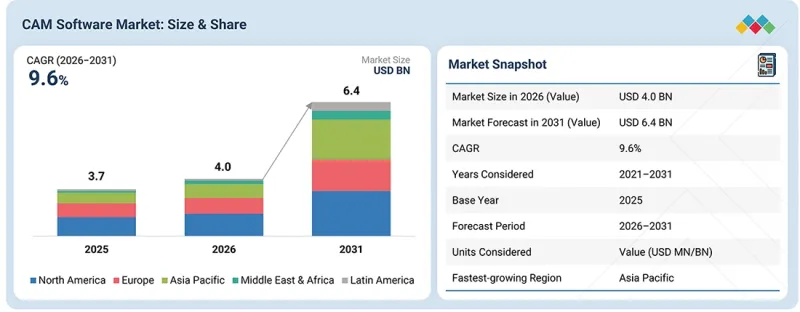
全球電腦輔助製造 (CAM) 軟體市場正在穩步擴張,預計市場規模將從 2026 年的 40 億美元成長到 2031 年的 64 億美元,預測期內複合年成長率為 9.6%。
| 調查範圍 | |
|---|---|
| 調查期 | 2021-2031 |
| 基準年 | 2025 |
| 預測期 | 2026-2031 |
| 計算單位 | 10億美元 |
| 部分 | 按可用性、應用、組織規模、部署模式和產業分類。 |
| 目標區域 | 北美、歐洲、亞太地區、中東和非洲以及拉丁美洲 |
製造商正持續投資於人工智慧驅動的程式設計、整合式設計製造平台和加工仿真,以集中生產計畫、減輕人工程式設計的負擔,並在加工精度和產量方面取得可衡量的改進。
“按部署方式分類,預計雲端運算在預測期內將實現最高的複合年成長率。”
基於雲端的CAM軟體具有快速擴充性、集中式編程重用和持續功能交付等優勢,使其成為分散式製造營運和多站點加工中心的理想選擇。 Autodesk和Dassault Systèmes等供應商正優先推出「雲端優先」的全新AI驅動刀具路徑生成與模擬功能,加速企業擺脫對工作站依賴型程式設計的轉型,並鞏固其作為雲端市場佔有率成長最快廠商的地位。
“按功能分類,預計2D將在預測期內佔據最大的市場佔有率。”
2D (2D) 加工能力,包括 2 軸和 2.5 軸銑削、車削和鑽孔,構成了 CAM 軟體市場的基礎,支援平面、矩形和旋轉零件的加工,這些零件構成了機械加工車間和一般製造業生產程序的大多數。由於其編程複雜度低、與入門級和中階CNC 控制器廣泛兼容,以及在幾何複雜度低的大批量生產中得到廣泛應用,即使製造商不斷為更複雜的航太、醫療和模具應用添加同步 3 軸和 5 軸加工能力,2D 加工能力仍然是 CAM 軟體中最廣泛授權的功能。
“北美在CAM軟體市場佔據領先地位,這得益於其成熟的航太、汽車和工業機械基礎,CNC和雲端基礎設施的廣泛應用,以及大規模離散製造企業的集中度很高。”
預計北美將主導 CAM 軟體市場,這得益於大規模離散製造中人工智慧程式設計工具的日益普及、對數位化製造和工業 4.0舉措的持續資本投資,以及該地區成熟的航太、汽車和工業機械生態系統。
主要調查主題細分
- 按公司分類:一級供應商 - 40%,二級供應商 - 25%,三級供應商 - 35%
- 按職位分類:C級主管 -25%,總監 -37%,其他 -38%
- 按地區分類:北美 - 38%,歐洲 - 24%,亞太地區 - 22%,其他地區 - 16%
本報告包含對主要CAM軟體產品供應商的研究。整體市場根據產品組合、功能、部署模式、組織規模、最終用戶產業和地區進行細分。
調查範圍
本研究報告按產品和服務(軟體和服務)對CAM軟體市場進行細分。此外,還按功能(2D、3D、多軸)、應用(產品設計、原型製作和製造)以及部署方式(本地部署和雲端部署)進行細分。報告還按企業規模(大型企業和中小企業)和行業(石油天然氣、食品飲料、醫療設備和製藥、能源電力、金屬和採礦、紙漿和造紙、汽車、航太、電子和半導體、重型機械以及其他行業)進行細分。電腦輔助製造(CAM)市場按地區分類(北美、歐洲、中東和非洲、亞太地區和拉丁美洲)。本報告包含對主要市場參與者的詳細競爭分析,以及公司簡介、產品和業務觀察、近期發展和主要市場策略。
購買本報告的理由
本報告為市場領導者和新參與企業提供CAM軟體市場及其細分市場最準確的收入預測。它幫助相關人員了解競爭格局,更好地定位自身業務,並制定合適的打入市場策略。此外,它還有助於相關人員了解市場趨勢,並獲取有關關鍵市場促進因素和挑戰的資訊。
本報告深入分析了以下幾點:
- 本分析探討了影響 CAM 軟體市場成長的因素,包括關鍵促進因素(製造商對 AI 驅動的刀具路徑編程的投資增加、對將關聯設計整合到製造中日益重視、基於雲端的 CAM 平台的廣泛採用,以及航太和醫療行業對加工品質和可追溯性要求的提高)、阻礙因素(多軸工具機和模擬的高投資成本,以及熟練的 CNC程式設計人員短缺)、機會(對預測性加工分析的需求不斷成長,以及進入中小型加工車間),以及挑戰(與傳統 CNC 控制器整合的複雜性以及工具機後處理器標準的不一致)。
- 產品開發與創新:深入了解 CAM 軟體市場的未來技術、研發活動以及新產品/服務的推出。
- 市場發展:盈利市場的全面資訊-本報告按地區分析CAM軟體市場。
- 市場多元化:關於CAM軟體市場的新產品和服務、未開發的市場、近期趨勢和投資的全面資訊。
- 競爭分析:對CAM軟體市場主要參與者的市場佔有率、成長策略和服務產品進行詳細評估。
目錄
第1章:引言
第2章執行摘要
第3章重要考察
- CAM軟體市場對企業而言極具吸引力的機會
- CAM軟體市場:依產品/服務分類
- CAM軟體市場:依軟體類型分類
- CAM軟體市場:依產業分類
- CAM軟體市場:按地區分類
第4章 市場概覽
- 市場動態
- 促進因素
- 抑制因子
- 機會
- 任務
- 未滿足的需求和未開發的領域
- CAM軟體市場中尚未滿足的需求
- 未開發市場中的機遇
- 相互關聯的市場與跨產業機遇
- 相互關聯的市場
- 跨產業機遇
- 新的經營模式與生態系轉型
- 新經營模式
- 生態系的轉變
- 1/2/3級玩家的策略舉措
- 主要進展和戰略重點
第5章 產業趨勢
- 波特五力分析
- 新進入者的威脅
- 替代品的威脅
- 供應商的議價能力
- 買方的議價能力
- 競爭公司之間的競爭強度
- 總體經濟指標
- GDP趨勢與預測
- 全球CAD軟體市場趨勢
- 全球CNC工具機市場趨勢
- 價值鏈分析
- 生態系分析
- CAM軟體市場:生態系統分析
- 價格分析
- 各地區商販平均售價趨勢(2025 年)
- CAM軟體市場價格趨勢(2025年)
- 2025年主要供應商價格趨勢(參考值)
- 重大會議和活動(2026-2027)
- 影響客戶業務的趨勢/變革
- 投資和資金籌措場景
- 案例研究分析
- 西門子的 NX CAM 和本田飛機公司簡化了飛機零件的多軸加工。
- 航太領域的 Mastercam 和精密加工設備正在利用動態運動刀具路徑來縮短程式設計時間。
- 達梭系統公司的Delmia和雷諾公司共同最佳化了全球工廠的製造流程規劃。
- Autodesk 的 PowerMill 和 JCB 改良了施工機械零件中複雜曲面的加工。
- Hexagon Edgecam 和航太供應商提高了多工位加工中的刀具路徑一致性。
- 2025年美國關稅對CAM軟體市場的影響
- 主要關稅稅率
- 價格影響分析
- 對國家和地區的影響
- 產業影響
第6章:技術進步、人工智慧的影響、專利、創新與未來應用
- 主要新興技術
- 人工智慧驅動的CAM編程和自動化製程規劃
- 數位孿生、機器模擬和干擾避免
- 雲端連接的CAM和協同製造
- 互補技術
- CAD、PLM數位線程技術
- CNC控制器、工具機連接和後處理技術
- 工具、切割數據和製造技術訣竅
- 相關技術
- 技術和產品藍圖
- 短期(2026-2028)| 人工智慧驅動的CAM和工作流程自動化
- 中期規劃(2028-2031年)| 自主流程規劃與互聯製造
- 長期規劃(2031-2035年及以後)| 自主加工與智慧工廠CAM
- 專利分析
- 人工智慧/生成式人工智慧對CAM軟體市場的影響
- 主要應用場景和市場潛力
- CAM軟體管理最佳實務
- 人工智慧在CAM軟體市場的應用案例研究
- 相互關聯的鄰近生態系及其對市場參與者的影響
- CAM軟體市場中客戶對生成式人工智慧的接受程度
第7章 監理情勢
- 監管機構、政府機構和其他組織
- 地方法規
- 北美洲
- 歐洲
- 亞太地區
- 中東和南非
- 拉丁美洲
- 區域產業標準
- 北美洲
- 歐洲
- 亞太地區
- 世界其他地區
第8章:CAM軟體市場:依產品分類
- 軟體
- 服務
第9章:CAM軟體市場:依應用領域分類
- 產品設計與原型製作
- 加工和生產
- 品管和檢驗
第10章:CAM軟體市場:依功能分類
- 2D
- 3D
- 多軸
第11章 CAM軟體市場:依部署模式分類
- 現場
- 雲
第12章 CAM軟體市場:依組織規模分類
- 大公司
- 小型企業
第13章 CAM軟體市場:依產業分類
- 石油和天然氣
- 食品/飲料
- 醫療設備和藥品
- 化學
- 能源與電力
- 金屬和採礦
- 紙漿和造紙
- 車
- 航太
- 電子和半導體
- 重型機械
- 其他行業
第14章 CAM軟體市場:按地區分類
- 北美洲
- 北美:CAM軟體市場的促進因素
- 美國
- 加拿大
- 歐洲
- 歐洲:CAM軟體市場的促進因素
- 英國
- 德國
- 法國
- 義大利
- 其他歐洲國家
- 亞太地區
- 亞太地區:CAM軟體市場的促進因素
- 中國
- 日本
- 印度
- ANZ
- 亞太其他地區
- 中東和非洲
- 中東和非洲:CAM軟體市場的促進因素
- 波灣合作理事會(GCC)成員國
- 南非
- 其他中東和非洲地區
- 拉丁美洲
- 拉丁美洲:CAM軟體市場的促進因素
- 巴西
- 墨西哥
- 其他拉丁美洲
第15章 競爭格局
- 主要參與企業的策略/優勢,2024-2026 年
- 收入分析
- 2025年市佔率分析
- 企業估值矩陣:主要公司,2026 年
- 明星公司
- 新興領導者
- 企業發展範圍廣泛的公司
- 參與企業
- 企業企業發展:主要公司,2026 年
- 公司估值矩陣:新創企業/中小企業,2026 年
- 先進公司
- 應對力的公司
- 充滿活力的公司
- 起始點
- 競爭標竿分析:新創企業/中小企業,2026 年
- 企業估值和財務指標
- 競爭格局與趨勢
- 產品發布和功能增強
- 交易
第16章:公司簡介
- 大公司
- AUTODESK
- SIEMENS
- HEXAGON
- DASSAULT SYSTEMES
- HYPERTHERM
- PTC
- SOLIDCAM
- TOPSOLID
- CAMWORKS
- MASTERCAM
- 其他主要公司
- SIGMANEST
- NTT DATA ENGINEERING SYSTEMS
- ZWSOFT
- LANTEK
- BOBCAD-CAM
- MECSOFT CORPORATION
- GIBBSCAM
- EZCAM
- OPEN MIND TECHNOLOGIES
- TEBIS
- NCG CAM SOLUTIONS
- SMARTCAM
- CARBIDE
- METAMATION
- VAYO TECHNOLOGY
- ONG SOLUTIONS
- MAXXCAM
第17章調查方法
第18章 鄰近及相關市場
- 相關市場
- 本研究的局限性
- 產品生命週期管理市場
- 模擬軟體市場
第19章附錄
The global computer-aided manufacturing (CAM) software market is expanding steadily, with a projected market size rising from USD 4.0 billion in 2026 to USD 6.4 billion by 2031, at a CAGR of 9.6% during the forecast period.
| Scope of the Report | |
|---|---|
| Years Considered for the Study | 2021-2031 |
| Base Year | 2025 |
| Forecast Period | 2026-2031 |
| Units Considered | USD Billion |
| Segments | Offering, application, organization size, deployment mode, vertical |
| Regions covered | North America, Europe, Asia Pacific, Middle East & Africa, and Latin America |
Manufacturers are increasingly investing in AI-enabled programming, associative design-to-manufacturing platforms, and machining simulation to centralize production planning, reduce manual programming effort, and demonstrate measurable gains in machining accuracy and throughput.
"By deployment type, cloud is expected to record the highest CAGR during the forecast period"
Cloud-based CAM software delivers rapid scalability, centralized programming reuse, and continuous feature delivery well-suited to distributed manufacturing operations and multi-site machine shops. Vendors including Autodesk and Dassault Systemes are prioritizing cloud-first release of new AI-assisted toolpath generation and simulation capabilities, accelerating enterprise migration away from workstation-bound programming and sustaining cloud's fastest-growing share of the market.
"By capability, 2D to hold the largest market share during the forecast period"
Two-dimensional (2D) machining capability, covering 2-axis and 2.5-axis milling, turning, and drilling operations, forms the installed base of the CAM software market, supporting the flat, prismatic, and rotational parts that make up most production programs across machine shops and general manufacturing. Its lower programming complexity, broad compatibility with entry-level and mid-range CNC controllers, and established use across high-volume, less geometrically complex production keep 2D capability the most widely licensed CAM function, even as manufacturers continue to add simultaneous 3-axis and 5-axis capability for more complex aerospace, medical, and tooling applications.
"North America leads the CAM software market with a mature aerospace, automotive, and industrial machinery base, widespread CNC and cloud infrastructure adoption, and dense concentration of large discrete manufacturers"
North America is expected to dominate the CAM software market, driven by the rising adoption of AI-enabled programming tools among large discrete manufacturers, sustained capital investment in digital manufacturing and Industry 4.0 initiatives, and the region's mature aerospace, automotive, and industrial machinery ecosystem.
Breakdown of Primaries
In-depth interviews were conducted with Chief Executive Officers (CEOs), manufacturing and engineering directors, CNC programming leads, and other executives from key organizations operating in the CAM software market.
- By Company: Tier I - 40%, Tier II - 25%, and Tier III - 35%
- By Designation: C-Level Executives - 25%, Directors - 37%, and Others - 38%
- By Region: North America - 38%, Europe - 24%, Asia Pacific - 22%, RoW - 16%
The report includes a study of key players offering CAM software products. It profiles major vendors in the market, including Autodesk (US), Dassault Systemes (France), Siemens (Germany), Hexagon (Sweden), PTC (US), CNC Software / Mastercam (US), SolidCAM (Israel), Open Mind Technologies (Germany), Tebis (Germany), and ANCA (Australia). The overall market is segmented based on offering, capability, deployment type, organization size, end-use industry, and region.
Research Coverage
This research report categorizes the CAM software market by offering (software and services). It is segmented by capability (2D, 3D, multi-axis), by application (product design & prototyping and machining & production), and by deployment mode (On-premises and cloud). By organization size (large enterprises and small & medium-sized enterprises) and verticals (oil& gas, food & beverage, medical devices & pharmaceutical, energy & power, metal & mining, pulp & paper, automotive, aerospace, electronics & semiconductor, heavy machinery and other verticals). The computer-aided manufacturing market is segmented by region (North America, Europe, the Middle East and Africa, Asia Pacific, and Latin America). The report includes an in-depth competitive analysis of key market players, along with company profiles, key observations on product and business offerings, recent developments, and key market strategies.
Reasons to buy this Report
The report would provide market leaders and new entrants with information on the closest approximations of the revenue numbers for the overall CAM software market and its subsegments. This report would help stakeholders understand the competitive landscape and gain more insights to better position their business and plan suitable go-to-market strategies. It also helps stakeholders understand the pulse of the market and provides them with information on key market drivers, restraints, challenges, and opportunities.
The report provides insights on the following pointers:
- Analysis of key drivers (increasing manufacturer investment in AI-enabled toolpath programming, growing emphasis on associative design-to-manufacturing integration, rising adoption of cloud-based CAM platforms, and expanding quality and traceability requirements in aerospace and medical machining), restraints (high cost of multi-axis machine tools and simulation investment, and shortage of skilled CNC programmers), opportunities (growing demand for predictive machining analytics, and expansion into small and medium-sized machine shops), and challenges (integration complexity with legacy CNC controllers, and inconsistent post-processor standards across machine tools) influencing the growth of the CAM software market
- Product Development/Innovation: Detailed insights on upcoming technologies, research & development activities, and new product & service launches in the CAM software market
- Market Development: Comprehensive information about lucrative markets - the report analyses the CAM software market across regions
- Market Diversification: Exhaustive information about new products & services, untapped geographies, recent developments, and investments in the CAM software market
- Competitive Assessment: In-depth assessment of market shares, growth strategies, and service offerings of leading players in the CAM software market
TABLE OF CONTENTS
1 INTRODUCTION
- 1.1 STUDY OBJECTIVES
- 1.2 MARKET DEFINITION
- 1.3 MARKET SCOPE
- 1.3.1 MARKET SEGMENTATION AND REGIONAL SCOPE
- 1.3.2 INCLUSIONS AND EXCLUSIONS
- 1.3.3 YEARS CONSIDERED
- 1.4 CURRENCY CONSIDERED
- 1.5 LIMITATIONS
- 1.6 STAKEHOLDERS
- 1.7 SUMMARY OF CHANGES
2 EXECUTIVE SUMMARY
- 2.1 MARKET HIGHLIGHTS AND KEY INSIGHTS
- 2.2 KEY MARKET PARTICIPANTS: MAPPING OF STRATEGIC DEVELOPMENTS
- 2.3 DISRUPTIVE TRENDS IN CAM SOFTWARE MARKET
- 2.4 HIGH-GROWTH SEGMENTS
- 2.5 REGIONAL SNAPSHOT: MARKET SIZE, GROWTH RATE, AND FORECAST
3 PREMIUM INSIGHTS
- 3.1 ATTRACTIVE OPPORTUNITIES FOR PLAYERS IN CAM SOFTWARE MARKET
- 3.2 CAM SOFTWARE MARKET, BY OFFERING
- 3.3 CAM SOFTWARE MARKET, BY SOFTWARE TYPE
- 3.4 CAM SOFTWARE MARKET, BY VERTICAL
- 3.5 CAM SOFTWARE MARKET, BY REGION
4 MARKET OVERVIEW
- 4.1 INTRODUCTION
- 4.2 MARKET DYNAMICS
- 4.2.1 DRIVERS
- 4.2.1.1 Rising Demand for Complex Multi-Axis Machining Driving CAM Adoption
- 4.2.1.2 Accelerating CNC Automation Increasing Demand for CAM Programming
- 4.2.1.3 Shorter Production Cycles Driving Automated CAM Workflows
- 4.2.1.4 Integrated Design-to-Manufacturing Workflows Strengthening CAM Adoption
- 4.2.2 RESTRAINTS
- 4.2.2.1 High Advanced CAM Costs Limiting Adoption Among SMEs
- 4.2.2.2 Legacy CNC Integration Increasing CAM Deployment Complexity
- 4.2.3 OPPORTUNITIES
- 4.2.3.1 Additive-Hybrid Machining Expanding CAM Application Scope
- 4.2.3.2 Automated Feature Recognition Reducing High-Mix Programming Effort
- 4.2.3.3 Increasing CAM Use in Composite Component Manufacturing
- 4.2.4 CHALLENGES
- 4.2.4.1 CNC Controller Compatibility Complicating CAM Deployment
- 4.2.4.2 Complex Toolpath Validation Increasing CAM Implementation Requirements
- 4.2.1 DRIVERS
- 4.3 UNMET NEEDS AND WHITE SPACES
- 4.3.1 UNMET NEEDS IN THE CAM SOFTWARE MARKET
- 4.3.2 WHITE SPACE OPPORTUNITIES
- 4.4 INTERCONNECTED MARKETS AND CROSS-SECTOR OPPORTUNITIES
- 4.4.1 INTERCONNECTED MARKETS
- 4.4.2 CROSS-SECTOR OPPORTUNITIES
- 4.5 EMERGING BUSINESS MODELS AND ECOSYSTEM SHIFTS
- 4.5.1 EMERGING BUSINESS MODELS
- 4.5.1.1 CAM Software Business Models
- 4.5.2 ECOSYSTEM SHIFTS
- 4.5.1 EMERGING BUSINESS MODELS
- 4.6 STRATEGIC MOVES BY TIER-1/2/3 PLAYERS
- 4.6.1 KEY MOVES AND STRATEGIC FOCUS
5 INDUSTRY TRENDS
- 5.1 PORTER'S FIVE FORCES ANALYSIS
- 5.1.1 THREAT OF NEW ENTRANTS
- 5.1.2 THREAT OF SUBSTITUTES
- 5.1.3 BARGAINING POWER OF SUPPLIERS
- 5.1.4 BARGAINING POWER OF BUYERS
- 5.1.5 INTENSITY OF COMPETITIVE RIVALRY
- 5.2 MACROECONOMIC INDICATORS
- 5.2.1 INTRODUCTION
- 5.2.2 GDP TRENDS & FORECASTS
- 5.2.3 TRENDS IN THE GLOBAL CAD SOFTWARE MARKET
- 5.2.4 TRENDS IN THE GLOBAL CNC MACHINE TOOLS MARKET
- 5.3 VALUE CHAIN ANALYSIS
- 5.4 ECOSYSTEM ANALYSIS
- 5.4.1 CAM SOFTWARE MARKET: ECOSYSTEM ANALYSIS
- 5.5 PRICING ANALYSIS
- 5.5.1 AVERAGE SELLING PRICE TRENDS OF VENDORS, BY REGION,2025
- 5.5.1.1 North America
- 5.5.1.2 Europe
- 5.5.1.3 Asia Pacific
- 5.5.1.4 Middle East & Africa
- 5.5.1.5 Latin America
- 5.5.2 PRICING LANDSCAPE FOR CAM SOFTWARE MARKET, 2025
- 5.5.3 INDICATIVE PRICING TRENDS, BY KEY VENDOR, 2025
- 5.5.1 AVERAGE SELLING PRICE TRENDS OF VENDORS, BY REGION,2025
- 5.6 KEY CONFERENCES AND EVENTS, 2026-2027
- 5.7 TRENDS/DISRUPTIONS IMPACTING CUSTOMER BUSINESS
- 5.8 INVESTMENT AND FUNDING SCENARIO
- 5.9 CASE STUDY ANALYSIS
- 5.9.1 SIEMENS NX CAM AND HONDA AIRCRAFT COMPANY STREAMLINE MULTI-AXIS MACHINING FOR AIRCRAFT COMPONENTS
- 5.9.2 MASTERCAM AND A PRECISION AEROSPACE MACHINE SHOP REDUCE PROGRAMMING TIME WITH DYNAMIC MOTION TOOLPATHS
- 5.9.3 DASSAULT SYSTEMES DELMIA AND RENAULT OPTIMIZE MANUFACTURING PROCESS PLANNING ACROSS GLOBAL PLANTS
- 5.9.4 AUTODESK POWERMILL AND JCB IMPROVE COMPLEX SURFACE MACHINING FOR CONSTRUCTION EQUIPMENT COMPONENTS
- 5.9.5 HEXAGON EDGECAM AND AN AEROSPACE SUPPLIER STRENGTHEN TOOLPATH CONSISTENCY ACROSS MULTI-SITE MACHINING
- 5.10 IMPACT OF 2025 US TARIFF - CAM SOFTWARE MARKET
- 5.10.1 INTRODUCTION
- 5.11 KEY TARIFF RATES
- 5.11.1 PRICE IMPACT ANALYSIS
- 5.11.2 IMPACT ON COUNTRY/REGION
- 5.11.2.1 North America
- 5.11.2.2 Europe
- 5.11.2.3 Asia Pacific
- 5.11.3 IMPACT ON VERTICALS
- 5.11.3.1 Automotive & Transportation
- 5.11.3.2 Aerospace & Defense
- 5.11.3.3 Electronics & Semiconductor
- 5.11.3.4 Healthcare & Medical Devices
6 TECHNOLOGICAL ADVANCEMENTS, AI-DRIVEN IMPACT, PATENTS, INNOVATIONS, AND FUTURE APPLICATIONS
- 6.1 KEY EMERGING TECHNOLOGIES
- 6.1.1 AI-ASSISTED CAM PROGRAMMING AND AUTOMATED PROCESS PLANNING
- 6.1.2 DIGITAL TWIN, MACHINE SIMULATION, AND COLLISION AVOIDANCE
- 6.1.3 CLOUD-CONNECTED CAM AND COLLABORATIVE MANUFACTURING
- 6.2 COMPLEMENTARY TECHNOLOGIES
- 6.2.1 CAD, PLM, AND DIGITAL THREAD TECHNOLOGIES
- 6.2.2 CNC CONTROLLERS, MACHINE TOOL CONNECTIVITY, AND POSTPROCESSING TECHNOLOGIES
- 6.2.3 TOOLING, CUTTING DATA, AND MANUFACTURING KNOWLEDGE TECHNOLOGIES
- 6.2.4 ADJACENT TECHNOLOGIES
- 6.2.4.1 MES/MOM, Production Planning, and Shop-Floor Execution Technologies
- 6.2.4.2 Metrology, Inspection, and Quality Technologies
- 6.2.4.3 Additive, Hybrid Manufacturing, and Robotics Technologies
- 6.3 TECHNOLOGY/PRODUCT ROADMAP
- 6.3.1 SHORT-TERM (2026-2028) | AI-ASSISTED CAM & WORKFLOW AUTOMATION
- 6.3.2 MID-TERM (2028-2031) | AUTONOMOUS PROCESS PLANNING & CONNECTED MANUFACTURING
- 6.3.3 LONG-TERM (2031-2035+) | AUTONOMOUS MACHINING & INTELLIGENT FACTORY CAM
- 6.4 PATENT ANALYSIS
- 6.5 IMPACT OF AI/GENERATIVE AI ON THE CAM SOFTWARE MARKET
- 6.5.1 TOP USE CASES AND MARKET POTENTIAL
- 6.5.2 BEST PRACTICES IN CAM SOFTWARE MANAGEMENT
- 6.5.3 CASE STUDY OF AI IMPLEMENTATION IN THE CAM SOFTWARE MARKET
- 6.5.3.1 Autodesk Fusion: AI-Assisted CAM Programming and Manufacturing Automation
- 6.5.4 INTERCONNECTED ADJACENT ECOSYSTEM AND IMPACT ON MARKET PLAYERS
- 6.5.5 CLIENT READINESS TO ADOPT GENERATIVE AI IN THE CAM SOFTWARE MARKET
7 REGULATORY LANDSCAPE
- 7.1 REGULATORY BODIES, GOVERNMENT AGENCIES, AND OTHER ORGANIZATIONS
- 7.2 REGULATIONS, BY REGION
- 7.2.1 NORTH AMERICA
- 7.2.2 EUROPE
- 7.2.3 ASIA PACIFIC
- 7.2.4 MIDDLE EAST & SOUTH AFRICA
- 7.2.5 LATIN AMERICA
- 7.3 INDUSTRY STANDARDS, BY REGION
- 7.3.1 NORTH AMERICA
- 7.3.2 EUROPE
- 7.3.3 ASIA PACIFIC
- 7.3.4 REST OF THE WORLD
8 CAM SOFTWARE MARKET, BY OFFERING
- 8.1 INTRODUCTION
- 8.1.1 OFFERINGS: CAM SOFTWARE MARKET DRIVERS
- 8.2 SOFTWARE
- 8.2.1 AUTOMATING AND OPTIMIZING MANUFACTURING PROCESSES TO DRIVE MARKET
- 8.2.2 CAD-EMBEDDED CAM SOFTWARE
- 8.2.3 INDEPENDENT CAM SOFTWARE
- 8.3 SERVICES
- 8.3.1 GROWING DEMAND FOR SMART MANUFACTURING TO PROPEL MARKET
- 8.3.2 IMPLEMENTATION & INTEGRATION
- 8.3.3 CONSULTING
- 8.3.4 TRAINING, SUPPORT, AND MAINTENANCE
9 CAM SOFTWARE MARKET, BY APPLICATION
- 9.1 INTRODUCTION
- 9.1.1 APPLICATIONS: CAM SOFTWARE MARKET DRIVERS
- 9.2 PRODUCT DESIGN & PROTOTYPING
- 9.2.1 GROWING COMPLEXITY IN DESIGNING PROCESS TO FUEL MARKET GROWTH
- 9.2.2 SIMULATION
- 9.2.3 3D PRINTING/ADDITIVE MANUFACTURING
- 9.2.4 TOOL & DIE MANUFACTURING
- 9.3 MACHINING & PRODUCTION
- 9.3.1 OPTIMIZING PRECISION AND EFFICIENCY TO BOOST MARKET GROWTH
- 9.3.2 CNC MACHINING
- 9.3.3 SHEET METAL FABRICATION
- 9.4 QUALITY CONTROL & INSPECTION
- 9.4.1 MEETING INDUSTRY STANDARDS AND DESIGN SPECIFICATIONS TO BOLSTER MARKET GROWTH
10 CAM SOFTWARE MARKET, BY CAPABILITY
- 10.1 INTRODUCTION
- 10.1.1 CAPABILITIES: CAM SOFTWARE MARKET DRIVERS
- 10.2 2D
- 10.2.1 PRECISE, COST-EFFECTIVE TOOLPATHING TO FOSTER MARKET GROWTH
- 10.3 3D
- 10.3.1 3D CAPABILITY TO ADVANCE MANUFACTURING TECHNOLOGY
- 10.4 MULTI-AXIS
- 10.4.1 ADVANCEMENTS IN DESIGNING MODELS TO ACCELERATE MARKET GROWTH
11 CAM SOFTWARE MARKET, BY DEPLOYMENT MODE
- 11.1 INTRODUCTION
- 11.1.1 DEPLOYMENT MODES: CAM SOFTWARE MARKET DRIVERS
- 11.2 ON-PREMISES
- 11.2.1 SPECIALIZED ENVIRONMENT FOR HANDLING SENSITIVE DATA TO DRIVE MARKET
- 11.3 CLOUD
- 11.3.1 COST-EFFECTIVENESS AND SCALABILITY TO BOOST DEMAND FOR CAM SOFTWARE SOLUTIONS
12 CAM SOFTWARE MARKET, BY ORGANIZATION SIZE
- 12.1 INTRODUCTION
- 12.1.1 ORGANIZATION SIZES: CAM SOFTWARE MARKET DRIVERS
- 12.2 LARGE ENTERPRISES
- 12.2.1 HANDLING HIGH PRODUCTION VOLUMES TO DRIVE MARKET
- 12.3 SMALL AND MEDIUM-SIZED ENTERPRISES
- 12.3.1 DRIVING EFFICIENCY, CUSTOMIZATION, AND GROWTH TO BOOST MARKET GROWTH
13 CAM SOFTWARE MARKET, BY VERTICAL
- 13.1 INTRODUCTION
- 13.1.1 VERTICALS: CAM SOFTWARE MARKET DRIVERS
- 13.2 OIL & GAS
- 13.2.1 OPTIMIZING DESIGN AND PRODUCING COMPLEX COMPONENTS TO FOSTER MARKET GROWTH
- 13.2.2 OIL & GAS: APPLICATION AREAS
- 13.2.2.1 Exploration & drilling
- 13.2.2.2 Pipeline manufacturing
- 13.2.2.3 Refining and petrochemical processing
- 13.2.2.4 Other oil & gas application areas
- 13.3 FOOD & BEVERAGES
- 13.3.1 ENHANCING OPERATIONAL SAFETY AND REDUCING COSTS TO BOLSTER MARKET GROWTH
- 13.3.2 FOOD & BEVERAGES: APPLICATION AREAS
- 13.3.2.1 Food machinery and equipment
- 13.3.2.2 Dairy processing
- 13.3.2.3 Bakery & confectionary
- 13.3.2.4 Other food & beverage application areas
- 13.4 MEDICAL DEVICES & PHARMACEUTICALS
- 13.4.1 GROWING DEMAND FOR PRODUCT QUALITY AND REGULATORY COMPLIANCE TO BOOST MARKET GROWTH
- 13.4.2 MEDICAL DEVICES & PHARMACEUTICALS: APPLICATION AREAS
- 13.4.2.1 Drug manufacturing
- 13.4.2.2 Packaging and labeling
- 13.4.2.3 Heavy manufacturing
- 13.4.2.4 Other medical device & pharmaceutical application areas
- 13.5 CHEMICALS
- 13.5.1 ENSURING SAFER, MORE EFFICIENT CHEMICAL MANUFACTURING OPERATIONS TO BOLSTER MARKET GROWTH
- 13.5.2 CHEMICALS: APPLICATION AREAS
- 13.5.2.1 Petrochemicals
- 13.5.2.2 Agrochemicals
- 13.5.2.3 Polymers & plastics
- 13.5.2.4 Other chemical application areas
- 13.6 ENERGY & POWER
- 13.6.1 OPTIMIZING MAINTENANCE AND EFFICIENCY OF ENERGY & POWER SECTOR TO DRIVE MARKET
- 13.6.2 ENERGY & POWER: APPLICATION AREAS
- 13.6.2.1 Renewable energy
- 13.6.2.2 Power generation equipment
- 13.6.2.3 Consumer chemicals
- 13.6.2.4 Other energy & power application areas
- 13.7 METALS & MINING
- 13.7.1 HIGH PRECISION AND EFFICIENCY FOR PRODUCTION TO PROPEL MARKET
- 13.7.2 METALS & MINING: APPLICATION AREAS
- 13.7.2.1 Metal extraction
- 13.7.2.2 Mineral processing
- 13.7.2.3 Steel manufacturing
- 13.7.2.4 Other metals & mining application areas
- 13.8 PULP & PAPER
- 13.8.1 REDUCING WASTE AND ENERGY CONSUMPTION TO DRIVE MARKET
- 13.8.2 PULP & PAPER: APPLICATION AREAS
- 13.8.2.1 Paper manufacturing
- 13.8.2.2 Chemical pulping
- 13.8.2.3 Packaging paper & board
- 13.8.2.4 Other pulp & paper application areas
- 13.9 AUTOMOTIVE
- 13.9.1 GROWING DEMAND FOR COMPONENT DESIGNING TO BOOST MARKET GROWTH
- 13.9.2 AUTOMOTIVE: APPLICATION AREAS
- 13.9.2.1 Passenger vehicles
- 13.9.2.2 Commercial vehicles
- 13.9.2.3 Automotive electronics
- 13.9.2.4 Other automotive application areas
- 13.10 AEROSPACE
- 13.10.1 HANDLING COMPLEX GEOMETRIES TO ACCELERATE MARKET GROWTH
- 13.10.2 AEROSPACE: APPLICATION AREAS
- 13.10.2.1 Commercial aviation
- 13.10.2.2 Military & defense
- 13.10.2.3 Space exploration
- 13.10.2.4 Other aerospace application areas
- 13.11 ELECTRONICS & SEMICONDUCTORS
- 13.11.1 MANUFACTURING INTRICATE CIRCUIT COMPONENTS TO FUEL MARKET GROWTH
- 13.11.2 ELECTRONICS & SEMICONDUCTORS: APPLICATION AREAS
- 13.11.2.1 Printed Circuit Board (PCB)
- 13.11.2.2 Consumer electronics
- 13.11.2.3 Industry electronics
- 13.11.2.4 Other electronics & semiconductor application areas
- 13.12 HEAVY MACHINERY
- 13.12.1 EXCEPTIONAL ACCURACY AND OPTIMIZED MATERIAL USAGE TO AUGMENT MARKET GROWTH
- 13.12.2 HEAVY MACHINERY: APPLICATION AREAS
- 13.12.2.1 Construction machinery
- 13.12.2.2 Industrial machinery
- 13.12.2.3 Material handling
- 13.12.2.4 Other heavy machinery application areas
- 13.13 OTHER VERTICALS
14 CAM SOFTWARE MARKET, BY REGION
- 14.1 INTRODUCTION
- 14.2 NORTH AMERICA
- 14.2.1 NORTH AMERICA: CAM SOFTWARE MARKET DRIVERS
- 14.2.2 US
- 14.2.2.1 Government initiatives and technological advancements to drive demand for CAM solutions
- 14.2.3 CANADA
- 14.2.3.1 CAM solutions to transform manufacturing sector with advanced technologies
- 14.3 EUROPE
- 14.3.1 EUROPE: CAM SOFTWARE MARKET DRIVERS
- 14.3.2 UK
- 14.3.2.1 Automation, digital technologies, and Industry 4.0 to propel market
- 14.3.3 GERMANY
- 14.3.3.1 Strong industrial foundation, Industry 4.0, and sustainability to fuel market growth
- 14.3.4 FRANCE
- 14.3.4.1 Improving production efficiency, precision, and flexibility to accelerate market growth
- 14.3.5 ITALY
- 14.3.5.1 Piano Transizione 4.0 and digital technologies to foster market growth
- 14.3.6 REST OF EUROPE
- 14.4 ASIA PACIFIC
- 14.4.1 ASIA PACIFIC: CAM SOFTWARE MARKET DRIVERS
- 14.4.2 CHINA
- 14.4.2.1 Adoption of automation, AI, and digital manufacturing to boost market growth
- 14.4.3 JAPAN
- 14.4.3.1 Government investments and Society 5.0 to bolster market growth
- 14.4.4 INDIA
- 14.4.4.1 SAMARTH Udyog Bharat 4.0 and automation to drive market
- 14.4.5 ANZ
- 14.4.5.1 Automation and digital manufacturing to drive CAM adoption
- 14.4.6 REST OF ASIA PACIFIC
- 14.5 MIDDLE EAST & AFRICA
- 14.5.1 MIDDLE EAST & AFRICA: CAM SOFTWARE MARKET DRIVERS
- 14.5.2 GULF COOPERATION COUNCIL (GCC) COUNTRIES
- 14.5.2.1 UAE
- 14.5.2.1.1 Industrial modernization and government regulations to boost market growth
- 14.5.2.2 Saudi Arabia
- 14.5.2.2.1 Vision 2030 and advanced manufacturing technologies to drive market
- 14.5.2.3 Rest of GCC countries
- 14.5.2.1 UAE
- 14.5.3 SOUTH AFRICA
- 14.5.3.1 Rising demand for automation and Industry 4.0 to boost market growth
- 14.5.4 REST OF MIDDLE EAST & AFRICA
- 14.6 LATIN AMERICA
- 14.6.1 LATIN AMERICA: CAM SOFTWARE MARKET DRIVERS
- 14.6.2 BRAZIL
- 14.6.2.1 CAM technologies to enhance precision, optimize production, and reduce waste
- 14.6.3 MEXICO
- 14.6.3.1 Improving precision, reducing costs, and speeding production to boost market growth
- 14.6.4 REST OF LATIN AMERICA
15 COMPETITIVE LANDSCAPE
- 15.1 INTRODUCTION
- 15.2 KEY PLAYER STRATEGIES/RIGHT TO WIN, 2024-2026
- 15.3 REVENUE ANALYSIS
- 15.4 MARKET SHARE ANALYSIS,2025
- 15.5 COMPANY EVALUATION MATRIX: KEY PLAYERS, 2026
- 15.5.1 STARS
- 15.5.2 EMERGING LEADERS
- 15.5.3 PERVASIVE PLAYERS
- 15.5.4 PARTICIPANTS
- 15.5.5 COMPANY FOOTPRINT: KEY PLAYERS, 2026
- 15.5.5.1 Company footprint
- 15.5.5.2 Offering footprint
- 15.5.5.3 Organization size footprint
- 15.5.5.4 Vertical footprint
- 15.5.5.5 Regional footprint
- 15.6 COMPANY EVALUATION MATRIX: START-UPS/SMES, 2026
- 15.6.1 PROGRESSIVE COMPANIES
- 15.6.2 RESPONSIVE COMPANIES
- 15.6.3 DYNAMIC COMPANIES
- 15.6.4 STARTING BLOCKS
- 15.6.5 COMPETITIVE BENCHMARKING: START-UP/SMES, 2026
- 15.6.5.1 Detailed list of key start-ups/SMEs
- 15.6.5.2 Competitive benchmarking of start-ups/SMEs
- 15.7 COMPANY VALUATION AND FINANCIAL METRICS
- 15.8 COMPETITIVE SCENARIO AND TRENDS
- 15.8.1 PRODUCT LAUNCHES AND ENHANCEMENTS
- 15.8.2 DEALS
16 COMPANY PROFILES
- 16.1 INTRODUCTION
- 16.2 MAJOR PLAYERS
- 16.2.1 AUTODESK
- 16.2.1.1 Business overview
- 16.2.1.2 Products/Solutions/Services offered
- 16.2.1.3 Recent developments
- 16.2.1.3.1 Product launches and enhancements
- 16.2.1.3.2 Deals
- 16.2.1.4 MnM view
- 16.2.1.4.1 Right to win
- 16.2.1.4.2 Strategic choices
- 16.2.1.4.3 Weaknesses and competitive threats
- 16.2.2 SIEMENS
- 16.2.2.1 Business overview
- 16.2.2.2 Products/Solutions/Services offered.
- 16.2.2.3 Recent developments
- 16.2.2.3.1 Product enhancements
- 16.2.2.3.2 Deals
- 16.2.2.4 MnM view
- 16.2.2.4.1 Right to win
- 16.2.2.4.2 Strategic choices
- 16.2.2.4.3 Weaknesses and competitive threats
- 16.2.3 HEXAGON
- 16.2.3.1 Business overview
- 16.2.3.2 Products/Solutions/Services offered
- 16.2.3.3 Recent developments
- 16.2.3.3.1 Product enhancements
- 16.2.3.3.2 Deals
- 16.2.3.4 MnM view
- 16.2.3.4.1 Right to win
- 16.2.3.4.2 Strategic choices
- 16.2.3.4.3 Weaknesses and competitive threats
- 16.2.4 DASSAULT SYSTEMES
- 16.2.4.1 Business overview
- 16.2.4.2 Products/Solutions/Services offered
- 16.2.4.3 Recent developments
- 16.2.4.3.1 Product enhancements
- 16.2.4.3.2 Deals
- 16.2.4.4 MnM view
- 16.2.4.4.1 Right to win
- 16.2.4.4.2 Strategic choices
- 16.2.4.4.3 Weaknesses and competitive threats
- 16.2.5 HYPERTHERM
- 16.2.5.1 Business overview
- 16.2.5.2 Products/Solutions/Services offered
- 16.2.5.3 Recent developments
- 16.2.5.3.1 Product enhancements
- 16.2.5.4 MnM view
- 16.2.5.4.1 Right to win
- 16.2.5.4.2 Strategic choices
- 16.2.5.4.3 Weaknesses and competitive threats
- 16.2.6 PTC
- 16.2.6.1 Business overview
- 16.2.6.2 Products/Solutions/Services offered
- 16.2.6.3 Recent developments
- 16.2.6.3.1 Product enhancements
- 16.2.6.3.2 Deals
- 16.2.7 SOLIDCAM
- 16.2.7.1 Business overview
- 16.2.7.2 Products/Solutions/Services offered
- 16.2.7.3 Recent developments
- 16.2.7.3.1 Product enhancements
- 16.2.7.3.2 Deals
- 16.2.8 TOPSOLID
- 16.2.8.1 Business overview
- 16.2.8.2 Products/Solutions/Services offered
- 16.2.8.3 Recent developments
- 16.2.8.3.1 Product enhancements
- 16.2.8.3.2 Deals
- 16.2.9 CAMWORKS
- 16.2.9.1 Business overview
- 16.2.9.2 Products/Solutions/Services offered
- 16.2.9.3 Recent developments
- 16.2.9.3.1 Product enhancements
- 16.2.10 MASTERCAM
- 16.2.10.1 Business overview
- 16.2.10.2 Products/Solutions/Services offered
- 16.2.10.3 Recent developments
- 16.2.10.3.1 Product enhancements
- 16.2.10.3.2 Deals
- 16.2.1 AUTODESK
- 16.3 OTHER PLAYERS
- 16.3.1 SIGMANEST
- 16.3.2 NTT DATA ENGINEERING SYSTEMS
- 16.3.3 ZWSOFT
- 16.3.4 LANTEK
- 16.3.5 BOBCAD-CAM
- 16.3.6 MECSOFT CORPORATION
- 16.3.7 GIBBSCAM
- 16.3.8 EZCAM
- 16.3.9 OPEN MIND TECHNOLOGIES
- 16.3.10 TEBIS
- 16.3.11 NCG CAM SOLUTIONS
- 16.3.12 SMARTCAM
- 16.3.13 CARBIDE
- 16.3.14 METAMATION
- 16.3.15 VAYO TECHNOLOGY
- 16.3.16 ONG SOLUTIONS
- 16.3.17 MAXXCAM
17 RESEARCH METHODOLOGY
- 17.1 SECONDARY DATA
- 17.1.1 BREAKUP OF PRIMARY PROFILES
- 17.1.2 KEY INDUSTRY INSIGHTS
- 17.2 MARKET BREAKUP AND DATA TRIANGULATION
- 17.3 MARKET SIZE ESTIMATION
- 17.4 MARKET FORECAST
- 17.5 RESEARCH ASSUMPTIONS
18 ADJACENT/RELATED MARKETS
- 18.1 INTRODUCTION
- 18.1.1 RELATED MARKETS
- 18.1.2 LIMITATIONS
- 18.2 PRODUCT LIFECYCLE MANAGEMENT MARKET
- 18.3 SIMULATION SOFTWARE MARKET
19 APPENDIX
- 19.1 DISCUSSION GUIDE
- 19.2 KNOWLEDGESTORE: MARKETSANDMARKETS' SUBSCRIPTION PORTAL
- 19.3 CUSTOMIZATION OPTIONS
- 19.4 RELATED REPORTS
- 19.5 AUTHOR DETAILS
List of Tables
- TABLE 1 USD EXCHANGE RATES, 2021-2025
- TABLE 2 IMPACT OF PORTER'S FIVE FORCES ON MANAGED SERVICES MARKET
- TABLE 3 GDP PERCENTAGE CHANGE, BY KEY COUNTRIES, 2021-2029
- TABLE 4 AVERAGE SELLING PRICE TREND OF VENDORS, BY REGION, 2025 (USD THOUSAND)
- TABLE 5 PRICING LANDSCAPE FOR CAM SOFTWARE MARKET, 2025
- TABLE 6 CAM SOFTWARE MARKET: INDICATIVE PRICING ANALYSIS, BY KEY VENDOR, 2025
- TABLE 7 CAM SOFTWARE MARKET: LIST OF KEY CONFERENCES AND EVENTS, 2026-2027
- TABLE 8 US ADJUSTED RECIPROCAL TARIFF RATES
- TABLE 9 LIST OF GRANTED PATENTS IN THE CAM SOFTWARE MARKET, 2024-2026
- TABLE 10 TOP USE CASES AND MARKET POTENTIAL
- TABLE 11 BEST PRACTICES: COMPANIES IMPLEMENTING AI AND AUTOMATION USE CASES
- TABLE 12 INTERCONNECTED ADJACENT ECOSYSTEM AND IMPLICATIONS FOR MARKET PLAYERS
- TABLE 13 EUROPE: REGULATORY BODIES, GOVERNMENT AGENCIES, AND OTHER ORGANIZATIONS
- TABLE 14 ASIA PACIFIC: REGULATORY BODIES, GOVERNMENT AGENCIES, AND OTHER ORGANIZATIONS
- TABLE 15 REST OF THE WORLD: REGULATORY BODIES, GOVERNMENT AGENCIES, AND OTHER ORGANIZATIONS
- TABLE 16 CAM SOFTWARE MARKET, BY OFFERING, 2021-2025 (USD MILLION)
- TABLE 17 CAM SOFTWARE MARKET, BY OFFERING, 2026-2031 (USD MILLION)
- TABLE 18 CAM SOFTWARE MARKET, BY SOFTWARE, 2021-2025 (USD MILLION)
- TABLE 19 CAM SOFTWARE MARKET, BY SOFTWARE, 2026-2031 (USD MILLION)
- TABLE 20 CAD-EMBEDDED CAM SOFTWARE MARKET, BY REGION, 2021-2025 (USD MILLION)
- TABLE 21 CAD-EMBEDDED CAM SOFTWARE MARKET, BY REGION, 2026-2031 (USD MILLION)
- TABLE 22 INDEPENDENT CAM SOFTWARE MARKET, BY REGION, 2021-2025 (USD MILLION)
- TABLE 23 INDEPENDENT CAM SOFTWARE MARKET, BY REGION, 2026-2031 (USD MILLION)
- TABLE 24 CAM SOFTWARE MARKET, BY SERVICE, 2021-2025 (USD MILLION)
- TABLE 25 CAM SOFTWARE MARKET, BY SERVICE, 2026-2031 (USD MILLION)
- TABLE 26 CAM SERVICES MARKET, BY REGION, 2021-2025 (USD MILLION)
- TABLE 27 CAM SERVICES MARKET, BY REGION, 2026-2031 (USD MILLION)
- TABLE 28 CAM IMPLEMENTATION & INTEGRATION SERVICES MARKET, BY REGION, 2021-2025 (USD MILLION)
- TABLE 29 CAM IMPLEMENTATION & INTEGRATION SERVICES MARKET, BY REGION, 2026-2031 (USD MILLION)
- TABLE 30 CAM CONSULTING SERVICES MARKET, BY REGION, 2021-2025 (USD MILLION)
- TABLE 31 CAM CONSULTING SERVICES MARKET, BY REGION, 2026-2031 (USD MILLION)
- TABLE 32 CAM TRAINING, SUPPORT, AND MAINTENANCE SERVICES MARKET, BY REGION, 2021-2025 (USD MILLION)
- TABLE 33 CAM TRAINING, SUPPORT, AND MAINTENANCE SERVICES MARKET, BY REGION, 2026-2031 (USD MILLION)
- TABLE 34 CAM SOFTWARE MARKET, BY APPLICATION, 2021-2025 (USD MILLION)
- TABLE 35 CAM SOFTWARE MARKET, BY APPLICATION, 2026-2031 (USD MILLION)
- TABLE 36 CAM SOFTWARE MARKET, BY PRODUCT DESIGN & PROTOTYPING, 2021-2025 (USD MILLION)
- TABLE 37 CAM SOFTWARE MARKET, BY PRODUCT DESIGN & PROTOTYPING, 2026-2031 (USD MILLION)
- TABLE 38 CAM SOFTWARE MARKET IN SIMULATION, BY REGION, 2021-2025 (USD MILLION)
- TABLE 39 CAM SOFTWARE MARKET IN SIMULATION, BY REGION, 2026-2031 (USD MILLION)
- TABLE 40 CAM SOFTWARE MARKET IN 3D PRINTING/ADDITIVE MANUFACTURING, BY REGION, 2021-2025 (USD MILLION)
- TABLE 41 CAM SOFTWARE MARKET IN 3D PRINTING/ADDITIVE MANUFACTURING, BY REGION, 2026-2031 (USD MILLION)
- TABLE 42 CAM SOFTWARE MARKET IN TOOL & DIE MANUFACTURING, BY REGION, 2021-2025 (USD MILLION)
- TABLE 43 CAM SOFTWARE MARKET IN TOOL & DIE MANUFACTURING, BY REGION, 2026-2031 (USD MILLION)
- TABLE 44 CAM SOFTWARE MARKET, BY MACHINING & PRODUCTION, 2021-2025 (USD MILLION)
- TABLE 45 CAM SOFTWARE MARKET, BY MACHINING & PRODUCTION, 2026-2031 (USD MILLION)
- TABLE 46 CAM SOFTWARE MARKET IN MACHINING & PRODUCTION, BY REGION, 2021-2025 (USD MILLION)
- TABLE 47 CAM SOFTWARE MARKET IN MACHINING & PRODUCTION, BY REGION, 2026-2031 (USD MILLION)
- TABLE 48 CAM SOFTWARE MARKET IN CNC MACHINING, BY REGION, 2021-2025 (USD MILLION)
- TABLE 49 CAM SOFTWARE MARKET IN CNC MACHINING, BY REGION, 2026-2031 (USD MILLION)
- TABLE 50 CAM SOFTWARE MARKET IN SHEET METAL FABRICATION, BY REGION, 2021-2025 (USD MILLION)
- TABLE 51 CAM SOFTWARE MARKET IN SHEET METAL FABRICATION, BY REGION, 2026-2031 (USD MILLION)
- TABLE 52 CAM SOFTWARE MARKET IN QUALITY CONTROL & INSPECTION, BY REGION, 2021-2025 (USD MILLION)
- TABLE 53 CAM SOFTWARE MARKET IN QUALITY CONTROL & INSPECTION, BY REGION, 2026-2031 (USD MILLION)
- TABLE 54 CAM SOFTWARE MARKET, BY CAPABILITY, 2021-2025 (USD MILLION)
- TABLE 55 CAM SOFTWARE MARKET, BY CAPABILITY, 2026-2031 (USD MILLION)
- TABLE 56 2D CAM SOFTWARE MARKET, BY REGION, 2021-2025 (USD MILLION)
- TABLE 57 2D CAM SOFTWARE MARKET, BY REGION, 2026-2031 (USD MILLION)
- TABLE 58 3D CAM SOFTWARE MARKET, BY REGION, 2021-2025 (USD MILLION)
- TABLE 59 3D CAM SOFTWARE MARKET, BY REGION, 2026-2031 (USD MILLION)
- TABLE 60 MULTI-AXIS CAM SOFTWARE MARKET, BY REGION, 2021-2025 (USD MILLION)
- TABLE 61 MULTI-AXIS CAM SOFTWARE MARKET, BY REGION, 2026-2031 (USD MILLION)
- TABLE 62 CAM SOFTWARE MARKET, BY DEPLOYMENT MODE, 2021-2025 (USD MILLION)
- TABLE 63 CAM SOFTWARE MARKET, BY DEPLOYMENT MODE, 2026-2031 (USD MILLION)
- TABLE 64 ON-PREMISES CAM SOFTWARE MARKET, BY REGION, 2021-2025 (USD MILLION)
- TABLE 65 ON-PREMISES CAM SOFTWARE MARKET, BY REGION, 2026-2031 (USD MILLION)
- TABLE 66 CLOUD CAM SOFTWARE MARKET, BY REGION, 2021-2025 (USD MILLION)
- TABLE 67 CLOUD CAM SOFTWARE MARKET, BY REGION, 2026-2031 (USD MILLION)
- TABLE 68 CAM SOFTWARE MARKET, BY ORGANIZATION SIZE, 2021-2025 (USD MILLION)
- TABLE 69 CAM SOFTWARE MARKET, BY ORGANIZATION SIZE, 2026-2031 (USD MILLION)
- TABLE 70 CAM SOFTWARE MARKET FOR LARGE ENTERPRISES, BY REGION, 2021-2025 (USD MILLION)
- TABLE 71 CAM SOFTWARE MARKET FOR LARGE ENTERPRISES, BY REGION, 2026-2031 (USD MILLION)
- TABLE 72 CAM SOFTWARE MARKET FOR SMALL AND MEDIUM-SIZED ENTERPRISES, BY REGION, 2021-2025 (USD MILLION)
- TABLE 73 CAM SOFTWARE MARKET FOR SMALL AND MEDIUM-SIZED ENTERPRISES, BY REGION, 2026-2031 (USD MILLION)
- TABLE 74 CAM SOFTWARE MARKET, BY VERTICAL, 2021-2025 (USD MILLION)
- TABLE 75 CAM SOFTWARE MARKET, BY VERTICAL, 2026-2031 (USD MILLION)
- TABLE 76 CAM SOFTWARE MARKET IN OIL & GAS, BY REGION, 2021-2025 (USD MILLION)
- TABLE 77 CAM SOFTWARE MARKET IN OIL & GAS, BY REGION, 2026-2031 (USD MILLION)
- TABLE 78 CAM SOFTWARE MARKET IN FOOD & BEVERAGES, BY REGION, 2021-2025 (USD MILLION)
- TABLE 79 CAM SOFTWARE MARKET IN FOOD & BEVERAGES, BY REGION, 2026-2031 (USD MILLION)
- TABLE 80 CAM SOFTWARE MARKET IN MEDICAL DEVICES & PHARMACEUTICALS, BY REGION, 2021-2025 (USD MILLION)
- TABLE 81 CAM SOFTWARE MARKET IN MEDICAL DEVICES & PHARMACEUTICALS, BY REGION, 2026-2031 (USD MILLION)
- TABLE 82 CAM SOFTWARE MARKET IN CHEMICALS, BY REGION, 2021-2025 (USD MILLION)
- TABLE 83 CAM SOFTWARE MARKET IN CHEMICALS, BY REGION, 2026-2031 (USD MILLION)
- TABLE 84 CAM SOFTWARE MARKET IN ENERGY & POWER, BY REGION, 2021-2025 (USD MILLION)
- TABLE 85 CAM SOFTWARE MARKET IN ENERGY & POWER, BY REGION, 2026-2031 (USD MILLION)
- TABLE 86 CAM SOFTWARE MARKET IN METALS & MINING, BY REGION, 2021-2025 (USD MILLION)
- TABLE 87 CAM SOFTWARE MARKET IN METALS & MINING, BY REGION, 2026-2031 (USD MILLION)
- TABLE 88 CAM SOFTWARE MARKET IN PULP & PAPER, BY REGION, 2021-2025 (USD MILLION)
- TABLE 89 CAM SOFTWARE MARKET IN PULP & PAPER, BY REGION, 2026-2031 (USD MILLION)
- TABLE 90 CAM SOFTWARE MARKET IN AUTOMOTIVE, BY REGION, 2021-2025 (USD MILLION)
- TABLE 91 CAM SOFTWARE MARKET IN AUTOMOTIVE, BY REGION, 2026-2031 (USD MILLION)
- TABLE 92 CAM SOFTWARE MARKET IN AEROSPACE, BY REGION, 2021-2025 (USD MILLION)
- TABLE 93 CAM SOFTWARE MARKET IN AEROSPACE, BY REGION, 2026-2031 (USD MILLION)
- TABLE 94 CAM SOFTWARE MARKET IN ELECTRONICS & SEMICONDUCTORS, BY REGION, 2021-2025 (USD MILLION)
- TABLE 95 CAM SOFTWARE MARKET IN ELECTRONICS & SEMICONDUCTORS, BY REGION, 2026-2031 (USD MILLION)
- TABLE 96 CAM SOFTWARE MARKET IN HEAVY MACHINERY, BY REGION, 2021-2025 (USD MILLION)
- TABLE 97 CAM SOFTWARE MARKET IN HEAVY MACHINERY, BY REGION, 2026-2031 (USD MILLION)
- TABLE 98 CAM SOFTWARE MARKET IN OTHER VERTICALS, BY REGION, 2021-2025 (USD MILLION)
- TABLE 99 CAM SOFTWARE MARKET IN OTHER VERTICALS, BY REGION, 2026-2031 (USD MILLION)
- TABLE 100 CAM SOFTWARE MARKET, BY REGION, 2021-2025 (USD MILLION)
- TABLE 101 CAM SOFTWARE MARKET, BY REGION, 2026-2031 (USD MILLION)
- TABLE 102 NORTH AMERICA: CAM SOFTWARE MARKET, BY OFFERING, 2021-2025 (USD MILLION)
- TABLE 103 NORTH AMERICA: CAM SOFTWARE MARKET, BY OFFERING, 2026-2031 (USD MILLION)
- TABLE 104 NORTH AMERICA: CAM SOFTWARE MARKET, BY SOFTWARE, 2021-2025 (USD MILLION)
- TABLE 105 NORTH AMERICA: CAM SOFTWARE MARKET, BY SOFTWARE, 2026-2031 (USD MILLION)
- TABLE 106 NORTH AMERICA: CAM SOFTWARE MARKET, BY SERVICE, 2021-2025 (USD MILLION)
- TABLE 107 NORTH AMERICA: CAM SOFTWARE MARKET, BY SERVICE, 2026-2031 (USD MILLION)
- TABLE 108 NORTH AMERICA: CAM SOFTWARE MARKET, BY CAPABILITY, 2021-2025 (USD MILLION)
- TABLE 109 NORTH AMERICA: CAM SOFTWARE MARKET, BY CAPABILITY, 2026-2031 (USD MILLION)
- TABLE 110 NORTH AMERICA: CAM SOFTWARE MARKET, BY APPLICATION, 2021-2025 (USD MILLION
- TABLE 111 NORTH AMERICA: CAM SOFTWARE MARKET, BY APPLICATION, 2026-2031 (USD MILLION)
- TABLE 112 NORTH AMERICA: CAM SOFTWARE MARKET, BY PRODUCT DESIGN & PROTOTYPING, 2021-2025 (USD MILLION)
- TABLE 113 NORTH AMERICA: CAM SOFTWARE MARKET, BY PRODUCT DESIGN & PROTOTYPING, 2026-2031 (USD MILLION)
- TABLE 114 NORTH AMERICA: CAM SOFTWARE MARKET, BY MACHINING & PRODUCTION, 2021-2025 (USD MILLION)
- TABLE 115 NORTH AMERICA: CAM SOFTWARE MARKET, BY MACHINING & PRODUCTION, 2026-2031 (USD MILLION)
- TABLE 116 NORTH AMERICA: CAM SOFTWARE MARKET, BY DEPLOYMENT MODE, 2021-2025 (USD MILLION)
- TABLE 117 NORTH AMERICA: CAM SOFTWARE MARKET, BY DEPLOYMENT MODE, 2026-2031 (USD MILLION)
- TABLE 118 NORTH AMERICA: CAM SOFTWARE MARKET, BY ORGANIZATION SIZE, 2021-2025 (USD MILLION)
- TABLE 119 NORTH AMERICA: CAM SOFTWARE MARKET, BY ORGANIZATION SIZE, 2026-2031 (USD MILLION)
- TABLE 120 NORTH AMERICA: CAM SOFTWARE MARKET, BY VERTICAL, 2021-2025 (USD MILLION)
- TABLE 121 NORTH AMERICA: CAM SOFTWARE MARKET, BY VERTICAL, 2026-2031 (USD MILLION)
- TABLE 122 NORTH AMERICA: CAM SOFTWARE MARKET, BY COUNTRY, 2021-2025 (USD MILLION)
- TABLE 123 NORTH AMERICA: CAM SOFTWARE MARKET, BY COUNTRY, 2026-2031 (USD MILLION)
- TABLE 124 US: CAM SOFTWARE MARKET, BY OFFERING, 2021-2025 (USD MILLION)
- TABLE 125 US: CAM SOFTWARE MARKET, BY OFFERING, 2026-2031 (USD MILLION)
- TABLE 126 CANADA: CAM SOFTWARE MARKET, BY OFFERING, 2021-2025 (USD MILLION)
- TABLE 127 CANADA: CAM SOFTWARE MARKET, BY OFFERING, 2026-2031 (USD MILLION)
- TABLE 128 EUROPE: CAM SOFTWARE MARKET, BY OFFERING, 2021-2025 (USD MILLION)
- TABLE 129 EUROPE: CAM SOFTWARE MARKET, BY OFFERING, 2026-2031 (USD MILLION)
- TABLE 130 EUROPE: CAM SOFTWARE MARKET, BY SOFTWARE, 2021-2025 (USD MILLION)
- TABLE 131 EUROPE: CAM SOFTWARE MARKET, BY SOFTWARE, 2026-2031 (USD MILLION)
- TABLE 132 EUROPE: CAM SOFTWARE MARKET, BY SERVICE, 2021-2025 (USD MILLION)
- TABLE 133 EUROPE: CAM SOFTWARE MARKET, BY SERVICE, 2026-2031 (USD MILLION)
- TABLE 134 EUROPE: CAM SOFTWARE MARKET, BY CAPABILITY, 2021-2025 (USD MILLION)
- TABLE 135 EUROPE: CAM SOFTWARE MARKET, BY CAPABILITY, 2026-2031 (USD MILLION)
- TABLE 136 EUROPE: CAM SOFTWARE MARKET, BY APPLICATION, 2021-2025 (USD MILLION
- TABLE 137 EUROPE: CAM SOFTWARE MARKET, BY APPLICATION, 2026-2031 (USD MILLION)
- TABLE 138 EUROPE: CAM SOFTWARE MARKET, BY PRODUCT DESIGN & PROTOTYPING, 2021-2025 (USD MILLION)
- TABLE 139 EUROPE: CAM SOFTWARE MARKET, BY PRODUCT DESIGN & PROTOTYPING, 2026-2031 (USD MILLION)
- TABLE 140 EUROPE: CAM SOFTWARE MARKET, BY MACHINING & PRODUCTION, 2021-2025 (USD MILLION)
- TABLE 141 EUROPE: CAM SOFTWARE MARKET, BY MACHINING & PRODUCTION, 2026-2031 (USD MILLION)
- TABLE 142 EUROPE: CAM SOFTWARE MARKET, BY DEPLOYMENT MODE, 2021-2025 (USD MILLION)
- TABLE 143 EUROPE: CAM SOFTWARE MARKET, BY DEPLOYMENT MODE, 2026-2031 (USD MILLION)
- TABLE 144 EUROPE: CAM SOFTWARE MARKET, BY ORGANIZATION SIZE, 2021-2025 (USD MILLION)
- TABLE 145 EUROPE: CAM SOFTWARE MARKET, BY ORGANIZATION SIZE, 2026-2031 (USD MILLION)
- TABLE 146 EUROPE: CAM SOFTWARE MARKET, BY VERTICAL, 2021-2025 (USD MILLION)
- TABLE 147 EUROPE: CAM SOFTWARE MARKET, BY VERTICAL, 2026-2031 (USD MILLION)
- TABLE 148 EUROPE: CAM SOFTWARE MARKET, BY COUNTRY, 2021-2025 (USD MILLION)
- TABLE 149 EUROPE: CAM SOFTWARE MARKET, BY COUNTRY, 2026-2031 (USD MILLION)
- TABLE 150 UK: CAM SOFTWARE MARKET, BY OFFERING, 2021-2025 (USD MILLION)
- TABLE 151 UK: CAM SOFTWARE MARKET, BY OFFERING, 2026-2031 (USD MILLION)
- TABLE 152 GERMANY: CAM SOFTWARE MARKET, BY OFFERING, 2021-2025 (USD MILLION)
- TABLE 153 GERMANY: CAM SOFTWARE MARKET, BY OFFERING, 2026-2031 (USD MILLION)
- TABLE 154 FRANCE: CAM SOFTWARE MARKET, BY OFFERING, 2021-2025 (USD MILLION)
- TABLE 155 FRANCE: CAM SOFTWARE MARKET, BY OFFERING, 2026-2031 (USD MILLION)
- TABLE 156 ITALY: CAM SOFTWARE MARKET, BY OFFERING, 2021-2025 (USD MILLION)
- TABLE 157 ITALY: CAM SOFTWARE MARKET, BY OFFERING, 2026-2031 (USD MILLION)
- TABLE 158 REST OF EUROPE: CAM SOFTWARE MARKET, BY OFFERING, 2021-2025 (USD MILLION)
- TABLE 159 REST OF EUROPE: CAM SOFTWARE MARKET, BY OFFERING, 2026-2031 (USD MILLION)
- TABLE 160 ASIA PACIFIC: CAM SOFTWARE MARKET, BY OFFERING, 2021-2025 (USD MILLION)
- TABLE 161 ASIA PACIFIC: CAM SOFTWARE MARKET, BY OFFERING, 2026-2031 (USD MILLION)
- TABLE 162 ASIA PACIFIC: CAM SOFTWARE MARKET, BY SOFTWARE, 2021-2025 (USD MILLION)
- TABLE 163 ASIA PACIFIC: CAM SOFTWARE MARKET, BY SOFTWARE, 2026-2031 (USD MILLION)
- TABLE 164 ASIA PACIFIC: CAM SOFTWARE MARKET, BY SERVICE, 2021-2025 (USD MILLION)
- TABLE 165 ASIA PACIFIC: CAM SOFTWARE MARKET, BY SERVICE, 2026-2031 (USD MILLION)
- TABLE 166 ASIA PACIFIC: CAM SOFTWARE MARKET, BY CAPABILITY, 2021-2025 (USD MILLION)
- TABLE 167 ASIA PACIFIC: CAM SOFTWARE MARKET, BY CAPABILITY, 2026-2031 (USD MILLION)
- TABLE 168 ASIA PACIFIC: CAM SOFTWARE MARKET, BY APPLICATION, 2021-2025 (USD MILLION
- TABLE 169 ASIA PACIFIC: CAM SOFTWARE MARKET, BY APPLICATION, 2026-2031 (USD MILLION)
- TABLE 170 ASIA PACIFIC: CAM SOFTWARE MARKET, BY PRODUCT DESIGN & PROTOTYPING, 2021-2025 (USD MILLION)
- TABLE 171 ASIA PACIFIC: CAM SOFTWARE MARKET, BY PRODUCT DESIGN & PROTOTYPING, 2026-2031 (USD MILLION)
- TABLE 172 ASIA PACIFIC: CAM SOFTWARE MARKET, BY MACHINING & PRODUCTION, 2021-2025 (USD MILLION)
- TABLE 173 ASIA PACIFIC: CAM SOFTWARE MARKET, BY MACHINING & PRODUCTION, 2026-2031 (USD MILLION)
- TABLE 174 ASIA PACIFIC: CAM SOFTWARE MARKET, BY DEPLOYMENT MODE, 2021-2025 (USD MILLION)
- TABLE 175 ASIA PACIFIC: CAM SOFTWARE MARKET, BY DEPLOYMENT MODE, 2026-2031 (USD MILLION)
- TABLE 176 ASIA PACIFIC: CAM SOFTWARE MARKET, BY ORGANIZATION SIZE, 2021-2025 (USD MILLION)
- TABLE 177 ASIA PACIFIC: CAM SOFTWARE MARKET, BY ORGANIZATION SIZE, 2026-2031 (USD MILLION)
- TABLE 178 ASIA PACIFIC: CAM SOFTWARE MARKET, BY VERTICAL, 2021-2025 (USD MILLION)
- TABLE 179 ASIA PACIFIC: CAM SOFTWARE MARKET, BY VERTICAL, 2026-2031 (USD MILLION)
- TABLE 180 ASIA PACIFIC: CAM SOFTWARE MARKET, BY COUNTRY, 2021-2025 (USD MILLION)
- TABLE 181 ASIA PACIFIC: CAM SOFTWARE MARKET, BY COUNTRY, 2026-2031 (USD MILLION)
- TABLE 182 CHINA: CAM SOFTWARE MARKET, BY OFFERING, 2021-2025 (USD MILLION)
- TABLE 183 CHINA: CAM SOFTWARE MARKET, BY OFFERING, 2026-2031 (USD MILLION)
- TABLE 184 JAPAN: CAM SOFTWARE MARKET, BY OFFERING, 2021-2025 (USD MILLION)
- TABLE 185 JAPAN: CAM SOFTWARE MARKET, BY OFFERING, 2026-2031 (USD MILLION)
- TABLE 186 INDIA: CAM SOFTWARE MARKET, BY OFFERING, 2021-2025 (USD MILLION)
- TABLE 187 INDIA: CAM SOFTWARE MARKET, BY OFFERING, 2026-2031 (USD MILLION)
- TABLE 188 ANZ: CAM SOFTWARE MARKET, BY OFFERING, 2021-2025 (USD MILLION)
- TABLE 189 ANZ: CAM SOFTWARE MARKET, BY OFFERING, 2026-2031 (USD MILLION)
- TABLE 190 REST OF ASIA PACIFIC: CAM SOFTWARE MARKET, BY OFFERING, 2021-2025 (USD MILLION)
- TABLE 191 REST OF ASIA PACIFIC: CAM SOFTWARE MARKET, BY OFFERING, 2026-2031 (USD MILLION)
- TABLE 192 MIDDLE EAST & AFRICA: CAM SOFTWARE MARKET, BY OFFERING, 2021-2025 (USD MILLION)
- TABLE 193 MIDDLE EAST & AFRICA: CAM SOFTWARE MARKET, BY OFFERING, 2026-2031 (USD MILLION)
- TABLE 194 MIDDLE EAST & AFRICA: CAM SOFTWARE MARKET, BY SOFTWARE, 2021-2025 (USD MILLION)
- TABLE 195 MIDDLE EAST & AFRICA: CAM SOFTWARE MARKET, BY SOFTWARE, 2026-2031 (USD MILLION)
- TABLE 196 MIDDLE EAST & AFRICA: CAM SOFTWARE MARKET, BY SERVICE, 2021-2025 (USD MILLION)
- TABLE 197 MIDDLE EAST & AFRICA: CAM SOFTWARE MARKET, BY SERVICE, 2026-2031 (USD MILLION)
- TABLE 198 MIDDLE EAST & AFRICA: CAM SOFTWARE MARKET, BY CAPABILITY, 2021-2025 (USD MILLION)
- TABLE 199 MIDDLE EAST & AFRICA: CAM SOFTWARE MARKET, BY CAPABILITY, 2026-2031 (USD MILLION)
- TABLE 200 MIDDLE EAST & AFRICA: CAM SOFTWARE MARKET, BY APPLICATION, 2021-2025 (USD MILLION
- TABLE 201 MIDDLE EAST & AFRICA: CAM SOFTWARE MARKET, BY APPLICATION, 2026-2031 (USD MILLION)
- TABLE 202 MIDDLE EAST & AFRICA: CAM SOFTWARE MARKET, BY PRODUCT DESIGN & PROTOTYPING, 2021-2025 (USD MILLION)
- TABLE 203 MIDDLE EAST & AFRICA: CAM SOFTWARE MARKET, BY PRODUCT DESIGN & PROTOTYPING, 2026-2031 (USD MILLION)
- TABLE 204 MIDDLE EAST & AFRICA: CAM SOFTWARE MARKET, BY MACHINING & PRODUCTION, 2021-2025 (USD MILLION)
- TABLE 205 MIDDLE EAST & AFRICA: CAM SOFTWARE MARKET, BY MACHINING & PRODUCTION, 2026-2031 (USD MILLION)
- TABLE 206 MIDDLE EAST & AFRICA: CAM SOFTWARE MARKET, BY DEPLOYMENT MODE, 2021-2025 (USD MILLION)
- TABLE 207 MIDDLE EAST & AFRICA: CAM SOFTWARE MARKET, BY DEPLOYMENT MODE, 2026-2031 (USD MILLION)
- TABLE 208 MIDDLE EAST & AFRICA: CAM SOFTWARE MARKET, BY ORGANIZATION SIZE, 2021-2025 (USD MILLION)
- TABLE 209 MIDDLE EAST & AFRICA: CAM SOFTWARE MARKET, BY ORGANIZATION SIZE, 2026-2031 (USD MILLION)
- TABLE 210 MIDDLE EAST & AFRICA: CAM SOFTWARE MARKET, BY VERTICAL, 2021-2025 (USD MILLION)
- TABLE 211 MIDDLE EAST & AFRICA: CAM SOFTWARE MARKET, BY VERTICAL, 2026-2031 (USD MILLION)
- TABLE 212 MIDDLE EAST & AFRICA: CAM SOFTWARE MARKET, BY COUNTRY, 2021-2025 (USD MILLION)
- TABLE 213 MIDDLE EAST & AFRICA: CAM SOFTWARE MARKET, BY COUNTRY, 2026-2031 (USD MILLION)
- TABLE 214 GCC COUNTRIES: CAM SOFTWARE MARKET, BY COUNTRY, 2021-2025 (USD MILLION)
- TABLE 215 GCC COUNTRIES: CAM SOFTWARE MARKET, BY COUNTRY, 2026-2031 (USD MILLION)
- TABLE 216 GCC COUNTRIES: CAM SOFTWARE MARKET, BY OFFERING, 2021-2025 (USD MILLION)
- TABLE 217 GCC COUNTRIES: CAM SOFTWARE MARKET, BY OFFERING, 2026-2031 (USD MILLION)
- TABLE 218 UAE: CAM SOFTWARE MARKET, BY OFFERING, 2021-2025 (USD MILLION)
- TABLE 219 UAE: CAM SOFTWARE MARKET, BY OFFERING, 2026-2031 (USD MILLION)
- TABLE 220 SAUDI ARABIA: CAM SOFTWARE MARKET, BY OFFERING, 2021-2025 (USD MILLION)
- TABLE 221 SAUDI ARABIA: CAM SOFTWARE MARKET, BY OFFERING, 2026-2031 (USD MILLION)
- TABLE 222 REST OF GCC COUNTRIES: CAM SOFTWARE MARKET, BY OFFERING, 2021-2025 (USD MILLION)
- TABLE 223 REST OF GCC COUNTRIES: CAM SOFTWARE MARKET, BY OFFERING, 2026-2031 (USD MILLION)
- TABLE 224 SOUTH AFRICA: CAM SOFTWARE MARKET, BY OFFERING, 2021-2025 (USD MILLION)
- TABLE 225 SOUTH AFRICA: CAM SOFTWARE MARKET, BY OFFERING, 2026-2031 (USD MILLION)
- TABLE 226 REST MIDDLE EAST & AFRICA: CAM SOFTWARE MARKET, BY OFFERING, 2021-2025 (USD MILLION)
- TABLE 227 REST MIDDLE EAST & AFRICA: CAM SOFTWARE MARKET, BY OFFERING, 2026-2031 (USD MILLION)
- TABLE 228 LATIN AMERICA: CAM SOFTWARE MARKET, BY OFFERING, 2021-2025 (USD MILLION)
- TABLE 229 LATIN AMERICA: CAM SOFTWARE MARKET, BY OFFERING, 2026-2031 (USD MILLION)
- TABLE 230 LATIN AMERICA: CAM SOFTWARE MARKET, BY SOFTWARE, 2021-2025 (USD MILLION)
- TABLE 231 LATIN AMERICA: CAM SOFTWARE MARKET, BY SOFTWARE, 2026-2031 (USD MILLION)
- TABLE 232 LATIN AMERICA: CAM SOFTWARE MARKET, BY SERVICE, 2021-2025 (USD MILLION)
- TABLE 233 LATIN AMERICA: CAM SOFTWARE MARKET, BY SERVICE, 2026-2031 (USD MILLION)
- TABLE 234 LATIN AMERICA: CAM SOFTWARE MARKET, BY CAPABILITY, 2021-2025 (USD MILLION)
- TABLE 235 LATIN AMERICA: CAM SOFTWARE MARKET, BY CAPABILITY, 2026-2031 (USD MILLION)
- TABLE 236 LATIN AMERICA: CAM SOFTWARE MARKET, BY APPLICATION, 2021-2025 (USD MILLION
- TABLE 237 LATIN AMERICA: CAM SOFTWARE MARKET, BY APPLICATION, 2026-2031 (USD MILLION)
- TABLE 238 LATIN AMERICA: CAM SOFTWARE MARKET, BY PRODUCT DESIGN & PROTOTYPING, 2021-2025 (USD MILLION)
- TABLE 239 LATIN AMERICA: CAM SOFTWARE MARKET, BY PRODUCT DESIGN & PROTOTYPING, 2026-2031 (USD MILLION)
- TABLE 240 LATIN AMERICA: CAM SOFTWARE MARKET, BY MACHINING & PRODUCTION, 2021-2025 (USD MILLION)
- TABLE 241 LATIN AMERICA: CAM SOFTWARE MARKET, BY MACHINING & PRODUCTION, 2026-2031 (USD MILLION)
- TABLE 242 LATIN AMERICA: CAM SOFTWARE MARKET, BY DEPLOYMENT MODE, 2021-2025 (USD MILLION)
- TABLE 243 LATIN AMERICA: CAM SOFTWARE MARKET, BY DEPLOYMENT MODE, 2026-2031 (USD MILLION)
- TABLE 244 LATIN AMERICA: CAM SOFTWARE MARKET, BY ORGANIZATION SIZE, 2021-2025 (USD MILLION)
- TABLE 245 LATIN AMERICA: CAM SOFTWARE MARKET, BY ORGANIZATION SIZE, 2026-2031 (USD MILLION)
- TABLE 246 LATIN AMERICA: CAM SOFTWARE MARKET, BY VERTICAL, 2021-2025 (USD MILLION)
- TABLE 247 LATIN AMERICA: CAM SOFTWARE MARKET, BY VERTICAL, 2026-2031 (USD MILLION)
- TABLE 248 LATIN AMERICA: CAM SOFTWARE MARKET, BY COUNTRY, 2021-2025 (USD MILLION)
- TABLE 249 LATIN AMERICA: CAM SOFTWARE MARKET, BY COUNTRY, 2026-2031 (USD MILLION)
- TABLE 250 BRAZIL: CAM SOFTWARE MARKET, BY OFFERING, 2021-2025 (USD MILLION)
- TABLE 251 BRAZIL: CAM SOFTWARE MARKET, BY OFFERING, 2026-2031 (USD MILLION)
- TABLE 252 MEXICO: CAM SOFTWARE MARKET, BY OFFERING, 2021-2025 (USD MILLION)
- TABLE 253 MEXICO: CAM SOFTWARE MARKET, BY OFFERING, 2026-2031 (USD MILLION)
- TABLE 254 REST OF LATIN AMERICA: CAM SOFTWARE MARKET, BY OFFERING, 2021-2025 (USD MILLION)
- TABLE 255 REST OF LATIN AMERICA: CAM SOFTWARE MARKET, BY OFFERING, 2026-2031 (USD MILLION)
- TABLE 256 OVERVIEW OF STRATEGIES ADOPTED BY KEY VENDORS OF CAM SOFTWARE MARKET
- TABLE 257 CAM SOFTWARE MARKET: DEGREE OF COMPETITION, 2025
- TABLE 258 CAM SOFTWARE MARKET: OFFERING FOOTPRINT
- TABLE 259 CAM SOFTWARE MARKET: ORGANIZATION SIZE FOOTPRINT
- TABLE 260 CAM SOFTWARE MARKET: VERTICAL FOOTPRINT
- TABLE 261 CAM SOFTWARE MARKET: REGIONAL FOOTPRINT
- TABLE 262 DETAILED LIST OF KEY START-UPS/SMES
- TABLE 263 COMPETITIVE BENCHMARKING OF KEY START-UPS/SMES
- TABLE 264 CAM SOFTWARE MARKET: PRODUCT LAUNCHES AND ENHANCEMENTS, JANUARY 2023-OCTOBER 2026
- TABLE 265 CAM SOFTWARE MARKET: DEALS, JANUARY 2023-OCTOBER 2026
- TABLE 266 AUTODESK: COMPANY OVERVIEW
- TABLE 267 AUTODESK: PRODUCTS/SOLUTIONS/SERVICES OFFERED
- TABLE 268 AUTODESK: PRODUCT LAUNCHES AND ENHANCEMENTS
- TABLE 269 AUTODESK: DEALS
- TABLE 270 SIEMENS: COMPANY OVERVIEW
- TABLE 271 SIEMENS: PRODUCTS/SOLUTIONS/SERVICES OFFERED
- TABLE 272 SIEMENS: PRODUCT ENHANCEMENTS
- TABLE 273 SIEMENS: DEALS
- TABLE 274 HEXAGON: COMPANY OVERVIEW
- TABLE 275 HEXAGON: PRODUCTS/SOLUTIONS/SERVICES OFFERED
- TABLE 276 HEXAGON: PRODUCT ENHANCEMENTS
- TABLE 277 HEXAGON: DEALS
- TABLE 278 DASSAULT SYSTEMES: COMPANY OVERVIEW
- TABLE 279 DASSAULT SYSTEMES: PRODUCTS/SOLUTIONS/SERVICES OFFERED
- TABLE 280 DASSAULT SYSTEMES: PRODUCT ENHANCEMENTS
- TABLE 281 DASSAULT SYSTEMES: DEALS
- TABLE 282 HYPERTHERM: COMPANY OVERVIEW
- TABLE 283 HYPERTHERM: PRODUCTS/SOLUTIONS/SERVICES OFFERED
- TABLE 284 HYPERTHERM: PRODUCT ENHANCEMENTS
- TABLE 285 PTC: COMPANY OVERVIEW
- TABLE 286 PTC: PRODUCTS/SOLUTIONS/SERVICES OFFERED
- TABLE 287 PTC: PRODUCT ENHANCEMENTS
- TABLE 288 PTC: DEALS
- TABLE 289 SOLIDCAM: COMPANY OVERVIEW
- TABLE 290 SOLIDCAM: PRODUCTS/SOLUTIONS/SERVICES OFFERED
- TABLE 291 SOLIDCAM: PRODUCT ENHANCEMENTS
- TABLE 292 SOLIDCAM: DEALS
- TABLE 293 TOPSOLID: COMPANY OVERVIEW
- TABLE 294 TOPSOLID: PRODUCTS/SOLUTIONS/SERVICES OFFERED
- TABLE 295 TOPSOLID: PRODUCT ENHANCEMENTS
- TABLE 296 TOPSOLID: DEALS
- TABLE 297 CAMWORKS: COMPANY OVERVIEW
- TABLE 298 CAMWORKS: PRODUCTS/SOLUTIONS/SERVICES OFFERED
- TABLE 299 CAMWORKS: PRODUCT ENHANCEMENTS
- TABLE 300 MASTERCAM: COMPANY OVERVIEW
- TABLE 301 MASTERCAM: PRODUCTS/SOLUTIONS/SERVICES OFFERED
- TABLE 302 MASTERCAM: PRODUCT ENHANCEMENTS
- TABLE 303 MASTERCAM: DEALS
- TABLE 304 FACTOR ANALYSIS
- TABLE 305 PRODUCT LIFECYCLE MANAGEMENT MARKET, BY COMPONENT, 2017-2024 (USD MILLION)
- TABLE 306 PRODUCT LIFECYCLE MANAGEMENT MARKET, BY SERVICE TYPE, 2017-2024 (USD MILLION)
- TABLE 307 PRODUCT LIFECYCLE MANAGEMENT MARKET, BY DEPLOYMENT MODE, 2017-2024 (USD MILLION)
- TABLE 308 PRODUCT LIFECYCLE MANAGEMENT MARKET, BY ORGANIZATION SIZE, 2017-2024 (USD MILLION)
- TABLE 309 PRODUCT LIFECYCLE MANAGEMENT MARKET, BY VERTICAL, 2017-2024 (USD MILLION)
- TABLE 310 PRODUCT LIFECYCLE MANAGEMENT MARKET, BY REGION, 2017-2024 (USD MILLION)
- TABLE 311 SIMULATION SOFTWARE MARKET, BY OFFERING, 2018-2023 (USD MILLION)
- TABLE 312 SIMULATION SOFTWARE MARKET, BY OFFERING, 2024-2030 (USD MILLION)
- TABLE 313 SIMULATION SOFTWARE MARKET, BY SOFTWARE TYPE, 2018-2023 (USD MILLION)
- TABLE 314 SIMULATION SOFTWARE MARKET, BY SOFTWARE TYPE, 2024-2030 (USD MILLION)
- TABLE 315 SIMULATION SOFTWARE MARKET, BY DEPLOYMENT MODE, 2018-2023 (USD MILLION)
- TABLE 316 SIMULATION SOFTWARE MARKET, BY DEPLOYMENT MODE, 2024-2030 (USD MILLION)
- TABLE 317 SIMULATION SOFTWARE MARKET, BY ORGANIZATION SIZE, 2018-2023 (USD MILLION)
- TABLE 318 SIMULATION SOFTWARE MARKET, BY ORGANIZATION SIZE, 2024-2030 (USD MILLION)
- TABLE 319 SIMULATION SOFTWARE MARKET, BY APPLICATION, 2018-2023 (USD MILLION)
- TABLE 320 SIMULATION SOFTWARE MARKET, BY APPLICATION, 2024-2030 (USD MILLION)
- TABLE 321 SIMULATION SOFTWARE MARKET, BY VERTICAL, 2018-2023 (USD MILLION)
- TABLE 322 SIMULATION SOFTWARE MARKET, BY VERTICAL, 2024-2030 (USD MILLION)
- TABLE 323 SIMULATION SOFTWARE MARKET, BY REGION, 2018-2023 (USD MILLION)
- TABLE 324 SIMULATION SOFTWARE MARKET, BY REGION, 2024-2030 (USD MILLION)
List of Figures
- FIGURE 1 CAM SOFTWARE MARKET SEGMENTATION AND REGIONAL SCOPE
- FIGURE 2 MARKET SCENARIO
- FIGURE 3 GLOBAL CAM SOFTWARE MARKET, 2021-2031 (USD MILLION)
- FIGURE 4 MAJOR STRATEGIES ADOPTED BY KEY PLAYERS IN CAM SOFTWARE MARKET (2023-2026)
- FIGURE 5 DISRUPTIONS INFLUENCING GROWTH OF CAM SOFTWARE MARKET
- FIGURE 6 HIGH-GROWTH SEGMENTS IN CAM SOFTWARE MARKET, 2026-2031
- FIGURE 7 ASIA PACIFIC TO EMERGE AS THE LARGEST MARKET BY 2031
- FIGURE 8 ACCELERATING CAM ADOPTION THROUGH ADVANCED MANUFACTURING
- FIGURE 9 SOFTWARE SEGMENT TO ACCOUNT FOR LARGEST MARKET SHARE
- FIGURE 10 CAD-EMBEDDED CAM TO ACCOUNT FOR LARGEST MARKET SHARE
- FIGURE 11 AUTOMOTIVE TO HOLD LARGEST MARKET SHARE
- FIGURE 12 ASIA PACIFIC TO EMERGE AS MOST SIGNIFICANT MARKET IN NEXT FIVE YEARS
- FIGURE 13 CAM SOFTWARE MARKET: DRIVERS, RESTRAINTS, OPPORTUNITIES, AND CHALLENGES
- FIGURE 14 CAM SOFTWARE MARKET: PORTER'S FIVE FORCES ANALYSIS
- FIGURE 15 CAM SOFTWARE MARKET: VALUE CHAIN ANALYSIS
- FIGURE 16 AVERAGE SELLING PRICE TREND OF VENDORS, BY REGION, 2025 (USD THOUSAND)
- FIGURE 17 TRENDS/DISRUPTIONS IMPACTING CUSTOMER BUSINESS
- FIGURE 18 CAM SOFTWARE MARKET: INVESTMENT AND FUNDING SCENARIO
- FIGURE 19 PATENTS APPLIED AND GRANTED, 2015-2026
- FIGURE 20 SOFTWARE SEGMENT TO HOLD LARGER MARKET SIZE DURING FORECAST PERIOD
- FIGURE 21 CAD-EMBEDDED CAM SOFTWARE SEGMENT TO HOLD LARGER MARKET DURING FORECAST PERIOD
- FIGURE 22 TRAINING, SUPPORT, AND MAINTENANCE SEGMENT TO REGISTER HIGHER CAGR DURING FORECAST PERIOD
- FIGURE 23 QUALITY CONTROL & INSPECTION SEGMENT TO RECORD HIGHEST CAGR DURING FORECAST PERIOD
- FIGURE 24 MULTI-AXIS SEGMENT TO RECORD HIGHER CAGR DURING FORECAST PERIOD
- FIGURE 25 CLOUD DEPLOYMENT MODE TO RECORD HIGHER CAGR DURING FORECAST PERIOD
- FIGURE 26 SMALL AND MEDIUM-SIZED ENTERPRISES SEGMENT TO RECORD HIGHER CAGR DURING FORECAST PERIOD
- FIGURE 27 MEDICAL DEVICES & PHARMACEUTICALS VERTICAL TO RECORD HIGHEST CAGR DURING FORECAST PERIOD
- FIGURE 28 NORTH AMERICA TO HOLD LARGEST MARKET SIZE DURING FORECAST PERIOD
- FIGURE 29 NORTH AMERICA: MARKET SNAPSHOT
- FIGURE 30 ASIA PACIFIC: MARKET SNAPSHOT
- FIGURE 31 HISTORICAL REVENUE ANALYSIS, 2021-2025 (USD MILLION)
- FIGURE 32 CAM SOFTWARE MARKET: MARKET SHARE ANALYSIS, 2025
- FIGURE 33 BRAND/PRODUCT COMPARISON
- FIGURE 34 CAM SOFTWARE MARKET: COMPANY EVALUATION MATRIX (KEY PLAYERS), 2026
- FIGURE 35 CAM SOFTWARE MARKET: COMPANY FOOTPRINT
- FIGURE 36 CAM SOFTWARE MARKET: COMPANY EVALUATION MATRIX (START-UPS/SMES), 2026
- FIGURE 37 COMPANY VALUATION OF KEY VENDORS
- FIGURE 38 FINANCIAL METRICS OF KEY VENDORS
- FIGURE 39 YEAR-TO-DATE (YTD) PRICE TOTAL RETURN AND 5-YEAR STOCK BETA OF KEY VENDORS
- FIGURE 40 AUTODESK: COMPANY SNAPSHOT
- FIGURE 41 SIEMENS: COMPANY SNAPSHOT
- FIGURE 42 HEXAGON: COMPANY SNAPSHOT
- FIGURE 43 DASSAULT SYSTEMES: COMPANY SNAPSHOT
- FIGURE 44 PTC: COMPANY SNAPSHOT
- FIGURE 45 CAM SOFTWARE MARKET: RESEARCH DESIGN
- FIGURE 46 BREAKUP OF PRIMARY INTERVIEWS: BY COMPANY TYPE, DESIGNATION, AND REGION
- FIGURE 47 CAM SOFTWARE MARKET: TOP-DOWN AND BOTTOM-UP APPROACHES
- FIGURE 48 MARKET SIZE ESTIMATION METHODOLOGY: SUPPLY-SIDE ANALYSIS
- FIGURE 49 MARKET SIZE ESTIMATION METHODOLOGY - BOTTOM-UP APPROACH (SUPPLY SIDE): COLLECTIVE REVENUE OF CAM SOFTWARE VENDORS
- FIGURE 50 MARKET SIZE ESTIMATION METHODOLOGY - (SUPPLY SIDE): ILLUSTRATION OF VENDOR REVENUE ESTIMATION
- FIGURE 51 MARKET SIZE ESTIMATION METHODOLOGY - APPROACH 2 (DEMAND SIDE): REVENUE GENERATED FROM OFFERINGS
- FIGURE 52 MARKET SIZE ESTIMATION METHODOLOGY - APPROACH 2 (DEMAND SIDE): CAM SOFTWARE MARKET

 CAM軟體市場(截至2034年)
 電腦輔助製造:市場佔有率分析、產業趨勢與統計、成長預測(2026-2031)
 電腦輔助製造 (CAM) 市場預測至 2034 年—按組件、部署模式、機器類型、應用、產業和地區分類的全球分析
 2026年全球生產計畫工具市場報告2026年全球虛擬原型市場報告2026年全球電腦輔助製造市場報告2032 年電腦輔助製造 (CAM) 市場預測:按產品、CAM 類型、部署模式、應用、最終用戶和地區進行的全球分析
 電腦輔助製造市場規模、佔有率、成長分析,按產品、按應用、按功能、按部署模式、按組織規模、按行業、按地區 - 行業預測,2025-2032 年