


 |
市場調查報告書
商品編碼
2123071
電腦輔助製造:市場佔有率分析、產業趨勢與統計、成長預測(2026-2031)Computer Aided Manufacturing - Market Share Analysis, Industry Trends & Statistics, Growth Forecasts (2026 - 2031) |
||||||

※ 本網頁內容可能與最新版本有所差異。詳細情況請與我們聯繫。
根據 Mordor Intelligence 預測,電腦輔助製造 (CAM) 市場將從 2025 年的 34.5 億美元成長到 2026 年的 37.8 億美元,然後在 2031 年達到 59.4 億美元,2026 年至 2031 年的複合年成長率為 9.48%。
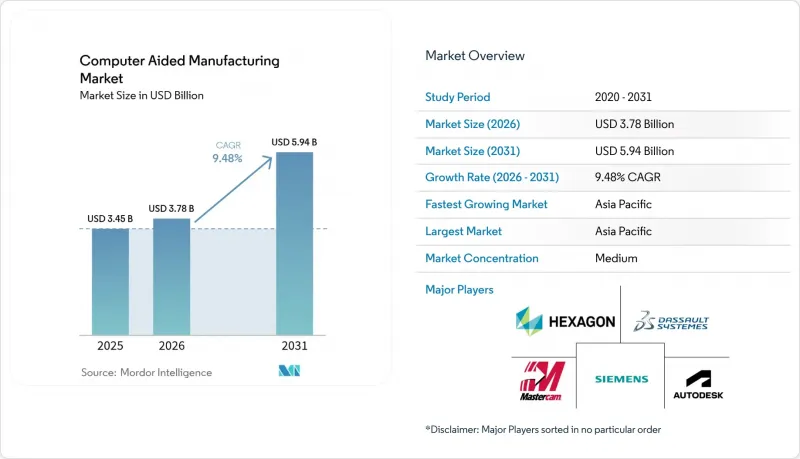
本報告按部署模式(本地部署和雲端部署)、終端用戶產業(航太與國防、汽車、醫療設備等)、組件(軟體和服務)、製造程序(銑削、車削、鑽孔等)以及地區(北美、南美、歐洲、亞太等)進行細分。市場預測以美元計價。
全球電腦輔助製造 (CAM) 市場趨勢與洞察
混合加工中心的興起正在改變生產的經濟模式。
此混合系統將雷射或定向能量沉積與高速精加工整合於同一機殼內,無需二次設置,並可減少高達 40% 的原料浪費。西門子 NX 現在可自動產生輪胎邊緣熔敷和精加工刀具路徑,使製造商能夠僅在需要的地方沉積材料,並獲得航太輪胎邊緣表面光潔度,從而將複雜鈦零件的整體加工週期縮短 25% 至 30%。然而,實際應用中仍需要訓練有素的操作人員在微秒級的時限內同步沉積和切割動作,而大多數訂單的工廠都缺乏這種技能。
工業4.0的數位線程實現了預測性製造。
封閉回路型平台將CAM編程參數與主軸輸出、振動和刀具磨損的即時感測器數據相結合。 Hexagon的演算法能夠提前15-20分鐘偵測刀具故障,並自動調整進給速度,從而將表面品質保持在公差範圍內,進而減少易碎航太合金的廢品率。由於這些解決方案需要高密度感測器網路和高吞吐量的分析處理,因此其部署僅限於那些零件價值足以支撐資本投資的工廠。
開放原始碼CAM替代方案對商業定價模式提出了挑戰。
FreeCAD PathWorkbench 現在無需支付許可費即可輸出 2.5 軸 G 代碼,已成為學校和小規模工作室可靠的入門級選擇。商業供應商則透過捆綁人工智慧驅動的最佳化和雲端協作等功能來與之抗衡。雖然這些功能的運算能力超越了大多數社群項目,但它們也必須解決基礎模組商品化的問題。
細分市場分析
儘管雲端託管套件在整個電腦輔助製造 (CAM) 市場中仍佔少數,但預計到 2031 年將以 10.72% 的複合年成長率成長,這表明這一趨勢不可逆轉。一家在三大洲均設有工廠的航太集團正在利用基於瀏覽器的刀具路徑編輯功能,實現夜間作業,將前置作業時間縮短了 20-25%。由於 ITAR 法規要求現場資料主權,國防承包商不願完全轉型。因此,由本地後處理器連接到雲端求解器組成的混合堆疊正在彌合這一差距。邊緣閘道器可以改造缺少 OPC-UA 或 MTConnect 的舊機器,無需更換控制器即可傳輸加密資料。訂閱模式正在將成本從資本預算轉移到營運支出,這對以前推遲軟體升級的小規模工廠來說是一項重大優勢。雲端分析還允許供應商對匿名機器組的主軸運轉率進行基準測試,並將資料反映在預測性維護儀表板中,從而大幅減少非計劃性停機時間。隨著零信任架構的成熟,即使是保守的行業也計劃在 2027 年前進行試點遷移,這表明電腦輔助製造 (CAM) 市場將在下一個預算週期內克服採用雲端的心理障礙。
然而,對於採用空氣間隙網路和獨特合金配方的工廠而言,本地部署基礎設施仍然至關重要。供應商正試圖透過授權「數位線程」模組來吸引這些客戶。這些模組雖然部署在防火牆後,但會將選定的元資料同步到雲端,以便遠端專家存取。這種雙管齊下的策略確保了穩定的授權續訂,並在客戶轉向混合分析時提高了經常性收入。未來,隨著雲端運算額度根據平台訂閱等級的啟用或停用而生效,針對每種部署模式的單獨定價可能會消失。如今,工具機網路風險已反映在網路保險費中,財務長們正擴大將安全認證納入總體擁有成本 (TCO) 的計算中。因此,電腦輔助製造 (CAM) 市場正從雲端與本地部署的二元對立模式演變為靈活的租戶模式。
到2025年,汽車產業將佔銷售額的35.85%,成為更廣泛的電腦輔助製造市場的核心組成部分。然而,從內燃機零件加工到電動車零件加工的轉變,對沿用多年的刀具路徑庫提出了挑戰。例如,在加工高矽鋁材的電池托盤時,需要採用薄壁加工策略來抑制顫振,同時維持加工效率。同時,航太和國防領域雖然規模較小,但也需要用於五軸加工和複合材料加工的高級許可證。醫療設備製造商正在利用人工智慧驅動的參數調整來滿足ISO 13485可追溯性要求,即使在單人操作的電池生產中,也能在無需人工編輯的情況下實現小於10µm的公差。電子和半導體封裝產業的操作員需要熱最佳化鑽孔順序,以防止在100,000rpm的鑽孔速度下出現銅層剝離。這是一個小眾領域,但現代CAM模組正透過實體求解器來滿足這項需求。行業間的相互影響力也不斷增強。醫療設備製造商正在採用航太表面處理流程,汽車零件供應商正在將晶圓製造廠的無塵室標準應用於電池模組,從而擴大了電腦輔助製造 (CAM) 的整體潛在市場。
汽車製造業內部的多元化發展同樣令人矚目。結構件的超大規模鑄造無需數十個沖壓成型零件,但同時也需要對壓鑄鋁進行大批量數控精加工,這就要求極高的材料去除率和可靠的刀具壽命模型。投資這些生產線的供應商正在尋求能夠自動補償刀具磨損偏差的軟體,以確保在20小時無人值守運作期間的穩定運作。相較之下,小眾超級跑車製造商則專注於碳纖維裝飾件,使用五軸銑床,並在每個生產週期中透過探針更新加工路徑。這種多元化意味著單一垂直市場涵蓋了多個CAM許可級別,從而確保即使汽車總產量趨於穩定,電腦輔助製造(CAM)市場也能保持其深度。
區域分析
儘管中國在亞太地區46.75%的市佔率凸顯了其在製造業的重要地位,但該地區仍飽受數控協議碎片化的困擾,難以實現即插即用的互通性。中國的政策傾向使用與國產控制器配對的專有CAM演算法,從而形成了一個平行的生態系統。全球供應商需要透過雙語後處理器和開放API工具庫來彌合這一差距。日本工具機OEM廠商將CAM直接整合到其控制韌體中,雖然縮短了刀具路徑載入時間,但也讓客戶只能使用專有軟體。印度的生產連結獎勵計畫(PLI)計畫透過補貼與勞動力技能發展掛鉤的CAM許可,幫助供應商在這個新興的中型市場站穩腳跟,並有望在2030年與傳統巨頭展開競爭。
北美用戶在雲端技術應用方面處於領先。原因之一是《晶片製造和整合法案》(CHIPS Act)已投資520億美元用於區域晶圓廠建設,要求在實體設施建成前就採用分散式程式設計。歐洲則致力於推廣節能製造,強制要求設定壓縮空氣消耗減少和工具重複利用的目標。相較之下,CAM策略模擬器目前仍以每零件千瓦時為單位進行建模。儘管資料主權法規構成了一定的障礙,但一級供應商正在積極採用區域資料湖,以換取跨工廠最佳化演算法的使用權。這些區域差異維持了電腦輔助製造(CAM)市場的多樣性,從而減輕了特定地區景氣衰退的影響。
其他好處:
- Excel格式的市場預測(ME)表
- 3個月的分析師支持
目錄
第1章:引言
- 研究假設和市場定義
- 調查範圍
第2章:調查方法
第3章執行摘要
第4章 市場狀況
- 市場概覽
- 市場促進因素
- 混合式(切削+積層製造)加工中心數量增加
- 擴大與工業4.0相容的數位線程的應用
- 先進封裝生產線對超精密元件的需求
- 電動車平台在地化對敏捷生產的需求
- 遷移到雲端原生CAM以實現多站點協作
- 政府採取措施促進戰略部門的國內人員遣返
- 市場限制因素
- 開放原始碼/低成本CAM替代方案的激增
- 長期缺乏NC程式設計與後處理技能
- 國防企業採用雲端運算相關的智慧財產權 (IP) 安全問題
- 工具機控制器規格的差異
- 產業價值鏈分析
- 監理情勢
- 技術展望
- 宏觀經濟因素的影響
- 波特五力分析
第5章 市場規模與成長預測
- 按部署模式
- 現場
- 基於雲端的
- 按最終用戶行業分類
- 航太/國防
- 車
- 醫療器材
- 能源公用事業
- 電子和半導體
- 工業機械
- 按組件
- 軟體
- 服務
- 透過製造程序
- 粉碎
- 轉彎
- 挖掘
- 多軸/5軸
- 積層製造
- 按地區
- 北美洲
- 美國
- 加拿大
- 墨西哥
- 南美洲
- 巴西
- 阿根廷
- 其他南美國家
- 歐洲
- 德國
- 英國
- 法國
- 俄羅斯
- 其他歐洲國家
- 亞太地區
- 中國
- 日本
- 印度
- 韓國
- 東南亞
- 其他亞太國家
- 中東和非洲
- 中東
- 沙烏地阿拉伯
- 阿拉伯聯合大公國
- 其他中東國家
- 非洲
- 南非
- 埃及
- 其他非洲國家
- 中東
- 北美洲
第6章 競爭情勢
- 市場集中度
- 策略趨勢
- 市佔率分析
- 公司簡介
- Autodesk Inc.
- Siemens Digital Industries Software(Siemens AG)
- Dassault Systemes SE
- Hexagon AB(Hexagon Manufacturing Intelligence)
- CNC Software LLC(Mastercam)
- HCL Technologies Ltd.
- OPEN MIND Technologies AG
- SolidCAM Ltd.
- Cimatron Ltd.
- NTT Data Engineering Systems Corp.
- BobCAD-CAM Inc.
- MecSoft Corporation
- PTC Inc.
- ZWSOFT Co. Ltd.
- SmartCAMcnc Inc.
- GibbsCAM(3D Systems Corp.)
- Hypertherm Inc.
- SprutCAM Tech Ltd.
第7章 市場機會與未來展望
According to Mordor Intelligence, the computer aided manufacturing market size is expected to grow from USD 3.45 billion in 2025 to USD 3.78 billion in 2026 and is forecast to reach USD 5.94 billion by 2031 at 9.48% CAGR over 2026-2031.
This report is Segmented by Deployment Model (On-Premises, and Cloud-Based), End-User Industry (Aerospace and Defense, Automotive, Medical Devices, and More), Component (Software, and Services), Manufacturing Process (Milling, Turning, Drilling, and More), and Geography (North America, South America, Europe, Asia-Pacific, and More). The Market Forecasts are Provided in Terms of Value (USD).
Global Computer Aided Manufacturing Market Trends and Insights
Rise in Hybrid Machining Centers Transforms Production Economics
Hybrid systems integrate laser or directed-energy deposition with high-speed finishing inside one enclosure, eliminating secondary setups and cutting raw-material waste by up to 40%. Siemens NX now automates bead-on-wall deposition and finishing toolpaths so manufacturers deposit material only where needed before achieving aerospace-grade surface finish, reducing overall cycle time for complex titanium parts by 25-30%. Real-world rollouts still hinge on operators trained to synchronize additive and subtractive motions within microsecond windows, a skill set in short supply across most job shops.
Industry 4.0 Digital Threads Enable Predictive Manufacturing
Closed-loop platforms connect CAM programming parameters to real-time spindle power, vibration, and tool-wear sensors. Hexagon algorithms detect impending tool failure 15-20 minutes in advance and auto-adjust feed rates to hold surface quality within tolerance, mitigating scrap on fragile aerospace alloys. These solutions require dense sensor networks and high-throughput analytics, restricting adoption to plants where part value justifies the capital outlay.
Open-Source CAM Alternatives Challenge Commercial Pricing Models
FreeCAD PathWorkbench now outputs 2.5-axis G-code at no license cost, making it a credible entry-level choice for schools and micro-workshops. Commercial vendors counter by bundling AI-driven optimization and cloud collaboration, features that exceed the computing means of most community projects, yet must guard against basic modules edging toward commoditization.
Other drivers and restraints analyzed in the detailed report include:
- Ultra-Precision Packaging Lines Drive CAM Innovation
- EV Platform Localization Accelerates Precision Machining Demand
- Skills Gap in CNC Programming Constrains Market Expansion
For complete list of drivers and restraints, kindly check the Table Of Contents.
Segment Analysis
Cloud-hosted suites still represent a minority of the overall Computer Aided Manufacturing market, but their 10.72% CAGR through 2031 underscores an irreversible direction. Aerospace groups with plants on three continents rely on browser-based toolpath editing to hand off jobs overnight, trimming lead times by 20-25%. Defense contractors resist full migration because ITAR rules demand onsite data sovereignty; consequently, hybrid stacks local post-processors linked to cloud solvers form the bridge. Edge gateways retrofit older machines lacking OPC-UA or MTConnect, letting them stream encrypted data without controller replacement. Subscription models shift costs from capital budgets to operating expenses, a boon for small shops that previously deferred software upgrades. Cloud analytics also enable vendors to benchmark spindle utilization across an anonymized fleet, feeding predictive-maintenance dashboards that slash unscheduled downtime. As zero-trust architectures mature, even conservative sectors plan pilot migrations by 2027, suggesting the Computer Aided Manufacturing market will cross a psychological cloud-adoption threshold within the next budget cycle.
The on-premises base nevertheless remains indispensable for plants with air-gapped networks and proprietary alloy formulations. Vendors court these accounts by licensing digital-thread modules that reside behind the firewall yet sync selected metadata to a cloud vault for remote experts. This twin-track strategy stabilizes license renewals while boosting recurring revenue as customers graduate to hybrid analytics. Over time, discrete pricing between deployment modes may vanish as platform subscription tiers simply toggle cloud compute credits on or off. With cyber-insurance premiums now reflecting machine-tool network exposure, CFOs increasingly factor security accreditation into total cost of ownership. Consequently, the Computer-Aided Manufacturing market is evolving toward flexible tenancy rather than binary cloud-versus-on-site choices.
Automotive held 35.85% revenue in 2025, making it the anchor segment of the broader Compute Aided Manufacturing market. Yet the shift from internal-combustion machining to electric-vehicle parts challenges long-standing toolpath libraries. Battery tray milling demands thin-wall strategies that manage chatter while sustaining throughput in high-silicon aluminum. Meanwhile, aerospace and defense, though smaller, command premium licenses for 5-axis and composite machining. Medical-device firms adopt AI-assisted parameter tuning to meet ISO 13485 traceability, letting single-operator cells hit sub-10 µm tolerances without manual edits. Electronics and semiconductor packaging operators require thermal-aware drill sequencing to prevent copper delamination during 100,000-rpm via drilling, a niche that the latest CAM modules fulfill through physics solvers. Cross-pollination is rising: medical device shops replicate aerospace surface-finish routines, while automotive tiers import wafer-fab cleanliness protocols for battery modules, expanding the total addressable market of Computer Aided Manufacturing.
Diversification inside automaking is equally profound. Gigacasting of structural components eliminates dozens of stamped parts, but introduces massive CNC finishing of die-cast aluminum, requiring high material-removal rates and robust tool-life models. Suppliers investing in these cells demand software that auto-compensates for tool-wear drift across 20-hour unmanned shifts. In contrast, niche hypercar builders focus on carbon-fiber trim, using 5-axis routers and probe-based path updates each production cycle. Such divergence means one vertical now spans multiple CAM license tiers, ensuring that the Computer Aided Manufacturing market retains depth even if overall car volumes level off.
Complete Report Scope:
- By Deployment Model
- On-Premises
- Cloud-Based
- By End-User Industry
- Aerospace and Defence
- Automotive
- Medical Devices
- Energy and Utilities
- Electronics and Semiconductor
- Industrial Machinery
- By Component
- Software
- Services
- By Manufacturing Process
- Milling
- Turning
- Drilling
- Multi-Axis / 5-Axis
- Additive Manufacturing
- By Geography
- North America
- United States
- Canada
- Mexico
- South America
- Brazil
- Argentina
- Rest of South America
- Europe
- Germany
- United Kingdom
- France
- Russia
- Rest of Europe
- Asia-Pacific
- China
- Japan
- India
- South Korea
- South-East Asia
- Rest of Asia-Pacific
- Middle East and Africa
- Middle East
- Saudi Arabia
- United Arab Emirates
- Rest of Middle East
- Africa
- South Africa
- Egypt
- Rest of Africa
- Middle East
- North America
Geography Analysis
Asia-Pacific's 46.75% share underscores its manufacturing heft, yet the region still wrestles with CNC protocol fragmentation that complicates plug-and-play interoperability. Chinese policy favors indigenous CAM algorithms tied to homegrown controllers, spurring parallel ecosystems that global vendors must bridge through dual-language post-processors and open-API tool libraries. Japan's machine OEMs integrate CAM directly into control firmware, shortening toolpath load times but locking customers into proprietary stacks. India's Production Linked Incentive schemes subsidize CAM licenses if tied to workforce upskilling, giving vendors a foothold in an emerging mid-market that could rival traditional giants by 2030.
North American users lead in cloud adoption, partly because the CHIPS Act funnels USD 52 billion into regional fabs that require distributed programming sooner than brick-and-mortar capacity is completed. Europe champions energy-efficient machining, mandating compressed-air reduction and tool reuse targets that CAM strategy simulators now model in kilowatt-hours per part. Data-sovereignty rules add friction, but tier-one suppliers accept localized data lakes in exchange for cross-plant optimization algorithms. These regional nuances ensure the Computer Aided Manufacturing market maintains broad diversification, cushioning it against localized downturns.
- Autodesk Inc.
- Siemens Digital Industries Software (Siemens AG)
- Dassault Systemes SE
- Hexagon AB (Hexagon Manufacturing Intelligence)
- CNC Software LLC (Mastercam)
- HCL Technologies Ltd.
- OPEN MIND Technologies AG
- SolidCAM Ltd.
- Cimatron Ltd.
- NTT Data Engineering Systems Corp.
- BobCAD-CAM Inc.
- MecSoft Corporation
- PTC Inc.
- ZWSOFT Co. Ltd.
- SmartCAMcnc Inc.
- GibbsCAM (3D Systems Corp.)
- Hypertherm Inc.
- SprutCAM Tech Ltd.
Additional Benefits:
- The market estimate (ME) sheet in Excel format
- 3 months of analyst support
TABLE OF CONTENTS
1 INTRODUCTION
- 1.1 Study Assumptions and Market Definition
- 1.2 Scope of the Study
2 RESEARCH METHODOLOGY
3 EXECUTIVE SUMMARY
4 MARKET LANDSCAPE
- 4.1 Market Overview
- 4.2 Market Drivers
- 4.2.1 Rise in hybrid (subtractive + additive) machining centres
- 4.2.2 Expanding adoption of Industry 4.0-ready digital threads
- 4.2.3 Demand for ultra-precision parts in advanced packaging lines
- 4.2.4 Agile production needs for EV platform localisation
- 4.2.5 Shift toward cloud-native CAM for multi-site collaboration
- 4.2.6 Government re-shoring incentives for strategic sectors
- 4.3 Market Restraints
- 4.3.1 Proliferation of open-source / low-cost CAM alternatives
- 4.3.2 Persistent skills gap in NC programming and post-processing
- 4.3.3 IP-security concerns with cloud adoption in defence firms
- 4.3.4 Fragmented machine-tool controller standards
- 4.4 Industry Value Chain Analysis
- 4.5 Regulatory Landscape
- 4.6 Technological Outlook
- 4.7 Impact of Macroeconomic Factors
- 4.8 Porter's Five Forces Analysis
- 4.8.1 Bargaining Power of Suppliers
- 4.8.2 Bargaining Power of Buyers
- 4.8.3 Threat of New Entrants
- 4.8.4 Threat of Substitutes
- 4.8.5 Intensity of Competitive Rivalry
5 MARKET SIZE AND GROWTH FORECASTS (VALUE)
- 5.1 By Deployment Model
- 5.1.1 On-Premises
- 5.1.2 Cloud-Based
- 5.2 By End-User Industry
- 5.2.1 Aerospace and Defence
- 5.2.2 Automotive
- 5.2.3 Medical Devices
- 5.2.4 Energy and Utilities
- 5.2.5 Electronics and Semiconductor
- 5.2.6 Industrial Machinery
- 5.3 By Component
- 5.3.1 Software
- 5.3.2 Services
- 5.4 By Manufacturing Process
- 5.4.1 Milling
- 5.4.2 Turning
- 5.4.3 Drilling
- 5.4.4 Multi-Axis / 5-Axis
- 5.4.5 Additive Manufacturing
- 5.5 By Geography
- 5.5.1 North America
- 5.5.1.1 United States
- 5.5.1.2 Canada
- 5.5.1.3 Mexico
- 5.5.2 South America
- 5.5.2.1 Brazil
- 5.5.2.2 Argentina
- 5.5.2.3 Rest of South America
- 5.5.3 Europe
- 5.5.3.1 Germany
- 5.5.3.2 United Kingdom
- 5.5.3.3 France
- 5.5.3.4 Russia
- 5.5.3.5 Rest of Europe
- 5.5.4 Asia-Pacific
- 5.5.4.1 China
- 5.5.4.2 Japan
- 5.5.4.3 India
- 5.5.4.4 South Korea
- 5.5.4.5 South-East Asia
- 5.5.4.6 Rest of Asia-Pacific
- 5.5.5 Middle East and Africa
- 5.5.5.1 Middle East
- 5.5.5.1.1 Saudi Arabia
- 5.5.5.1.2 United Arab Emirates
- 5.5.5.1.3 Rest of Middle East
- 5.5.5.2 Africa
- 5.5.5.2.1 South Africa
- 5.5.5.2.2 Egypt
- 5.5.5.2.3 Rest of Africa
- 5.5.5.1 Middle East
- 5.5.1 North America
6 COMPETITIVE LANDSCAPE
- 6.1 Market Concentration
- 6.2 Strategic Moves
- 6.3 Market Share Analysis
- 6.4 Company Profiles (includes Global level Overview, Market level overview, Core Segments, Financials as available, Strategic Information, Market Rank/Share for key companies, Products and Services, and Recent Developments)
- 6.4.1 Autodesk Inc.
- 6.4.2 Siemens Digital Industries Software (Siemens AG)
- 6.4.3 Dassault Systemes SE
- 6.4.4 Hexagon AB (Hexagon Manufacturing Intelligence)
- 6.4.5 CNC Software LLC (Mastercam)
- 6.4.6 HCL Technologies Ltd.
- 6.4.7 OPEN MIND Technologies AG
- 6.4.8 SolidCAM Ltd.
- 6.4.9 Cimatron Ltd.
- 6.4.10 NTT Data Engineering Systems Corp.
- 6.4.11 BobCAD-CAM Inc.
- 6.4.12 MecSoft Corporation
- 6.4.13 PTC Inc.
- 6.4.14 ZWSOFT Co. Ltd.
- 6.4.15 SmartCAMcnc Inc.
- 6.4.16 GibbsCAM (3D Systems Corp.)
- 6.4.17 Hypertherm Inc.
- 6.4.18 SprutCAM Tech Ltd.
7 MARKET OPPORTUNITIES AND FUTURE OUTLOOK
- 7.1 White-space and Unmet-Need Assessment

 CAM軟體市場(截至2034年)
 電腦輔助製造(CAM)市場-2026-2032年全球市場預測
 電腦輔助製造 (CAM) 市場預測至 2034 年—按組件、部署模式、機器類型、應用、產業和地區分類的全球分析
 2026年全球生產計畫工具市場報告2026年全球虛擬原型市場報告2026年全球電腦輔助製造市場報告
 虛擬原型市場:按應用和地區分類
 全球虛擬原型市場規模、佔有率、趨勢和成長分析報告:2026-2034年2032 年電腦輔助製造 (CAM) 市場預測:按產品、CAM 類型、部署模式、應用、最終用戶和地區進行的全球分析
 電腦輔助製造市場規模、佔有率、成長分析,按產品、按應用、按功能、按部署模式、按組織規模、按行業、按地區 - 行業預測,2025-2032 年