


 |
市場調查報告書
商品編碼
2126795
全球鋼筋市場:按類型、製程、塗佈類型、鋼筋直徑、最終用途產業和地區分類-預測至2031年Steel Rebar Market by Type (Deformed, Mild), Process (BOS, EAF), Coating Type (Plain, Galvanized, Epoxy Coated), Bar Size (#3, #4, #5, #8), End-use Sector (Infrastructure, Housing, Industrial), and Region - Global Forecast to 2031 |
||||||


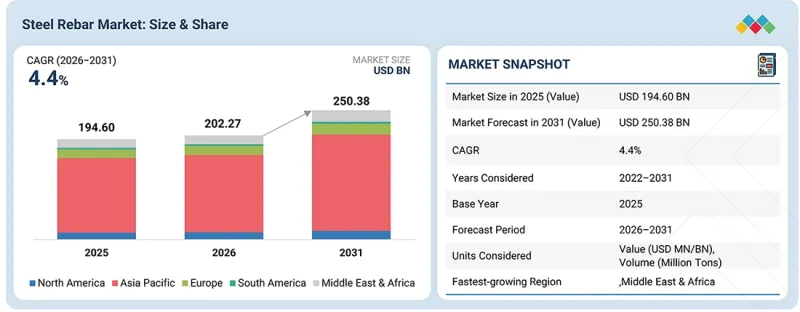
預計鋼筋市場將從 2026 年的 2,022.7 億美元成長到 2031 年的 2,503.8 億美元,預測期內複合年成長率為 4.4%。
預計基礎設施、建築和工業領域的建設活動增加將推動這一成長。對公路、橋樑、鐵路、城市基礎設施項目、可再生能源項目和住宅開發等投資的增加預計將對這一成長做出重大貢獻。
| 調查範圍 | |
|---|---|
| 調查期 | 2022-2031 |
| 基準年 | 2025 |
| 預測期 | 2026-2031 |
| 計算單位 | 金額(100萬美元/10億美元) 數量(100萬噸) |
| 部分 | 按類型、工藝、塗層類型、棒材直徑、最終用途行業和地區 |
| 目標區域 | 北美洲、亞太地區、歐洲、中東和非洲、南美洲 |
此外,隨著都市化、人口成長和工業化,對鋼筋的需求預計將會增加,從而推動鋼筋混凝土結構在各個領域的發展。
“預計從 2026 年到 2031 年,電弧爐 (EAF) 領域將呈現最高的複合年成長率。”
由於對低碳和永續鋼鐵生產的需求不斷成長,預計電弧爐(EAF)領域在預測期內將實現最高的複合年成長率。電弧爐製程使鋼鐵生產商能夠利用更多的廢鐵,從而減少對未充分利用原料的依賴,並降低鋼鐵生產的碳排放強度。此外,由於政府和鋼鐵生產商日益重視脫碳和綠色鋼鐵生產,電弧爐領域正經歷顯著成長。對採用電弧爐的生產設施投資增加、廢鐵供應充足以及對低碳鋼筋的需求不斷成長等因素,預計將推動該領域的成長。
“預計從 2026 年到 2031 年,第三細分市場將呈現最高的複合年成長率。”
由於住宅建築和小規模建築工程中3號鋼筋的使用量不斷增加,預計在預測期內,3號鋼筋的複合年成長率(CAGR)將最高。 3號鋼筋易於搬運、彎曲和安裝,適用於樓板、牆壁、地基、車道以及各種鋼筋混凝土結構。 3號鋼筋日益普及的原因在於住宅的成長以及小規模基礎設施項目的增加。都市化、住宅開發以及對高效鋼筋解決方案的需求等因素預計將在預測期內推動3號鋼筋的成長。
“預計從2026年到2031年,基礎設施領域的複合年成長率將最高。”
按最終用途產業分類,預計基礎設施領域在預測期內將呈現最高的複合年成長率。這一成長主要得益於各領域基礎設施開發項目投資的增加,包括交通運輸、都市化、能源和一般基礎設施。此外,道路、橋樑、鐵路、機場、港口和可再生能源基礎設施的建設增加也推動了該領域的成長。開發中國家政府在現代化和大型基礎設施項目上的支出也促進了鋼筋需求的成長。不斷成長的都市化和基礎設施維修需求也導致了鋼筋消費量的成長。
“預計從 2026 年到 2031 年,未塗層碳鋼市場將呈現最高的複合年成長率。”
在所有塗層鋼筋中,未塗層碳鋼預計將達到最高的複合年成長率。這一成長主要歸功於未塗層碳鋼鋼筋在傳統建築項目中的廣泛應用,以及其相比塗層鋼筋更具成本效益。由於產品供應充足、生產基礎雄厚,且適用於住宅、商業、工業和基礎設施項目,未塗層碳鋼市場預計將快速擴張。此外,新興國家建設活動的增加和基礎設施項目投資的擴大預計也將推動對未塗層碳鋼的需求。
“預計從 2026 年到 2031 年,變形鋼筋構件的複合年成長率將高於普通鋼筋構件。”
從鋼筋類型來看,變形鋼筋由於其優異的抗張強度、與混凝土的黏結力以及比普通鋼筋更高的承載能力,預計在預測期內將保持較高的複合年成長率。變形鋼筋在住宅、商業、工業和基礎設施建設等領域的應用日益廣泛。大規模建設項目中對耐用、堅固鋼筋的需求不斷成長,是推動變形鋼筋應用的重要因素之一。此外,基礎設施投資的增加、都市化的推進以及高層建築的建設,預計也將推動該領域在預測期內持續成長。
“預計中東和非洲地區在預測期內將錄得最高的複合年成長率。”
預計在預測期內,中東和非洲地區將在全球鋼筋市場中實現最高的複合年成長率,這主要得益於住宅、工業和城市建設項目投資的增加。該地區正經歷大規模的建設活動,尤其是在交通基礎設施、商業建築、住宅項目和能源基礎設施領域。此外,政府的多元化計畫和對旅遊業的投資也推動了這一建築熱潮。快速的都市化和人口成長預計將增加對鋼筋混凝土和鋼筋的需求。
涵蓋的公司:本報告涵蓋了安賽樂米塔爾(盧森堡)、紐柯公司(美國)、NLMK集團(俄羅斯)、新日鐵株式會社(日本)和塔塔鋼鐵(印度)等公司。
本研究對鋼筋市場的主要參與者進行了詳細的競爭分析,包括公司簡介、近期發展和主要市場策略。
調查範圍
本研究報告根據鋼筋類型(低碳鋼筋、變形鋼筋)、塗層類型(未塗裝碳鋼、環氧塗層、鍍鋅)、鋼筋直徑(3號、4號、5號、8號及其他規格)、終端用戶產業(基礎設施、住宅、工業)、加工製程(爐排、電弧爐)和地區(亞太地區、北美地區、歐洲市場細分市場。報告涵蓋了影響鋼筋市場成長的促進因素、阻礙因素、挑戰和機會的詳細資訊。該報告對主要行業參與者進行了深入分析,以提供有關其業務概況、產品供應和關鍵策略(例如市場合作、收購和擴張)的見解。此外,報告也對鋼筋市場生態系統中新興的新創公司進行了競爭分析。
購買本報告的理由
本報告為市場領導及新參與企業提供最精確的鋼筋市場整體及各細分市場收入估算。它幫助相關人員了解競爭格局,深入洞察市場動態以最佳化業務定位,並制定合適的打入市場策略。此外,本報告還幫助相關人員了解市場,提供關鍵市場促進因素、阻礙因素、挑戰和機會的資訊。
本報告深入分析了以下幾點:
對關鍵促進因素(新興經濟體城市公共交通系統的擴張、可再生能源基礎設施的強勁需求以及新興經濟體的再工業化和製造業園區的發展)、制約因素(進口關稅和反傾銷措施,以及廢煤和焦煤價格的波動)、機遇(採用氫基直接還原的綠色鋼筋建築部門以及與預製結構的非經濟化和非經濟化的基礎來分析
- 產品開發/創新:深入了解鋼筋市場的未來技術、研發活動以及產品/服務發布。
- 市場發展:盈利市場的全面資訊-本報告分析了各個地區的鋼筋市場。
市場多元化:全面介紹鋼筋市場的新產品和服務、未開發的市場、近期趨勢和投資機會。
- 競爭評估:對安賽樂米塔爾(盧森堡)、紐柯公司(美國)、NLMK集團(俄羅斯)、新日鐵(日本)和塔塔鋼鐵(印度)等主要公司的市場佔有率、成長策略和服務產品進行詳細評估。
目錄
第1章:引言
第2章執行摘要
第3章重要考察
第4章 市場概覽
- 市場動態
- 促進因素
- 抑制因子
- 機會
- 任務
- 未滿足的需求和未開發的領域
- 相互關聯的市場與跨產業機遇
- 一級企業的策略性舉措
第5章 產業趨勢
- 波特五力分析
- 宏觀經濟分析
- 價值鏈分析
- 生態系分析
- 貿易分析
- 2026年重大會議和活動
- 影響客戶業務的趨勢/顛覆性因素
- 投資和資金籌措場景
- 2025年美國關稅的影響:鋼筋市場
第6章:透過採用技術、專利、數位技術和人工智慧實現策略顛覆
- 主要技術
- 互補技術
- 鄰近技術
- 技術/產品藍圖
- 專利分析
- 未來應用
- 人工智慧/生成式人工智慧對鋼筋市場的影響
- 成功案例和實際應用
第7章永續性和監管情勢
- 當地法規和合規性
- 對永續性的承諾
- 監理政策對永續性舉措的影響
第8章:顧客趨勢與購買行為
- 決策流程
- 買方相關人員和採購評估標準
- 實施障礙和內部挑戰
- 各領域尚未滿足的需求
- 市場盈利
第9章:鋼筋市場(按類型分類)
- 變形鋼筋
- 低碳鋼筋
第10章:鋼筋市場(依工藝分類)
- 基本煉鐵方法
- 電弧爐
第11章:鋼筋市場(依塗層類型分類)
- 普通碳鋼鋼筋
- 鍍鋅鋼筋
- 環氧樹脂塗層鋼筋
第12章:鋼筋市場(以鋼筋直徑分類)
- 3號桿直徑
- 4號桿直徑
- 5號桿直徑
- 8號桿直徑
- 其他
第13章:鋼筋市場(依終端用戶產業分類)
- 基礎設施
- 住宅
- 產業
第14章:鋼筋市場(依地區分類)
- 北美洲
- 美國
- 加拿大
- 墨西哥
- 亞太地區
- 亞太地區鋼筋市場(按國家/地區分類)
- 中國
- 印度
- 日本
- 韓國
- 澳洲
- 其他
- 歐洲
- 歐洲鋼筋市場(按國家/地區分類)
- 德國
- 英國
- 法國
- 義大利
- 西班牙
- 俄羅斯
- 烏克蘭
- 土耳其
- 其他
- 中東和非洲
- 中東和非洲鋼筋市場(按國家/地區分類)
- 海灣合作理事會國家
- 南非
- 其他
- 南美洲
- 巴西
- 阿根廷
- 其他
第15章 競爭格局
- 概述
- 大公司的策略
- 市佔率分析
- 收入分析
- 企業估值和財務指標
- 產品/品牌對比
- 企業估值矩陣:主要公司,2025 年
- 公司估值矩陣:新創企業/中小企業,2025 年
- 競爭格局
第16章:公司簡介
- 大公司
- NIPPON STEEL CORPORATION
- ARCELORMITTAL
- GERDAU S/A
- NUCOR CORPORATION
- COMMERCIAL METALS COMPANY
- TATA STEEL
- STEEL AUTHORITY OF INDIA LIMITED
- MECHEL PAO
- STEEL DYNAMICS INC.
- NLMK GROUP
- JSW
- BAOSTEEL GROUP CO., LTD
- 其他公司
- METINVEST
- PAO SEVERSTAL
- BYER STEEL CORPORATION
- DAIDO STEEL CO. LTD.
- ACERINOX
- HYUNDAI STEEL
- JIANGSU SHAGANG GROUP CO., LTD
- HBIS GROUP CO., LTD
- EVRAZ PLC
- SWISS STEEL GROUP
- SUNFLAG IRON AND STEEL CO. LTD
- OUTOKUMPU
- 7 STEEL UK
第17章調查方法
第18章附錄
The steel rebar market is projected to grow from USD 202.27 billion in 2026 to USD 250.38 billion by 2031, at a CAGR of 4.4% during the forecast period. This growth is anticipated to be driven by an increase in construction activities across infrastructure, buildings, and industries. Factors such as higher investments in highways, bridges, railroads, urban infrastructure projects, renewable energy initiatives, and housing developments will significantly contribute to this growth.
| Scope of the Report | |
|---|---|
| Years Considered for the Study | 2022-2031 |
| Base Year | 2025 |
| Forecast Period | 2026-2031 |
| Units Considered | Value (USD Million/Billion) Volume (Million Tons) |
| Segments | Type, Coating Type, Process, Bar Size, End-use Sector, and Region |
| Regions covered | North America, Asia Pacific, Europe, Middle East & Africa, and South America |
Additionally, the demand for steel reinforcement bars will rise due to urbanization, population growth, and industrialization, leading to the development of reinforced concrete structures across various sectors.
"Electric arc furnace (EAF) segment projected to exhibit the highest CAGR from 2026 to 2031"
The EAF segment is expected to witness the highest CAGR during the forecast period due to the growing preference for low-carbon and sustainable steel production. The EAF process allows steel producers to utilize a greater amount of scrap steel, which reduces their reliance on virgin raw materials and lowers the carbon intensity associated with steel manufacturing. Additionally, the EAF segment is experiencing significant growth due to the increasing emphasis on decarbonization and the production of green steel by both governments and steel manufacturers. Factors such as rising investments in EAF-based production facilities, a plentiful supply of scrap steel, and a growing demand for low-carbon rebar are expected to drive the growth of this segment.
"#3 segment projected to exhibit the highest CAGR from 2026 to 2031"
The #3 bar size category is expected to show the maximum CAGR during the forecast period owing to its rising use in residential and light-to-medium construction purposes. #3 rebars provide easy handling, bending, and installation, making them applicable for slabs, walls, footings, driveways, and various reinforced concrete constructions. The growing popularity of the #3 bar size category can be attributed to the increase in residential construction and smaller to medium-scale infrastructure projects. Factors such as urbanization, housing developments, and the demand for efficient reinforcement solutions are expected to drive the growth of the #3 bar size category during the forecast period.
"Infrastructure segment projected to exhibit the highest CAGR from 2026 to 2031"
By end-use sector, the infrastructure segment is expected to experience the highest CAGR during the forecast period. This growth is driven by increased investments in infrastructure development projects across various sectors, including transportation, urbanization, energy, and general infrastructure. The rise in this segment can also be linked to the growing construction of roads, bridges, railways, airports, ports, and renewable energy infrastructure. Additionally, government spending on modernization and major infrastructure projects in developing countries is contributing to the rising demand for steel rebars. Moreover, urbanization and the need for infrastructure upgrades are leading to an increased consumption of steel rebar.
"Plain carbon segment projected to exhibit the highest CAGR from 2026 to 2031"
The plain carbon segment is expected to experience the highest CAGR among coating types. This growth can be attributed to the widespread use of plain carbon rebars in traditional construction projects and their cost-effectiveness compared to coated alternatives. The plain carbon segment is anticipated to expand rapidly due to the product's availability, a strong manufacturing base, and its suitability for residential, commercial, industrial, and infrastructural projects. Additionally, increasing construction activities in emerging economies and rising investments in infrastructure projects are expected to drive demand for plain carbon rebar.
"Deformed segment projected to exhibit higher CAGR than mild segment from 2026 to 2031"
By type, the deformed segment is likely to register a higher CAGR over the forecast period on account of its better tensile strength, stronger bond with concrete, and load-carrying ability compared to mild steel bar. This segment is gaining significance in residential, commercial, industrial, and infrastructural construction applications. The growing need for durable and strong reinforcement in large-scale construction projects is one of the factors driving the acceptance of deformed rebar. Moreover, growing infrastructural spending, urbanization, and the construction of high-rise buildings are likely to boost the segment's growth over the forecast period.
"Middle East & Africa projected to witness highest CAGR during the forecast period"
The Middle East & Africa region is set to witness the highest CAGR in the global steel rebar market during the forecast period, driven by the increasing investment in housing, industry, and urban construction projects. There is a significant amount of construction activity taking place in the region, particularly in transport infrastructure, commercial buildings, residential projects, and energy infrastructure initiatives. Additionally, government diversification projects and investments in the tourism sector are contributing to this construction boom. It is anticipated that rapid urbanization and population growth will increase the demand for reinforced concrete and steel bars.
By Company Type: Tier 1 - 35%, Tier 2 - 40%, and Tier 3- 25%
By Designation: Executives - 21%, CXOs - 23%, and Managers - 56%
By Region: North America - 30%, Europe - 23%, Asia Pacific - 27%, South America - 5%, and Middle East & Africa - 15%
Companies Covered: ArcelorMittal (Luxembourg), Nucor Corporation (US), NLMK Group (Russia), Nippon Steel Corporation (Japan), and Tata Steel (India), among other companies, are covered in the report.
The study includes an in-depth competitive analysis of these key players in the steel rebar market, including their company profiles, recent developments, and key market strategies.
Research Coverage
This research report categorizes the steel rebar market based on type (Mild, Deformed), coating type (Plain Carbon, Epoxy Coated, Galvanized), bar size (#3, #4, #5, #8, other bar sizes), end-use sector (Infrastructure, Housing, Industrial), process (BOS, EAF), and region (Asia Pacific, North America, Europe, South America, and the Middle East & Africa). The report's scope covers detailed information regarding the drivers, restraints, challenges, and opportunities influencing the growth of the steel rebar market. A detailed analysis of the key industry players has been done to provide insights into their business overview, products offered, and key strategies, such as partnerships, acquisitions, and expansions, associated with the market. This report also covers a competitive analysis of upcoming startups in the steel rebar market ecosystem.
Reasons to Buy the Report
The report will offer market leaders/new entrants with information on the closest approximations of the revenue numbers for the overall steel rebar market and the subsegments. This report will help stakeholders understand the competitive landscape, gain more insights into positioning their businesses better, and plan suitable go-to-market strategies. The report will help stakeholders understand the market and provide them with information on key market drivers, restraints, challenges, and opportunities.
The report provides insights into the following points:
Analysis of key drivers (Expansion of urban mass transit systems across developing economies, Resilient demand from renewable energy infrastructure, and Reindustrialization and manufacturing parks in emerging economies), restraints (Import tariffs and anti-dumping measures, and Volatility in scrap and coking coal prices), opportunities (Green steel rebar from hydrogen-based DRI, and Integration with precast and modular construction), and challenges (Lack of recycling infrastructure in emerging economies, and Untracked informal sector dominance in rural rebar supply).
- Product Development/Innovation: Detailed insights into upcoming technologies, research & development activities, and product & service launches in the steel rebar market.
- Market Development: Comprehensive information about profitable markets-the report analyzes the steel rebar market across varied regions.
Market Diversification: Exhaustive information about new products & services, untapped geographies, recent developments, and investments in the steel rebar market.
- Competitive Assessment: In-depth assessment of market shares, growth strategies, and service offerings of leading players, such as ArcelorMittal (Luxembourg), Nucor Corporation (US), NLMK Group (Russia), Nippon Steel Corporation (Japan), Tata Steel (India), and others.
TABLE OF CONTENTS
1 INTRODUCTION
- 1.1 STUDY OBJECTIVES
- 1.2 MARKET DEFINITION
- 1.3 STUDY SCOPE
- 1.3.1 MARKETS COVERED AND REGIONAL SCOPE
- 1.3.2 INCLUSIONS AND EXCLUSIONS
- 1.3.3 YEARS CONSIDERED FOR STUDY
- 1.4 CURRENCY
- 1.5 UNIT CONSIDERED
- 1.6 STAKEHOLDERS
- 1.7 LIMITATIONS
- 1.8 SUMMARY OF CHANGES
2 EXECUTIVE SUMMARY
- 2.1 KEY INSIGHTS AND MARKET HIGHLIGHTS
- 2.2 KEY MARKET PARTICIPANTS: SHARE INSIGHTS AND STRATEGIC DEVELOPMENTS
- 2.3 DISRUPTIVE TRENDS SHAPING STEEL REBAR MARKET
- 2.4 HIGH-GROWTH SEGMENTS & EMERGING FRONTIERS
- 2.5 SNAPSHOT: GLOBAL MARKET SIZE AND FORECAST
3 PREMIUM INSIGHTS
- 3.1 ATTRACTIVE OPPORTUNITIES FOR PLAYERS IN STEEL REBAR MARKET
- 3.2 STEEL REBAR MARKET, BY TYPE AND REGION
- 3.3 STEEL REBAR MARKET, BY TYPE
- 3.4 STEEL REBAR MARKET, BY BAR SIZE
- 3.5 STEEL REBAR MARKET, BY PROCESS
- 3.6 STEEL REBAR MARKET, BY COATING TYPE
- 3.7 STEEL REBAR MARKET, BY END-USE SECTOR
- 3.8 STEEL REBAR MARKET, BY COUNTRY
4 MARKET OVERVIEW
- 4.1 INTRODUCTION
- 4.2 MARKET DYNAMICS
- 4.2.1 DRIVERS
- 4.2.1.1 Expansion of urban mass transit systems across developing economies
- 4.2.1.2 Resilient demand from renewable energy infrastructure
- 4.2.1.3 Reindustrialization and manufacturing parks in emerging economies
- 4.2.2 RESTRAINTS
- 4.2.2.1 Import tariffs and anti-dumping measures
- 4.2.2.2 Volatility in scrap and coking coal prices
- 4.2.3 OPPORTUNITIES
- 4.2.3.1 Green steel rebar from hydrogen-based DRI
- 4.2.3.2 Integration with precast and modular construction
- 4.2.4 CHALLENGES
- 4.2.4.1 Lack of recycling infrastructure in emerging economies
- 4.2.4.2 Untracked informal sector dominance in rural rebar supply
- 4.2.1 DRIVERS
- 4.3 UNMET NEEDS AND WHITE SPACES
- 4.3.1 UNMET NEEDS IN THE STEEL REBAR MARKET
- 4.3.2 WHITE SPACE OPPORTUNITIES
- 4.4 INTERCONNECTED MARKETS AND CROSS-SECTOR OPPORTUNTIES
- 4.4.1 INTERCONNECTED MARKETS
- 4.4.2 CROSS-SECTOR OPPORTUNITIES
- 4.4.2.1 Steel rebar - digital construction & building information modeling (BIM)
- 4.4.2.2 Steel rebar - renewable energy infrastructure
- 4.5 STRATEGIC MOVES BY TIER-1 PLAYERS
- 4.5.1 TIER 1 PLAYERS: GLOBAL LEADERS DRIVING CAPACITY EXPANSION, SUSTAINABILITY, AND VALUE-ADDED SOLUTIONS
- 4.5.1.1 Nucor corporation - expanding low-carbon rebar production and downstream reinforcement solutions
- 4.5.1.2 Arcelormittal - strengthening high-strength rebar portfolio and regional long products capacity
- 4.5.1 TIER 1 PLAYERS: GLOBAL LEADERS DRIVING CAPACITY EXPANSION, SUSTAINABILITY, AND VALUE-ADDED SOLUTIONS
5 INDUSTRY TRENDS
- 5.1 PORTER'S FIVE FORCES ANALYSIS
- 5.1.1 THREAT OF NEW ENTRANTS
- 5.1.2 THREAT OF SUBSTITUTES
- 5.1.3 BARGAINING POWER OF SUPPLIERS
- 5.1.4 BARGAINING POWER OF BUYERS
- 5.1.5 INTENSITY OF COMPETITIVE RIVALRY
- 5.2 MACROECONOMIC ANALYSIS
- 5.2.1 INTRODUCTION
- 5.2.2 GDP TRENDS AND FORECASTS
- 5.2.3 GLOBAL STEEL PRODUCTION
- 5.2.4 INFRASTRUCTURE INVESTMENT IMPACT
- 5.3 VALUE CHAIN ANALYSIS
- 5.4 ECOSYSTEM ANALYSIS
- 5.4.1 PRICING ANALYSIS
- 5.4.1.1 Pricing analysis based on region
- 5.4.1 PRICING ANALYSIS
- 5.5 TRADE ANALYSIS
- 5.5.1 EXPORT SCENARIO (HS CODE 721420)
- 5.5.2 IMPORT SCENARIO (HS CODE 721420)
- 5.6 KEY CONFERENCES AND EVENTS, 2026
- 5.7 TRENDS/DISRUPTIONS IMPACTING CUSTOMER BUSINESS
- 5.7.1 TRENDS/DISRUPTIONS IMPACTING CUSTOMER BUSINESS
- 5.8 INVESTMENT AND FUNDING SCENARIO
- 5.9 IMPACT OF 2025 US TARIFF: STEEL REBAR MARKET
- 5.9.1 INTRODUCTION
- 5.9.2 KEY TARIFF RATES
- 5.9.3 PRICE IMPACT ANALYSIS
- 5.9.4 IMPACT ON COUNTRIES/REGIONS
- 5.9.4.1 US
- 5.9.4.2 China
- 5.9.4.3 Middle East
- 5.9.4.4 India
- 5.9.5 IMPACT ON END-USE SECTORS
6 STRATEGIC DISRUPTION THROUGH TECHNOLOGY, PATENTS, DIGITAL, AND AI ADOPTIONS
- 6.1 KEY TECHNOLOGIES
- 6.1.1 CORROSION-RESISTANT COATINGS
- 6.1.2 NON-DESTRUCTIVE TESTING (NDT)
- 6.2 COMPLEMENTARY TECHNOLOGIES
- 6.2.1 REBAR TRACKING AND TAGGING
- 6.2.2 REBAR SCANNING AND DETECTION TOOLS
- 6.3 ADJACENT TECHNOLOGIES
- 6.3.1 SELF-SENSING REBARS
- 6.3.2 3D PRINTING OF REBAR CAGES
- 6.4 TECHNOLOGY/PRODUCT ROADMAP
- 6.4.1 SHORT-TERM (2025-2027) |DIGITAL MANUFACTURING, HIGH-STRENGTH REBAR, AND LOW-CARBON PRODUCTION
- 6.4.2 MID-TERM (2027-2030) | GREEN STEEL EXPANSION, ADVANCED ALLOY REBARS, AND SMART MANUFACTURING
- 6.4.3 LONG-TERM (2030-2035+) | CARBON-NEUTRAL STEELMAKING, SMART REINFORCEMENT SYSTEMS, AND NEXT-GENERATION HIGH-PERFORMANCE REBARS
- 6.5 PATENT ANALYSIS
- 6.5.1 INTRODUCTION
- 6.5.2 METHODOLOGY
- 6.5.3 STEEL REBAR MARKET, PATENT ANALYSIS, 2016-2025
- 6.6 FUTURE APPLICATIONS
- 6.6.1 HIGH-STRENGTH & HIGH-PERFORMANCE STEEL REBAR
- 6.6.2 LOW-CARBON & RECYCLED STEEL REBAR
- 6.6.3 CORROSION-RESISTANT & LONG-LIFE REINFORCEMENT
- 6.6.4 SEISMIC-RESISTANT & SPECIALTY REBAR
- 6.7 IMPACT OF AI/GEN AI ON STEEL REBAR MARKET
- 6.7.1 TOP USE CASES AND MARKET POTENTIAL
- 6.7.2 BEST PRACTICES IN STEEL REBAR MARKET
- 6.7.3 INTERCONNECTED ADJACENT ECOSYSTEM AND IMPACT ON MARKET PLAYERS
- 6.7.4 CLIENTS' READINESS TO ADOPT GENERATIVE AI IN THE ALUMINUM PLATE MARKET
- 6.8 SUCCESS STORIES AND REAL-WORLD APPLICATIONS
- 6.8.1 HIGH-STRENGTH STEEL REBAR REDUCES MATERIAL REQUIREMENTS IN LARGE-SCALE STRUCTURES
- 6.8.2 CORROSION-RESISTANT REBAR EXTENDS SERVICE LIFE OF INFRASTRUCTURE
- 6.8.3 AUTOMATED CUT-AND-BEND REBAR IMPROVES CONSTRUCTION PRODUCTIVITY AND REDUCES WASTAGE
7 SUSTAINABILITY AND REGULATORY LANDSCAPE
- 7.1 REGIONAL REGULATIONS AND COMPLIANCE
- 7.1.1 REGULATORY BODIES, GOVERNMENT AGENCIES, AND OTHER ORGANIZATIONS
- 7.1.2 INDUSTRY STANDARDS
- 7.2 SUSTAINABILITY INITIATIVES
- 7.2.1 LOW-CARBON AND SUSTAINABLE REINFORCEMENT STEEL
- 7.2.2 ENERGY EFFICIENCY AND CARBON EMISSION REDUCTION IN REBAR MANUFACTURING
- 7.2.3 SCRAP RECYCLING, WASTE REDUCTION, AND CIRCULAR RESOURCE UTILIZATION
- 7.3 IMPACT OF REGULATORY POLICY ON SUSTAINABILITY INITIATIVES
8 CUSTOMER LANDSCAPE & BUYER BEHAVIOR
- 8.1 DECISION-MAKING PROCESS
- 8.2 BUYER STAKEHOLDERS AND BUYING EVALUATION CRITERIA
- 8.2.1 KEY STAKEHOLDERS IN THE BUYING PROCESS
- 8.2.2 BUYING CRITERIA
- 8.3 ADOPTION BARRIERS & INTERNAL CHALLENGES
- 8.4 UNMET NEEDS FROM VARIOUS SECTORS
- 8.5 MARKET PROFITABILITY
- 8.5.1 REVENUE POTENTIAL
- 8.5.2 COST DYNAMICS
- 8.5.3 MARGIN OPPORTUNITIES BY END-USE SECTORS
9 STEEL REBAR MARKET, BY TYPE
- 9.1 INTRODUCTION
- 9.2 DEFORMED
- 9.2.1 WIDE APPLICATIONS FOR STRUCTURAL STABILITY IN HIGH-STRENGTH CONCRETE TO DRIVE MARKET
- 9.3 MILD
- 9.3.1 DEMAND IN SPECIALIZED AND COST-EFFICIENT APPLICATIONS TO DRIVE MARKET
10 STEEL REBAR MARKET, BY PROCESS
- 10.1 INTRODUCTION
- 10.2 BASIC OXYGEN STEELMAKING
- 10.2.1 BASIC OXYGEN STEELMAKING EMPOWERS REBAR PRODUCTION AMIDST RECORD INFRASTRUCTURE INVESTMENT
- 10.3 ELECTRIC ARC FURNACE
- 10.3.1 FLEXIBLE, SUSTAINABLE, AND STRATEGICALLY ALIGNED FOR MODERN REBAR PRODUCTION
11 STEEL REBAR MARKET, BY COATING TYPE
- 11.1 INTRODUCTION
- 11.2 PLAIN CARBON STEEL REBAR
- 11.2.1 COST-EFFECTIVE AND STRUCTURALLY RELIABLE FOR STANDARD CONSTRUCTION ENVIRONMENTS TO DRIVE MARKET
- 11.3 GALVANIZED STEEL REBAR
- 11.3.1 RISING DEMAND FOR CORROSION-RESISTANT INFRASTRUCTURE SOLUTIONS TO DRIVE MARKET
- 11.4 EPOXY-COATED STEEL REBAR
- 11.4.1 STEADY DEMAND IN HIGHWAY AND MARINE INFRASTRUCTURE APPLICATIONS TO INFLUENCE MARKET
12 STEEL REBAR MARKET, BY BAR SIZE
- 12.1 INTRODUCTION
- 12.2 #3 BAR SIZE
- 12.2.1 IDEAL USE IN SWIMMING POOL FRAMES AND ROAD & HIGHWAY PAVING TO DRIVE DEMAND
- 12.3 #4 BAR SIZE
- 12.3.1 COMMON USE IN SLAB-ON-GRADE FOUNDATIONS AND WALL REINFORCEMENT TO DRIVE DEMAND
- 12.4 #5 BAR SIZE
- 12.4.1 WIDE APPLICATIONS IN BRIDGE DECKS, TRANSPORT STRUCTURES, AND MEDIUM TO HEAVY FOUNDATIONS TO DRIVE DEMAND
- 12.5 #8 BAR SIZE
- 12.5.1 SUBSTANTIAL CROSS-SECTIONAL AREA AND HIGH TENSILE STRENGTH TO DRIVE DEMAND IN HEAVY CIVIL CONSTRUCTION AND HIGH-STRENGTH CONCRETE STRUCTURES
- 12.6 OTHER BAR SIZES
13 STEEL REBAR MARKET, BY END-USE SECTOR
- 13.1 INTRODUCTION
- 13.2 INFRASTRUCTURE
- 13.2.1 RISING GLOBAL INVESTMENTS IN INFRASTRUCTURE SIGNIFICANTLY ACCELERATE STEEL REBAR DEMAND ACROSS URBAN AND TRANSPORT PROJECTS
- 13.3 HOUSING
- 13.3.1 GOVERNMENT-BACKED HOUSING INITIATIVES AND URBAN EXPANSION DRIVE CONSISTENT GROWTH IN STEEL REBAR DEMAND GLOBALLY
- 13.4 INDUSTRIAL
- 13.4.1 SURGING INVESTMENTS IN MANUFACTURING AND CLEAN ENERGY DRIVE STRONG STEEL REBAR DEMAND IN INDUSTRIAL CONSTRUCTION
14 STEEL REBAR MARKET, BY REGION
- 14.1 INTRODUCTION
- 14.2 NORTH AMERICA
- 14.2.1 US
- 14.2.1.1 Government initiatives to drive market
- 14.2.2 CANADA
- 14.2.2.1 Rise in residential and non-residential construction activities to trigger market
- 14.2.3 MEXICO
- 14.2.3.1 Government investments to drive market
- 14.2.1 US
- 14.3 ASIA PACIFIC
- 14.3.1 ASIA PACIFIC STEEL REBAR MARKET, BY COUNTRY
- 14.3.2 CHINA
- 14.3.2.1 Urban expansion and BRI infrastructure projects to drive demand
- 14.3.3 INDIA
- 14.3.3.1 Steady rise in steel rebar demand amid infrastructure expansion to drive market
- 14.3.4 JAPAN
- 14.3.4.1 Infrastructure resilience and global investments to drive demand
- 14.3.5 SOUTH KOREA
- 14.3.5.1 Industrial expansion and rapid housing and redevelopment projects to drive market
- 14.3.6 AUSTRALIA
- 14.3.6.1 Large-scale infrastructure, housing, and energy projects to drive demand
- 14.3.7 REST OF ASIA PACIFIC
- 14.4 EUROPE
- 14.4.1 EUROPE STEEL REBAR MARKET, BY COUNTRY
- 14.4.2 GERMANY
- 14.4.2.1 Infrastructure investments and government initiatives to drive market
- 14.4.3 UK
- 14.4.3.1 Rising government commitments to investments in infrastructure and improving housing sector to drive market
- 14.4.4 FRANCE
- 14.4.4.1 Surging infrastructure and housing recovery to drive market
- 14.4.5 ITALY
- 14.4.5.1 Extensive infrastructure and energy investments to drive market
- 14.4.6 SPAIN
- 14.4.6.1 Rising infrastructure and energy investments to drive demand
- 14.4.7 RUSSIA
- 14.4.7.1 Rising construction and infrastructure investments to drive market
- 14.4.8 UKRAINE
- 14.4.8.1 Reconstruction and infrastructure revitalization efforts to drive demand
- 14.4.9 TURKEY
- 14.4.9.1 Rising construction, infrastructure, and housing investments to drive demand
- 14.4.10 REST OF EUROPE
- 14.5 MIDDLE EAST & AFRICA
- 14.5.1 MIDDLE EAST & AFRICA STEEL REBAR MARKET, BY COUNTRY
- 14.5.2 GCC COUNTRIES
- 14.5.2.1 Saudi Arabia
- 14.5.2.1.1 Robust infrastructure and housing investments to drive market
- 14.5.2.2 UAE
- 14.5.2.2.1 Strong infrastructure and real estate expansion to drive demand
- 14.5.2.3 Rest of GCC countries
- 14.5.2.1 Saudi Arabia
- 14.5.3 SOUTH AFRICA
- 14.5.3.1 Robust infrastructure and real estate developments to drive demand
- 14.5.4 REST OF MIDDLE EAST & AFRICA
- 14.6 SOUTH AMERICA
- 14.6.1 BRAZIL
- 14.6.1.1 Robust infrastructure and housing initiatives to demand
- 14.6.2 ARGENTINA
- 14.6.2.1 Rising infrastructure investments and urban resilience projects to drive market
- 14.6.3 REST OF SOUTH AMERICA
- 14.6.1 BRAZIL
15 COMPETITIVE LANDSCAPE
- 15.1 OVERVIEW
- 15.2 KEY PLAYER STRATEGIES
- 15.3 MARKET SHARE ANALYSIS
- 15.4 REVENUE ANALYSIS
- 15.5 COMPANY VALUATION AND FINANCIAL METRICS
- 15.6 PRODUCT/BRAND COMPARISON
- 15.7 COMPANY EVALUATION MATRIX: KEY PLAYERS, 2025
- 15.7.1 STARS
- 15.7.2 EMERGING LEADERS
- 15.7.3 PERVASIVE PLAYERS
- 15.7.4 PARTICIPANTS
- 15.7.5 COMPANY FOOTPRINT: KEY PLAYERS, 2025
- 15.7.5.1 Company footprint
- 15.7.5.2 Region footprint
- 15.7.5.3 Type footprint
- 15.7.5.4 Process footprint
- 15.7.5.5 Coating type footprint
- 15.7.5.6 Bar size footprint
- 15.7.5.7 End-use industry footprint
- 15.8 COMPANY EVALUATION MATRIX: STARTUPS/SMES, 2025
- 15.8.1 PROGRESSIVE COMPANIES
- 15.8.2 RESPONSIVE COMPANIES
- 15.8.3 DYNAMIC COMPANIES
- 15.8.4 STARTING BLOCKS
- 15.8.5 COMPETITIVE BENCHMARKING: STARTUPS/SMES, 2025
- 15.8.5.1 Detailed list of key startups/SMEs
- 15.8.6 COMPETITIVE BENCHMARKING OF KEY STARTUPS/SMES
- 15.9 COMPETITIVE SCENARIO
- 15.9.1 PRODUCT LAUNCHES
- 15.9.2 DEALS
- 15.9.3 EXPANSIONS
16 COMPANY PROFILES
- 16.1 KEY PLAYERS
- 16.1.1 NIPPON STEEL CORPORATION
- 16.1.1.1 Business overview
- 16.1.1.2 Products/Solutions/Services offered
- 16.1.1.3 Recent developments
- 16.1.1.3.1 Deals
- 16.1.1.3.2 Expansions
- 16.1.1.4 MnM view
- 16.1.1.4.1 Right to win
- 16.1.1.4.2 Strategic choices
- 16.1.1.4.3 Weaknesses and competitive threats
- 16.1.2 ARCELORMITTAL
- 16.1.2.1 Business overview
- 16.1.2.2 Products/Solutions/Services offered
- 16.1.2.3 Recent developments
- 16.1.2.3.1 Deals
- 16.1.2.3.2 Expansions
- 16.1.2.4 MnM view
- 16.1.2.4.1 Right to win
- 16.1.2.4.2 Strategic choices
- 16.1.2.4.3 Weaknesses and competitive threats
- 16.1.3 GERDAU S/A
- 16.1.3.1 Business overview
- 16.1.3.2 Products/Solutions/Services offered
- 16.1.3.3 Recent developments
- 16.1.3.3.1 Deals
- 16.1.3.4 MnM view
- 16.1.3.4.1 Right to win
- 16.1.3.4.2 Strategic choices
- 16.1.3.4.3 Weaknesses and competitive threats
- 16.1.4 NUCOR CORPORATION
- 16.1.4.1 Business overview
- 16.1.4.2 Products/Solutions/Services offered
- 16.1.4.3 Recent developments
- 16.1.4.3.1 Deals
- 16.1.4.3.2 Expansions
- 16.1.4.4 MnM view
- 16.1.4.4.1 Right to win
- 16.1.4.4.2 Strategic choices
- 16.1.4.4.3 Weaknesses and competitive threats
- 16.1.5 COMMERCIAL METALS COMPANY
- 16.1.5.1 Business overview
- 16.1.5.2 Products/Solutions/Services offered
- 16.1.5.3 Recent developments
- 16.1.5.3.1 Deals
- 16.1.5.3.2 Expansions
- 16.1.5.4 MnM view
- 16.1.5.4.1 Right to win
- 16.1.5.4.2 Strategic choices
- 16.1.5.4.3 Weaknesses and competitive threats
- 16.1.6 TATA STEEL
- 16.1.6.1 Business overview
- 16.1.6.2 Products/Solutions/Services offered
- 16.1.6.3 Recent developments
- 16.1.6.3.1 Deals
- 16.1.6.4 MnM view
- 16.1.7 STEEL AUTHORITY OF INDIA LIMITED
- 16.1.7.1 Business overview
- 16.1.7.2 Products/Solutions/Services offered
- 16.1.7.2.1 Deals
- 16.1.7.2.2 Expansions
- 16.1.7.3 MnM view
- 16.1.8 MECHEL PAO
- 16.1.8.1 Business overview
- 16.1.8.2 Products/Solutions/Services offered
- 16.1.8.3 Recent developments
- 16.1.8.3.1 Expansions
- 16.1.8.4 MnM view
- 16.1.9 STEEL DYNAMICS INC.
- 16.1.9.1 Business overview
- 16.1.9.2 Products/Solutions/Services offered
- 16.1.9.3 Recent developments
- 16.1.9.3.1 Deals
- 16.1.9.4 MnM view
- 16.1.10 NLMK GROUP
- 16.1.10.1 Business overview
- 16.1.10.2 Products/Solutions/Services offered
- 16.1.10.3 Recent developments
- 16.1.10.3.1 Deals
- 16.1.10.3.2 Expansions
- 16.1.10.4 MnM view
- 16.1.11 JSW
- 16.1.11.1 Business overview
- 16.1.11.2 Products/Solutions/Services offered
- 16.1.11.3 Recent developments
- 16.1.11.3.1 Deals
- 16.1.11.3.2 Expansions
- 16.1.11.4 MnM view
- 16.1.12 BAOSTEEL GROUP CO., LTD
- 16.1.12.1 Business overview
- 16.1.12.2 Products/Solutions/Services offered
- 16.1.12.3 Recent developments
- 16.1.12.3.1 Deals
- 16.1.12.3.2 Expansions
- 16.1.12.4 MnM view
- 16.1.1 NIPPON STEEL CORPORATION
- 16.2 OTHER PLAYERS
- 16.2.1 METINVEST
- 16.2.2 PAO SEVERSTAL
- 16.2.3 BYER STEEL CORPORATION
- 16.2.4 DAIDO STEEL CO. LTD.
- 16.2.5 ACERINOX
- 16.2.6 HYUNDAI STEEL
- 16.2.7 JIANGSU SHAGANG GROUP CO., LTD
- 16.2.8 HBIS GROUP CO., LTD
- 16.2.9 EVRAZ PLC
- 16.2.10 SWISS STEEL GROUP
- 16.2.11 SUNFLAG IRON AND STEEL CO. LTD
- 16.2.12 OUTOKUMPU
- 16.2.13 7 STEEL UK
17 RESEARCH METHODOLOGY
- 17.1 RESEARCH DATA
- 17.1.1 SECONDARY DATA
- 17.1.1.1 Key data from secondary sources
- 17.1.2 PRIMARY DATA
- 17.1.2.1 Key data from primary sources
- 17.1.2.2 Key industry insights
- 17.1.1 SECONDARY DATA
- 17.2 MARKET SIZE ESTIMATION
- 17.3 BASE NUMBER CALCULATION
- 17.3.1 SUPPLY-SIDE APPROACH
- 17.4 MARKET FORECAST APPROACH
- 17.4.1 SUPPLY SIDE
- 17.4.2 DEMAND SIDE
- 17.5 DATA TRIANGULATION
- 17.6 FACTOR ANALYSIS
- 17.7 RESEARCH ASSUMPTIONS
- 17.8 RESEARCH LIMITATIONS AND RISK ASSESSMENT
18 APPENDIX
- 18.1 DISCUSSION GUIDE
- 18.2 KNOWLEDGE STORE: MARKETSANDMARKETS' SUBSCRIPTION PORTAL
- 18.3 CUSTOMIZATION OPTIONS
- 18.4 RELATED REPORTS
- 18.5 AUTHOR DETAILS
List of Tables
- TABLE 1 PORTER'S FIVE FORCES ANALYSIS
- TABLE 2 GLOBAL GDP GROWTH PROJECTION, BY REGION, 2021-2028 (USD TRILLION)
- TABLE 3 WORLD CRUDE STEEL PRODUCTION, 2016- 2025 IN MILLION TONS (MT)
- TABLE 4 INFRASTRUCTURE INVESTMENT IMPACT ON THE STEEL REBAR MARKET BY REGION
- TABLE 5 ROLES OF COMPANIES IN STEEL REBAR ECOSYSTEM
- TABLE 6 AVERAGE SELLING PRICE OF STEEL REBAR OFFERED BY KEY PLAYERS, 2025 (USD/TON)
- TABLE 7 AVERAGE SELLING PRICE TREND OF STEEL REBAR OFFERED BY KEY PLAYERS, BY REGION, 2022-2025 (USD/TON)
- TABLE 8 EXPORT DATA RELATED TO HS CODE 721420-COMPLIANT PRODUCTS, BY COUNTRY, 2021-2025 (USD MILLION)
- TABLE 9 IMPORT DATA RELATED TO HS CODE 721420-COMPLIANT PRODUCTS, BY COUNTRY, 2021-2025 (USD MILLION)
- TABLE 10 STEEL REBAR MARKET: DETAILED LIST OF CONFERENCES AND EVENTS, 2026
- TABLE 11 STEEL REBAR MARKET: LIST OF KEY PATENTS, 2025-2026
- TABLE 12 TOP USE CASES AND MARKET POTENTIAL
- TABLE 13 BEST PRACTICES: COMPANIES IMPLEMENTING USE CASES
- TABLE 14 NORTH AMERICA: LIST OF REGULATORY BODIES, GOVERNMENT AGENCIES, INDUSTRY ASSOCIATIONS, AND OTHER ORGANIZATIONS
- TABLE 15 EUROPE: LIST OF REGULATORY BODIES, GOVERNMENT AGENCIES, INDUSTRY ASSOCIATIONS, AND OTHER ORGANIZATIONS
- TABLE 16 ASIA PACIFIC: LIST OF REGULATORY BODIES, GOVERNMENT AGENCIES, INDUSTRY ASSOCIATIONS, AND OTHER ORGANIZATIONS
- TABLE 17 MIDDLE EAST & AFRICA: LIST OF REGULATORY BODIES, GOVERNMENT AGENCIES, INDUSTRY ASSOCIATIONS, AND OTHER ORGANIZATIONS
- TABLE 18 SOUTH AMERICA: LIST OF REGULATORY BODIES, GOVERNMENT AGENCIES, INDUSTRY ASSOCIATIONS, AND OTHER ORGANIZATIONS
- TABLE 19 GLOBAL INDUSTRY STANDARDS IN STEEL REBAR MARKET
- TABLE 20 INFLUENCE OF STAKEHOLDERS ON BUYING PROCESS, BY KEY END-USE SECTORS (%)
- TABLE 21 KEY BUYING CRITERIA FOR END-USE SECTORS
- TABLE 22 UNMET NEEDS IN THE STEEL REBAR MARKET BY END-USE SECTORS
- TABLE 23 STEEL REBAR MARKET, BY TYPE, 2022-2024 (MILLION TON)
- TABLE 24 STEEL REBAR MARKET, BY TYPE, 2025-2031 (MILLION TON)
- TABLE 25 STEEL REBAR MARKET, BY TYPE, 2022-2024 (USD MILLION)
- TABLE 26 STEEL REBAR MARKET, BY TYPE, 2025-2031 (USD MILLION)
- TABLE 27 STEEL REBAR MARKET, BY PROCESS, 2022-2024 (MILLION TON)
- TABLE 28 STEEL REBAR MARKET, BY PROCESS, 2025-2031 (MILLION TON)
- TABLE 29 STEEL REBAR MARKET, BY PROCESS, 2022-2024 (USD MILLION)
- TABLE 30 STEEL REBAR MARKET, BY PROCESS, 2025-2031 (USD MILLION)
- TABLE 31 STEEL REBAR MARKET, BY COATING TYPE, 2022-2024 (MILLION TON)
- TABLE 32 STEEL REBAR MARKET, BY COATING TYPE, 2025-2031 (MILLION TON)
- TABLE 33 STEEL REBAR MARKET, BY COATING TYPE, 2022-2024 (USD MILLION)
- TABLE 34 STEEL REBAR MARKET, BY COATING TYPE, 2025-2031 (USD MILLION)
- TABLE 35 REBAR SIZE CHART
- TABLE 36 STEEL REBAR MARKET, BY BAR SIZE, 2022-2024 (MILLION TON)
- TABLE 37 STEEL REBAR MARKET, BY BAR SIZE, 2025-2031 (MILLION TON)
- TABLE 38 STEEL REBAR MARKET, BY BAR SIZE, 2022-2024 (USD MILLION)
- TABLE 39 STEEL REBAR MARKET, BY BAR SIZE, 2025-2031 (USD MILLION)
- TABLE 40 STEEL REBAR MARKET, BY END-USE SECTOR, 2022-2024 (MILLION TON)
- TABLE 41 STEEL REBAR MARKET, BY END-USE SECTOR, 2025-2031 (MILLION TON)
- TABLE 42 STEEL REBAR MARKET, BY END-USE SECTOR, 2022-2024 (USD MILLION)
- TABLE 43 STEEL REBAR MARKET, BY END-USE SECTOR, 2025-2031 (USD MILLION)
- TABLE 44 STEEL REBAR MARKET, BY REGION, 2022-2024 (MILLION TON)
- TABLE 45 STEEL REBAR MARKET, BY REGION, 2025-2031 (MILLION TON)
- TABLE 46 STEEL REBAR MARKET, BY REGION, 2022-2024 (USD MILLION)
- TABLE 47 STEEL REBAR MARKET, BY REGION, 2025-2031 (USD MILLION)
- TABLE 48 NORTH AMERICA: STEEL REBAR MARKET, BY COUNTRY, 2022-2024 (MILLION TON)
- TABLE 49 NORTH AMERICA: STEEL REBAR MARKET, BY COUNTRY, 2025-2031 (MILLION TON)
- TABLE 50 NORTH AMERICA: STEEL REBAR MARKET, BY COUNTRY, 2022-2024 (USD MILLION)
- TABLE 51 NORTH AMERICA: STEEL REBAR MARKET, BY COUNTRY, 2025-2031 (USD MILLION)
- TABLE 52 NORTH AMERICA: STEEL REBAR MARKET, BY PROCESS, 2022-2024 (MILLION TON)
- TABLE 53 NORTH AMERICA: STEEL REBAR MARKET, BY PROCESS, 2025-2031 (MILLION TON)
- TABLE 54 NORTH AMERICA: STEEL REBAR MARKET, BY PROCESS, 2022-2024 (USD MILLION)
- TABLE 55 NORTH AMERICA: STEEL REBAR MARKET, BY PROCESS, 2025-2031 (USD MILLION)
- TABLE 56 NORTH AMERICA: STEEL REBAR MARKET, BY TYPE, 2022-2024 (MILLION TON)
- TABLE 57 NORTH AMERICA: STEEL REBAR MARKET, BY TYPE, 2025-2031 (MILLION TON)
- TABLE 58 NORTH AMERICA: STEEL REBAR MARKET, BY TYPE, 2022-2024 (USD MILLION)
- TABLE 59 NORTH AMERICA: STEEL REBAR MARKET, BY TYPE, 2025-2031 (USD MILLION)
- TABLE 60 NORTH AMERICA: STEEL REBAR MARKET, BY END-USE SECTOR, 2022-2024 (MILLION TON)
- TABLE 61 NORTH AMERICA: STEEL REBAR MARKET, BY END-USE SECTOR, 2025-2031 (MILLION TON)
- TABLE 62 NORTH AMERICA: STEEL REBAR MARKET, BY END-USE SECTOR, 2022-2024 (USD MILLION)
- TABLE 63 NORTH AMERICA: STEEL REBAR MARKET, BY END-USE SECTOR, 2025-2031 (USD MILLION)
- TABLE 64 US: STEEL REBAR MARKET, BY END-USE SECTOR, 2022-2024 (MILLION TON)
- TABLE 65 US: STEEL REBAR MARKET, BY END-USE SECTOR, 2025-2031 (MILLION TON)
- TABLE 66 US: STEEL REBAR MARKET, BY END-USE SECTOR, 2022-2024 (USD MILLION)
- TABLE 67 US: STEEL REBAR MARKET, BY END-USE SECTOR, 2025-2031 (USD MILLION)
- TABLE 68 CANADA: STEEL REBAR MARKET, BY END-USE SECTOR, 2022-2024 (MILLION TON)
- TABLE 69 CANADA: STEEL REBAR MARKET, BY END-USE SECTOR, 2025-2031 (MILLION TON)
- TABLE 70 CANADA: STEEL REBAR MARKET, BY END-USE SECTOR, 2022-2024 (USD MILLION)
- TABLE 71 CANADA: STEEL REBAR MARKET, BY END-USE SECTOR, 2025-2031 (USD MILLION)
- TABLE 72 MEXICO: STEEL REBAR MARKET, BY END-USE SECTOR, 2022-2024 (MILLION TON)
- TABLE 73 MEXICO: STEEL REBAR MARKET, BY END-USE SECTOR, 2025-2031 (MILLION TON)
- TABLE 74 MEXICO: STEEL REBAR MARKET, BY END-USE SECTOR, 2022-2024 (USD MILLION)
- TABLE 75 MEXICO: STEEL REBAR MARKET, BY END-USE SECTOR, 2025-2031 (USD MILLION)
- TABLE 76 ASIA PACIFIC: STEEL REBAR MARKET, BY COUNTRY, 2022-2024 (MILLION TON)
- TABLE 77 ASIA PACIFIC: STEEL REBAR MARKET, BY COUNTRY, 2025-2031 (MILLION TON)
- TABLE 78 ASIA PACIFIC: STEEL REBAR MARKET, BY COUNTRY, 2022-2024 (USD MILLION)
- TABLE 79 ASIA PACIFIC: STEEL REBAR MARKET, BY COUNTRY, 2025-2031 (USD MILLION)
- TABLE 80 ASIA PACIFIC: STEEL REBAR MARKET, BY PROCESS, 2022-2024 (MILLION TON)
- TABLE 81 ASIA PACIFIC: STEEL REBAR MARKET, BY PROCESS, 2025-2031 (MILLION TON)
- TABLE 82 ASIA PACIFIC: STEEL REBAR MARKET, BY PROCESS, 2022-2024 (USD MILLION)
- TABLE 83 ASIA PACIFIC: STEEL REBAR MARKET, BY PROCESS, 2025-2031 (USD MILLION)
- TABLE 84 ASIA PACIFIC: STEEL REBAR MARKET, BY TYPE, 2022-2024 (MILLION TON)
- TABLE 85 ASIA PACIFIC: STEEL REBAR MARKET, BY TYPE, 2025-2031 (MILLION TON)
- TABLE 86 ASIA PACIFIC: STEEL REBAR MARKET, BY TYPE, 2022-2024 (USD MILLION)
- TABLE 87 ASIA PACIFIC: STEEL REBAR MARKET, BY TYPE, 2025-2031 (USD MILLION)
- TABLE 88 ASIA PACIFIC: STEEL REBAR MARKET, BY END-USE SECTOR, 2022-2024 (MILLION TON)
- TABLE 89 ASIA PACIFIC: STEEL REBAR MARKET, BY END-USE SECTOR, 2025-2031 (MILLION TON)
- TABLE 90 ASIA PACIFIC: STEEL REBAR MARKET, BY END-USE SECTOR, 2022-2024 (USD MILLION)
- TABLE 91 ASIA PACIFIC: STEEL REBAR MARKET, BY END-USE SECTOR, 2025-2031 (USD MILLION)
- TABLE 92 CHINA: STEEL REBAR MARKET, BY END-USE SECTOR, 2022-2024 (MILLION TON)
- TABLE 93 CHINA: STEEL REBAR MARKET, BY END-USE SECTOR, 2025-2031 (MILLION TON)
- TABLE 94 CHINA: STEEL REBAR MARKET, BY END-USE SECTOR, 2022-2024 (USD MILLION)
- TABLE 95 CHINA: STEEL REBAR MARKET, BY END-USE SECTOR, 2025-2031 (USD MILLION)
- TABLE 96 INDIA: STEEL REBAR MARKET, BY END-USE SECTOR, 2022-2024 (MILLION TON)
- TABLE 97 INDIA: STEEL REBAR MARKET, BY END-USE SECTOR, 2025-2031 (MILLION TON)
- TABLE 98 INDIA: STEEL REBAR MARKET, BY END-USE SECTOR, 2022-2024 (USD MILLION)
- TABLE 99 INDIA: STEEL REBAR MARKET, BY END-USE SECTOR, 2025-2031 (USD MILLION)
- TABLE 100 JAPAN: STEEL REBAR MARKET, BY END-USE SECTOR, 2022-2024 (MILLION TON)
- TABLE 101 JAPAN: STEEL REBAR MARKET, BY END-USE SECTOR, 2025-2031 (MILLION TON)
- TABLE 102 JAPAN: STEEL REBAR MARKET, BY END-USE SECTOR, 2022-2024 (USD MILLION)
- TABLE 103 JAPAN: STEEL REBAR MARKET, BY END-USE SECTOR, 2025-2031 (USD MILLION)
- TABLE 104 SOUTH KOREA: STEEL REBAR MARKET, BY END-USE SECTOR, 2022-2024 (MILLION TON)
- TABLE 105 SOUTH KOREA: STEEL REBAR MARKET, BY END-USE SECTOR, 2025-2031 (MILLION TON)
- TABLE 106 SOUTH KOREA: STEEL REBAR MARKET, BY END-USE SECTOR, 2022-2024 (USD MILLION)
- TABLE 107 SOUTH KOREA: STEEL REBAR MARKET, BY END-USE SECTOR, 2025-2031 (USD MILLION)
- TABLE 108 AUSTRALIA: STEEL REBAR MARKET, BY END-USE SECTOR, 2022-2024 (MILLION TON)
- TABLE 109 AUSTRALIA: STEEL REBAR MARKET, BY END-USE SECTOR, 2025-2031 (MILLION TON)
- TABLE 110 AUSTRALIA: STEEL REBAR MARKET, BY END-USE SECTOR, 2022-2024 (USD MILLION)
- TABLE 111 AUSTRALIA: STEEL REBAR MARKET, BY END-USE SECTOR, 2025-2031 (USD MILLION)
- TABLE 112 REST OF ASIA PACIFIC: STEEL REBAR MARKET, BY END-USE SECTOR, 2022-2024 (MILLION TON)
- TABLE 113 REST OF ASIA PACIFIC: STEEL REBAR MARKET, BY END-USE SECTOR, 2025-2031 (MILLION TON)
- TABLE 114 REST OF ASIA PACIFIC: STEEL REBAR MARKET, BY END-USE SECTOR, 2022-2024 (USD MILLION)
- TABLE 115 REST OF ASIA PACIFIC: STEEL REBAR MARKET, BY END-USE SECTOR, 2025-2031 (USD MILLION)
- TABLE 116 EUROPE: STEEL REBAR MARKET, BY COUNTRY, 2022-2024 (MILLION TON)
- TABLE 117 EUROPE: STEEL REBAR MARKET, BY COUNTRY, 2025-2031 (MILLION TON)
- TABLE 118 EUROPE: STEEL REBAR MARKET, BY COUNTRY, 2022-2024 (USD MILLION)
- TABLE 119 EUROPE: STEEL REBAR MARKET, BY COUNTRY, 2025-2031 (USD MILLION)
- TABLE 120 EUROPE: STEEL REBAR MARKET, BY PROCESS, 2022-2024 (MILLION TON)
- TABLE 121 EUROPE: STEEL REBAR MARKET, BY PROCESS, 2025-2031 (MILLION TON)
- TABLE 122 EUROPE: STEEL REBAR MARKET, BY PROCESS, 2022-2024 (USD MILLION)
- TABLE 123 EUROPE: STEEL REBAR MARKET, BY PROCESS, 2025-2031 (USD MILLION)
- TABLE 124 EUROPE: STEEL REBAR MARKET, BY TYPE, 2022-2024 (MILLION TON)
- TABLE 125 EUROPE: STEEL REBAR MARKET, BY TYPE, 2025-2031 (MILLION TON)
- TABLE 126 EUROPE: STEEL REBAR MARKET, BY TYPE, 2022-2024 (USD MILLION)
- TABLE 127 EUROPE: STEEL REBAR MARKET, BY TYPE, 2025-2031 (USD MILLION)
- TABLE 128 EUROPE: STEEL REBAR MARKET, BY END-USE SECTOR, 2022-2024 (MILLION TON)
- TABLE 129 EUROPE: STEEL REBAR MARKET, BY END-USE SECTOR, 2025-2031 (MILLION TON)
- TABLE 130 EUROPE: STEEL REBAR MARKET, BY END-USE SECTOR, 2022-2024 (USD MILLION)
- TABLE 131 EUROPE: STEEL REBAR MARKET, BY END-USE SECTOR, 2025-2031 (USD MILLION)
- TABLE 132 GERMANY: STEEL REBAR MARKET, BY END-USE SECTOR, 2022-2024 (MILLION TON)
- TABLE 133 GERMANY: STEEL REBAR MARKET, BY END-USE SECTOR, 2025-2031 (MILLION TON)
- TABLE 134 GERMANY: STEEL REBAR MARKET, BY END-USE SECTOR, 2022-2024 (USD MILLION)
- TABLE 135 GERMANY: STEEL REBAR MARKET, BY END-USE SECTOR, 2025-2031 (USD MILLION)
- TABLE 136 UK: STEEL REBAR MARKET, BY END-USE SECTOR, 2022-2024 (MILLION TON)
- TABLE 137 UK: STEEL REBAR MARKET, BY END-USE SECTOR, 2025-2031 (MILLION TON)
- TABLE 138 UK: STEEL REBAR MARKET, BY END-USE SECTOR, 2022-2024 (USD MILLION)
- TABLE 139 UK: STEEL REBAR MARKET, BY END-USE SECTOR, 2025-2031 (USD MILLION)
- TABLE 140 FRANCE: STEEL REBAR MARKET, BY END-USE SECTOR, 2022-2024 (MILLION TON)
- TABLE 141 FRANCE: STEEL REBAR MARKET, BY END-USE SECTOR, 2025-2031 (MILLION TON)
- TABLE 142 FRANCE: STEEL REBAR MARKET, BY END-USE SECTOR, 2022-2024 (USD MILLION)
- TABLE 143 FRANCE: STEEL REBAR MARKET, BY END-USE SECTOR, 2025-2031 (USD MILLION)
- TABLE 144 ITALY: STEEL REBAR MARKET, BY END-USE SECTOR, 2022-2024 (MILLION TON)
- TABLE 145 ITALY: STEEL REBAR MARKET, BY END-USE SECTOR, 2025-2031 (MILLION TON)
- TABLE 146 ITALY: STEEL REBAR MARKET, BY END-USE SECTOR, 2022-2024 (USD MILLION)
- TABLE 147 ITALY: STEEL REBAR MARKET, BY END-USE SECTOR, 2025-2031 (USD MILLION)
- TABLE 148 SPAIN: STEEL REBAR MARKET, BY END-USE SECTOR, 2022-2024 (MILLION TON)
- TABLE 149 SPAIN: STEEL REBAR MARKET, BY END-USE SECTOR, 2025-2031 (MILLION TON)
- TABLE 150 SPAIN: STEEL REBAR MARKET, BY END-USE SECTOR, 2022-2024 (USD MILLION)
- TABLE 151 SPAIN: STEEL REBAR MARKET, BY END-USE SECTOR, 2025-2031 (USD MILLION)
- TABLE 152 RUSSIA: STEEL REBAR MARKET, BY END-USE SECTOR, 2022-2024 (MILLION TON)
- TABLE 153 RUSSIA: STEEL REBAR MARKET, BY END-USE SECTOR, 2025-2031 (MILLION TON)
- TABLE 154 RUSSIA: STEEL REBAR MARKET, BY END-USE SECTOR, 2022-2024 (USD MILLION)
- TABLE 155 RUSSIA: STEEL REBAR MARKET, BY END-USE SECTOR, 2025-2031 (USD MILLION)
- TABLE 156 UKRAINE: STEEL REBAR MARKET, BY END-USE SECTOR, 2022-2024 (MILLION TON)
- TABLE 157 UKRAINE: STEEL REBAR MARKET, BY END-USE SECTOR, 2025-2031 (MILLION TON)
- TABLE 158 UKRAINE: STEEL REBAR MARKET, BY END-USE SECTOR, 2022-2024 (USD MILLION)
- TABLE 159 UKRAINE: STEEL REBAR MARKET, BY END-USE SECTOR, 2025-2031 (USD MILLION)
- TABLE 160 TURKEY: STEEL REBAR MARKET, BY END-USE SECTOR, 2022-2024 (MILLION TON)
- TABLE 161 TURKEY: STEEL REBAR MARKET, BY END-USE SECTOR, 2025-2031 (MILLION TON)
- TABLE 162 TURKEY: STEEL REBAR MARKET, BY END-USE SECTOR, 2022-2024 (USD MILLION)
- TABLE 163 TURKEY: STEEL REBAR MARKET, BY END-USE SECTOR, 2025-2031 (USD MILLION)
- TABLE 164 REST OF EUROPE: STEEL REBAR MARKET, BY END-USE SECTOR, 2022-2024 (MILLION TON)
- TABLE 165 REST OF EUROPE: STEEL REBAR MARKET, BY END-USE SECTOR, 2025-2031 (MILLION TON)
- TABLE 166 REST OF EUROPE: STEEL REBAR MARKET, BY END-USE SECTOR, 2022-2024 (USD MILLION)
- TABLE 167 REST OF EUROPE: STEEL REBAR MARKET, BY END-USE SECTOR, 2025-2031 (USD MILLION)
- TABLE 168 MIDDLE EAST & AFRICA: STEEL REBAR MARKET, BY COUNTRY, 2022-2024 (MILLION TON)
- TABLE 169 MIDDLE EAST & AFRICA: STEEL REBAR MARKET, BY COUNTRY, 2025-2031 (MILLION TON)
- TABLE 170 MIDDLE EAST & AFRICA: STEEL REBAR MARKET, BY COUNTRY, 2022-2024 (USD MILLION)
- TABLE 171 MIDDLE EAST & AFRICA: STEEL REBAR MARKET, BY COUNTRY, 2025-2031 (USD MILLION)
- TABLE 172 MIDDLE EAST & AFRICA: STEEL REBAR MARKET, BY PROCESS, 2022-2024 (MILLION TON)
- TABLE 173 MIDDLE EAST & AFRICA: STEEL REBAR MARKET, BY PROCESS, 2025-2031 (MILLION TON)
- TABLE 174 MIDDLE EAST & AFRICA: STEEL REBAR MARKET, BY PROCESS, 2022-2024 (USD MILLION)
- TABLE 175 MIDDLE EAST & AFRICA: STEEL REBAR MARKET, BY PROCESS, 2025-2031 (USD MILLION)
- TABLE 176 MIDDLE EAST & AFRICA: STEEL REBAR MARKET, BY TYPE, 2022-2024 (MILLION TON)
- TABLE 177 MIDDLE EAST & AFRICA: STEEL REBAR MARKET, BY TYPE, 2025-2031 (MILLION TON)
- TABLE 178 MIDDLE EAST & AFRICA: STEEL REBAR MARKET, BY TYPE, 2022-2024 (USD MILLION)
- TABLE 179 MIDDLE EAST & AFRICA: STEEL REBAR MARKET, BY TYPE, 2025-2031 (USD MILLION)
- TABLE 180 MIDDLE EAST & AFRICA: STEEL REBAR MARKET, BY END-USE SECTOR, 2022-2024 (MILLION TON)
- TABLE 181 MIDDLE EAST & AFRICA: STEEL REBAR MARKET, BY END-USE SECTOR, 2025-2031 (MILLION TON)
- TABLE 182 MIDDLE EAST & AFRICA: STEEL REBAR MARKET, BY END-USE SECTOR, 2022-2024 (USD MILLION)
- TABLE 183 MIDDLE EAST & AFRICA: STEEL REBAR MARKET, BY END-USE SECTOR, 2025-2031 (USD MILLION)
- TABLE 184 GCC COUNTRIES: STEEL REBAR MARKET, BY END-USE SECTOR, 2022-2024 (MILLION TON)
- TABLE 185 GCC COUNTRIES: STEEL REBAR MARKET, BY END-USE SECTOR, 2025-2031 (MILLION TON)
- TABLE 186 GCC COUNTRIES: STEEL REBAR MARKET, BY END-USE SECTOR, 2022-2024 (USD MILLION)
- TABLE 187 GCC COUNTRIES: STEEL REBAR MARKET, BY END-USE SECTOR, 2025-2031 (USD MILLION)
- TABLE 188 SAUDI ARABIA: STEEL REBAR MARKET, BY END-USE SECTOR, 2022-2024 (MILLION TON)
- TABLE 189 SAUDI ARABIA: STEEL REBAR MARKET, BY END-USE SECTOR, 2025-2031 (MILLION TON)
- TABLE 190 SAUDI ARABIA: STEEL REBAR MARKET, BY END-USE SECTOR, 2022-2024 (USD MILLION)
- TABLE 191 SAUDI ARABIA: STEEL REBAR MARKET, BY END-USE SECTOR, 2025-2031 (USD MILLION)
- TABLE 192 UAE: STEEL REBAR MARKET, BY END-USE SECTOR, 2022-2024 (MILLION TON)
- TABLE 193 UAE: STEEL REBAR MARKET, BY END-USE SECTOR, 2025-2031 (MILLION TON)
- TABLE 194 UAE: STEEL REBAR MARKET, BY END-USE SECTOR, 2022-2024 (USD MILLION)
- TABLE 195 UAE: STEEL REBAR MARKET, BY END-USE SECTOR, 2025-2031 (USD MILLION)
- TABLE 196 REST OF GCC: STEEL REBAR MARKET, BY END-USE SECTOR, 2022-2024 (MILLION TON)
- TABLE 197 REST OF GCC: STEEL REBAR MARKET, BY END-USE SECTOR, 2025-2031 (MILLION TON)
- TABLE 198 REST OF GCC: STEEL REBAR MARKET, BY END-USE SECTOR, 2022-2024 (USD MILLION)
- TABLE 199 REST OF GCC: STEEL REBAR MARKET, BY END-USE SECTOR, 2025-2031 (USD MILLION)
- TABLE 200 SOUTH AFRICA: STEEL REBAR MARKET, BY END-USE SECTOR, 2022-2024 (MILLION TON)
- TABLE 201 SOUTH AFRICA: STEEL REBAR MARKET, BY END-USE SECTOR, 2025-2031 (MILLION TON)
- TABLE 202 SOUTH AFRICA: STEEL REBAR MARKET, BY END-USE SECTOR, 2022-2024 (USD MILLION)
- TABLE 203 SOUTH AFRICA: STEEL REBAR MARKET, BY END-USE SECTOR, 2025-2031 (USD MILLION)
- TABLE 204 REST OF MIDDLE EAST & AFRICA: STEEL REBAR MARKET, BY END-USE SECTOR, 2022-2024 (MILLION TON)
- TABLE 205 REST OF MIDDLE EAST & AFRICA: STEEL REBAR MARKET, BY END-USE SECTOR, 2025-2031 (MILLION TON)
- TABLE 206 REST OF MIDDLE EAST & AFRICA: STEEL REBAR MARKET, BY END-USE SECTOR, 2022-2024 (USD MILLION)
- TABLE 207 REST OF MIDDLE EAST & AFRICA: STEEL REBAR MARKET, BY END-USE SECTOR, 2025-2031 (USD MILLION)
- TABLE 208 SOUTH AMERICA: STEEL REBAR MARKET, BY COUNTRY, 2022-2024 (MILLION TON)
- TABLE 209 SOUTH AMERICA: STEEL REBAR MARKET, BY COUNTRY, 2025-2031 (MILLION TON)
- TABLE 210 SOUTH AMERICA: STEEL REBAR MARKET, BY COUNTRY, 2022-2024 (USD MILLION)
- TABLE 211 SOUTH AMERICA: STEEL REBAR MARKET, BY COUNTRY, 2025-2031 (USD MILLION)
- TABLE 212 SOUTH AMERICA: STEEL REBAR MARKET, BY PROCESS, 2022-2024 (MILLION TON)
- TABLE 213 SOUTH AMERICA: STEEL REBAR MARKET, BY PROCESS, 2025-2031 (MILLION TON)
- TABLE 214 SOUTH AMERICA: STEEL REBAR MARKET, BY PROCESS, 2022-2024 (USD MILLION)
- TABLE 215 SOUTH AMERICA: STEEL REBAR MARKET, BY PROCESS, 2025-2031 (USD MILLION)
- TABLE 216 SOUTH AMERICA: STEEL REBAR MARKET, BY TYPE, 2022-2024 (MILLION TON)
- TABLE 217 SOUTH AMERICA: STEEL REBAR MARKET, BY TYPE, 2025-2031 (MILLION TON)
- TABLE 218 SOUTH AMERICA: STEEL REBAR MARKET, BY TYPE, 2022-2024 (USD MILLION)
- TABLE 219 SOUTH AMERICA: STEEL REBAR MARKET, BY TYPE, 2025-2031 (USD MILLION)
- TABLE 220 SOUTH AMERICA: STEEL REBAR MARKET, BY END-USE SECTOR, 2022-2024 (MILLION TON)
- TABLE 221 SOUTH AMERICA: STEEL REBAR MARKET, BY END-USE SECTOR, 2025-2031 (MILLION TON)
- TABLE 222 SOUTH AMERICA: STEEL REBAR MARKET, BY END-USE SECTOR, 2022-2024 (USD MILLION)
- TABLE 223 SOUTH AMERICA: STEEL REBAR MARKET, BY END-USE SECTOR, 2025-2031 (USD MILLION)
- TABLE 224 BRAZIL: STEEL REBAR MARKET, BY END-USE SECTOR, 2022-2024 (MILLION TON)
- TABLE 225 BRAZIL: STEEL REBAR MARKET, BY END-USE SECTOR, 2025-2031 (MILLION TON)
- TABLE 226 BRAZIL: STEEL REBAR MARKET, BY END-USE SECTOR, 2022-2024 (USD MILLION)
- TABLE 227 BRAZIL: STEEL REBAR MARKET, BY END-USE SECTOR, 2025-2031 (USD MILLION)
- TABLE 228 ARGENTINA: STEEL REBAR MARKET, BY END-USE SECTOR, 2022-2024 (MILLION TON)
- TABLE 229 ARGENTINA: STEEL REBAR MARKET, BY END-USE SECTOR, 2025-2031 (MILLION TON)
- TABLE 230 ARGENTINA: STEEL REBAR MARKET, BY END-USE SECTOR, 2022-2024 (USD MILLION)
- TABLE 231 ARGENTINA: STEEL REBAR MARKET, BY END-USE SECTOR, 2025-2031 (USD MILLION)
- TABLE 232 REST OF SOUTH AMERICA: STEEL REBAR MARKET, BY END-USE SECTOR, 2022-2024 (MILLION TON)
- TABLE 233 REST OF SOUTH AMERICA: STEEL REBAR MARKET, BY END-USE SECTOR, 2025-2031 (MILLION TON)
- TABLE 234 REST OF SOUTH AMERICA: STEEL REBAR MARKET, BY END-USE SECTOR, 2022-2024 (USD MILLION)
- TABLE 235 REST OF SOUTH AMERICA: STEEL REBAR MARKET, BY END-USE SECTOR, 2025-2031 (USD MILLION)
- TABLE 236 STEEL REBAR MARKET: OVERVIEW OF MAJOR STRATEGIES ADOPTED BY KEY PLAYERS, JANUARY 2021-JULY 2026
- TABLE 237 STEEL REBAR MARKET: DEGREE OF COMPETITION
- TABLE 238 STEEL REBAR MARKET: REGION FOOTPRINT
- TABLE 239 STEEL REBAR MARKET: TYPE FOOTPRINT
- TABLE 240 STEEL REBAR MARKET: PROCESS FOOTPRINT
- TABLE 241 STEEL REBAR MARKET: COATING TYPE FOOTPRINT
- TABLE 242 STEEL REBAR MARKET: BAR SIZE FOOTPRINT
- TABLE 243 STEEL REBAR MARKET: END-USE INDUSTRY FOOTPRINT
- TABLE 244 STEEL REBAR MARKET: DETAILED LIST OF KEY STARTUPS/SMES
- TABLE 245 STEEL REBAR MARKET: COMPETITIVE BENCHMARKING OF KEY STARTUPS/SMES (1/2)
- TABLE 246 STEEL REBAR MARKET: COMPETITIVE BENCHMARKING OF KEY STARTUPS/SMES (2/2)
- TABLE 247 STEEL REBAR MARKET: PRODUCT LAUNCHES, JANUARY 2021-JULY 2026
- TABLE 248 STEEL REBAR MARKET: DEALS, JANUARY 2021-JULY 2026
- TABLE 249 STEEL REBAR MARKET: EXPANSIONS, JANUARY 2021-JULY 2026
- TABLE 250 NIPPON STEEL CORPORATION: COMPANY OVERVIEW
- TABLE 251 NIPPON STEEL CORPORATION: PRODUCTS/SOLUTIONS/SERVICES OFFERED
- TABLE 252 NIPPON STEEL CORPORATION: DEALS, JANUARY 2021 - JULY 2026
- TABLE 253 NIPPON STEEL CORPORATION: EXPANSIONS, JANUARY 2021-JULY 2026
- TABLE 254 ARCELORMITTAL: COMPANY OVERVIEW
- TABLE 255 ARCELORMITTAL: PRODUCTS/SOLUTIONS/SERVICES OFFERED
- TABLE 256 ARCELORMITTAL: DEALS, JANUARY 2021-JULY 2026
- TABLE 257 ARCELORMITTAL: EXPANSIONS, JANUARY 2021-MAY 2025
- TABLE 258 GERDAU S/A: COMPANY OVERVIEW
- TABLE 259 GERDAU S/A: PRODUCTS/SOLUTIONS/SERVICES OFFERED
- TABLE 260 GERDAU S/A: DEALS, JANUARY 2021-JULY 2026
- TABLE 261 NUCOR CORPORATION: COMPANY OVERVIEW
- TABLE 262 NUCOR CORPORATION: PRODUCTS/SOLUTIONS/SERVICES OFFERED
- TABLE 263 NUCOR CORPORATION: DEALS, JANUARY 2021-JULY 2026
- TABLE 264 NUCOR CORPORATION: EXPANSIONS, JANUARY 2021-JULY 2026
- TABLE 265 COMMERCIAL METALS COMPANY: COMPANY OVERVIEW
- TABLE 266 COMMERCIAL METALS COMPANY: PRODUCTS/SOLUTIONS/SERVICES OFFERED
- TABLE 267 COMMERCIAL METALS COMPANY: DEALS, JANUARY 2021-JULY 2026
- TABLE 268 COMMERCIAL METALS COMPANY: EXPANSIONS, JANUARY 2021-JULY 2026
- TABLE 269 TATA STEEL: COMPANY OVERVIEW
- TABLE 270 TATA STEEL: PRODUCTS/SOLUTIONS/SERVICES OFFERED
- TABLE 271 TATA STEEL: DEALS, JANUARY 2021-JULY 2026
- TABLE 272 STEEL AUTHORITY OF INDIA LIMITED: COMPANY OVERVIEW
- TABLE 273 STEEL AUTHORITY OF INDIA LIMITED: PRODUCTS/SOLUTIONS/SERVICES OFFERED
- TABLE 274 STEEL AUTHORITY OF INDIA LIMITED: DEALS, JANUARY 2021-JULY 2026
- TABLE 275 STEEL AUTHORITY OF INDIA LIMITED: EXPANSIONS, JANUARY 2021-JULY 2026
- TABLE 276 MECHEL PAO: COMPANY OVERVIEW
- TABLE 277 MECHEL PAO: PRODUCTS/SOLUTIONS/SERVICES OFFERED
- TABLE 278 MECHEL PAO: EXPANSIONS, JANUARY 2021-JULY 2026
- TABLE 279 STEEL DYNAMICS INC.: COMPANY OVERVIEW
- TABLE 280 STEEL DYNAMICS INC.: PRODUCTS/SOLUTIONS/SERVICES OFFERED
- TABLE 281 STEEL DYNAMICS INC.: PRODUCT LAUNCHES, JANUARY 2021-JULY 2026
- TABLE 282 STEEL DYNAMICS INC.: DEALS, JANUARY 2021-JULY 2026
- TABLE 283 NLMK GROUP: COMPANY OVERVIEW
- TABLE 284 NLMK GROUP: PRODUCTS/SOLUTIONS/SERVICES OFFERED
- TABLE 285 NLMK GROUP: DEALS, JANUARY 2021-JULY 2026
- TABLE 286 NLMK GROUP: EXPANSIONS, JANUARY 2021-JULY 2026
- TABLE 287 JSW: COMPANY OVERVIEW
- TABLE 288 JSW: PRODUCTS/SOLUTIONS/SERVICES OFFERED
- TABLE 289 JSW: DEALS, JANUARY 2021-JULY 2026
- TABLE 290 JSW: EXPANSIONS, JANUARY 2021-JULY 2026
- TABLE 291 BAOSTEEL GROUP CO., LTD: COMPANY OVERVIEW
- TABLE 292 BAOSTEEL GROUP CO., LTD: PRODUCTS/SOLUTIONS/SERVICES OFFERED
- TABLE 293 BAOSTEEL GROUP CO., LTD: DEALS, JANUARY 2021-JULY 2026
- TABLE 294 BAOSTEEL GROUP CO., LTD: EXPANSIONS, JANUARY 2021-JULY 2026
- TABLE 295 METINVEST: COMPANY OVERVIEW
- TABLE 296 PAO SEVERSTAL: COMPANY OVERVIEW
- TABLE 297 BYER STEEL CORPORATION: COMPANY OVERVIEW
- TABLE 298 DAIDO STEEL CO. LTD.: COMPANY OVERVIEW
- TABLE 299 ACERINOX: COMPANY OVERVIEW
- TABLE 300 HYUNDAI STEEL: COMPANY OVERVIEW
- TABLE 301 JIANGSU SHAGANG GROUP CO., LTD: COMPANY OVERVIEW
- TABLE 302 HBIS GROUP CO., LTD: COMPANY OVERVIEW
- TABLE 303 EVRAZ PLC: COMPANY OVERVIEW
- TABLE 304 SWISS STEEL GROUP: COMPANY OVERVIEW
- TABLE 305 SUNFLAG IRON AND STEEL CO. LTD: COMPANY OVERVIEW
- TABLE 306 OUTOKUMPU: COMPANY OVERVIEW
- TABLE 307 7 STEEL UK: COMPANY OVERVIEW
List of Figures
- FIGURE 1 STEEL REBAR MARKET SEGMENTATION AND REGIONAL SCOPE
- FIGURE 2 KEY INSIGHTS AND MARKET HIGHLIGHTS
- FIGURE 3 GLOBAL STEEL REBAR MARKET, 2022-2031
- FIGURE 4 MAJOR STRATEGIES ADOPTED BY KEY PLAYERS IN STEEL REBAR MARKET (2021-2026)
- FIGURE 5 DISRUPTIVE TRENDS IMPACTING GROWTH OF STEEL REBAR MARKET
- FIGURE 6 HIGH-GROWTH SEGMENTS AND EMERGING FRONTIERS IN STEEL REBAR MARKET, 2026-2031
- FIGURE 7 ASIA PACIFIC ACCOUNTED FOR LARGEST MARKET SHARE IN 2025
- FIGURE 8 ASIA PACIFIC TO BE FASTEST-GROWING STEEL REBAR MARKET DURING FORECAST PERIOD
- FIGURE 9 ASIA PACIFIC ACCOUNTED FOR LARGEST MARKET SHARE IN 2025
- FIGURE 10 DEFORMED DOMINATED STEEL REBAR MARKET IN 2025
- FIGURE 11 #4 ACCOUNTED FOR LARGEST SHARE OF STEEL REBAR MARKET IN 2025
- FIGURE 12 BASIC OXYGEN STEELMAKING ACCOUNTED FOR LARGES SHARE OF STEEL REBAR MARKET IN 2025
- FIGURE 13 PLAIN CARBON ACCOUNTED FOR LARGEST SHARE OF STEEL REBAR MARKET IN 2025
- FIGURE 14 INFRASTRUCTURE ACCOUNTED FOR LARGEST SHARE OF STEEL REBAR MARKET IN 2025
- FIGURE 15 INDIA TO REGISTER HIGHEST CAGR DURING FORECAST PERIOD
- FIGURE 16 STEEL REBAR MARKET: DRIVERS, RESTRAINTS, OPPORTUNITIES, AND CHALLENGES
- FIGURE 17 RENEWABLE ELECTRICITY CAPACITY GROWTH BY COUNTRY/REGION, 2017-2030
- FIGURE 18 STEEL REBAR MARKET: PORTER'S FIVE FORCES ANALYSIS
- FIGURE 19 STEEL REBAR MARKET: VALUE CHAIN ANALYSIS
- FIGURE 20 STEEL REBAR MARKET: ECOSYSTEM ANALYSIS
- FIGURE 21 AVERAGE SELLING PRICE OF STEEL REBAR OFFERED BY KEY PLAYERS, 2025 (USD/TON)
- FIGURE 22 STEEL REBAR MARKET: AVERAGE SELLING PRICE, BY REGION, (2022-2025) (USD/TON)
- FIGURE 23 EXPORT DATA FOR HS CODE 721420-COMPLIANT PRODUCTS, BY COUNTRY, 2021-2025 (USD MILLION)
- FIGURE 24 IMPORT DATA FOR HS CODE 721420-COMPLIANT PRODUCTS, BY COUNTRY, 2021-2025 (USD MILLION)
- FIGURE 25 TRENDS/DISRUPTIONS IMPACTING CUSTOMER BUSINESS
- FIGURE 26 INVESTOR DEAL AND FUNDING TREND, 2020-2024 (USD MILLION)
- FIGURE 27 LIST OF MAJOR PATENTS FOR STEEL REBAR, 2016-2025
- FIGURE 28 MAJOR PATENTS APPLIED AND GRANTED RELATED TO STEEL REBAR, BY COUNTRY/REGION, 2016-2025
- FIGURE 29 STEEL REBAR MARKET DECISION-MAKING FACTORS
- FIGURE 30 INFLUENCE OF STAKEHOLDERS ON BUYING PROCESS, BY END-USE SECTORS
- FIGURE 31 KEY BUYING CRITERIA, BY END-USE SECTORS
- FIGURE 32 ADOPTION BARRIERS & INTERNAL CHALLENGES
- FIGURE 33 STEEL REBAR MARKET, BY TYPE, 2026 VS. 2031 (USD MILLION)
- FIGURE 34 STEEL REBAR MARKET, BY PROCESS, 2026 VS. 2031 (USD MILLION)
- FIGURE 35 STEEL REBAR MARKET, BY COATING TYPE, 2026 VS. 2031 (USD MILLION)
- FIGURE 36 STEEL REBAR MARKET, BY BAR SIZE, 2026 VS. 2031 (USD MILLION)
- FIGURE 37 STEEL REBAR MARKET, BY END-USE SECTOR, 2026 VS. 2031 (USD MILLION)
- FIGURE 38 MIDDLE EAST & AFRICA TO BE FASTEST-GROWING MARKET FOR STEEL REBAR DURING FORECAST PERIOD
- FIGURE 39 ASIA PACIFIC: STEEL REBAR MARKET SNAPSHOT
- FIGURE 40 EUROPE: STEEL REBAR MARKET SNAPSHOT
- FIGURE 41 STEEL REBAR MARKET SHARE ANALYSIS, 2025
- FIGURE 42 STEEL REBAR MARKET: REVENUE ANALYSIS OF KEY COMPANIES FOR LAST FIVE YEARS, 2021-2025 (USD BILLION)
- FIGURE 43 STEEL REBAR MARKET: COMPANY VALUATION, 2025 (USD BILLION)
- FIGURE 44 STEEL REBAR MARKET: FINANCIAL MATRIX: EV/EBITDA RATIO, 2025
- FIGURE 45 STEEL REBAR MARKET: YEAR-TO-DATE PRICE AND FIVE-YEAR STOCK BETA, 2025
- FIGURE 46 STEEL REBAR MARKET: PRODUCT/BRAND COMPARISON
- FIGURE 47 STEEL REBAR MARKET: COMPANY EVALUATION MATRIX, KEY PLAYERS, 2025
- FIGURE 48 STEEL REBAR MARKET: COMPANY FOOTPRINT, 2025
- FIGURE 49 STEEL REBAR MARKET: COMPANY EVALUATION MATRIX (STARTUPS/SMES), 2025
- FIGURE 50 NIPPON STEEL CORPORATION: COMPANY SNAPSHOT
- FIGURE 51 ARCELORMITTAL: COMPANY SNAPSHOT
- FIGURE 52 GERDAU S/A: COMPANY SNAPSHOT
- FIGURE 53 NUCOR CORPORATION: COMPANY SNAPSHOT
- FIGURE 54 COMMERCIAL METALS COMPANY: COMPANY SNAPSHOT
- FIGURE 55 TATA STEEL: COMPANY SNAPSHOT
- FIGURE 56 STEEL AUTHORITY OF INDIA LIMITED: COMPANY SNAPSHOT
- FIGURE 57 MECHEL PAO: COMPANY SNAPSHOT
- FIGURE 58 STEEL DYNAMICS INC.: COMPANY SNAPSHOT
- FIGURE 59 NLMK GROUP: COMPANY SNAPSHOT
- FIGURE 60 JSW: COMPANY SNAPSHOT
- FIGURE 61 STEEL REBAR MARKET: RESEARCH DESIGN
- FIGURE 62 BREAKDOWN OF INTERVIEWS WITH EXPERTS
- FIGURE 63 MARKET SIZE ESTIMATION: BOTTOM-UP APPROACH
- FIGURE 64 MARKET SIZE ESTIMATION: TOP-DOWN APPROACH
- FIGURE 65 STEEL REBAR MARKET
- FIGURE 66 STEEL REBAR MARKET: DATA TRIANGULATION

 2026年全球光亮鋼棒市場報告
 2026-2030年全球TMT鋼筋市場
 鋼筋:市場佔有率分析、產業趨勢與統計、成長預測(2026-2031)
 鋼筋市場-2026-2032年全球市場預測熱機械處理鋼筋市場:2026-2032年全球市場預測(依產品類型、等級、尺寸範圍、產品形態、表面處理、最終用戶和通路分類)
 全球鋼筋市場規模、佔有率、趨勢和成長分析報告(2026-2034年)
 不鏽鋼圓棒市場 - 全球產業規模、佔有率、趨勢、機會、預測:銷售管道、最終用途、地區和競爭格局分類,2021-2031年
 鋼筋市場規模、佔有率和趨勢分析報告:按應用、地區和細分市場預測(2026-2033 年)
 圓鋼市場:依材料類型、直徑範圍、製造流程、最終用途產業、應用、分銷通路及地區分類。冷軋鋼捲:市場佔有率分析、行業趨勢和統計數據以及成長預測(2026-2031 年)