


 |
市場調查報告書
商品編碼
2125001
全球建築塗裝機器人市場:依產品、自主程度、應用領域、建築類型、施工階段及地區分類-預測至2032年Architectural Painting Robot Market, by Offering (Robot Platform, Software & Autonomy Layer, Services), Level of Autonomy (Semi-Autonomous, Autonomous), Application Type (Interior Painting, Exterior Painting) - Global Forecast to 2032 |
||||||


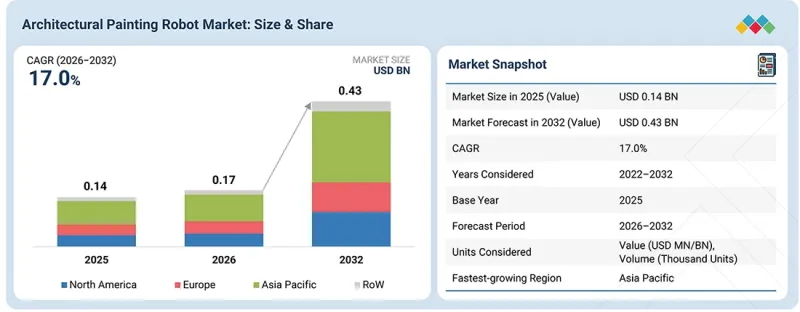
據估計,2026 年全球建築塗裝機器人市場價值為 1.7 億美元,預計到 2032 年將達到 4.3 億美元。
預計從 2026 年到 2032 年,該市場將以 17.0% 的複合年成長率成長。受塗裝作業自動化需求不斷成長的推動,尤其是在高牆、天花板和難以觸及的室內表面,預計該市場將經歷強勁成長。
| 調查範圍 | |
|---|---|
| 調查期 | 2021-2032 |
| 基準年 | 2025 |
| 預測期 | 2026-2032 |
| 計算單位 | 金額(10億美元) |
| 部分 | 依產品/服務、自主程度、應用、建築類型、施工階段、區域 |
| 目標區域 | 北美、歐洲、亞太地區及其他地區 |
建築承包商正擴大採用能夠在高空進行噴塗的機器人系統。這些機器人能夠實現可控的移動和噴塗作業,從而最大限度地減少重複性的人工操作。此外,它們尤其適用於多層住宅和商業建築項目,因為它們能夠有效地在大面積垂直延伸的表面上作業,且現場干預極少。
對能夠簡化高空噴漆作業並提高施工機械運轉率的解決方案的需求不斷成長,進一步推動了工程噴漆機器人市場的成長。
“據估計,到 2026 年,住宅將佔據最大的市場佔有率。”
住宅建築是建築塗裝機器人市場中佔比最大的領域。住宅建築的龐大數量以及公寓、多用戶住宅和住宅小區對室內塗裝的大量需求,支撐了這個市場主導地位。隨著大規模住宅項目的增加,建築商擴大採用塗裝機器人來自動化完成多個單元和樓層的重複性牆面和天花板塗裝工作。此外,人們對提高勞動生產力、確保塗裝品質一致性以及加快住宅項目竣工速度的需求也不斷成長。這一趨勢進一步推動了塗裝機器人在住宅建築領域的應用,從而鞏固了該領域在市場上的主導地位。
“預計在預測期內,維修、改造和維護行業的複合年成長率將最高。”
在建築塗裝機器人市場中,維修、改造和維護領域預計將實現最高的複合年成長率。這一成長主要得益於對現有建築維修和維護需求的不斷成長,同時希望最大限度地減少對運作中運營的干擾。業主和承包商越來越傾向於為居住使用、正在運作或已投入使用的住宅、商業和公共建築中的重複性維修工作尋求自動化塗裝解決方案。此外,塗裝機器人非常適合維修項目,因為它們即使在已塗漆的表面上也能確保塗層均勻,並能在計劃的維修進度內高效運作。隨著人們越來越重視延長建築壽命、實現現有空間現代化以及提高維修效率,預計建築塗裝機器人在該領域的應用將會加速。
“在預測期內,北美預計將佔據第二大市場佔有率。”
預計北美將佔據建築塗裝機器人市場第二大佔有率。這一成長主要得益於該地區先進的建設產業、高昂的人事費用以及建築裝修自動化需求的不斷成長。大規模住宅和商業項目的持續開發為機器人塗裝解決方案創造了機遇,這些方案能夠提高勞動力生產力並加快專案進度。此外,專注於建築機器人領域的公司眾多、自主技術的早期應用以及對人工智慧驅動的施工機械投資的不斷增加,都進一步推動了建築塗裝機器人在該地區的應用。
為了確定並檢驗透過一手和二手調查收集到的各個細分市場和子細分市場的市場規模,我們對提供建築噴塗機器人解決方案的關鍵行業專家進行了廣泛的一手訪談。本報告中一手訪談的對象構成如下:
本報告介紹了建築塗裝機器人市場主要參與者的概況,並分析了它們各自的市場排名。本報告涵蓋的主要參與者包括:光明夢想機器人(中國)、Okibo(美國和以色列)、MYRO International PTE(新加坡)、大方愛普(新加坡)和ConBotics(德國)。
此外,其他建築塗裝機器人市場的知名公司包括 Les Companions(法國)、Constrobot Robotics Private Ltd.(印度)、上海傳奇智慧科技有限公司(中國)、上海威博科技有限公司(中國)和北京方仕機器人(中國)。
調查範圍:
本研究報告對建築塗裝機器人市場進行了細分,涵蓋產品類型、自主程度、應用領域、建築類型、施工階段和地區等多個方面。報告中還概述了建築塗裝機器人市場的主要促進因素、限制因素、挑戰和機遇,並對2032年之前的市場發展趨勢進行了預測。此外,報告中還包含一份涵蓋建築塗裝機器人市場生態系統中所有相關企業的領導力分析。
購買本報告的主要好處
本報告旨在透過提供關於建築噴塗機器人市場及其細分市場的準確數據,為市場領導和新參與企業提供支援。報告力求為相關人員提供有價值的洞察,幫助他們了解競爭格局、最佳化業務定位並制定有效的打入市場策略。此外,報告還重點介紹了關鍵的市場促進因素和挑戰,使相關人員能夠了解當前的市場動態。
本報告深入分析了以下幾點:
- 對關鍵促進因素(建設活動的擴張、對工人安全和減少危險的手工塗裝工作的日益重視、對項目提前完工和縮短工期的需求不斷成長、對提高油漆利用效率和維修材料浪費的日益重視、人工智慧、電腦視覺和自主維修技術的進步)、阻礙因素(高昂的初始資本投資和部署成本、建設產業的去中心(RaaS)經營模式的擴展、進入新興建築市場)和挑戰(確保不同牆壁材料和表面油漆品質的一致性、工人對機器人塗裝技術的準備不足以及高維護、校準和服務要求)的分析。
- 產品開發/創新:對建築塗裝機器人市場的未來技術、研發活動和新產品/服務發布進行詳細分析。
- 市場發展:盈利市場的全面資訊-本報告分析了各個地區的建築噴漆機器人市場。
- 市場多元化:有關建築塗裝機器人市場的新產品和服務、未開發的地區、近期趨勢和投資的全面資訊。
- 競爭評估:對建築塗裝機器人市場主要參與者的市場佔有率、成長策略和服務產品進行詳細評估(包括光明夢想機器人(中國)、Okibo(美國/以色列)、MYRO International PTE(新加坡)、DAFANG AI PTE. LTD(新加坡)和ConBotics(德國))。
目錄
第1章:引言
第2章:調查方法
第3章執行摘要
第4章重要考察
第5章 市場概覽與趨勢
- 市場動態
- 促進因素
- 抑制因子
- 機會
- 任務
- 趨勢和顛覆性變化
- 價格分析
- 供應鏈分析
- 生態系分析
- 技術分析
- 專利分析
- 貿易分析
- 主要會議
- 案例研究分析
- 投資及資金籌措方案及關稅環境
- 波特五力分析
- 採購過程中的關鍵相關人員和採購標準
- 人工智慧/人工智慧生成技術的影響以及美國關稅的影響。
第6章 以產品/服務形式進行市場評估
第7章 依自主程度進行市場評估
第8章 按應用進行市場評估
第9章:依建築類型進行市場評估
第10章 依施工階段進行市場評估
第11章 區域市場評估
第12章 競爭格局
- 市佔率分析
- 品牌對比
- 企業估值矩陣
- 企業企業發展
第13章:公司簡介
- 主要參與企業
- BRIGHT DREAM ROBOTICS
- OKIBO
- MYRO INTERNATIONAL PTE
- DAFANG AI PTE. LTD
- CONBOTICS
- LES COMPANIONS
- CONSTROBOT ROBOTICS PRIVATE LTD.
- SHANGHAI LEGEND INTELLIGENT TECHNOLOGY CO., LTD.
- SHANGHAI WEIBUILD TECHNOLOGY CO., LTD.
- BEIJING FANGSHI ROBOTICS CO., LTD
- 其他公司
- ROBOSURF
- FINISH ROBOTICS
- BES
- JANYU TECHNOLOGIES PVT. LTD.
- JLG INDUSTRIES
- DUCO ROBOTS CO., LTD.
- ROBOPRINT INC.
- AGUSTIN ELECTRIC TECHNOLOGY(HANGZHOU)CO., LTD.
- PAINTIQ ROBOTICS
- SOL ROBOTICS
- PAINTJET
- SMARTBUILD ROBOTICS
- PROBUILD ROBOTICS
- ZQ-AUTOMATION
- WUHAN ONEW TECHNOLOGY CO., LTD.
第14章附錄
The global architectural painting robot market is estimated at USD 0.17 billion in 2026 and is projected to reach USD 0.43 billion by 2032, growing at a CAGR of 17.0% from 2026 to 2032. This market is expected to experience strong growth due to increasing demand for automation in painting, particularly for high walls, ceilings, and hard-to-reach interior surfaces.
| Scope of the Report | |
|---|---|
| Years Considered for the Study | 2021-2032 |
| Base Year | 2025 |
| Forecast Period | 2026-2032 |
| Units Considered | Value (USD Billion) |
| Segments | By Offering, Level of Autonomy, Application Type and Region |
| Regions covered | North America, Europe, APAC, RoW |
Construction contractors are increasingly adopting robotic systems capable of performing painting tasks at elevated heights. These robots offer controlled movement and spray application, which help minimize the need for repeated manual access. Additionally, their ability to work efficiently on large, vertically extensive surfaces with minimal site intervention makes them particularly suitable for multi-floor residential and commercial projects.
The rising demand for solutions that simplify high-reach painting operations and improve the utilization of construction equipment is further driving growth in the architectural painting robot market.
"Residential buildings are estimated to hold the largest market share in 2026."
Residential buildings constitute the largest segment in the architectural painting robot market. This dominance is driven by the high volume of housing construction and the extensive interior painting needs of apartments, multifamily housing units, and residential communities. The rise in large-scale residential projects is prompting contractors to adopt robotic painting solutions to automate repetitive wall and ceiling finishing tasks across multiple units and floors. Additionally, there is a growing demand to enhance labor productivity, achieve consistent finishing quality, and complete housing projects more quickly. This trend is further boosting the adoption of painting robots in residential construction, thereby reinforcing this segment's market leadership.
"The renovation, remodeling, and maintenance segment is estimated to record the highest CAGR during the forecast period."
The renovation, remodeling, and maintenance segment is predicted to experience the highest CAGR in the architectural painting robot market. This growth is driven by the increasing demand to upgrade and maintain existing buildings while minimizing disruption to ongoing operations. Building owners and contractors are increasingly seeking automated painting solutions for repetitive refurbishment tasks in occupied residential, commercial, and public buildings. Additionally, painting robots can ensure consistent application on previously painted surfaces and operate effectively within structured renovation schedules, making them well-suited for refurbishment projects. As there is a growing focus on extending building lifespans, modernizing existing spaces, and improving renovation efficiency, the adoption of architectural painting robots in this segment is expected to accelerate.
"North America is expected to hold the second-largest market share during the forecast period."
North America is projected to hold the second-largest share of the architectural painting robot market. This growth is driven by the region's advanced construction industry, high labor costs, and increasing demand for automation in building finishing activities. The continuous development of large residential and commercial projects is creating opportunities for robotic painting solutions that enhance workforce productivity and accelerate project completion. Additionally, the presence of companies specializing in construction robotics, early adoption of autonomous technologies, and rising investments in AI-enabled construction equipment are further supporting the adoption of architectural painting robots in the region.
Extensive primary interviews were conducted with key industry experts who offer architectural painting robot solutions to determine and verify the market size for various segments and subsegments, as gathered through secondary research. The breakdown of primary participants for the report is provided below:
The study contains insights from various industry experts, including component suppliers, Tier 1 companies, and OEMs. The breakdown of the primary participants is as follows:
- By Stakeholder: OEMs/Supply Side (64%), Demand Side (25%), and Industry Associations, Government Agencies, etc. (11%)
- By Designation: C-level Executives (30%), Directors (30%), and Others (40%)
- By Region: North America (40%), Europe (30%), Asia Pacific (25%), and RoW (5%)
The report profiles key players in the architectural painting robot market and analyzes their respective market rankings. The prominent companies featured in this report include Bright Dream Robotics (China), Okibo (US and Israel), MYRO International PTE (Singapore), DAFANG AI PTE. LTD. (Singapore), and ConBotics (Germany).
Additionally, other notable companies in the architectural painting robot market include Les Companions (France), Constrobot Robotics Private Ltd. (India), Shanghai Legend Intelligent Technology Co., Ltd. (China), Shanghai WEIBUILD Technology Co., Ltd. (China), and Beijing Fangshi Robotics Co., Ltd. (China).
Research Coverage:
This research report categorizes the architectural painting robot market into various segments, including offering, level of autonomy, application type, building type, construction phase, and region. It outlines the key drivers, restraints, challenges, and opportunities for architectural painting robots, along with forecasts through 2032. Additionally, the report features a leadership mapping analysis of all companies involved in the architectural painting robot market ecosystem.
Key Benefits of Buying the Report
The report is designed to assist market leaders and new entrants in the architectural painting robot market by providing accurate data on both the overall market and its subsegments. It aims to help stakeholders understand the competitive landscape and gain valuable insights to better position their businesses and formulate effective go-to-market strategies. Additionally, the report informs stakeholders about the current market dynamics, highlighting key drivers, restraints, challenges, and opportunities.
The report provides insights into the following pointers:
- Analysis of key drivers (growing construction activity, increasing emphasis on worker safety and reduction of hazardous manual painting tasks, increasing demand for faster project completion and reduced construction timelines, growing focus on improving paint utilization and reducing material waste, and advancements in AI, computer vision, and autonomous navigation technologies), restraints(high upfront capital investment and implementation costs and fragmented nature of construction industry), opportunities (growing adoption of robots in renovation and building upgrade projects, expansion of Robotics-as-a-Service (RaaS) business models, and expansion into emerging construction markets), and challenges (delivering consistent paint quality across different wall materials and surface, limited workforce readiness for robotic painting technologies, and high maintenance, calibration, and servicing requirements)
- Product Development/Innovation: Detailed insights into upcoming technologies, research & development activities, and new product & service launches in the architectural painting robot market
- Market Development: Comprehensive information about lucrative markets-the report analyzes the architectural painting robot market across varied regions.
- Market Diversification: Exhaustive information about new products & services, untapped geographies, recent developments, and investments in the architectural painting robot market
- Competitive Assessment: In-depth assessment of market shares, growth strategies, and service offerings of leading players, such as Bright Dream Robotics (China), Okibo (US; Israel), MYRO International PTE (Singapore), DAFANG AI PTE. LTD (Singapore), and ConBotics (Germany) in the architectural painting robot market.
TABLE OF CONTENTS
1 INTRODUCTION
- 1.1 DEFINITION AND OVERVIEW
- 1.2 STUDY OBJECTIVE & CURRENCY CONSIDERED
- 1.3 STUDY SCOPE
- 1.4 INCLUSIONS AND EXCLUSIONS, LIMITATIONS, AND STAKEHOLDERS
2 RESEARCH METHODOLOGY
- 2.1 MARKET SIZE ESTIMATION: TOP-DOWN ANALYSIS AND BOTTOM-UP ANALYSIS
- 2.2 PRIMARY SOURCES
- 2.3 RESEARCH ASSUMPTIONS
3 EXECUTIVE SUMMARY
4 PREMIUM INSIGHTS
5 MARKET OVERVIEW AND DYNAMICS
- 5.1 MARKET DYNAMICS
- 5.1.1 DRIVERS
- 5.1.2 RESTRAINTS
- 5.1.3 OPPORTUNITY
- 5.1.4 CHALLENGES
- 5.2 TRENDS & DISRUPTION
- 5.3 PRICING ANALYSIS
- 5.4 SUPPLY CHAIN ANALYSIS
- 5.5 ECOSYSTEM ANALYSIS
- 5.6 TECHNOLOGY ANALYSIS
- 5.7 PATENT ANALYSIS
- 5.8 TRADE ANALYSIS
- 5.9 KEY CONFERENCES
- 5.10 CASE STUDY ANALYSIS
- 5.11 INVESTMENT AND FUNDING SCENARIO AND TARIFF LANDSCAPE
- 5.12 PORTER'S FIVE FORCE ANALYSIS
- 5.13 KEY STAKEHOLDERS IN BUYING PROCESS AND BUYING CRITERIA
- 5.14 IMPACT OF AI/GEN AI AND IMPACT OF US TARIFF
6 MARKET ASSESSMENT, BY OFFERING
7 MARKET ASSESSMENT, BY LEVEL OF AUTONOMY
8 MARKET ASSESSMENT, BY APPLICATION
9 MARKET ASSESSMENT, BY BUILDING TYPE
10 MARKET ASSESSMENT, BY CONSTRUCTION PHASE
11 MARKET ASSESSMENT, BY REGION
12 COMPETITIVE LANDSCAPE
- 12.1 MARKET SHARE ANALYSIS
- 12.2 BRAND COMPARISON
- 12.3 COMPANY EVALUATION MATRIX
- 12.4 COMPANY FOOTPRINT
13 COMPANY PROFILES
- 13.1 KEY PLAYERS
- 13.1.1 BRIGHT DREAM ROBOTICS
- 13.1.2 OKIBO
- 13.1.3 MYRO INTERNATIONAL PTE
- 13.1.4 DAFANG AI PTE. LTD
- 13.1.5 CONBOTICS
- 13.1.6 LES COMPANIONS
- 13.1.7 CONSTROBOT ROBOTICS PRIVATE LTD.
- 13.1.8 SHANGHAI LEGEND INTELLIGENT TECHNOLOGY CO., LTD.
- 13.1.9 SHANGHAI WEIBUILD TECHNOLOGY CO., LTD.
- 13.1.10 BEIJING FANGSHI ROBOTICS CO., LTD
- 13.2 OTHER PLAYERS
- 13.2.1 ROBOSURF
- 13.2.2 FINISH ROBOTICS
- 13.2.3 BES
- 13.2.4 JANYU TECHNOLOGIES PVT. LTD.
- 13.2.5 JLG INDUSTRIES
- 13.2.6 DUCO ROBOTS CO., LTD.
- 13.2.7 ROBOPRINT INC.
- 13.2.8 AGUSTIN ELECTRIC TECHNOLOGY (HANGZHOU) CO., LTD.
- 13.2.9 PAINTIQ ROBOTICS
- 13.2.10 SOL ROBOTICS
- 13.2.11 PAINTJET
- 13.2.12 SMARTBUILD ROBOTICS
- 13.2.13 PROBUILD ROBOTICS
- 13.2.14 ZQ-AUTOMATION
- 13.2.15 WUHAN ONEW TECHNOLOGY CO., LTD.
14 APPENDIX
- 14.1 DISCUSSION GUIDE
- 14.2 RELATED REPORTS
- 14.3 AUTHOR DETAILS

 2026 年至 2035 年噴塗機器人的市場機會、成長要素、產業趨勢分析與預測。
 噴塗機器人市場:依安裝方式、機器人類型、承重能力、最終用途、國家及地區分類-產業分析、市場規模、市場佔有率及2026年至2033年預測
 噴塗機器人市場 - 全球產業規模、佔有率、趨勢、機會、預測:按安裝類型、機器人類型、應用、終端用戶產業、地區和競爭格局分類,2021-2031年
 噴塗機器人市場規模、佔有率、趨勢和預測:按類型、應用、最終用戶和地區分類,2026-2034年
 噴塗機器人市場:2026-2032年全球市場預測(依終端用戶產業、機器人類型、噴塗類型、技術、軸數、自動化程度及承重能力)新型機器人霧化器市場:按技術、壓力類型、移動性、噴霧模式、最終用戶和應用分類-全球預測,2026-2032年高空噴塗機器人市場:依機器人類型、最終用途產業、自動化程度、操作模式、塗料和經營模式-全球預測,2026-2032年
 2026年全球噴塗機器人市場報告噴塗機器人市場按機器人類型、有效載荷能力、自動化程度、銷售形式、應用類型、行業垂直領域和分銷管道分類,全球預測(2026-2032年)
 噴塗機器人市場規模、佔有率、成長分析(按類型、功能、應用、最終用戶和地區分類)-2026-2033年產業預測