


 |
市場調查報告書
商品編碼
2083363
2026 年至 2035 年噴塗機器人的市場機會、成長要素、產業趨勢分析與預測。Painting Robot Market Opportunity, Growth Drivers, Industry Trend Analysis, and Forecast 2026 - 2035 |
||||||

預計到 2025 年,全球噴塗機器人市場價值將達到 32 億美元,並有望以 8.1% 的複合年成長率成長,到 2035 年達到 70 億美元。
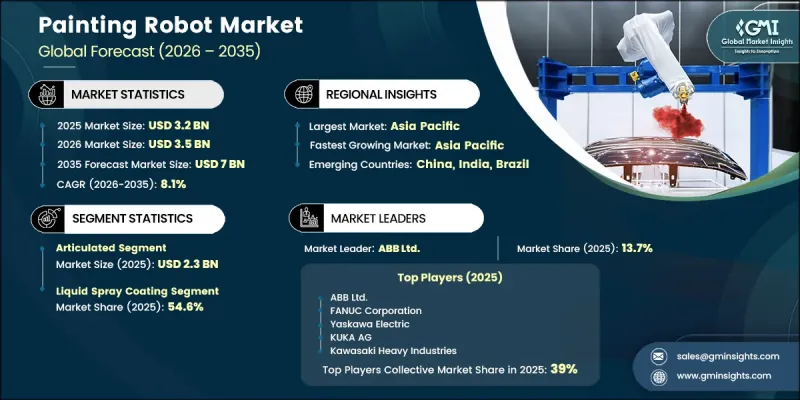
工業自動化的日益普及、對高品質表面處理日益成長的需求以及對提高生產效率的迫切需要,正在推動全球噴塗機器人市場的成長。各行各業的製造商都在加速向機器人噴塗解決方案轉型,以實現更高的均勻性、減少材料浪費、改善職場安全並維持更高的生產標準。隨著企業尋求能夠滿足複雜表面處理要求並最佳化營運成本的可靠解決方案,自動化噴塗系統正成為現代製造營運中不可或缺的組成部分。儘管汽車製造仍然是其主要應用領域,但由於噴塗機器人具有柔軟性、精確性和大規模生產能力,它們正被各個工業領域廣泛接受。機器人技術的進步、編程能力的提升以及對智慧製造日益成長的關注,正在進一步加速市場擴張。隨著對高效生產流程和永續製造實踐的日益重視,預計全球市場將持續湧現噴塗機器人的應用機會。
| 市場範圍 | |
|---|---|
| 開始年份 | 2025 |
| 預測期 | 2026-2035 |
| 初始市場規模 | 32億美元 |
| 預計金額 | 70億美元 |
| 複合年成長率 | 8.1% |
預計2025年,關節型機器人市場規模將達23億美元,佔據噴塗機器人市場最大佔有率。這些機器人憑藉其高度的柔軟性、先進的運動能力以及即使在複雜表面上也能執行精準噴塗任務的能力,持續引領市場。多軸機械臂結構實現了流暢精準的運動,使製造商能夠確保不同形狀和設計的產品表面處理品質的一致性。關節型機器人兼具高重複性、高工作效率和強適應性,是需要精細可靠表面處理的工業噴塗應用的理想選擇。
預計到2025年,液體噴塗將佔據54.6%的市場。該細分市場之所以能保持主導地位,得益於液體噴塗技術的多功能性、均勻的噴塗效果以及與多種材料的兼容性。與傳統噴塗方法相比,機器人液體噴塗系統能夠更好地控制噴塗過程,提升表面質量,並減少過噴。其滿足多樣化生產需求的能力,正推動各產業對高效、穩定的表面處理解決方案的廣泛應用。
預計到2025年,美國噴塗機器人市場將佔據82%的市場佔有率,市場規模將達到5.587億美元。北美憑藉其先進的製造業生態系統、對工業自動化的積極應用以及對生產現代化持續的投資,仍然是重要的市場。美國仍然是主要貢獻者,因為製造商正在推動噴塗製程的自動化,以提高效率、維持產品品質並滿足不斷變化的職場和環境要求。該地區成熟的工業基礎和智慧製造技術的日益普及將繼續支撐市場成長。
目錄
第1章:調查方法
第2章執行摘要
第3章 行業洞察
- 產業生態系與價值鏈分析
- 上游:原料、執行器和感測器的供應商
- 中游企業:機器人OEM廠商、系統整合商、噴漆房製造商
- 下游:終端用戶產業和售後服務服務供應商
- 生態系相互依存性與關鍵瓶頸
- 影響產業的因素
- 市場促進因素
- 市場挑戰與陷阱
- 市場機遇
- 成長潛力分析
- 產業生態系分析
- 監理框架
- VOC排放標準 - 歐盟VOC溶劑指令、美國環保署國家排放標準(EPA NESHAP)
- 符合防爆標準 - ATEX 2G/3G、FM Global (IEC 60079)
- 人機協作機器人安全標準 - ISO 10218、ISO/TS 15066
- 歐盟機械法規 (EU) 2023/1230 - 對噴塗機器人採購的影響
- 美國職業安全與健康管理局 (OSHA) 關於異氰酸酯和六價鉻的容許暴露限值 (PEL) – 促進基於自動化的替代
- 關於鉻基顏料的 REACH 法規和 F-gas 法規(歐洲)
- 價格分析
- 2022-2024年歷史價格趨勢分析
- 依球員類型分類的定價策略(高級球員、超值球員、成本加成球員)
- 價格差異 - 因變體而異:鉸接式、笛卡爾式、SCARA 式和 Kobot 式。
- 總擁有成本 (TCO) 分析 - 初始投資、整合與維護
- 技術與創新展望
- 噴霧霧化技術的發展(旋轉式、無氣式、靜電式HVLP)
- 多軸運動學(5軸到7軸關節系統)的發展
- 視覺引導與自適應路由技術
- 將數位雙胞胎體整合到塗裝過程模擬中
- 電動車專用塗裝技術(電池外殼和麵板飾面)
- 波特的分析
- PESTLE分析
- 貿易數據分析
- 進出口數量和價值趨勢 - HS編碼8479/8428
- 主要貿易路線及關稅的影響
- 人工智慧和生成式人工智慧對市場的影響
- 利用人工智慧改造現有噴漆製程和經營模式
- GenAI 應用案例與部署藍圖- 離線路徑程式設計、缺陷偵測、預測性維護
- 人工智慧驅動的噴塗系統的風險、限制和監管考量
- 生產能力和生產情況
- 按地區及主要機器人OEM廠商分類的已安裝設備數量
- 運轉率和擴張計劃
第4章 競爭情勢
- 介紹
- 企業市佔率分析
- 北美洲
- 歐洲
- 亞太地區
- LATAM
- 中東和非洲
- 企業矩陣分析
- 主要市場公司的競爭分析
- 競爭定位矩陣
- 主要進展
- 併購
- 夥伴關係和聯盟
- 新產品發布
- 業務拓展計劃
第5章 市場估算與預測:機器人類型,2022-2035年
- 關節機器人
- 笛卡兒/龍門式機器人
- SCARA機器人
- 其他
第6章 市場估算與預測:依塗層製程分類,2022-2035年
- 液體噴塗
- 底漆應用
- 塗底塗層
- 透明塗層和裝飾塗層
- 粉末塗裝
- 密封和分配
- 電泳塗裝
- 其他
第7章 市場估計與預測:依最終用戶產業分類,2022-2035年
- 汽車和運輸業
- 航太/國防
- 電子電器設備
- 家具和木材行業
- 通用工業設備和機械
- 建築和基礎設施
- 其他
第8章 市場估算與預測:依通路分類,2022-2035年
- 直銷
- 間接銷售
第9章 市場估計與預測:依地區分類,2022-2035年
- 北美洲
- 美國
- 加拿大
- 歐洲
- 德國
- 英國
- 法國
- 義大利
- 西班牙
- 亞太地區
- 中國
- 印度
- 日本
- 澳洲
- 韓國
- 拉丁美洲
- 巴西
- 墨西哥
- 阿根廷
- 中東和非洲
- 南非
- 沙烏地阿拉伯
- UAE
第10章:公司簡介
- 世界頂尖公司
- ABB Ltd.
- FANUC Corporation
- KUKA AG
- Yaskawa Electric Corporation
- Kawasaki Heavy Industries Ltd.
- Durr AG
- Staubli International AG
- 本地公司
- Comau SpA
- HD Hyundai Robotics
- Sames
- Cefla Finishing
- EFORT Intelligent Robot Co., Ltd.
- Nachi-Fujikoshi Corporation
- Gaiotto Automation SpA
- Niche & Specialist Players
- CMA Robotics SpA
- Lesta Srl
- B+M Surface Systems GmbH
- Trinity Industrial Corporation
- Epistolio Srl
- Huayan Robotics
- Venjakob Maschinenbau GmbH & Co. KG
The Global Painting Robot Market was valued at USD 3.2 billion in 2025 and is estimated to grow at a CAGR of 8.1% to reach USD 7 billion by 2035.
The increasing adoption of industrial automation, rising demand for high-quality surface finishing, and the need for improved production efficiency are driving the growth of the painting robot market worldwide. Manufacturers across multiple industries are increasingly shifting toward robotic painting solutions to achieve greater consistency, reduce material wastage, improve workplace safety, and maintain higher production standards. Automated painting systems are becoming an essential part of modern manufacturing operations as companies seek reliable solutions that can handle complex finishing requirements while optimizing operational costs. Although automotive manufacturing remains a significant application area, painting robots are gaining wider acceptance across diverse industrial sectors due to their flexibility, precision, and ability to support large-scale production. Advancements in robotic technologies, improved programming capabilities, and increasing focus on smart manufacturing are further accelerating market expansion. The growing emphasis on efficient production processes and sustainable manufacturing practices is expected to create continued opportunities for painting robot adoption across global markets.
| Market Scope | |
|---|---|
| Start Year | 2025 |
| Forecast Year | 2026-2035 |
| Start Value | $3.2 Billion |
| Forecast Value | $7 Billion |
| CAGR | 8.1% |
The articulated robot segment generated USD 2.3 billion in 2025, representing the largest share of the painting robot market. These robots continue to dominate due to their high flexibility, advanced movement capabilities, and ability to perform precise coating operations across complex surfaces. Their multi-axis robotic arm structure enables smooth and accurate motion, allowing manufacturers to achieve consistent finishing quality on products with varying shapes and designs. The combination of strong repeatability, operational efficiency, and adaptability makes articulated robots a preferred choice for industrial painting applications requiring detailed and reliable surface treatment.
The liquid spray coating segment accounted for 54.6% share in 2025. This segment maintains its leading position because liquid spray technology offers versatility, uniform application, and compatibility with a wide range of materials. Robotic liquid spray systems provide controlled coating distribution, improved finish quality, and reduced overspray compared with conventional painting methods. Their ability to support different production requirements has increased adoption among industries seeking efficient and consistent finishing solutions.
U.S. Painting Robot Market accounted for 82% share generating USD 558.7 million in 2025. North America continues to represent a significant market due to its advanced manufacturing ecosystem, strong industrial automation adoption, and continuous investments in production modernization. The United States remains the key contributor as manufacturers upgrade automated painting operations to improve efficiency, maintain product quality, and comply with evolving workplace and environmental requirements. The region's established industrial base and increasing adoption of smart manufacturing technologies continue to support market growth.
Major companies operating in the global painting robot market include ABB Ltd., FANUC Corporation, KUKA AG, Yaskawa Electric Corporation, Kawasaki Heavy Industries Ltd., Durr AG, Staubli International AG, Comau S.p.A., HD Hyundai Robotics, Sames, Cefla Finishing, EFORT Intelligent Robot Co., Ltd., Nachi-Fujikoshi Corporation, Gaiotto Automation S.p.A., CMA Robotics S.p.A., Lesta Srl, B+M Surface Systems GmbH, Trinity Industrial Corporation, Epistolio S.r.l., Huayan Robotics, and Venjakob Maschinenbau GmbH & Co. KG. Companies operating in the painting robot market are strengthening their competitive position by focusing on technological innovation, automation advancements, and expansion of robotic product portfolios. Manufacturers are investing in research and development to improve robot accuracy, flexibility, energy efficiency, and integration with digital manufacturing platforms. Strategic collaborations with industrial manufacturers and investments in global service networks are helping companies expand their customer base. Businesses are also developing customized robotic painting solutions designed for specific application requirements while enhancing software capabilities for easier operation and monitoring.
Table of Contents
Chapter 1 Methodology
- 1.1 Research approach
- 1.2 Quality Commitments
- 1.2.1 GMI AI policy & data integrity commitment
- 1.2.1.1 Source consistency protocol
- 1.2.1 GMI AI policy & data integrity commitment
- 1.3 Research Trail & Confidence Scoring
- 1.3.1 Research Trail Components
- 1.3.2 Scoring Components
- 1.4 Data Collection
- 1.4.1 Partial list of primary sources
- 1.5 Data mining sources
- 1.5.1 Paid sources
- 1.5.1.1 Sources, by region
- 1.5.1 Paid sources
- 1.6 Base estimates and calculations
- 1.6.1 Base year calculation for any one approach
- 1.7 Forecast model
- 1.7.1 Quantified market impact analysis
- 1.7.1.1 Mathematical impact of growth parameters on forecast
- 1.7.1 Quantified market impact analysis
- 1.8 Research transparency addendum
- 1.8.1 Source attribution framework
- 1.8.2 Quality assurance metrics
- 1.8.3 Our commitment to trust
Chapter 2 Executive Summary
- 2.1 Industry snapshot
- 2.2 Business trends
- 2.3 Robot type trends
- 2.4 Coating process trends
- 2.5 End user industry trends
- 2.6 Distribution channel trends
- 2.7 Regional trends
Chapter 3 Industry Insights
- 3.1 Industry ecosystem and value chain analysis
- 3.1.1 Upstream: raw materials, actuators & sensor suppliers
- 3.1.2 Midstream: robot OEMs, system integrators & paint booth manufacturers
- 3.1.3 Downstream: end-user industries & aftermarket service providers
- 3.1.4 Ecosystem interdependencies & critical bottlenecks
- 3.2 Industry impact forces
- 3.2.1 Market Driver
- 3.2.2 Market challenges/pitfalls
- 3.2.3 Market opportunities
- 3.3 Growth potential analysis
- 3.4 Industry ecosystem analysis
- 3.5 Regulatory framework
- 3.5.1 VOC emission standards - EU VOC solvents directive, EPA NESHAP (USA)
- 3.5.2 Explosion protection compliance - ATEX 2G/3G, FM Global (IEC 60079)
- 3.5.3 Human-robot collaboration safety standards - ISO 10218, ISO/TS 15066
- 3.5.4 EU machinery regulation (EU) 2023/1230 - impact on paint robot procurement
- 3.5.5 OSHA PELs for isocyanates & hexavalent chromium - driving automation substitution
- 3.5.6 REACH restrictions on chromium-based pigments & F-gas regulation (Europe)
- 3.6 Pricing analysis (driven by primary research)
- 3.6.1 Historical price trend analysis (2022-2024) (driven by primary research)
- 3.6.2 Pricing strategy by player type (premium / value / cost-plus) (driven by primary research)
- 3.6.3 Price differential - articulated vs. cartesian vs. SCARA vs. cobot variants
- 3.6.4 Total cost of ownership (TCO) analysis - capital, integration & maintenance
- 3.7 Technology and innovation landscape
- 3.7.1 Spray atomization technology evolution (rotary, airless, electrostatic HVLP)
- 3.7.2 Multi-axis kinematic advancements (5-axis to 7-axis articulated systems)
- 3.7.3 Vision-guided & adaptive path control technologies
- 3.7.4 Digital twin integration for paint process simulation
- 3.7.5 EV-specific paint cell technology (battery housing & panel finishing)
- 3.8 Porter's Analysis
- 3.9 PESTEL Analysis
- 3.10 Trade data analysis (driven by primary research)
- 3.10.1 Import/export volume & value trends - HS code 8479/8428
- 3.10.2 Key trade corridors & tariff impact
- 3.11 Impact of AI and generative AI on the market
- 3.11.1 AI-driven disruption of existing paint process business models
- 3.11.2 GenAI use cases & adoption roadmap - offline path programming, defect detection, predictive maintenance
- 3.11.3 Risks, limitations & regulatory considerations for AI-enabled painting systems
- 3.12 Capacity and production landscape (driven by primary research)
- 3.12.1 Installed capacity by region & key robot OEM producer (driven by primary research)
- 3.12.2 Capacity utilization rates & expansion pipelines (driven by primary research)
Chapter 4 Competitive Landscape, 2025
- 4.1 Introduction
- 4.2 Company market share analysis
- 4.2.1 North America
- 4.2.2 Europe
- 4.2.3 APAC
- 4.2.4 LATAM
- 4.2.5 MEA
- 4.3 Company matrix analysis
- 4.4 Competitive analysis of major market players
- 4.5 Competitive positioning matrix
- 4.6 Key developments
- 4.6.1 Mergers & acquisitions
- 4.6.2 Partnerships & collaborations
- 4.6.3 New product launches
- 4.6.4 Expansion plans
Chapter 5 Market Estimates and Forecast, By Robot Type, 2022 - 2035 ($ Billion) (Thousand Units)
- 5.1 Key trends
- 5.2 Articulated Robots
- 5.3 Cartesian / Gantry Robots
- 5.4 SCARA Robots
- 5.5 Others
Chapter 6 Market Estimates and Forecast, By Coating Process, 2022 - 2035 ($ Billion) (Thousand Units)
- 6.1 Key trends
- 6.2 Liquid Spray Coating
- 6.2.1 Primer Application
- 6.2.2 Basecoat Application
- 6.2.3 Clearcoat & Decorative Coating
- 6.3 Powder Coating
- 6.4 Sealing & Dispensing
- 6.5 E-Coat / Electrocoating
- 6.6 Others
Chapter 7 Market Estimates and Forecast, By End-User Industry, 2022 - 2035 ($ Billion) (Thousand Units)
- 7.1 Key trends
- 7.2 Automotive & Transportation
- 7.3 Aerospace & Defense
- 7.4 Electronics & Electrical Equipment
- 7.5 Furniture & Wood Industry
- 7.6 General Industrial Equipment & Machinery
- 7.7 Construction & Infrastructure
- 7.8 Others
Chapter 8 Market Estimates and Forecast, By Distribution Channel, 2022 - 2035 ($ Billion) (Thousand Units)
- 8.1 Key trends
- 8.2 Direct sales
- 8.3 Indirect sales
Chapter 9 Market Estimates and Forecast, By Region, 2022 - 2035 ($ Billion) (Thousand Units)
- 9.1 Key trends
- 9.2 North America
- 9.2.1 US
- 9.2.2 Canada
- 9.3 Europe
- 9.3.1 Germany
- 9.3.2 UK
- 9.3.3 France
- 9.3.4 Italy
- 9.3.5 Spain
- 9.4 Asia Pacific
- 9.4.1 China
- 9.4.2 India
- 9.4.3 Japan
- 9.4.4 Australia
- 9.4.5 South Korea
- 9.5 Latin America
- 9.5.1 Brazil
- 9.5.2 Mexico
- 9.5.3 Argentina
- 9.6 Middle East and Africa
- 9.6.1 South Africa
- 9.6.2 Saudi Arabia
- 9.6.3 UAE
Chapter 10 Company Profiles
- 10.1 Top Global Players
- 10.1.1 ABB Ltd.
- 10.1.2 FANUC Corporation
- 10.1.3 KUKA AG
- 10.1.4 Yaskawa Electric Corporation
- 10.1.5 Kawasaki Heavy Industries Ltd.
- 10.1.6 Durr AG
- 10.1.7 Staubli International AG
- 10.2 Regional Players
- 10.2.1 Comau S.p.A.
- 10.2.2 HD Hyundai Robotics
- 10.2.3 Sames
- 10.2.4 Cefla Finishing
- 10.2.5 EFORT Intelligent Robot Co., Ltd.
- 10.2.6 Nachi-Fujikoshi Corporation
- 10.2.7 Gaiotto Automation S.p.A.
- 10.3 Niche & Specialist Players
- 10.3.1 CMA Robotics S.p.A.
- 10.3.2 Lesta Srl
- 10.3.3 B+M Surface Systems GmbH
- 10.3.4 Trinity Industrial Corporation
- 10.3.5 Epistolio S.r.l.
- 10.3.6 Huayan Robotics
- 10.3.7 Venjakob Maschinenbau GmbH & Co. KG

 全球建築塗裝機器人市場:依產品、自主程度、應用領域、建築類型、施工階段及地區分類-預測至2032年
 噴塗機器人市場:依安裝方式、機器人類型、承重能力、最終用途、國家及地區分類-產業分析、市場規模、市場佔有率及2026年至2033年預測
 噴塗機器人市場 - 全球產業規模、佔有率、趨勢、機會、預測:按安裝類型、機器人類型、應用、終端用戶產業、地區和競爭格局分類,2021-2031年
 噴塗機器人市場規模、佔有率、趨勢和預測:按類型、應用、最終用戶和地區分類,2026-2034年
 噴塗機器人市場:2026-2032年全球市場預測(依終端用戶產業、機器人類型、噴塗類型、技術、軸數、自動化程度及承重能力)新型機器人霧化器市場:按技術、壓力類型、移動性、噴霧模式、最終用戶和應用分類-全球預測,2026-2032年高空噴塗機器人市場:依機器人類型、最終用途產業、自動化程度、操作模式、塗料和經營模式-全球預測,2026-2032年
 2026年全球噴塗機器人市場報告噴塗機器人市場按機器人類型、有效載荷能力、自動化程度、銷售形式、應用類型、行業垂直領域和分銷管道分類,全球預測(2026-2032年)
 噴塗機器人市場規模、佔有率、成長分析(按類型、功能、應用、最終用戶和地區分類)-2026-2033年產業預測