

 |
市場調查報告書
商品編碼
2086837
全球陸域風電市場(至2035年):按組件(風機和電力基礎設施)、風扇額定功率(2兆瓦以下、2-3兆瓦、3-5兆瓦、5兆瓦以上)和地區分類Onshore Wind Market by Component (Turbines, Electrical Infrastructure), By Turbine Rating (below 2 MW, 2-3 MW, 3-5 MW, and above 5 MW) and Region - Global Forecast to 2035 |
||||||


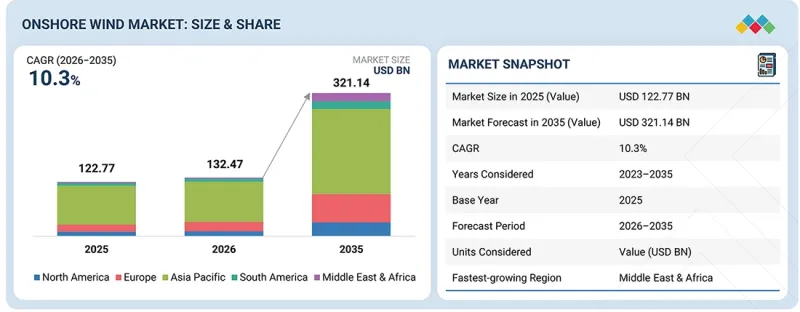
預計在預測期內,陸上風電市場將以 10.3% 的複合年成長率成長,從 2026 年的 1,324.7 億美元成長到 2035 年的 3,211.4 億美元。
市場擴張的促進因素包括可再生能源發電的快速成長、對能源安全的日益關注、雄心勃勃的脫碳目標以及促進清潔電力普及的政府支持政策。
| 調查範圍 | |
|---|---|
| 調查期 | 2023-2035 |
| 基準年 | 2025 |
| 預測期 | 2026-2035 |
| 單元 | 美元 |
| 部分 | 零件、渦輪機額定功率(按地區分類) |
| 目標區域 | 北美洲、亞太地區、歐洲、南美洲、中東和非洲 |
隨著各國向低碳能源系統轉型,陸上風電憑藉其具有競爭力的發電成本、成熟的技術以及相對較短的項目開發週期,已成為最具成本效益和擴充性的再生能源來源之一。諸如5兆瓦以上大型風力渦輪機、更高的輪轂高度、更長的葉輪、人工智慧驅動的預測性維護、數位孿生以及即時資產監控等技術進步,正在提升發電效率和營運效率。老舊風電場的改造升級和電池儲能系統的引入,進一步提高了電網可靠性和專案經濟效益。然而,儘管長期成長前景強勁,但陸上風電市場仍面臨諸多挑戰,例如冗長的核准流程、複雜的土地徵用、輸電基礎設施的限制以及某些地區當地社區的反對,這些因素可能會延緩項目實施並增加開發成本。
“從各個組成部分來看,預計在預測期內,電力基礎設施領域將成為第二大領域。”
從各個組成部分來看,在預測期內,受電力傳輸、併網和可靠供電需求不斷成長的驅動,電力基礎設施預計將成為陸上風電市場第二大組成部分。隨著陸域風電裝置容量的擴大,為適應更多再生能源的需求,對變電站、變壓器、開關設備、電纜和高壓輸電網的投資也在增加。輸電網現代化改造和智慧電網技術的引入進一步推動了對先進電力基礎設施的需求。此外,大容量風力發電機和公用事業規模風電場的部署需要強大的併網系統來確保穩定的電力供應,這使得電力基礎設施成為專案整體開發和長期營運效率的關鍵要素。
“從渦輪機額定功率來看,預計在預測期內,2-3兆瓦細分市場的成長率將位居第三。”
從風力渦輪機的額定功率來看,由於其在性能、成本和部署柔軟性方面實現了卓越的平衡,預計2-3兆瓦風力渦輪機細分市場在預測期內將保持第三高的成長率。這些渦輪機尤其適用於風力資源適中的地區,以及因土地資源和電網容量限制而難以部署大型渦輪機的專案。此外,由於其初始投資較低且回報可觀,它們在新興市場和分散式公用事業規模的風電項目中也得到了廣泛應用。而且,在現有風電場持續現代化改造和中型開發商需求不斷成長的推動下,預計2-3兆瓦風力渦輪機細分市場將在未來幾年繼續穩步擴張。
“從區域分類來看,預計在預測期內,歐洲將佔據第二大市場佔有率。”
預計在預測期內,歐洲陸上風電市場將佔據全球第二大市場佔有率,這主要得益於該地區強勁的可再生能源市場、脫碳目標、政策支持以及對綠色電力基礎設施的持續投資。德國、西班牙、英國、英國、瑞典和義大利等國正透過競標、永續能源轉型計畫和扶持政策,大力投資擴大陸上風電裝置容量。該地區擁有成熟的風力渦輪機製造商、陸上風電發電工程開發商、電網營運商和工程服務供應商生態系統,這些企業正投資於高效風力發電機和數位化解決方案。高容量陸上風力發電機機的日益普及、現有項目的改造升級以及電網基礎設施的改進將推動歐洲陸上風電市場的發展。除了各國政府作為「歐洲綠色協議」和「歐盟再生能源計畫」(REPowerEU)的一部分所採取的措施外,各國制定的可再生能源目標預計也將進一步刺激對陸上風電開發的投資,以確保能源安全並減少碳排放。此外,電池儲能系統、數位平台和智慧電網的引入提高了電網的可靠性,為區域陸上風電市場的企業創造了盈利的機會。
本報告考察了全球陸上風電市場,提供了市場概述、影響市場成長的各種因素分析、技術和專利趨勢、法律制度、案例研究、市場規模趨勢和預測、按各個細分市場、地區/主要國家進行的詳細分析、競爭格局以及主要公司的概況。
目錄
第1章:引言
第2章執行摘要
第3章重要考察
第4章 市場概覽
- 市場動態
- 促進因素
- 抑制因子
- 機會
- 任務
- 未滿足的需求和閒置頻段
- 與相關市場和不同產業相關的跨領域機遇
- 一級/二級/三級公司的策略性舉措
第5章 產業趨勢
- 波特五力分析
- 宏觀經濟展望
- GDP趨勢與預測
- 全球可再生能源產業的發展趨勢
- 全球電氣設備產業的發展趨勢
- 價值鏈分析
- 生態系分析
- 價格分析
- 貿易分析
- 2026-2027 年主要會議和活動
- 影響客戶業務的趨勢/顛覆性因素
- 投資和資金籌措場景
- 案例研究分析
- 中東地區持續的地緣政治發展對陸域風電市場的影響。
- 美國關稅對陸域風電市場的影響
- 對渦輪機額定功率的影響
第6章:技術進步、人工智慧的影響、專利、創新與未來應用
- 主要新興技術
- 直接驅動和混合驅動系統
- 互補技術
- 監控與數據採集(SCADA)
- 數位資產管理系統(DAM)
- 技術/產品藍圖
- 專利分析
- 未來應用
- 人工智慧/生成式人工智慧對陸域風電市場的影響
第7章:監理情勢與永續性舉措
- 當地法規和合規性
- 對永續性的承諾
- 監理政策對永續性舉措的影響
- 認證、標籤檢視、環境標準
第8章:顧客趨勢與購買行為
- 決策流程
- 採購過程中的關鍵相關人員及其評估標準
- 實施障礙和內部挑戰
- 市場盈利
第9章 陸域風電市場:依組件分類
- 渦輪
- 納賽爾
- 旋翼葉片
- 塔
- 電力基礎設施
- 電線電纜
- 變電站
- 其他
第10章 陸域風電市場:依渦輪機額定輸出功率分類
- 小於2兆瓦
- 2~3MW
- 4~5MW
- 超過5兆瓦
第11章 陸域風電市場:依地區分類
- 亞太地區
- 中國
- 印度
- 澳洲
- 越南
- 其他
- 北美洲
- 美國
- 加拿大
- 歐洲
- 德國
- 英國
- 西班牙
- 法國
- 義大利
- 瑞典
- 其他
- 中東和非洲
- 沙烏地阿拉伯
- 南非
- 其他
- 南美洲
- 巴西
- 其他
第12章 競爭格局
- 概述
- 主要公司/領先公司的競爭策略
- 收入分析
- 市佔率分析
- 企業估值和財務指標
- 產品對比
- 企業估值矩陣:主要公司
- 公司估值矩陣:新創企業/中小企業
- 競爭格局
第13章:公司簡介
- 大公司
- VESTAS
- GOLDWIND SCIENCE & TECHNOLOGY CO., LTD.
- MING YANG SMART ENERGY GROUP CO., LTD.
- SIEMENS ENERGY
- GE VERNOVA
- ENVISION GROUP
- WINDEY ENERGY TECHNOLOGY GROUP CO.,LTD.
- DOOSAN CORPORATION
- ABB
- PRYSMIAN GROUP
- NORDEX SE
- SCHNEIDER ELECTRIC
- DONGFANG ELECTRIC WIND POWER CO., LTD.
- SANY RENEWABLE ENERGY CO., LTD.
- SUZLON ENERGY LTD.
- 其他公司
- HITACHI ENERGY LTD
- CRRC SHANDONG WIND POWER CO., LTD.
- SHANGHAI ELECTRIC POWER CO., LTD
- INOX WIND LIMITED
- SENVION INDIA PRIVATE LIMITED
- ENERCON GLOBAL GMBH
- VAYONA ENERGY PVT. LTD.
- SINOVEL WIND GROUP CO., LTD.
- LEITWIND
- EWT
第14章調查方法
第15章附錄
The onshore wind market is projected to grow at a CAGR of 10.3% during the forecast period, increasing from an estimated USD 132.47 billion in 2026 to USD 321.14 billion by 2035. Market expansion is driven by the rapid growth of renewable energy generation, rising energy security concerns, ambitious decarbonization targets, and supportive government policies promoting clean power deployment.
| Scope of the Report | |
|---|---|
| Years Considered for the Study | 2023-2035 |
| Base Year | 2025 |
| Forecast Period | 2026-2035 |
| Units Considered | USD Million |
| Segments | By Component, By Turbine Rating, and Region |
| Regions covered | North America, Asia Pacific, Europe, South America, Middle East & Africa |
As countries transition toward low-carbon energy systems, onshore wind has become one of the most cost-effective and scalable renewable energy sources due to its competitive generation costs, mature technology, and relatively shorter project development timelines. Technological advancements, including larger turbines exceeding 5 MW, taller hub heights, longer rotor blades, AI-enabled predictive maintenance, digital twins, and real-time asset monitoring, are improving energy output and operational efficiency. Repowering aging wind farms and integrating battery energy storage systems are further enhancing grid reliability and project economics. However, the market continues to face challenges related to lengthy permitting processes, land acquisition complexities, transmission infrastructure constraints, and local community opposition in certain regions, which can delay project execution and increase development costs despite strong long-term growth prospects.
"By component, the electrical infrastructure segment is expected to be the second largest component segment in the onshore wind market during the forecast period."
By component, the electrical infrastructure segment is expected to be the second largest segment in the onshore wind market during the forecast period, supported by the growing need for power transmission, grid integration, and reliable energy distribution. As onshore wind capacity expands, investments in substations, transformers, switchgear, cables, and high-voltage transmission networks are increasing to accommodate larger volumes of renewable electricity. Grid modernization initiatives and the integration of smart grid technologies are further driving demand for advanced electrical infrastructure. Additionally, the deployment of high-capacity turbines and utility-scale wind farms requires robust interconnection systems to ensure stable power delivery, making electrical infrastructure an indispensable component of overall project development and long-term operational efficiency.
"By Turbine Rating, the 2-3 MW segment is projected to register the third fastest growth in the onshore wind market during the forecast period."
By turbine rating, the 2-3 MW segment is projected to register the third-fastest growth in the onshore wind market during the forecast period, driven by its balance of performance, cost, and deployment flexibility. These turbines are particularly well-suited for regions with moderate wind resources and projects where land availability or grid capacity limits the use of larger machines. They are also widely adopted in emerging markets and distributed utility-scale installations because they offer attractive returns with lower upfront investment. In addition, ongoing upgrades of older wind farms and increasing demand from medium-sized developers are expected to support steady expansion of the 2-3 MW segment over the coming years.
"By region, Europe is estimated to account for the second-largest market share during the forecast period."
The onshore wind energy market in Europe is estimated to hold the second-largest share during the forecast period, owing to a strong regional renewable energy market, decarbonization targets, policy support, and ongoing investment in infrastructure for green power generation. Countries like Germany, Spain, the UK, France, Sweden, and Italy have made significant investments to expand onshore wind capacity through competitive auctions, sustainable energy transition programs, and supportive policies. The region has an established ecosystem of turbine manufacturers, onshore wind project developers, grid companies, and engineering services providers investing in efficient wind turbines and digital solutions. The increasing use of high-capacity onshore turbines, the repowering of existing projects, and the development of grid infrastructure will drive the onshore wind energy market in Europe. Initiatives taken by governments as part of the European Green Deal and the REPowerEU program, along with the renewable energy objectives set by individual countries, will spur further investment in onshore wind farm development to ensure energy security and reduce carbon emissions. Moreover, deployment of battery energy storage systems, digital platforms, and smart grids is enhancing grid reliability and offering lucrative opportunities for companies in the regional onshore wind energy market.
In-depth interviews have been conducted with key industry participants, subject-matter experts, C-level executives of leading market players, and industry consultants, among others, to obtain and verify critical qualitative and quantitative information and to assess future market prospects. The distribution of primary interviews is as follows:
By Company Type: Tier 1 - 45%, Tier 2 - 30%, and Tier 3 - 25%
By Designation: C-level Executives - 35%, Directors - 25%, and Others - 40%
By Region: Asia Pacific - 35%, Europe - 30%, North America - 17%, South America - 10%, and Middle East & Africa - 8%
Notes: The company tiers are defined by their total revenue as of 2025. Tier 1: > USD 1 billion, Tier 2: USD 500 million to USD 1 billion, and Tier 3: < USD 500 million.
Other designations include sales managers, engineers, and regional managers.
Siemens Energy (Germany), Mingyang Smart Energy Group Co., Ltd. (China), Vestas (Denmark), Goldwind (China), and GE Vernova (US) are among the major players in the onshore wind market. The study includes an in-depth competitive analysis of these key players, including their company profiles, recent developments, and key market strategies.
Research Coverage:
The report defines, describes, and forecasts the global onshore wind market by component, turbine rating, and region. It also offers a detailed qualitative and quantitative analysis of the market. The report comprehensively reviews the major market drivers, restraints, opportunities, and challenges. It also covers various important aspects of the market. These include an analysis of the competitive landscape, market dynamics, market value estimates, and future trends in the onshore wind market.
Key Benefits of Buying the Report
- It provides an analysis of key drivers (Rising Global Renewable Energy Targets Fuel Onshore Wind Deployment, Government Incentives and Decarbonization Policies Support Onshore Wind Expansion), restraints (Grid Integration Constraints Limit Large-Scale Onshore Wind Projects, High capital expenditure and project development costs), opportunities (High capital expenditure and project development costs, Exp Digitalization and Advanced Turbine Technologies Enhance Project Performance), challenges (Env Transmission Infrastructure Gaps Restrict Onshore Wind Capacity Expansion) influencing the growth of the onshore wind market.
- Market Development: Comprehensive information about lucrative markets - the report analyses the onshore wind market across varied regions.
- Market Diversification: Exhaustive information about new products and services, untapped geographies, recent developments, and product launches in the onshore wind market.
- Competitive Assessment: In-depth assessment of market shares, growth strategies, and service offerings of leading players like Vestas (Denmark), Goldwind Science & Technology Co., Ltd. (China), Ming Yang Smart Energy Group Co., Ltd. (China), Siemens Energy (Germany), GE Vernova (US), SANY Renewable Energy Co., Ltd. (China), Suzlon Energy Ltd. (India), Doosan Enerbility (South Korea), Dongfang Electric Wind Power Co. Ltd. (China), Envision Energy (China), Windey Energy Technology Group Co., Ltd. (China), Nordex SE (Germany), Shanghai Electric Wind Power Group (China), CRRC Shandong Wind Power (China), Hitachi Energy Ltd. (Switzerland), ABB (Switzerland), Prysmian Group (Italy), Schneider Electric (France), Inox Wind (India), Senvion India (India), ENERCON Global GmbH (Germany), and Vayona Energy Pvt. Ltd. (India) among others, in the onshore wind market.
- Product Innovation/Development: Product innovation and continuous technological advancements are playing a pivotal role in accelerating the growth of the onshore wind market as developers seek higher energy output, improved efficiency, and lower project costs. Manufacturers are increasingly introducing next-generation onshore turbines with capacities exceeding 5 MW, larger rotor diameters, taller hub heights, lightweight composite blades, and advanced drivetrain technologies to maximize power generation across a wider range of wind conditions. At the same time, digital innovations such as AI-enabled predictive maintenance, digital twins, condition monitoring systems, and real-time performance analytics are helping operators reduce downtime and optimize asset performance. These advancements are particularly valuable for utility-scale wind farms and repowering projects, where improving energy yield, extending turbine lifespan, and lowering operating costs are essential for enhancing long-term project profitability.
TABLE OF CONTENTS
1 INTRODUCTION
- 1.1 STUDY OBJECTIVES
- 1.2 MARKET DEFINITION
- 1.3 STUDY SCOPE
- 1.3.1 MARKETS COVERED AND REGIONAL SCOPE
- 1.3.2 INCLUSIONS AND EXCLUSIONS
- 1.3.3 YEARS CONSIDERED
- 1.4 CURRENCY CONSIDERED
- 1.5 LIMITATIONS
- 1.6 STAKEHOLDERS
2 EXECUTIVE SUMMARY
- 2.1 MARKET HIGHLIGHTS AND KEY INSIGHTS
- 2.2 KEY MARKET PARTICIPANTS: MAPPING OF STRATEGIC DEVELOPMENTS
- 2.3 DISRUPTIONS IN ONSHORE WIND MARKET
- 2.4 HIGH GROWTH SEGMENTS
- 2.5 REGIONAL SNAPSHOT: MARKET SIZE, GROWTH RATE, AND FORECAST
3 PREMIUM INSIGHTS
- 3.1 ATTRACTIVE OPPORTUNITIES FOR PLAYERS IN ONSHORE WIND MARKET
- 3.2 ONSHORE WIND MARKET, BY COMPONENT AND REGION
- 3.3 ONSHORE WIND MARKET, BY COMPONENT
- 3.4 ONSHORE WIND MARKET, BY TURBINE RATING
- 3.5 ONSHORE WIND MARKET, BY COUNTRY
4 MARKET OVERVIEW
- 4.1 INTRODUCTION
- 4.2 MARKET DYNAMICS
- 4.2.1 DRIVERS
- 4.2.1.1 Increasing renewable energy deployment targets
- 4.2.1.2 Rising implementation of financial incentives to support decarbonization
- 4.2.2 RESTRAINTS
- 4.2.2.1 Grid connection delays, curtailment risks, and rising project costs
- 4.2.2.2 High capital expenditure and lengthy project development cycles
- 4.2.3 OPPORTUNITIES
- 4.2.3.1 Strong focus on repowering aging onshore wind farms
- 4.2.3.2 Rising adoption of digital technologies and advanced turbine designs
- 4.2.4 CHALLENGES
- 4.2.4.1 Insufficient onshore wind energy transmission infrastructure
- 4.2.1 DRIVERS
- 4.3 UNMET NEEDS AND WHITE SPACES
- 4.4 INTERCONNECTED MARKETS AND CROSS-SECTOR OPPORTUNITIES
- 4.5 STRATEGIC MOVES BY TIER 1/2/3 PLAYERS
5 INDUSTRY TRENDS
- 5.1 PORTER'S FIVE FORCES ANALYSIS
- 5.1.1 THREAT OF NEW ENTRANTS
- 5.1.2 BARGAINING POWER OF SUPPLIERS
- 5.1.3 BARGAINING POWER OF BUYERS
- 5.1.4 THREAT OF SUBSTITUTES
- 5.1.5 INTENSITY OF COMPETITIVE RIVALRY
- 5.2 MACROECONOMIC OUTLOOK
- 5.2.1 INTRODUCTION
- 5.2.2 GDP TRENDS AND FORECAST
- 5.2.3 TRENDS IN GLOBAL RENEWABLE ENERGY INDUSTRY
- 5.2.4 TRENDS IN GLOBAL ELECTRICAL EQUIPMENT INDUSTRY
- 5.3 VALUE CHAIN ANALYSIS
- 5.4 ECOSYSTEM ANALYSIS
- 5.5 PRICING ANALYSIS
- 5.5.1 AVERAGE CAPITAL EXPENDITURE OF ONSHORE WIND COMPONENTS, BY TYPE, 2025
- 5.6 TRADE ANALYSIS
- 5.6.1 IMPORT SCENARIO (HS CODE 850231)
- 5.6.2 EXPORT SCENARIO (HS CODE 850231)
- 5.7 KEY CONFERENCES AND EVENTS, 2026-2027
- 5.8 TRENDS/DISRUPTIONS IMPACTING CUSTOMER BUSINESS
- 5.9 INVESTMENT AND FUNDING SCENARIO
- 5.10 CASE STUDY ANALYSIS
- 5.10.1 WHITELEE WIND FARM PARTNERS WITH VESTAS TO DEPLOY ADVANCED TURBINES AND TOOLS TO ENHANCE OPERATIONAL EFFICIENCY
- 5.10.2 BJORNBERGET WIND FARM IN SWEDEN ADOPTS SIEMENS GAMESA'S 5.X PLATFORM TURBINES TO ACHIEVE HIGH ENERGY CAPTURE
- 5.10.3 ALTA WIND ENERGY CENTER IMPLEMENTS ONSHORE WIND TURBINES TO SUPPORT CALIFORNIA'S CLEAN ENERGY TRANSITION
- 5.11 IMPACT OF ONGOING GEOPOLITICAL DEVELOPMENTS IN THE MIDDLE EAST- ONSHORE WIND MARKET
- 5.12 IMPACT OF US TARIFFS - ONSHORE WIND MARKET
- 5.12.1 INTRODUCTION
- 5.12.2 KEY TARIFF RATES
- 5.12.3 PRICE IMPACT ANALYSIS
- 5.12.4 IMPACT ON COUNTRIES/REGIONS
- 5.12.4.1 US
- 5.12.4.2 Europe
- 5.12.4.3 Asia Pacific
- 5.12.4.4 South America
- 5.12.4.5 Middle East & Africa
- 5.13 IMPACT ON TURBINE RATINGS
6 TECHNOLOGICAL ADVANCEMENTS, AI-DRIVEN IMPACT, PATENTS, INNOVATIONS, AND FUTURE APPLICATIONS
- 6.1 KEY EMERGING TECHNOLOGIES
- 6.1.1 DIRECT-DRIVE AND HYBRID DRIVETRAIN SYSTEMS
- 6.2 COMPLEMENTARY TECHNOLOGIES
- 6.2.1 SUPERVISORY CONTROL AND DATA ACQUISITION (SCADA)
- 6.2.2 DIGITAL ASSET MANAGEMENT SYSTEMS (DAM)
- 6.3 TECHNOLOGY/PRODUCT ROADMAP
- 6.4 PATENT ANALYSIS
- 6.5 FUTURE APPLICATIONS
- 6.6 IMPACT OF AI/GEN AI ON ONSHORE WIND MARKET
- 6.6.1 TOP USE CASES AND MARKET POTENTIAL
- 6.6.2 BEST PRACTICES FOLLOWED BY OEMS IN ONSHORE WIND MARKET
- 6.6.3 CASE STUDIES RELATED TO AI/GEN AI IMPLEMENTATION IN ONSHORE WIND MARKET
- 6.6.4 INTERCONNECTED ECOSYSTEMS AND IMPACT ON MARKET PLAYERS
- 6.6.5 CLIENTS' READINESS TO ADOPT AI/GEN AI-INTEGRATED ONSHORE WIND SYSTEMS
7 REGULATORY LANDSCAPE AND SUSTAINABILITY INITIATIVES
- 7.1 REGIONAL REGULATIONS AND COMPLIANCE
- 7.1.1 REGULATORY BODIES, GOVERNMENT AGENCIES, AND OTHER ORGANIZATIONS
- 7.1.2 INDUSTRY STANDARDS
- 7.2 SUSTAINABILITY INITIATIVES
- 7.2.1 CARBON IMPACT AND ECO-APPLICATIONS OF ONSHORE WIND SYSTEMS
- 7.3 IMPACT OF REGULATORY POLICIES ON SUSTAINABILITY INITIATIVES
- 7.4 CERTIFICATIONS, LABELING, AND ECO-STANDARDS
8 CUSTOMER LANDSCAPE AND BUYER BEHAVIOR
- 8.1 DECISION-MAKING PROCESS
- 8.2 KEY STAKEHOLDERS INVOLVED IN BUYING PROCESS AND THEIR EVALUATION CRITERIA
- 8.2.1 KEY STAKEHOLDERS IN BUYING PROCESS
- 8.2.2 BUYING CRITERIA
- 8.3 ADOPTION BARRIERS AND INTERNAL CHALLENGES
- 8.4 MARKET PROFITABILITY
9 ONSHORE WIND MARKET, BY COMPONENT
- 9.1 INTRODUCTION
- 9.2 TURBINES
- 9.2.1 INVESTMENTS IN RENEWABLE ENERGY, CORPORATE SUSTAINABILITY COMMITMENTS, AND DEMAND FOR LOW-CARBON ELECTRICITY GENERATION TO FOSTER SEGMENTAL GROWTH
- 9.2.2 NACELLES
- 9.2.3 ROTORS & BLADES
- 9.2.4 TOWERS
- 9.3 ELECTRICAL INFRASTRUCTURE
- 9.3.1 GOVERNMENT POLICIES PROMOTING RENEWABLE ENERGY DEPLOYMENT AND GRID MODERNIZATION TO ACCELERATE SEGMENTAL GROWTH
- 9.3.2 WIRES & CABLES
- 9.3.3 SUBSTATIONS
- 9.3.4 OTHERS
10 ONSHORE WIND MARKET, BY TURBINE RATING
- 10.1 INTRODUCTION
- 10.2 BELOW 2 MW
- 10.2.1 GOVERNMENT INCENTIVES AND RURAL ELECTRIFICATION PROGRAMS TO CONTRIBUTE TO SEGMENTAL GROWTH
- 10.3 2-3 MW
- 10.3.1 RENEWABLE ENERGY TARGETS AND COMPETITIVE PROCUREMENT PROGRAMS TO ACCELERATE SEGMENTAL GROWTH
- 10.4 4-5 MW
- 10.4.1 DECARBONIZATION INITIATIVES AND SHIFT TOWARD HIGH-PERFORMANCE WIND ASSETS TO FOSTER SEGMENTAL GROWTH
- 10.5 ABOVE 5 MW
- 10.5.1 ADVANCES IN MODULAR TOWER CONSTRUCTION AND DIGITAL TWIN TECHNOLOGY TO EXPEDITE SEGMENTAL GROWTH
11 ONSHORE WIND MARKET, BY REGION
- 11.1 INTRODUCTION
- 11.2 ASIA PACIFIC
- 11.2.1 CHINA
- 11.2.1.1 Strong industrial base, growing electricity demand, and investments in renewable energy to drive market
- 11.2.2 INDIA
- 11.2.2.1 Increasing clean energy investments and competitive tariff-based auctions to augment market growth
- 11.2.3 AUSTRALIA
- 11.2.3.1 High commitment to decarbonization and electricity sector modernization to expedite market growth
- 11.2.4 VIETNAM
- 11.2.4.1 Ambitious renewable energy policies and expanding transmission infrastructure to foster market growth
- 11.2.5 REST OF ASIA PACIFIC
- 11.2.1 CHINA
- 11.3 NORTH AMERICA
- 11.3.1 US
- 11.3.1.1 Increasing investment in energy infrastructure to cater to high electricity demand to drive market
- 11.3.2 CANADA
- 11.3.2.1 High commitment to decarbonization and electrification needs to contribute to market growth
- 11.3.1 US
- 11.4 EUROPE
- 11.4.1 GERMANY
- 11.4.1.1 Accelerating renewable energy permitting reforms to contribute to market growth
- 11.4.2 UK
- 11.4.2.1 Rapid renewable energy transition and net-zero commitments to accelerate market growth
- 11.4.3 SPAIN
- 11.4.3.1 High emphasis on repowering aging wind farms to expedite market growth
- 11.4.4 FRANCE
- 11.4.4.1 Rising deployment of clean energy and grid modernization targets to foster market growth
- 11.4.5 ITALY
- 11.4.5.1 Strong focus on meeting climate and energy security objectives to augment market growth
- 11.4.6 SWEDEN
- 11.4.6.1 Growing commitment to industrial decarbonization to contribute to market growth
- 11.4.7 REST OF EUROPE
- 11.4.1 GERMANY
- 11.5 MIDDLE EAST & AFRICA
- 11.5.1 SAUDI ARABIA
- 11.5.1.1 Rapid expansion of renewable energy capacity to bolster market growth
- 11.5.2 SOUTH AFRICA
- 11.5.2.1 Increasing effort to address electricity shortages and reduce dependence on coal-fired generation to drive market
- 11.5.3 REST OF MIDDLE EAST & AFRICA
- 11.5.1 SAUDI ARABIA
- 11.6 SOUTH AMERICA
- 11.6.1 BRAZIL
- 11.6.1.1 Favorable wind resources and power transmission investments to boost market growth
- 11.6.2 REST OF SOUTH AMERICA
- 11.6.1 BRAZIL
12 COMPETITIVE LANDSCAPE
- 12.1 OVERVIEW
- 12.2 KEY PLAYER COMPETITIVE STRATEGIES/RIGHT TO WIN, 2023-2026
- 12.3 REVENUE ANALYSIS, 2021-2025
- 12.4 MARKET SHARE ANALYSIS, 2025
- 12.5 COMPANY VALUATION AND FINANCIAL METRICS
- 12.6 PRODUCT COMPARISON
- 12.6.1 VESTAS (DENMARK)
- 12.6.2 GOLDWIND SCIENCE & TECHNOLOGY CO., LTD.(CHINA)
- 12.6.3 MING YANG SMART ENERGY GROUP CO., LTD (CHINA)
- 12.6.4 SIEMENS ENERGY (GERMANY)
- 12.6.5 GE VERNOVA (US)
- 12.7 COMPANY EVALUATION MATRIX: KEY PLAYERS, 2025
- 12.7.1 STARS
- 12.7.2 EMERGING LEADERS
- 12.7.3 PERVASIVE PLAYERS
- 12.7.4 PARTICIPANTS
- 12.7.5 COMPANY FOOTPRINT, KEY PLAYERS, 2025
- 12.7.5.1 Company footprint
- 12.7.5.2 Region footprint
- 12.7.5.3 Component footprint
- 12.7.5.4 Turbine rating footprint
- 12.8 COMPANY EVALUATION MATRIX: STARTUPS/SMES, 2025
- 12.8.1 PROGRESSIVE COMPANIES
- 12.8.2 RESPONSIVE COMPANIES
- 12.8.3 DYNAMIC COMPANIES
- 12.8.4 STARTING BLOCKS
- 12.8.5 COMPETITIVE BENCHMARKING: STARTUPS/SMES, 2025
- 12.8.5.1 Detailed list of key startups/SMEs
- 12.8.5.2 Competitive benchmarking of key startups/SMEs
- 12.9 COMPETITIVE SCENARIO
- 12.9.1 PRODUCT LAUNCHES
- 12.9.2 DEALS
- 12.9.3 EXPANSIONS
- 12.9.4 OTHER DEVELOPMENTS
13 COMPANY PROFILES
- 13.1 KEY PLAYERS
- 13.1.1 VESTAS
- 13.1.1.1 Business overview
- 13.1.1.2 Products/Solutions/Services offered
- 13.1.1.3 Recent developments
- 13.1.1.3.1 Deals
- 13.1.1.3.2 Other developments
- 13.1.1.4 MnM view
- 13.1.1.4.1 Key strengths/Right to win
- 13.1.1.4.2 Strategic choices
- 13.1.1.4.3 Weaknesses/Competitive threats
- 13.1.2 GOLDWIND SCIENCE & TECHNOLOGY CO., LTD.
- 13.1.2.1 Business overview
- 13.1.2.2 Products/Solutions/Services offered
- 13.1.2.3 Recent developments
- 13.1.2.3.1 Product launches
- 13.1.2.3.2 Deals
- 13.1.2.3.3 Expansions
- 13.1.2.3.4 Other developments
- 13.1.2.4 MnM view
- 13.1.2.4.1 Key strengths/Right to win
- 13.1.2.4.2 Strategic choices
- 13.1.2.4.3 Weaknesses/Competitive threats
- 13.1.3 MING YANG SMART ENERGY GROUP CO., LTD.
- 13.1.3.1 Business overview
- 13.1.3.2 Products/Solutions/Services offered
- 13.1.3.3 Recent developments
- 13.1.3.3.1 Product launches
- 13.1.3.3.2 Deals
- 13.1.3.3.3 Expansions
- 13.1.3.3.4 Other developments
- 13.1.3.4 MnM view
- 13.1.3.4.1 Key strengths/Right to win
- 13.1.3.4.2 Strategic choices
- 13.1.3.4.3 Weaknesses/Competitive threats
- 13.1.4 SIEMENS ENERGY
- 13.1.4.1 Business overview
- 13.1.4.2 Products/Solutions/Services offered
- 13.1.4.3 Recent developments
- 13.1.4.3.1 Deals
- 13.1.4.3.2 Other developments
- 13.1.4.4 MnM view
- 13.1.4.4.1 Key strengths/Right to win
- 13.1.4.4.2 Strategic choices
- 13.1.4.4.3 Weaknesses/Competitive threats
- 13.1.5 GE VERNOVA
- 13.1.5.1 Business overview
- 13.1.5.2 Products/Solutions/Services offered
- 13.1.5.3 Recent developments
- 13.1.5.3.1 Deals
- 13.1.5.3.2 Expansions
- 13.1.5.3.3 Other developments
- 13.1.5.4 MnM view
- 13.1.5.4.1 Key strengths/Right to win
- 13.1.5.4.2 Strategic choices
- 13.1.5.4.3 Weaknesses/Competitive threats
- 13.1.6 ENVISION GROUP
- 13.1.6.1 Business overview
- 13.1.6.2 Products/Solutions/Services offered
- 13.1.6.3 Recent developments
- 13.1.6.3.1 Deals
- 13.1.7 WINDEY ENERGY TECHNOLOGY GROUP CO.,LTD.
- 13.1.7.1 Business overview
- 13.1.7.2 Products/Solutions/Services offered
- 13.1.8 DOOSAN CORPORATION
- 13.1.8.1 Business overview
- 13.1.8.2 Products/Solutions/Services offered
- 13.1.9 ABB
- 13.1.9.1 Business overview
- 13.1.9.2 Products/Solutions/Services offered
- 13.1.9.3 Recent developments
- 13.1.9.3.1 Deals
- 13.1.10 PRYSMIAN GROUP
- 13.1.10.1 Business overview
- 13.1.10.2 Products/Solutions/Services offered
- 13.1.10.3 Recent developments
- 13.1.10.3.1 Product launches
- 13.1.11 NORDEX SE
- 13.1.11.1 Business overview
- 13.1.11.2 Products/Solutions/Services offered
- 13.1.12 SCHNEIDER ELECTRIC
- 13.1.12.1 Business overview
- 13.1.12.2 Products/Solutions/Services offered
- 13.1.13 DONGFANG ELECTRIC WIND POWER CO., LTD.
- 13.1.13.1 Business overview
- 13.1.13.2 Products/Solutions/Services offered
- 13.1.14 SANY RENEWABLE ENERGY CO., LTD.
- 13.1.14.1 Business overview
- 13.1.14.2 Products/Solutions/Services offered
- 13.1.15 SUZLON ENERGY LTD.
- 13.1.15.1 Business overview
- 13.1.15.2 Products/Solutions/Services offered
- 13.1.15.3 Recent developments
- 13.1.15.3.1 Product launches
- 13.1.15.3.2 Deals
- 13.1.1 VESTAS
- 13.2 OTHER PLAYERS
- 13.2.1 HITACHI ENERGY LTD
- 13.2.2 CRRC SHANDONG WIND POWER CO., LTD.
- 13.2.3 SHANGHAI ELECTRIC POWER CO., LTD
- 13.2.4 INOX WIND LIMITED
- 13.2.5 SENVION INDIA PRIVATE LIMITED
- 13.2.6 ENERCON GLOBAL GMBH
- 13.2.7 VAYONA ENERGY PVT. LTD.
- 13.2.8 SINOVEL WIND GROUP CO., LTD.
- 13.2.9 LEITWIND
- 13.2.10 EWT
14 RESEARCH METHODOLOGY
- 14.1 RESEARCH DATA
- 14.2 SECONDARY AND PRIMARY RESEARCH
- 14.2.1 SECONDARY DATA
- 14.2.1.1 List of key secondary sources
- 14.2.1.2 Key data from secondary sources
- 14.2.2 PRIMARY DATA
- 14.2.2.1 List of primary interview participants
- 14.2.2.2 Key industry insights
- 14.2.2.3 Breakdown of primary interviews
- 14.2.2.4 Key data from primary sources
- 14.2.1 SECONDARY DATA
- 14.3 MARKET SIZE ESTIMATION
- 14.3.1 BOTTOM-UP APPROACH
- 14.3.2 TOP-DOWN APPROACH
- 14.4 MARKET FORECAST APPROACH
- 14.4.1 DEMAND-SIDE ANALYSIS
- 14.4.1.1 Demand-side assumptions
- 14.4.1.2 Demand-side calculations
- 14.4.2 SUPPLY-SIDE ANALYSIS
- 14.4.2.1 Supply-side assumptions
- 14.4.2.2 Supply-side calculations
- 14.4.1 DEMAND-SIDE ANALYSIS
- 14.5 FORECAST
- 14.6 DATA TRIANGULATION
- 14.7 RESEARCH LIMITATIONS
- 14.8 RISK ANALYSIS
15 APPENDIX
- 15.1 DISCUSSION GUIDE
- 15.2 KNOWLEDGESTORE: MARKETSANDMARKETS' SUBSCRIPTION PORTAL
- 15.3 CUSTOMIZATION OPTIONS
- 15.4 RELATED REPORTS
- 15.5 AUTHOR DETAILS
List of Tables
- TABLE 1 ONSHORE WIND MARKET: INCLUSIONS AND EXCLUSIONS
- TABLE 2 INTERCONNECTED MARKETS
- TABLE 3 KEY MOVES AND STRATEGIC FOCUS OF TIER 1/2/3 PLAYERS
- TABLE 4 IMPACT OF PORTER'S FIVE FORCES ANALYSIS
- TABLE 5 GDP PERCENTAGE CHANGE, BY KEY COUNTRY, 2021-2029
- TABLE 6 ROLE OF COMPANIES IN ONSHORE WIND ECOSYSTEM
- TABLE 7 AVERAGE CAPEX OF ONSHORE WIND COMPONENTS, BY TYPE, 2025 (USD MILLION/MW)
- TABLE 8 IMPORT DATA FOR HS CODE 850231-COMPLIANT PRODUCTS, BY COUNTRY, 2022-2025 (USD THOUSAND)
- TABLE 9 EXPORT DATA FOR HS CODE 850231-COMPLIANT PRODUCTS, BY COUNTRY, 2022-2025 (USD THOUSAND)
- TABLE 10 LIST OF KEY CONFERENCES AND EVENTS, 2026-2027
- TABLE 11 WHITELEE WIND FARM AND VESTAS PARTNER TO MODERNIZE OPERATIONS THROUGH TURBINE UPGRADES, PREDICTIVE MAINTENANCE TOOLS, AND ASSET MANAGEMENT SOLUTIONS
- TABLE 12 SIEMENS GAMESA SUPPLIES 5.X PLATFORM TURBINES TO BJORNBERGET WIND FARM IN SWEDEN TO MAXIMIZE ENERGY YIELD
- TABLE 13 ALTA WIND ENERGY CENTER ADOPTS UTILITY-SCALE ONSHORE WIND TURBINES TO INCREASE RENEWABLE POWER GENERATION
- TABLE 14 US-ADJUSTED RECIPROCAL TARIFF RATES
- TABLE 15 EXPECTED CHANGE IN PRICES AND IMPACT ON COMPONENT MARKETS DUE TO TARIFFS
- TABLE 16 LIST OF PATENTS, 2021-2025
- TABLE 17 GREEN HYDROGEN PRODUCTION: ELECTRICITY SUPPLY TO ELECTROLYZERS FOR PRODUCTION OF GREEN HYDROGEN
- TABLE 18 HYBRID RENEWABLE ENERGY PARKS: INTEGRATED RENEWABLE ENERGY HUB
- TABLE 19 POWER SUPPLY FOR DATA CENTERS AND AI INFRASTRUCTURE: POWERING HYPERSCALE DATA CENTERS, CLOUD COMPUTING FACILITIES, AND AI INFRASTRUCTURE
- TABLE 20 ELECTRIC VEHICLE (EV) CHARGING NETWORKS: SUPPORTING LARGE-SCALE EV CHARGING INFRASTRUCTURE
- TABLE 21 SMART GRIDS AND VIRTUAL POWER PLANTS (VPPS): AI-BASED ENERGY MANAGEMENT SYSTEMS
- TABLE 22 TOP USE CASES AND ONSHORE WIND MARKET POTENTIAL
- TABLE 23 BEST PRACTICES RELATED TO ONSHORE WIND MARKET, BY OEM
- TABLE 24 CASE STUDIES RELATED TO AI/GEN AI IMPLEMENTATION
- TABLE 25 INTERCONNECTED ECOSYSTEMS AND IMPACT ON ONSHORE WIND MARKET PLAYERS
- TABLE 26 NORTH AMERICA: REGULATORY BODIES, GOVERNMENT AGENCIES, AND OTHER ORGANIZATIONS
- TABLE 27 EUROPE: REGULATORY BODIES, GOVERNMENT AGENCIES, AND OTHER ORGANIZATIONS
- TABLE 28 ASIA PACIFIC: REGULATORY BODIES, GOVERNMENT AGENCIES, AND OTHER ORGANIZATIONS
- TABLE 29 ROW: REGULATORY BODIES, GOVERNMENT AGENCIES, AND OTHER ORGANIZATIONS
- TABLE 30 GLOBAL INDUSTRY STANDARDS
- TABLE 31 CERTIFICATIONS, LABELING, AND ECO-STANDARDS IN ONSHORE WIND MARKET
- TABLE 32 INFLUENCE OF STAKEHOLDERS ON BUYING PROCESS, BY COMPONENT (%)
- TABLE 33 KEY BUYING CRITERIA FOR COMPONENT SEGMENTS
- TABLE 34 ONSHORE WIND MARKET, BY COMPONENT, 2023-2025 (USD MILLION)
- TABLE 35 ONSHORE WIND MARKET, BY COMPONENT, 2026-2035 (USD MILLION)
- TABLE 36 TURBINES: ONSHORE WIND MARKET, BY REGION, 2023-2025 (USD MILLION)
- TABLE 37 TURBINES: ONSHORE WIND MARKET, BY REGION, 2026-2035 (USD MILLION)
- TABLE 38 ELECTRICAL INFRASTRUCTURE: ONSHORE WIND MARKET, BY REGION, 2023-2025 (USD MILLION)
- TABLE 39 ELECTRICAL INFRASTRUCTURE: ONSHORE WIND MARKET, BY REGION, 2026-2035 (USD MILLION)
- TABLE 40 ONSHORE WIND MARKET, BY TURBINE RATING, 2023-2025 (USD MILLION)
- TABLE 41 ONSHORE WIND MARKET, BY TURBINE RATING, 2026-2035 (USD MILLION)
- TABLE 42 BELOW 2 MW: ONSHORE WIND MARKET, BY REGION, 2023-2025 (USD MILLION)
- TABLE 43 BELOW 2 MW: ONSHORE WIND MARKET, BY REGION, 2026-2035 (USD MILLION)
- TABLE 44 2-3 MW: ONSHORE WIND MARKET, BY REGION, 2023-2025 (USD MILLION)
- TABLE 45 2-3 MW: ONSHORE WIND MARKET, BY REGION, 2026-2035 (USD MILLION)
- TABLE 46 4-5 MW: ONSHORE WIND MARKET, BY REGION, 2023-2025 (USD MILLION)
- TABLE 47 4-5 MW: ONSHORE WIND MARKET, BY REGION, 2026-2035 (USD MILLION)
- TABLE 48 ABOVE 5 MW: ONSHORE WIND MARKET, BY REGION, 2023-2025 (USD MILLION)
- TABLE 49 ABOVE 5 MW: ONSHORE WIND MARKET, BY REGION, 2026-2035 (USD MILLION)
- TABLE 50 ONSHORE WIND MARKET, BY REGION, 2023-2025 (USD MILLION)
- TABLE 51 ONSHORE WIND MARKET, BY REGION, 2026-2035 (USD MILLION)
- TABLE 52 ASIA PACIFIC: ONSHORE WIND MARKET, BY COMPONENT, 2023-2025 (USD MILLION)
- TABLE 53 ASIA PACIFIC: ONSHORE WIND MARKET, BY COMPONENT, 2026-2035 (USD MILLION)
- TABLE 54 ASIA PACIFIC: ONSHORE WIND MARKET, BY TURBINE RATING, 2023-2025 (USD MILLION)
- TABLE 55 ASIA PACIFIC: ONSHORE WIND MARKET, BY TURBINE RATING, 2026-2035 (USD MILLION)
- TABLE 56 ASIA PACIFIC: ONSHORE WIND MARKET, BY COUNTRY, 2023-2025 (USD MILLION)
- TABLE 57 ASIA PACIFIC: ONSHORE WIND MARKET, BY COUNTRY, 2026-2035 (USD MILLION)
- TABLE 58 CHINA: ONSHORE WIND MARKET, BY COMPONENT, 2023-2025 (USD MILLION)
- TABLE 59 CHINA: ONSHORE WIND MARKET, BY COMPONENT, 2026-2035 (USD MILLION)
- TABLE 60 CHINA: ONSHORE WIND MARKET, BY TURBINE RATING, 2023-2025 (USD MILLION)
- TABLE 61 CHINA: ONSHORE WIND MARKET, BY TURBINE RATING, 2026-2035 (USD MILLION)
- TABLE 62 INDIA: ONSHORE WIND MARKET, BY COMPONENT, 2023-2025 (USD MILLION)
- TABLE 63 INDIA: ONSHORE WIND MARKET, BY COMPONENT, 2026-2035 (USD MILLION)
- TABLE 64 INDIA: ONSHORE WIND MARKET, BY TURBINE RATING, 2023-2025 (USD MILLION)
- TABLE 65 INDIA: ONSHORE WIND MARKET, BY TURBINE RATING, 2026-2035 (USD MILLION)
- TABLE 66 AUSTRALIA: ONSHORE WIND MARKET, BY COMPONENT, 2023-2025 (USD MILLION)
- TABLE 67 AUSTRALIA: ONSHORE WIND MARKET, BY COMPONENT, 2026-2035 (USD MILLION)
- TABLE 68 AUSTRALIA: ONSHORE WIND MARKET, BY TURBINE RATING, 2023-2025 (USD MILLION)
- TABLE 69 AUSTRALIA: ONSHORE WIND MARKET, BY TURBINE RATING, 2026-2035 (USD MILLION)
- TABLE 70 VIETNAM: ONSHORE WIND MARKET, BY COMPONENT, 2023-2025 (USD MILLION)
- TABLE 71 VIETNAM: ONSHORE WIND MARKET, BY COMPONENT, 2026-2035 (USD MILLION)
- TABLE 72 VIETNAM: ONSHORE WIND MARKET, BY TURBINE RATING, 2023-2025 (USD MILLION)
- TABLE 73 VIETNAM: ONSHORE WIND MARKET, BY TURBINE RATING, 2026-2035 (USD MILLION)
- TABLE 74 REST OF ASIA PACIFIC: ONSHORE WIND MARKET, BY COMPONENT, 2023-2025 (USD MILLION)
- TABLE 75 REST OF ASIA PACIFIC: ONSHORE WIND MARKET, BY COMPONENT, 2026-2035 (USD MILLION)
- TABLE 76 REST OF ASIA PACIFIC: ONSHORE WIND MARKET, BY TURBINE RATING, 2023-2025 (USD MILLION)
- TABLE 77 REST OF ASIA PACIFIC: ONSHORE WIND MARKET, BY TURBINE RATING, 2026-2035 (USD MILLION)
- TABLE 78 NORTH AMERICA: ONSHORE WIND MARKET, BY COMPONENT, 2023-2025 (USD MILLION)
- TABLE 79 NORTH AMERICA: ONSHORE WIND MARKET, BY COMPONENT, 2026-2035 (USD MILLION)
- TABLE 80 NORTH AMERICA: ONSHORE WIND MARKET, BY TURBINE RATING, 2023-2025 (USD MILLION)
- TABLE 81 NORTH AMERICA: ONSHORE WIND MARKET, BY TURBINE RATING, 2026-2035 (USD MILLION)
- TABLE 82 NORTH AMERICA: ONSHORE WIND MARKET, BY COUNTRY, 2023-2025 (USD MILLION)
- TABLE 83 NORTH AMERICA: ONSHORE WIND MARKET, BY COUNTRY, 2026-2035 (USD MILLION)
- TABLE 84 US: ONSHORE WIND MARKET, BY COMPONENT, 2023-2025 (USD MILLION)
- TABLE 85 US: ONSHORE WIND MARKET, BY COMPONENT, 2026-2035 (USD MILLION)
- TABLE 86 US: ONSHORE WIND MARKET, BY TURBINE RATING, 2023-2025 (USD MILLION)
- TABLE 87 US: ONSHORE WIND MARKET, BY TURBINE RATING, 2026-2035 (USD MILLION)
- TABLE 88 CANADA: ONSHORE WIND MARKET, BY COMPONENT, 2023-2025 (USD MILLION)
- TABLE 89 CANADA: ONSHORE WIND MARKET, BY COMPONENT, 2026-2035 (USD MILLION)
- TABLE 90 CANADA: ONSHORE WIND MARKET, BY TURBINE RATING, 2023-2025 (USD MILLION)
- TABLE 91 CANADA: ONSHORE WIND MARKET, BY TURBINE RATING, 2026-2035 (USD MILLION)
- TABLE 92 EUROPE: ONSHORE WIND MARKET, BY COMPONENT, 2023-2025 (USD MILLION)
- TABLE 93 EUROPE: ONSHORE WIND MARKET, BY COMPONENT, 2026-2035 (USD MILLION)
- TABLE 94 EUROPE: ONSHORE WIND MARKET, BY TURBINE RATING, 2023-2025 (USD MILLION)
- TABLE 95 EUROPE: ONSHORE WIND MARKET, BY TURBINE RATING, 2026-2035 (USD MILLION)
- TABLE 96 EUROPE: ONSHORE WIND MARKET, BY COUNTRY, 2023-2025 (USD MILLION)
- TABLE 97 EUROPE: ONSHORE WIND MARKET, BY COUNTRY, 2026-2035 (USD MILLION)
- TABLE 98 GERMANY: ONSHORE WIND MARKET, BY COMPONENT, 2023-2025 (USD MILLION)
- TABLE 99 GERMANY: ONSHORE WIND MARKET, BY COMPONENT, 2026-2035 (USD MILLION)
- TABLE 100 GERMANY: ONSHORE WIND MARKET, BY TURBINE RATING, 2023-2025 (USD MILLION)
- TABLE 101 GERMANY: ONSHORE WIND MARKET, BY TURBINE RATING, 2026-2035 (USD MILLION)
- TABLE 102 UK: ONSHORE WIND MARKET, BY COMPONENT, 2023-2025 (USD MILLION)
- TABLE 103 UK: ONSHORE WIND MARKET, BY COMPONENT, 2026-2035 (USD MILLION)
- TABLE 104 UK: ONSHORE WIND MARKET, BY TURBINE RATING, 2023-2025 (USD MILLION)
- TABLE 105 UK: ONSHORE WIND MARKET, BY TURBINE RATING, 2026-2035 (USD MILLION)
- TABLE 106 SPAIN: ONSHORE WIND MARKET, BY COMPONENT, 2023-2025 (USD MILLION)
- TABLE 107 SPAIN: ONSHORE WIND MARKET, BY COMPONENT, 2026-2035 (USD MILLION)
- TABLE 108 SPAIN: ONSHORE WIND MARKET, BY TURBINE RATING, 2023-2025 (USD MILLION)
- TABLE 109 SPAIN: ONSHORE WIND MARKET, BY TURBINE RATING, 2026-2035 (USD MILLION)
- TABLE 110 FRANCE: ONSHORE WIND MARKET, BY COMPONENT, 2023-2025 (USD MILLION)
- TABLE 111 FRANCE: ONSHORE WIND MARKET, BY COMPONENT, 2026-2035 (USD MILLION)
- TABLE 112 FRANCE: ONSHORE WIND MARKET, BY TURBINE RATING, 2023-2025 (USD MILLION)
- TABLE 113 FRANCE: ONSHORE WIND MARKET, BY TURBINE RATING, 2026-2035 (USD MILLION)
- TABLE 114 ITALY: ONSHORE WIND MARKET, BY COMPONENT, 2023-2025 (USD MILLION)
- TABLE 115 ITALY: ONSHORE WIND MARKET, BY COMPONENT, 2026-2035 (USD MILLION)
- TABLE 116 ITALY: ONSHORE WIND MARKET, BY TURBINE RATING, 2023-2025 (USD MILLION)
- TABLE 117 ITALY: ONSHORE WIND MARKET, BY TURBINE RATING, 2026-2035 (USD MILLION)
- TABLE 118 SWEDEN: ONSHORE WIND MARKET, BY COMPONENT, 2023-2025 (USD MILLION)
- TABLE 119 SWEDEN: ONSHORE WIND MARKET, BY COMPONENT, 2026-2035 (USD MILLION)
- TABLE 120 SWEDEN: ONSHORE WIND MARKET, BY TURBINE RATING, 2023-2025 (USD MILLION)
- TABLE 121 SWEDEN: ONSHORE WIND MARKET, BY TURBINE RATING, 2026-2035 (USD MILLION)
- TABLE 122 REST OF EUROPE: ONSHORE WIND MARKET, BY COMPONENT, 2023-2025 (USD MILLION)
- TABLE 123 REST OF EUROPE: ONSHORE WIND MARKET, BY COMPONENT, 2026-2035 (USD MILLION)
- TABLE 124 REST OF EUROPE: ONSHORE WIND MARKET, BY TURBINE RATING, 2023-2025 (USD MILLION)
- TABLE 125 REST OF EUROPE: ONSHORE WIND MARKET, BY TURBINE RATING, 2026-2035 (USD MILLION)
- TABLE 126 MIDDLE EAST & AFRICA: ONSHORE WIND MARKET, BY COMPONENT, 2023-2025 (USD MILLION)
- TABLE 127 MIDDLE EAST & AFRICA: ONSHORE WIND MARKET, BY COMPONENT, 2026-2035 (USD MILLION)
- TABLE 128 MIDDLE EAST & AFRICA: ONSHORE WIND MARKET, BY TURBINE RATING, 2023-2025 (USD MILLION)
- TABLE 129 MIDDLE EAST & AFRICA: ONSHORE WIND MARKET, BY TURBINE RATING, 2026-2035 (USD MILLION)
- TABLE 130 MIDDLE EAST & AFRICA: ONSHORE WIND MARKET, BY COUNTRY, 2023-2025 (USD MILLION)
- TABLE 131 MIDDLE EAST & AFRICA: ONSHORE WIND MARKET, BY COUNTRY, 2026-2035 (USD MILLION)
- TABLE 132 SAUDI ARABIA: ONSHORE WIND MARKET, BY COMPONENT, 2023-2025 (USD MILLION)
- TABLE 133 SAUDI ARABIA: ONSHORE WIND MARKET, BY COMPONENT, 2026-2035 (USD MILLION)
- TABLE 134 SAUDI ARABIA: ONSHORE WIND MARKET, BY TURBINE RATING, 2023-2025 (USD MILLION)
- TABLE 135 SAUDI ARABIA: ONSHORE WIND MARKET, BY TURBINE RATING, 2026-2035 (USD MILLION)
- TABLE 136 SOUTH AFRICA: ONSHORE WIND MARKET, BY COMPONENT, 2023-2025 (USD MILLION)
- TABLE 137 SOUTH AFRICA: ONSHORE WIND MARKET, BY COMPONENT, 2026-2035 (USD MILLION)
- TABLE 138 SOUTH AFRICA: ONSHORE WIND MARKET, BY TURBINE RATING, 2023-2025 (USD MILLION)
- TABLE 139 SOUTH AFRICA: ONSHORE WIND MARKET, BY TURBINE RATING, 2026-2035 (USD MILLION)
- TABLE 140 REST OF MIDDLE EAST & AFRICA: ONSHORE WIND MARKET, BY COMPONENT, 2023-2025 (USD MILLION)
- TABLE 141 REST OF MIDDLE EAST & AFRICA: ONSHORE WIND MARKET, BY COMPONENT, 2026-2035 (USD MILLION)
- TABLE 142 REST OF MIDDLE EAST & AFRICA: ONSHORE WIND MARKET, BY TURBINE RATING, 2023-2025 (USD MILLION)
- TABLE 143 REST OF MIDDLE EAST & AFRICA: ONSHORE WIND MARKET, BY TURBINE RATING, 2026-2035 (USD MILLION)
- TABLE 144 SOUTH AMERICA: ONSHORE WIND MARKET, BY COMPONENT, 2023-2025 (USD MILLION)
- TABLE 145 SOUTH AMERICA: ONSHORE WIND MARKET, BY COMPONENT, 2026-2035 (USD MILLION)
- TABLE 146 SOUTH AMERICA: ONSHORE WIND MARKET, BY TURBINE RATING, 2023-2025 (USD MILLION)
- TABLE 147 SOUTH AMERICA: ONSHORE WIND MARKET, BY TURBINE RATING, 2026-2035 (USD MILLION)
- TABLE 148 SOUTH AMERICA: ONSHORE WIND MARKET, BY COUNTRY, 2023-2025 (USD MILLION)
- TABLE 149 SOUTH AMERICA: ONSHORE WIND MARKET, BY COUNTRY, 2026-2035 (USD MILLION)
- TABLE 150 BRAZIL: ONSHORE WIND MARKET, BY COMPONENT, 2023-2025 (USD MILLION)
- TABLE 151 BRAZIL: ONSHORE WIND MARKET, BY COMPONENT, 2026-2035 (USD MILLION)
- TABLE 152 BRAZIL: ONSHORE WIND MARKET, BY TURBINE RATING, 2023-2025 (USD MILLION)
- TABLE 153 BRAZIL: ONSHORE WIND MARKET, BY TURBINE RATING, 2026-2035 (USD MILLION)
- TABLE 154 REST OF SOUTH AMERICA: ONSHORE WIND MARKET, BY COMPONENT, 2023-2025 (USD MILLION)
- TABLE 155 REST OF SOUTH AMERICA: ONSHORE WIND MARKET, BY COMPONENT, 2026-2035 (USD MILLION)
- TABLE 156 REST OF SOUTH AMERICA: ONSHORE WIND MARKET, BY TURBINE RATING, 2023-2025 (USD MILLION)
- TABLE 157 REST OF SOUTH AMERICA: ONSHORE WIND MARKET, BY TURBINE RATING, 2026-2035 (USD MILLION)
- TABLE 158 ONSHORE WIND MARKET: OVERVIEW OF STRATEGIES ADOPTED BY KEY PLAYERS, MARCH 2023- MAY 2026
- TABLE 159 ONSHORE WIND MARKET: DEGREE OF COMPETITION, 2025
- TABLE 160 ONSHORE WIND MARKET: REGION FOOTPRINT
- TABLE 161 ONSHORE WIND MARKET: COMPONENT FOOTPRINT
- TABLE 162 ONSHORE WIND MARKET: TURBINE RATING FOOTPRINT
- TABLE 163 ONSHORE WIND MARKET: DETAILED LIST OF KEY STARTUPS/SMES
- TABLE 164 ONSHORE WIND MARKET: COMPETITIVE BENCHMARKING OF KEY STARTUPS/SMES
- TABLE 165 ONSHORE WIND MARKET: PRODUCT LAUNCHES, MARCH 2023-JUNE 2026
- TABLE 166 ONSHORE WIND MARKET: DEALS, MARCH 2023-JUNE 2026
- TABLE 167 ONSHORE WIND MARKET: EXPANSIONS, MARCH 2023-JUNE 2026
- TABLE 168 ONSHORE WIND MARKET: OTHER DEVELOPMENTS, MARCH 2023-JUNE 2026
- TABLE 169 VESTAS: COMPANY OVERVIEW
- TABLE 170 VESTAS: PRODUCTS/SOLUTIONS OFFERED
- TABLE 171 VESTAS: DEALS
- TABLE 172 VESTAS: OTHER DEVELOPMENTS
- TABLE 173 GOLDWIND SCIENCE & TECHNOLOGY CO., LTD.: COMPANY OVERVIEW
- TABLE 174 GOLDWIND SCIENCE & TECHNOLOGY CO., LTD.: PRODUCTS/SOLUTIONS/ SERVICES OFFERED
- TABLE 175 GOLDWIND SCIENCE & TECHNOLOGY CO., LTD.: PRODUCT LAUNCHES
- TABLE 176 GOLDWIND SCIENCE & TECHNOLOGY CO., LTD.: DEALS
- TABLE 177 GOLDWIND SCIENCE & TECHNOLOGY CO., LTD.: EXPANSIONS
- TABLE 178 GOLDWIND SCIENCE & TECHNOLOGY CO., LTD.: OTHER DEVELOPMENTS
- TABLE 179 MING YANG SMART ENERGY GROUP CO., LTD.: COMPANY OVERVIEW
- TABLE 180 MING YANG SMART ENERGY GROUP CO., LTD.: PRODUCTS/SOLUTIONS/ SERVICES OFFERED
- TABLE 181 MING YANG SMART ENERGY GROUP CO., LTD.: PRODUCT LAUNCHES
- TABLE 182 MING YANG SMART ENERGY GROUP CO., LTD.: DEALS
- TABLE 183 MING YANG SMART ENERGY GROUP CO., LTD.: EXPANSIONS
- TABLE 184 MING YANG SMART ENERGY GROUP CO., LTD.: OTHER DEVELOPMENTS
- TABLE 185 SIEMENS ENERGY: COMPANY OVERVIEW
- TABLE 186 SIEMENS ENERGY: PRODUCTS/SOLUTIONS/SERVICES OFFERED
- TABLE 187 SIEMENS ENERGY: DEALS
- TABLE 188 SIEMENS ENERGY: OTHER DEVELOPMENTS
- TABLE 189 GE VERNOVA: COMPANY OVERVIEW
- TABLE 190 GE VERNOVA: PRODUCTS/SOLUTIONS/SERVICES OFFERED
- TABLE 191 GE VERNOVA: DEALS
- TABLE 192 GE VERNOVA: EXPANSIONS
- TABLE 193 GE VERNOVA: OTHER DEVELOPMENTS
- TABLE 194 ENVISION GROUP: COMPANY OVERVIEW
- TABLE 195 ENVISION GROUP: PRODUCTS/SOLUTIONS/SERVICES OFFERED
- TABLE 196 ENVISION GROUP: DEALS
- TABLE 197 WINDEY ENERGY TECHNOLOGY GROUP CO.,LTD.: COMPANY OVERVIEW
- TABLE 198 WINDEY ENERGY TECHNOLOGY GROUP CO.,LTD.: PRODUCTS/SOLUTIONS/SERVICES OFFERED
- TABLE 199 DOOSAN CORPORATION: COMPANY OVERVIEW
- TABLE 200 DOOSAN CORPORATION: PRODUCTS/SOLUTIONS/SERVICES OFFERED
- TABLE 201 ABB: COMPANY OVERVIEW
- TABLE 202 ABB: PRODUCTS/SOLUTIONS/SERVICES OFFERED
- TABLE 203 ABB: DEALS
- TABLE 204 PRYSMIAN GROUP: COMPANY OVERVIEW
- TABLE 205 PRYSMIAN GROUP: PRODUCTS/SOLUTIONS/SERVICES OFFERED
- TABLE 206 PRYSMIAN GROUP: PRODUCT LAUNCHES
- TABLE 207 NORDEX SE: COMPANY OVERVIEW
- TABLE 208 NORDEX SE: PRODUCTS/SOLUTIONS/SERVICES OFFERED
- TABLE 209 SCHNEIDER ELECTRIC: COMPANY OVERVIEW
- TABLE 210 SCHNEIDER ELECTRIC: PRODUCTS/SOLUTIONS/SERVICES OFFERED
- TABLE 211 DONGFANG ELECTRIC WIND POWER CO., LTD.: COMPANY OVERVIEW
- TABLE 212 DONGFANG ELECTRIC WIND POWER CO., LTD.: PRODUCTS/SOLUTIONS/ SERVICES OFFERED
- TABLE 213 SANY RENEWABLE ENERGY CO., LTD.: COMPANY OVERVIEW
- TABLE 214 SANY RENEWABLE ENERGY CO., LTD.: PRODUCTS/SOLUTIONS/SERVICES OFFERED
- TABLE 215 SUZLON ENERGY LTD.: COMPANY OVERVIEW
- TABLE 216 SUZLON ENERGY LTD.: PRODUCTS/SOLUTIONS/SERVICES OFFERED
- TABLE 217 SUZLON ENERGY LTD.: PRODUCT LAUNCHES
- TABLE 218 SUZLON ENERGY LTD.: DEALS
- TABLE 219 HITACHI ENERGY LTD: COMPANY OVERVIEW
- TABLE 220 CRRC SHANDONG WIND POWER CO., LTD.: COMPANY OVERVIEW
- TABLE 221 SHANGHAI ELECTRIC POWER CO., LTD.: COMPANY OVERVIEW
- TABLE 222 INOX WIND LIMITED: COMPANY OVERVIEW
- TABLE 223 SENVION INDIA PRIVATE LIMITED: COMPANY OVERVIEW
- TABLE 224 ENERCON GLOBAL GMBH: COMPANY OVERVIEW
- TABLE 225 VAYONA ENERGY PVT. LTD.: COMPANY OVERVIEW
- TABLE 226 SINOVEL WIND GROUP CO., LTD.: COMPANY OVERVIEW
- TABLE 227 LEITWIND: COMPANY OVERVIEW
- TABLE 228 EWT: COMPANY OVERVIEW
- TABLE 229 MAJOR SECONDARY SOURCES
- TABLE 230 PRIMARY INTERVIEW PARTICIPANTS
- TABLE 231 DATA CAPTURED FROM PRIMARY SOURCES
- TABLE 232 ONSHORE WIND MARKET: RISK ANALYSIS
List of Figures
- FIGURE 1 ONSHORE WIND MARKET SEGMENTATION AND REGIONAL SCOPE
- FIGURE 2 ONSHORE WIND MARKET: DURATION CONSIDERED
- FIGURE 3 ONSHORE WIND MARKET SCENARIO
- FIGURE 4 GLOBAL ONSHORE WIND MARKET SIZE, 2023-2035
- FIGURE 5 MAJOR STRATEGIES ADOPTED BY KEY PLAYERS IN ONSHORE WIND MARKET, 2023-2026
- FIGURE 6 DISRUPTIONS INFLUENCING ONSHORE WIND MARKET GROWTH
- FIGURE 7 HIGH-GROWTH SEGMENTS IN ONSHORE WIND MARKET, 2026-2035
- FIGURE 8 ASIA PACIFIC TO DOMINATE ONSHORE WIND MARKET DURING FORECAST PERIOD
- FIGURE 9 RISING ELECTRICITY DEMAND AND RENEWABLE ENERGY AUCTIONS TO BOOST ONSHORE WIND MARKET GROWTH
- FIGURE 10 TURBINES SEGMENT AND ASIA PACIFIC TO CAPTURE LARGEST MARKET SHARE IN 2026
- FIGURE 11 TURBINES SEGMENT TO HOLD LARGER MARKET SHARE IN 2026
- FIGURE 12 4-5 MW SEGMENT TO ACCOUNT FOR LARGEST MARKET SHARE IN 2026
- FIGURE 13 SAUDI ARABIA TO REGISTER HIGHEST CAGR DURING FORECAST PERIOD
- FIGURE 14 DRIVERS, RESTRAINTS, OPPORTUNITIES, AND CHALLENGES
- FIGURE 15 RENEWABLE ELECTRICITY CAPACITY GROWTH, 2013-2030
- FIGURE 16 CUMULATIVE REPOWERED CAPACITY OF ONSHORE WIND FARMS IN US, 2015-2024
- FIGURE 17 PORTER'S FIVE FORCES ANALYSIS
- FIGURE 18 ONSHORE WIND VALUE CHAIN ANALYSIS
- FIGURE 19 KEY PARTICIPANTS IN ONSHORE WIND ECOSYSTEM
- FIGURE 20 ONSHORE WIND ECOSYSTEM ANALYSIS
- FIGURE 21 IMPORT DATA FOR HS CODE 850231-COMPLIANT PRODUCTS FOR TOP FIVE COUNTRIES, 2022-2025
- FIGURE 22 EXPORT DATA FOR HS CODE 850231-COMPLIANT PRODUCTS FOR TOP FIVE COUNTRIES, 2022-2025
- FIGURE 23 TRENDS/DISRUPTIONS INFLUENCING CUSTOMER BUSINESS
- FIGURE 24 INVESTMENT AND FUNDING SCENARIO, 2025
- FIGURE 25 PATENTS APPLIED AND GRANTED, 2015-2025
- FIGURE 26 FUTURE APPLICATIONS OF ONSHORE WIND SYSTEMS
- FIGURE 27 KEY PLAYERS' READINESS TO ADOPT AI/GEN
- FIGURE 28 ONSHORE WIND MARKET: FACTORS INFLUENCING DECISION-MAKING
- FIGURE 29 INFLUENCE OF STAKEHOLDERS ON BUYING PROCESS, BY COMPONENT
- FIGURE 30 KEY BUYING CRITERIA, BY COMPONENT
- FIGURE 31 ONSHORE WIND ADOPTION BARRIERS AND INTERNAL CHALLENGES
- FIGURE 32 TURBINES SEGMENT HELD LARGER SHARE OF ONSHORE WIND MARKET IN 2025
- FIGURE 33 4-5 MW SEGMENT ACCOUNTED FOR LARGEST MARKET SHARE IN 2025
- FIGURE 34 SAUDI ARABIA TO REGISTER HIGHEST CAGR IN GLOBAL ONSHORE WIND MARKET FROM 2026 TO 2035
- FIGURE 35 ASIA PACIFIC HELD LARGEST SHARE OF ONSHORE WIND MARKET IN 2025
- FIGURE 36 ASIA PACIFIC: ONSHORE WIND MARKET SNAPSHOT
- FIGURE 37 MIDDLE EAST & AFRICA: ONSHORE WIND MARKET SNAPSHOT
- FIGURE 38 ONSHORE WIND MARKET: REVENUE ANALYSIS OF TOP FIVE PLAYERS, 2021-2025
- FIGURE 39 MARKET SHARE ANALYSIS OF COMPANIES OFFERING ONSHORE WIND SYSTEMS, 2025
- FIGURE 40 COMPANY VALUATION
- FIGURE 41 FINANCIAL METRICS (EV/EBITDA)
- FIGURE 42 PRODUCT COMPARISON
- FIGURE 43 ONSHORE WIND MARKET: COMPANY EVALUATION MATRIX (KEY PLAYERS), 2025
- FIGURE 44 ONSHORE WIND MARKET: COMPANY FOOTPRINT
- FIGURE 45 ONSHORE WIND MARKET: COMPANY EVALUATION MATRIX (STARTUPS/SMES), 2025
- FIGURE 46 VESTAS: COMPANY SNAPSHOT
- FIGURE 47 GOLDWIND SCIENCE & TECHNOLOGY CO., LTD.: COMPANY SNAPSHOT
- FIGURE 48 MING YANG SMART ENERGY GROUP CO., LTD.: COMPANY SNAPSHOT
- FIGURE 49 SIEMENS ENERGY: COMPANY SNAPSHOT
- FIGURE 50 GE VERNOVA: COMPANY SNAPSHOT
- FIGURE 51 WINDEY ENERGY TECHNOLOGY GROUP CO.,LTD.: COMPANY SNAPSHOT
- FIGURE 52 DOOSAN CORPORATION: COMPANY SNAPSHOT
- FIGURE 53 ABB: COMPANY SNAPSHOT
- FIGURE 54 PRYSMIAN GROUP: COMPANY SNAPSHOT
- FIGURE 55 NORDEX SE: COMPANY SNAPSHOT
- FIGURE 56 SCHNEIDER ELECTRIC: COMPANY SNAPSHOT
- FIGURE 57 DONGFANG ELECTRIC WIND POWER CO., LTD.: COMPANY SNAPSHOT
- FIGURE 58 SUZLON ENERGY LTD.: COMPANY SNAPSHOT
- FIGURE 59 ONSHORE WIND MARKET: RESEARCH DESIGN
- FIGURE 60 DATA CAPTURED FROM SECONDARY SOURCES
- FIGURE 61 CORE FINDINGS FROM INDUSTRY EXPERTS
- FIGURE 62 BREAKDOWN OF PRIMARY INTERVIEWS, BY COMPANY TYPE, DESIGNATION, AND REGION
- FIGURE 63 ONSHORE WIND MARKET: BOTTOM-UP APPROACH
- FIGURE 64 ONSHORE WIND MARKET: TOP-DOWN APPROACH
- FIGURE 65 KEY METRICS CONSIDERED TO ANALYZE DEMAND FOR ONSHORE WIND SYSTEMS
- FIGURE 66 KEY METRICS CONSIDERED TO ASSESS SUPPLY OF ONSHORE WIND SYSTEMS
- FIGURE 67 ONSHORE WIND MARKET: SUPPLY-SIDE ANALYSIS
- FIGURE 68 INDUSTRY CONCENTRATION, 2025
- FIGURE 69 ONSHORE WIND MARKET: DATA TRIANGULATION
- FIGURE 70 ONSHORE WIND MARKET: RESEARCH LIMITATIONS


