


 |
市場調查報告書
商品編碼
2070357
全球混凝土外加劑市場(至2031年):按類型(高性能減水劑、標準減水劑、速凝劑、緩凝劑、引氣劑)、應用(住宅、商業、基礎設施)和地區分類Concrete Admixtures Market by Type (Superplasticizers, Normal Plasticizers, Accelerating Admixtures, Retarding Admixtures, Air-entraining Admixtures), Application (Residential, Commercial, Infrastructure), and Region - Global Forecast to 2031 |
||||||


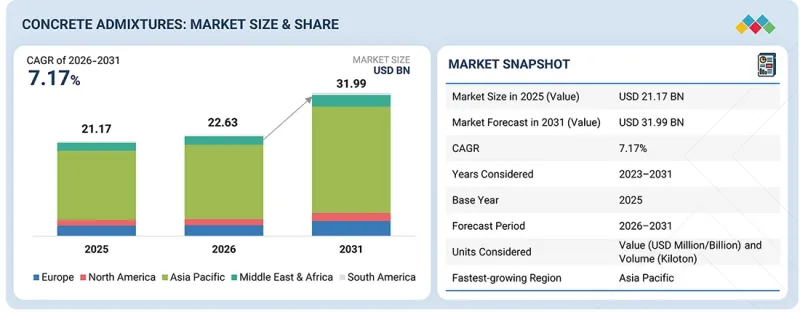
預計混凝土外加劑市場將從 2026 年的 226.3 億美元成長到 2031 年的 319.9 億美元,預測期內的複合年成長率預計為 7.17%。
| 調查範圍 | |
|---|---|
| 調查期 | 2023-2031 |
| 基準年 | 2025 |
| 預測期 | 2026-2031 |
| 單元 | 金額(美元)和數量(千噸) |
| 部分 | 類型,使用 |
| 目標區域 | 亞太地區、歐洲、北美、中東和非洲 |
對永續建築日益成長的關注是混凝土外加劑市場成長的主要驅動力。建築相關人員優先考慮能夠提高材料利用率並同時實現卓越結構性能的解決方案。混凝土外加劑能夠最佳化混凝土配合比,從而更有效地利用原料並提升整體施工效果。它們還有助於建造使用壽命更長的耐久性結構,這與行業延長資產壽命和降低整個生命週期資源消耗的努力方向相契合。
綠建築實踐、永續性認證計畫和環境績效標準的日益普及,進一步推動了先進混凝土技術的應用。此外,開發商和建築商也擴大將永續性目標納入專案規劃和材料選擇流程。隨著建設產業不斷優先考慮資源的高效利用和建築的長期性能,混凝土外加劑在永續建築策略中正扮演著越來越重要的角色。
“預計在預測期內,固化促進劑細分市場將成為成長速度第二快的細分市場。”
預計從2026年到2031年,加速劑市場將呈現第二高的成長率。基礎設施維修的日益重視推動了混凝土應用領域對加速劑需求的成長。針對公路、橋樑、機場跑道、隧道、公用設施網路和工業設施的維修和維護項目通常需要在嚴格的時間限制下進行,以確保服務的可用性。加速劑能夠加速修復混凝土的強度發展,使修復工程能夠在更短的時間內投入使用。這減少了施工帶來的干擾,並有助於有效率地進行維護活動。公共部門實體和基礎設施營運商正在加大對資產更新項目的投資,以延長資產使用壽命並提高網路可靠性。隨著快速基礎設施恢復的需求不斷成長,加速劑正成為提高維修效率和有效維護實踐的關鍵解決方案。
“預計基礎設施領域在預測期內將實現最高的複合年成長率。”
主要經濟體的政府正優先投資於幹線公路、高速公路、橋樑、鐵路走廊、地鐵系統和機場基礎設施,以增強互聯互通並支持經濟發展。這些項目需要大量的混凝土,且必須滿足嚴格的結構和運作要求。混凝土外加劑在提高大規模基礎設施建設中的可加工性、施工效率和性能穩定性方面發揮著至關重要的作用。交通基礎設施項目通常涉及複雜的施工計劃、大量的鋼筋佈置以及各種不同的施工場地條件,因此需要先進的混凝土技術。透過使用外加劑,承包商既可以滿足專案規範要求,又能保持施工效率。隨著公共和私人對交通基礎設施投資的持續成長,對高性能混凝土解決方案的需求也在增加,從而推動了混凝土外加劑市場的持續成長。
“到2025年,中東和非洲地區將佔據全球第三大佔有率(以金額為準)。”
中東和非洲許多國家的氣候條件對建設活動提出了特殊的混凝土解決方案要求。混凝土外加劑有助於在高溫下保持混凝土的可加工性,控制其硬化性能,並確保混凝土品質的穩定性。建築公司擴大採用外加劑技術,以提高澆築效率,並在大型專案中實現所需的結構性能。在環境條件惡劣的基礎設施、商業和工業開發項目中,可靠的混凝土性能尤其重要。建設公司致力於在保證高品質成果的同時,確保專案按時完成。隨著溫暖氣候地區開發活動的不斷擴展,由於混凝土外加劑能夠提高混凝土的效率和可靠性,其需求也穩定成長。
本報告考察了全球混凝土外加劑市場,提供了市場概述、影響市場成長的各種因素分析、技術和專利趨勢、法律制度、案例研究、歷史和預測市場規模、按各個細分市場和地區/主要國家進行的詳細分析、競爭格局以及主要公司的概況。
目錄
第1章:引言
第2章執行摘要
第3章重要考察
第4章 市場概覽
- 市場動態
- 促進因素
- 抑制因子
- 機會
- 任務
- 未滿足的需求和閒置頻段
- 與相關市場和不同產業相關的跨領域機遇
- 一級/二級/三級公司的策略性舉措
第5章 產業趨勢
- 波特五力分析
- 宏觀經濟展望
- GDP趨勢與預測
- 電子產業的發展趨勢
- 供應鏈分析
- 生態系分析
- 價格分析
- 貿易分析
- 2026-2027 年主要會議和活動
- 影響客戶業務的趨勢/顛覆性因素
- 投資和資金籌措場景
- 案例研究分析
- 2025年美國關稅的影響概述
第6章:技術進步、人工智慧的影響、專利、創新與未來應用
- 主要新興技術
- 自癒合混凝土技術
- 混凝土中的奈米技術
- 互補技術
- 3D列印技術
- 超高性能混凝土(UHPC)
- 技術/產品藍圖
- 短期(2026-2027 年)| 流程最佳化與早期應用拓展
- 中期規劃(2027-2030)| 績效提升與產業標準化
- 長期規劃(2030-2035年及以後)| 低碳混凝土系統與數位化施工解決方案
- 專利分析
- 人工智慧/生成式人工智慧對混凝土外加劑市場的影響
第7章:顧客趨勢與購買行為
- 決策流程
- 採購相關利益者和採購評估標準
- 實施障礙和內部挑戰
- 各種應用中尚未滿足的需求
第8章:監理情勢與永續性舉措
- 當地法規和合規性
- 對永續性的承諾
- 對永續性和監管政策舉措的影響
- 認證、標籤檢視、環境標準
第9章 混凝土外加劑市場:依產品類型分類
- 高效減水劑
- 標準減水劑
- 加速器
- 延誤代理人
- AE代理
- 防水劑
- 其他
第10章:混凝土外加劑市場:依應用領域分類
- 住宅
- 商業
- 基礎設施
第11章:混凝土外加劑市場:依地區分類
- 亞太地區
- 中國
- 印度
- 日本
- 韓國
- 印尼
- 北美洲
- 美國
- 加拿大
- 墨西哥
- 歐洲
- 德國
- 義大利
- 英國
- 法國
- 西班牙
- 土耳其
- 中東和非洲
- 海灣合作理事會國家
- 埃及
- 伊朗
- 南美洲
- 巴西
- 阿根廷
第12章 競爭格局
- 主要參與企業的策略/優勢
- 市佔率分析
- 收入分析
- 企業估值矩陣:主要公司
- 公司評估矩陣:新創企業/中小企業
- 產品對比
- 企業估值和財務指標
- 競爭格局
第13章:公司簡介
- 大公司
- SIKA AG
- SAINT-GOBAIN
- MAPEI CORPORATION
- RPM INTERNATIONAL INC.
- ARKEMA SA
- MUHU (CHINA) CONSTRUCTION MATERIALS CO., LTD.
- RHEIN-CHEMOTECHNIK GMBH
- XYPEX CHEMICAL CORPORATION
- CEMEX, SAB DE CV
- CICO GROUP
- 新創企業/中小企業
- ECMAS GROUP
- WACKER CHEMIE AG
- PENETRON
- CHEMATE TECHNOLOGY CO., LTD.
- BORREGAARD ASA
- CHEMBOND CHEMICALS LIMITED
- DOW INC.
- NIPPON SHOKUBAI CO., LTD.
- YUANWANG GROUP
- CHRISTEYNS NV
- AWAL READYMIX CONCRETE WLL
- KRYTON INTERNATIONAL INC.
- MYK ARMENT PRIVATE LIMITED
- QINGDAO SUNCHEM MATERIAL TECH CO., LTD.
- MC-BAUCHEMIE MULLER GMBH & CO. KG
第14章調查方法
第15章附錄
The concrete admixtures market is expected to reach USD 31.99 billion by 2031 from USD 22.63 billion in 2026, at a CAGR of 7.17% during the forecast period.
| Scope of the Report | |
|---|---|
| Years Considered for the Study | 2023-2031 |
| Base Year | 2025 |
| Forecast Period | 2026-2031 |
| Units Considered | Value (USD Million/Billion), and Volume (Kiloton) |
| Segments | Type, Application |
| Regions covered | Asia Pacific, Europe, North America, and Middle East & Africa |
The increasing focus on sustainable construction is contributing significantly to the growth of the concrete admixtures market. Construction stakeholders are prioritizing solutions that improve material efficiency while delivering high structural performance. Concrete admixtures help optimize concrete formulations, enabling more effective use of raw materials and supporting better overall construction outcomes. They also contribute to the development of durable structures with longer service lives, aligning with industry efforts to enhance asset longevity and reduce resource consumption over the lifecycle.
Growing adoption of green building practices, sustainability certification programs, and environmental performance standards is further encouraging the use of advanced concrete technologies. Furthermore, developers and contractors are increasingly integrating sustainability objectives into project planning and material selection processes. As the construction sector continues to emphasize efficient resource utilization and long-term building performance, concrete admixtures are becoming an increasingly important component of sustainable construction strategies.
"The accelerating admixtures segment is projected to be the second-fastest-growing application of concrete admixtures during the forecast period."
The accelerating admixtures segment is projected to be the second-fastest-growing application of concrete admixtures between 2026 and 2031. The growing focus on infrastructure rehabilitation is driving increased demand for accelerating admixtures in concrete applications. Repair and maintenance projects involving highways, bridges, airport runways, tunnels, utility networks, and industrial facilities often operate under strict time constraints to maintain service availability. Accelerating admixtures promote faster strength development in repair concrete, enabling repaired sections to become operational within shorter periods. This helps reduce construction-related disruptions and supports efficient execution of maintenance activities. Public authorities and infrastructure operators are increasingly investing in asset renewal programs to extend service life and improve network reliability. As the need for rapid infrastructure restoration continues to rise, accelerating admixtures are becoming an important solution for enhancing repair efficiency and supporting effective maintenance practices.
"The infrastructure segment is projected to witness the highest CAGR during the forecast period."
Governments across major economies are prioritizing investments in highways, expressways, bridges, rail corridors, metro systems, and airport infrastructure to strengthen connectivity and support economic development. These projects require massive volumes of concrete that must meet demanding structural and operational requirements. Concrete admixtures play a critical role in improving workability, placement efficiency, and performance consistency across large infrastructure developments. Transportation projects often involve complex construction schedules, extensive reinforcement layouts, and varying site conditions, necessitating advanced concrete technologies. Admixtures enable contractors to achieve project specifications while maintaining construction productivity. As public and private sector funding for transportation infrastructure continues to expand, demand for high-performance concrete solutions is increasing, supporting sustained growth in the concrete admixtures market.
"Middle East & Africa accounted for the third-largest share of the global concrete admixtures market, in terms of value, in 2025."
The Middle East & Africa held the third-largest share of the overall concrete admixtures market, in terms of value, in 2025. Many countries across the Middle East & Africa experience climatic conditions that require specialized concrete solutions during construction activities. Concrete admixtures help maintain workability, control setting characteristics, and support consistent concrete quality under elevated temperatures. Contractors increasingly incorporate admixture technologies to improve placement efficiency and achieve desired structural performance during large-scale projects. Reliable concrete behavior is particularly important for infrastructure, commercial, and industrial developments that operate under demanding environmental conditions. Construction companies focus on ensuring quality outcomes while maintaining project schedules. As development activity continues to expand across regions with warm climates, demand for concrete admixtures grows steadily due to their ability to support efficient, dependable concrete performance.
- By Company Type: Tier 1 - 55%, Tier 2 - 25%, and Tier 3 - 20%
- By Designation: Directors - 50%, Managers - 30%, and Others - 20%
- By Region: North America - 40%, Europe - 35%, Asia Pacific - 20%, RoW- 5%
The key players profiled in the report include Sika AG (Switzerland), Saint-Gobain (France), MAPEI Corporation (Italy), RPM International Inc. (US), Arkema S.A. (France), MUHU (China) Construction Materials Co., Ltd. (China), Rhein-Chemotechnik GmbH (Germany), Xypex Chemical Corporation (Canada), Cemex, S.A.B. de C.V. (Mexico), and CICO Group (India).
Study Coverage
This report segments the concrete admixture market by product type, application, and region, and provides estimates of value (in USD Million/Billion) and volume (in Kiloton) for the overall market size across regions. A detailed analysis of key industry players has been conducted to provide insights into their business overviews, services, and key strategies associated with the concrete admixtures market.
Reasons to Buy this Report
This research report is focused on various levels of analysis-industry analysis (industry trends), market share analysis of top players, and company profiles, which together provide an overall view of the competitive landscape, emerging and high-growth segments of the concrete admixtures market, high-growth regions, and market drivers, restraints, and opportunities.
The report provides insights into the following points:
- Market Penetration: Comprehensive information on concrete admixtures offered by top players in the global market
- Analysis of key drivers: (Emerging construction industry with huge growth potential in the developing countries, growing urbanization trend, improved quality and economics of construction), restraints (stringent government and environmental regulations, established infrastructure in developed countries), opportunities (exploring advanced applications in 3D printing and self-healing concrete, emerging demand for concrete admixtures in the construction industry, utilization of ready-mix concrete (RMC) in developing countries) and challenges (lack of technical guidance and R&D, unstable cost of raw materials) influencing the growth of concrete admixtures market
- Product Development/Innovation: Detailed insights on upcoming technologies, research & development activities, and new product & service launches in the concrete admixtures market
- Market Development: Comprehensive information about lucrative emerging markets-the report analyzes the market for concrete admixtures across regions
- Market Diversification: Exhaustive information about new products, untapped regions, and recent developments in the global concrete admixtures market
- Competitive Assessment: In-depth assessment of market shares, strategies, products, and manufacturing capabilities of leading players in the concrete admixtures market
TABLE OF CONTENTS
1 INTRODUCTION
- 1.1 STUDY OBJECTIVES
- 1.2 MARKET DEFINITION
- 1.3 STUDY SCOPE
- 1.3.1 MARKETS COVERED AND REGIONAL SCOPE
- 1.3.2 INCLUSIONS AND EXCLUSIONS OF STUDY
- 1.3.3 MARKET DEFINITION AND INCLUSIONS, BY PRODUCT TYPE
- 1.3.4 MARKET DEFINITION AND INCLUSIONS, BY APPLICATION
- 1.3.5 YEARS CONSIDERED
- 1.3.6 CURRENCY CONSIDERED
- 1.3.7 UNIT CONSIDERED
- 1.4 STAKEHOLDERS
- 1.5 SUMMARY OF CHANGES
2 EXECUTIVE SUMMARY
- 2.1 MARKET HIGHLIGHTS AND KEY INSIGHTS
- 2.2 KEY MARKET PARTICIPANTS: MAPPING OF STRATEGIC DEVELOPMENTS
- 2.3 DISRUPTIVE TRENDS IN CONCRETE ADMIXTURES MARKET
- 2.4 HIGH-GROWTH SEGMENTS
- 2.5 REGIONAL SNAPSHOT: MARKET SIZE, GROWTH RATE, AND FORECAST
3 PREMIUM INSIGHTS
- 3.1 ATTRACTIVE OPPORTUNITIES FOR PLAYERS IN CONCRETE ADMIXTURES MARKET
- 3.2 CONCRETE ADMIXTURES MARKET, BY PRODUCT TYPE AND REGION
- 3.3 CONCRETE ADMIXTURES MARKET, BY APPLICATION
- 3.4 CONCRETE ADMIXTURES MARKET, BY COUNTRY
4 MARKET OVERVIEW
- 4.1 INTRODUCTION
- 4.2 MARKET DYNAMICS
- 4.2.1 DRIVERS
- 4.2.1.1 Emerging construction industry with strong growth potential in developing countries
- 4.2.1.2 Growing urbanization
- 4.2.1.3 Improved quality and economics of construction
- 4.2.2 RESTRAINTS
- 4.2.2.1 Stringent government and environmental regulations
- 4.2.2.2 Established infrastructure in developed countries
- 4.2.3 OPPORTUNITIES
- 4.2.3.1 Exploring advanced applications in 3D printing and self-healing concrete
- 4.2.3.2 Emerging demand for concrete admixtures in construction industry
- 4.2.3.3 Utilization of ready-mix concrete (RMC) in developing countries
- 4.2.4 CHALLENGES
- 4.2.4.1 Lack of technical guidance and R&D
- 4.2.4.2 Unstable cost of raw materials
- 4.2.1 DRIVERS
- 4.3 INTERCONNECTED MARKETS AND CROSS-SECTOR OPPORTUNITIES
- 4.3.1 INTERCONNECTED MARKETS
- 4.3.2 CROSS-SECTOR OPPORTUNITIES
- 4.4 STRATEGIC MOVES BY TIER-1/2/3 PLAYERS
- 4.4.1 KEY MOVES AND STRATEGIC FOCUS
5 INDUSTRY TRENDS
- 5.1 PORTER'S FIVE FORCES ANALYSIS
- 5.1.1 THREAT OF NEW ENTRANTS
- 5.1.2 THREAT OF SUBSTITUTES
- 5.1.3 BARGAINING POWER OF BUYERS
- 5.1.4 BARGAINING POWER OF SUPPLIERS
- 5.1.5 INTENSITY OF COMPETITIVE RIVALRY
- 5.2 MACROECONOMIC OUTLOOK
- 5.2.1 INTRODUCTION
- 5.2.2 GDP TRENDS AND FORECAST
- 5.2.3 TRENDS IN ELECTRONICS INDUSTRY
- 5.3 SUPPLY CHAIN ANALYSIS
- 5.3.1 RAW MATERIALS
- 5.3.2 MANUFACTURERS
- 5.3.3 DISTRIBUTION NETWORK
- 5.3.4 END USERS
- 5.4 ECOSYSTEM ANALYSIS
- 5.5 PRICING ANALYSIS
- 5.5.1 AVERAGE SELLING PRICE OFFERED BY KEY PLAYERS, BY PRODUCT TYPE, 2025
- 5.5.2 AVERAGE SELLING PRICE TREND OF CONCRETE ADMIXTURES, BY REGION, 2023-2025
- 5.6 TRADE ANALYSIS
- 5.6.1 IMPORT SCENARIO (HS CODE 382440)
- 5.6.2 EXPORT SCENARIO (HS CODE 382440)
- 5.7 KEY CONFERENCES & EVENTS, 2026-2027
- 5.8 TRENDS/DISRUPTIONS IMPACTING CUSTOMER BUSINESS
- 5.8.1 REVENUE SHIFTS & REVENUE POCKETS FOR CONCRETE ADMIXTURES MARKET
- 5.9 INVESTMENT AND FUNDING SCENARIO
- 5.10 CASE STUDY ANALYSIS
- 5.10.1 OPTIMIZING SAND RESOURCES IN CONCRETE FORMULATION WITH CHRYSOQUAD 870
- 5.10.2 SAINT-GOBAIN'S AQUIRED 'FOSROC'S INNOVATIVE SOLUTION ENHANCES IZAN TERMINAL DREDGING BACKFILL PROJECT IN SAUDI ARABIA
- 5.10.3 SIKA'S SUSTAINABLE CONCRETE SOLUTIONS TRANSFORMING 'LONDON'S SUPER SEWER PROJECT
- 5.11 IMPACT OF 2025 US TARIFF - OVERVIEW
- 5.11.1 INTRODUCTION
- 5.11.2 KEY TARIFF RATES
- 5.11.3 PRICE IMPACT ANALYSIS
- 5.11.4 IMPACT ON COUNTRIES/REGIONS
- 5.11.4.1 US
- 5.11.4.2 Europe
- 5.11.4.3 Asia Pacific
- 5.11.5 IMPACT ON APPLICATIONS
6 TECHNOLOGICAL ADVANCEMENTS, AI-DRIVEN IMPACT, PATENTS, INNOVATIONS, AND FUTURE APPLICATIONS
- 6.1 KEY EMERGING TECHNOLOGIES
- 6.1.1 SELF-HEALING CONCRETE TECHNOLOGY
- 6.1.2 NANOTECHNOLOGY IN CONCRETE
- 6.2 COMPLEMENTARY TECHNOLOGIES
- 6.2.1 3D PRINTING TECHNOLOGY
- 6.2.2 ULTRA-HIGH PERFORMANCE CONCRETE (UHPC)
- 6.3 TECHNOLOGY/PRODUCT ROADMAP
- 6.3.1 SHORT-TERM (2026-2027) | PROCESS OPTIMIZATION & EARLY APPLICATION EXPANSION
- 6.3.2 MID-TERM (2027-2030) | PERFORMANCE ENHANCEMENT & INDUSTRY STANDARDIZATION
- 6.3.3 LONG-TERM (2030-2035+) | LOW-CARBON CONCRETE SYSTEMS & DIGITALIZED CONSTRUCTION SOLUTIONS
- 6.4 PATENT ANALYSIS
- 6.4.1 APPROACH
- 6.4.2 DOCUMENT TYPES
- 6.4.3 TOP APPLICANTS
- 6.4.4 JURISDICTION ANALYSIS
- 6.5 IMPACT OF AI/GEN AI ON CONCRETE ADMIXTURES MARKET
- 6.5.1 TOP USE CASES AND MARKET POTENTIAL
- 6.5.2 BEST PRACTICES IN CONCRETE ADMIXTURE PROCESSING
- 6.5.3 CASE STUDIES OF AI IMPLEMENTATION IN CONCRETE ADMIXTURES MARKET
- 6.5.4 INTERCONNECTED ADJACENT ECOSYSTEM AND IMPACT ON MARKET PLAYERS
- 6.5.5 CLIENTS' READINESS TO ADOPT GENERATIVE AI IN CONCRETE ADMIXTURES MARKET
7 CUSTOMER LANDSCAPE & BUYER BEHAVIOR
- 7.1 DECISION-MAKING PROCESS
- 7.2 BUYER STAKEHOLDERS AND BUYING EVALUATION CRITERIA
- 7.2.1 KEY STAKEHOLDERS IN BUYING PROCESS
- 7.2.2 BUYING CRITERIA
- 7.3 ADOPTION BARRIERS & INTERNAL CHALLENGES
- 7.4 UNMET NEEDS IN VARIOUS APPLICATIONS
8 REGULATORY LANDSCAPE AND SUSTAINABILITY INITIATIVES
- 8.1 REGIONAL REGULATIONS AND COMPLIANCE
- 8.1.1 REGULATORY BODIES, GOVERNMENT AGENCIES, AND OTHER ORGANIZATIONS
- 8.1.2 INDUSTRY STANDARDS
- 8.2 SUSTAINABILITY INITIATIVES
- 8.2.1 PRODUCTION EFFICIENCY AND RESOURCE OPTIMIZATION
- 8.2.2 SUSTAINABLE APPLICATION ENABLEMENT
- 8.3 SUSTAINABILITY IMPACT AND REGULATORY POLICY INITIATIVES
- 8.4 CERTIFICATIONS, LABELING, AND ECO-STANDARDS
9 CONCRETE ADMIXTURES MARKET, BY PRODUCT TYPE
- 9.1 INTRODUCTION
- 9.2 SUPERPLASTICIZERS
- 9.2.1 IMPROVES WORKABILITY OF CONCRETE
- 9.3 NORMAL PLASTICIZERS
- 9.3.1 REDUCES WATER USAGE, PROVIDES STRENGTH, AND IMPROVES WORKABILITY OF CONCRETE
- 9.4 ACCELERATING ADMIXTURES
- 9.4.1 REDUCES SEGREGATION, INCREASES DENSITY & STRENGTH, IMPROVES CURING RATE OF CEMENT BY PROVIDING UNIFORM CURING DURING SUMMER AND WINTER
- 9.5 RETARDING ADMIXTURES
- 9.5.1 USED TO OBTAIN ARCHITECTURAL FINISH IN INTERIOR SURFACE OF STRUCTURE TO DELAY HARDENING OF CEMENT/CONCRETE LAYER
- 9.6 AIR-ENTRAINING ADMIXTURES
- 9.6.1 UNIFORM DISPERSION OF AIR IN CONCRETE RESTRICTS WATER FLOW BETWEEN CEMENT PARTICLES AND FORMATION OF CAPILLARIES
- 9.7 WATER-PROOFING ADMIXTURES
- 9.7.1 USED IN CONSTRUCTION OF RESERVOIRS, SEWAGE, TANKS, TUNNELS, MANHOLES, AND OTHER WATER RETAINING STRUCTURES/FLOORS TO PREVENT WATER LEAKAGES
- 9.8 OTHER CONCRETE ADMIXTURES
10 CONCRETE ADMIXTURES MARKET, BY APPLICATION
- 10.1 INTRODUCTION
- 10.2 RESIDENTIAL
- 10.2.1 RISE IN POPULATION AND RAPID URBANIZATION INCREASING DEVELOPMENT IN RESIDENTIAL SECTOR
- 10.3 COMMERCIAL
- 10.3.1 HIGHER COSTS AND GREATER COMPLEXITY OF COMMERCIAL BUILDINGS RESULTING IN FEWER COMPETITORS IN COMMERCIAL SECTOR
- 10.4 INFRASTRUCTURE
- 10.4.1 GROWTH AND DEVELOPMENT IN INFRASTRUCTURE SECTOR BOOSTS GLOBAL ECONOMY
11 CONCRETE ADMIXTURES MARKET, BY REGION
- 11.1 INTRODUCTION
- 11.2 ASIA PACIFIC
- 11.2.1 CHINA
- 11.2.1.1 Steady increase in cement and concrete demand to drive market
- 11.2.2 INDIA
- 11.2.2.1 Investments from foreign players to drive the market
- 11.2.3 JAPAN
- 11.2.3.1 Stagnant tourism-related investment and rising coal prices affecting the market
- 11.2.4 SOUTH KOREA
- 11.2.4.1 Government's efforts to revive economy to drive market
- 11.2.5 INDONESIA
- 11.2.5.1 New moratorium policy and new investment arrangements to drive market
- 11.2.1 CHINA
- 11.3 NORTH AMERICA
- 11.3.1 US
- 11.3.1.1 Aging infrastructure and stringent building codes driving demand for concrete admixtures
- 11.3.2 CANADA
- 11.3.2.1 Improvements to its public infrastructure development bolstering concrete admixtures demand
- 11.3.3 MEXICO
- 11.3.3.1 Public infrastructure investment and growing industrial investment tied to nearshoring propelling concrete admixtures market in Mexico
- 11.3.1 US
- 11.4 EUROPE
- 11.4.1 GERMANY
- 11.4.1.1 Implementation of increasingly stringent environmental regulations increasing cement and concrete admixtures production
- 11.4.2 ITALY
- 11.4.2.1 Infrastructural investment to fuel demand for concrete admixtures
- 11.4.3 UK
- 11.4.3.1 Government's affirmation to support economic infrastructure to drive market
- 11.4.4 FRANCE
- 11.4.4.1 Olympic Games in 2024 and National Resilience and Recovery Plan (NRRP) to drive market
- 11.4.5 SPAIN
- 11.4.5.1 Investment in public sector infrastructure and energy-efficient housing renovations to drive market
- 11.4.6 TURKEY
- 11.4.6.1 Capacity, export potential of construction materials to drive market
- 11.4.1 GERMANY
- 11.5 MIDDLE EAST & AFRICA
- 11.5.1 GCC COUNTRIES
- 11.5.1.1 Saudi Arabia
- 11.5.1.1.1 Investment in upgrading infrastructure to positively influence market
- 11.5.1.1 Saudi Arabia
- 11.5.2 EGYPT
- 11.5.2.1 Foreign cement plant operations, and demand for affordable housing to drive market
- 11.5.3 IRAN
- 11.5.3.1 Strong regulations and new cement plant to drive market
- 11.5.1 GCC COUNTRIES
- 11.6 SOUTH AMERICA
- 11.6.1 BRAZIL
- 11.6.1.1 Significant and dynamic construction industry to drive market
- 11.6.2 ARGENTINA
- 11.6.2.1 New infrastructure projects and growing private sector industries to fuel market
- 11.6.1 BRAZIL
12 COMPETITIVE LANDSCAPE
- 12.1 INTRODUCTION
- 12.2 KEY PLAYER STRATEGIES/RIGHT TO WIN, 2022-2025
- 12.3 MARKET SHARE ANALYSIS, 2025
- 12.4 REVENUE ANALYSIS, 2021-2025
- 12.5 COMPANY EVALUATION MATRIX: KEY PLAYERS, 2025
- 12.5.1 STARS
- 12.5.2 EMERGING LEADERS
- 12.5.3 PERVASIVE PLAYERS
- 12.5.4 PARTICIPANTS
- 12.5.5 CONCRETE ADMIXTURES MARKET: COMPANY FOOTPRINT: KEY PLAYERS, 2025
- 12.5.5.1 Company footprint
- 12.5.5.2 Region footprint
- 12.5.5.3 Product type footprint
- 12.5.5.4 Application footprint
- 12.6 COMPANY EVALUATION MATRIX: START-UPS/SMES, 2025
- 12.6.1 PROGRESSIVE COMPANIES
- 12.6.2 RESPONSIVE COMPANIES
- 12.6.3 DYNAMIC COMPANIES
- 12.6.4 STARTING BLOCKS
- 12.6.5 COMPETITIVE BENCHMARKING: START-UPS/SMES, 2025
- 12.6.5.1 Detailed list of start-ups/SMEs
- 12.6.5.2 Competitive benchmarking of start-ups/SMEs
- 12.7 PRODUCT COMPARISON
- 12.8 COMPANY VALUATION AND FINANCIAL METRICS
- 12.9 COMPETITIVE SCENARIO
- 12.9.1 DEALS
- 12.9.2 EXPANSIONS
13 COMPANY PROFILES
- 13.1 KEY PLAYERS
- 13.1.1 SIKA AG
- 13.1.1.1 Business overview
- 13.1.1.2 Products/Solutions/Services offered
- 13.1.1.3 Recent developments
- 13.1.1.3.1 Deals
- 13.1.1.3.2 Expansions
- 13.1.1.4 MnM view
- 13.1.1.4.1 Key strengths/right to win
- 13.1.1.4.2 Strategic choices
- 13.1.1.4.3 Weaknesses and competitive threats
- 13.1.2 SAINT-GOBAIN
- 13.1.2.1 Business overview
- 13.1.2.2 Products /Solutions/Services offered
- 13.1.2.3 Recent developments
- 13.1.2.3.1 Deals
- 13.1.2.4 MnM view
- 13.1.2.4.1 Key strengths/Right to win
- 13.1.2.4.2 Strategic choices
- 13.1.2.4.3 Weaknesses and competitive threats
- 13.1.3 MAPEI CORPORATION
- 13.1.3.1 Business overview
- 13.1.3.2 Products/Solutions/Services offered
- 13.1.3.3 Recent developments
- 13.1.3.3.1 Expansions
- 13.1.3.4 MnM view
- 13.1.3.4.1 Key strengths/Right to win
- 13.1.3.4.2 Strategic choices
- 13.1.3.4.3 Weaknesses and competitive threats
- 13.1.4 RPM INTERNATIONAL INC.
- 13.1.4.1 Business overview
- 13.1.4.2 Products/Services/Solutions offered
- 13.1.4.3 Recent developments
- 13.1.4.3.1 Deals
- 13.1.4.3.2 Expansions
- 13.1.4.4 MnM view
- 13.1.4.4.1 Key strengths/Right to win
- 13.1.4.4.2 Strategic choices
- 13.1.4.4.3 Weaknesses and competitive threats
- 13.1.5 ARKEMA S.A.
- 13.1.5.1 Business overview
- 13.1.5.2 Products/Services/Solutions offered
- 13.1.5.3 MnM view
- 13.1.5.3.1 Key strengths/Right to win
- 13.1.5.3.2 Strategic choices
- 13.1.5.3.3 Weaknesses and competitive threats
- 13.1.6 MUHU (CHINA) CONSTRUCTION MATERIALS CO., LTD.
- 13.1.6.1 Business overview
- 13.1.6.2 Products/Services/Solutions offered
- 13.1.7 RHEIN-CHEMOTECHNIK GMBH
- 13.1.7.1 Business overview
- 13.1.7.2 Products/Services/Solutions offered
- 13.1.8 XYPEX CHEMICAL CORPORATION
- 13.1.8.1 Business overview
- 13.1.8.2 Products/Services/Solutions offered
- 13.1.9 CEMEX, S.A.B. DE C.V.
- 13.1.9.1 Business overview
- 13.1.9.2 Products/Services/Solutions offered
- 13.1.10 CICO GROUP
- 13.1.10.1 Business overview
- 13.1.10.2 Products/Services/Solutions offered
- 13.1.1 SIKA AG
- 13.2 STARTUP/SMES
- 13.2.1 ECMAS GROUP
- 13.2.2 WACKER CHEMIE AG
- 13.2.3 PENETRON
- 13.2.4 CHEMATE TECHNOLOGY CO., LTD.
- 13.2.5 BORREGAARD ASA
- 13.2.6 CHEMBOND CHEMICALS LIMITED
- 13.2.7 DOW INC.
- 13.2.8 NIPPON SHOKUBAI CO., LTD.
- 13.2.9 YUANWANG GROUP
- 13.2.10 CHRISTEYNS NV
- 13.2.11 AWAL READYMIX CONCRETE W.L.L.
- 13.2.12 KRYTON INTERNATIONAL INC.
- 13.2.13 MYK ARMENT PRIVATE LIMITED
- 13.2.14 QINGDAO SUNCHEM MATERIAL TECH CO., LTD.
- 13.2.15 MC-BAUCHEMIE MULLER GMBH & CO. KG
14 RESEARCH METHODOLOGY
- 14.1 RESEARCH DATA
- 14.1.1 SECONDARY DATA
- 14.1.1.1 Key data from secondary sources
- 14.1.2 PRIMARY DATA
- 14.1.2.1 Key data from primary sources
- 14.1.2.2 Primary interview - demand side and supply side
- 14.1.2.3 Breakdown of primary interviews
- 14.1.2.4 Key industry insights
- 14.1.1 SECONDARY DATA
- 14.2 MARKET SIZE ESTIMATION
- 14.2.1 BOTTOM-UP APPROACH
- 14.2.2 TOP-DOWN APPROACH
- 14.3 GROWTH FORECAST
- 14.3.1 SUPPLY SIDE
- 14.3.2 DEMAND SIDE
- 14.4 DATA TRIANGULATION
- 14.5 RESEARCH ASSUMPTIONS
- 14.6 RESEARCH LIMITATIONS
- 14.7 RISK ASSESSMENT
15 APPENDIX
- 15.1 DISCUSSION GUIDE
- 15.2 KNOWLEDGESTORE: MARKETSANDMARKETS' SUBSCRIPTION PORTAL
- 15.3 CUSTOMIZATION OPTIONS
- 15.4 RELATED REPORTS
- 15.5 AUTHOR DETAILS
List of Tables
- TABLE 1 ONGOING CONSTRUCTION PROJECT WORLDWIDE (2025)
- TABLE 2 COUNTRIES WITH BEST INFRASTRUCTURE IN 2025
- TABLE 3 CONSTRUCTION PROJECTS UNDERSCORE IMPACT OF HIGH-PERFORMANCE CONCRETE AND ADMIXTURES
- TABLE 4 REGULATIONS FOR CONCRETE ADMIXTURES
- TABLE 5 NATURAL GAS AND OIL PRICES (USD PER BARREL)
- TABLE 6 CONCRETE ADMIXTURES MARKET: 'PORTER'S FIVE FORCES ANALYSIS
- TABLE 7 GDP TRENDS AND FORECAST OF MAJOR ECONOMIES, 2021-2030 (USD BILLION)
- TABLE 8 CONCRETE ADMIXTURES MARKET: ROLE OF COMPANIES IN ECOSYSTEM
- TABLE 9 AVERAGE SELLING PRICE OFFERED BY KEY PLAYERS FOR TOP PRODUCT TYPES, 2025 (USD/KG)
- TABLE 10 AVERAGE SELLING PRICE TREND OF CONCRETE ADMIXTURES, BY REGION, 2023-2025 (USD/KG)
- TABLE 11 IMPORT DATA FOR CONCRETE ADMIXTURES, BY REGION, 2021-2025 (USD MILLION)
- TABLE 12 EXPORT DATA FOR CONCRETE ADMIXTURES, BY REGION, 2021-2025 (USD MILLION)
- TABLE 13 CONCRETE ADMIXTURES MARKET: LIST OF CONFERENCES & EVENTS, 2026-2027
- TABLE 14 CONCRETE ADMIXTURES MARKET: FUNDING/INVESTMENT SCENARIO, 2023-2026
- TABLE 15 US ADJUSTED RECIPROCAL TARIFF RATES
- TABLE 16 LIST OF MAJOR PATENTS RELATED TO CONCRETE ADMIXTURES, 2015-2025
- TABLE 17 TOP USE CASES AND MARKET POTENTIAL
- TABLE 18 BEST PRACTICES: COMPANIES IMPLEMENTING USE CASES
- TABLE 19 CONCRETE ADMIXTURES MARKET: CASE STUDIES RELATED TO GEN AI IMPLEMENTATION
- TABLE 20 INTERCONNECTED ADJACENT ECOSYSTEM AND IMPACT ON MARKET PLAYERS
- TABLE 21 INFLUENCE OF STAKEHOLDERS IN BUYING PROCESS FOR TOP THREE PRODUCT TYPES (%)
- TABLE 22 KEY BUYING CRITERIA FOR TOP THREE PRODUCT TYPES
- TABLE 23 CONCRETE ADMIXTURES MARKET: UNMET NEEDS IN KEY APPLICATIONS
- TABLE 24 GLOBAL: REGULATORY BODIES, GOVERNMENT AGENCIES, AND OTHER ORGANIZATIONS
- TABLE 25 NORTH AMERICA: REGULATORY BODIES, GOVERNMENT AGENCIES, AND OTHER ORGANIZATIONS
- TABLE 26 EUROPE: REGULATORY BODIES, GOVERNMENT AGENCIES, AND OTHER ORGANIZATIONS
- TABLE 27 ASIA PACIFIC: REGULATORY BODIES, GOVERNMENT AGENCIES, AND OTHER ORGANIZATIONS
- TABLE 28 SOUTH AMERICA: REGULATORY BODIES, GOVERNMENT AGENCIES, AND OTHER ORGANIZATIONS
- TABLE 29 MIDDLE EAST & AFRICA: REGULATORY BODIES, GOVERNMENT AGENCIES, AND OTHER ORGANIZATIONS
- TABLE 30 CERTIFICATIONS, LABELING, AND ECO-STANDARDS IN CONCRETE ADMIXTURES MARKET
- TABLE 31 CHEMICAL COMPOSITION OF ADMIXTURES, BY PRODUCT TYPE
- TABLE 32 CONCRETE ADMIXTURES MARKET, BY PRODUCT TYPE, 2023-2025 (KILOTON)
- TABLE 33 CONCRETE ADMIXTURES MARKET, BY PRODUCT TYPE, 2026-2031 (KILOTON)
- TABLE 34 CONCRETE ADMIXTURES MARKET, BY PRODUCT TYPE, 2023-2025 (USD MILLION)
- TABLE 35 CONCRETE ADMIXTURES MARKET, BY PRODUCT TYPE, 2026-2031 (USD MILLION)
- TABLE 36 CONCRETE ADMIXTURE PRODUCTS IN SUPERPLASTICIZERS CATEGORY
- TABLE 37 SUPERPLASTICIZERS: CONCRETE ADMIXTURES MARKET, BY REGION, 2023-2025 (KILOTON)
- TABLE 38 SUPERPLASTICIZERS: CONCRETE ADMIXTURES MARKET, BY REGION, 2026-2031 (KILOTON)
- TABLE 39 SUPERPLASTICIZERS: CONCRETE ADMIXTURES MARKET, BY REGION, 2023-2025 (USD MILLION)
- TABLE 40 SUPERPLASTICIZERS: CONCRETE ADMIXTURES MARKET, BY REGION, 2026-2031 (USD MILLION)
- TABLE 41 CONCRETE ADMIXTURE PRODUCTS IN NORMAL PLASTICIZERS CATEGORY
- TABLE 42 NORMAL PLASTICIZERS: CONCRETE ADMIXTURES MARKET, BY REGION, 2023-2025 (KILOTON)
- TABLE 43 NORMAL PLASTICIZERS: CONCRETE ADMIXTURES MARKET, BY REGION, 2026-2031 (KILOTON)
- TABLE 44 NORMAL PLASTICIZERS: CONCRETE ADMIXTURES MARKET, BY REGION, 2023-2025 (USD MILLION)
- TABLE 45 NORMAL PLASTICIZERS: CONCRETE ADMIXTURES MARKET, BY REGION, 2026-2031 (USD MILLION)
- TABLE 46 CONCRETE ADMIXTURE PRODUCTS IN ACCELERATING ADMIXTURE CATEGORY
- TABLE 47 ACCELERATING ADMIXTURES: CONCRETE ADMIXTURES MARKET, BY REGION, 2023-2025 (KILOTON)
- TABLE 48 ACCELERATING ADMIXTURES: CONCRETE ADMIXTURES MARKET, BY REGION, 2026-2031 (KILOTON)
- TABLE 49 ACCELERATING ADMIXTURES: CONCRETE ADMIXTURES MARKET, BY REGION, 2023-2025 (USD MILLION)
- TABLE 50 ACCELERATING ADMIXTURES: CONCRETE ADMIXTURES MARKET, BY REGION, 2026-2031 (USD MILLION)
- TABLE 51 CONCRETE ADMIXTURE PRODUCTS IN RETARDING ADMIXTURE CATEGORY
- TABLE 52 RETARDING ADMIXTURES: CONCRETE ADMIXTURES MARKET, BY REGION, 2023-2025 (KILOTON)
- TABLE 53 RETARDING ADMIXTURES: CONCRETE ADMIXTURES MARKET, BY REGION, 2026-2031 (KILOTON)
- TABLE 54 RETARDING ADMIXTURES: CONCRETE ADMIXTURES MARKET, BY REGION, 2023-2025 (USD MILLION)
- TABLE 55 RETARDING ADMIXTURES: CONCRETE ADMIXTURES MARKET, BY REGION, 2026-2031 (USD MILLION)
- TABLE 56 CONCRETE ADMIXTURE PRODUCTS IN AIR-ENTRAINING ADMIXTURE CATEGORY
- TABLE 57 AIR-ENTRAINING ADMIXTURES: CONCRETE ADMIXTURES MARKET, BY REGION, 2023-2025 (KILOTON)
- TABLE 58 AIR-ENTRAINING ADMIXTURES: CONCRETE ADMIXTURES MARKET, BY REGION, 2026-2031 (KILOTON)
- TABLE 59 AIR-ENTRAINING ADMIXTURES: CONCRETE ADMIXTURES MARKET, BY REGION, 2023-2025 (USD MILLION)
- TABLE 60 AIR-ENTRAINING ADMIXTURES: CONCRETE ADMIXTURES MARKET, BY REGION, 2026-2031 (USD MILLION)
- TABLE 61 CONCRETE ADMIXTURE PRODUCTS IN WATERPROOFING ADMIXTURES CATEGORY
- TABLE 62 WATERPROOFING ADMIXTURES: CONCRETE ADMIXTURES MARKET, BY REGION, 2023-2025 (KILOTON)
- TABLE 63 WATERPROOFING ADMIXTURES: CONCRETE ADMIXTURES MARKET, BY REGION, 2026-2031 (KILOTON)
- TABLE 64 WATERPROOFING ADMIXTURES: CONCRETE ADMIXTURES MARKET, BY REGION, 2023-2025 (USD MILLION)
- TABLE 65 WATERPROOFING ADMIXTURES: CONCRETE ADMIXTURES MARKET, BY REGION, 2026-2031 (USD MILLION)
- TABLE 66 CONCRETE ADMIXTURE PRODUCTS IN OTHER ADMIXTURES CATEGORY
- TABLE 67 OTHER CONCRETE ADMIXTURES MARKET, BY REGION, 2023-2025 (KILOTON)
- TABLE 68 OTHER CONCRETE ADMIXTURES MARKET, BY REGION, 2026-2031 (KILOTON)
- TABLE 69 OTHER CONCRETE ADMIXTURES MARKET, BY REGION, 2023-2025 (USD MILLION)
- TABLE 70 OTHER CONCRETE ADMIXTURES MARKET, BY REGION, 2026-2031 (USD MILLION)
- TABLE 71 CONCRETE ADMIXTURES MARKET, BY APPLICATION, 2023-2025 (KILOTON)
- TABLE 72 CONCRETE ADMIXTURES MARKET, BY APPLICATION, 2026-2031 (KILOTON)
- TABLE 73 CONCRETE ADMIXTURES MARKET, BY APPLICATION, 2023-2025 (USD MILLION)
- TABLE 74 CONCRETE ADMIXTURES MARKET, BY APPLICATION, 2026-2031 (USD MILLION)
- TABLE 75 RESIDENTIAL: CONCRETE ADMIXTURES MARKET, BY REGION, 2023-2025 (KILOTON)
- TABLE 76 RESIDENTIAL: CONCRETE ADMIXTURES MARKET, BY REGION, 2026-2031 (KILOTON)
- TABLE 77 RESIDENTIAL: CONCRETE ADMIXTURES MARKET, BY REGION, 2023-2025 (USD MILLION)
- TABLE 78 RESIDENTIAL: CONCRETE ADMIXTURES MARKET, BY REGION, 2026-2031 (USD MILLION)
- TABLE 79 COMMERCIAL: CONCRETE ADMIXTURES MARKET, BY REGION, 2023-2025 (KILOTON)
- TABLE 80 COMMERCIAL: CONCRETE ADMIXTURES MARKET, BY REGION, 2026-2031 (KILOTON)
- TABLE 81 COMMERCIAL: CONCRETE ADMIXTURES MARKET, BY REGION, 2023-2025 (USD MILLION)
- TABLE 82 COMMERCIAL: CONCRETE ADMIXTURES MARKET, BY REGION, 2026-2031 (USD MILLION)
- TABLE 83 INFRASTRUCTURE: CONCRETE ADMIXTURES MARKET, BY REGION, 2023-2025 (KILOTON)
- TABLE 84 INFRASTRUCTURE: CONCRETE ADMIXTURES, BY REGION, 2026-2031 (KILOTON)
- TABLE 85 INFRASTRUCTURE: CONCRETE ADMIXTURES, BY REGION, 2023-2025 (USD MILLION)
- TABLE 86 INFRASTRUCTURE: CONCRETE ADMIXTURES MARKET, BY REGION, 2026-2031 (USD MILLION)
- TABLE 87 CONCRETE ADMIXTURES MARKET, BY REGION, 2023-2025 (KILOTON)
- TABLE 88 CONCRETE ADMIXTURES MARKET, BY REGION, 2026-2031 (KILOTON)
- TABLE 89 CONCRETE ADMIXTURES MARKET, BY REGION, 2023-2025 (USD MILLION)
- TABLE 90 CONCRETE ADMIXTURES MARKET, BY REGION, 2026-2031 (USD MILLION)
- TABLE 91 ASIA PACIFIC: CONCRETE ADMIXTURES MARKET, BY PRODUCT TYPE, 2023-2025 (KILOTON)
- TABLE 92 ASIA PACIFIC: CONCRETE ADMIXTURES MARKET, BY PRODUCT TYPE, 2026-2031 (KILOTON)
- TABLE 93 ASIA PACIFIC: CONCRETE ADMIXTURES MARKET, BY PRODUCT TYPE, 2023-2025 (USD MILLION)
- TABLE 94 ASIA PACIFIC: CONCRETE ADMIXTURES MARKET, BY PRODUCT TYPE, 2026-2031 (USD MILLION)
- TABLE 95 ASIA PACIFIC: CONCRETE ADMIXTURES MARKET, BY APPLICATION, 2023-2025 (KILOTON)
- TABLE 96 ASIA PACIFIC: CONCRETE ADMIXTURES MARKET, BY APPLICATION, 2026-2031 (KILOTON)
- TABLE 97 ASIA PACIFIC: CONCRETE ADMIXTURES MARKET, BY APPLICATION, 2023-2025 (USD MILLION)
- TABLE 98 ASIA PACIFIC: CONCRETE ADMIXTURES MARKET, BY APPLICATION, 2026-2031 (USD MILLION)
- TABLE 99 ASIA PACIFIC: CONCRETE ADMIXTURES MARKET, BY COUNTRY, 2023-2025 (KILOTON)
- TABLE 100 ASIA PACIFIC: CONCRETE ADMIXTURES MARKET, BY COUNTRY, 2026-2031 (KILOTON)
- TABLE 101 ASIA PACIFIC: CONCRETE ADMIXTURES MARKET, BY COUNTRY, 2023-2025 (USD MILLION)
- TABLE 102 ASIA PACIFIC: CONCRETE ADMIXTURES MARKET, BY COUNTRY, 2026-2031 (USD MILLION)
- TABLE 103 CHINA: CONCRETE ADMIXTURES MARKET, BY APPLICATION, 2023-2025 (KILOTON)
- TABLE 104 CHINA: CONCRETE ADMIXTURES MARKET, BY APPLICATION, 2026-2031 (KILOTON)
- TABLE 105 CHINA: CONCRETE ADMIXTURES MARKET, BY APPLICATION, 2023-2025 (USD MILLION)
- TABLE 106 CHINA: CONCRETE ADMIXTURES MARKET, BY APPLICATION, 2026-2031 (USD MILLION)
- TABLE 107 INDIA: CONCRETE ADMIXTURES MARKET, BY APPLICATION, 2023-2025 (KILOTON)
- TABLE 108 INDIA: CONCRETE ADMIXTURES MARKET, BY APPLICATION, 2026-2031 (KILOTON)
- TABLE 109 INDIA: CONCRETE ADMIXTURES MARKET, BY APPLICATION, 2023-2025 (USD MILLION)
- TABLE 110 INDIA: CONCRETE ADMIXTURES MARKET, BY APPLICATION, 2026-2031 (USD MILLION)
- TABLE 111 JAPAN: CONCRETE ADMIXTURES MARKET, BY APPLICATION, 2023-2025 (KILOTON)
- TABLE 112 JAPAN: CONCRETE ADMIXTURES MARKET, BY APPLICATION, 2026-2031 (KILOTON)
- TABLE 113 JAPAN: CONCRETE ADMIXTURES MARKET, BY APPLICATION, 2023-2025 (USD MILLION)
- TABLE 114 JAPAN: CONCRETE ADMIXTURES MARKET, BY APPLICATION, 2026-2031 (USD MILLION)
- TABLE 115 SOUTH KOREA: CONCRETE ADMIXTURES MARKET, BY APPLICATION, 2023-2025 (KILOTON)
- TABLE 116 SOUTH KOREA: CONCRETE ADMIXTURES MARKET, BY APPLICATION, 2026-2031 (KILOTON)
- TABLE 117 SOUTH KOREA: CONCRETE ADMIXTURES MARKET, BY APPLICATION, 2023-2025 (USD MILLION)
- TABLE 118 SOUTH KOREA: CONCRETE ADMIXTURES MARKET, BY APPLICATION, 2026-2031 (USD MILLION)
- TABLE 119 INDONESIA: CONCRETE ADMIXTURES MARKET, BY APPLICATION, 2023-2025 (KILOTON)
- TABLE 120 INDONESIA: CONCRETE ADMIXTURES MARKET, BY APPLICATION, 2026-2031 (KILOTON)
- TABLE 121 INDONESIA: CONCRETE ADMIXTURES MARKET, BY APPLICATION, 2023-2025 (USD MILLION)
- TABLE 122 INDONESIA: CONCRETE ADMIXTURES MARKET, BY APPLICATION, 2026-2031 (USD MILLION)
- TABLE 123 NORTH AMERICA: CONCRETE ADMIXTURES MARKET, BY PRODUCT TYPE, 2023-2025 (KILOTON)
- TABLE 124 NORTH AMERICA: CONCRETE ADMIXTURES MARKET, BY PRODUCT TYPE, 2026-2031 (KILOTON)
- TABLE 125 NORTH AMERICA: CONCRETE ADMIXTURES MARKET, BY PRODUCT TYPE, 2023-2025 (USD MILLION)
- TABLE 126 NORTH AMERICA: CONCRETE ADMIXTURES MARKET, BY PRODUCT TYPE, 2026-2031 (USD MILLION)
- TABLE 127 NORTH AMERICA: CONCRETE ADMIXTURES MARKET, BY APPLICATION, 2023-2025 (KILOTON)
- TABLE 128 NORTH AMERICA: CONCRETE ADMIXTURES MARKET, BY APPLICATION, 2026-2031 (KILOTON)
- TABLE 129 NORTH AMERICA: CONCRETE ADMIXTURES MARKET, BY APPLICATION, 2023-2025 (USD MILLION)
- TABLE 130 NORTH AMERICA: CONCRETE ADMIXTURES MARKET, BY APPLICATION, 2026-2031 (USD MILLION)
- TABLE 131 NORTH AMERICA: CONCRETE ADMIXTURES MARKET, BY COUNTRY, 2023-2025 (KILOTON)
- TABLE 132 NORTH AMERICA: CONCRETE ADMIXTURES MARKET, BY COUNTRY, 2026-2031 (KILOTON)
- TABLE 133 NORTH AMERICA: CONCRETE ADMIXTURES MARKET, BY COUNTRY, 2023-2025 (USD MILLION)
- TABLE 134 NORTH AMERICA: CONCRETE ADMIXTURES MARKET, BY COUNTRY, 2026-2031 (USD MILLION)
- TABLE 135 US: CONCRETE ADMIXTURES MARKET, BY APPLICATION, 2023-2025 (KILOTON)
- TABLE 136 US: CONCRETE ADMIXTURES MARKET, BY APPLICATION, 2026-2031 (KILOTON)
- TABLE 137 US: CONCRETE ADMIXTURES MARKET, BY APPLICATION, 2023-2025 (USD MILLION)
- TABLE 138 US: CONCRETE ADMIXTURES MARKET, BY APPLICATION, 2026-2031 (USD MILLION)
- TABLE 139 CANADA: CONCRETE ADMIXTURES MARKET, BY APPLICATION, 2023-2025 (KILOTON)
- TABLE 140 CANADA: CONCRETE ADMIXTURES MARKET, BY APPLICATION, 2026-2031 (KILOTON)
- TABLE 141 CANADA: CONCRETE ADMIXTURES MARKET, BY APPLICATION, 2023-2025 (USD MILLION)
- TABLE 142 CANADA: CONCRETE ADMIXTURES MARKET, BY APPLICATION, 2026-2031 (USD MILLION)
- TABLE 143 MEXICO: CONCRETE ADMIXTURES MARKET, BY APPLICATION, 2023-2025 (KILOTON)
- TABLE 144 MEXICO: CONCRETE ADMIXTURES MARKET, BY APPLICATION, 2026-2031 (KILOTON)
- TABLE 145 MEXICO: CONCRETE ADMIXTURES MARKET, BY APPLICATION, 2023-2025 (USD MILLION)
- TABLE 146 MEXICO: CONCRETE ADMIXTURES MARKET, BY APPLICATION, 2026-2031 (USD MILLION)
- TABLE 147 EUROPE: CONCRETE ADMIXTURES MARKET, BY PRODUCT TYPE, 2023-2025 (KILOTON)
- TABLE 148 EUROPE: CONCRETE ADMIXTURES MARKET, BY PRODUCT TYPE, 2026-2031 (KILOTON)
- TABLE 149 EUROPE: CONCRETE ADMIXTURES MARKET, BY PRODUCT TYPE, 2023-2025 (USD MILLION)
- TABLE 150 EUROPE: CONCRETE ADMIXTURES MARKET, BY PRODUCT TYPE, 2026-2031 (USD MILLION)
- TABLE 151 EUROPE: CONCRETE ADMIXTURES MARKET, BY APPLICATION, 2023-2025 (KILOTON)
- TABLE 152 EUROPE: CONCRETE ADMIXTURES MARKET, BY APPLICATION, 2026-2031 (KILOTON)
- TABLE 153 EUROPE: CONCRETE ADMIXTURES MARKET, BY APPLICATION, 2023-2025 (USD MILLION)
- TABLE 154 EUROPE: CONCRETE ADMIXTURES MARKET, BY APPLICATION, 2026-2031 (USD MILLION)
- TABLE 155 EUROPE: CONCRETE ADMIXTURES MARKET, BY COUNTRY, 2023-2025 (KILOTON)
- TABLE 156 EUROPE: CONCRETE ADMIXTURES MARKET, BY COUNTRY, 2026-2031 (KILOTON)
- TABLE 157 EUROPE: CONCRETE ADMIXTURES MARKET, BY COUNTRY, 2023-2025 (USD MILLION)
- TABLE 158 EUROPE: CONCRETE ADMIXTURES MARKET, BY COUNTRY, 2026-2031 (USD MILLION)
- TABLE 159 GERMANY: CONCRETE ADMIXTURES MARKET, BY APPLICATION, 2023-2025 (KILOTON)
- TABLE 160 GERMANY: CONCRETE ADMIXTURES MARKET, BY APPLICATION, 2026-2031 (KILOTON)
- TABLE 161 GERMANY: CONCRETE ADMIXTURES MARKET, BY APPLICATION, 2023-2025 (USD MILLION)
- TABLE 162 GERMANY: CONCRETE ADMIXTURES MARKET, BY APPLICATION, 2026-2031 (USD MILLION)
- TABLE 163 ITALY: CONCRETE ADMIXTURES MARKET, BY APPLICATION, 2023-2025 (KILOTON)
- TABLE 164 ITALY: CONCRETE ADMIXTURES MARKET, BY APPLICATION, 2026-2031 (KILOTON)
- TABLE 165 ITALY: CONCRETE ADMIXTURES MARKET, BY APPLICATION, 2023-2025 (USD MILLION)
- TABLE 166 ITALY: CONCRETE ADMIXTURES MARKET, BY APPLICATION, 2026-2031 (USD MILLION)
- TABLE 167 UK: CONCRETE ADMIXTURES MARKET, BY APPLICATION, 2023-2025 (KILOTON)
- TABLE 168 UK: CONCRETE ADMIXTURES MARKET, BY APPLICATION, 2026-2031 (KILOTON)
- TABLE 169 UK: CONCRETE ADMIXTURES MARKET, BY APPLICATION, 2023-2025 (USD MILLION)
- TABLE 170 UK: CONCRETE ADMIXTURES MARKET, BY APPLICATION, 2026-2031 (USD MILLION)
- TABLE 171 FRANCE: CONCRETE ADMIXTURES MARKET, BY APPLICATION, 2023-2025 (KILOTON)
- TABLE 172 FRANCE: CONCRETE ADMIXTURES MARKET, BY APPLICATION, 2026-2031 (KILOTON)
- TABLE 173 FRANCE: CONCRETE ADMIXTURES MARKET, BY APPLICATION, 2023-2025 (USD MILLION)
- TABLE 174 FRANCE: CONCRETE ADMIXTURES MARKET, BY APPLICATION, 2026-2031 (USD MILLION)
- TABLE 175 SPAIN: CONCRETE ADMIXTURES MARKET, BY APPLICATION, 2023-2025 (KILOTON)
- TABLE 176 SPAIN: CONCRETE ADMIXTURES MARKET, BY APPLICATION, 2026-2031 (KILOTON)
- TABLE 177 SPAIN: CONCRETE ADMIXTURES MARKET, BY APPLICATION, 2023-2025 (USD MILLION)
- TABLE 178 SPAIN: CONCRETE ADMIXTURES MARKET, BY APPLICATION, 2026-2031 (USD MILLION)
- TABLE 179 TURKEY: CONCRETE ADMIXTURES MARKET, BY APPLICATION, 2023-2025 (KILOTON)
- TABLE 180 TURKEY: CONCRETE ADMIXTURES MARKET, BY APPLICATION, 2026-2031 (KILOTON)
- TABLE 181 TURKEY: CONCRETE ADMIXTURES MARKET, BY APPLICATION, 2023-2025 (USD MILLION)
- TABLE 182 TURKEY: CONCRETE ADMIXTURES MARKET, BY APPLICATION, 2026-2031 (USD MILLION)
- TABLE 183 MIDDLE EAST & AFRICA: CONCRETE ADMIXTURES MARKET, BY PRODUCT TYPE, 2023-2025 (KILOTON)
- TABLE 184 MIDDLE EAST & AFRICA: CONCRETE ADMIXTURES MARKET, BY PRODUCT TYPE, 2026-2031 (KILOTON)
- TABLE 185 MIDDLE EAST & AFRICA: CONCRETE ADMIXTURES MARKET, BY PRODUCT TYPE, 2023-2025 (USD MILLION)
- TABLE 186 MIDDLE EAST & AFRICA: CONCRETE ADMIXTURES MARKET, BY PRODUCT TYPE, 2026-2031 (USD MILLION)
- TABLE 187 MIDDLE EAST & AFRICA: CONCRETE ADMIXTURES MARKET, BY APPLICATION, 2023-2025 (KILOTON)
- TABLE 188 MIDDLE EAST & AFRICA: CONCRETE ADMIXTURES MARKET, BY APPLICATION, 2026-2031 (KILOTON)
- TABLE 189 MIDDLE EAST & AFRICA: CONCRETE ADMIXTURES MARKET, BY APPLICATION, 2023-2025 (USD MILLION)
- TABLE 190 MIDDLE EAST & AFRICA: CONCRETE ADMIXTURES MARKET, BY APPLICATION, 2026-2031 (USD MILLION)
- TABLE 191 MIDDLE EAST & AFRICA: CONCRETE ADMIXTURES MARKET, BY COUNTRY, 2023-2025 (KILOTON)
- TABLE 192 MIDDLE EAST & AFRICA: CONCRETE ADMIXTURES MARKET, BY COUNTRY, 2026-2031 (KILOTON)
- TABLE 193 MIDDLE EAST & AFRICA: CONCRETE ADMIXTURES MARKET, BY COUNTRY, 2023-2025 (USD MILLION)
- TABLE 194 MIDDLE EAST & AFRICA: CONCRETE ADMIXTURES MARKET, BY COUNTRY, 2026-2031 (USD MILLION)
- TABLE 195 SAUDI ARABIA: CONCRETE ADMIXTURES MARKET, BY APPLICATION, 2023-2025 (KILOTON)
- TABLE 196 SAUDI ARABIA: CONCRETE ADMIXTURES MARKET, BY APPLICATION, 2026-2031 (KILOTON)
- TABLE 197 SAUDI ARABIA: CONCRETE ADMIXTURES MARKET, BY APPLICATION, 2023-2025 (USD MILLION)
- TABLE 198 SAUDI ARABIA: CONCRETE ADMIXTURES MARKET, BY APPLICATION, 2026-2031 (USD MILLION)
- TABLE 199 EGYPT: CONCRETE ADMIXTURES MARKET, BY APPLICATION, 2023-2025 (KILOTON)
- TABLE 200 EGYPT: CONCRETE ADMIXTURES MARKET, BY APPLICATION, 2026-2031 (KILOTON)
- TABLE 201 EGYPT: CONCRETE ADMIXTURES MARKET, BY APPLICATION, 2023-2025 (USD MILLION)
- TABLE 202 EGYPT: CONCRETE ADMIXTURES MARKET, BY APPLICATION, 2026-2031 (USD MILLION)
- TABLE 203 IRAN: CONCRETE ADMIXTURES MARKET, BY APPLICATION, 2023-2025 (KILOTON)
- TABLE 204 IRAN: CONCRETE ADMIXTURES MARKET, BY APPLICATION, 2026-2031 (KILOTON)
- TABLE 205 IRAN: CONCRETE ADMIXTURES MARKET, BY APPLICATION, 2023-2025 (USD MILLION)
- TABLE 206 IRAN: CONCRETE ADMIXTURES MARKET, BY APPLICATION, 2026-2031 (USD MILLION)
- TABLE 207 SOUTH AMERICA: CONCRETE ADMIXTURES MARKET, BY PRODUCT TYPE, 2023-2025 (KILOTON)
- TABLE 208 SOUTH AMERICA: CONCRETE ADMIXTURES MARKET, BY PRODUCT TYPE, 2026-2031 (KILOTON)
- TABLE 209 SOUTH AMERICA: CONCRETE ADMIXTURES MARKET, BY PRODUCT TYPE, 2023-2025 (USD MILLION)
- TABLE 210 SOUTH AMERICA: CONCRETE ADMIXTURES MARKET, BY PRODUCT TYPE, 2026-2031 (USD MILLION)
- TABLE 211 SOUTH AMERICA: CONCRETE ADMIXTURES MARKET, BY APPLICATION, 2023-2025 (KILOTON)
- TABLE 212 SOUTH AMERICA: CONCRETE ADMIXTURES MARKET, BY APPLICATION, 2026-2031 (KILOTON)
- TABLE 213 SOUTH AMERICA: CONCRETE ADMIXTURES MARKET, BY APPLICATION, 2023-2025 (USD MILLION)
- TABLE 214 SOUTH AMERICA: CONCRETE ADMIXTURES MARKET, BY APPLICATION, 2026-2031 (USD MILLION)
- TABLE 215 SOUTH AMERICA: CONCRETE ADMIXTURES MARKET, BY COUNTRY, 2023-2025 (KILOTON)
- TABLE 216 SOUTH AMERICA: CONCRETE ADMIXTURES MARKET, BY COUNTRY, 2026-2031 (KILOTON)
- TABLE 217 SOUTH AMERICA: CONCRETE ADMIXTURES MARKET, BY COUNTRY, 2023-2025 (USD MILLION)
- TABLE 218 SOUTH AMERICA: CONCRETE ADMIXTURES MARKET, BY COUNTRY, 2026-2031 (USD MILLION)
- TABLE 219 BRAZIL: CONCRETE ADMIXTURES MARKET, BY APPLICATION, 2023-2025 (KILOTON)
- TABLE 220 BRAZIL: CONCRETE ADMIXTURES MARKET, BY APPLICATION, 2026-2031 (KILOTON)
- TABLE 221 BRAZIL: CONCRETE ADMIXTURES MARKET, BY APPLICATION, 2023-2025 (USD MILLION)
- TABLE 222 BRAZIL: CONCRETE ADMIXTURES MARKET, BY APPLICATION, 2026-2031 (USD MILLION)
- TABLE 223 ARGENTINA: CONCRETE ADMIXTURES MARKET, BY APPLICATION, 2023-2025 (KILOTON)
- TABLE 224 ARGENTINA: CONCRETE ADMIXTURES MARKET, BY APPLICATION, 2026-2031 (KILOTON)
- TABLE 225 ARGENTINA: CONCRETE ADMIXTURES MARKET, BY APPLICATION, 2023-2025 (USD MILLION)
- TABLE 226 ARGENTINA: CONCRETE ADMIXTURES MARKET, BY APPLICATION, 2026-2031 (USD MILLION)
- TABLE 227 KEY PLAYER STRATEGIES/RIGHT TO WIN, 2022-2025
- TABLE 228 CONCRETE ADMIXTURES MARKET: DEGREE OF COMPETITION, 2025
- TABLE 229 CONCRETE ADMIXTURES MARKET: REGION FOOTPRINT
- TABLE 230 CONCRETE ADMIXTURES MARKET: PRODUCT TYPE FOOTPRINT
- TABLE 231 CONCRETE ADMIXTURES MARKET: APPLICATION FOOTPRINT
- TABLE 232 CONCRETE ADMIXTURES MARKET: DETAILED LIST OF START-UPS/SMES
- TABLE 233 CONCRETE ADMIXTURES MARKET: COMPETITIVE BENCHMARKING OF START-UPS/SMES
- TABLE 234 CONCRETE ADMIXTURES MARKET: DEALS, JANUARY 2022- MAY 2026
- TABLE 235 CONCRETE ADMIXTURES MARKET: EXPANSIONS, JANUARY 2022- MAY 2026
- TABLE 236 SIKA AG: COMPANY OVERVIEW
- TABLE 237 SIKA AG: PRODUCTS/SOLUTIONS/SERVICES OFFERED
- TABLE 238 SIKA AG: DEALS
- TABLE 239 SIKA AG: EXPANSIONS
- TABLE 240 SAINT-GOBAIN: COMPANY OVERVIEW
- TABLE 241 SAINT-GOBAIN: PRODUCTS/SOLUTIONS/SERVICES OFFERED
- TABLE 242 SAINT-GOBAIN: DEALS
- TABLE 243 MAPEI CORPORATION: COMPANY OVERVIEW
- TABLE 244 MAPEI CORPORATION: PRODUCTS/SOLUTIONS/SERVICES OFFERED
- TABLE 245 MAPEI CORPORATION: EXPANSIONS
- TABLE 246 RPM INTERNATIONAL INC.: COMPANY OVERVIEW
- TABLE 247 RPM INTERNATIONAL INC.: PRODUCTS/SOLUTIONS/SERVICES OFFERED
- TABLE 248 RPM INTERNATIONAL INC.: DEALS
- TABLE 249 RPM INTERNATIONAL INC.: EXPANSIONS
- TABLE 250 ARKEMA S.A.: COMPANY OVERVIEW
- TABLE 251 ARKEMA S.A.: PRODUCTS/SOLUTIONS/SERVICES OFFERED
- TABLE 252 MUHU (CHINA) CONSTRUCTION MATERIALS CO., LTD.: COMPANY OVERVIEW
- TABLE 253 MUHU (CHINA) CONSTRUCTION MATERIALS CO., LTD.: PRODUCTS/SOLUTIONS/ SERVICES OFFERED
- TABLE 254 RHEIN-CHEMOTECHNIK GMBH: COMPANY OVERVIEW
- TABLE 255 RHEIN-CHEMOTECHNIK GMBH: PRODUCTS/SOLUTIONS/SERVICES OFFERED
- TABLE 256 XYPEX CHEMICAL CORPORATION: COMPANY OVERVIEW
- TABLE 257 XYPEX CHEMICAL CORPORATION: PRODUCTS/SOLUTIONS/SERVICES OFFERED
- TABLE 258 CEMEX, S.A.B. DE C.V.: COMPANY OVERVIEW
- TABLE 259 CEMEX, S.A.B. DE C.V.: PRODUCTS/SOLUTIONS/SERVICES OFFERED
- TABLE 260 CICO GROUP: COMPANY OVERVIEW
- TABLE 261 CICO GROUP: PRODUCTS/SOLUTIONS/SERVICES OFFERED
- TABLE 262 ECMAS GROUP: COMPANY OVERVIEW
- TABLE 263 WACKER CHEMIE AG: COMPANY OVERVIEW
- TABLE 264 PENETRON: COMPANY OVERVIEW
- TABLE 265 CHEMATE TECHNOLOGY CO., LTD.: COMPANY OVERVIEW
- TABLE 266 BORREGAARD ASA: COMPANY OVERVIEW
- TABLE 267 CHEMBOND CHEMICALS LIMITED: COMPANY OVERVIEW
- TABLE 268 DOW INC.: COMPANY OVERVIEW
- TABLE 269 NIPPON SHOKUBAI CO., LTD.: COMPANY OVERVIEW
- TABLE 270 YUANWANG GROUP: COMPANY OVERVIEW
- TABLE 271 CHRISTEYNS NV: COMPANY OVERVIEW
- TABLE 272 AWAL READYMIX CONCRETE W.L.L.: COMPANY OVERVIEW
- TABLE 273 KRYTON INTERNATIONAL INC.: COMPANY OVERVIEW
- TABLE 274 MYK ARMENT PRIVATE LIMITED: COMPANY OVERVIEW
- TABLE 275 QINGDAO SUNCHEM MATERIAL TECH CO., LTD.: COMPANY OVERVIEW
- TABLE 276 MC-BAUCHEMIE MULLER GMBH & CO. KG: COMPANY OVERVIEW
- TABLE 277 CONCRETE ADMIXTURES MARKET: RISK ASSESSMENT
List of Figures
- FIGURE 1 CONCRETE ADMIXTURES MARKET SEGMENTATION AND REGIONAL SCOPE
- FIGURE 2 KEY INSIGHTS AND MARKET HIGHLIGHTS
- FIGURE 3 GLOBAL CONCRETE ADMIXTURES MARKET, 2023-2031
- FIGURE 4 MAJOR STRATEGIES ADOPTED BY KEY PLAYERS IN CONCRETE ADMIXTURES MARKET (2023-2025)
- FIGURE 5 DISRUPTIONS INFLUENCING GROWTH OF CONCRETE ADMIXTURES MARKET
- FIGURE 6 HIGH-GROWTH SEGMENTS AND EMERGING FRONTIERS IN CONCRETE ADMIXTURES MARKET, 2026-2031
- FIGURE 7 ASIA PACIFIC TO REGISTER HIGHEST GROWTH DURING FORECAST PERIOD
- FIGURE 8 RAPID URBANIZATION TO CREATE LUCRATIVE OPPORTUNITIES FOR MARKET PLAYERS
- FIGURE 9 SUPERPLASTICIZERS AND ASIA PACIFIC ACCOUNTED FOR LARGEST MARKET SHARE IN 2025
- FIGURE 10 RESIDENTIAL SEGMENT LED CONCRETE ADMIXTURES MARKET IN 2025
- FIGURE 11 INDIA TO REGISTER HIGHEST CAGR DURING FORECAST PERIOD
- FIGURE 12 CONCRETE ADMIXTURES MARKET: DRIVERS, RESTRAINTS, OPPORTUNITIES, AND CHALLENGES
- FIGURE 13 CONCRETE ADMIXTURES MARKET: 'PORTER'S FIVE FORCES ANALYSIS
- FIGURE 14 CONCRETE ADMIXTURES: SUPPLY CHAIN ANALYSIS
- FIGURE 15 CONCRETE ADMIXTURES MARKET: KEY PARTICIPANTS IN ECOSYSTEM
- FIGURE 16 CONCRETE ADMIXTURES MARKET: ECOSYSTEM ANALYSIS
- FIGURE 17 AVERAGE SELLING PRICE OFFERED BY KEY PLAYERS FOR TOP PRODUCT TYPES, 2025
- FIGURE 18 AVERAGE SELLING PRICE TREND OF CONCRETE ADMIXTURES, BY REGION, 2023-2025
- FIGURE 19 IMPORT DATA FOR CONCRETE ADMIXTURES, BY KEY COUNTRY, 2021-2025
- FIGURE 20 EXPORT DATA FOR CONCRETE ADMIXTURES, BY KEY COUNTRY, 2021-2025
- FIGURE 21 REVENUE SHIFT & REVENUE POCKETS IN CONCRETE ADMIXTURES MARKET
- FIGURE 22 PATENTS REGISTERED FOR CONCRETE ADMIXTURES, 2015-2025
- FIGURE 23 MAJOR PATENTS RELATED TO CONCRETE ADMIXTURES, 2015-2025
- FIGURE 24 LEGAL STATUS OF PATENTS FILED RELATED TO CONCRETE ADMIXTURES, 2015-2025
- FIGURE 25 MAXIMUM PATENTS FILED IN JURISDICTION OF CHINA, 2015-2025
- FIGURE 26 IMPACT OF AI/GEN AI ON CONCRETE ADMIXTURES MARKET
- FIGURE 27 CONCRETE ADMIXTURES MARKET: DECISION-MAKING FACTORS
- FIGURE 28 INFLUENCE OF STAKEHOLDERS IN BUYING PROCESS FOR TOP THREE PRODUCT TYPES
- FIGURE 29 KEY BUYING CRITERIA FOR TOP THREE PRODUCT TYPES
- FIGURE 30 ADOPTION BARRIERS & INTERNAL CHALLENGES
- FIGURE 31 SUPERPLASTICIZERS TO BE LARGEST SEGMENT OF CONCRETE ADMIXTURES MARKET DURING FORECAST PERIOD
- FIGURE 32 RESIDENTIAL APPLICATION TO LEAD MARKET DURING FORECAST PERIOD
- FIGURE 33 ASIA PACIFIC TO BE FASTEST-GROWING CONCRETE ADMIXTURES MARKET DURING FORECAST PERIOD
- FIGURE 34 ASIA PACIFIC: CONCRETE ADMIXTURES MARKET SNAPSHOT
- FIGURE 35 NORTH AMERICA: CONCRETE ADMIXTURES MARKET SNAPSHOT
- FIGURE 36 EUROPE: CONCRETE ADMIXTURES MARKET SNAPSHOT
- FIGURE 37 MARKET SHARE ANALYSIS OF KEY PLAYERS, 2025
- FIGURE 38 CONCRETE ADMIXTURES MARKET: REVENUE ANALYSIS OF TOP FIVE PLAYERS, 2021-2025 (USD MILLION)
- FIGURE 39 CONCRETE ADMIXTURES MARKET: COMPANY EVALUATION MATRIX (KEY PLAYERS), 2025
- FIGURE 40 CONCRETE ADMIXTURES MARKET: COMPANY FOOTPRINT
- FIGURE 41 CONCRETE ADMIXTURES MARKET: COMPANY EVALUATION MATRIX (START-UPS/SMES), 2025
- FIGURE 42 CONCRETE ADMIXTURES MARKET: PRODUCT COMPARISON
- FIGURE 43 CONCRETE ADMIXTURES MARKET: FINANCIAL METRICS (EV/EBITDA)
- FIGURE 44 CONCRETE ADMIXTURES MARKET: COMPANY VALUATION (USD BILLION)
- FIGURE 45 SIKA AG: COMPANY SNAPSHOT
- FIGURE 46 SAINT-GOBAIN: COMPANY SNAPSHOT
- FIGURE 47 RPM INTERNATIONAL INC.: COMPANY SNAPSHOT
- FIGURE 48 ARKEMA S.A.: COMPANY SNAPSHOT
- FIGURE 49 CEMEX, S.A.B. DE C.V.: COMPANY SNAPSHOT
- FIGURE 50 CONCRETE ADMIXTURES MARKET: RESEARCH DESIGN
- FIGURE 51 MARKET SIZE ESTIMATION METHODOLOGY - APPROACH 1 (SUPPLY SIDE): COLLECTIVE REVENUE AND SHARE OF MAJOR PLAYERS
- FIGURE 52 MARKET SIZE ESTIMATION METHODOLOGY: APPROACH 2 BOTTOM-UP (SUPPLY SIDE): COLLECTIVE REVENUE OF ALL PRODUCTS
- FIGURE 53 MARKET SIZE ESTIMATION METHODOLOGY - APPROACH 3 - BOTTOM-UP (DEMAND-SIDE)
- FIGURE 54 CONCRETE ADMIXTURES MARKET: TOP-DOWN APPROACH
- FIGURE 55 MARKET CAGR PROJECTIONS FROM SUPPLY SIDE
- FIGURE 56 MARKET GROWTH PROJECTIONS FROM DEMAND SIDE: DRIVERS AND OPPORTUNITIES
- FIGURE 57 CONCRETE ADMIXTURES MARKET: DATA TRIANGULATION

 全球混凝土外加劑市場規模、佔有率、趨勢和成長分析報告(2026-2034年)
 二氧化碳反應型混凝土外加劑市場分析及預測(至2035年):類型、產品、技術、成分、應用、形式、材料類型、製程、最終用戶、功能
 飛灰清除設備市場規模、佔有率和成長分析:按技術類型、運作規模、系統核心組件、最終用途產業和地區分類-2026-2033年產業預測
 混凝土外加劑市場:按類型、材料類型、形態、應用和最終用戶分類-2026-2032年全球市場預測
 混凝土外加劑市場報告:按產品、最終用戶和地區分類(2026-2034 年)
 2026年全球混凝土外加劑市場報告2026年全球減縮劑市場報告
 亞太地區混凝土外加劑:市場佔有率分析、產業趨勢與統計、成長預測(2026-2031)混凝土外加劑:市場佔有率分析、產業趨勢與統計、成長預測(2026-2031)2026年全球多羧酸減水劑市場報告