


 |
市場調查報告書
商品編碼
2033998
全球ADAS市場:按PC/LCV/HCV系統類型、產品類型、自動駕駛等級、安全應用、電動車類型和地區分類-預測(至2033年)ADAS market by PC, LCV, HCV System Type (ACC, AEB, LDW, BSD), Offering Type [Hardware (Camera, Radar, LiDAR) and Software], LOA (L1, L2, L3, L4, L5), Safety Application (OCS, DashCam), EV Type, and Region - Global Forecast to 2033 |
||||||


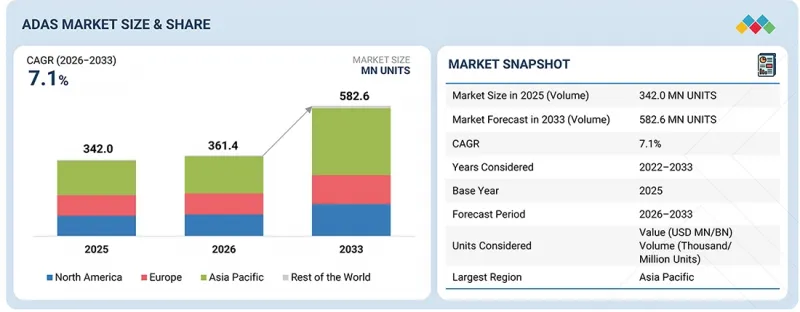
全球ADAS市場預計將從2026年的3.614億台成長到2033年的5.826億台,複合年成長率為7.1%。
| 調查範圍 | |
|---|---|
| 調查期 | 2026-2033 |
| 基準年 | 2025 |
| 預測期 | 2026-2033 |
| 單元 | 1000套,100萬美元 |
| 部分 | 汽車系統、交付方式、LOA、安全應用、電動車類型、區域 |
| 目標區域 | 亞太地區、歐洲、北美及其他地區 |
ADAS市場正朝著軟體主導創新轉型,專注於使用者友善介面、OTA更新和資料分析,以提升系統長期效能。邊緣運算技術的進步使攝影機和感測器能夠在本地處理數據,即使在通訊環境不穩定的區域也能實現更快的決策和更可靠的運作。此外,人工智慧、機器學習、物聯網和巨量資料等技術的融合正在加速開發更智慧、更具適應性的系統。隨著安全法規的日益嚴格和對更安全交通需求的不斷成長,ADAS在提升駕駛員安全性和減少事故方面發揮著重要作用,預計商用車領域也將隨之成長。
 2033
2033預計在預測期內,超音波感測器將推動ADAS市場的發展。
超音波感測器已從基本的泊車輔助功能發展到更複雜的功能,例如盲點偵測、車道變換輔助和駕駛員監控。這一發展得益於感測器精度的提高、小型化以及與其他車輛系統的整合,從而增強了現代車輛的安全性能。這些感測器通常安裝在前後保險桿上,能夠偵測附近的車輛和障礙物,有效工作範圍可達3公尺。然而,其性能會受到一定角度的物體檢測以及訊號干擾的影響。儘管有這些挑戰,超音波感測器在各種天氣條件下都能可靠運作。羅伯特·博世有限公司、電裝公司和法雷奧等公司為主要汽車製造商提供超音波感測器。例如,羅伯特·博世有限公司為寶馬集團2026款M2/M3車型提供了超音波感測器,而電裝公司則為豐田汽車公司2026款蘭德酷路澤300、普銳斯和Sienta車型提供了超音波感測器。
預計在預測期內,電池式電動車(BEV)將佔據ADAS市場最大的佔有率。
電池式電動車(BEV) 基於集中式、軟體定義的電氣/電子 (E/E) 架構,能夠無縫整合先進的高級駕駛輔助系統 (ADAS) 功能和高速通訊網路。汽車製造商將 BEV 定位為技術驅動型汽車,通常將自動緊急煞車 (AEB)、自適應巡航控制 (ACC) 和高速公路輔助等 ADAS 功能作為標準配置或訂閱服務提供。這些車輛採用高效能運算平台和網域/區域控制器,支援感測器融合和即時處理。與內燃機汽車 (ICE) 不同,BEV 不受傳統設計限制,可輕鬆整合可擴展的感測器配置,包括攝影機、雷達和雷射雷達 (LiDAR)。此外,BEV 與 OTA 更新高度親和性,即使在車輛售出後也能持續改進 ADAS 功能。日益成長的車輛安全監管擔憂以及消費者對智慧連網汽車不斷成長的需求,進一步推動了 ADAS 在 BEV 中的應用。此外,將基於深度學習的視覺系統與雷達和LiDAR相結合,正在提高 AEB 等 ADAS 功能的精度和整體性能。 BMW、比亞迪、賓士和奧迪等汽車製造商正在推出配備先進安全和駕駛輔助功能的電動車。例如,奇瑞於2026年4月推出了Exeed EX7,該車型配備了27個高性能感測器,包括用於智慧駕駛的遠程高精度雷射雷達和毫米波雷達,以及英偉達Orin-Y晶片。上述所有因素都在推動純電動車(BEV)採用高級駕駛輔助系統(ADAS)。
本報告對全球ADAS市場進行了深入分析,深入探討了關鍵促進因素和限制因素、產品開發和創新以及競爭格局。
目錄
第1章:引言
第2章執行摘要
第3章 主要發現
- ADAS市場對企業而言極具吸引力的機會
- ADAS市場:以自動駕駛等級分類
- ADAS市場:依乘用車系統類型分類
- ADAS市場:以小型商用車系統類型分類
- ADAS市場:依大型商用車系統類型分類
- ADAS市場:以電動車類型分類
- ADAS市場:依產品類型分類
- ADAS市場:依安全應用分類
- ADAS市場:按地區分類
第4章 市場概覽
- 市場動態
- 促進因素
- 抑制因子
- 機會
- 任務
- 市場動態影響分析
- 未滿足的需求和閒置頻段
- ADAS市場中尚未滿足的需求
- 閒置頻段的機遇
- 相互關聯的市場與跨產業機遇
- 互聯市場
- 跨部門機會
- 一級/二級/三級公司的策略性舉措
第5章 產業趨勢
- 總體經濟指標
- GDP趨勢與預測
- 全球ADAS市場趨勢
- 全球自動駕駛汽車產業趨勢
- 影響客戶業務的趨勢/干擾因素
- 定價分析
- 相機平均售價趨勢:按地區分類(2023-2025 年)
- LiDAR平均售價趨勢:按地區分類(2023-2025 年)
- 雷達感測器平均售價趨勢:按地區分類(2023-2025 年)
- 超音波感測器平均售價趨勢:按地區分類(2023-2025 年)
- 生態系分析
- OEM
- 一級供應商
- 自動駕駛汽車開發商
- 軟體系統供應商
- LiDAR系統供應商
- 雷達系統供應商
- 相機供應商
- 處理器(SoC)製造商
- 感測器元件供應商
- 供應鏈分析
- 案例研究分析
- 投資和資金籌措場景
- 供應商分析
- 半自動/自動駕駛車輛的開發與部署
- 3級
- 4級和5級
- 2級/3級和4級自動駕駛技術堆疊的主要區別
- 移動式卡車運輸技能提升至 4 級
- 貿易分析
- 導入數據
- 匯出數據
- 能源市場動盪
- 對營運成本的影響
- 市場需求的變化
- 供應鍊和本地化的影響
- 戰略市場展望
- 歐盟-印度貿易協定的影響分析
- 歐盟關稅
- 進口到印度
- 印度出口
第6章 技術進步
- 專利分析
- 技術分析
- 主要技術
- 互補技術
- 鄰近技術
- 技術/產品藍圖
- 短期:基礎建設和初步商業化(2026-2027 年)
- 中期計畫:擴張與標準化(2028-2030年)
- 長期:大規模商業化與顛覆性變革(2031-2035 年及以後)
- 人工智慧/生成式人工智慧的影響
- 主要應用案例和市場展望
- 製造商遵循的最佳實踐
- 人工智慧實施案例研究
- 相互關聯的生態系和市場企業的影響
- 客戶對人工智慧應用的準備情況
第7章 監理環境與永續性舉措
- 當地法規和合規性
- 監管機構、政府機構和其他組織
- 主要法規
- 對永續性的承諾
- 碳排放與環保應用
- 對永續性和監管政策措施的影響
- 認證、標籤檢視、環境標準
第8章:顧客趨勢與購買行為
- 決策流程
- 採購過程中的關鍵相關利益者及其評估標準
- 採購過程中的關鍵相關利益者
- 購買標準
- 招募障礙和內部挑戰
- 各終端使用者/終端用途產業中未被滿足的需求
第9章 乘用車ADAS市場:依系統類型分類
- 主動車距控制巡航系統(ACC)
- 自我調整頭燈(AFL)
- 自動緊急煞車(AEB)
- 盲點偵測(BSD)
- 交叉路口交通警報(CTA)
- 駕駛員監控系統(DMS)
- 前向碰撞警報(FCW)
- 智慧泊車輔助系統(IPA)
- 車道偏離預警(LDW)
- 夜視系統(NVS)
- 道路標誌識別(RSR)
- 輪胎壓力監測系統(TPMS)
- 交通堵塞援助 (TJA)
- 重要見解
第10章:輕型商用車ADAS市場:依系統類型分類
- 主動車距控制巡航系統(ACC)
- 自我調整頭燈(AFL)
- 自動緊急煞車(AEB)
- 盲點偵測(BSD)
- 交叉路口交通警報(CTA)
- 駕駛員監控系統(DMS)
- 前向碰撞警報(FCW)
- 智慧泊車輔助系統(IPA)
- 車道偏離預警(LDW)
- 夜視系統(NVS)
- 道路標誌識別(RSR)
- 輪胎壓力監測系統(TPMS)
- 交通堵塞援助 (TJA)
- 重要見解
第11章:重型商用車ADAS市場:依系統類型分類
- 主動車距控制巡航系統(ACC)
- 自動緊急煞車(AEB)
- 盲點偵測(BSD)
- 前向碰撞警報(FCW)
- 智慧泊車輔助系統(IPA)
- 車道偏離預警(LDW)
- 交通堵塞援助 (TJA)
- 重要見解
第12章 ADAS 市場:以電動車類型分類
- 電池式電動車(BEV)
- 混合動力電動車(HEV)
- 插電式混合動力車(PHEV)
- 燃料電池電動車(FCEV)
- 重要見解
第13章 ADAS 市場:以自動駕駛等級分類
- L1
- L2
- L3
- L4
- L5
- 重要見解
第14章 ADAS市場,產品類型
- 硬體供應
- 攝影機單元
- LiDAR
- 雷達感測器
- 超音波感測器
- ECU
- 軟體供應
- OEM 提供方式:透過軟體
- 中介軟體
- 應用軟體
- 作業系統
- 主要行業趨勢
第15章 ADAS 市場:依安全應用分類
- 船員分類系統
- 行車記錄儀
- 入侵偵測
- 重要見解
第16章 ADAS 市場:按地區分類
- 亞太地區
- 中國
- 印度
- 日本
- 韓國
- 泰國
- 印尼
- 亞太其他地區
- 歐洲
- 德國
- 法國
- 義大利
- 西班牙
- 俄羅斯
- 英國
- 土耳其
- 其他歐洲國家
- 北美洲
- 美國
- 加拿大
- 墨西哥
- 其他地區
- 巴西
- 南非
- 伊朗
第17章 競爭格局
- 概述
- 主要參與企業的策略/優勢
- 主要公司市佔率分析(2025 年)
- 非上市公司及上市公司獲利分析(2025 年)
- 企業評估與財務指標
- 品牌/產品對比
- 企業評估矩陣:主要公司(2025 年)
- 公司評估矩陣:新創企業/中小企業(2025 年)
- 競爭格局
第18章:公司簡介
- 大公司
- ROBERT BOSCH GMBH
- AUMOVIO SE
- ZF FRIEDRICHSHAFEN AG
- DENSO CORPORATION
- MAGNA INTERNATIONAL INC.
- MOBILEYE
- APTIV
- VALEO
- HYUNDAI MOBIS
- NVIDIA CORPORATION
- NXP SEMICONDUCTORS
- AUTOLIV
- ASTEMO LTD.
- HORIZON ROBOTICS INC.
- ADVANCED MICRO DEVICES, INC.
- FICOSA INTERNACIONAL SA
- 其他主要公司
- AISIN CORPORATION
- RENESAS ELECTRONICS CORPORATION
- INFINEON TECHNOLOGIES AG
- HELLA GMBH & CO. KGAA
- TEXAS INSTRUMENTS INCORPORATED
- SAMSUNG
- GENTEX CORPORATION
- BLACKBERRY LIMITED
- MICROCHIP TECHNOLOGY INC.
- VEONEER US SAFETY SYSTEMS, LLC.
- PANASONIC AUTOMOTIVE SYSTEMS CO., LTD.
第19章:調查方法
第20章附錄
The ADAS market is projected to grow from 361.4 million units in 2026 to 582.6 million units by 2033, at a CAGR of 7.1%.
| Scope of the Report | |
|---|---|
| Years Considered for the Study | 2026-2033 |
| Base Year | 2025 |
| Forecast Period | 2026-2033 |
| Units Considered | Volume (Thousand Units) and Value (USD Million) |
| Segments | Car Sysytem, Offering Type, LOA, Safety Application, EV Type, and Region |
| Regions covered | Asia Pacific, Europe, North America, and Rest of the World |
The ADAS market is shifting toward software-driven innovation, with a focus on user-friendly interfaces, over-the-air updates, and data analytics to improve system performance over time. Advancements in edge computing enable cameras and sensors to process data locally, allowing faster decision-making and reliable operation even in low-connectivity areas. In addition, the integration of technologies such as AI, machine learning, IoT, and big data is supporting the development of more intelligent and adaptive systems. With stricter safety regulations and increasing demand for safer transportation, the commercial vehicle segment is also expected to grow, as ADAS helps improve driver safety and reduce accidents.
Ultrasonic sensors are projected to lead the ADAS market during the forecast period.
Ultrasonic sensors have advanced from basic parking assistance to more complex functions such as blind spot detection, lane change assistance, and driver monitoring. This development is supported by improvements in sensor accuracy, miniaturization, and integration with other vehicle systems, enabling enhanced safety features in modern vehicles. These sensors are typically installed in the front and rear bumpers to detect nearby vehicles or obstacles and perform effectively within a range of up to 3 meters. However, they may face limitations when detecting angled objects or due to signal interference. Despite these challenges, ultrasonic sensors function reliably in all weather conditions. Companies such as Robert Bosch GmbH, Denso Corporation, and Valeo supply ultrasonic sensors to major OEMs. For instance, Robert Bosch GmbH supplied ultrasonic sensors to BMW AG for its 2026 M2 and M3 models, while Denso Corporation supplied them to Toyota Corporation for its 2026 Land Cruiser 300, Prius, and Sienta models.
The battery electric vehicle (BEV) is projected to hold the largest share of the ADAS market during the forecast period.
Battery electric vehicles (BEVs) are built on centralized and software-defined electrical/electronic (E/E) architectures, which enable seamless integration of advanced ADAS features and high-speed communication networks. Automakers position BEVs as technology-focused vehicles, often offering ADAS functions such as AEB, ACC, and highway assist as standard or subscription-based features. These vehicles use high-performance computing platforms and domain or zonal controllers that support sensor fusion and real-time processing. Unlike ICE vehicles, BEVs do not have legacy design constraints, allowing easier integration of scalable sensor setups, including cameras, radar, and LiDAR. In addition, BEVs are well aligned with OTA updates, enabling continuous improvement of ADAS features after the vehicle is sold. The growing regulatory focus on vehicle safety and increasing consumer demand for intelligent and connected vehicles are further driving ADAS adoption in BEVs. Moreover, the use of deep learning-based vision systems combined with radar and LiDAR is improving the accuracy and overall performance of ADAS functions such as AEB. OEMs such as BMW, BYD, Mercedes-Benz, and Audi are introducing electric vehicles with advanced safety and driver-assistance features. For instance, in April 2026, Chery launched the Exeed EX7, which is equipped with 27 high-performance sensors and an Nvidia Orin-Y chip, including long-range high-precision LiDAR and millimeter-wave radar for intelligent driving. All the aforementioned factors are driving the adoption of ADAS in BEVs.
"Europe is expected to have a significant market share in the ADAS market during the forecast period."
Europe is expected to hold a significant share of the ADAS market during the forecast period. Strict emission regulations and zero-emission targets are influencing manufacturers of both passenger and commercial vehicles. Market growth is supported by advancements in driver assistance features such as traffic jam assist and blind spot detection with rear cross-traffic alert. From July 7, 2024, the second phase of the EU General Safety Regulation II (GSR II) requires all new vehicles to comply with stricter safety standards. This includes mandatory systems such as Advanced Emergency Braking System (AEBS), Emergency Lane Keeping System (ELKS), Emergency Stop Signal (ESS), Intelligent Speed Assistance (ISA), Driver Drowsiness and Attention Warning (DDAW), Reversing Detection (REV), and Event Data Recorder (EDR). For buses and heavy commercial vehicles, additional systems such as Blind Spot Information System (BSIS), Moving Off Information System (MOIS), and Tire Pressure Monitoring System (TPMS) are also required. In addition, the increasing shift toward electric vehicles, along with rising road safety concerns and greater consumer awareness, is expected to further drive the demand for ADAS in the region.
In-depth interviews were conducted with CEOs, marketing directors, other innovation and technology directors, and executives from various key organizations operating in this market.
- By Company Type: Tier I - 24%, Tier II - 67%, and Tier III - 9%
- By Designation: C-Level - 33%, Managers - 52%, and Executives - 15%
- By Region: North America - 26%, Europe - 30%, Asia Pacific - 35%, and RoW - 9%
The ADAS market is dominated by major players, including Robert Bosch GmbH (Germany), Aumovio SE (Germany), ZF Friedrichshafen AG (Germany), Denso Corporation (Japan), and Magna International Inc. (Canada). These companies offer advanced, integrated ADAS solutions that enhance vehicle safety, enable higher levels of automation, and meet evolving regulatory and consumer demands.
Research Coverage:
The report covers the ADAS market in terms of PC, LCV, HCV system type (ACC, AEB, LDW, BSD & Others), offering type [hardware (camera, radar, LiDAR & others) and software], LOA (L1, L2, L3, L4, L5), safety application (OCS, DashCam), EV type, and Region. It covers the competitive landscape and company profiles of the major ADAS market ecosystem players.
The study also includes an in-depth competitive analysis of the key market players, along with their company profiles, key observations related to product and business offerings, recent developments, and key market strategies.
Key Benefits of Buying the Report:
- The report will help market leaders/new entrants with information on the closest approximations of revenue numbers for the overall ADAS market and its subsegments.
- This report will help stakeholders understand the competitive landscape and gain more insights to position their businesses better and plan suitable go-to-market strategies.
- The report will help stakeholders understand the market pulse and provide information on key market drivers, restraints, challenges, and opportunities.
- The report will also help stakeholders understand the current and future pricing trends of the ADAS market.
The report provides insights into the following pointers:
- Analysis of key drivers (rising demand for enhanced vehicle safety and driving comfort through ADAS, increasing regulatory mandates and safety standard compliance), restraints (infrastructure gaps limiting effective deployment of ADAS and autonomous systems, consumer trust and acceptance challenges for autonomous vehicle technologies), opportunities (advancements in autonomous driving technologies enabling next-generation ADAS capabilities, EV-driven innovation accelerating enhanced safety and user experience integration), and challenges (high integration costs and system complexity limiting ADAS adoption, sensor reliability and performance constraints impacting ADAS effectiveness)
- Product Development/Innovation: Detailed insights into upcoming technologies and research & development activities in the ADAS market
- Market Development: Comprehensive information about lucrative markets (the report analyzes the ADAS market across varied regions)
- Market Diversification: Exhaustive information about untapped geographies, recent developments, and investments in the ADAS market
- Competitive Assessment: In-depth assessment of market share, growth strategies, and product offerings of leading players like Robert Bosch GmbH (Germany), Aumovio SE (Germany), ZF Friedrichshafen AG (Germany), Denso Corporation (Japan), Magna International Inc. (Canada), among others, in the ADAS market
TABLE OF CONTENTS
1 INTRODUCTION
- 1.1 STUDY OBJECTIVES
- 1.2 MARKET DEFINITION
- 1.2.1 INCLUSIONS AND EXCLUSIONS
- 1.3 STUDY SCOPE
- 1.3.1 YEARS CONSIDERED
- 1.4 CURRENCY CONSIDERED
- 1.5 UNIT CONSIDERED
- 1.6 STAKEHOLDERS
- 1.7 SUMMARY OF CHANGES
2 EXECUTIVE SUMMARY
- 2.1 KEY INSIGHTS & MARKET HIGHLIGHTS
- 2.2 KEY MARKET PARTICIPANTS: MAPPING OF STRATEGIC DEVELOPMENTS
- 2.3 DISRUPTIVE TRENDS SHAPING ADAS MARKET
- 2.4 HIGH-GROWTH SEGMENTS
- 2.5 SNAPSHOT: GLOBAL MARKET SIZE, GROWTH RATE, AND FORECAST
3 PREMIUM INSIGHTS
- 3.1 ATTRACTIVE OPPORTUNITIES FOR PLAYERS IN ADAS MARKET
- 3.2 ADAS MARKET, BY LEVEL OF AUTONOMY
- 3.3 ADAS MARKET, BY PASSENGER CAR SYSTEM TYPE
- 3.4 ADAS MARKET, BY LIGHT COMMERCIAL VEHICLE SYSTEM TYPE
- 3.5 ADAS MARKET, BY HEAVY COMMERCIAL VEHICLE SYSTEM TYPE
- 3.6 ADAS MARKET, BY ELECTRIC VEHICLE TYPE
- 3.7 ADAS MARKET, BY OFFERING TYPE
- 3.8 ADAS MARKET, BY SAFETY APPLICATION
- 3.9 ADAS MARKET, BY REGION
4 MARKET OVERVIEW
- 4.1 INTRODUCTION
- 4.2 MARKET DYNAMICS
- 4.2.1 DRIVERS
- 4.2.1.1 Rising demand for enhanced vehicle safety and driving comfort through ADAS
- 4.2.1.2 Increasing regulatory mandates and safety standard compliance
- 4.2.2 RESTRAINTS
- 4.2.2.1 Infrastructure gaps limiting effective deployment of ADAS and autonomous systems
- 4.2.2.2 Consumer trust and acceptance challenges for autonomous vehicle technologies
- 4.2.3 OPPORTUNITIES
- 4.2.3.1 Advancements in autonomous driving technologies enabling next-generation ADAS capabilities
- 4.2.3.2 EV-driven innovation accelerating enhanced safety and user experience integration
- 4.2.4 CHALLENGES
- 4.2.4.1 High integration costs and system complexity limiting ADAS adoption
- 4.2.4.2 Sensor reliability and performance constraints impacting ADAS effectiveness
- 4.2.5 IMPACT ANALYSIS OF MARKET DYNAMICS
- 4.2.1 DRIVERS
- 4.3 UNMET NEEDS AND WHITE SPACES
- 4.3.1 UNMET NEEDS IN ADAS MARKET
- 4.3.2 WHITE SPACE OPPORTUNITIES
- 4.4 INTERCONNECTED MARKETS AND CROSS-SECTOR OPPORTUNITIES
- 4.4.1 INTERCONNECTED MARKETS
- 4.4.2 CROSS-SECTOR OPPORTUNITIES
- 4.5 STRATEGIC MOVES BY TIER 1/2/3 PLAYERS
5 INDUSTRY TRENDS
- 5.1 MACROECONOMIC INDICATORS
- 5.1.1 GDP TRENDS AND FORECAST
- 5.1.2 TRENDS IN GLOBAL ADAS MARKET
- 5.1.3 TRENDS IN GLOBAL AUTONOMOUS VEHICLE INDUSTRY
- 5.2 TRENDS/DISRUPTIONS IMPACTING CUSTOMER BUSINESS
- 5.3 PRICING ANALYSIS
- 5.3.1 AVERAGE SELLING PRICE TREND OF CAMERA UNITS, BY REGION, 2023-2025
- 5.3.2 AVERAGE SELLING PRICE TREND OF LIDARS, BY REGION, 2023-2025
- 5.3.3 AVERAGE SELLING PRICE TREND OF RADAR SENSORS, BY REGION, 2023-2025
- 5.3.4 AVERAGE SELLING PRICE TREND OF ULTRASONIC SENSORS, BY REGION, 2023-2025
- 5.4 ECOSYSTEM ANALYSIS
- 5.4.1 OEMS
- 5.4.2 TIER 1 SUPPLIERS
- 5.4.3 AUTONOMOUS VEHICLE DEVELOPERS
- 5.4.4 SOFTWARE AND SYSTEMS PROVIDERS
- 5.4.5 LIDAR SYSTEM PROVIDERS
- 5.4.6 RADAR SYSTEM PROVIDERS
- 5.4.7 CAMERA SUPPLIERS
- 5.4.8 PROCESSOR (SOC) MANUFACTURERS
- 5.4.9 SENSOR COMPONENT SUPPLIERS
- 5.5 SUPPLY CHAIN ANALYSIS
- 5.6 CASE STUDY ANALYSIS
- 5.6.1 ACCELERATING AUTONOMOUS DRIVING WITH ADVANCED ADAS SOLUTIONS
- 5.6.2 ACCELERATING SAFE AND SCALABLE ADAS DEVELOPMENT WITH EDGE-CENTRIC DATA MANAGEMENT
- 5.6.3 SCENARIO-BASED TESTING VALIDATION FOR ADS/ADAS
- 5.6.4 KONRAD TECHNOLOGIES TO CONDUCT ADAS SENSOR PACKAGE AND RELIABILITY TEST
- 5.6.5 NVIDIA TO PROVIDE OPEN AV DEVELOPMENT PLATFORM FOR AUTONOMOUS VEHICLES
- 5.6.6 ZF TO RELEASE NEW AI-BASED SERVICES FOR ADAS
- 5.6.7 RENESAS TO BOOST DEEP LEARNING DEVELOPMENT FOR ADAS AND AUTOMATED DRIVING APPLICATIONS
- 5.6.8 MERCEDES-BENZ USED ANSYS OPTISLANG FOR ADAS VALIDATION THROUGH RELIABLE ANALYSIS
- 5.7 INVESTMENT AND FUNDING SCENARIO
- 5.8 SUPPLIER ANALYSIS
- 5.8.1 ADAS SUPPLIERS, BY KEY OEMS
- 5.8.2 RADAR (MILLIMETER WAVE RADAR, LIDAR, AND OTHERS), BY KEY OEMS
- 5.8.3 CAMERA, BY KEY OEMS
- 5.8.4 PARKING ASSIST, BY KEY OEMS
- 5.8.5 VEHICLE-APPROACH NOTICE CONTROL UNIT, BY KEY OEMS
- 5.8.6 CRUISE CONTROL, BY KEY OEMS
- 5.8.7 DRIVER MONITORING SYSTEM, BY KEY OEMS
- 5.8.8 HIGH-DEFINITION MAP, BY KEY OEMS
- 5.8.9 LANE DEPARTURE WARNING SYSTEM, BY KEY OEMS
- 5.8.10 TIRE PRESSURE MONITORING SYSTEM, BY KEY OEMS
- 5.8.11 ADAS OFFERINGS BY KEY PLAYERS
- 5.8.11.1 Tesla
- 5.8.11.2 Toyota Motor Corporation
- 5.8.11.2.1 Corolla
- 5.8.11.2.2 Camry
- 5.8.11.2.3 RAV4
- 5.8.11.2.4 Tundra
- 5.8.11.3 Nissan Motor Co., Ltd.
- 5.8.11.3.1 Versa
- 5.8.11.3.2 Altima
- 5.8.11.3.3 Nissan Leaf
- 5.8.11.4 Mercedes-Benz
- 5.8.11.4.1 S-Class Sedan
- 5.8.11.4.2 C-Class Sedan
- 5.8.11.4.3 E-Class Sedan
- 5.8.11.5 Audi
- 5.8.11.5.1 A3 Sedan
- 5.8.11.5.2 A6 Sedan
- 5.9 SEMIAUTONOMOUS AND AUTONOMOUS VEHICLE DEVELOPMENT AND DEPLOYMENT
- 5.9.1 LEVEL 3
- 5.9.2 LEVEL 4 AND LEVEL 5
- 5.9.2.1 Global ADAS and autonomous driving deployments by key regions
- 5.9.2.2 Baidu
- 5.9.2.3 DiDi
- 5.9.2.4 Pony.ai and Hyundai
- 5.9.2.5 Waymo
- 5.9.2.6 Volvo
- 5.9.2.7 Einride
- 5.9.3 KEY DISTINCTIONS BETWEEN LEVEL 2/LEVEL 3 AND LEVEL 4 AUTONOMOUS DRIVING STACKS
- 5.9.4 ADVANCEMENT TO LEVEL 4 IN MOBILITY & TRUCKING
- 5.10 TRADE ANALYSIS
- 5.10.1 IMPORT DATA
- 5.10.2 EXPORT DATA
- 5.11 UNLOCKING NEW REVENUE STREAMS: SUBSCRIPTION-DRIVEN ADAS SERVICES IN SOFTWARE-DEFINED VEHICLES
- 5.12 KEY CONFERENCES AND EVENTS, 2026-2027
- 5.13 MNM INSIGHTS INTO HIGH-PERFORMANCE CHIPS POWERING NEXT-GEN ADAS AND AUTONOMY
- 5.14 IMPACT OF ISRAEL-IRAN WAR
- 5.14.1 INTRODUCTION
- 5.14.2 ENERGY MARKET DISRUPTION
- 5.14.3 OPERATING COST IMPACT
- 5.14.4 MARKET DEMAND SHIFT
- 5.14.5 SUPPLY CHAIN AND LOCALIZATION IMPACT
- 5.14.6 STRATEGIC MARKET OUTLOOK
- 5.15 EU-INDIA TRADE DEAL IMPACT ANALYSIS
- 5.15.1 INTRODUCTION
- 5.15.2 EU TARIFFS
- 5.15.3 IMPORTS TO INDIA
- 5.15.4 EXPORTS FROM INDIA
6 TECHNOLOGICAL ADVANCEMENTS
- 6.1 PATENT ANALYSIS
- 6.2 TECHNOLOGY ANALYSIS
- 6.2.1 INTRODUCTION
- 6.2.2 KEY TECHNOLOGIES
- 6.2.2.1 Cockpit-ADAS integration platform for centralized vehicle computing
- 6.2.2.2 Precision localization system for assisted and automated driving
- 6.2.2.3 Software-based video perception system for driving and parking automation
- 6.2.3 COMPLEMENTARY TECHNOLOGIES
- 6.2.3.1 Cooperative adaptive cruise control
- 6.2.3.2 Autonomous vehicles: Cybersecurity and data privacy
- 6.2.3.3 Vehicle-to-Everything (V2X) Communication
- 6.2.3.3.1 Vehicle-to-cloud (V2C)
- 6.2.3.3.2 Vehicle-to-pedestrian (V2P)
- 6.2.3.3.3 Vehicle-to-infrastructure (V2I)
- 6.2.3.3.4 Vehicle-to-vehicle (V2V)
- 6.2.3.3.5 Cellular V2X
- 6.2.3.3.5.1 LTE-V2X
- 6.2.3.3.5.2 5G-V2X
- 6.2.4 ADJACENT TECHNOLOGIES
- 6.2.4.1 Automated vehicles are reshaping ride-hailing
- 6.2.4.1.1 Impact of automation L2 on ride-hailing
- 6.2.4.1.2 Impact of automation L3 on ride-hailing
- 6.2.4.1.3 Impact of automation L4/L5 on ride-hailing
- 6.2.4.1 Automated vehicles are reshaping ride-hailing
- 6.3 TECHNOLOGY/PRODUCT ROADMAP
- 6.3.1 SHORT-TERM (2026-2027): FOUNDATION AND EARLY COMMERCIALIZATION
- 6.3.2 MID-TERM (2028-2030): EXPANSION AND STANDARDIZATION
- 6.3.3 LONG-TERM (2031-2035+): MASS COMMERCIALIZATION AND DISRUPTION
- 6.4 IMPACT OF AI/GENERATIVE AI
- 6.4.1 TOP USE CASES AND MARKET POTENTIAL
- 6.4.1.1 AI and Generative AI capabilities
- 6.4.1.2 AI for ADAS in practice
- 6.4.2 BEST PRACTICES FOLLOWED BY MANUFACTURERS
- 6.4.2.1 Safety standards & validation
- 6.4.2.2 Regulatory compliance
- 6.4.2.3 Data governance & privacy
- 6.4.2.4 Compute architecture & deployment
- 6.4.2.5 Over-the-air updates
- 6.4.3 CASE STUDIES RELATED TO AI IMPLEMENTATION
- 6.4.3.1 Accelerating ADAS safety validation using Generative AI and simulation
- 6.4.3.2 Scalable and cost-efficient ADAS deployment with AI-driven Gen6 platform
- 6.4.3.3 Accelerating ADAS deployment with a pre-integrated AI and SoC platform
- 6.4.3.4 Scaling advanced ADAS in India with a single-chip AI platform
- 6.4.4 INTERCONNECTED ECOSYSTEM AND IMPACT OF MARKET PLAYERS
- 6.4.5 CLIENTS' READINESS TO ADOPT AI
- 6.4.1 TOP USE CASES AND MARKET POTENTIAL
7 REGULATORY LANDSCAPE AND SUSTAINABILITY INITIATIVES
- 7.1 REGIONAL REGULATIONS AND COMPLIANCE
- 7.1.1 REGULATORY BODIES, GOVERNMENT AGENCIES, AND OTHER ORGANIZATIONS
- 7.1.1.1 North America
- 7.1.1.2 Europe
- 7.1.1.3 Asia Pacific
- 7.1.2 KEY REGULATIONS
- 7.1.2.1 ADAS Regulations and Initiatives
- 7.1.2.2 NCAP Regulations
- 7.1.1 REGULATORY BODIES, GOVERNMENT AGENCIES, AND OTHER ORGANIZATIONS
- 7.2 SUSTAINABILITY INITIATIVES
- 7.2.1 CARBON IMPACT AND ECO-APPLICATIONS
- 7.2.1.1 Lifecycle vs. operation
- 7.2.1.2 Eco applications
- 7.2.2 SUSTAINABILITY IMPACT AND REGULATORY POLICY INITIATIVES
- 7.2.2.1 European Union
- 7.2.2.2 US
- 7.2.2.3 China
- 7.2.2.4 India
- 7.2.3 CERTIFICATIONS, LABELING, AND ECO-STANDARDS
- 7.2.3.1 Type I Ecolabels (ISO 14024)
- 7.2.3.2 Product Carbon Footprint (ISO 14067)
- 7.2.3.3 EcoDesign and Material Standards (IEC 62430)
- 7.2.3.4 Hazardous Substance Restrictions (RoHS/REACH)
- 7.2.3.5 Circular Economy & Recycling Certification
- 7.2.1 CARBON IMPACT AND ECO-APPLICATIONS
8 CUSTOMER LANDSCAPE AND BUYER BEHAVIOR
- 8.1 DECISION-MAKING PROCESS
- 8.2 KEY STAKEHOLDERS IN BUYING PROCESS AND THEIR EVALUATION CRITERIA
- 8.2.1 KEY STAKEHOLDERS IN BUYING PROCESS
- 8.2.2 BUYING CRITERIA
- 8.3 ADOPTION BARRIERS AND INTERNAL CHALLENGES
- 8.4 UNMET NEEDS OF VARIOUS END USERS/END-USE INDUSTRIES
9 PASSENGER CAR ADAS MARKET, BY SYSTEM TYPE
- 9.1 INTRODUCTION
- 9.2 ADAPTIVE CRUISE CONTROL (ACC)
- 9.2.1 OEMS BUNDLING ACC WITH LANE-CENTERING FEATURES TO DRIVE GROWTH
- 9.3 ADAPTIVE FRONT LIGHTS (AFL)
- 9.3.1 RISING ADOPTION OF LED AND MATRIX LIGHTING SYSTEMS TO DRIVE GROWTH
- 9.4 AUTOMATIC EMERGENCY BRAKING (AEB)
- 9.4.1 REGULATORY MANDATES FOR AEB ACROSS MAJOR COUNTRIES TO DRIVE GROWTH
- 9.5 BLIND SPOT DETECTION (BSD)
- 9.5.1 HIGH TWO-WHEELER AND MIXED-TRAFFIC DENSITY IN URBAN ENVIRONMENTS TO DRIVE GROWTH
- 9.6 CROSS TRAFFIC ALERT (CTA)
- 9.6.1 LIMITED REAR VISIBILITY IN SUVS AND CROSSOVERS TO DRIVE GROWTH
- 9.7 DRIVER MONITORING SYSTEM (DMS)
- 9.7.1 REGULATORY REQUIREMENTS TO INCLUDE DMS IN NEW VEHICLES TO DRIVE GROWTH
- 9.8 FORWARD COLLISION WARNING (FCW)
- 9.8.1 OEM'S STANDARDIZATION OF FCW ACROSS ENTRY- AND MID-LEVEL VEHICLES TO DRIVE GROWTH
- 9.9 INTELLIGENT PARK ASSIST (IPA)
- 9.9.1 INCREASING URBAN PARKING CONSTRAINTS IN DENSE CITIES TO DRIVE GROWTH
- 9.10 LANE DEPARTURE WARNING SYSTEM (LDW)
- 9.10.1 MAJOR OEMS OFFERING LDW AS STANDARD FEATURE ACROSS NEW VEHICLES TO DRIVE GROWTH
- 9.11 NIGHT VISION SYSTEM (NVS)
- 9.11.1 HIGHER INCIDENCE OF NIGHTTIME ACCIDENTS ON HIGHWAYS AND RURAL ROADS TO DRIVE GROWTH
- 9.12 ROAD SIGN RECOGNITION (RSR)
- 9.12.1 GROWING INTEGRATION WITH ADAPTIVE CRUISE CONTROL AND SPEED-LIMITING SYSTEMS TO DRIVE GROWTH
- 9.13 TIRE PRESSURE MONITORING SYSTEM (TPMS)
- 9.13.1 REGULATORY MANDATES IN MAJOR REGIONS TO DRIVE GROWTH
- 9.14 TRAFFIC JAM ASSIST (TJA)
- 9.14.1 INCREASING URBAN CONGESTION IN MEGACITIES TO DRIVE GROWTH
- 9.15 KEY PRIMARY INSIGHTS
10 LIGHT COMMERCIAL VEHICLE ADAS MARKET, BY SYSTEM TYPE
- 10.1 INTRODUCTION
- 10.2 ADAPTIVE CRUISE CONTROL (ACC)
- 10.2.1 GROWING NEED FOR EFFICIENCY AND DRIVER COMFORT TO DRIVE MARKET
- 10.3 ADAPTIVE FRONT LIGHT (AFL)
- 10.3.1 NEED TO IMPROVE VISIBILITY AND OPERATIONAL SAFETY IN VARIED DRIVING ENVIRONMENTS TO DRIVE GROWTH
- 10.4 AUTOMATIC EMERGENCY BRAKING (AEB)
- 10.4.1 RISING PRESSURE TO IMPROVE FLEET SAFETY TO DRIVE GROWTH
- 10.5 BLIND SPOT DETECTION (BSD)
- 10.5.1 NEED TO REDUCE SIDE-COLLISION INCIDENTS AND LIABILITY COSTS TO DRIVE GROWTH
- 10.6 CROSS TRAFFIC ALERT (CTA)
- 10.6.1 RISING COMPLEXITY OF URBAN DELIVERY ENVIRONMENTS TO DRIVE GROWTH
- 10.7 DRIVER MONITORING SYSTEM (DMS)
- 10.7.1 INCREASING FOCUS ON DRIVER ACCOUNTABILITY AND FATIGUE MANAGEMENT TO DRIVE GROWTH
- 10.8 FORWARD COLLISION WARNING (FCW)
- 10.8.1 RISING EXPOSURE TO FRONT-END COLLISION RISKS IN URBAN DELIVERY CYCLES TO DRIVE GROWTH
- 10.9 INTELLIGENT PARK ASSIST (IPA)
- 10.9.1 GROWING OPERATIONAL CHALLENGES IN URBAN LOGISTICS TO DRIVE GROWTH
- 10.10 LANE DEPARTURE WARNING (LDW)
- 10.10.1 INCREASING EMPHASIS ON HIGHWAY SAFETY AND DRIVER COMPLIANCE TO DRIVE GROWTH
- 10.11 NIGHT VISION SYSTEM (NVS)
- 10.11.1 NEED TO IMPROVE VISIBILITY DURING OVERNIGHT LOGISTICS AND INTERCITY FREIGHT MOVEMENT TO DRIVE GROWTH
- 10.12 ROAD SIGN RECOGNITION (RSR)
- 10.12.1 INCREASING ENFORCEMENT OF SPEED COMPLIANCE AND ROUTE DISCIPLINE IN FLEET OPERATIONS TO DRIVE GROWTH
- 10.13 TIRE PRESSURE MONITORING SYSTEM (TPMS)
- 10.13.1 RISING FOCUS ON VEHICLE UPTIME AND OPERATING COST CONTROL TO DRIVE GROWTH
- 10.14 TRAFFIC JAM ASSIST (TJA)
- 10.14.1 RISING CONGESTION IN URBAN DELIVERY CORRIDORS TO DRIVE GROWTH
- 10.15 KEY PRIMARY INSIGHTS
11 HEAVY COMMERCIAL VEHICLE ADAS MARKET, BY SYSTEM TYPE
- 11.1 INTRODUCTION
- 11.2 ADAPTIVE CRUISE CONTROL (ACC)
- 11.2.1 NEED TO IMPROVE EFFICIENCY AND CONSISTENCY IN LONG-HAUL FREIGHT OPERATIONS TO DRIVE GROWTH
- 11.3 AUTOMATIC EMERGENCY BRAKING (AEB)
- 11.3.1 GLOBAL SAFETY REGULATIONS ARE PUSHING OEMS TO STANDARDIZE AEB ACROSS NEW HEAVY-DUTY PLATFORMS
- 11.4 BLIND SPOT DETECTION (BSD)
- 11.4.1 INCREASING EXPOSURE TO SIDE-SWIPE INCIDENTS IN HIGH-TRAFFIC FREIGHT CORRIDORS TO DRIVE GROWTH
- 11.5 FORWARD COLLISION WARNING (FCW)
- 11.5.1 NEED FOR EARLY HAZARD DETECTION IN HIGH-SPEED FREIGHT OPERATIONS TO DRIVE GROWTH
- 11.6 INTELLIGENT PARK ASSIST (IPA)
- 11.6.1 NEED FOR FREQUENT DOCKING AND MANEUVERING IN CONFINED LOGISTICS ENVIRONMENTS TO DRIVE GROWTH
- 11.7 LANE DEPARTURE WARNING (LDW)
- 11.7.1 GROWING EMPHASIS ON MAINTAINING LANE DISCIPLINE IN LONG-HAUL FREIGHT OPERATIONS TO DRIVE GROWTH
- 11.8 TRAFFIC JAM ASSIST (TJA)
- 11.8.1 FREQUENT CONGESTION NEAR PORTS, INDUSTRIAL ZONES, AND URBAN FREIGHT CORRIDORS TO DRIVE GROWTH
- 11.9 KEY PRIMARY INSIGHTS
12 ADAS MARKET, BY ELECTRIC VEHICLE TYPE
- 12.1 INTRODUCTION
- 12.2 BATTERY ELECTRIC VEHICLE (BEV)
- 12.2.1 INCREASING LEVEL 2+ ADAS ADOPTION IN BEVS TO DRIVE GROWTH
- 12.3 HYBRID ELECTRIC VEHICLE (HEV)
- 12.3.1 EXPANSION OF HYBRID VEHICLES WITH LEVEL 1 & LEVEL 2 ADAS TO DRIVE GROWTH
- 12.4 PLUG-IN HYBRID ELECTRIC VEHICLE (PHEV)
- 12.4.1 EXPANSION OF PHEVS WITH ENHANCED SAFETY SYSTEMS TO DRIVE GROWTH
- 12.5 FUEL CELL ELECTRIC VEHICLE (FCEV)
- 12.6 PRIMARY INSIGHTS
13 ADAS MARKET, BY LEVEL OF AUTONOMY
- 13.1 INTRODUCTION
- 13.2 L1
- 13.2.1 INCREASING ADOPTION WITHIN MID-SIZED VEHICLE SEGMENT TO DRIVE GROWTH
- 13.3 L2
- 13.3.1 ESCALATING DEMAND FOR PREMIUM VEHICLES TO DRIVE GROWTH
- 13.4 L3
- 13.4.1 ADVANCEMENT IN AUTONOMOUS VEHICLE TECHNOLOGY TO DRIVE GROWTH
- 13.5 L4
- 13.6 L5
- 13.7 KEY PRIMARY INSIGHTS
14 ADAS MARKET, OFFERING TYPE
- 14.1 INTRODUCTION
- 14.2 HARDWARE OFFERING
- 14.2.1 INTRODUCTION
- 14.2.1.1 ADAS functions supported by ADAS sensors
- 14.2.1.2 Top hardware providers, 2026
- 14.2.2 CAMERA UNIT
- 14.2.2.1 Rising adoption of Level 2+ driver-assist packages in mid-range vehicles to drive growth
- 14.2.3 LIDAR
- 14.2.3.1 Increasing adoption of autonomous driving systems to drive growth
- 14.2.3.1.1 Installation of LiDAR systems in passenger cars, height vs. volume
- 14.2.3.1 Increasing adoption of autonomous driving systems to drive growth
- 14.2.4 RADAR SENSOR
- 14.2.4.1 Advancements in 4D imaging radar technology to drive growth
- 14.2.5 ULTRASONIC SENSOR
- 14.2.5.1 Continuous improvements in sensor accuracy and miniaturization to drive growth
- 14.2.6 ECU
- 14.2.6.1 Rising compute demand and centralized architectures to drive growth
- 14.2.1 INTRODUCTION
- 14.3 SOFTWARE OFFERING
- 14.3.1 INTRODUCTION
- 14.3.2 OEM OFFERINGS, BY SOFTWARE
- 14.3.3 MIDDLEWARE
- 14.3.3.1 Growing need for scalable and standardized software integration to drive growth
- 14.3.4 APPLICATION SOFTWARE
- 14.3.4.1 Increasing demand for advanced perception, AI-driven features, and continuous OTA feature updates to drive growth
- 14.3.5 OPERATING SYSTEMS
- 14.3.5.1 Rising need for real-time, safety-certified platforms to manage centralized ADAS workloads to drive growth
- 14.4 KEY INDUSTRY INSIGHTS
15 ADAS MARKET, BY SAFETY APPLICATION
- 15.1 INTRODUCTION
- 15.2 OCCUPANT CLASSIFICATION SYSTEM
- 15.2.1 GROWING COMPLEXITY OF IN-CABIN SAFETY SYSTEMS TO DRIVE GROWTH
- 15.2.2 CHILD PRESENCE DETECTION
- 15.3 DASHCAM
- 15.3.1 RISING NEED FOR VERIFIABLE INCIDENT DATA TO DRIVE GROWTH
- 15.4 INTRUSION DETECTION
- 15.5 KEY PRIMARY INSIGHTS
16 ADAS MARKET, BY REGION
- 16.1 INTRODUCTION
- 16.2 ASIA PACIFIC
- 16.2.1 CHINA
- 16.2.1.1 Strong policy framework and ADAS innovation to drive market
- 16.2.2 INDIA
- 16.2.2.1 Mandatory inclusion of ADAS in vehicles to drive market
- 16.2.3 JAPAN
- 16.2.3.1 Advanced ADAS integration and policy support to drive market
- 16.2.4 SOUTH KOREA
- 16.2.4.1 Substantial investments by automakers and tech providers to enhance performance of ADAS solutions to drive market
- 16.2.5 THAILAND
- 16.2.5.1 Government mandates to include ADAS features in BEVs and HEVs to drive market
- 16.2.6 INDONESIA
- 16.2.6.1 Active involvement of private sector in ADAS technological development to drive market
- 16.2.7 REST OF ASIA PACIFIC
- 16.2.1 CHINA
- 16.3 EUROPE
- 16.3.1 GERMANY
- 16.3.1.1 Increasing sales of luxury vehicles equipped with advanced safety features to drive market
- 16.3.2 FRANCE
- 16.3.2.1 Mandating safety requirements to drive market
- 16.3.3 ITALY
- 16.3.3.1 Innovation in automobile industry to drive market
- 16.3.4 SPAIN
- 16.3.4.1 Legislative support for autonomous vehicle development and trials to drive market
- 16.3.5 RUSSIA
- 16.3.5.1 Increasing integration of advanced safety features in new vehicle models to drive market
- 16.3.6 UK
- 16.3.6.1 Rising inclusion of ADAS features in mid-tier automobiles to drive market
- 16.3.7 TURKEY
- 16.3.7.1 Advancements aimed at improving driving comfort in compact cars to drive growth
- 16.3.8 REST OF EUROPE
- 16.3.1 GERMANY
- 16.4 NORTH AMERICA
- 16.4.1 US
- 16.4.1.1 Substantial investments by OEMs in autonomous driving to drive market
- 16.4.2 CANADA
- 16.4.2.1 Rising safety awareness and demand for efficient driving to drive market
- 16.4.3 MEXICO
- 16.4.3.1 Growing awareness about crash-prevention technologies to drive market
- 16.4.1 US
- 16.5 REST OF THE WORLD
- 16.5.1 BRAZIL
- 16.5.1.1 Safety regulations and OEM investments to drive market
- 16.5.2 SOUTH AFRICA
- 16.5.2.1 Development of ADAS for integration into vehicles to drive market
- 16.5.3 IRAN
- 16.5.1 BRAZIL
17 COMPETITIVE LANDSCAPE
- 17.1 OVERVIEW
- 17.2 KEY PLAYERS' STRATEGIES/RIGHT TO WIN
- 17.3 MARKET SHARE ANALYSIS FOR KEY PLAYERS, 2025
- 17.4 REVENUE ANALYSIS OF TOP LISTED/PUBLIC PLAYERS, 2025
- 17.5 COMPANY VALUATION AND FINANCIAL METRICS
- 17.5.1 COMPANY VALUATION
- 17.5.2 FINANCIAL METRICS
- 17.6 BRAND/ PRODUCT COMPARISON
- 17.7 COMPANY EVALUATION MATRIX: KEY PLAYERS, 2025
- 17.7.1 STARS
- 17.7.2 EMERGING LEADERS
- 17.7.3 PERVASIVE PLAYERS
- 17.7.4 PARTICIPANTS
- 17.7.5 COMPANY FOOTPRINT: KEY PLAYERS, 2025
- 17.7.5.1 Company footprint
- 17.7.5.2 Region footprint
- 17.7.5.3 Hardware offering footprint
- 17.7.5.4 Software offering footprint
- 17.7.5.5 Vehicle type footprint
- 17.8 COMPANY EVALUATION MATRIX: STARTUPS/SMES, 2025
- 17.8.1 PROGRESSIVE COMPANIES
- 17.8.2 RESPONSIVE COMPANIES
- 17.8.3 DYNAMIC COMPANIES
- 17.8.4 STARTING BLOCKS
- 17.8.5 COMPETITIVE BENCHMARKING: STARTUPS/SMES, 2025
- 17.8.5.1 List of startups/SMEs
- 17.8.5.2 Competitive benchmarking of startups/SMEs
- 17.9 COMPETITIVE SCENARIO
- 17.9.1 PRODUCT LAUNCHES/DEVELOPMENTS
- 17.9.2 DEALS
- 17.9.3 EXPANSIONS
- 17.9.4 OTHER DEVELOPMENTS
18 COMPANY PROFILES
- 18.1 KEY PLAYERS
- 18.1.1 ROBERT BOSCH GMBH
- 18.1.1.1 Business overview
- 18.1.1.2 Products offered
- 18.1.1.3 Recent developments
- 18.1.1.3.1 Product launches/developments
- 18.1.1.3.2 Deals
- 18.1.1.3.3 Expansions
- 18.1.1.3.4 Other developments
- 18.1.1.4 MnM view
- 18.1.1.4.1 Key strengths
- 18.1.1.4.2 Strategic choices
- 18.1.1.4.3 Weaknesses and competitive threats
- 18.1.2 AUMOVIO SE
- 18.1.2.1 Business overview
- 18.1.2.2 Products offered
- 18.1.2.3 Recent developments
- 18.1.2.3.1 Product launches/developments
- 18.1.2.3.2 Deals
- 18.1.2.3.3 Expansions
- 18.1.2.3.4 Other developments
- 18.1.2.4 MnM view
- 18.1.2.4.1 Key strengths
- 18.1.2.4.2 Strategic choices
- 18.1.2.4.3 Weaknesses and competitive threats
- 18.1.3 ZF FRIEDRICHSHAFEN AG
- 18.1.3.1 Business overview
- 18.1.3.2 Products offered
- 18.1.3.3 Recent developments
- 18.1.3.3.1 Product developments
- 18.1.3.3.2 Deals
- 18.1.3.3.3 Expansions
- 18.1.3.3.4 Other developments
- 18.1.3.4 MnM view
- 18.1.3.4.1 Key strengths
- 18.1.3.4.2 Strategic choices
- 18.1.3.4.3 Weaknesses and competitive threats
- 18.1.4 DENSO CORPORATION
- 18.1.4.1 Business overview
- 18.1.4.2 Products offered
- 18.1.4.3 Recent developments
- 18.1.4.3.1 Product launches
- 18.1.4.3.2 Deals
- 18.1.4.3.3 Other developments
- 18.1.4.4 MnM view
- 18.1.4.4.1 Key strengths
- 18.1.4.4.2 Strategic choices
- 18.1.4.4.3 Weaknesses and competitive threats
- 18.1.5 MAGNA INTERNATIONAL INC.
- 18.1.5.1 Business overview
- 18.1.5.2 Products offered
- 18.1.5.3 Recent developments
- 18.1.5.3.1 Product launches
- 18.1.5.3.2 Deals
- 18.1.5.3.3 Expansions
- 18.1.5.3.4 Other developments
- 18.1.5.4 MnM view
- 18.1.5.4.1 Key strengths
- 18.1.5.4.2 Strategic choices
- 18.1.5.4.3 Weaknesses and competitive threats
- 18.1.6 MOBILEYE
- 18.1.6.1 Business overview
- 18.1.6.2 Products offered
- 18.1.6.3 Recent developments
- 18.1.6.3.1 Product launches
- 18.1.6.3.2 Deals
- 18.1.6.3.3 Contracts
- 18.1.6.3.4 Other developments
- 18.1.7 APTIV
- 18.1.7.1 Business overview
- 18.1.7.2 Products offered
- 18.1.7.3 Recent developments
- 18.1.7.3.1 Product launches
- 18.1.7.3.2 Deals
- 18.1.7.3.3 Expansions
- 18.1.7.3.4 Contracts
- 18.1.7.3.5 Other developments
- 18.1.8 VALEO
- 18.1.8.1 Business overview
- 18.1.8.2 Products offered
- 18.1.8.3 Recent developments
- 18.1.8.3.1 Deals
- 18.1.8.3.2 Expansions
- 18.1.8.3.3 Contracts
- 18.1.8.3.4 Other developments
- 18.1.9 HYUNDAI MOBIS
- 18.1.9.1 Business overview
- 18.1.9.2 Products offered
- 18.1.9.3 Recent developments
- 18.1.9.3.1 Product launches/developments
- 18.1.9.3.2 Deals
- 18.1.9.3.3 Other developments
- 18.1.10 NVIDIA CORPORATION
- 18.1.10.1 Business Overview
- 18.1.10.2 Products offered
- 18.1.10.3 Recent developments
- 18.1.10.3.1 Product launches
- 18.1.10.3.2 Deals
- 18.1.10.3.3 Contracts
- 18.1.11 NXP SEMICONDUCTORS
- 18.1.11.1 Business overview
- 18.1.11.2 Products offered
- 18.1.11.3 Recent developments
- 18.1.11.3.1 Product launches/developments
- 18.1.11.3.2 Deals
- 18.1.11.3.3 Other developments
- 18.1.12 AUTOLIV
- 18.1.12.1 Business overview
- 18.1.12.2 Products offered
- 18.1.12.3 Recent developments
- 18.1.12.3.1 Deals
- 18.1.13 ASTEMO LTD.
- 18.1.13.1 Business overview
- 18.1.13.2 Products offered
- 18.1.13.3 Recent developments
- 18.1.13.3.1 Product launches/developments
- 18.1.13.3.2 Deals
- 18.1.14 HORIZON ROBOTICS INC.
- 18.1.14.1 Business overview
- 18.1.14.2 Products offered
- 18.1.14.3 Recent developments
- 18.1.14.3.1 Product launches/developments
- 18.1.14.3.2 Deals
- 18.1.15 ADVANCED MICRO DEVICES, INC.
- 18.1.15.1 Business overview
- 18.1.15.2 Products offered
- 18.1.15.3 Recent developments
- 18.1.15.3.1 Product launches/developments
- 18.1.15.3.2 Deals
- 18.1.16 FICOSA INTERNACIONAL SA
- 18.1.16.1 Business overview
- 18.1.16.2 Products offered
- 18.1.16.3 Recent developments
- 18.1.16.3.1 Other developments
- 18.1.1 ROBERT BOSCH GMBH
- 18.2 OTHER KEY PLAYERS
- 18.2.1 AISIN CORPORATION
- 18.2.2 RENESAS ELECTRONICS CORPORATION
- 18.2.3 INFINEON TECHNOLOGIES AG
- 18.2.4 HELLA GMBH & CO. KGAA
- 18.2.5 TEXAS INSTRUMENTS INCORPORATED
- 18.2.6 SAMSUNG
- 18.2.7 GENTEX CORPORATION
- 18.2.8 BLACKBERRY LIMITED
- 18.2.9 MICROCHIP TECHNOLOGY INC.
- 18.2.10 VEONEER US SAFETY SYSTEMS, LLC.
- 18.2.11 PANASONIC AUTOMOTIVE SYSTEMS CO., LTD.
19 RESEARCH METHODOLOGY
- 19.1 RESEARCH DATA
- 19.1.1 SECONDARY DATA
- 19.1.1.1 Key secondary sources
- 19.1.1.2 Key data from secondary sources
- 19.1.2 PRIMARY DATA
- 19.1.2.1 Primary interviewees from demand and supply sides
- 19.1.2.2 Key industry insights and breakdown of primary interviews
- 19.1.2.3 List of primary interview participants
- 19.1.1 SECONDARY DATA
- 19.2 MARKET SIZE ESTIMATION
- 19.2.1 BOTTOM-UP APPROACH
- 19.2.2 TOP-DOWN APPROACH
- 19.3 DATA TRIANGULATION
- 19.4 FACTOR ANALYSIS
- 19.4.1 DEMAND AND SUPPLY-SIDE FACTOR ANALYSIS
- 19.5 RESEARCH ASSUMPTIONS
- 19.6 RESEARCH LIMITATIONS
- 19.7 RISK ASSESSMENT
20 APPENDIX
- 20.1 DISCUSSION GUIDE
- 20.2 KNOWLEDGESTORE: MARKETSANDMARKETS' SUBSCRIPTION PORTAL
- 20.3 CUSTOMIZATION OPTIONS
- 20.3.1 EV ADAS MARKET, BY REGION
- 20.3.2 ADAS MARKET BY VEHICLE TYPE AT COUNTRY LEVEL
- 20.3.3 COMPANY INFORMATION:
- 20.3.3.1 Profiling of additional market players (up to 5)
- 20.4 RELATED REPORTS
- 20.5 AUTHOR DETAILS
List of Tables
- TABLE 1 ADAS MARKET DEFINITION, BY SYSTEM TYPE
- TABLE 2 ADAS MARKET DEFINITION, BY ELECTRIC VEHICLE TYPE
- TABLE 3 ADAS MARKET DEFINITION, BY LEVEL OF AUTONOMY
- TABLE 4 ADAS MARKET DEFINITION, BY VEHICLE TYPE
- TABLE 5 ADAS MARKET DEFINITION, BY HARDWARE OFFERING
- TABLE 6 ADAS MARKET DEFINITION, BY SOFTWARE OFFERING
- TABLE 7 ADAS MARKET DEFINITION, BY SAFETY APPLICATION
- TABLE 8 INCLUSIONS AND EXCLUSIONS
- TABLE 9 CURRENCY EXCHANGE RATES (PER USD), 2021-2025
- TABLE 10 GOVERNMENT SAFETY REGULATIONS
- TABLE 11 FUTURE OPPORTUNITIES DRIVEN BY AUTONOMOUS TECH
- TABLE 12 FUTURE OPPORTUNITIES IN EV-DRIVEN INNOVATIONS
- TABLE 13 STRATEGIC MOVES BY TIER 1/2/3 PLAYERS
- TABLE 14 GDP PERCENTAGE CHANGE, BY COUNTRY, 2021-2030
- TABLE 15 INDICATIVE PRICING ANALYSIS, BY HARDWARE OFFERING, 2025
- TABLE 16 AVERAGE SELLING PRICE TREND OF CAMERA UNITS, BY REGION, 2023-2025 (USD)
- TABLE 17 AVERAGE SELLING PRICE TREND OF LIDARS, BY REGION, 2023-2025 (USD)
- TABLE 18 AVERAGE SELLING PRICE TREND OF RADAR SENSORS, BY REGION, 2023-2025 (USD)
- TABLE 19 AVERAGE SELLING PRICE TREND OF ULTRASONIC SENSORS, BY REGION, 2023-2025 (USD)
- TABLE 20 ROLE OF COMPANIES IN ECOSYSTEM
- TABLE 21 LIST OF FUNDING, 2022-2026
- TABLE 22 ADAS SUPPLIERS, BY KEY OEMS
- TABLE 23 RADAR (MILLIMETER WAVE RADAR, LIDAR, AND OTHERS), BY KEY OEMS
- TABLE 24 CAMERA, BY KEY OEMS
- TABLE 25 PARKING ASSIST, BY KEY OEMS
- TABLE 26 VEHICLE-APPROACH NOTICE CONTROL UNIT, BY KEY OEMS
- TABLE 27 CRUISE CONTROL, BY KEY OEMS
- TABLE 28 DRIVER MONITORING SYSTEM, BY KEY OEMS
- TABLE 29 HIGH-DEFINITION MAP, BY KEY OEMS
- TABLE 30 LANE DEPARTURE WARNING SYSTEM, BY KEY OEMS
- TABLE 31 TIRE PRESSURE MONITORING SYSTEM, BY KEY OEMS
- TABLE 32 TESLA AUTOPILOT SUBSCRIPTION PRICING
- TABLE 33 STANDARD SAFETY FEATURES: MERCEDES S-CLASS
- TABLE 34 ADAS PACKAGE: MERCEDES C-CLASS
- TABLE 35 ADAS PACKAGE: MERCEDES E-CLASS
- TABLE 36 IMPORT DATA FOR HS CODE 8708, BY COUNTRY, 2021-2025 (USD BILLION)
- TABLE 37 EXPORT DATA FOR HS CODE 8708, BY COUNTRY, 2021-2025 (USD BILLION)
- TABLE 38 OEM ADAS SUBSCRIPTION PRICING, 2026 (GLOBAL)
- TABLE 39 KEY CONFERENCES AND EVENTS, 2026-2027
- TABLE 40 IMPORT TARIFFS ON ADAS COMPONENTS AND SEMICONDUCTORS IN INDIA
- TABLE 41 IMPACT OF TRADE LIBERALIZATION ON ADAS COMPONENT IMPORTS INTO INDIA
- TABLE 42 IMPACT OF TRADE LIBERALIZATION ON ADAS EXPORTS FROM INDIA
- TABLE 43 PATENT REGISTRATIONS, 2023-2025
- TABLE 44 NORTH AMERICA: REGULATORY BODIES, GOVERNMENT AGENCIES, AND OTHER ORGANIZATIONS
- TABLE 45 EUROPE: REGULATORY BODIES, GOVERNMENT AGENCIES, AND OTHER ORGANIZATIONS
- TABLE 46 ASIA PACIFIC: REGULATORY BODIES, GOVERNMENT AGENCIES, AND OTHER ORGANIZATIONS
- TABLE 47 ADAS REGULATIONS AND INITIATIVES
- TABLE 48 NCAP REGULATIONS
- TABLE 49 POWER CONSUMPTION, BY COMPONENT
- TABLE 50 INFLUENCE OF STAKEHOLDERS ON BUYING PROCESS FOR ADAS, BY VEHICLE TYPE (%)
- TABLE 51 KEY BUYING CRITERIA FOR ADAS, BY VEHICLE TYPE
- TABLE 52 UNMET NEEDS IN ADAS MARKET, BY END-USE INDUSTRY
- TABLE 53 PASSENGER CAR ADAS MARKET, BY SYSTEM TYPE, 2022-2025 (THOUSAND UNITS)
- TABLE 54 PASSENGER CAR ADAS MARKET, BY SYSTEM TYPE, 2026-2033 (THOUSAND UNITS)
- TABLE 55 ADAPTIVE CRUISE CONTROL: PASSENGER CAR MARKET, BY REGION, 2022-2025 (THOUSAND UNITS)
- TABLE 56 ADAPTIVE CRUISE CONTROL: PASSENGER CAR MARKET, BY REGION, 2026-2033 (THOUSAND UNITS)
- TABLE 57 ADAPTIVE FRONT LIGHTS: PASSENGER CAR MARKET, BY REGION, 2022-2025 (THOUSAND UNITS)
- TABLE 58 ADAPTIVE FRONT LIGHTS: PASSENGER ADAS MARKET, BY REGION, 2026-2033 (THOUSAND UNITS)
- TABLE 59 AUTOMATIC EMERGENCY BRAKING: PASSENGER CAR MARKET, BY REGION, 2022-2025 (THOUSAND UNITS)
- TABLE 60 AUTOMATIC EMERGENCY BRAKING: PASSENGER CAR MARKET, BY REGION, 2026-2033 (THOUSAND UNITS)
- TABLE 61 BLIND SPOT DETECTION: PASSENGER CAR MARKET, BY REGION, 2022-2025 (THOUSAND UNITS)
- TABLE 62 BLIND SPOT DETECTION: PASSENGER CAR MARKET, BY REGION, 2026-2033 (THOUSAND UNITS)
- TABLE 63 CROSS TRAFFIC ALERT: PASSENGER CAR MARKET, BY REGION, 2022-2025 (THOUSAND UNITS)
- TABLE 64 CROSS TRAFFIC ALERT: PASSENGER CAR MARKET, BY REGION, 2026-2033 (THOUSAND UNITS)
- TABLE 65 DRIVER MONITORING SYSTEM: PASSENGER CAR MARKET, BY REGION, 2022-2025 (THOUSAND UNITS)
- TABLE 66 DRIVER MONITORING SYSTEM: PASSENGER CAR MARKET, BY REGION, 2026-2033 (THOUSAND UNITS)
- TABLE 67 FORWARD COLLISION WARNING: PASSENGER CAR MARKET, BY REGION, 2022-2025 (THOUSAND UNITS)
- TABLE 68 FORWARD COLLISION WARNING: PASSENGER CAR MARKET, BY REGION, 2026-2033 (THOUSAND UNITS)
- TABLE 69 INTELLIGENT PARK ASSIST: PASSENGER CAR MARKET, BY REGION, 2022-2025 (THOUSAND UNITS)
- TABLE 70 INTELLIGENT PARK ASSIST: PASSENGER CAR MARKET, BY REGION, 2026-2033 (THOUSAND UNITS)
- TABLE 71 LANE DEPARTURE WARNING SYSTEM: PASSENGER CAR MARKET, BY REGION, 2022-2025 (THOUSAND UNITS)
- TABLE 72 LANE DEPARTURE WARNING SYSTEM: PASSENGER CAR MARKET, BY REGION, 2026-2033 (THOUSAND UNITS)
- TABLE 73 NIGHT VISION SYSTEM: PASSENGER CAR MARKET, BY REGION, 2022-2025 (THOUSAND UNITS)
- TABLE 74 NIGHT VISION SYSTEM: PASSENGER CAR MARKET, BY REGION, 2026-2033 (THOUSAND UNITS)
- TABLE 75 ROAD SIGN RECOGNITION: PASSENGER CAR MARKET, BY REGION, 2022-2025 (THOUSAND UNITS)
- TABLE 76 ROAD SIGN RECOGNITION: PASSENGER CAR MARKET, BY REGION, 2026-2033 (THOUSAND UNITS)
- TABLE 77 TIRE PRESSURE MONITORING SYSTEM: PASSENGER CAR MARKET, BY REGION, 2022-2025 (THOUSAND UNITS)
- TABLE 78 TIRE PRESSURE MONITORING SYSTEM: PASSENGER CAR MARKET, BY REGION, 2026-2033 (THOUSAND UNITS)
- TABLE 79 TRAFFIC JAM ASSIST: PASSENGER CAR MARKET, BY REGION, 2022-2025 (THOUSAND UNITS)
- TABLE 80 TRAFFIC JAM ASSIST: PASSENGER CAR MARKET, BY REGION, 2026-2033 (THOUSAND UNITS)
- TABLE 81 LIGHT COMMERCIAL VEHICLE ADAS MARKET, BY SYSTEM TYPE, 2022-2025 (THOUSAND UNITS)
- TABLE 82 LIGHT COMMERCIAL VEHICLE ADAS MARKET, BY SYSTEM TYPE, 2026-2033 (THOUSAND UNITS)
- TABLE 83 ADAPTIVE CRUISE CONTROL: LIGHT COMMERCIAL VEHICLE MARKET, BY REGION, 2022-2025 (THOUSAND UNITS)
- TABLE 84 ADAPTIVE CRUISE CONTROL: LIGHT COMMERCIAL VEHICLE MARKET, BY REGION, 2026-2033 (THOUSAND UNITS)
- TABLE 85 ADAPTIVE FRONT LIGHTS: LIGHT COMMERCIAL VEHICLE MARKET, BY REGION, 2022-2025 (THOUSAND UNITS)
- TABLE 86 ADAPTIVE FRONT LIGHTS: LIGHT COMMERCIAL VEHICLE MARKET, BY REGION, 2026-2033 (THOUSAND UNITS)
- TABLE 87 AUTOMATIC EMERGENCY BRAKING: LIGHT COMMERCIAL VEHICLE MARKET, BY REGION, 2022-2025 (THOUSAND UNITS)
- TABLE 88 AUTOMATIC EMERGENCY BRAKING: LIGHT COMMERCIAL VEHICLE MARKET, BY REGION, 2026-2033 (THOUSAND UNITS)
- TABLE 89 BLIND SPOT DETECTION: LIGHT COMMERCIAL VEHICLE MARKET, BY REGION, 2022-2025 (THOUSAND UNITS)
- TABLE 90 BLIND SPOT DETECTION: LIGHT COMMERCIAL VEHICLE MARKET, BY REGION, 2026-2033 (THOUSAND UNITS)
- TABLE 91 CROSS TRAFFIC ALERT: LIGHT COMMERCIAL VEHICLE MARKET, BY REGION, 2022-2025 (THOUSAND UNITS)
- TABLE 92 CROSS TRAFFIC ALERT: LIGHT COMMERCIAL VEHICLE MARKET, BY REGION, 2026-2033 (THOUSAND UNITS)
- TABLE 93 DRIVER MONITORING SYSTEM: LIGHT COMMERCIAL VEHICLE MARKET, BY REGION, 2022-2025 (THOUSAND UNITS)
- TABLE 94 DRIVER MONITORING SYSTEM: LIGHT COMMERCIAL VEHICLE MARKET, BY REGION, 2026-2033 (THOUSAND UNITS)
- TABLE 95 FORWARD COLLISION WARNING: LIGHT COMMERCIAL VEHICLE MARKET, BY REGION, 2022-2025 (THOUSAND UNITS)
- TABLE 96 FORWARD COLLISION WARNING: LIGHT COMMERCIAL VEHICLE MARKET, BY REGION, 2026-2033 (THOUSAND UNITS)
- TABLE 97 INTELLIGENT PARK ASSIST: LIGHT COMMERCIAL VEHICLE MARKET, BY REGION, 2022-2025 (THOUSAND UNITS)
- TABLE 98 INTELLIGENT PARK ASSIST: LIGHT COMMERCIAL VEHICLE MARKET, BY REGION, 2026-2033 (THOUSAND UNITS)
- TABLE 99 LANE DEPARTURE WARNING: LIGHT COMMERCIAL VEHICLE MARKET, BY REGION, 2022-2025 (THOUSAND UNITS)
- TABLE 100 LANE DEPARTURE WARNING: LIGHT COMMERCIAL VEHICLE MARKET, BY REGION, 2026-2033 (THOUSAND UNITS)
- TABLE 101 NIGHT VISION SYSTEM: LIGHT COMMERCIAL VEHICLE MARKET, BY REGION, 2022-2025 (THOUSAND UNITS)
- TABLE 102 NIGHT VISION SYSTEM: LIGHT COMMERCIAL VEHICLE MARKET, BY REGION, 2026-2033 (THOUSAND UNITS)
- TABLE 103 ROAD SIGN RECOGNITION: LIGHT COMMERCIAL VEHICLE MARKET, BY REGION, 2022-2025 (THOUSAND UNITS)
- TABLE 104 ROAD SIGN RECOGNITION: LIGHT COMMERCIAL VEHICLE MARKET, BY REGION, 2026-2033 (THOUSAND UNITS)
- TABLE 105 TIRE PRESSURE MONITORING SYSTEM: LIGHT COMMERCIAL VEHICLE MARKET, BY REGION, 2022-2025 (THOUSAND UNITS)
- TABLE 106 TIRE PRESSURE MONITORING SYSTEM: LIGHT COMMERCIAL VEHICLE MARKET, BY REGION, 2026-2033 (THOUSAND UNITS)
- TABLE 107 TRAFFIC JAM ASSIST: LIGHT COMMERCIAL VEHICLE MARKET, BY REGION, 2022-2025 (THOUSAND UNITS)
- TABLE 108 TRAFFIC JAM ASSIST: LIGHT COMMERCIAL VEHICLE MARKET, BY REGION, 2026-2033 (THOUSAND UNITS)
- TABLE 109 HEAVY COMMERCIAL VEHICLE ADAS MARKET, BY SYSTEM TYPE, 2022-2025 (THOUSAND UNITS)
- TABLE 110 HEAVY COMMERCIAL VEHICLE ADAS MARKET, BY SYSTEM TYPE, 2026-2033 (THOUSAND UNITS)
- TABLE 111 ADAPTIVE CRUISE CONTROL: HEAVY COMMERCIAL VEHICLE MARKET, BY REGION, 2022-2025 (THOUSAND UNITS)
- TABLE 112 ADAPTIVE CRUISE CONTROL: HEAVY COMMERCIAL VEHICLE MARKET, BY REGION, 2026-2033 (THOUSAND UNITS)
- TABLE 113 AUTOMATIC EMERGENCY BRAKING: HEAVY COMMERCIAL VEHICLE MARKET, BY REGION, 2022-2025 (THOUSAND UNITS)
- TABLE 114 AUTOMATIC EMERGENCY BRAKING: HEAVY COMMERCIAL VEHICLE MARKET, BY REGION, 2026-2033 (THOUSAND UNITS)
- TABLE 115 BLIND SPOT DETECTION: HEAVY COMMERCIAL VEHICLE MARKET, BY REGION, 2022-2025 (THOUSAND UNITS)
- TABLE 116 BLIND SPOT DETECTION: HEAVY COMMERCIAL VEHICLE MARKET, BY REGION, 2026-2033 (THOUSAND UNITS)
- TABLE 117 FORWARD COLLISION WARNING: HEAVY COMMERCIAL VEHICLE MARKET, BY REGION, 2022-2025 (THOUSAND UNITS)
- TABLE 118 FORWARD COLLISION WARNING: HEAVY COMMERCIAL VEHICLE MARKET, BY REGION, 2026-2033 (THOUSAND UNITS)
- TABLE 119 INTELLIGENT PARK ASSIST: HEAVY COMMERCIAL VEHICLE MARKET, BY REGION, 2022-2025 (THOUSAND UNITS)
- TABLE 120 INTELLIGENT PARK ASSIST: HEAVY COMMERCIAL VEHICLE MARKET, BY REGION, 2026-2033 (THOUSAND UNITS)
- TABLE 121 LANE DEPARTURE WARNING SYSTEM: HEAVY COMMERCIAL VEHICLE MARKET, BY REGION, 2022-2025 (THOUSAND UNITS)
- TABLE 122 LANE DEPARTURE WARNING SYSTEM: HEAVY COMMERCIAL VEHICLE MARKET, BY REGION, 2026-2033 (THOUSAND UNITS)
- TABLE 123 TRAFFIC JAM ASSIST: HEAVY COMMERCIAL VEHICLE MARKET, BY REGION, 2022-2025 (THOUSAND UNITS)
- TABLE 124 TRAFFIC JAM ASSIST: HEAVY COMMERCIAL VEHICLE MARKET, BY REGION, 2026-2033 (THOUSAND UNITS)
- TABLE 125 ADAS MARKET, BY ELECTRIC VEHICLE TYPE, 2022-2025 (THOUSAND UNITS)
- TABLE 126 ADAS MARKET, BY ELECTRIC VEHICLE TYPE, 2026-2033 (THOUSAND UNITS)
- TABLE 127 BATTERY ELECTRIC VEHICLE: ADAS MARKET, BY SYSTEM TYPE, 2022-2025 (THOUSAND UNITS)
- TABLE 128 BATTERY ELECTRIC VEHICLE: ADAS MARKET, BY SYSTEM TYPE, 2026-2033 (THOUSAND UNITS)
- TABLE 129 HYBRID ELECTRIC VEHICLE: ADAS MARKET, BY SYSTEM TYPE, 2022-2025 (THOUSAND UNITS)
- TABLE 130 HYBRID ELECTRIC VEHICLE: ADAS MARKET, BY SYSTEM TYPE, 2026-2033 (THOUSAND UNITS)
- TABLE 131 PLUG-IN HYBRID ELECTRIC VEHICLE: ADAS MARKET, BY SYSTEM TYPE, 2022-2025 (THOUSAND UNITS)
- TABLE 132 PLUG-IN HYBRID ELECTRIC VEHICLE: ADAS MARKET, BY SYSTEM TYPE, 2026-2033 (THOUSAND UNITS)
- TABLE 133 ADAS MARKET, BY LEVEL OF AUTONOMY, 2022-2025 (THOUSAND UNITS)
- TABLE 134 ADAS MARKET, BY LEVEL OF AUTONOMY, 2026-2033 (THOUSAND UNITS)
- TABLE 135 L1: ADAS MARKET, BY REGION, 2022-2025 (THOUSAND UNITS)
- TABLE 136 L1: ADAS MARKET, BY REGION, 2026-2033 (THOUSAND UNITS)
- TABLE 137 L2: ADAS MARKET, BY REGION, 2022-2025 (THOUSAND UNITS)
- TABLE 138 L2: ADAS MARKET, BY REGION, 2026-2033 (THOUSAND UNITS)
- TABLE 139 L3: ADAS MARKET, BY REGION, 2022-2025 (THOUSAND UNITS)
- TABLE 140 L3: ADAS MARKET, BY REGION, 2026-2033 (THOUSAND UNITS)
- TABLE 141 ADAS MARKET, BY OFFERING TYPE, 2022-2025 (USD MILLION)
- TABLE 142 ADAS MARKET, BY OFFERING TYPE, 2026-2033 (USD MILLION)
- TABLE 143 ADAS FUNCTIONS SUPPORTED BY ADAS SENSORS
- TABLE 144 TOP HARDWARE PROVIDERS, 2026
- TABLE 145 ADAS MARKET, BY HARDWARE OFFERING, 2022-2025 (THOUSAND UNITS)
- TABLE 146 ADAS MARKET, BY HARDWARE OFFERING, 2026-2033 (THOUSAND UNITS)
- TABLE 147 ADAS MARKET, BY HARDWARE OFFERING, 2022-2025 (USD MILLION)
- TABLE 148 ADAS MARKET, BY HARDWARE OFFERING, 2026-2033 (USD MILLION)
- TABLE 149 CAMERA UNITS MARKET, BY REGION, 2022-2025 (THOUSAND UNITS)
- TABLE 150 CAMERA UNITS MARKET, BY REGION, 2026-2033 (THOUSAND UNITS)
- TABLE 151 CAMERA UNITS MARKET, BY REGION, 2022-2025 (USD MILLION)
- TABLE 152 CAMERA UNITS MARKET, BY REGION, 2026-2033 (USD MILLION)
- TABLE 153 LIDAR MARKET, BY REGION, 2022-2025 (THOUSAND UNITS)
- TABLE 154 LIDAR MARKET, BY REGION, 2026-2033 (THOUSAND UNITS)
- TABLE 155 LIDAR MARKET, BY REGION, 2022-2025 (USD MILLION)
- TABLE 156 LIDAR MARKET, BY REGION, 2026-2033 (USD MILLION)
- TABLE 157 RADAR SENSORS MARKET, BY REGION, 2022-2025 (THOUSAND UNITS)
- TABLE 158 RADAR SENSORS MARKET, BY REGION, 2026-2033 (THOUSAND UNITS)
- TABLE 159 RADAR SENSORS MARKET, BY REGION, 2022-2025 (USD MILLION)
- TABLE 160 RADAR SENSORS MARKET, BY REGION, 2026-2033 (USD MILLION)
- TABLE 161 ULTRASONIC SENSORS MARKET, BY REGION, 2022-2025 (THOUSAND UNITS)
- TABLE 162 ULTRASONIC SENSORS MARKET, BY REGION, 2026-2033 (THOUSAND UNITS)
- TABLE 163 ULTRASONIC SENSORS MARKET, BY REGION, 2022-2025 (USD MILLION)
- TABLE 164 ULTRASONIC SENSORS MARKET, BY REGION, 2026-2033 (USD MILLION)
- TABLE 165 ECUS MARKET, BY REGION, 2022-2025 (THOUSAND UNITS)
- TABLE 166 ECUS MARKET, BY REGION, 2026-2033 (THOUSAND UNITS)
- TABLE 167 ECUS MARKET, BY REGION, 2022-2025 (USD MILLION)
- TABLE 168 ECUS MARKET, BY REGION, 2026-2033 (USD MILLION)
- TABLE 169 AUTOMOTIVE SOFTWARE OFFERINGS BY KEY PLAYERS
- TABLE 170 ADAS MARKET, BY SOFTWARE OFFERING, 2022-2025 (USD MILLION)
- TABLE 171 ADAS MARKET, BY SOFTWARE OFFERING, 2026-2033 (USD MILLION)
- TABLE 172 MIDDLEWARE: ADAS SOFTWARE MARKET, BY REGION, 2022-2025 (USD MILLION)
- TABLE 173 MIDDLEWARE: ADAS SOFTWARE MARKET, BY REGION, 2026-2033 (USD MILLION)
- TABLE 174 APPLICATION SOFTWARE: ADAS SOFTWARE MARKET, BY REGION, 2022-2025 (USD MILLION)
- TABLE 175 APPLICATION SOFTWARE: ADAS SOFTWARE MARKET, BY REGION, 2026-2033 (USD MILLION)
- TABLE 176 OPERATING SYSTEMS: ADAS SOFTWARE MARKET, BY REGION, 2022-2025 (USD MILLION)
- TABLE 177 OPERATING SYSTEMS: ADAS SOFTWARE MARKET, BY REGION, 2026-2033 (USD MILLION)
- TABLE 178 ADAS MARKET, BY SAFETY APPLICATION, 2022-2025 (THOUSAND UNITS)
- TABLE 179 ADAS MARKET, BY SAFETY APPLICATION, 2026-2033 (THOUSAND UNITS)
- TABLE 180 ADAS MARKET, BY SAFETY APPLICATION, 2022-2025 (USD MILLION)
- TABLE 181 ADAS MARKET, BY SAFETY APPLICATION, 2026-2033 (USD MILLION)
- TABLE 182 OCCUPANT CLASSIFICATION SYSTEM MARKET, BY REGION, 2022-2025 (THOUSAND UNITS)
- TABLE 183 OCCUPANT CLASSIFICATION SYSTEM MARKET, BY REGION, 2026-2033 (THOUSAND UNITS)
- TABLE 184 OCCUPANT CLASSIFICATION SYSTEM MARKET, BY REGION, 2022-2025 (USD MILLION)
- TABLE 185 OCCUPANT CLASSIFICATION SYSTEM MARKET, BY REGION, 2026-2033 (USD MILLION)
- TABLE 186 DASHCAM MARKET, BY REGION, 2022-2025 (THOUSAND UNITS)
- TABLE 187 DASHCAM MARKET, BY REGION, 2026-2033 (THOUSAND UNITS)
- TABLE 188 DASHCAM MARKET, BY REGION, 2022-2025 (USD MILLION)
- TABLE 189 DASHCAM MARKET, BY REGION, 2026-2033 (USD MILLION)
- TABLE 190 ADAS MARKET, BY REGION, 2022-2025 (THOUSAND UNITS)
- TABLE 191 ADAS MARKET, BY REGION, 2026-2033 (THOUSAND UNITS)
- TABLE 192 ASIA PACIFIC: ADAS MARKET, BY COUNTRY, 2022-2025 (THOUSAND UNITS)
- TABLE 193 ASIA PACIFIC: ADAS MARKET, BY COUNTRY, 2026-2033 (THOUSAND UNITS)
- TABLE 194 CHINA: ADAS MARKET, BY SYSTEM TYPE, 2022-2025 (THOUSAND UNITS)
- TABLE 195 CHINA: ADAS MARKET, BY SYSTEM TYPE, 2026-2033 (THOUSAND UNITS)
- TABLE 196 INDIA: ADAS MARKET, BY SYSTEM TYPE, 2022-2025 (THOUSAND UNITS)
- TABLE 197 INDIA: ADAS MARKET, BY SYSTEM TYPE, 2026-2033 (THOUSAND UNITS)
- TABLE 198 JAPAN: ADAS MARKET, BY SYSTEM TYPE, 2022-2025 (THOUSAND UNITS)
- TABLE 199 JAPAN: ADAS MARKET, BY SYSTEM TYPE, 2026-2033 (THOUSAND UNITS)
- TABLE 200 SOUTH KOREA: ADAS MARKET, BY SYSTEM TYPE, 2022-2025 (THOUSAND UNITS)
- TABLE 201 SOUTH KOREA: ADAS MARKET, BY SYSTEM TYPE, 2026-2033 (THOUSAND UNITS)
- TABLE 202 THAILAND: ADAS MARKET, BY SYSTEM TYPE, 2022-2025 (THOUSAND UNITS)
- TABLE 203 THAILAND: ADAS MARKET, BY SYSTEM TYPE, 2026-2033 (THOUSAND UNITS)
- TABLE 204 INDONESIA: ADAS MARKET, BY SYSTEM TYPE, 2022-2025 (THOUSAND UNITS)
- TABLE 205 INDONESIA: ADAS MARKET, BY SYSTEM TYPE, 2026-2033 (THOUSAND UNITS)
- TABLE 206 REST OF ASIA PACIFIC: ADAS MARKET, BY SYSTEM TYPE, 2022-2025 (THOUSAND UNITS)
- TABLE 207 REST OF ASIA PACIFIC: ADAS MARKET, BY SYSTEM TYPE, 2026-2033 (THOUSAND UNITS)
- TABLE 208 EUROPE: ADAS MARKET, BY COUNTRY, 2022-2025 (THOUSAND UNITS)
- TABLE 209 EUROPE: ADAS MARKET, BY COUNTRY, 2026-2033 (THOUSAND UNITS)
- TABLE 210 GERMANY: ADAS MARKET, BY SYSTEM TYPE, 2022-2025 (THOUSAND UNITS)
- TABLE 211 GERMANY: ADAS MARKET, BY SYSTEM TYPE, 2026-2033 (THOUSAND UNITS)
- TABLE 212 FRANCE: ADAS MARKET, BY SYSTEM TYPE, 2022-2025 (THOUSAND UNITS)
- TABLE 213 FRANCE: ADAS MARKET, BY SYSTEM TYPE, 2026-2033 (THOUSAND UNITS)
- TABLE 214 ITALY: ADAS MARKET, BY SYSTEM TYPE, 2022-2025 (THOUSAND UNITS)
- TABLE 215 ITALY: ADAS MARKET, BY SYSTEM TYPE, 2026-2033 (THOUSAND UNITS)
- TABLE 216 SPAIN: ADAS MARKET, BY SYSTEM TYPE, 2022-2025 (THOUSAND UNITS)
- TABLE 217 SPAIN: ADAS MARKET, BY SYSTEM TYPE, 2026-2033 (THOUSAND UNITS)
- TABLE 218 RUSSIA: ADAS MARKET, BY SYSTEM TYPE, 2022-2025 (THOUSAND UNITS)
- TABLE 219 RUSSIA: ADAS MARKET, BY SYSTEM TYPE, 2026-2033 (THOUSAND UNITS)
- TABLE 220 UK: ADAS MARKET, BY SYSTEM TYPE, 2022-2025 (THOUSAND UNITS)
- TABLE 221 UK: ADAS MARKET, BY SYSTEM TYPE, 2026-2033 (THOUSAND UNITS)
- TABLE 222 TURKEY: ADAS MARKET, BY SYSTEM TYPE, 2022-2025 (THOUSAND UNITS)
- TABLE 223 TURKEY: ADAS MARKET, BY SYSTEM TYPE, 2026-2033 (THOUSAND UNITS)
- TABLE 224 REST OF EUROPE: ADAS MARKET, BY SYSTEM TYPE, 2022-2025 (THOUSAND UNITS)
- TABLE 225 REST OF EUROPE: ADAS MARKET, BY SYSTEM TYPE, 2026-2033 (THOUSAND UNITS)
- TABLE 226 NORTH AMERICA: ADAS MARKET, BY COUNTRY, 2022-2025 (THOUSAND UNITS)
- TABLE 227 NORTH AMERICA: ADAS MARKET, BY COUNTRY, 2026-2033 (THOUSAND UNITS)
- TABLE 228 US: ADAS MARKET, BY SYSTEM TYPE, 2022-2025 (THOUSAND UNITS)
- TABLE 229 US: ADAS MARKET, BY SYSTEM TYPE, 2026-2033 (THOUSAND UNITS)
- TABLE 230 CANADA: ADAS MARKET, BY SYSTEM TYPE, 2022-2025 (THOUSAND UNITS)
- TABLE 231 CANADA: ADAS MARKET, BY SYSTEM TYPE, 2026-2033 (THOUSAND UNITS)
- TABLE 232 MEXICO: ADAS MARKET, BY SYSTEM TYPE, 2022-2025 (THOUSAND UNITS)
- TABLE 233 MEXICO: ADAS MARKET, BY SYSTEM TYPE, 2026-2033 (THOUSAND UNITS)
- TABLE 234 REST OF THE WORLD: ADAS MARKET, BY COUNTRY, 2022-2025 (THOUSAND UNITS)
- TABLE 235 REST OF THE WORLD: ADAS MARKET, BY COUNTRY, 2026-2033 (THOUSAND UNITS)
- TABLE 236 BRAZIL: ADAS MARKET, BY SYSTEM TYPE, 2022-2025 (THOUSAND UNITS)
- TABLE 237 BRAZIL: ADAS MARKET, BY SYSTEM TYPE, 2026-2033 (THOUSAND UNITS)
- TABLE 238 SOUTH AFRICA: ADAS MARKET, BY SYSTEM TYPE, 2022-2025 (THOUSAND UNITS)
- TABLE 239 SOUTH AFRICA: ADAS MARKET, BY SYSTEM TYPE, 2026-2033 (THOUSAND UNITS)
- TABLE 240 KEY PLAYER STRATEGIES/RIGHT TO WIN, JANUARY 2022-MARCH 2026
- TABLE 241 MARKET SHARE ANALYSIS OF TOP 5 PLAYERS, 2025
- TABLE 242 ADAS MARKET: REGION FOOTPRINT, 2025
- TABLE 243 ADAS MARKET: HARDWARE OFFERING FOOTPRINT, 2025
- TABLE 244 ADAS MARKET: SOFTWARE OFFERING FOOTPRINT, 2025
- TABLE 245 ADAS MARKET: VEHICLE TYPE FOOTPRINT, 2025
- TABLE 246 ADAS MARKET: LIST OF KEY STARTUPS/SMES
- TABLE 247 COMPETITIVE BENCHMARKING OF KEY STARTUPS/SMES
- TABLE 248 ADAS MARKET: PRODUCT LAUNCHES/DEVELOPMENTS, JANUARY 2022-APRIL 2026
- TABLE 249 ADAS MARKET: DEALS, JANUARY 2022-APRIL 2026
- TABLE 250 ADAS MARKET: EXPANSIONS, JANUARY 2022-APRIL 2026
- TABLE 251 ADAS MARKET: OTHER DEVELOPMENTS, JANUARY 2022-APRIL 2026
- TABLE 252 ROBERT BOSCH GMBH: COMPANY OVERVIEW
- TABLE 253 ROBERT BOSCH GMBH: SUPPLIER ANALYSIS
- TABLE 254 ROBERT BOSCH GMBH: PRODUCTS OFFERED
- TABLE 255 ROBERT BOSCH GMBH: PRODUCT LAUNCHES/DEVELOPMENTS
- TABLE 256 ROBERT BOSCH GMBH: DEALS
- TABLE 257 ROBERT BOSCH GMBH: EXPANSIONS
- TABLE 258 ROBERT BOSCH GMBH: OTHER DEVELOPMENTS
- TABLE 259 AUMOVIO SE: COMPANY OVERVIEW
- TABLE 260 AUMOVIO SE: SUPPLIER ANALYSIS
- TABLE 261 AUMOVIO SE: PRODUCTS OFFERED
- TABLE 262 AUMOVIO SE: PRODUCT LAUNCHES/DEVELOPMENTS
- TABLE 263 AUMOVIO SE: DEALS
- TABLE 264 AUMOVIO SE: EXPANSIONS
- TABLE 265 AUMOVIO SE: OTHER DEVELOPMENTS
- TABLE 266 ZF FRIEDRICHSHAFEN AG: COMPANY OVERVIEW
- TABLE 267 ZF FRIEDRICHSHAFEN AG: PRODUCTS OFFERED
- TABLE 268 ZF FRIEDRICHSHAFEN AG: PRODUCT DEVELOPMENTS
- TABLE 269 ZF FRIEDRICHSHAFEN AG: DEALS
- TABLE 270 ZF FRIEDRICHSHAFEN AG: EXPANSIONS
- TABLE 271 ZF FRIEDRICHSHAFEN AG: OTHER DEVELOPMENTS
- TABLE 272 DENSO CORPORATION: COMPANY OVERVIEW
- TABLE 273 DENSO CORPORATION: SUPPLIER ANALYSIS
- TABLE 274 DENSO CORPORATION: PRODUCTS OFFERED
- TABLE 275 DENSO CORPORATION: PRODUCT LAUNCHES
- TABLE 276 DENSO CORPORATION: DEALS
- TABLE 277 DENSO CORPORATION: OTHER DEVELOPMENTS
- TABLE 278 MAGNA INTERNATIONAL INC.: COMPANY OVERVIEW
- TABLE 279 MAGNA INTERNATIONAL INC.: SUPPLIER ANALYSIS
- TABLE 280 MAGNA INTERNATIONAL INC.: PRODUCTS OFFERED
- TABLE 281 MAGNA INTERNATIONAL INC: PRODUCT LAUNCHES
- TABLE 282 MAGNA INTERNATIONAL INC.: DEALS
- TABLE 283 MAGNA INTERNATIONAL INC: EXPANSIONS
- TABLE 284 MAGNA INTERNATIONAL INC: OTHER DEVELOPMENTS
- TABLE 285 MOBILEYE: COMPANY OVERVIEW
- TABLE 286 MOBILEYE: SUPPLIER ANALYSIS
- TABLE 287 MOBILEYE: PRODUCTS OFFERED
- TABLE 288 MOBILEYE: PRODUCT LAUNCHES
- TABLE 289 MOBILEYE: DEALS
- TABLE 290 MOBILEYE: CONTRACTS
- TABLE 291 MOBILEYE: OTHER DEVELOPMENTS
- TABLE 292 APTIV: COMPANY OVERVIEW
- TABLE 293 APTIV: SUPPLIER ANALYSIS
- TABLE 294 APTIV: PRODUCTS OFFERED
- TABLE 295 APTIV: PRODUCT LAUNCHES
- TABLE 296 APTIV: DEALS
- TABLE 297 APTIV: EXPANSIONS
- TABLE 298 APTIV: CONTRACTS
- TABLE 299 APTIV: OTHER DEVELOPMENTS
- TABLE 300 VALEO: COMPANY OVERVIEW
- TABLE 301 VALEO: SUPPLIER ANALYSIS
- TABLE 302 VALEO: PRODUCTS OFFERED
- TABLE 303 VALEO: DEALS
- TABLE 304 VALEO: EXPANSIONS
- TABLE 305 VALEO: CONTRACTS
- TABLE 306 VALEO: OTHER DEVELOPMENTS
- TABLE 307 HYUNDAI MOBIS: COMPANY OVERVIEW
- TABLE 308 HYUNDAI MOBIS: SUPPLIER ANALYSIS
- TABLE 309 HYUNDAI MOBIS: PRODUCTS OFFERED
- TABLE 310 HYUNDAI MOBIS: PRODUCT LAUNCHES/DEVELOPMENTS
- TABLE 311 HYUNDAI MOBIS: DEALS
- TABLE 312 HYUNDAI MOBIS: OTHER DEVELOPMENTS
- TABLE 313 NVIDIA CORPORATION: COMPANY OVERVIEW
- TABLE 314 NVIDIA CORPORATION: SUPPLIER ANALYSIS
- TABLE 315 NVIDIA CORPORATION: PRODUCTS OFFERED
- TABLE 316 NVIDIA CORPORATION: PRODUCT LAUNCHES
- TABLE 317 NVIDIA CORPORATION: DEALS
- TABLE 318 NVIDIA CORPORATION: CONTRACTS
- TABLE 319 NXP SEMICONDUCTORS: COMPANY OVERVIEW
- TABLE 320 NXP SEMICONDUCTORS: PRODUCTS OFFERED
- TABLE 321 NXP SEMICONDUCTORS: PRODUCT LAUNCHES/DEVELOPMENTS
- TABLE 322 NXP SEMICONDUCTORS: DEALS
- TABLE 323 NXP SEMICONDUCTORS: OTHER DEVELOPMENTS
- TABLE 324 AUTOLIV: COMPANY OVERVIEW
- TABLE 325 AUTOLIV: SUPPLIER ANALYSIS
- TABLE 326 AUTOLIV: PRODUCTS OFFERED
- TABLE 327 AUTOLIV: DEALS
- TABLE 328 ASTEMO LTD.: COMPANY OVERVIEW
- TABLE 329 ASTEMO LTD.: SUPPLIER ANALYSIS
- TABLE 330 ASTEMO LTD.: PRODUCTS OFFERED
- TABLE 331 ASTEMO LTD.: PRODUCT LAUNCHES/DEVELOPMENTS
- TABLE 332 ASTEMO LTD.: DEALS
- TABLE 333 HORIZON ROBOTICS INC.: COMPANY OVERVIEW
- TABLE 334 HORIZON ROBOTICS INC.: SUPPLIER ANALYSIS
- TABLE 335 HORIZON ROBOTICS INC.: PRODUCT PORTFOLIO
- TABLE 336 HORIZON ROBOTICS INC.: PRODUCTS OFFERED
- TABLE 337 HORIZON ROBOTICS INC.: PRODUCT LAUNCHES/DEVELOPMENTS
- TABLE 338 HORIZON ROBOTICS INC.: DEALS
- TABLE 339 ADVANCED MICRO DEVICES, INC.: COMPANY OVERVIEW
- TABLE 340 ADVANCED MICRO DEVICES, INC.: PRODUCTS OFFERED
- TABLE 341 ADVANCED MICRO DEVICES, INC.: PRODUCT LAUNCHES/DEVELOPMENTS
- TABLE 342 ADVANCED MICRO DEVICES, INC.: DEALS
- TABLE 343 FICOSA INTERNACIONAL SA: COMPANY OVERVIEW
- TABLE 344 FICOSA INTERNACIONAL SA: SUPPLIER ANALYSIS
- TABLE 345 FICOSA INTERNACIONAL SA: PRODUCTS OFFERED
- TABLE 346 FICOSA INTERNACIONAL SA: OTHER DEVELOPMENTS
- TABLE 347 AISIN CORPORATION: COMPANY OVERVIEW
- TABLE 348 RENESAS ELECTRONICS CORPORATION: COMPANY OVERVIEW
- TABLE 349 INFINEON TECHNOLOGIES AG: COMPANY OVERVIEW
- TABLE 350 HELLA GMBH & CO. KGAA: COMPANY OVERVIEW
- TABLE 351 TEXAS INSTRUMENTS INCORPORATED: COMPANY OVERVIEW
- TABLE 352 SAMSUNG: COMPANY OVERVIEW
- TABLE 353 GENTEX CORPORATION: COMPANY OVERVIEW
- TABLE 354 BLACKBERRY LIMITED: COMPANY OVERVIEW
- TABLE 355 MICROCHIP TECHNOLOGY INC.: COMPANY OVERVIEW
- TABLE 356 VEONEER US SAFETY SYSTEMS, LLC.: COMPANY OVERVIEW
- TABLE 357 PANASONIC AUTOMOTIVE SYSTEMS CO., LTD.: COMPANY OVERVIEW
List of Figures
- FIGURE 1 MARKET SEGMENTATION
- FIGURE 2 MARKET SCENARIO
- FIGURE 3 GLOBAL ADAS MARKET, 2022-2033 (THOUSAND UNITS)
- FIGURE 4 MAJOR STRATEGIES ADOPTED BY KEY PLAYERS IN ADAS MARKET, 2022-2026
- FIGURE 5 DISRUPTIONS INFLUENCING GROWTH OF ADAS MARKET
- FIGURE 6 HIGH-GROWTH SEGMENTS IN ADAS MARKET, 2026-2033
- FIGURE 7 ASIA PACIFIC TO LEAD MARKET DURING FORECAST PERIOD
- FIGURE 8 INCREASING DEMAND FOR ROAD SAFETY TO DRIVE MARKET
- FIGURE 9 L2 TO HOLD LARGEST MARKET SHARE IN 2033
- FIGURE 10 NIGHT VISION SYSTEM TO GROW AT FASTEST RATE DURING FORECAST PERIOD
- FIGURE 11 TIRE PRESSURE MONITORING SYSTEM TO DOMINATE MARKET IN 2033
- FIGURE 12 AUTOMATIC EMERGENCY BRAKING TO DOMINATE MARKET IN 2033
- FIGURE 13 BEV SEGMENT TO LEAD MARKET IN 2033
- FIGURE 14 HARDWARE OFFERING TO DOMINATE MARKET IN 2033
- FIGURE 15 OCCUPANT CLASSIFICATION SYSTEM TO DOMINATE MARKET IN 2033
- FIGURE 16 ASIA PACIFIC TO ACCOUNT FOR LARGEST MARKET SHARE IN 2026
- FIGURE 17 OVERVIEW OF ADAS TECHNOLOGIES
- FIGURE 18 ADAS MARKET: DRIVERS, RESTRAINTS, OPPORTUNITIES, AND CHALLENGES
- FIGURE 19 ADVANCED ELECTRONICS FOR HIGHER SAFETY
- FIGURE 20 DRIVERS' PERCEPTION OF AUTONOMOUS VEHICLES IN US
- FIGURE 21 VISION SYSTEM OF FULLY AUTONOMOUS VEHICLES
- FIGURE 22 TRENDS/DISRUPTIONS IMPACTING CUSTOMER BUSINESS
- FIGURE 23 INDICATIVE PRICING ANALYSIS, BY HARDWARE OFFERING, 2025
- FIGURE 24 AVERAGE SELLING PRICE TREND OF CAMERA UNITS, BY REGION, 2023-2025 (USD)
- FIGURE 25 AVERAGE SELLING PRICE TREND OF LIDARS, BY REGION, 2023-2025 (USD)
- FIGURE 26 AVERAGE SELLING PRICE TREND OF RADAR SENSORS, BY REGION, 2023-2025 (USD)
- FIGURE 27 AVERAGE SELLING PRICE TREND OF ULTRASONIC SENSORS, BY REGION, 2023-2025 (USD)
- FIGURE 28 ECOSYSTEM MAPPING
- FIGURE 29 SUPPLY CHAIN ANALYSIS
- FIGURE 30 INVESTMENT AND FUNDING IN ADAS MARKET, 2022-2026
- FIGURE 31 ADAS OFFERINGS IN SELECTED VEHICLE MODELS BY KEY AUTOMAKERS
- FIGURE 32 TOYOTA SAFETY SENSE 4.0 (TSS 4.0)
- FIGURE 33 GLOBAL ADAS AND AUTONOMOUS DRIVING DEPLOYMENTS
- FIGURE 34 DIFFERENCES BETWEEN L2/L3 AND L4 STACKS
- FIGURE 35 ADVANCEMENT TO L4 IN MOBILITY & TRUCKING
- FIGURE 36 IMPORT DATA FOR HS CODE 8708, BY COUNTRY, 2021-2025 (USD BILLION)
- FIGURE 37 EXPORT DATA FOR HS CODE 8708, BY COUNTRY, 2021-2025 (USD BILLION)
- FIGURE 38 COMPUTING UNITS FOR ADAS APPLICATIONS
- FIGURE 39 CRUDE OIL PRICE SURGE FOLLOWING ISRAEL-IRAN CONFLICT, 2026
- FIGURE 40 INCREASE IN PETROL PRICES ACROSS KEY COUNTRIES, 2026
- FIGURE 41 DIRECT IMPACT OF ISRAEL-IRAN CONFLICT ON AUTOMOTIVE SECTOR
- FIGURE 42 INDIRECT IMPACT OF ISRAEL-IRAN CONFLICT ON AUTOMOTIVE SECTOR
- FIGURE 43 PATENT ANALYSIS, 2016-2025
- FIGURE 44 LEGAL STATUS OF PATENTS, 2016-2025
- FIGURE 45 ADAS AND INFOTAINMENT FUNCTIONS IMPLEMENTED ON SPECIALLY DESIGNED SOC
- FIGURE 46 COOPERATIVE ADAPTIVE CRUISE CONTROL BASED ON 5G CONNECTIVITY
- FIGURE 47 STANDARDS AND CERTIFICATIONS APPLICABLE TO ADAS AND AUTONOMOUS DRIVING
- FIGURE 48 VOLKSWAGEN'S AI-POWERED ADAS
- FIGURE 49 INFLUENCE OF STAKEHOLDERS ON BUYING PROCESS FOR ADAS, BY VEHICLE TYPE
- FIGURE 50 KEY BUYING CRITERIA FOR ADAS, BY VEHICLE TYPE
- FIGURE 51 PASSENGER CAR ADAS MARKET, BY SYSTEM TYPE, 2026 VS. 2033 (THOUSAND UNITS)
- FIGURE 52 LIGHT COMMERCIAL VEHICLE ADAS MARKET, BY SYSTEM TYPE, 2026 VS. 2033 (THOUSAND UNITS)
- FIGURE 53 HEAVY COMMERCIAL VEHICLE ADAS MARKET, BY SYSTEM TYPE, 2026 VS 2033 (THOUSAND UNITS)
- FIGURE 54 ADAS MARKET, BY ELECTRIC VEHICLE TYPE, 2026 VS. 2033 (THOUSAND UNITS)
- FIGURE 55 PROGRESSION OF ADAS FUNCTIONALITY ACROSS DRIVING SCENARIOS
- FIGURE 56 ADAS MARKET, BY LEVEL OF AUTONOMY, 2026 VS. 2033 (THOUSAND UNITS)
- FIGURE 57 ADAS MARKET, BY OFFERING TYPE, 2026 VS. 2033 (USD MILLION)
- FIGURE 58 ADAS MARKET, BY HARDWARE OFFERING, 2026 VS. 2033 (THOUSAND UNITS)
- FIGURE 59 INSTALLATION OF LIDAR SYSTEMS IN PASSENGER CARS, HEIGHT VS. VOLUME
- FIGURE 60 SOFTWARE LAYER: IN CLOUD VS. IN CAR
- FIGURE 61 ADAS MARKET, BY SOFTWARE OFFERING, 2026 VS. 2033 (USD MILLION)
- FIGURE 62 ADAS MARKET, BY SAFETY APPLICATION, 2026 VS. 2033 (USD MILLION)
- FIGURE 63 ADAS MARKET, BY REGION, 2026 VS. 2033 (THOUSAND UNITS)
- FIGURE 64 ASIA PACIFIC: ADAS MARKET SNAPSHOT
- FIGURE 65 EUROPE: ADAS MARKET, 2026 VS. 2033 (THOUSAND UNITS)
- FIGURE 66 NORTH AMERICA: ADAS MARKET SNAPSHOT
- FIGURE 67 REST OF THE WORLD: ADAS MARKET, 2026 VS. 2033 (THOUSAND UNITS)
- FIGURE 68 MARKET SHARE ANALYSIS OF TOP ADAS COMPONENT MANUFACTURERS, 2025
- FIGURE 69 AUTOMOTIVE CAMERA MARKET SHARE ANALYSIS, 2025
- FIGURE 70 AUTOMOTIVE RADAR MARKET SHARE ANALYSIS, 2025
- FIGURE 71 AUTOMOTIVE LIDAR MARKET SHARE ANALYSIS, 2025
- FIGURE 72 REVENUE ANALYSIS OF TOP 5 MARKET PLAYERS, 2021-2025
- FIGURE 73 COMPANY VALUATION OF TOP 5 PLAYERS, 2026 (USD BILLION)
- FIGURE 74 FINANCIAL METRICS OF TOP 5 PLAYERS, 2026
- FIGURE 75 BRAND COMPARISON OF TOP 5 PLAYERS
- FIGURE 76 ADAS MARKET: COMPANY EVALUATION MATRIX (KEY PLAYERS), 2025
- FIGURE 77 ADAS MARKET: COMPANY FOOTPRINT, 2025
- FIGURE 78 ADAS MARKET: COMPANY EVALUATION MATRIX (STARTUPS/SMES), 2025
- FIGURE 79 ROBERT BOSCH GMBH: COMPANY SNAPSHOT
- FIGURE 80 ROBERT BOSCH GMBH: ADAS INTEGRATION PLATFORM
- FIGURE 81 AUMOVIO SE: COMPANY SNAPSHOT
- FIGURE 82 ZF FRIEDRICHSHAFEN AG: COMPANY SNAPSHOT
- FIGURE 83 DENSO CORPORATION: COMPANY SNAPSHOT
- FIGURE 84 MAGNA INTERNATIONAL INC.: COMPANY SNAPSHOT
- FIGURE 85 MOBILEYE: COMPANY SNAPSHOT
- FIGURE 86 APTIV: COMPANY SNAPSHOT
- FIGURE 87 VALEO: COMPANY SNAPSHOT
- FIGURE 88 HYUNDAI MOBIS: COMPANY SNAPSHOT
- FIGURE 89 NVIDIA CORPORATION: COMPANY SNAPSHOT
- FIGURE 90 NXP SEMICONDUCTORS: COMPANY SNAPSHOT
- FIGURE 91 AUTOLIV: COMPANY SNAPSHOT
- FIGURE 92 HORIZON ROBOTICS INC.: COMPANY SNAPSHOT
- FIGURE 93 ADVANCED MICRO DEVICES, INC.: COMPANY SNAPSHOT
- FIGURE 94 FICOSA INTERNACIONAL SA: COMPANY SNAPSHOT
- FIGURE 95 RESEARCH DESIGN
- FIGURE 96 RESEARCH PROCESS FLOW
- FIGURE 97 KEY INSIGHTS FROM INDUSTRY EXPERTS
- FIGURE 98 BREAKDOWN OF PRIMARY INTERVIEWS
- FIGURE 99 MARKET ESTIMATION METHODOLOGY
- FIGURE 100 BOTTOM-UP APPROACH
- FIGURE 101 TOP-DOWN APPROACH
- FIGURE 102 DATA TRIANGULATION
- FIGURE 103 MARKET GROWTH PROJECTIONS FROM DEMAND-SIDE DRIVERS AND OPPORTUNITIES

 高級駕駛輔助系統 (ADAS) 市場預測至 2034 年——按系統類型、組件、感測器類型、自動化等級、驅動系統、應用和地區分類的全球分析
 2026 年全球共享出行和自動駕駛出行領域的成長機會。ADAS晶片市場預測至2034年-按晶片類型、車輛類型、應用和地區分類的全球分析
 ADAS(高級駕駛輔助系統)市場規模、佔有率和趨勢分析報告:按解決方案、組件、車輛類型、地區和細分市場預測(2026-2033 年)
 全球ADAS模擬市場:依產品/服務、模擬類型、最終用戶、車輛類型及地區分類-市場規模、產業動態、機會分析與預測(2026-2035年)2026年中重型商用車售後市場成長機會高階駕駛輔助系統 (ADAS) 的人工智慧 (AI) 市場:未來預測(至 2034 年)—按組件、技術、自動駕駛等級、車輛類型、動力系統、應用和地區進行分析
 高級駕駛輔助系統 (ADAS) 市場:按組件、系統類型、自動駕駛等級、車輛類型、應用和銷售管道分類-2026-2032 年全球市場預測
 ADAS標定服務市場:按服務類型、車輛類型、應用程式、最終用戶和地區分類
 全球行人保護系統市場:依技術、組件、車輛類型、電動車類型及地區分類-預測至2033年