


 |
市場調查報告書
商品編碼
2029905
全球甲基丙烯酸甲酯黏合劑市場:依基材、固化速度、系統類型、終端應用產業及地區分類-預測至2030年Methyl Methacrylate Adhesives Market by System Type, Substrate, Cure Speed, End-use Industry, and Region - Global Forecast to 2030 |
||||||


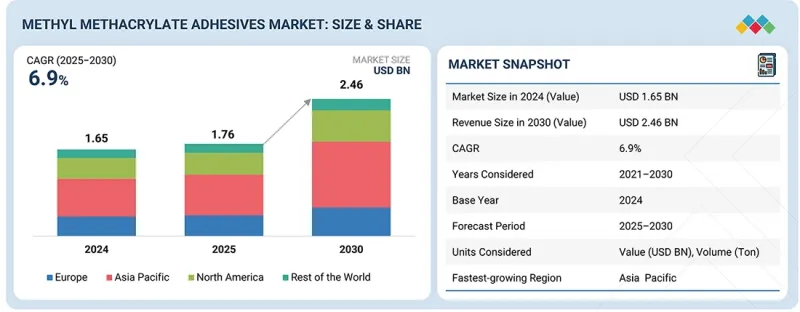
全球甲基丙烯酸甲酯黏合劑市場預計將從 2025 年的 17.6 億美元成長到 2030 年的 24.6 億美元,預測期內複合年成長率為 6.9%。
| 調查範圍 | |
|---|---|
| 調查期 | 2021-2030 |
| 基準年 | 2024 |
| 預測期 | 2025-2030 |
| 計算單位 | 金額(百萬/十億美元),數量(噸) |
| 部分 | 依基材、固化速度、系統類型、最終用途產業及地區分類 |
| 目標區域 | 亞太地區、北美地區、歐洲地區及世界其他地區 |
近年來,甲基丙烯酸甲酯黏合劑市場持續成長。這主要歸功於市場對高強度、耐久性和快速固化黏合劑的需求不斷成長。在汽車、風力發電、建築和造船等各個領域中,多材料結構輕質材料的日益普及也推動了甲基丙烯酸甲酯黏合劑市場的成長。甲基丙烯酸甲酯黏合劑對金屬、複合材料和塑膠具有優異的黏合性,且只需要極少的表面處理。電動車和可再生能源技術的發展,包括風力發電機葉片的製造,也促進了甲基丙烯酸甲酯黏合劑市場的成長。此外,建築業對甲基丙烯酸甲酯黏合劑的需求也不斷成長。亞太地區是甲基丙烯酸甲酯黏合劑市場成長的主要驅動力,這主要得益於亞太地區的快速工業化進程。
“按系統類型分類,預計在預測期內,雙組分預混合料(2K)細分市場將佔據最大的市場佔有率。”
雙組分預混合料(2K)體系憑藉其在性能、可靠性和易用性方面的最佳平衡,在嚴苛的工業應用中佔據甲基丙烯酸甲酯黏合劑市場的主導地位。與基於諾麥克斯活化劑的黏合劑系統和紫外線/光固化丙烯酸黏合劑體係不同,2K系統能夠實現可靠的固化,因為樹脂和固化劑之間的化學反應過程不受光照和表面活化等環境因素的影響。雙組分預混合料(2K)系統具有廣泛的適用性,可用於包括金屬、複合材料和塑膠在內的多種表面。該體係是汽車、建築和船舶行業的理想之選,因為它能夠形成牢固的結構粘合,提供出色的間隙填充性能,並具有高抗衝擊性。預混合料包裝有助於減少操作人員的失誤。憑藉其耐久性、高生產率和簡便的施工工藝,雙組分預混合料(2K)系統一直是製造商的首選,並保持其在全球市場的主導地位。
從終端用戶產業來看,預計在預測期內,陸路運輸(汽車、卡車、鐵路和巴士)領域將佔據最大的市場佔有率。
陸路運輸(汽車、卡車、鐵路和巴士)領域佔據了甲基丙烯酸甲酯黏合劑市場最大的佔有率。這主要歸功於對輕質高強度永久性黏合解決方案的旺盛需求。汽車、商用卡車和鐵路運輸等行業正日益依賴甲基丙烯酸甲酯黏合劑來取代傳統的機械緊固件和焊接。這些黏合劑非常適合承受持續振動和惡劣工況的車輛,因為它們能夠提供全面的抗衝擊保護,即使經過多次循環也能保持強度。使用甲基丙烯酸甲酯黏合劑可以加快生產流程、降低生產成本,同時也能實現現代化的設計方案。
“預計亞太地區在預測期內將佔據最大的市場佔有率。”
亞太地區是甲基丙烯酸甲酯黏合劑最大的市場。憑藉其完善的製造業基礎設施和快速的工業化進程,該地區為甲基丙烯酸甲酯黏合劑產業提供了巨大的成長機會。推動亞太地區甲基丙烯酸甲酯黏合劑市場成長的主要國家包括中國、印度、日本和韓國。該地區各行各業對甲基丙烯酸甲酯黏合劑的需求不斷成長,包括汽車、建築、造船、風力發電和電子等行業。甲基丙烯酸甲酯黏合劑因其優異的黏接強度、快速的黏接速度以及能夠黏接金屬、塑膠和複合材料等多種材料而被廣泛應用。亞太地區是世界領先的汽車工業中心之一。在該地區,甲基丙烯酸甲酯黏合劑被用於輕量化黏合和結構黏接。都市化加快、生活水準提高以及中產階級的壯大正在推動住宅和商業建築領域對甲基丙烯酸甲酯膠粘劑需求的成長。
甲基丙烯酸甲酯黏合劑市場的主要參與者包括:3M(美國)、漢高股份公司(德國)、富樂公司(美國)、IPS公司(美國)、伊利諾工具公司(美國)、史考特·巴德公司(英國)、亨斯邁國際公司(美國)、波士基(法國)、西華卡公司(瑞士)和派克漢尼汾公司(美國)。本研究對這些甲基丙烯酸甲酯黏合劑市場的主要參與者進行了詳細的競爭分析,包括公司簡介、近期發展和關鍵市場策略。
調查範圍
本報告根據體系類型、終端用戶產業、基材、固化速率和地區對甲基丙烯酸甲酯黏合劑市場進行細分,並估算了各地區的市場規模。該報告還對主要行業參與者進行了詳細分析,深入剖析了他們的業務概況、產品和服務、關鍵策略以及與甲基丙烯酸甲酯黏合劑市場相關的業務拓展情況。
購買本報告的主要好處
本研究報告著重於多方面分析,包括行業分析(行業趨勢)、主要公司市場排名分析和公司概況。透過整合這些內容,報告揭示了甲基丙烯酸甲酯黏合劑市場的整體情況、新興和高成長細分市場、高成長地區以及市場促進因素、限制因素、機會和挑戰。
本報告深入分析了以下幾點:
- 對促進因素(對輕質和多材料粘合的需求、與傳統黏合劑系統相比的優異性能以及可再生能源的加速採用)、阻礙因素(採用障礙和操作複雜性、高成本限制了甲基丙烯酸甲酯黏合劑在價格敏感型市場中的採用)、機遇(電動汽車和電池黏合劑的快速擴張以及複合材料應用的丙烯酸特性和挑戰(性能)的市場發展因素,表明這些市場認證,甲基化鐵酯和應用的丙烯酸黏合劑),這些因素會發現了市場認證?
- 市場滲透率:提供全球甲基丙烯酸甲酯黏合劑市場主要參與者所提供產品的全面資訊。
- 產品開發與創新:對甲基丙烯酸甲酯黏合劑市場的未來技術趨勢、新產品發布、業務擴張和收購進行詳細分析。
- 市場發展:提供有關盈利新興市場的全面資訊。本報告按地區分析了甲基丙烯酸甲酯黏合劑市場。
- 市場產能:甲基丙烯酸甲酯黏合劑市場中各公司的產能(可用範圍)和未來產能預測。
- 競爭分析:對甲基丙烯酸甲酯黏合劑市場主要參與者的市場佔有率、策略、產品和製造能力進行詳細評估。
目錄
第1章:引言
第2章執行摘要
第3章重要考察
第4章 市場概覽
- 市場動態
- 促進因素
- 抑制因子
- 機會
- 任務
- 未滿足的需求和未開發的領域
- 相互關聯的市場與跨產業機遇
- 一級/二級/三級公司的策略性舉措
第5章 產業趨勢
- 波特五力分析
- 總體經濟指標
- 供應鏈分析
- 價格分析(2022-2025)
- 生態系分析
- 貿易分析
- 2026-2027 年主要會議和活動
- 影響客戶業務的趨勢/顛覆性因素
- 投資和資金籌措場景
- 案例研究分析
- 2025年美國關稅對甲基丙烯酸甲酯黏合劑市場的影響
第6章:技術進步、人工智慧的影響、專利、創新與未來應用
- 主要新興技術
- 互補技術
- 鄰近技術
- 技術/產品藍圖
- 專利分析
- 未來應用
- 人工智慧/通用人工智慧對甲基丙烯酸甲酯黏合劑市場的影響
- 成功案例和實際應用
第7章永續性和監管情勢
- 當地法規和合規性
- 對永續性的承諾
- 對永續性和監管政策舉措的影響
- 認證、標籤檢視、環境標準
第8章:顧客趨勢與購買行為
- 決策流程
- 買方相關人員和採購評估標準
- 實施障礙和內部挑戰
- 各個終端用戶產業尚未滿足的需求
- 市場盈利
第9章:甲基丙烯酸甲酯黏合劑基材分類)
- 金屬(鋼、鋁、不鏽鋼)
- 熱固性複合材料(FRP/CRP/GRP)
- 標準熱塑性塑膠(ABS、PC、PVC)
- 工程塑膠/LSE(尼龍、PP、PE、TPO)
- 陶瓷/磁鐵/玻璃
第10章:甲基丙烯酸甲酯黏合劑固化速度分類)
- 超快速型(少於3分鐘)
- 短期類型(3-10分鐘)
- 長時型(15-60分鐘)
- UV/光固化型(單組分型,1-5分鐘)
第11章:甲基丙烯酸甲酯黏合劑系統類型分類)
- 雙組分預混合料(2K)
- 無需混合/活化劑
- UV/光固化丙烯酸樹脂
第12章:甲基丙烯酸甲酯黏合劑終端用戶產業分類)
- 陸路運輸(汽車、卡車、鐵路、巴士)
- 海洋相關(造船+休閒遊艇)
- 可再生能源(風能、太陽能)
- 結構(面板、立面、玻璃)
- 電動車/新能源(電瓶、馬達、磁鐵)
- 電子設備(設備、機殼、顯示器)
- 航太與國防(認證)
- 醫療設備(通過 ISO 10993 認證)
- 通用工業/MRO
第13章:甲基丙烯酸甲酯黏合劑市場(按地區分類)
- 亞太地區
- 中國
- 日本
- 印度
- 韓國
- 其他
- 北美洲
- 美國
- 加拿大
- 墨西哥
- 歐洲
- 德國
- 義大利
- 法國
- 英國
- 西班牙
- 其他
- 中東和非洲
- 海灣合作理事會國家
- 南非
- 其他
- 南美洲
- 阿根廷
- 巴西
- 其他
第14章 競爭格局
- 主要參與企業的策略/優勢
- 2025年市佔率分析
- 2021-2025年收入分析
- 企業估值矩陣:主要公司,2025 年
- 公司估值矩陣:新創企業/中小企業,2025 年
- 產品對比
- 企業估值和財務指標
- 競爭格局
第15章:公司簡介
- 主要參與企業
- HENKEL AG & CO. KGAA
- HB FULLER COMPANY
- IPS CORPORATION
- ILLINOIS TOOL WORKS INC.
- SCOTT BADER COMPANY LTD.
- 3M
- HUNTSMAN INTERNATIONAL LLC.
- BOSTIK
- SIKA AG
- PARKER HANNIFIN CORP
- 其他公司
- PERMABOND
- PARSON ADHESIVES, INC.
- ADVANCED ADHESIVE SYSTEMS
- ADHESIVE SYSTEMS, INC.
- DYNAMIC ADHESIVE SOLUTIONS
- INFINITY BOND ADHESIVES
- WEICON INC.
- HERNON MANUFACTURING
- BONDLOC UK LTD
- HOENLE AG
- SUPEX
- ADINOX
- KISLING AG
- NOVACHEM CORPORATION LTD.
- LOXEAL SRL
第16章調查方法
第17章附錄
The global methyl methacrylate adhesives market is projected to grow from USD 1.76 billion in 2025 to USD 2.46 billion by 2030, registering a CAGR of 6.9% during the forecast period.
| Scope of the Report | |
|---|---|
| Years Considered for the Study | 2021-2030 |
| Base Year | 2024 |
| Forecast Period | 2025-2030 |
| Units Considered | Value (USD Million/Billion), Volume (Ton) |
| Segments | Substrate, System Type, Cure Speed, End-use Industry, and Region |
| Regions covered | Asia Pacific, North America, Europe, Rest of the World |
The methyl methacrylate adhesives market has been witnessing growth in recent years. This is mainly due to the increasing demand for high-strength, durable, and fast-curing adhesives. The increasing trend of using lightweight materials in multi-material constructions in various sectors, including automotive, wind energy, construction, and marine, is contributing to the growth of methyl methacrylate adhesives. Methyl methacrylate adhesives have good bonding properties with metals, composites, and plastics with low surface preparation. The development of electric vehicles and renewable energy technologies, including wind turbine blade manufacturing, is also contributing to the growth of methyl methacrylate adhesives. The demand for methyl methacrylate adhesives is also increasing in the building & construction sectors. Asia Pacific is the major contributor to the growth of the methyl methacrylate adhesives market. This is mainly due to the rapid industrialization in Asia Pacific.
"By system type, the two-part pre-mix (2K) segment is anticipated to account for the largest market share during the forecast period."
The two-part pre-mix (2K) system dominates the methyl methacrylate adhesives market as it delivers the best balance of performance, reliability, and ease of use for demanding industrial applications. 2K systems provide reliable curing as their chemical reaction process between resin and hardener develops independently from environmental factors such as light and surface activation, unlike the no-mix activator adhesive system and UV/light-cure acrylic adhesive system. Two-part pre-mix (2K) system shows extensive adaptability as it can be used on various surfaces, such as metals, composites, and plastics. This system type serves perfectly for automotive, construction, and marine industries as they create strong structural bonds and provides excellent gap-filling performance and high impact resistance. Pre-mixed packaging enables workers to complete their tasks with fewer mistakes. Two-part pre-mix (2K) continues to dominate the global market as manufacturers choose it for their ability to provide durability, high productivity, and straightforward application processes.
By end-use industry, the land transport (auto, truck, rail, bus) segment is anticipated to account for the largest market share during the forecast period.
The land transport (auto, truck, rail, bus) segment accounted for the largest share of the methyl methacrylate adhesives market. This is attributed to the high demand for their lightweight and strong permanent adhesive solutions. Industries such as the automotive, commercial trucking, and rail transport increasingly rely on methyl methacrylate adhesives to replace traditional mechanical fasteners and welding. These adhesives provide complete protection against strong impacts while sustaining their strength through multiple cycles, which makes them ideal for vehicles that undergo continuous vibrations and intense operational demands. The use of methyl methacrylate adhesives leads to quicker production processes together with decreased production expenses, while enabling contemporary design options.
"Asia Pacific is anticipated to account for the largest market share during the forecast period.
Asia Pacific is the largest market for methyl methacrylate adhesives. The region offers immense growth opportunities in the methyl methacrylate adhesive industry because of the presence of robust manufacturing infrastructure and rapid industrialization. In the Asia Pacific region, the key countries that contribute to the growth of the methyl methacrylate adhesive market are China, India, Japan, and South Korea. Countries in this region have a high demand for methyl methacrylate adhesives in various industries, such as the automotive, construction, marine, wind energy, and electronics. Methyl methacrylate adhesives are widely used because of the superior bonding strength, quick bonding time, and the ability of the product to bond different materials such as metals, plastics, and composite materials. The Asia Pacific region is one of the largest automotive hubs in the world. In this region, methyl methacrylate adhesives are used in lightweight bonding and structural bonding. The rise in urbanization and the growth in the standard of living and middle-class population have led to an increase in demand for residential and commercial construction.
In-depth interviews were conducted with Chief Executive Officers (CEOs), marketing directors, other innovation and technology directors, and executives from various key organizations operating in the methyl methacrylate adhesives market, and information was gathered from secondary research to determine and verify the market size of several segments.
- By Company Type: Tier 1 - 50%, Tier 2 - 30%, and Tier 3 - 20%
- By Designation: Managers - 15%, Directors - 20%, and Others - 65%
- By Region: North America - 30%, Europe - 25%, Asia Pacific - 35%, Rest of the World - 15%
The methyl methacrylate adhesives market comprises of major companies, such as 3M (US), Henkel AG & Co. KGaA (Germany), H.B. Fuller Company (US), IPS Corporation (US), Illinois Tool Works Inc. (US), Scott Bader Company Ltd. (UK), Huntsman International LLC (US), Bostik (France), Sika AG (Switzerland), and PARKER HANNIFIN CORP. (US). The study includes in-depth competitive analysis of these key players in the methyl methacrylate adhesives market, with their company profiles, recent developments, and key market strategies.
Research Coverage
This report segments the market for methyl methacrylate adhesives market on the basis of system type, end-use industry, substrate, cure speed, and region, and provides estimations for the overall value of the market across various regions. A detailed analysis of key industry players has been conducted to provide insights into their business overviews, products & services, key strategies, and expansions associated with the methyl methacrylate adhesives market.
Key benefits of buying this report
This research report is focused on various levels of analysis-industry analysis (industry trends), market ranking analysis of top players, and company profiles, which together provide an overall view of the competitive landscape; emerging and high-growth segments of the methyl methacrylate adhesives market; high-growth regions; and market drivers, restraints, opportunities, and challenges.
The report provides insights into the following points:
- Analysis of Drivers: (Lightweighting & multi-material bonding demand, superior performance compared to conventional adhesive systems, Accelerating renewable energy deployment driving demand for high-performance methyl methacrylate adhesives), restraints (Adoption barriers and operational complexity, High cost of methyl methacrylate adhesives limiting adoption in price-sensitive markets), opportunities (Rapid expansion of electrical vehicles and battery systems, Expansion in composite applications), and challenges (Performance standardization and certification requirements delaying market commercialization) influencing the growth of methyl methacrylate adhesives market
- Market Penetration: Comprehensive information on the methyl methacrylate adhesives offered by top players in the global methyl methacrylate adhesives market
- Product Development/Innovation: Detailed insights on upcoming technologies, product launches, expansions, and acquisitions in the methyl methacrylate adhesives market
- Market Development: Comprehensive information about lucrative emerging markets, the report analyzes the markets for methyl methacrylate adhesives across regions.
- Market Capacity: Production capacity of the companies is provided wherever available with upcoming capacities for the methyl methacrylate adhesives market
- Competitive Assessment: In-depth assessment of market shares, strategies, products, and manufacturing capabilities of leading players in the methyl methacrylate adhesives market
TABLE OF CONTENTS
1 INTRODUCTION
- 1.1 STUDY OBJECTIVES
- 1.2 MARKET DEFINITION
- 1.3 STUDY SCOPE
- 1.3.1 MARKETS COVERED AND REGIONAL SCOPE
- 1.3.2 INCLUSIONS AND EXCLUSIONS
- 1.3.3 YEARS CONSIDERED
- 1.3.4 CURRENCY CONSIDERED
- 1.3.5 UNIT CONSIDERED
- 1.4 STAKEHOLDERS
- 1.5 SUMMARY OF CHANGES
2 EXECUTIVE SUMMARY
- 2.1 KEY INSIGHTS AND MARKET HIGHLIGHTS
- 2.2 KEY MARKET PARTICIPANTS: SHARE INSIGHTS AND STRATEGIC DEVELOPMENTS
- 2.3 DISRUPTIVE TRENDS SHAPING MARKET
- 2.4 HIGH-GROWTH SEGMENTS & EMERGING FRONTIERS
- 2.5 SNAPSHOT: MARKET SIZE, GROWTH RATE, AND FORECAST
3 PREMIUM INSIGHTS
- 3.1 ATTRACTIVE OPPORTUNITIES FOR PLAYERS IN METHYL METHACRYLATE ADHESIVES MARKET
- 3.2 METHYL METHACRYLATE ADHESIVES MARKET, BY SUBSTRATE AND REGION
- 3.3 METHYL METHACRYLATE ADHESIVES MARKET, BY SYSTEM TYPE
- 3.4 METHYL METHACRYLATE ADHESIVES MARKET, BY CURE SPEED
- 3.5 METHYL METHACRYLATE ADHESIVES MARKET, BY END-USE INDUSTRY
- 3.6 METHYL METHACRYLATE ADHESIVES MARKET, BY COUNTRY
4 MARKET OVERVIEW
- 4.1 INTRODUCTION
- 4.2 MARKET DYNAMICS
- 4.2.1 DRIVERS
- 4.2.1.1 Lightweighting & multi-material bonding demand
- 4.2.1.2 Superior performance to conventional adhesive systems
- 4.2.1.3 Accelerating renewable energy deployment
- 4.2.2 RESTRAINTS
- 4.2.2.1 Adoption barriers and operational complexity
- 4.2.2.2 High cost limiting adoption in price-sensitive markets
- 4.2.3 OPPORTUNITIES
- 4.2.3.1 Rapid expansion of electric vehicles and battery systems
- 4.2.3.2 Expansion in composite applications
- 4.2.4 CHALLENGES
- 4.2.4.1 Performance standardization and certification requirements delaying commercialization
- 4.2.1 DRIVERS
- 4.3 UNMET NEEDS AND WHITE SPACES
- 4.3.1 UNMET NEEDS IN METHYL METHACRYLATE ADHESIVES MARKET
- 4.3.2 WHITE SPACE OPPORTUNITIES
- 4.4 INTERCONNECTED MARKETS AND CROSS-SECTOR OPPORTUNITIES
- 4.4.1 INTERCONNECTED MARKETS
- 4.4.2 CROSS-SECTOR OPPORTUNITIES
- 4.5 STRATEGIC MOVES BY TIER-1/2/3 PLAYERS
- 4.5.1 KEY MOVES AND STRATEGIC FOCUS
5 INDUSTRY TRENDS
- 5.1 PORTER'S FIVE FORCES ANALYSIS
- 5.1.1 THREAT OF NEW ENTRANTS
- 5.1.2 THREAT OF SUBSTITUTES
- 5.1.3 BARGAINING POWER OF SUPPLIERS
- 5.1.4 BARGAINING POWER OF BUYERS
- 5.1.5 INTENSITY OF COMPETITIVE RIVALRY
- 5.2 MACROECONOMICS INDICATORS
- 5.2.1 INTRODUCTION
- 5.2.2 GDP TRENDS AND FORECAST
- 5.2.3 TRENDS IN GLOBAL AUTOMOTIVE INDUSTRY
- 5.3 SUPPLY CHAIN ANALYSIS
- 5.4 PRICING ANALYSIS (2022-2025)
- 5.4.1 AVERAGE SELLING PRICE TREND OF METHYL METHACRYLATE ADHESIVES, BY REGION (2022-2025)
- 5.4.2 AVERAGE SELLING PRICE TREND OF METHYL METHACRYLATE ADHESIVES, BY SYSTEM TYPE (2022-2025)
- 5.4.3 AVERAGE SELLING PRICE TREND OF METHYL METHACRYLATE ADHESIVES, BY CURE SPEED (2022-2025)
- 5.4.4 AVERAGE SELLING PRICE TREND OF METHYL METHACRYLATE ADHESIVES, BY SUBSTRATE (2022-2025)
- 5.4.5 AVERAGE SELLING PRICE TREND OF METHYL METHACRYLATE ADHESIVES, BY END-USE INDUSTRY (2022-2025)
- 5.4.6 AVERAGE SELLING PRICE OF METHYL METHACRYLATE ADHESIVES AMONG KEY PLAYERS, BY SYSTEM TYPE, 2025
- 5.5 ECOSYSTEM ANALYSIS
- 5.6 TRADE ANALYSIS
- 5.6.1 IMPORT SCENARIO (HS CODE 291614)
- 5.6.2 EXPORT SCENARIO (HS CODE 291614)
- 5.7 KEY CONFERENCES AND EVENTS, 2026-2027
- 5.8 TRENDS/DISRUPTIONS IMPACTING CUSTOMER BUSINESS
- 5.9 INVESTMENT AND FUNDING SCENARIO
- 5.10 CASE STUDY ANALYSIS
- 5.10.1 ENABLING ADVANCED STRUCTURAL BONDING SOLUTIONS THROUGH METHYL METHACRYLATE ADHESIVE TECHNOLOGIES
- 5.10.2 ENABLING ENERGY-EFFICIENT BUILDINGS THROUGH METHYL METHACRYLATE ADHESIVE-BASED STRUCTURAL AND PREFABRICATED ASSEMBLIES
- 5.10.3 STRENGTHENING ELECTRONICS DURABILITY AND THERMAL MANAGEMENT THROUGH METHYL METHACRYLATE ADHESIVE-BASED SOLUTIONS
- 5.11 IMPACT OF 2025 US TARIFF - METHYL METHACRYLATE ADHESIVES MARKET
- 5.11.1 INTRODUCTION
- 5.11.2 KEY TARIFF RATES
- 5.11.3 PRICE IMPACT ANALYSIS
- 5.11.4 IMPACT ON COUNTRIES/REGIONS
- 5.11.4.1 North America
- 5.11.4.2 Europe
- 5.11.4.3 Asia Pacific
- 5.11.5 IMPACT ON END-USE INDUSTRIES
6 TECHNOLOGICAL ADVANCEMENTS, AI-DRIVEN IMPACT, PATENTS, INNOVATIONS, AND FUTURE APPLICATIONS
- 6.1 KEY EMERGING TECHNOLOGIES
- 6.1.1 FAST-CURING METHYL METHACRYLATE ADHESIVES (3-10 MIN)
- 6.1.2 HIGH TEMPERATURE RESISTANCE (>150°C)
- 6.1.3 LOW-EMISSION AND SUSTAINABLE METHYL METHACRYLATE ADHESIVES
- 6.1.4 NANOTECHNOLOGY-ENHANCED METHYL METHACRYLATE ADHESIVES
- 6.2 COMPLEMENTARY TECHNOLOGIES
- 6.2.1 SURFACE TREATMENT AND PRIMER TECHNOLOGIES
- 6.2.2 AUTOMATED DISPENSING AND APPLICATION SYSTEMS
- 6.2.3 CURE MONITORING AND NONDESTRUCTIVE TESTING (NDT) TOOLS
- 6.3 ADJACENT TECHNOLOGIES
- 6.3.1 UV-CURABLE AND LIGHT-ACTIVATED ADHESIVE TECHNOLOGIES
- 6.3.2 HIGH-PERFORMANCE STRUCTURAL EPOXY ADHESIVES
- 6.4 TECHNOLOGY/PRODUCT ROADMAP
- 6.4.1 SHORT-TERM ROADMAP: PROCESS OPTIMIZATION AND COST RATIONALIZATION
- 6.4.2 MID-TERM ROADMAP: CUSTOMIZATION, APPLICATION-SPECIFIC FORMULATIONS, AND SUSTAINABILITY INTEGRATION
- 6.4.3 LONG-TERM ROADMAP: ADVANCED PERFORMANCE AND SUSTAINABILITY ENABLEMENT
- 6.5 PATENT ANALYSIS
- 6.5.1 METHODOLOGY
- 6.5.2 GRANTED PATENTS, 2016-2025
- 6.5.2.1 Publication trends for last ten years
- 6.5.3 INSIGHTS
- 6.5.4 LEGAL STATUS
- 6.5.5 JURISDICTION ANALYSIS
- 6.5.6 TOP APPLICANTS
- 6.5.7 LIST OF MAJOR PATENTS
- 6.6 FUTURE APPLICATIONS
- 6.6.1 STRUCTURAL BODY BONDING & BATTERY ENCLOSURE ASSEMBLY IN AUTOMOTIVE & EVS
- 6.6.2 FRP PANEL BONDING & STRUCTURAL REINFORCEMENT IN CONSTRUCTION & INFRASTRUCTURE
- 6.6.3 COMPOSITE TURBINE BLADE BONDING & REPAIR IN WIND ENERGY
- 6.6.4 METAL PANEL BONDING & STRUCTURAL ASSEMBLY IN RAIL AND INDUSTRIAL EQUIPMENT
- 6.7 IMPACT OF AI/GEN AI ON METHYL METHACRYLATE ADHESIVES MARKET
- 6.7.1 TOP USE CASES AND MARKET POTENTIAL
- 6.7.2 BEST PRACTICES IN METHYL METHACRYLATE ADHESIVES MANUFACTURING
- 6.7.3 CASE STUDIES OF AI IMPLEMENTATION IN METHYL METHACRYLATE ADHESIVES MARKET
- 6.7.4 INTERCONNECTED ADJACENT ECOSYSTEM AND IMPACT ON MARKET PLAYERS
- 6.7.5 CLIENTS' READINESS TO ADOPT GENERATIVE AI IN METHYL METHACRYLATE ADHESIVES MARKET
- 6.8 SUCCESS STORIES AND REAL-WORLD APPLICATIONS
- 6.8.1 3M (U.S.): ADVANCED METHYL METHACRYLATE ADHESIVE SOLUTIONS FOR MULTI-MATERIAL BONDING
- 6.8.2 HENKEL AG & CO. KGAA (GERMANY): HIGH-PERFORMANCE METHYL METHACRYLATE ADHESIVES FOR AUTOMOTIVE AND INDUSTRIAL APPLICATIONS
- 6.8.3 SIKA AG (SWITZERLAND): METHYL METHACRYLATE ADHESIVES FOR CONSTRUCTION AND INFRASTRUCTURE APPLICATIONS
7 SUSTAINABILITY AND REGULATORY LANDSCAPE
- 7.1 REGIONAL REGULATIONS AND COMPLIANCE
- 7.1.1 REGULATORY BODIES, GOVERNMENT AGENCIES, AND OTHER ORGANIZATIONS
- 7.1.2 INDUSTRY STANDARDS
- 7.2 SUSTAINABILITY INITIATIVES
- 7.2.1 CARBON IMPACT AND ECO-APPLICATIONS OF METHYL METHACRYLATE ADHESIVES
- 7.3 SUSTAINABILITY IMPACT AND REGULATORY POLICY INITIATIVES
- 7.4 CERTIFICATIONS, LABELING, ECO-STANDARDS
8 CUSTOMER LANDSCAPE & BUYER BEHAVIOR
- 8.1 DECISION-MAKING PROCESS
- 8.2 BUYER STAKEHOLDERS AND BUYING EVALUATION CRITERIA
- 8.2.1 KEY STAKEHOLDERS IN BUYING PROCESS
- 8.2.2 BUYING CRITERIA
- 8.3 ADOPTION BARRIERS & INTERNAL CHALLENGES
- 8.4 UNMET NEEDS FROM VARIOUS END-USE INDUSTRY
- 8.5 MARKET PROFITABILITY
- 8.5.1 VALUE ADDITION AND FUNCTIONAL PREMIUMS
- 8.5.2 FEEDSTOCK AND COST STRUCTURE SENSITIVITY
- 8.5.3 SCALE, CUSTOMIZATION, AND OPERATING LEVERAGE
- 8.5.4 CUSTOMER LOCK-IN AND SWITCHING COSTS
9 METHYL METHACRYLATE ADHESIVES MARKET, BY SUBSTRATE
- 9.1 INTRODUCTION
- 9.2 METALS (STEEL, AL, SS)
- 9.2.1 INCREASING SHIFT FROM WELDING TO ADHESIVE BONDING IN METAL STRUCTURES DRIVING DEMAND
- 9.3 THERMOSET COMPOSITES (FRP/CRP/GRP)
- 9.3.1 RISING ADOPTION OF LIGHTWEIGHT COMPOSITE MATERIALS BOOSTING DEMAND
- 9.4 STANDARD THERMOPLASTICS (ABS, PC, PVC)
- 9.4.1 INCREASING USE OF THERMOPLASTICS IN MULTI-MATERIAL ASSEMBLIES INCREASING ADOPTION
- 9.5 ENGINEERING PLASTICS/LSE (NYLON, PP, PE, TPO)
- 9.5.1 GROWING USE OF LOW SURFACE ENERGY PLASTICS IS INCREASING DEMAND FOR ADVANCED MMA ADHESIVE FORMULATIONS.
- 9.6 CERAMICS/MAGNETS/GLASS
- 9.6.1 RISING DEMAND FOR HIGH-PERFORMANCE BONDING IN ELECTRONICS AND ENERGY SYSTEMS DRIVING DEMAND
10 METHYL METHACRYLATE ADHESIVES MARKET, BY CURE SPEED
- 10.1 INTRODUCTION
- 10.2 ULTRA-FAST (< 3 MIN)
- 10.2.1 INCREASING DEMAND FOR HIGH-THROUGHPUT MANUFACTURING ACCELERATING ADOPTION OF ULTRA-FAST CURING METHYL METHACRYLATE ADHESIVES
- 10.3 FAST (3-10 MIN)
- 10.3.1 NEED FOR BALANCED WORKING TIME AND PRODUCTIVITY DRIVING WIDESPREAD ADOPTION OF FAST-CURING METHYL METHACRYLATE ADHESIVES
- 10.4 EXTENDED (15-60 MIN)
- 10.4.1 INCREASING USE OF LARGE AND COMPLEX ASSEMBLIES BOOSTING DEMAND FOR EXTENDED-CURE METHYL METHACRYLATE ADHESIVES
- 10.5 UV/LIGHT-CURE (1-PART, 1-5 MIN)
- 10.5.1 RISING DEMAND FOR PRECISION BONDING IN ELECTRONICS AND MEDICAL DEVICES DRIVING ADOPTION OF UV/LIGHT-CURE METHYL METHACRYLATE ADHESIVES
11 METHYL METHACRYLATE ADHESIVES MARKET, BY SYSTEM TYPE
- 11.1 INTRODUCTION
- 11.2 TWO-PART PRE-MIX (2K)
- 11.2.1 HIGH DEMAND FOR RELIABLE, HIGH-STRENGTH STRUCTURAL BONDING DRIVING WIDESPREAD ADOPTION OF 2K MMA ADHESIVE SYSTEMS
- 11.3 NO-MIX/ACTIVATOR
- 11.3.1 NEED FOR SIMPLE, EQUIPMENT-FREE BONDING SOLUTIONS ACCELERATING ADOPTION OF NO-MIX MMA ADHESIVE SYSTEMS
- 11.4 UV/LIGHT-CURE ACRYLIC
- 11.4.1 INCREASING DEMAND FOR PRECISION AND CLEAN PROCESSING IN HIGH-TECH INDUSTRIES DRIVING ADOPTION OF UV-CURE METHYL METHACRYLATE ADHESIVE SYSTEMS
12 METHYL METHACRYLATE ADHESIVES MARKET, BY END-USE INDUSTRY
- 12.1 INTRODUCTION
- 12.2 LAND TRANSPORT (AUTO, TRUCK, RAIL, BUS)
- 12.2.1 VEHICLE LIGHTWEIGHTING AND MULTI-MATERIAL DESIGN TRENDS DRIVING METHYL METHACRYLATE ADHESIVE ADOPTION IN TRANSPORTATION
- 12.3 MARINE (SHIPBUILDING + LEISURE BOATS)
- 12.3.1 DEMAND FOR CORROSION-RESISTANT BONDING IN COMPOSITE MARINE STRUCTURES BOOSTING DEMAND
- 12.4 RENEWABLE ENERGY (WIND, SOLAR FRAMES)
- 12.4.1 EXPANSION OF WIND AND SOLAR INFRASTRUCTURE DRIVING DEMAND FOR METHYL METHACRYLATE ADHESIVES IN ENERGY SYSTEMS
- 12.5 CONSTRUCTION (PANELS, FACADES, GLAZING)
- 12.5.1 RISING ADOPTION OF PREFABRICATED AND MODULAR CONSTRUCTION IS ACCELERATING DEMAND
- 12.6 EV/NEW ENERGY (BATTERY, MOTOR, MAGNETS)
- 12.6.1 RAPID GROWTH OF ELECTRIC MOBILITY DRIVING DEMAND FOR METHYL METHACRYLATE ADHESIVES IN EV COMPONENTS
- 12.7 ELECTRONICS (DEVICES, ENCLOSURES, DISPLAYS)
- 12.7.1 INCREASING MINIATURIZATION AND COMPLEXITY OF ELECTRONIC DEVICES DRIVING METHYL METHACRYLATE ADHESIVE ADOPTION
- 12.8 AEROSPACE & DEFENSE (CERTIFIED GRADES)
- 12.8.1 INCREASING USE OF LIGHTWEIGHT COMPOSITES IN AEROSPACE BOOSTING DEMAND
- 12.9 MEDICAL DEVICES (ISO 10993-QUALIFIED)
- 12.9.1 GROWING DEMAND FOR BIOCOMPATIBLE AND RELIABLE BONDING SOLUTIONS DRIVING DEMAND IN MEDICAL DEVICES
- 12.10 GENERAL INDUSTRIAL/MRO
- 12.10.1 INCREASING FOCUS ON MAINTENANCE EFFICIENCY AND EQUIPMENT LONGEVITY DRIVING METHYL METHACRYLATE ADHESIVE ADOPTION
13 METHYL METHACRYLATE ADHESIVES MARKET, BY REGION
- 13.1 INTRODUCTION
- 13.2 ASIA PACIFIC
- 13.2.1 CHINA
- 13.2.1.1 Massive growth in EVs, renewable energy, and manufacturing driving large-scale demand
- 13.2.2 JAPAN
- 13.2.2.1 Advanced manufacturing and high-precision electronics sustaining demand
- 13.2.3 INDIA
- 13.2.3.1 Infrastructure expansion and manufacturing growth under government initiatives demand
- 13.2.4 SOUTH KOREA
- 13.2.4.1 Semiconductor-driven manufacturing and offshore wind expansion supporting demand
- 13.2.5 REST OF ASIA PACIFIC
- 13.2.1 CHINA
- 13.3 NORTH AMERICA
- 13.3.1 US
- 13.3.1.1 Strong infrastructure spending and advanced manufacturing expansion accelerating demand
- 13.3.2 CANADA
- 13.3.2.1 Infrastructure investment and clean energy expansion driving methyl demand
- 13.3.3 MEXICO
- 13.3.3.1 Rapid nearshoring-led industrialization and automotive expansion fueling demand
- 13.3.1 US
- 13.4 EUROPE
- 13.4.1 GERMANY
- 13.4.1.1 Energy transition and automotive lightweighting sustaining long-term demand
- 13.4.2 ITALY
- 13.4.2.1 Strong marine manufacturing and construction activity driving demand
- 13.4.3 FRANCE
- 13.4.3.1 Renewable energy expansion and aerospace-driven manufacturing fueling demand
- 13.4.4 UK
- 13.4.4.1 Offshore wind expansion and infrastructure development driving demand
- 13.4.5 SPAIN
- 13.4.5.1 Rapid renewable energy deployment and infrastructure investments driving demand
- 13.4.6 REST OF EUROPE
- 13.4.1 GERMANY
- 13.5 MIDDLE EAST & AFRICA
- 13.5.1 GCC COUNTRIES
- 13.5.1.1 Saudi Arabia
- 13.5.1.1.1 Mega infrastructure projects and energy diversification under Vision 2030 driving demand
- 13.5.1.2 UAE
- 13.5.1.2.1 Infrastructure expansion and logistics hub development fueling demand
- 13.5.1.3 Rest of GCC Countries
- 13.5.1.1 Saudi Arabia
- 13.5.2 SOUTH AFRICA
- 13.5.2.1 Renewable energy expansion and automotive manufacturing supporting demand
- 13.5.3 REST OF MIDDLE EAST & AFRICA
- 13.5.1 GCC COUNTRIES
- 13.6 SOUTH AMERICA
- 13.6.1 ARGENTINA
- 13.6.1.1 Renewable energy development and automotive manufacturing supporting growth
- 13.6.2 BRAZIL
- 13.6.2.1 Renewable energy expansion and construction growth
- 13.6.3 REST OF SOUTH AMERICA
- 13.6.1 ARGENTINA
14 COMPETITIVE LANDSCAPE
- 14.1 INTRODUCTION
- 14.2 KEY PLAYER STRATEGIES/RIGHT TO WIN
- 14.3 MARKET SHARE ANALYSIS, 2025
- 14.3.1 HENKEL AG & CO. KGAA
- 14.3.2 3M
- 14.3.3 SIKA AG
- 14.3.4 H.B. FULLER COMPANY
- 14.3.5 ILLINOIS TOOL WORKS INC.
- 14.4 REVENUE ANALYSIS, 2021-2025
- 14.5 COMPANY EVALUATION MATRIX: KEY PLAYERS, 2025
- 14.5.1 STARS
- 14.5.2 EMERGING LEADERS
- 14.5.3 PERVASIVE PLAYERS
- 14.5.4 PARTICIPANTS
- 14.5.5 COMPANY FOOTPRINT: KEY PLAYERS, 2025
- 14.5.5.1 Company footprint
- 14.5.5.2 Region footprint
- 14.5.5.3 System type footprint
- 14.5.5.4 End-use industry footprint
- 14.5.5.5 Substrate footprint
- 14.6 COMPANY EVALUATION MATRIX: STARTUPS/SMES, 2025
- 14.6.1 PROGRESSIVE COMPANIES
- 14.6.2 RESPONSIVE COMPANIES
- 14.6.3 DYNAMIC COMPANIES
- 14.6.4 STARTING BLOCKS
- 14.6.5 COMPETITIVE BENCHMARKING
- 14.6.5.1 Detailed list of key startups/SMEs
- 14.6.5.2 Competitive benchmarking of key startups/SMEs
- 14.7 PRODUCT COMPARISON
- 14.8 COMPANY VALUATION AND FINANCIAL METRICS
- 14.9 COMPETITIVE SCENARIO
- 14.9.1 PRODUCT LAUNCHES
- 14.9.2 DEALS
- 14.9.3 EXPANSIONS
15 COMPANY PROFILES
- 15.1 KEY PLAYERS
- 15.1.1 HENKEL AG & CO. KGAA
- 15.1.1.1 Business overview
- 15.1.1.2 Products/Solutions/Services offered
- 15.1.1.3 Recent developments
- 15.1.1.3.1 Product launches
- 15.1.1.3.2 Deals
- 15.1.1.4 MnM view
- 15.1.1.4.1 Key strengths
- 15.1.1.4.2 Strategic choices
- 15.1.1.4.3 Weaknesses and competitive threats
- 15.1.2 H.B. FULLER COMPANY
- 15.1.2.1 Business overview
- 15.1.2.2 Products/Solutions/Services offered
- 15.1.2.3 Recent developments
- 15.1.2.3.1 Deals
- 15.1.2.3.2 Expansions
- 15.1.2.4 MnM view
- 15.1.2.4.1 Key strengths
- 15.1.2.4.2 Strategic choices
- 15.1.2.4.3 Weaknesses and competitive threats
- 15.1.3 IPS CORPORATION
- 15.1.3.1 Business overview
- 15.1.3.2 Products/Solutions/Services offered
- 15.1.3.3 MnM view
- 15.1.3.3.1 Key strengths
- 15.1.3.3.2 Strategic choices
- 15.1.3.3.3 Weaknesses and competitive threats
- 15.1.4 ILLINOIS TOOL WORKS INC.
- 15.1.4.1 Business overview
- 15.1.4.2 Products/Solutions/Services offered
- 15.1.4.3 Recent developments
- 15.1.4.3.1 Product launches
- 15.1.4.4 MnM view
- 15.1.4.4.1 Key strengths
- 15.1.4.4.2 Strategic choices
- 15.1.4.4.3 Weaknesses and competitive threats
- 15.1.5 SCOTT BADER COMPANY LTD.
- 15.1.5.1 Business overview
- 15.1.5.2 Products/Solutions/Services offered
- 15.1.5.3 Recent developments
- 15.1.5.3.1 Product launches
- 15.1.5.3.2 Deals
- 15.1.5.3.3 Expansions
- 15.1.5.4 MnM view
- 15.1.5.4.1 Key strengths
- 15.1.5.4.2 Strategic choices
- 15.1.5.4.3 Weaknesses and competitive threats
- 15.1.6 3M
- 15.1.6.1 Business overview
- 15.1.6.2 Products/Solutions/Services offered
- 15.1.6.3 MnM view
- 15.1.6.3.1 Right to win
- 15.1.6.3.2 Strategic choices
- 15.1.6.3.3 Weaknesses and competitive threats
- 15.1.7 HUNTSMAN INTERNATIONAL LLC.
- 15.1.7.1 Business overview
- 15.1.7.2 Products/Solutions/Services offered
- 15.1.7.3 MnM view
- 15.1.7.3.1 Right to win
- 15.1.7.3.2 Strategic choices
- 15.1.7.3.3 Weaknesses and competitive threats
- 15.1.8 BOSTIK
- 15.1.8.1 Business overview
- 15.1.8.2 Products/Solutions/Services offered
- 15.1.8.3 Recent developments
- 15.1.8.3.1 Product launches
- 15.1.8.3.2 Expansions
- 15.1.8.4 MnM view
- 15.1.8.4.1 Right to win
- 15.1.8.4.2 Strategic choices
- 15.1.8.4.3 Weaknesses and competitive threats
- 15.1.9 SIKA AG
- 15.1.9.1 Business overview
- 15.1.9.2 Products/Solutions/Services offered
- 15.1.9.3 MnM view
- 15.1.9.3.1 Right to win
- 15.1.9.3.2 Strategic choices
- 15.1.9.3.3 Weaknesses and competitive threats
- 15.1.10 PARKER HANNIFIN CORP
- 15.1.10.1 Business overview
- 15.1.10.2 Products/Solutions/Services offered
- 15.1.10.3 MnM view
- 15.1.10.3.1 Key strengths/Right to win
- 15.1.10.3.2 Strategic choices
- 15.1.10.3.3 Weaknesses and competitive threats
- 15.1.1 HENKEL AG & CO. KGAA
- 15.2 OTHER PLAYERS
- 15.2.1 PERMABOND
- 15.2.2 PARSON ADHESIVES, INC.
- 15.2.3 ADVANCED ADHESIVE SYSTEMS
- 15.2.4 ADHESIVE SYSTEMS, INC.
- 15.2.5 DYNAMIC ADHESIVE SOLUTIONS
- 15.2.6 INFINITY BOND ADHESIVES
- 15.2.7 WEICON INC.
- 15.2.8 HERNON MANUFACTURING
- 15.2.9 BONDLOC UK LTD
- 15.2.10 HOENLE AG
- 15.2.11 SUPEX
- 15.2.12 ADINOX
- 15.2.13 KISLING AG
- 15.2.14 NOVACHEM CORPORATION LTD.
- 15.2.15 LOXEAL S.R.L.
16 RESEARCH METHODOLOGY
- 16.1 RESEARCH DATA
- 16.1.1 SECONDARY DATA
- 16.1.1.1 Key data from secondary sources
- 16.1.2 PRIMARY DATA
- 16.1.2.1 Key data from primary sources
- 16.1.2.2 Key primary interview participants
- 16.1.2.3 Breakdown of primary interviews
- 16.1.2.4 Key industry insights
- 16.1.1 SECONDARY DATA
- 16.2 MARKET SIZE ESTIMATION
- 16.2.1 BOTTOM-UP APPROACH
- 16.2.2 TOP-DOWN APPROACH
- 16.3 BASE NUMBER CALCULATION
- 16.3.1 APPROACH 1: SUPPLY-SIDE ANALYSIS
- 16.3.2 APPROACH 2: DEMAND-SIDE ANALYSIS
- 16.4 MARKET FORECAST APPROACH
- 16.4.1 SUPPLY SIDE
- 16.4.2 DEMAND SIDE
- 16.5 DATA TRIANGULATION
- 16.6 FACTOR ANALYSIS
- 16.7 RESEARCH ASSUMPTIONS
- 16.8 RESEARCH LIMITATIONS AND RISK ASSESSMENT
17 APPENDIX
- 17.1 DISCUSSION GUIDE
- 17.2 KNOWLEDGESTORE: MARKETSANDMARKETS' SUBSCRIPTION PORTAL
- 17.3 CUSTOMIZATION OPTIONS
- 17.4 RELATED REPORTS
- 17.5 AUTHOR DETAILS
List of Tables
- TABLE 1 METHYL METHACRYLATE ADHESIVES MARKET: PORTER'S FIVE FORCES ANALYSIS
- TABLE 2 GDP PERCENTAGE CHANGE, BY KEY COUNTRY, 2021-2029
- TABLE 3 AVERAGE SELLING PRICE TREND OF METHYL METHACRYLATE ADHESIVES, BY REGION, 2022-2025 (USD/KG)
- TABLE 4 AVERAGE SELLING PRICE TREND OF METHYL METHACRYLATE ADHESIVES, BY SYSTEM TYPE, 2022-2025 (USD/KG)
- TABLE 5 AVERAGE SELLING PRICE TREND OF METHYL METHACRYLATE ADHESIVES, BY CURE SPEED, 2022-2025 (USD/KG)
- TABLE 6 AVERAGE SELLING PRICE TREND OF METHYL METHACRYLATE ADHESIVES, BY SUBSTRATE, 2022-2025 (USD/KG)
- TABLE 7 AVERAGE SELLING PRICE TREND OF METHYL METHACRYLATE ADHESIVES, BY END-USE INDUSTRY, 2022-2025 (USD/KG)
- TABLE 8 AVERAGE SELLING PRICE OF METHYL METHACRYLATE ADHESIVES OFFERED BY KEY PLAYERS, BY SYSTEM TYPE, 2025, (USD/KG)
- TABLE 9 ROLES OF COMPANIES IN METHYL METHACRYLATE ADHESIVES ECOSYSTEM
- TABLE 10 IMPORT DATA FOR HS CODE 291614 COMPLIANT PRODUCTS (USD THOUSAND)
- TABLE 11 EXPORT DATA FOR HS CODE 291614 COMPLIANT PRODUCTS (USD THOUSAND)
- TABLE 12 METHYL METHACRYLATE ADHESIVES: KEY CONFERENCES AND EVENTS, 2026-2027
- TABLE 13 US-ADJUSTED RECIPROCAL TARIFF RATES
- TABLE 14 EXPECTED CHANGE IN PRICES AND IMPACT ON END-USE MARKET DUE TO TARIFFS
- TABLE 15 TOTAL NUMBER OF PATENTS
- TABLE 16 METHYL METHACRYLATE ADHESIVES: LIST OF MAJOR PATENTS, 2016-2025
- TABLE 17 TOP USE CASES AND MARKET POTENTIAL
- TABLE 18 BEST PRACTICES: COMPANIES IMPLEMENTING USE CASES
- TABLE 19 METHYL METHACRYLATE ADHESIVES MARKET: CASE STUDIES RELATED TO GEN AI IMPLEMENTATION
- TABLE 20 INTERCONNECTED ADJACENT ECOSYSTEM AND IMPACT ON MARKET PLAYERS
- TABLE 21 NORTH AMERICA: REGULATORY BODIES, GOVERNMENT AGENCIES, AND OTHER ORGANIZATIONS
- TABLE 22 EUROPE: REGULATORY BODIES, GOVERNMENT AGENCIES, AND OTHER ORGANIZATIONS
- TABLE 23 ASIA PACIFIC: REGULATORY BODIES, GOVERNMENT AGENCIES, AND OTHER ORGANIZATIONS
- TABLE 24 MIDDLE EAST & AFRICA: REGULATORY BODIES, GOVERNMENT AGENCIES, AND OTHER ORGANIZATIONS
- TABLE 25 SOUTH AMERICA: REGULATORY BODIES, GOVERNMENT AGENCIES, AND OTHER ORGANIZATIONS
- TABLE 26 GLOBAL INDUSTRY STANDARDS IN METHYL METHACRYLATE ADHESIVES MARKET
- TABLE 27 CERTIFICATIONS, LABELING, ECO-STANDARDS IN METHYL METHACRYLATE ADHESIVES MARKET
- TABLE 28 INFLUENCE OF STAKEHOLDERS ON BUYING PROCESS, BY END-USE INDUSTRY (%)
- TABLE 29 KEY BUYING CRITERIA, BY END-USE INDUSTRY
- TABLE 30 UNMET NEEDS IN METHYL METHACRYLATE ADHESIVES IN VARIOUS END-USE INDUSTRIES
- TABLE 31 METHYL METHACRYLATE ADHESIVES MARKET, BY SUBSTRATE, 2022-2025 (USD MILLION)
- TABLE 32 METHYL METHACRYLATE ADHESIVES MARKET, BY SUBSTRATE, 2026-2031 (USD MILLION)
- TABLE 33 METHYL METHACRYLATE ADHESIVES MARKET, BY SUBSTRATE, 2022-2025 (TON)
- TABLE 34 METHYL METHACRYLATE ADHESIVES MARKET, BY SUBSTRATE, 2026-2031 (TON)
- TABLE 35 METHYL METHACRYLATE ADHESIVES MARKET, BY CURE SPEED, 2022-2025 (USD MILLION)
- TABLE 36 METHYL METHACRYLATE ADHESIVES MARKET, BY CURE SPEED, 2026-2031 (USD MILLION)
- TABLE 37 METHYL METHACRYLATE ADHESIVES MARKET, BY CURE SPEED, 2022-2025 (TON)
- TABLE 38 METHYL METHACRYLATE ADHESIVES MARKET, BY CURE SPEED, 2026-2031 (TON)
- TABLE 39 METHYL METHACRYLATE ADHESIVES MARKET, BY SYSTEM TYPE, 2022-2025 (USD MILLION)
- TABLE 40 METHYL METHACRYLATE ADHESIVES MARKET, BY SYSTEM TYPE, 2026-2031 (USD MILLION)
- TABLE 41 METHYL METHACRYLATE ADHESIVES MARKET, BY SYSTEM TYPE, 2022-2025 (TON)
- TABLE 42 METHYL METHACRYLATE ADHESIVES MARKET, BY SYSTEM TYPE, 2026-2031 (TON)
- TABLE 43 METHYL METHACRYLATE ADHESIVES MARKET, BY END-USE INDUSTRY, 2022-2025 (USD MILLION)
- TABLE 44 METHYL METHACRYLATE ADHESIVES MARKET, BY END-USE INDUSTRY, 2026-2031 (USD MILLION)
- TABLE 45 METHYL METHACRYLATE ADHESIVES MARKET, BY END-USE INDUSTRY, 2022-2025 (TON)
- TABLE 46 METHYL METHACRYLATE ADHESIVES MARKET, BY END-USE INDUSTRY, 2026-2031 (TON)
- TABLE 47 METHYL METHACRYLATE ADHESIVES MARKET, BY REGION, 2022-2025 (USD MILLION)
- TABLE 48 METHYL METHACRYLATE ADHESIVES MARKET, BY REGION, 2026-2031 (USD MILLION)
- TABLE 49 METHYL METHACRYLATE ADHESIVES MARKET, BY REGION, 2022-2025 (TON)
- TABLE 50 METHYL METHACRYLATE ADHESIVES MARKET, BY REGION, 2026-2031 (TON)
- TABLE 51 ASIA PACIFIC: METHYL METHACRYLATE ADHESIVES MARKET, BY COUNTRY, 2022-2025 (USD MILLION)
- TABLE 52 ASIA PACIFIC: METHYL METHACRYLATE ADHESIVES MARKET, BY COUNTRY, 2026-2031 (USD MILLION)
- TABLE 53 ASIA PACIFIC: METHYL METHACRYLATE ADHESIVES MARKET, BY COUNTRY, 2022-2025 (TON)
- TABLE 54 ASIA PACIFIC: METHYL METHACRYLATE ADHESIVES MARKET, BY COUNTRY, 2026-2031 (KILOTON)
- TABLE 55 ASIA PACIFIC: METHYL METHACRYLATE ADHESIVES MARKET, BY SYSTEM TYPE, 2022-2025 (USD MILLION)
- TABLE 56 ASIA PACIFIC: METHYL METHACRYLATE ADHESIVES MARKET, BY SYSTEM TYPE, 2026-2031 (USD MILLION)
- TABLE 57 ASIA PACIFIC: METHYL METHACRYLATE ADHESIVES MARKET, BY SYSTEM TYPE, 2022-2025 (TON)
- TABLE 58 ASIA PACIFIC: METHYL METHACRYLATE ADHESIVES MARKET, BY SYSTEM TYPE, 2026-2031 (TON)
- TABLE 59 ASIA PACIFIC: METHYL METHACRYLATE ADHESIVES MARKET, BY CURE SPEED, 2022-2025 (USD MILLION)
- TABLE 60 ASIA PACIFIC: METHYL METHACRYLATE ADHESIVES MARKET, BY CURE SPEED, 2026-2031 (USD MILLION)
- TABLE 61 ASIA PACIFIC: METHYL METHACRYLATE ADHESIVES MARKET, BY CURE SPEED, 2022-2025 (TON)
- TABLE 62 ASIA PACIFIC: METHYL METHACRYLATE ADHESIVES MARKET, BY CURE SPEED, 2026-2031 (TON)
- TABLE 63 ASIA PACIFIC: METHYL METHACRYLATE ADHESIVES MARKET, BY SUBSTRATE, 2022-2025 (USD MILLION)
- TABLE 64 ASIA PACIFIC: METHYL METHACRYLATE ADHESIVES MARKET, BY SUBSTRATE, 2026-2031 (USD MILLION)
- TABLE 65 ASIA PACIFIC: METHYL METHACRYLATE ADHESIVES MARKET, BY SUBSTRATE, 2022-2025 (TON)
- TABLE 66 ASIA PACIFIC: METHYL METHACRYLATE ADHESIVES MARKET, BY SUBSTRATE, 2026-2031 (TON)
- TABLE 67 ASIA PACIFIC: METHYL METHACRYLATE ADHESIVES MARKET, BY END-USE INDUSTRY, 2022-2025 (USD MILLION)
- TABLE 68 ASIA PACIFIC: METHYL METHACRYLATE ADHESIVES MARKET, BY END-USE INDUSTRY, 2026-2031 (USD MILLION)
- TABLE 69 ASIA PACIFIC: METHYL METHACRYLATE ADHESIVES MARKET, BY END-USE INDUSTRY, 2022-2025 (TON)
- TABLE 70 ASIA PACIFIC: METHYL METHACRYLATE ADHESIVES MARKET, BY END-USE INDUSTRY, 2026-2031 (TON)
- TABLE 71 CHINA: METHYL METHACRYLATE ADHESIVES MARKET, BY END-USE INDUSTRY, 2022-2025 (USD MILLION)
- TABLE 72 CHINA: METHYL METHACRYLATE ADHESIVES MARKET, BY END-USE INDUSTRY, 2026-2031 (USD MILLION)
- TABLE 73 CHINA: METHYL METHACRYLATE ADHESIVES MARKET, BY END-USE INDUSTRY, 2022-2025 (TON)
- TABLE 74 CHINA: METHYL METHACRYLATE ADHESIVES MARKET, BY END-USE INDUSTRY, 2026-2031 (TON)
- TABLE 75 JAPAN: METHYL METHACRYLATE ADHESIVES MARKET, BY END-USE INDUSTRY, 2022-2025 (USD MILLION)
- TABLE 76 JAPAN: METHYL METHACRYLATE ADHESIVES MARKET, BY END-USE INDUSTRY, 2026-2031 (USD MILLION)
- TABLE 77 JAPAN: METHYL METHACRYLATE ADHESIVES MARKET, BY END-USE INDUSTRY, 2022-2025 (TON)
- TABLE 78 JAPAN: METHYL METHACRYLATE ADHESIVES MARKET, BY END-USE INDUSTRY, 2026-2031 (TON)
- TABLE 79 INDIA: METHYL METHACRYLATE ADHESIVES MARKET, BY END-USE INDUSTRY, 2022-2025 (USD MILLION)
- TABLE 80 INDIA: METHYL METHACRYLATE ADHESIVES MARKET, BY END-USE INDUSTRY, 2026-2031 (USD MILLION)
- TABLE 81 INDIA: METHYL METHACRYLATE ADHESIVES MARKET, BY END-USE INDUSTRY, 2022-2025 (TON)
- TABLE 82 INDIA: METHYL METHACRYLATE ADHESIVES MARKET, BY END-USE INDUSTRY, 2026-2031 (TON)
- TABLE 83 SOUTH KOREA: METHYL METHACRYLATE ADHESIVES MARKET, BY END-USE INDUSTRY, 2022-2025 (USD MILLION)
- TABLE 84 SOUTH KOREA: METHYL METHACRYLATE ADHESIVES MARKET, BY END-USE INDUSTRY, 2026-2031 (USD MILLION)
- TABLE 85 SOUTH KOREA: METHYL METHACRYLATE ADHESIVES MARKET, BY END-USE INDUSTRY, 2022-2025 (TON)
- TABLE 86 SOUTH KOREA: METHYL METHACRYLATE ADHESIVES MARKET, BY END-USE INDUSTRY, 2026-2031 (TON)
- TABLE 87 REST OF ASIA PACIFIC: METHYL METHACRYLATE ADHESIVES MARKET, BY END-USE INDUSTRY, 2022-2025 (USD MILLION)
- TABLE 88 REST OF ASIA PACIFIC: METHYL METHACRYLATE ADHESIVES MARKET, BY END-USE INDUSTRY, 2026-2031 (USD MILLION)
- TABLE 89 REST OF ASIA PACIFIC: METHYL METHACRYLATE ADHESIVES MARKET, BY END-USE INDUSTRY, 2022-2025 (TON)
- TABLE 90 REST OF ASIA PACIFIC: METHYL METHACRYLATE ADHESIVES MARKET, BY END-USE INDUSTRY, 2026-2031 (TON)
- TABLE 91 NORTH AMERICA: METHYL METHACRYLATE ADHESIVES MARKET, BY COUNTRY, 2022-2025 (USD MILLION)
- TABLE 92 NORTH AMERICA: METHYL METHACRYLATE ADHESIVES MARKET, BY COUNTRY, 2026-2031 (USD MILLION)
- TABLE 93 NORTH AMERICA: METHYL METHACRYLATE ADHESIVES MARKET, BY COUNTRY, 2022-2025 (TON)
- TABLE 94 NORTH AMERICA: METHYL METHACRYLATE ADHESIVES MARKET, BY COUNTRY, 2026-2031 (KILOTON)
- TABLE 95 NORTH AMERICA: METHYL METHACRYLATE ADHESIVES MARKET, BY SYSTEM TYPE, 2022-2025 (USD MILLION)
- TABLE 96 NORTH AMERICA: METHYL METHACRYLATE ADHESIVES MARKET, BY SYSTEM TYPE, 2026-2031 (USD MILLION)
- TABLE 97 NORTH AMERICA: METHYL METHACRYLATE ADHESIVES MARKET, BY SYSTEM TYPE, 2022-2025 (TON)
- TABLE 98 NORTH AMERICA: METHYL METHACRYLATE ADHESIVES MARKET, BY SYSTEM TYPE, 2026-2031 (TON)
- TABLE 99 NORTH AMERICA: METHYL METHACRYLATE ADHESIVES MARKET, BY CURE SPEED, 2022-2025 (USD MILLION)
- TABLE 100 NORTH AMERICA: METHYL METHACRYLATE ADHESIVES MARKET, BY CURE SPEED, 2026-2031 (USD MILLION)
- TABLE 101 NORTH AMERICA: METHYL METHACRYLATE ADHESIVES MARKET, BY CURE SPEED, 2022-2025 (TON)
- TABLE 102 NORTH AMERICA: METHYL METHACRYLATE ADHESIVES MARKET, BY CURE SPEED, 2026-2031 (TON)
- TABLE 103 NORTH AMERICA: METHYL METHACRYLATE ADHESIVES MARKET, BY SUBSTRATE, 2022-2025 (USD MILLION)
- TABLE 104 NORTH AMERICA: METHYL METHACRYLATE ADHESIVES MARKET, BY SUBSTRATE, 2026-2031 (USD MILLION)
- TABLE 105 NORTH AMERICA: METHYL METHACRYLATE ADHESIVES MARKET, BY SUBSTRATE, 2022-2025 (TON)
- TABLE 106 NORTH AMERICA: METHYL METHACRYLATE ADHESIVES MARKET, BY SUBSTRATE, 2026-2031 (TON)
- TABLE 107 NORTH AMERICA: METHYL METHACRYLATE ADHESIVES MARKET, BY END-USE INDUSTRY, 2022-2025 (USD MILLION)
- TABLE 108 NORTH AMERICA: METHYL METHACRYLATE ADHESIVES MARKET, BY END-USE INDUSTRY, 2026-2031 (USD MILLION)
- TABLE 109 NORTH AMERICA: METHYL METHACRYLATE ADHESIVES MARKET, BY END-USE INDUSTRY, 2022-2025 (TON)
- TABLE 110 NORTH AMERICA: METHYL METHACRYLATE ADHESIVES MARKET, BY END-USE INDUSTRY, 2026-2031 (TON)
- TABLE 111 US: METHYL METHACRYLATE ADHESIVES MARKET, BY END-USE INDUSTRY, 2022-2025 (USD MILLION)
- TABLE 112 US: METHYL METHACRYLATE ADHESIVES MARKET, BY END-USE INDUSTRY, 2026-2031 (USD MILLION)
- TABLE 113 US: METHYL METHACRYLATE ADHESIVES MARKET, BY END-USE INDUSTRY, 2022-2025 (TON)
- TABLE 114 US: METHYL METHACRYLATE ADHESIVES MARKET, BY END-USE INDUSTRY, 2026-2031 (TON)
- TABLE 115 CANADA: METHYL METHACRYLATE ADHESIVES MARKET, BY END-USE INDUSTRY, 2022-2025 (USD MILLION)
- TABLE 116 CANADA: METHYL METHACRYLATE ADHESIVES MARKET, BY END-USE INDUSTRY, 2026-2031 (USD MILLION)
- TABLE 117 CANADA: METHYL METHACRYLATE ADHESIVES MARKET, BY END-USE INDUSTRY, 2022-2025 (TON)
- TABLE 118 CANADA: METHYL METHACRYLATE ADHESIVES MARKET, BY END-USE INDUSTRY, 2026-2031 (TON)
- TABLE 119 MEXICO: METHYL METHACRYLATE ADHESIVES MARKET, BY END-USE INDUSTRY, 2022-2025 (USD MILLION)
- TABLE 120 MEXICO: METHYL METHACRYLATE ADHESIVES MARKET, BY END-USE INDUSTRY, 2026-2031 (USD MILLION)
- TABLE 121 MEXICO: METHYL METHACRYLATE ADHESIVES MARKET, BY END-USE INDUSTRY, 2022-2025 (TON)
- TABLE 122 MEXICO: METHYL METHACRYLATE ADHESIVES MARKET, BY END-USE INDUSTRY, 2026-2031 (TON)
- TABLE 123 EUROPE: METHYL METHACRYLATE ADHESIVES MARKET, BY COUNTRY, 2022-2025 (USD MILLION)
- TABLE 124 EUROPE: METHYL METHACRYLATE ADHESIVES MARKET, BY COUNTRY, 2026-2031 (USD MILLION)
- TABLE 125 EUROPE: METHYL METHACRYLATE ADHESIVES MARKET, BY COUNTRY, 2022-2025 (TON)
- TABLE 126 EUROPE: METHYL METHACRYLATE ADHESIVES MARKET, BY COUNTRY, 2026-2031 (KILOTON)
- TABLE 127 EUROPE: METHYL METHACRYLATE ADHESIVES MARKET, BY SYSTEM TYPE, 2022-2025 (USD MILLION)
- TABLE 128 EUROPE: METHYL METHACRYLATE ADHESIVES MARKET, BY SYSTEM TYPE, 2026-2031 (USD MILLION)
- TABLE 129 EUROPE: METHYL METHACRYLATE ADHESIVES MARKET, BY SYSTEM TYPE, 2022-2025 (TON)
- TABLE 130 EUROPE: METHYL METHACRYLATE ADHESIVES MARKET, BY SYSTEM TYPE, 2026-2031 (TON)
- TABLE 131 EUROPE: METHYL METHACRYLATE ADHESIVES MARKET, BY CURE SPEED, 2022-2025 (USD MILLION)
- TABLE 132 EUROPE: METHYL METHACRYLATE ADHESIVES MARKET, BY CURE SPEED, 2026-2031 (USD MILLION)
- TABLE 133 EUROPE: METHYL METHACRYLATE ADHESIVES MARKET, BY CURE SPEED, 2022-2025 (TON)
- TABLE 134 EUROPE: METHYL METHACRYLATE ADHESIVES MARKET, BY CURE SPEED, 2026-2031 (TON)
- TABLE 135 EUROPE: METHYL METHACRYLATE ADHESIVES MARKET, BY SUBSTRATE, 2022-2025 (USD MILLION)
- TABLE 136 EUROPE: METHYL METHACRYLATE ADHESIVES MARKET, BY SUBSTRATE, 2026-2031 (USD MILLION)
- TABLE 137 EUROPE: METHYL METHACRYLATE ADHESIVES MARKET, BY SUBSTRATE, 2022-2025 (TON)
- TABLE 138 EUROPE: METHYL METHACRYLATE ADHESIVES MARKET, BY SUBSTRATE, 2026-2031 (TON)
- TABLE 139 EUROPE: METHYL METHACRYLATE ADHESIVES MARKET, BY END-USE INDUSTRY, 2022-2025 (USD MILLION)
- TABLE 140 EUROPE: METHYL METHACRYLATE ADHESIVES MARKET, BY END-USE INDUSTRY, 2026-2031 (USD MILLION)
- TABLE 141 EUROPE: METHYL METHACRYLATE ADHESIVES MARKET, BY END-USE INDUSTRY, 2022-2025 (TON)
- TABLE 142 EUROPE: METHYL METHACRYLATE ADHESIVES MARKET, BY END-USE INDUSTRY, 2026-2031 (TON)
- TABLE 143 GERMANY: METHYL METHACRYLATE ADHESIVES MARKET, BY END-USE INDUSTRY, 2022-2025 (USD MILLION)
- TABLE 144 GERMANY: METHYL METHACRYLATE ADHESIVES MARKET, BY END-USE INDUSTRY, 2026-2031 (USD MILLION)
- TABLE 145 GERMANY: METHYL METHACRYLATE ADHESIVES MARKET, BY END-USE INDUSTRY, 2022-2025 (TON)
- TABLE 146 GERMANY: METHYL METHACRYLATE ADHESIVES MARKET, BY END-USE INDUSTRY, 2026-2031 (TON)
- TABLE 147 ITALY: METHYL METHACRYLATE ADHESIVES MARKET, BY END-USE INDUSTRY, 2022-2025 (USD MILLION)
- TABLE 148 ITALY: METHYL METHACRYLATE ADHESIVES MARKET, BY END-USE INDUSTRY, 2026-2031 (USD MILLION)
- TABLE 149 ITALY: METHYL METHACRYLATE ADHESIVES MARKET, BY END-USE INDUSTRY, 2022-2025 (TON)
- TABLE 150 ITALY: METHYL METHACRYLATE ADHESIVES MARKET, BY END-USE INDUSTRY, 2026-2031 (TON)
- TABLE 151 FRANCE: METHYL METHACRYLATE ADHESIVES MARKET, BY END-USE INDUSTRY, 2022-2025 (USD MILLION)
- TABLE 152 FRANCE: METHYL METHACRYLATE ADHESIVES MARKET, BY END-USE INDUSTRY, 2026-2031 (USD MILLION)
- TABLE 153 FRANCE: METHYL METHACRYLATE ADHESIVES MARKET, BY END-USE INDUSTRY, 2022-2025 (TON)
- TABLE 154 FRANCE: METHYL METHACRYLATE ADHESIVES MARKET, BY END-USE INDUSTRY, 2026-2031 (TON)
- TABLE 155 UK: METHYL METHACRYLATE ADHESIVES MARKET, BY END-USE INDUSTRY, 2022-2025 (USD MILLION)
- TABLE 156 UK: METHYL METHACRYLATE ADHESIVES MARKET, BY END-USE INDUSTRY, 2026-2031 (USD MILLION)
- TABLE 157 UK: METHYL METHACRYLATE ADHESIVES MARKET, BY END-USE INDUSTRY, 2022-2025 (TON)
- TABLE 158 UK: METHYL METHACRYLATE ADHESIVES MARKET, BY END-USE INDUSTRY, 2026-2031 (TON)
- TABLE 159 SPAIN: METHYL METHACRYLATE ADHESIVES MARKET, BY END-USE INDUSTRY, 2022-2025 (USD MILLION)
- TABLE 160 SPAIN: METHYL METHACRYLATE ADHESIVES MARKET, BY END-USE INDUSTRY, 2026-2031 (USD MILLION)
- TABLE 161 SPAIN: METHYL METHACRYLATE ADHESIVES MARKET, BY END-USE INDUSTRY, 2022-2025 (TON)
- TABLE 162 SPAIN: METHYL METHACRYLATE ADHESIVES MARKET, BY END-USE INDUSTRY, 2026-2031 (TON)
- TABLE 163 REST OF EUROPE: METHYL METHACRYLATE ADHESIVES MARKET, BY END-USE INDUSTRY, 2022-2025 (USD MILLION)
- TABLE 164 REST OF EUROPE: METHYL METHACRYLATE ADHESIVES MARKET, BY END-USE INDUSTRY, 2026-2031 (USD MILLION)
- TABLE 165 REST OF EUROPE: METHYL METHACRYLATE ADHESIVES MARKET, BY END-USE INDUSTRY, 2022-2025 (TON)
- TABLE 166 REST OF EUROPE: METHYL METHACRYLATE ADHESIVES MARKET, BY END-USE INDUSTRY, 2026-2031 (TON)
- TABLE 167 MIDDLE EAST & AFRICA: METHYL METHACRYLATE ADHESIVES MARKET, BY COUNTRY, 2022-2025 (USD MILLION)
- TABLE 168 MIDDLE EAST & AFRICA: METHYL METHACRYLATE ADHESIVES MARKET, BY COUNTRY, 2026-2031 (USD MILLION)
- TABLE 169 MIDDLE EAST & AFRICA: METHYL METHACRYLATE ADHESIVES MARKET, BY COUNTRY, 2022-2025 (TON)
- TABLE 170 MIDDLE EAST & AFRICA: METHYL METHACRYLATE ADHESIVES MARKET, BY COUNTRY, 2026-2031 (KILOTON)
- TABLE 171 MIDDLE EAST & AFRICA: METHYL METHACRYLATE ADHESIVES MARKET, BY SYSTEM TYPE, 2022-2025 (USD MILLION)
- TABLE 172 MIDDLE EAST & AFRICA: METHYL METHACRYLATE ADHESIVES MARKET, BY SYSTEM TYPE, 2026-2031 (USD MILLION)
- TABLE 173 MIDDLE EAST & AFRICA: METHYL METHACRYLATE ADHESIVES MARKET, BY SYSTEM TYPE, 2022-2025 (TON)
- TABLE 174 MIDDLE EAST & AFRICA: METHYL METHACRYLATE ADHESIVES MARKET, BY SYSTEM TYPE, 2026-2031 (TON)
- TABLE 175 MIDDLE EAST & AFRICA: METHYL METHACRYLATE ADHESIVES MARKET, BY CURE SPEED, 2022-2025 (USD MILLION)
- TABLE 176 MIDDLE EAST & AFRICA: METHYL METHACRYLATE ADHESIVES MARKET, BY CURE SPEED, 2026-2031 (USD MILLION)
- TABLE 177 MIDDLE EAST & AFRICA: METHYL METHACRYLATE ADHESIVES MARKET, BY CURE SPEED, 2022-2025 (TON)
- TABLE 178 MIDDLE EAST & AFRICA: METHYL METHACRYLATE ADHESIVES MARKET, BY CURE SPEED, 2026-2031 (TON)
- TABLE 179 MIDDLE EAST & AFRICA: METHYL METHACRYLATE ADHESIVES MARKET, BY SUBSTRATE, 2022-2025 (USD MILLION)
- TABLE 180 MIDDLE EAST & AFRICA: METHYL METHACRYLATE ADHESIVES MARKET, BY SUBSTRATE, 2026-2031 (USD MILLION)
- TABLE 181 MIDDLE EAST & AFRICA: METHYL METHACRYLATE ADHESIVES MARKET, BY SUBSTRATE, 2022-2025 (TON)
- TABLE 182 MIDDLE EAST & AFRICA: METHYL METHACRYLATE ADHESIVES MARKET, BY SUBSTRATE, 2026-2031 (TON)
- TABLE 183 MIDDLE EAST & AFRICA: METHYL METHACRYLATE ADHESIVES MARKET, BY END-USE INDUSTRY, 2022-2025 (USD MILLION)
- TABLE 184 MIDDLE EAST & AFRICA: METHYL METHACRYLATE ADHESIVES MARKET, BY END-USE INDUSTRY, 2026-2031 (USD MILLION)
- TABLE 185 MIDDLE EAST & AFRICA: METHYL METHACRYLATE ADHESIVES MARKET, BY END-USE INDUSTRY, 2022-2025 (TON)
- TABLE 186 MIDDLE EAST & AFRICA: METHYL METHACRYLATE ADHESIVES MARKET, BY END-USE INDUSTRY, 2026-2031 (TON)
- TABLE 187 SAUDI ARABIA: METHYL METHACRYLATE ADHESIVES MARKET, BY END-USE INDUSTRY, 2022-2025 (USD MILLION)
- TABLE 188 SAUDI ARABIA: METHYL METHACRYLATE ADHESIVES MARKET, BY END-USE INDUSTRY, 2026-2031 (USD MILLION)
- TABLE 189 SAUDI ARABIA: METHYL METHACRYLATE ADHESIVES MARKET, BY END-USE INDUSTRY, 2022-2025 (TON)
- TABLE 190 SAUDI ARABIA: METHYL METHACRYLATE ADHESIVES MARKET, BY END-USE INDUSTRY, 2026-2031 (TON)
- TABLE 191 UAE: METHYL METHACRYLATE ADHESIVES MARKET, BY END-USE INDUSTRY, 2022-2025 (USD MILLION)
- TABLE 192 UAE: METHYL METHACRYLATE ADHESIVES MARKET, BY END-USE INDUSTRY, 2026-2031 (USD MILLION)
- TABLE 193 UAE: METHYL METHACRYLATE ADHESIVES MARKET, BY END-USE INDUSTRY, 2022-2025 (TON)
- TABLE 194 UAE: METHYL METHACRYLATE ADHESIVES MARKET, BY END-USE INDUSTRY, 2026-2031 (TON)
- TABLE 195 REST OF GCC COUNTRIES: METHYL METHACRYLATE ADHESIVES MARKET, BY END-USE INDUSTRY, 2022-2025 (USD MILLION)
- TABLE 196 REST OF GCC COUNTRIES: METHYL METHACRYLATE ADHESIVES MARKET, BY END-USE INDUSTRY, 2026-2031 (USD MILLION)
- TABLE 197 REST OF GCC COUNTRIES: METHYL METHACRYLATE ADHESIVES MARKET, BY END-USE INDUSTRY, 2022-2025 (TON)
- TABLE 198 REST OF GCC COUNTRIES: METHYL METHACRYLATE ADHESIVES MARKET, BY END-USE INDUSTRY, 2026-2031 (TON)
- TABLE 199 SOUTH AFRICA: METHYL METHACRYLATE ADHESIVES MARKET, BY END-USE INDUSTRY, 2022-2025 (USD MILLION)
- TABLE 200 SOUTH AFRICA: METHYL METHACRYLATE ADHESIVES MARKET, BY END-USE INDUSTRY, 2026-2031 (USD MILLION)
- TABLE 201 SOUTH AFRICA: METHYL METHACRYLATE ADHESIVES MARKET, BY END-USE INDUSTRY, 2022-2025 (TON)
- TABLE 202 SOUTH AFRICA: METHYL METHACRYLATE ADHESIVES MARKET, BY END-USE INDUSTRY, 2026-2031 (TON)
- TABLE 203 REST OF MIDDLE EAST & AFRICA: METHYL METHACRYLATE ADHESIVES MARKET, BY END-USE INDUSTRY, 2022-2025 (USD MILLION)
- TABLE 204 REST OF MIDDLE EAST & AFRICA: METHYL METHACRYLATE ADHESIVES MARKET, BY END-USE INDUSTRY, 2026-2031 (USD MILLION)
- TABLE 205 REST OF MIDDLE EAST & AFRICA: METHYL METHACRYLATE ADHESIVES MARKET, BY END-USE INDUSTRY, 2022-2025 (TON)
- TABLE 206 REST OF MIDDLE EAST & AFRICA: METHYL METHACRYLATE ADHESIVES MARKET, BY END-USE INDUSTRY, 2026-2031 (TON)
- TABLE 207 SOUTH AMERICA: METHYL METHACRYLATE ADHESIVES MARKET, BY COUNTRY, 2022-2025 (USD MILLION)
- TABLE 208 SOUTH AMERICA: METHYL METHACRYLATE ADHESIVES MARKET, BY COUNTRY, 2026-2031 (USD MILLION)
- TABLE 209 SOUTH AMERICA: METHYL METHACRYLATE ADHESIVES MARKET, BY COUNTRY, 2022-2025 (TON)
- TABLE 210 SOUTH AMERICA: METHYL METHACRYLATE ADHESIVES MARKET, BY COUNTRY, 2026-2031 (KILOTON)
- TABLE 211 SOUTH AMERICA: METHYL METHACRYLATE ADHESIVES MARKET, BY SYSTEM TYPE, 2022-2025 (USD MILLION)
- TABLE 212 SOUTH AMERICA: METHYL METHACRYLATE ADHESIVES MARKET, BY SYSTEM TYPE, 2026-2031 (USD MILLION)
- TABLE 213 SOUTH AMERICA: METHYL METHACRYLATE ADHESIVES MARKET, BY SYSTEM TYPE, 2022-2025 (TON)
- TABLE 214 SOUTH AMERICA: METHYL METHACRYLATE ADHESIVES MARKET, BY SYSTEM TYPE, 2026-2031 (TON)
- TABLE 215 SOUTH AMERICA: METHYL METHACRYLATE ADHESIVES MARKET, BY CURE SPEED, 2022-2025 (USD MILLION)
- TABLE 216 SOUTH AMERICA: METHYL METHACRYLATE ADHESIVES MARKET, BY CURE SPEED, 2026-2031 (USD MILLION)
- TABLE 217 SOUTH AMERICA: METHYL METHACRYLATE ADHESIVES MARKET, BY CURE SPEED, 2022-2025 (TON)
- TABLE 218 SOUTH AMERICA: METHYL METHACRYLATE ADHESIVES MARKET, BY CURE SPEED, 2026-2031 (TON)
- TABLE 219 SOUTH AMERICA: METHYL METHACRYLATE ADHESIVES MARKET, BY SUBSTRATE, 2022-2025 (USD MILLION)
- TABLE 220 SOUTH AMERICA: METHYL METHACRYLATE ADHESIVES MARKET, BY SUBSTRATE, 2026-2031 (USD MILLION)
- TABLE 221 SOUTH AMERICA: METHYL METHACRYLATE ADHESIVES MARKET, BY SUBSTRATE, 2022-2025 (TON)
- TABLE 222 SOUTH AMERICA: METHYL METHACRYLATE ADHESIVES MARKET, BY SUBSTRATE, 2026-2031 (TON)
- TABLE 223 SOUTH AMERICA: METHYL METHACRYLATE ADHESIVES MARKET, BY END-USE INDUSTRY, 2022-2025 (USD MILLION)
- TABLE 224 SOUTH AMERICA: METHYL METHACRYLATE ADHESIVES MARKET, BY END-USE INDUSTRY, 2026-2031 (USD MILLION)
- TABLE 225 SOUTH AMERICA: METHYL METHACRYLATE ADHESIVES MARKET, BY END-USE INDUSTRY, 2022-2025 (TON)
- TABLE 226 SOUTH AMERICA: METHYL METHACRYLATE ADHESIVES MARKET, BY END-USE INDUSTRY, 2026-2031 (TON)
- TABLE 227 ARGENTINA: METHYL METHACRYLATE ADHESIVES MARKET, BY END-USE INDUSTRY, 2022-2025 (USD MILLION)
- TABLE 228 ARGENTINA: METHYL METHACRYLATE ADHESIVES MARKET, BY END-USE INDUSTRY, 2026-2031 (USD MILLION)
- TABLE 229 ARGENTINA: METHYL METHACRYLATE ADHESIVES MARKET, BY END-USE INDUSTRY, 2022-2025 (TON)
- TABLE 230 ARGENTINA: METHYL METHACRYLATE ADHESIVES MARKET, BY END-USE INDUSTRY, 2026-2031 (TON)
- TABLE 231 BRAZIL: METHYL METHACRYLATE ADHESIVES MARKET, BY END-USE INDUSTRY, 2022-2025 (USD MILLION)
- TABLE 232 BRAZIL: METHYL METHACRYLATE ADHESIVES MARKET, BY END-USE INDUSTRY, 2026-2031 (USD MILLION)
- TABLE 233 BRAZIL: METHYL METHACRYLATE ADHESIVES MARKET, BY END-USE INDUSTRY, 2022-2025 (TON)
- TABLE 234 BRAZIL: METHYL METHACRYLATE ADHESIVES MARKET, BY END-USE INDUSTRY, 2026-2031 (TON)
- TABLE 235 REST OF SOUTH AMERICA: METHYL METHACRYLATE ADHESIVES MARKET, BY END-USE INDUSTRY, 2022-2025 (USD MILLION)
- TABLE 236 REST OF SOUTH AMERICA: METHYL METHACRYLATE ADHESIVES MARKET, BY END-USE INDUSTRY, 2026-2031 (USD MILLION)
- TABLE 237 REST OF SOUTH AMERICA: METHYL METHACRYLATE ADHESIVES MARKET, BY END-USE INDUSTRY, 2022-2025 (TON)
- TABLE 238 REST OF SOUTH AMERICA: METHYL METHACRYLATE ADHESIVES MARKET, BY END-USE INDUSTRY, 2026-2031 (TON)
- TABLE 239 METHYL METHACRYLATE ADHESIVES MARKET: OVERVIEW OF STRATEGIES ADOPTED BY KEY PLAYERS
- TABLE 240 METHYL METHACRYLATE ADHESIVES MARKET: DEGREE OF COMPETITION, 2025
- TABLE 241 METHYL METHACRYLATE ADHESIVES MARKET: REGION FOOTPRINT
- TABLE 242 METHYL METHACRYLATE ADHESIVES MARKET: SYSTEM TYPE FOOTPRINT
- TABLE 243 METHYL METHACRYLATE ADHESIVES MARKET: END-USE INDUSTRY FOOTPRINT
- TABLE 244 METHYL METHACRYLATE ADHESIVES MARKET: SUBSTRATE FOOTPRINT
- TABLE 245 METHYL METHACRYLATE ADHESIVES MARKET: DETAILED LIST OF KEY STARTUPS/SMES
- TABLE 246 METHYL METHACRYLATE ADHESIVES MARKET: COMPETITIVE BENCHMARKING OF KEY STARTUPS/SMES
- TABLE 247 METHYL METHACRYLATE ADHESIVES MARKET: PRODUCT LAUNCHES, JANUARY 2021- MARCH 2026
- TABLE 248 METHYL METHACRYLATE ADHESIVES MARKET: DEALS, JANUARY 2021- MARCH 2026
- TABLE 249 METHYL METHACRYLATE ADHESIVES MARKET: EXPANSIONS, JANUARY 2021-MARCH 2026
- TABLE 250 HENKEL AG & CO. KGAA: COMPANY OVERVIEW
- TABLE 251 HENKEL AG & CO. KGAA: PRODUCTS/SOLUTIONS/SERVICES OFFERED
- TABLE 252 HENKEL AG & CO. KGAA: PRODUCT LAUNCHES, JANUARY 2021- MARCH 2026
- TABLE 253 HENKEL AG & CO. KGAA: DEALS, JANUARY 2021- MARCH 2026
- TABLE 254 H.B. FULLER COMPANY: COMPANY OVERVIEW
- TABLE 255 H.B. FULLER COMPANY: PRODUCTS/SOLUTIONS/SERVICES OFFERED
- TABLE 256 H.B FULLER COMPANY: DEALS, JANUARY 2021- MARCH 2026
- TABLE 257 H.B FULLER COMPANY: EXPANSIONS, JANUARY 2021- MARCH 2026
- TABLE 258 IPS CORPORATION: COMPANY OVERVIEW
- TABLE 259 IPS CORPORATION: PRODUCTS/SOLUTIONS/SERVICES OFFERED
- TABLE 260 ILLINOIS TOOL WORKS INC.: COMPANY OVERVIEW
- TABLE 261 ILLINOIS TOOL WORKS INC.: PRODUCTS/SOLUTIONS/SERVICES OFFERED
- TABLE 262 ILLINOIS TOOL WORKS INC.: PRODUCT LAUNCHES, JANUARY 2021- MARCH 2026
- TABLE 263 SCOTT BADER COMPANY LTD.: COMPANY OVERVIEW
- TABLE 264 SCOTT BADER COMPANY LTD.: PRODUCTS/SOLUTIONS/SERVICES OFFERED
- TABLE 265 SCOTT BADER COMPANY LTD.: PRODUCT LAUNCHES, JANUARY 2021- MARCH 2026
- TABLE 266 SCOTT BADER COMPANY LTD.: DEALS, JANUARY 2021- MARCH 2026
- TABLE 267 SCOTT BADER COMPANY LTD.: EXPANSIONS, JANUARY 2021- MARCH 2026
- TABLE 268 3M: COMPANY OVERVIEW
- TABLE 269 3M: PRODUCTS/SOLUTIONS/SERVICES OFFERED
- TABLE 270 HUNTSMAN INTERNATIONAL LLC: COMPANY OVERVIEW
- TABLE 271 HUNTSMAN INTERNATIONAL LLC: PRODUCTS/SOLUTIONS/SERVICES OFFERED
- TABLE 272 BOSTIK: COMPANY OVERVIEW
- TABLE 273 BOSTIK: PRODUCTS/SOLUTIONS/SERVICES OFFERED
- TABLE 274 BOSTIK: PRODUCT LAUNCHES, JANUARY 2021- MARCH 2026
- TABLE 275 BOSTIK: EXPANSIONS, JANUARY 2021- MARCH 2026
- TABLE 276 SIKA AG: COMPANY OVERVIEW
- TABLE 277 SIKA AG: PRODUCTS/SOLUTIONS/SERVICES OFFERED
- TABLE 278 PARKER HANNIFIN CORP: COMPANY OVERVIEW
- TABLE 279 PARKER HANNIFIN CORP: PRODUCTS/SOLUTIONS/SERVICES OFFERED
- TABLE 280 PERMABOND: COMPANY OVERVIEW
- TABLE 281 PARSON ADHESIVES, INC.: COMPANY OVERVIEW
- TABLE 282 ADVANCED ADHESIVE SYSTEMS: COMPANY OVERVIEW
- TABLE 283 ADHESIVE SYSTEMS, INC.: COMPANY OVERVIEW
- TABLE 284 DYNAMIC ADHESIVE SOLUTIONS: COMPANY OVERVIEW
- TABLE 285 INFINITY BOND ADHESIVES: COMPANY OVERVIEW
- TABLE 286 WEICON INC.: COMPANY OVERVIEW
- TABLE 287 HERNON MANUFACTURING: COMPANY OVERVIEW
- TABLE 288 BONDLOC UK LTD: COMPANY OVERVIEW
- TABLE 289 HOENLE AG: COMPANY OVERVIEW
- TABLE 290 SUPEX: COMPANY OVERVIEW
- TABLE 291 ADINOX: COMPANY OVERVIEW
- TABLE 292 KISLING AG: COMPANY OVERVIEW
- TABLE 293 NOVACHEM CORPORATION LTD: COMPANY OVERVIEW
- TABLE 294 LOXEAL S.R.L.: COMPANY OVERVIEW
List of Figures
- FIGURE 1 METHYL METHACRYLATE ADHESIVES MARKET SEGMENTATION AND REGIONAL SCOPE
- FIGURE 2 KEY INSIGHTS AND MARKET HIGHLIGHTS
- FIGURE 3 GLOBAL METHYL METHACRYLATE ADHESIVES MARKET, 2022-2031
- FIGURE 4 MAJOR STRATEGIES ADOPTED BY KEY PLAYERS IN METHYL METHACRYLATE ADHESIVES MARKET (2021-2025)
- FIGURE 5 DISRUPTIVE TRENDS IMPACTING GROWTH OF METHYL METHACRYLATE ADHESIVES MARKET
- FIGURE 6 HIGH-GROWTH SEGMENTS AND EMERGING FRONTIERS IN METHYL METHACRYLATE ADHESIVES MARKET
- FIGURE 7 ASIA PACIFIC TO REGISTER HIGHEST GROWTH DURING FORECAST PERIOD
- FIGURE 8 RISING DEMAND FOR LIGHTWEIGHT, HIGH-STRENGTH, MULTI-MATERIAL BONDING SOLUTIONS ACROSS CONSTRUCTION, AUTOMOTIVE, AND INDUSTRIAL APPLICATIONS TO DRIVE MARKET GROWTH
- FIGURE 9 METALS (STEEL, AL, SS) SEGMENT ACCOUNTED FOR LARGEST MARKET SHARE IN 2025
- FIGURE 10 TWO-PART PRE-MIX (2K) SEGMENT ACCOUNTED FOR LARGEST SHARE OF METHYL METHACRYLATE ADHESIVES MARKET IN 2025
- FIGURE 11 FAST (3-10 MINS) SEGMENT ACCOUNTED FOR LARGEST MARKET SHARE IN 2025
- FIGURE 12 LAND TRANSPORT (AUTO, TRUCK, RAIL, BUS) SEGMENT ACCOUNTED FOR LARGEST MARKET SHARE IN 2025
- FIGURE 13 INDIA TO REGISTER HIGHEST CAGR DURING FORECAST PERIOD
- FIGURE 14 METHYL METHACRYLATE ADHESIVES MARKET: DRIVERS, RESTRAINTS, OPPORTUNITIES, AND CHALLENGES
- FIGURE 15 METHYL METHACRYLATE ADHESIVES MARKET: PORTER'S FIVE FORCES ANALYSIS
- FIGURE 16 METHYL METHACRYLATE ADHESIVES MARKET: SUPPLY CHAIN ANALYSIS
- FIGURE 17 AVERAGE SELLING PRICE TREND OF METHYL METHACRYLATE ADHESIVES, BY REGION, 2022-2025 (USD/KG)
- FIGURE 18 AVERAGE PRICING OF METHYL METHACRYLATE ADHESIVES OFFERED BY KEY PLAYERS, BY SYSTEM TYPE, 2025 (USD/KG)
- FIGURE 19 KEY PARTICIPANTS IN METHYL METHACRYLATE ADHESIVES ECOSYSTEM
- FIGURE 20 METHYL METHACRYLATE ADHESIVES MARKET: ECOSYSTEM ANALYSIS
- FIGURE 21 IMPORT DATA RELATED TO HS CODE 291614-COMPLIANT PRODUCTS, BY KEY COUNTRY, 2021-2024 (USD THOUSAND)
- FIGURE 22 EXPORT DATA RELATED TO HS CODE 291614 COMPLIANT PRODUCTS, BY KEY COUNTRY, 2021-2024 (USD THOUSAND)
- FIGURE 23 TRENDS/DISRUPTIONS INFLUENCING CUSTOMER BUSINESS
- FIGURE 24 PATENT ANALYSIS, BY DOCUMENT TYPE, JANUARY 2016-DECEMBER 2025
- FIGURE 25 PATENTS PUBLICATION TRENDS, 2016-2025
- FIGURE 26 PATENT ANALYSIS, BY LEGAL STATUS
- FIGURE 27 REGIONAL ANALYSIS OF METHYL METHACRYLATE ADHESIVES- RELATED PATENTS GRANTED, 2025
- FIGURE 28 TOP 10 PATENT APPLICANTS IN LAST TEN YEARS
- FIGURE 29 FUTURE APPLICATIONS OF METHYL METHACRYLATE ADHESIVES
- FIGURE 30 METHYL METHACRYLATE ADHESIVES MARKET DECISION-MAKING FACTORS
- FIGURE 31 INFLUENCE OF STAKEHOLDERS ON BUYING PROCESS, BY END-USE INDUSTRY
- FIGURE 32 KEY BUYING CRITERIA, BY END-USE INDUSTRY
- FIGURE 33 ADOPTION BARRIERS & INTERNAL CHALLENGES
- FIGURE 34 ENGINEERING PLASTICS/LSE SUBSTRATE TYPE TO REGISTER FASTEST GROWTH DURING FORECAST PERIOD (2026-2031)
- FIGURE 35 UV/LIGHT-CURE (1-PART, 1-5 MIN) SEGMENT TO REGISTER FASTEST GROWTH DURING FORECAST PERIOD (2026-2030)
- FIGURE 36 UV/LIGHT-CURE ACRYLIC TO REGISTER FASTEST GROWTH DURING FORECAST PERIOD (2026-2031)
- FIGURE 37 EV/NEW ENERGY TO REGISTER FASTEST GROWTH DURING FORECAST PERIOD (2026-2031)
- FIGURE 38 MEXICO AND CHINA TO BE FASTEST-GROWING COUNTRY-LEVEL MARKETS DURING FORECAST PERIOD
- FIGURE 39 ASIA PACIFIC: METHYL METHACRYLATE ADHESIVES MARKET SNAPSHOT
- FIGURE 40 NORTH AMERICA: METHYL METHACRYLATE ADHESIVES MARKET SNAPSHOT
- FIGURE 41 EUROPE: METHYL METHACRYLATE ADHESIVES MARKET SNAPSHOT
- FIGURE 42 METHYL METHACRYLATE ADHESIVES MARKET SHARE ANALYSIS, 2025
- FIGURE 43 METHYL METHACRYLATE ADHESIVES MARKET: REVENUE ANALYSIS OF KEY PLAYERS, 2021-2025
- FIGURE 44 METHYL METHACRYLATE ADHESIVES MARKET: COMPANY EVALUATION MATRIX (KEY PLAYERS), 2025
- FIGURE 45 METHYL METHACRYLATE ADHESIVES MARKET: COMPANY FOOTPRINT
- FIGURE 46 METHYL METHACRYLATE ADHESIVES MARKET: COMPANY EVALUATION MATRIX (STARTUPS/SMES), 2025
- FIGURE 47 METHYL METHACRYLATE ADHESIVES MARKET: PRODUCT COMPARISON
- FIGURE 48 METHYL METHACRYLATE ADHESIVES MARKET: EV/EBITDA OF KEY COMPANIES, 2026
- FIGURE 49 METHYL METHACRYLATE ADHESIVES MARKET: YEAR-TO-DATE (YTD) TOTAL PRICE RETURN AND 5-YEAR STOCK BETA, 2026
- FIGURE 50 HENKEL AG & CO. KGAA: COMPANY SNAPSHOT
- FIGURE 51 H.B. FULLER COMPANY: COMPANY SNAPSHOT
- FIGURE 52 ILLINOIS TOOL WORKS INC.: COMPANY SNAPSHOT
- FIGURE 53 SCOTT BADER COMPANY LTD.: COMPANY SNAPSHOT
- FIGURE 54 3M: COMPANY SNAPSHOT
- FIGURE 55 HUNTSMAN INTERNATIONAL LLC: COMPANY SNAPSHOT
- FIGURE 56 BOSTIK: COMPANY SNAPSHOT
- FIGURE 57 SIKA AG: COMPANY SNAPSHOT
- FIGURE 58 PARKER HANNIFIN CORP: COMPANY SNAPSHOT
- FIGURE 59 METHYL METHACRYLATE ADHESIVES MARKET: RESEARCH DESIGN
- FIGURE 60 METHYL METHACRYLATE ADHESIVES MARKET: BOTTOM-UP APPROACH
- FIGURE 61 METHYL METHACRYLATE ADHESIVES MARKET: TOP-DOWN APPROACH
- FIGURE 62 METHYL METHACRYLATE ADHESIVES MARKET: DATA TRIANGULATION

 甲基丙烯酸甲酯黏合劑市場-2026-2032年全球市場預測
 2026年全球甲基丙烯酸甲酯黏合劑市場報告
 甲基丙烯酸甲酯(MMA)黏合劑市場-2026-2031年預測
 甲基丙烯酸甲酯黏合劑基材、最終用戶和地區分類)—2026-2033年產業預測
 甲基丙烯酸甲酯黏合劑市場-全球產業規模、佔有率、趨勢、機會和預測,按類型、按基材、按最終用戶、按地區和競爭情況細分,2020-2030 年
 全球甲基丙烯酸甲酯黏合劑市場規模研究及預測,依基材、應用及區域預測 2025-2035
 甲基丙烯酸甲酯 (MMA) 黏合劑:市場佔有率分析、產業趨勢與統計、成長預測(2025-2030 年)