


 |
市場調查報告書
商品編碼
2121124
一次性生物製程市場機會、成長促進因素、產業趨勢分析及2026-2035年預測Single-use Bioprocessing Market Opportunity, Growth Drivers, Industry Trend Analysis, and Forecast 2026 - 2035 |
||||||

2025 年全球一次性生物製程市場價值為 139 億美元,預計到 2035 年將以 10.1% 的複合年成長率成長至 358 億美元。
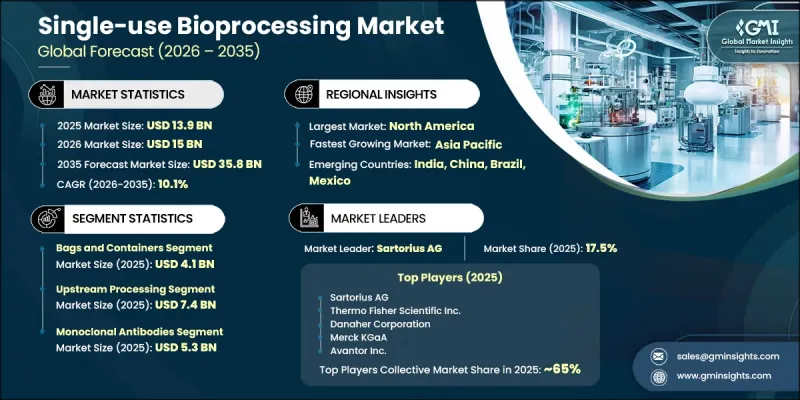
市場擴張的促進因素包括:生物製藥生產需求的不斷成長、生物相似藥的日益普及、與傳統不銹鋼基礎設施相比更低的資本投資要求以及交叉污染風險的降低。對合約研發生產力機構 (CDMO) 和契約製造機構 (CMO) 的日益依賴也為一次性技術創造了有利環境。同時,個人化醫療以及細胞和基因療法的廣泛應用促使生物製藥生產商採用更靈活的加工平台。一次性系統有助於生產商簡化生產流程、縮短設施部署時間並降低初始投資。隨著生物製藥公司應對日益複雜的生產需求,一次性系統支援靈活生產策略的能力變得越來越重要。生物相似藥生產商也因營運成本降低和設施部署速度加快而轉向一次性加工解決方案。隨著生產商持續優先考慮效率、柔軟性、擴充性和污染控制,預計在整個預測期內,對一次性生物製程解決方案的需求將保持強勁成長動能。
| 市場範圍 | |
|---|---|
| 開始年份 | 2025 |
| 預測期 | 2026-2035 |
| 起始金額 | 139億美元 |
| 預測金額 | 358億美元 |
| 複合年成長率 | 10.1% |
生物製藥企業外包生產的趨勢日益成長,正成為推動市場發展的另一個關鍵因素。生物製藥公司擴大選擇合約研發生產機構(CDMO)和合約生產機構(CMO),以減少資本投入、縮短產品上市時間並獲得專業的生產能力。外部生產供應商通常服務多個客戶,滿足其不同的生產需求,因此對適應性強、可擴展的加工基礎設施的需求也隨之增加。一次性生物製程系統能夠根據不斷變化的生產需求配置生產平台,從而滿足這些需求。這種柔軟性也使服務供應商能夠在保持高效設施運作的同時,管理多樣化的生產計劃。隨著外包在生物製藥生產策略中扮演越來越重要的角色,對一次性加工技術的需求也預計將隨之成長。
預計到2025年,一次性包裝袋和容器市場規模將達到41億美元。這些一次性組件支援生物製程操作的多個階段,包括原料製備、儲存、回收、轉移和中間體加工。其密封無菌設計使製造商能夠在最大限度降低污染風險的同時,維持受控的加工環境。包裝袋和容器有多種容量和配置可供選擇,製造商可根據其特定的生產需求選擇客製化解決方案。由於其操作相對簡便且基礎設施要求較低,它們還有助於提高設施的營運效率。與一次性組件的兼容性進一步促進了其與一次性生產工作流程的整合。隨著生物製藥生產的持續擴張以及製造商對設施設計和生產管理柔軟性的需求不斷成長,預計對一次性包裝袋和容器的需求將保持強勁。
到2025年,生物製藥和製藥公司將佔據61.5%的市場。這些企業是一次性生物製程技術的主要用戶,並且越來越依賴這些系統來支援高效生產並降低營運成本。一次性設備使製造商能夠更快地建立生產線,並根據不斷變化的需求調整生產計劃。與傳統製程方法相比,該技術還有助於減少污染風險。隨著製藥和生物製藥公司管理日益多元化的開發平臺,它們越來越重視生產的柔軟性和營運應對力。一次性平台能夠提供高度適應性的加工能力,使製造商能夠更有效率地應對生產和商業化需求的變化,從而支持這些目標的實現。
預計到2025年,北美一次性生物製程市場將佔據38%的佔有率。隨著製造商日益重視污染控制並滿足不斷成長的生物製藥生產需求,該地區的市場正在穩步擴張。北美擁有完善的生物製藥生產基礎設施、活躍的研發活動以及生物技術公司的集中,因此仍然是一次性生物製程最重要的市場之一。該地區的製造商正擴大採用一次性製程技術,以尋求更柔軟性、更有利於產品快速商業化的生產系統。此外,隨著企業努力簡化生產流程,一次性生物反應器、過濾技術和流體管理解決方案的使用也不斷增加。預計強大的工業基礎設施和對生物製藥生產的持續投資將進一步推動一次性技術在全部區域的應用。
目錄
第1章:調查方法和範圍
第2章執行摘要
第3章 行業洞察
- 產業生態系分析
- 影響產業的因素
- 成長促進因素
- 生物製藥和生物相似藥的需求不斷成長
- 個人化醫療和細胞/基因療法的擴展
- 增加對CDMO和CMO的外包
- 降低交叉感染風險
- 與不銹鋼系統相比,資本投入較少。
- 產業潛在風險與挑戰
- 關於萃取物和洗脫液的問題
- 與塑膠廢棄物產生相關的環境問題
- 耗材的持續成本相對較高。
- 市場機遇
- 一次性生物處理平台與連續生物製程的整合
- 開發先進的、高容量的、一次性生物反應器
- 成長促進因素
- 成長潛力分析
- 監理情勢
- 技術進步
- 最新科技趨勢
- 新興技術
- 價格趨勢分析
- 未來市場趨勢
- 波特的分析
- PESTLE分析
- 差距分析
- 人工智慧和生成式人工智慧對市場的影響
第4章 競爭情勢
- 介紹
- 企業矩陣分析
- 企業市佔率分析
- 世界
- 北美洲
- 歐洲
- 亞太地區
- 競爭定位矩陣
- 主要市場公司的競爭分析
- 主要進展
- 併購
- 夥伴關係和聯盟
- 新產品發布
- 業務拓展計劃
第5章 市場估算與預測:依產品類型分類,2022-2035年
- 免洗生物反應器
- 攪拌罐式一次性生物反應器
- 波浪式一次性生物反應器
- 鼓泡柱式一次性生物反應器
- 其他產品
- 袋子和容器
- 管組件
- 連接器和配件
- 過濾裝置
- 混合系統
- 感測器和探頭
- pH感測器
- 溶氧氧氣感測器
- 壓力和流量感測器
- 其他類型的感測器
- 採樣系統
第6章 市場估算與預測:依工作流程階段分類,2022-2035年
- 上游工程
- 下游工藝
- 最終處理
第7章 市場估計與預測:依應用領域分類,2022-2035年
- 單株抗體(mAbs)
- 疫苗生產
- 細胞和基因治療
- 血漿衍生產品
- 其他生物製劑
第8章 市場估算與預測:依最終用途分類,2022-2035年
- 生物製藥和製藥公司
- 首席行銷長和首席營收官
- 學術研究機構
第9章 市場估計與預測:依地區分類,2022-2035年
- 北美洲
- 美國
- 加拿大
- 歐洲
- 德國
- 英國
- 法國
- 西班牙
- 義大利
- 荷蘭
- 亞太地區
- 中國
- 印度
- 日本
- 澳洲
- 韓國
- 拉丁美洲
- 巴西
- 墨西哥
- 阿根廷
- 中東和非洲
- 沙烏地阿拉伯
- 南非
- UAE
第10章:公司簡介
- Avantor Inc.
- Cellexus International Ltd.
- Celltainer Biotech BV
- Danaher Corporation
- Entegris Inc.
- Eppendorf SE
- Getinge AB
- Meissner Filtration Products Inc.
- Merck KGaA
- Parker Hannifin Corporation
- PBS Biotech Inc.
- Repligen Corporation
- Saint-Gobain Life Sciences
- Sartorius AG
- Thermo Fisher Scientific Inc.
The Global Single-Use Bioprocessing Market was valued at USD 13.9 billion in 2025 and is estimated to grow at a CAGR of 10.1% to reach USD 35.8 billion by 2035.
Market expansion is supported by the increasing need for biologic manufacturing, growing adoption of biosimilars, lower capital requirements than conventional stainless-steel infrastructure, and a reduced likelihood of cross-contamination. Greater reliance on contract development and manufacturing organizations (CDMOs) and contract manufacturing organizations (CMOs) is also creating favorable conditions for single-use technologies. At the same time, the expanding use of personalized medicine and cell and gene therapies is encouraging biopharmaceutical manufacturers to adopt more flexible processing platforms. Single-use systems can help manufacturers streamline production, shorten facility deployment timelines, and reduce upfront investment. Their ability to support flexible manufacturing strategies is becoming increasingly valuable as biopharmaceutical companies manage more complex production requirements. Biosimilar manufacturers are also turning to disposable processing solutions because these systems can reduce operating expenses and enable faster facility implementation. As manufacturers continue to prioritize efficiency, flexibility, scalability, and contamination control, demand for single-use bioprocessing solutions is expected to maintain strong momentum throughout the forecast period.
| Market Scope | |
|---|---|
| Start Year | 2025 |
| Forecast Year | 2026-2035 |
| Start Value | $13.9 Billion |
| Forecast Value | $35.8 Billion |
| CAGR | 10.1% |
The growing tendency among biopharmaceutical manufacturers to outsource production is becoming another important factor driving market development. CDMOs and CMOs are increasingly being selected by biopharma companies seeking to control capital spending, shorten commercialization timelines, and obtain access to specialized production capabilities. External manufacturing providers often serve multiple customers with different production requirements, which increases the need for adaptable and scalable processing infrastructure. Single-use bioprocessing systems can address these requirements by allowing production platforms to be configured according to changing manufacturing needs. Their flexibility also enables service providers to manage diverse production schedules while maintaining efficient facility utilization. As outsourcing continues to become a more important component of biopharmaceutical manufacturing strategies, demand for disposable processing technologies is expected to increase accordingly.
The bags and containers segment generated USD 4.1 billion in 2025. These disposable components support several stages of bioprocessing operations, including material preparation, storage, collection, transfer, and intermediate handling. Their closed and sterile design helps manufacturers maintain controlled processing environments while limiting contamination exposure. Bags and containers are available across different capacities and configurations, allowing manufacturers to select solutions that align with specific production requirements. Their relatively simple handling characteristics and reduced infrastructure needs can also contribute to more efficient facility operations. Compatibility with disposable assemblies further supports their integration into single-use manufacturing workflows. As biopharmaceutical production continues to expand and manufacturers seek greater flexibility in facility design and production management, the demand for single-use bags and containers is expected to remain strong.
The biopharmaceutical and pharmaceutical companies segment accounted for a 61.5% share in 2025. These organizations constitute the primary users of disposable bioprocessing technologies and increasingly rely on these systems to support efficient manufacturing while controlling operational expenses. Single-use equipment enables manufacturers to establish production operations more rapidly and adjust manufacturing schedules according to changing requirements. Technology can also help limit contamination exposure compared with conventional processing approaches. As pharmaceutical and biopharmaceutical companies manage increasingly diverse development pipelines, they are placing greater emphasis on manufacturing flexibility and operational responsiveness. Single-use platforms can support these objectives by providing adaptable processing capabilities that allow manufacturers to respond more efficiently to production changes and commercialization requirements.
North America Single-Use Bioprocessing Market held a 38% share in 2025. The regional market is expanding steadily as manufacturers place greater emphasis on contamination control and respond to increasing demand for biologic production. North America remains one of the most important markets for single-use bioprocessing because of its established biopharmaceutical manufacturing infrastructure, substantial development activity, and concentration of biotechnology companies. Manufacturers throughout the region are increasingly adopting disposable processing technologies as they seek production systems that provide greater flexibility and support quicker commercialization. The use of single-use bioreactors, filtration technologies, and fluid management solutions is also increasing as companies seek to streamline manufacturing operations. Strong industry infrastructure and continued investment in biopharmaceutical production are expected to support further adoption of single-use technologies across the region.
Key companies operating in the global single-use bioprocessing market include Sartorius AG, Danaher Corporation, Avantor Inc., Thermo Fisher Scientific Inc., Merck KGaA, Getinge AB, Eppendorf SE, Repligen Corporation, Saint-Gobain Life Sciences, Entegris Inc., Parker Hannifin Corporation, Meissner Filtration Products Inc., Celltainer Biotech BV, PBS Biotech Inc., and Cellexus International Ltd. Companies operating in the single-use bioprocessing market are strengthening their positions by expanding their technology portfolios, improving disposable processing solutions, and investing in product development. Market participants are also focusing on strategic collaborations, regional expansion, and stronger distribution networks to reach a broader customer base. Companies are enhancing manufacturing capabilities to address rising demand for flexible and scalable bioprocessing platforms. Investments in research and development are helping suppliers improve system performance, process efficiency, and contamination control. Leading participants are also developing integrated solutions that can simplify manufacturing workflows and improve operational flexibility. In addition, companies are strengthening customer support and technical service capabilities to build long-term relationships with biopharmaceutical manufacturers.
Table of Contents
Chapter 1 Methodology and Scope
- 1.1 Market scope and definition
- 1.2 Research design
- 1.2.1 Research approach
- 1.2.2 Data collection methods
- 1.3 Data mining sources
- 1.3.1 Global
- 1.3.2 Regional/Country
- 1.4 Base estimates and calculations
- 1.4.1 Base year calculation
- 1.4.2 Key trends for market estimation
- 1.5 Primary research and validation
- 1.5.1 Primary sources
- 1.6 Forecast model
- 1.7 Research assumptions and limitations
Chapter 2 Executive Summary
- 2.1 Industry 360° synopsis
- 2.2 Key market trends
- 2.2.1 Regional trends
- 2.2.2 Product type trends
- 2.2.3 Workflow stage trends
- 2.2.4 Application trends
- 2.2.5 End use trends
- 2.3 CXO perspectives: Strategic imperatives
Chapter 3 Industry Insights
- 3.1 Industry ecosystem analysis
- 3.2 Industry impact forces
- 3.2.1 Growth drivers
- 3.2.1.1 Rising demand for biologics and biosimilars
- 3.2.1.2 Increasing adoption of personalized medicines and cell & gene therapies
- 3.2.1.3 Rising outsourcing to CDMOs and CMOs
- 3.2.1.4 Reduced risk of cross-contamination
- 3.2.1.5 Lower capital investment compared to stainless-steel systems
- 3.2.2 Industry pitfalls and challenges
- 3.2.2.1 Concerns regarding extractables and leachables
- 3.2.2.2 Environmental concerns related to plastic waste generation
- 3.2.2.3 High recurring consumables cost
- 3.2.3 Market opportunities
- 3.2.3.1 Continuous bioprocessing integration with single-use platforms
- 3.2.3.2 Development of advanced high-capacity single-use bioreactors
- 3.2.1 Growth drivers
- 3.3 Growth potential analysis
- 3.4 Regulatory landscape
- 3.4.1 North America
- 3.4.2 Europe
- 3.4.3 Asia Pacific
- 3.4.4 Latin America
- 3.4.5 Middle East and Africa
- 3.5 Technological advancements
- 3.5.1 Current technological trends
- 3.5.2 Emerging technologies
- 3.6 Pricing trend analysis (Driven by primary research)
- 3.7 Future market trends (Driven by primary research)
- 3.8 Porter's analysis
- 3.9 PESTEL analysis
- 3.10 Gap analysis
- 3.11 Impact of AI and Generative AI on the market (Driven by primary research)
Chapter 4 Competitive Landscape, 2025
- 4.1 Introduction
- 4.2 Company matrix analysis
- 4.3 Company market share analysis (Driven by primary research)
- 4.3.1 Global
- 4.3.2 North America
- 4.3.3 Europe
- 4.3.4 Asia Pacific
- 4.4 Competitive positioning matrix
- 4.5 Competitive analysis of major market players
- 4.6 Key developments
- 4.6.1 Mergers & acquisitions
- 4.6.2 Partnerships & collaborations
- 4.6.3 New product launches
- 4.6.4 Expansion plans
Chapter 5 Market Estimates and Forecast, By Product Type, 2022 - 2035 ($ Mn)
- 5.1 Key trends
- 5.2 Single-use bioreactors
- 5.2.1 Stirred tank single-use bioreactors
- 5.2.2 Wave-mixed single-use bioreactors
- 5.2.3 Bubble column single-use bioreactors
- 5.2.4 Other products
- 5.3 Bags and containers
- 5.4 Tubing assemblies
- 5.5 Connectors and fittings
- 5.6 Filtration devices
- 5.7 Mixing systems
- 5.8 Sensors and probes
- 5.8.1 pH sensors
- 5.8.2 Dissolved oxygen sensors
- 5.8.3 Pressure and flow sensors
- 5.8.4 Other sensor types
- 5.9 Sampling systems
Chapter 6 Market Estimates and Forecast, By Workflow Stage, 2022 - 2035 ($ Mn)
- 6.1 Key trends
- 6.2 Upstream processing
- 6.3 Downstream processing
- 6.4 Final processing
Chapter 7 Market Estimates and Forecast, By Application, 2022 - 2035 ($ Mn)
- 7.1 Key trends
- 7.2 Monoclonal antibodies (mAbs)
- 7.3 Vaccine production
- 7.4 Cell and gene therapy
- 7.5 Plasma-derived products
- 7.6 Other biologics
Chapter 8 Market Estimates and Forecast, By End Use, 2022 - 2035 ($ Mn)
- 8.1 Key trends
- 8.2 Biopharmaceutical and pharmaceutical companies
- 8.3 CMOs and CROs
- 8.4 Academic and research institutes
Chapter 9 Market Estimates and Forecast, By Region, 2022 - 2035 ($ Mn)
- 9.1 Key trends
- 9.2 North America
- 9.2.1 U.S.
- 9.2.2 Canada
- 9.3 Europe
- 9.3.1 Germany
- 9.3.2 UK
- 9.3.3 France
- 9.3.4 Spain
- 9.3.5 Italy
- 9.3.6 Netherlands
- 9.4 Asia Pacific
- 9.4.1 China
- 9.4.2 India
- 9.4.3 Japan
- 9.4.4 Australia
- 9.4.5 South Korea
- 9.5 Latin America
- 9.5.1 Brazil
- 9.5.2 Mexico
- 9.5.3 Argentina
- 9.6 Middle East and Africa
- 9.6.1 Saudi Arabia
- 9.6.2 South Africa
- 9.6.3 UAE
Chapter 10 Company Profiles
- 10.1 Avantor Inc.
- 10.2 Cellexus International Ltd.
- 10.3 Celltainer Biotech BV
- 10.4 Danaher Corporation
- 10.5 Entegris Inc.
- 10.6 Eppendorf SE
- 10.7 Getinge AB
- 10.8 Meissner Filtration Products Inc.
- 10.9 Merck KGaA
- 10.10 Parker Hannifin Corporation
- 10.11 PBS Biotech Inc.
- 10.12 Repligen Corporation
- 10.13 Saint-Gobain Life Sciences
- 10.14 Sartorius AG
- 10.15 Thermo Fisher Scientific Inc.

 一次性生物製程市場:2026-2032年全球市場預測(按產品、工作流程階段、生物製程方法、一次性子組件、製造流程、應用和最終用戶分類)
 2026-2034年全球一次性生物製程系統市場規模、佔有率、趨勢和成長分析報告
 一次性生物製程市場報告:按產品類型、應用、最終用途、最終用戶和地區分類,2026-2034 年
 一次性生物製程系統市場:按產品類型、應用、最終用戶和地區分類
 一次性生物製程市場分析及預測(至2035年):依類型、產品、服務、技術、應用、材料類型、製程、最終用戶、功能及設備分類
 全球一次性生物工藝袋膜市場評估:按薄膜材料類型、層結構、銷售、最終用戶、地區、機會和預測(2018-2032 年)
 全球一次性生物製程市場:依產品、應用、最終用戶、工作流程和地區劃分—市場規模、產業動態、機會、分析和預測(2026-2035年)日本一次性生物製程市場報告(按產品類型、應用、工作流程、最終用戶和地區分類,2026-2034年)
 一次性生物製程市場規模、佔有率及成長分析(按產品、應用和地區分類)-2026-2033年產業預測
 一次性生物製程市場:產業趨勢及全球預測(至 2035 年)-依產品類型、企業規模及主要地區劃分