

 |
市場調查報告書
商品編碼
2109255
成人紙尿褲市場機會、成長促進因素、產業趨勢分析及2026-2035年預測。Adult Diaper Market Opportunity, Growth Drivers, Industry Trend Analysis, and Forecast 2026 - 2035 |
||||||

據估計,到 2025 年,全球成人紙尿褲市場價值將達到 149 億美元,年複合成長率為 5.2%,到 2035 年將達到 248 億美元。
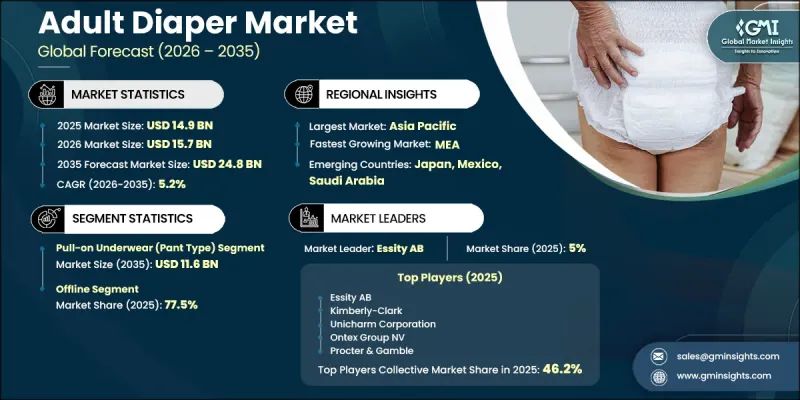
由於人口結構變化導致需要失禁護理產品的成年人數量不斷增加,市場持續擴張。預期壽命延長導致老年人口穩定成長,從而推動了對可靠舒適的失禁管理解決方案的需求。醫療保健專業人員、看護者和消費者越來越重視能夠提升舒適度、衛生狀況和生活品質的產品。長期照護機構、復健中心和居家醫療機構對成人失禁照護產品的日益普及,形成了穩定且持續的需求模式。隨著醫療機構將患者照護標準和可靠的產品供應放在首位,機構採購量也不斷成長。同時,製造商正致力於產品創新,例如提高吸收性、舒適度、皮膚保護性和隱蔽性,以滿足不斷變化的消費者期望。人們對失禁管理的認知不斷提高,以及對這些產品接受度的不斷提升,進一步推動了市場成長。這些長期的人口和醫療保健趨勢表明,全球成人紙尿褲市場將在預測期內持續擴張。
| 市場範圍 | |
|---|---|
| 開始年份 | 2025 |
| 預測期 | 2026-2035 |
| 上市時的市場規模 | 149億美元 |
| 預計金額 | 248億美元 |
| 複合年成長率 | 5.2% |
預計2025年,套穿式內褲(褲型)市場規模將達61億美元,2035年將達到1,16億美元。該細分市場持續成長,其類似內褲的設計為日常穿著提供了便利、舒適和隱蔽性。這種產品形式越來越受到消費者的歡迎,因為它提供了更高的安全性、穿著的便利性和活動自由度,同時還能有效應對日常失禁問題,從而帶來強勁的複購率。
2025年,線下銷售管道將佔據77.5%的市場佔有率,成為主要銷售管道。實體店的優勢在於,消費者和看護者可以在購買前檢查產品品質、布料柔軟度、包裝以及整體適用性,從而保持競爭優勢。銷售人員的個人化支援和即時供貨也是消費者更傾向於離線購買的原因。
美國成人紙尿褲市佔率高達74.8%。市場成長主要受人口老化、失禁管理意識提升以及對高品質個人保健產品需求不斷成長的推動。消費者教育和品牌行銷力道的加大,促進了成人失禁產品的普及,持續推動產品在全部區域的推廣,並鞏固了長期市場需求。
目錄
第1章:調查方法和範圍
第2章執行摘要
第3章 行業洞察
- 產業生態系分析
- 供應商情況
- 利潤率
- 每個階段增加的價值
- 影響價值鏈的因素
- 影響產業的因素
- 促進因素
- 全球人口老化和老年人口增加
- 尿失禁和慢性疾病盛行率增加
- 醫療成本上漲和失禁用品保險覆蓋範圍擴大。
- 產業潛在風險與挑戰
- 自有品牌與不知名的本土品牌之間競爭激烈。
- 材料安全和皮膚接觸標準的合規要求
- 機會
- 高成長新興市場尚未開發的需求
- 永續、可生物分解、親膚的成人紙尿褲產品創新
- 促進因素
- 成長潛力分析
- 監理框架
- 關鍵市場趨勢與顛覆性因素
- 技術與創新展望
- 當前趨勢
- 新進展
- 價格分析
- 對過去價格趨勢的分析
- 依球員類型分類的定價策略(高級球員、超值球員、成本加成球員)
- 未來市場趨勢
- 貿易數據分析
- 進出口量及進口額趨勢
- 主要貿易路線及關稅的影響
- 人工智慧和生成式人工智慧對市場的影響
- 利用人工智慧改造現有經營模式
- 按細分市場分類的生成式人工智慧用例和部署藍圖
- 風險、限制和監管考量
- 波特的分析
- PESTLE分析
- 目前分銷基礎設施和通路滲透情況
- 按地區與業態(現代零售與傳統零售)分類的通路覆蓋率
- 最後一公里基礎設施的差異以及新通路的變化
- 消費行為分析
- 購買模式
- 偏好分析
- 不同地區的消費者行為差異
- 電子商務對購買決策的影響
第4章 競爭情勢
- 介紹
- 企業市佔率分析
- 按地區
- 企業矩陣分析
- 主要市場公司的競爭分析
- 競爭定位矩陣
- 主要進展
- 併購
- 夥伴關係和聯盟
- 新產品發布
- 業務拓展計劃
第5章 市場估算與預測:依產品類型分類,2022-2035年
- 搭扣式內褲(膠帶式)
- 免洗式內褲
- 可重複使用的搭扣式內褲
- 套穿式內褲(三角褲型)
- 免洗套穿式內褲
- 可重複使用的套穿式內褲
- 增厚墊及尿失禁防護墊(墊型)
- 平型床墊墊和床墊保護墊(chux)
第6章 市場估計與預測:依類別分類,2022-2035年
- 拋棄式的
- 標準一次性產品
- 環保/可生物分解的一次性產品
- 可重複使用/布料
- 棉質可重複使用
- 可重複使用的超細纖維
第7章 市場估計與預測:依吸收能力等級分類,2022-2035年
- 輕度(壓力性尿失禁和急性尿失禁)
- 中度(混合性尿失禁)
- 嚴重/夜間使用(嚴重和功能性尿失禁)
第8章 市場估算與預測:依材料分類,2022-2035年
- 不織布(聚丙烯/聚乙烯)
- 棉布
- 超細纖維
- 絨毛漿
- 其他材料(竹子、生物基材料、混合複合材料)
第9章 市場規模估算與預測(2022-2035年)
- 小的
- 中等的
- 大的
- 特大號 (XL)
第10章 市場估價與預測:依價格區間分類,2022-2035年
- 低的
- 中等的
- 高的
第11章 市場估計與預測:依消費群組分類,2022-2035年
- 女士
- 男性
- 男女通用的
第12章 市場估計與預測:依護理環境分類,2022-2035年
- 居家照護
- 醫院和急診護理
- 護理機構及長期照護機構
- 門診及復健中心
第13章 市場估價與預測:依包裝量分類,2022-2035年
- 小包裝規格(1至25件)
- 中等容量(26-100件)
- 散裝(100 件或以上)
第14章 市場估價與預測:依通路分類,2022-2035年
- 線上
- 電子商務
- 每家公司的網站
- 離線
- 超級市場/大賣場
- 專業零售店
- 其他(獨立零售商等)
第15章 市場估計與預測:依地區分類,2022-2035年
- 北美洲
- 美國
- 加拿大
- 歐洲
- 德國
- 英國
- 法國
- 西班牙
- 義大利
- 亞太地區
- 中國
- 日本
- 印度
- 澳洲
- 韓國
- 拉丁美洲
- 巴西
- 墨西哥
- 阿根廷
- 中東和非洲
- 南非
- 沙烏地阿拉伯
- UAE
第16章:公司簡介
- 世界公司
- Abena Group
- Essity AB
- Kimberly-Clark
- Ontex Group NV
- Paul Hartmann AG
- Procter & Gamble
- Unicharm Corporation
- 本地公司
- Attindas Hygiene Partners
- Daio Paper Corporation
- First Quality Enterprises
- Hayat Kimya
- LiveDo Corporation
- Nobel Hygiene Pvt. Ltd.
- TZMO SA
- 新興企業
- Because Market
- Confitex
- Drylock Technologies
- Fippi SpA
- Hengan International Group
- Medline Industries
- Principle Business Enterprises(PBE)
The Global Adult Diaper Market was valued at USD 14.9 billion in 2025 and is estimated to grow at a CAGR of 5.2% to reach USD 24.8 billion by 2035.
The market continues to expand as demographic changes increase the number of adults requiring incontinence care products. Rising life expectancy is steadily enlarging the aging population, resulting in higher demand for reliable and comfortable incontinence management solutions. Healthcare providers, caregivers, and consumers are placing greater emphasis on products that improve comfort, hygiene, and quality of life. The growing adoption of adult incontinence products across long-term care facilities, rehabilitation centers, and home healthcare settings is creating a stable and recurring demand pattern. Institutional purchasing is also increasing as healthcare organizations prioritize patient care standards and dependable product availability. At the same time, manufacturers are focusing on product innovation by improving absorbency, comfort, skin protection, and discretion to address evolving consumer expectations. Expanding awareness of incontinence management and the increasing acceptance of these products are further supporting market growth. These long-term demographic and healthcare trends are expected to sustain the expansion of the global adult diaper market throughout the forecast period.
| Market Scope | |
|---|---|
| Start Year | 2025 |
| Forecast Year | 2026-2035 |
| Start Value | $14.9 Billion |
| Forecast Value | $24.8 Billion |
| CAGR | 5.2% |
The pull-on underwear (pant type) segment generated USD 6.1 billion in 2025 and is anticipated to reach USD 11.6 billion by 2035. The segment continues to lead the market because its underwear-like design offers convenience, comfort, and discretion for everyday use. Consumers increasingly prefer this product format because it provides greater confidence, ease of wear, and improved mobility while supporting effective daily incontinence management, contributing to strong repeat purchasing patterns.
The offline distribution channel accounted for 77.5% share in 2025, making it the dominant sales channel. Physical retail outlets continue to maintain a competitive advantage by allowing consumers and caregivers to examine product quality, material softness, packaging, and overall suitability before purchasing. Personalized assistance from retail staff and immediate product availability further strengthen consumer preference for offline purchasing.
United States Adult Diaper Market held 74.8% share. Market growth is supported by a steadily aging population, increasing awareness of incontinence management, and rising demand for high-quality personal care products. Growing acceptance of adult incontinence products, supported by expanding consumer education and brand marketing efforts, continues to encourage product adoption across the region while strengthening long-term market demand.
Key players operating in the adult diaper market include Abena Group, Attindas Hygiene Partners, Because Market, Confitex, Daio Paper Corporation, Drylock Technologies, Essity AB, Fippi SpA, First Quality Enterprises, Hayat Kimya, Hengan International Group, Kimberly-Clark, LiveDo Corporation, Medline Industries, Nobel Hygiene Pvt. Ltd., Ontex Group NV, Paul Hartmann AG, Principle Business Enterprises (PBE), Procter & Gamble, TZMO SA, and Unicharm Corporation. Companies operating in the adult diaper market are strengthening their market position by expanding premium product portfolios, investing in research and development, and enhancing product performance through improved absorbency, comfort, skin protection, and ergonomic design. Manufacturers are introducing innovative materials and advanced production technologies to improve user experience while addressing changing consumer preferences. Strategic partnerships with healthcare providers, distributors, and retail networks are helping companies broaden their customer reach and strengthen market penetration. Businesses are also expanding manufacturing capacity, improving supply chain efficiency, and increasing investments in sustainable materials and environmentally responsible production practices.
Table of Contents
Chapter 1 Methodology & Scope
- 1.1 Research approach
- 1.2 Quality Commitments
- 1.2.1 GMI AI policy & data integrity commitment
- 1.2.1.1 Source consistency protocol
- 1.2.1 GMI AI policy & data integrity commitment
- 1.3 Research Trail & Confidence Scoring
- 1.3.1 Research Trail Components
- 1.3.2 Scoring Components
- 1.4 Data Collection
- 1.4.1 Partial list of primary sources
- 1.5 Data mining sources
- 1.5.1 Paid sources
- 1.5.1.1 Sources, by region
- 1.5.1 Paid sources
- 1.6 Base estimates and calculations
- 1.6.1 Base year calculation for any one approach
- 1.7 Forecast model
- 1.7.1 Quantified market impact analysis
- 1.7.1.1 Mathematical impact of growth parameters on forecast
- 1.7.1 Quantified market impact analysis
- 1.8 Research transparency addendum
- 1.8.1 Source attribution framework
- 1.8.2 Quality assurance metrics
- 1.8.3 Our commitment to trust
Chapter 2 Executive Summary
- 2.1 Industry 360° synopsis
- 2.2 Key market trends
- 2.2.1 Regional
- 2.2.2 Product type
- 2.2.3 Category
- 2.2.4 Absorbency level
- 2.2.5 Material
- 2.2.6 Size
- 2.2.7 Price range
- 2.2.8 Consumer group
- 2.2.9 Care setting
- 2.2.10 Packaging quantity
- 2.2.11 Distribution channel
Chapter 3 Industry Insights
- 3.1 Industry ecosystem analysis
- 3.1.1 Supplier landscape
- 3.1.2 Profit margin
- 3.1.3 Value addition at each stage
- 3.1.4 Factor affecting the value chain
- 3.2 Industry impact forces
- 3.2.1 Growth drivers
- 3.2.1.1 Aging global population & rising geriatric demographic
- 3.2.1.2 Increasing prevalence of urinary incontinence & chronic health conditions
- 3.2.1.3 Growing healthcare expenditure & expanding insurance coverage for incontinence products
- 3.2.2 Industry pitfalls & challenges
- 3.2.2.1 Intense price competition from private-label & unbranded local alternatives
- 3.2.2.2 Regulatory compliance requirements for material safety & skin-contact standards
- 3.2.3 Opportunities
- 3.2.3.1 Untapped demand in high-growth emerging markets
- 3.2.3.2 Product innovation in sustainable, biodegradable & skin-friendly adult diapers
- 3.2.1 Growth drivers
- 3.3 Growth potential analysis
- 3.4 Regulatory framework
- 3.5 Major market trends and disruptions
- 3.6 Technology/innovation landscape
- 3.6.1 Current trends
- 3.6.2 Emerging trends
- 3.7 Pricing Analysis (driven by primary research)
- 3.7.1 Historical price trend analysis (driven by primary research)
- 3.7.2 Pricing strategy by player type (premium / value / cost-plus) (driven by primary research)
- 3.8 Future market trends
- 3.9 Trade data analysis (driven by paid database) (HS Code- 9619.00)
- 3.9.1 Import/export volume & value trends (driven by primary research)
- 3.9.2 Key trade corridors & tariff impact (driven by primary research)
- 3.10 Impact of AI & Generative AI on the Market
- 3.10.1 AI-driven disruption of existing business models
- 3.10.2 Gen-AI use cases & adoption roadmap by segment
- 3.10.3 Risks, limitations & regulatory considerations
- 3.11 Porter’s analysis
- 3.12 PESTEL analysis
- 3.13 Distribution infrastructure & channel penetration landscape (driven by primary research)
- 3.13.1 Channel coverage by region & format (modern vs. traditional trade) (driven by primary research)
- 3.13.2 Last-mile infrastructure gaps & emerging channel shifts (driven by primary Research).
- 3.14 Consumer behaviour analysis
- 3.14.1 Purchasing patterns
- 3.14.2 Preference analysis
- 3.14.3 Regional variations in consumer behaviour
- 3.14.4 Impact of e-commerce on buying decisions
Chapter 4 Competitive landscape, 2025
- 4.1 Introduction
- 4.2 Company market share analysis
- 4.2.1 By region
- 4.2.1.1 North America
- 4.2.1.2 Europe
- 4.2.1.3 Asia Pacific
- 4.2.1.4 Latin America
- 4.2.1.5 Middle East and Africa
- 4.2.1 By region
- 4.3 Company matrix analysis
- 4.4 Competitive analysis of major market players
- 4.5 Competitive positioning matrix
- 4.6 Key developments
- 4.6.1 Mergers & acquisitions
- 4.6.2 Partnerships & collaborations
- 4.6.3 New product launches
- 4.6.4 Expansion plans
Chapter 5 Market Estimates & Forecast, By Product Type, 2022 - 2035 (USD Billion, Units)
- 5.1 Key trends
- 5.2 Tab-style briefs (tape type)
- 5.2.1 Disposable tab-style briefs
- 5.2.2 Reusable tab-style briefs
- 5.3 Pull-on underwear (pant type)
- 5.3.1 Disposable pull-on underwear
- 5.3.2 Reusable pull-on underwear
- 5.4 Booster pads and incontinence guards (pad type)
- 5.5 Flat underpads and bed protectors (chux)
Chapter 6 Market Estimates & Forecast, By Category, 2022 - 2035 (USD Billion, Units)
- 6.1 Key trends
- 6.2 Disposable
- 6.2.1 Standard disposable
- 6.2.2 Eco-friendly/biodegradable disposable
- 6.3 Reusable/cloth-based
- 6.3.1 Cotton-based reusable
- 6.3.2 Microfiber reusable
Chapter 7 Market Estimates & Forecast, By Absorbency Level, 2022 - 2035 (USD Billion, Units)
- 7.1 Key trends
- 7.2 Light (stress and urge incontinence)
- 7.3 Moderate (mixed incontinence)
- 7.4 Heavy/overnight (severe and functional incontinence)
Chapter 8 Market Estimates & Forecast, By Material, 2022 - 2035 (USD Billion, Units)
- 8.1 Key trends
- 8.2 Nonwoven fabric (polypropylene/polyethylene)
- 8.3 Cotton
- 8.4 Microfiber
- 8.5 Fluff pulp
- 8.6 Others (bamboo, bio-based, hybrid composite)
Chapter 9 Market Estimates & Forecast, By Size, 2022 - 2035 (USD Billion, Units)
- 9.1 Key trends
- 9.2 Small
- 9.3 Medium
- 9.4 Large
- 9.5 Extra large (XL)
Chapter 10 Market Estimates & Forecast, By Pricing, 2022 - 2035 (USD Billion, Units)
- 10.1 Key trends
- 10.2 Low
- 10.3 Medium
- 10.4 High
Chapter 11 Market Estimates & Forecast, By Consumer Group, 2022 - 2035 (USD Billion, Units)
- 11.1 Key trends
- 11.2 Women
- 11.3 Men
- 11.4 Unisex
Chapter 12 Market Estimates & Forecast, By Care Setting, 2022 - 2035 (USD Billion, Units)
- 12.1 Key trends
- 12.2 Home care
- 12.3 Hospitals and acute care
- 12.4 Nursing homes and long-term care facilities
- 12.5 Ambulatory and rehabilitation centers
Chapter 13 Market Estimates & Forecast, By Packaging Quantity, 2022 - 2035 (USD Billion, Units)
- 13.1 Key trends
- 13.2 Small pack (1–25 units)
- 13.3 Mid pack (26–100 units)
- 13.4 Bulk pack (100+ units)
Chapter 14 Market Estimates & Forecast, By Distribution Channel, 2022 - 2035 (USD Billion, Units)
- 14.1 Key trends
- 14.2 Online
- 14.2.1 E-commerce
- 14.2.2 Company websites
- 14.3 Offline
- 14.3.1 Supermarkets/hypermarket
- 14.3.2 Specialty retail stores
- 14.4 Others (independent retailer etc.)
Chapter 15 Market Estimates & Forecast, By Region, 2022 – 2035 (USD Billion, Units)
- 15.1 Key trends
- 15.2 North America
- 15.2.1 U.S.
- 15.2.2 Canada
- 15.3 Europe
- 15.3.1 Germany
- 15.3.2 UK
- 15.3.3 France
- 15.3.4 Spain
- 15.3.5 Italy
- 15.4 Asia Pacific
- 15.4.1 China
- 15.4.2 Japan
- 15.4.3 India
- 15.4.4 Australia
- 15.4.5 South Korea
- 15.5 Latin America
- 15.5.1 Brazil
- 15.5.2 Mexico
- 15.5.3 Argentina
- 15.6 MEA
- 15.6.1 South Africa
- 15.6.2 Saudi Arabia
- 15.6.3 UAE
Chapter 16 Company Profiles
- 16.1 Global Companies
- 16.1.1 Abena Group
- 16.1.2 Essity AB
- 16.1.3 Kimberly-Clark
- 16.1.4 Ontex Group NV
- 16.1.5 Paul Hartmann AG
- 16.1.6 Procter & Gamble
- 16.1.7 Unicharm Corporation
- 16.2 Regional Companies
- 16.2.1 Attindas Hygiene Partners
- 16.2.2 Daio Paper Corporation
- 16.2.3 First Quality Enterprises
- 16.2.4 Hayat Kimya
- 16.2.5 LiveDo Corporation
- 16.2.6 Nobel Hygiene Pvt. Ltd.
- 16.2.7 TZMO SA
- 16.3 Emerging Companies
- 16.3.1 Because Market
- 16.3.2 Confitex
- 16.3.3 Drylock Technologies
- 16.3.4 Fippi SpA
- 16.3.5 Hengan International Group
- 16.3.6 Medline Industries
- 16.3.7 Principle Business Enterprises (PBE)

 成人紙尿褲市場:2026-2032年全球市場預測(依產品類型、年齡層、吸收量、最終用戶及通路分類)
 全球成人紙尿褲市場規模、佔有率、趨勢和成長分析報告(2026-2034年)
 成人紙尿褲市場規模、佔有率、趨勢及預測(按類型、通路及地區分類),2026-2034年
 2026-2030年全球成人紙尿褲市場按產品類型、失禁程度、性別、材料、分銷管道和最終用戶分類的膠帶式成人紙尿褲市場全球預測(2026-2032年)
 成人紙尿褲:全球市場佔有率和排名、總收入和需求預測(2025-2031年)
 全球成人護理尿布市場:績效與預測(2020-2031)日本成人紙尿褲市場報告(按類型(成人墊式紙尿褲、成人平板式紙尿褲、成人褲式紙尿褲)、配銷通路(藥店、便利店、網路商店等)和地區)2025 年至 2033 年成人一次性尿布市場:未來預測(2025-2030)
 成人紙尿褲市場規模、佔有率和成長分析(按類型、分銷管道、最終用戶和地區)- 產業預測 2025-2032