


 |
市場調查報告書
商品編碼
2109200
離岸風力發電設備安裝船市場機會、成長促進因素、產業趨勢分析及2026-2035年預測Offshore Wind Installation Vessel Market Opportunity, Growth Drivers, Industry Trend Analysis, and Forecast 2026 - 2035 |
||||||

全球離岸風力發電機安裝船市場預計到 2025 年將達到 90 億美元,並以 10.3% 的複合年成長率成長,到 2035 年將達到 329 億美元。
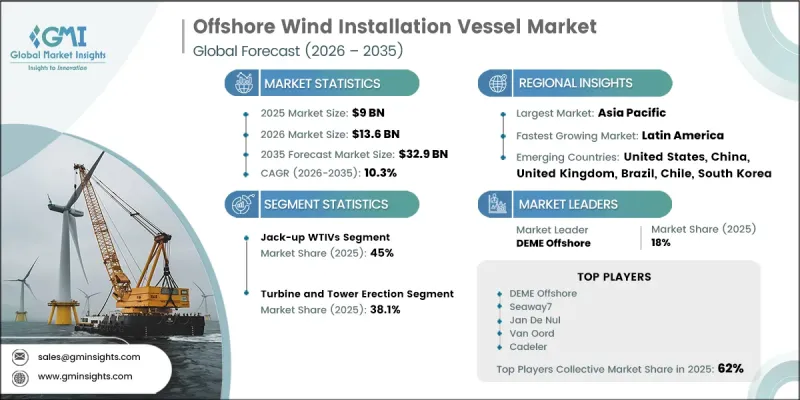
隨著全球離岸風力發電專案投資持續加速成長,市場發展勢頭強勁,對能夠支援日益複雜的海上建設活動的專用安裝船的需求也持續旺盛。大型風力發電機的部署、高容量海上專案的建設以及深海域的開發,都推動了對具備更大起重能力、更高穩定性和更高效作業效率的先進船舶的需求。人們對可再生能源發電的日益關注、離岸風電基礎設施的持續擴張以及專案規模的不斷擴大,都進一步促進了產業成長。為了滿足不斷變化的安裝需求,市場參與企業也在投資研發配備先進定位系統、更大甲板載重能力和更柔軟性作業方式的新一代船舶。
| 市場範圍 | |
|---|---|
| 開始年份 | 2025 |
| 預測期 | 2026-2035 |
| 初始市場規模 | 90億美元 |
| 預計金額 | 329億美元 |
| 複合年成長率 | 10.3% |
預計到2025年,起重能力在1,200噸及以下的自升式風力發電機安裝船(WTIV)將佔據45%的市場。該細分市場之所以能夠持續保持顯著佔有率,是因為其能夠有效地支援各種離岸風力發電安裝項目,並兼具作業柔軟性和可靠的起重性能。這些船舶之所以被廣泛應用,是因為它們能夠在各種海上環境中提供穩定的安裝平台、高效的運輸能力和可靠的作業性能。離岸風力發電建設的持續投資,以及對專業海上設備需求的不斷成長,預計將在未來幾年內推動該細分市場的成長。
預計到2025年,風扇和塔架安裝業務將佔市場佔有率的38.1%。該業務板塊持續保持主導地位,主要得益於對能夠安全運輸和安裝關鍵風力發電機部件(如塔架、機艙、輪轂和葉片)的船舶的需求不斷成長。足夠的起重機高度、強大的起重能力、寬敞的甲板空間和船舶穩定性仍然是支撐該業務板塊主導地位的關鍵因素。隨著離岸風力發電專案採用更大尺寸的風扇平台,以及安裝要求日益複雜,預計在整個預測期內,對能夠處理更重、更大部件的專用船舶的需求將穩步成長。
美國離岸風力渦輪機安裝船市場預計到2025年將佔90%的市場佔有率,並在2035年之前以14%的複合年成長率成長。這一強勁成長主要得益於海上可再生能源基礎設施投資的增加、離岸風電項目的持續開發以及對專業海上安裝服務日益成長的需求。港口基礎設施的擴建、海上施工能力的現代化以及先進安裝船的廣泛應用進一步鞏固了該行業的市場前景。此外,船隊規模的擴大、船舶升級以及對先進海上安裝技術的持續投資預計將推動市場的長期成長,並提升美國的專案執行能力。
目錄
第1章:調查方法和範圍
第2章執行摘要
第3章 行業洞察
- 產業生態系統
- 原物料供應及採購分析
- 生產能力評估
- 供應鏈韌性與風險因素
- 配電網路分析
- 監理情勢
- 影響產業的因素
- 促進因素
- 產業潛在風險與挑戰
- 成長潛力分析
- 價格趨勢分析
- 按水深
- 按地區
- 波特的分析
- PESTLE分析
- 新機會與趨勢
- 數位化和物聯網整合
- 進入新興市場
- 投資分析及未來展望
第4章 競爭情勢
- 介紹
- 企業市佔率分析
- 北美洲
- 歐洲
- 亞太地區
- 中東和非洲
- 拉丁美洲
- 戰略儀錶板
- 策略舉措
- 企業標竿管理
- 創新與科技趨勢
第5章 市場規模及預測:依船舶類型分類,2022-2035年
- 自升式 WTIV
- 高效能WTIV
- 超 WTIV
- 重型裝運船隻(HLV)
- 多用途海上支援船
第6章 市場規模及預測:依安裝活動分類,2022-2035年
- 基礎工作
- 渦輪機和塔架安裝
- 電纜牽引和鷹架
- 變電所安裝
- 退役及改造
第7章 市場規模與預測:以水深分類,2022-2035年
- 60米或更短
- 60~150m
- 150m
第8章 市場規模及預測:依地區分類,2022-2035年
- 北美洲
- 美國
- 加拿大
- 歐洲
- 英國
- 德國
- 荷蘭
- 丹麥
- 比利時
- 法國
- 亞太地區
- 中國
- 台灣
- 日本
- 韓國
- 中東和非洲
- 南非
- 南非
- 拉丁美洲
- 巴西
- 智利
第9章:公司簡介
- Cadeler
- CG Wind
- COSCO Shipping
- Damen ShipyardsGroup
- DEME Offshore
- GustoMSC(NOV)
- HuaDian Heavy Industries
- Jiangsu Hantong Ship Heavy Industry
- Jingjiang Nanyang Shipbuilding
- Jan De Nul
- Keppel
- MacGregor
- Nantong Rainbow Offshore
- Royal IHC
- RWE
- Seajacks
- Seaway7
- Ulstein Group
- Van Oord
- ZPMC
The Global Offshore Wind Installation Vessel Market was valued at USD 9 billion in 2025 and is estimated to grow at a CAGR of 10.3% to reach USD 32.9 billion by 2035.
The market is gaining significant momentum as global investments in offshore wind energy projects continue to accelerate, creating sustained demand for specialized installation vessels capable of supporting increasingly complex marine construction activities. The deployment of larger wind turbines, higher-capacity offshore projects, and deeper-water developments is driving the need for technologically advanced vessels with greater lifting capabilities, enhanced stability, and improved operational efficiency. Growing emphasis on renewable energy generation, continuous expansion of offshore wind infrastructure, and increasing project sizes are further supporting industry growth. Market participants are also investing in next-generation vessels equipped with advanced positioning systems, higher deck load capacity, and improved operational flexibility to accommodate evolving installation requirements.
| Market Scope | |
|---|---|
| Start Year | 2025 |
| Forecast Year | 2026-2035 |
| Start Value | $9 Billion |
| Forecast Value | $32.9 Billion |
| CAGR | 10.3% |
The jack-up wind turbine installation vessel (WTIV) segment with crane capacities of 1,200 tonnes or below held a 45% share in 2025. This segment continues to maintain a significant share due to its ability to efficiently support a wide range of offshore wind installation projects while offering operational flexibility and reliable lifting performance. These vessels remain widely utilized because they provide stable installation platforms, efficient transportation capabilities, and dependable operational performance under varying offshore conditions. Continued investments in offshore wind farm construction, combined with increasing demand for specialized marine equipment, are expected to sustain growth for this segment over the coming years.
The turbine and tower erection segment captured a 38.1% share in 2025. The segment continues to lead due to the increasing demand for vessels capable of safely transporting and installing major wind turbine components, including towers, nacelles, hubs, and blades. Adequate crane height, substantial lifting capacity, extensive deck space, and vessel stability remain essential factors supporting this segment's leadership. As offshore wind projects continue to utilize larger turbine platforms and more complex installation requirements, demand for specialized vessels capable of handling heavier and larger components is expected to increase steadily throughout the forecast period.
U.S. Offshore Wind Installation Vessel Market recorded a 90% share in 2025 and is forecast to grow at a 14% CAGR through 2035. Strong growth is supported by increasing investments in offshore renewable energy infrastructure, continued development of offshore wind projects, and rising demand for specialized marine installation services. Expanding port infrastructure, modernization of offshore construction capabilities, and growing deployment of advanced installation vessels are further strengthening the industry's outlook. In addition, ongoing investments in fleet expansion, vessel upgrades, and advanced offshore installation technologies are expected to reinforce long-term market growth while supporting increasing project execution capabilities across the U.S.
Major participants operating in the global offshore wind installation vessel market include Cadeler, CG Wind, COSCO Shipping, Damen Shipyards Group, DEME Offshore, GustoMSC (NOV), HuaDian Heavy Industries, Jiangsu Hantong Ship Heavy Industry, Jingjiang Nanyang Shipbuilding, Jan De Nul, Keppel, MacGregor, Nantong Rainbow Offshore, Royal IHC, RWE, Seajacks (Eneti), Seaway7, Ulstein Group, Van Oord, and ZPMC. Companies participating in the global offshore wind installation vessel market are reinforcing their competitive position by investing in technologically advanced vessels, expanding fleet capabilities, and strengthening engineering expertise. Industry participants are focusing on developing larger installation vessels with enhanced lifting capacity, improved deck layouts, advanced dynamic positioning systems, and greater operational efficiency to meet evolving offshore project requirements. Strategic partnerships, long-term vessel charter agreements, and collaborations with offshore wind developers are helping companies secure new business opportunities and strengthen customer relationships. Manufacturers and vessel operators are also investing in fleet modernization, digital monitoring systems, predictive maintenance technologies, and automation solutions to improve operational reliability and reduce project execution time. Furthermore, companies are expanding their geographic presence, increasing production and shipbuilding capacity, and enhancing integrated project support services to strengthen their market foothold, improve competitiveness, and capture emerging opportunities across the global offshore wind installation vessel market.
Table of Contents
Chapter 1 Methodology & Scope
- 1.1 Research design
- 1.1.1 Research approach
- 1.1.2 Data collection methods
- 1.2 Base estimates and calculations
- 1.2.1 Base year calculation
- 1.2.2 Key trends for market estimates
- 1.3 Forecast model
- 1.3.1 Quantified market impact analysis
- 1.3.2 Mathematical impact of growth parameters on forecast
- 1.4 Primary research & validation
- 1.4.1 Some of the primary sources (but not limited to)
- 1.5 Data mining sources
- 1.5.1 Paid sources
- 1.5.2 Sources, by region
- 1.6 Research trail & scoring components
- 1.6.1 Research trail components
- 1.6.2 Scoring components
- 1.7 Research transparency addendum
- 1.7.1 Source attribution framework
- 1.7.2 Quality assurance metrics
- 1.7.3 Our commitment to trust
- 1.8 Market definitions
Chapter 2 Executive Summary
- 2.1 Industry 360-degree synopsis, 2022 – 2035
- 2.2 Business trends
- 2.3 Vessel type trends
- 2.4 Installation activity trends
- 2.5 Water depth trends
- 2.6 Regional trends
Chapter 3 Industry Insights
- 3.1 Industry ecosystem
- 3.1.1 Raw material availability & sourcing analysis
- 3.1.2 Manufacturing capacity assessment
- 3.1.3 Supply chain resilience & risk factors
- 3.1.4 Distribution network analysis
- 3.2 Regulatory landscape
- 3.3 Industry impact forces
- 3.3.1 Growth drivers
- 3.3.2 Industry pitfalls & challenges
- 3.4 Growth potential analysis
- 3.5 Price trend analysis
- 3.5.1 By water depth
- 3.5.2 By region
- 3.6 Porter's analysis
- 3.6.1 Bargaining power of suppliers
- 3.6.2 Bargaining power of buyers
- 3.6.3 Threat of new entrants
- 3.6.4 Threat of substitutes
- 3.7 PESTEL analysis
- 3.7.1 Political factors
- 3.7.2 Economic factors
- 3.7.3 Social factors
- 3.7.4 Technological factors
- 3.7.5 Legal factors
- 3.8 Emerging opportunities and trends
- 3.8.1 Digitization & IoT integration
- 3.8.2 Emerging market penetration
- 3.9 Investment analysis & future outlook
Chapter 4 Competitive landscape, 2026
- 4.1 Introduction
- 4.2 Company market share analysis, 2025
- 4.2.1 North America
- 4.2.2 Europe
- 4.2.3 Asia pacific
- 4.2.4 Middle East & Africa
- 4.2.5 Latin America
- 4.3 Strategic dashboard
- 4.4 Strategic initiatives
- 4.5 Company benchmarking
- 4.6 Innovation & technology landscape
Chapter 5 Market Size and Forecast, By Vessel type, 2022 – 2035 (USD Million)
- 5.1 Key trends
- 5.2 Jack-Up WTIV
- 5.3 High-Spec WTIV
- 5.4 Ultra-WTIV
- 5.5 Heavy Lift Vessel (HLV)
- 5.6 Multi-Purpose Offshore Support
Chapter 6 Market Size and Forecast, By Installation activity, 2022 – 2035 (USD Million)
- 6.1 Key trends
- 6.2 Foundation Installation
- 6.3 Turbine & Tower Erection
- 6.4 Cable Pull-In & Scour
- 6.5 Substation Installation
- 6.6 Decommissioning & Repowering
Chapter 7 Market Size and Forecast, By Water depth, 2022 – 2035 (USD Million & MW)
- 7.1 Key trends
- 7.2 ≤60m
- 7.3 >60–150m
- 7.4 150m
Chapter 8 Market Size and Forecast, By Region, 2022 – 2035 (USD Million & MW)
- 8.1 Key trends
- 8.2 North America
- 8.2.1 U.S.
- 8.2.2 Canada
- 8.3 Europe
- 8.3.1 United Kingdom
- 8.3.2 Germany
- 8.3.3 Netherlands
- 8.3.4 Denmark
- 8.3.5 Belgium
- 8.3.6 France
- 8.4 Asia Pacific
- 8.4.1 China
- 8.4.2 Taiwan
- 8.4.3 Japan
- 8.4.4 South Korea
- 8.5 Middle East & Africa
- 8.5.1 South Africa
- 8.5.2 South Africa
- 8.6 Latin America
- 8.6.1 Brazil
- 8.6.2 Chile
Chapter 9 Company Profiles
- 9.1 Cadeler
- 9.2 CG Wind
- 9.3 COSCO Shipping
- 9.4 Damen ShipyardsGroup
- 9.5 DEME Offshore
- 9.6 GustoMSC (NOV)
- 9.7 HuaDian Heavy Industries
- 9.8 Jiangsu Hantong Ship Heavy Industry
- 9.9 Jingjiang Nanyang Shipbuilding
- 9.10 Jan De Nul
- 9.11 Keppel
- 9.12 MacGregor
- 9.13 Nantong Rainbow Offshore
- 9.14 Royal IHC
- 9.15 RWE
- 9.16 Seajacks
- 9.17 Seaway7
- 9.18 Ulstein Group
- 9.19 Van Oord
- 9.20 ZPMC

 2034年離岸風力發電安裝船市場預測:按船舶類型、所有權、應用和區域分類的全球分析
 2026年全球離岸風力發電安裝船市場報告
 離岸風力渦輪機安裝船市場規模、佔有率及預測:依船舶類型(自升式平台、浮式平台、起重機)、起重能力、甲板面積和水深劃分 - 全球預測(2026-2036 年)
 離岸風力發電作業船市場按船舶類型、服務類型、推進類型、租賃類型、船體尺寸等級及最終用途分類-2026-2032年全球預測離岸風力發電服務船市場:依船舶類型、服務類型、船舶尺寸、租賃類型、推進方式及功率容量分類-2026-2032年全球預測風力發電機安裝起重機市場按起重機類型、容量、安裝階段、操作類型、應用階段和最終用途分類 - 全球預測(2026-2032 年)
 離岸風力發電機安裝船市場報告:至2031年的趨勢、預測與競爭分析