


 |
市場調查報告書
商品編碼
2109148
行人用自動門市場商機、成長要素、產業趨勢分析及2026-2035年預測。Pedestrian Automatic Door Market Opportunity, Growth Drivers, Industry Trend Analysis, and Forecast 2026 - 2035 |
||||||

全球行人用自動門市場預計到 2025 年將達到 51 億美元,年複合成長率為 6.1%,到 2035 年將達到 92 億美元。
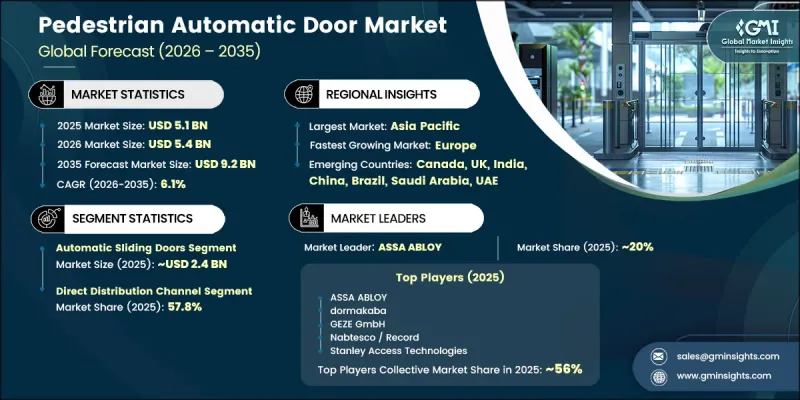
在全球範圍內,商業建築和基礎設施維修的持續投資不斷推動行人用自動門產業的整體成長。對能夠提升無障礙通行、營運效率和建築性能的智慧入口解決方案的需求日益成長,加速了行人用自動門系統的普及。此外,隨著維修和建築現代化項目的加速推進,市場也受到正面影響。業主們正擴大用符合不斷提升的安全、無障礙和節能標準的先進自動門來取代傳統的入口系統。升級現有設施是一種經濟有效的方法,既能提升建築功能,又能延長基礎設施的使用壽命,因此在許多商業環境中,改造升級都極具吸引力。此外,永續性也加速了節能型自動門系統的普及,這些系統旨在減少空氣滲漏並最佳化室內氣候控制,從而降低營運成本。運動偵測技術、智慧感測器、安全機制和自動化功能的不斷進步,進一步提升了系統的性能、可靠性和用戶便利性,並增強了行人用自動門市場的長期成長潛力。
| 市場範圍 | |
|---|---|
| 開始年份 | 2025 |
| 預測期 | 2026-2035 |
| 上市時的市場規模 | 51億美元 |
| 預測金額 | 92億美元 |
| 複合年成長率 | 6.1% |
預計到2025年,自動滑動門市場規模將達到24億美元,並在2026年至2035年間以5.6%的複合年成長率成長。該市場保持主導地位的原因在於,自動滑動門水平開啟和關閉,最大限度地利用了入口空間,同時確保了行人流暢無阻的通行。這種設計使得高人流入口處的通行更加高效,無需在運作中預留額外的空間,從而提升了便利性和建築的整體功能性。自動滑動門在最大限度減少擁擠的同時,還能維持行人持續通行,這項特性持續推動其在各種商業應用領域的強勁需求。
預計到2025年,直銷通路將佔據57.8%的市場佔有率,並在2035年之前以6%的複合年成長率成長。由於自動門系統需要專業的規劃、專業承包商的安裝、系統整合、持續維護以及遵守既定的安全和無障礙標準,因此與製造商直接交易仍然是首選的採購方式。這種分銷模式使製造商能夠提供滿足特定建築需求的客製化解決方案,同時還能提供全面的技術支援、保固、維護計劃和及時的售後服務。提供個人化系統提案和長期生命週期支援的能力不斷鞏固銷售管道的優勢。
預計2025年,美國行人用自動門市場規模將達到8.397億美元。市場成長主要得益於商業基礎設施和建築開發的持續投資,從而推動了自動入口系統的普及,提升了無障礙通行、營運效率和用戶便利性。此外,促進無障礙建築設計的監管要求也進一步推動了公共和私人設施中行人用自動門的採用。對現代化基礎設施和先進建築技術的持續投資,也進一步刺激了美國各地對自動入口解決方案的需求。
目錄
第1章:調查方法和範圍
第2章執行摘要
第3章 行業洞察
- 產業生態系分析
- 供應商情況
- 利潤率
- 每個階段增加的價值
- 影響價值鏈的因素
- 影響產業的因素
- 促進因素
- 商業設施和基礎設施的擴建
- 加強與智慧建築系統的整合
- 擴大維修和現代化項目
- 感測器和安全技術的進步
- 產業潛在風險與挑戰
- 持續維護和維修的要求
- 技術複雜性以及對熟練安裝工作的需求
- 機會
- 智慧建築和物聯網生態系統的擴展
- 對非接觸式和衛生基礎設施的需求日益成長
- 維修和現代化項目增加
- 促進因素
- 成長潛力分析
- 未來市場趨勢
- 技術與創新展望
- 最新科技趨勢
- 新興技術
- 監理情勢
- 標準和合規要求
- 區域監理框架
- 認證標準
- 貿易數據分析
- 進出口量及進口額趨勢
- 主要貿易路線及關稅的影響
- 價格分析
- 對過去價格趨勢的分析
- 按業務類型(高階/低階/大眾市場)分類的定價策略
- 人工智慧和生成式人工智慧對市場的影響
- 利用人工智慧改造現有經營模式
- 按細分市場分類的生成式人工智慧用例和部署藍圖
- 風險、限制和監管考量
- 波特的分析
- PESTLE分析
第4章 競爭情勢
- 介紹
- 企業市佔率分析
- 按地區
- 企業矩陣分析
- 主要市場公司的競爭分析
- 競爭定位矩陣
- 主要進展
- 併購
- 夥伴關係和聯盟
- 新產品發布
- 業務拓展計劃
第5章 市場估算與預測:依產品類型分類,2022-2035年
- 自動滑動門
- 自動搖擺門
- 自動折疊門
- 自動弧形/半弧形滑動門
- 自動旋轉門
第6章 市場估計與預測:依功能分類,2022-2035年
- 感測器基座
- 運動底座
- 按鈕
- 存取控制
第7章 市場估計與預測:依安裝類型分類,2022-2035年
- 新推出
- 維修/現代化改造/更換
第8章 市場估計與預測:依應用領域分類,2022-2035年
- 衛生保健
- 商業建築
- 零售
- 飯店業
- 運輸
- 工業設施
- 住宅
- 公共和政府設施
第9章 市場估價與預測:依通路分類,2022-2035年
- 銷售管道
- 間接通路
第10章 市場估價與預測:依地區分類,2022-2035年
- 北美洲
- 美國
- 加拿大
- 歐洲
- 德國
- 英國
- 法國
- 義大利
- 西班牙
- 亞太地區
- 中國
- 印度
- 日本
- 韓國
- 澳洲
- 印尼
- 馬來西亞
- 拉丁美洲
- 巴西
- 墨西哥
- 阿根廷
- 中東和非洲
- 沙烏地阿拉伯
- UAE
- 南非
第11章:公司簡介
- ASSA ABLOY Entrance Systems
- Dormakaba Group
- GEZE GmbH
- Nabtesco Corporation
- Royal Boon Edam International BV
- Horton Automatics
- Record USA
- TORMAX USA Inc.
- Panasonic Corporation
- Stanley Access Technologies
- Wilcox Door Service Inc.
- FAAC Group
- Manusa
- Portalp
- KBB Automatic Door Group
- Gilgen Door Systems AG
The Global Pedestrian Automatic Door Market was valued at USD 5.1 billion in 2025 and is estimated to grow at a CAGR of 6.1% to reach USD 9.2 billion by 2035.
Growth across the pedestrian automatic door industry continues to be fueled by ongoing investments in commercial construction and infrastructure upgrades worldwide. Rising demand for intelligent entrance solutions that improve accessibility, operational efficiency, and building performance is encouraging broader adoption of automated pedestrian access systems. The market is also benefiting from the growing pace of renovation and building modernization projects, as property owners increasingly replace conventional entrance systems with technologically advanced automatic doors that align with evolving safety, accessibility, and energy efficiency standards. Upgrading existing facilities provides an economical approach to improving building functionality while extending infrastructure lifespan, making retrofit installations an attractive option across numerous commercial environments. In addition, sustainability initiatives are accelerating the installation of energy-efficient automatic door systems designed to reduce air infiltration and optimize indoor climate control, contributing to lower operating costs. Continuous advancements in motion detection technologies, intelligent sensors, safety mechanisms, and automation capabilities are further improving system performance, reliability, and user convenience, strengthening long-term growth opportunities for the pedestrian automatic door market.
| Market Scope | |
|---|---|
| Start Year | 2025 |
| Forecast Year | 2026-2035 |
| Start Value | $5.1 Billion |
| Forecast Value | $9.2 Billion |
| CAGR | 6.1% |
The automatic sliding doors segment generated USD 2.4 billion in 2025 and is forecast to register a CAGR of 5.6% between 2026 and 2035. This segment maintains a leading position because horizontal door movement maximizes usable entrance space while delivering smooth and uninterrupted pedestrian access. The design supports efficient movement through high-traffic entry points without requiring additional clearance during operation, improving convenience and overall building functionality. Their ability to maintain continuous pedestrian movement while minimizing congestion continues to drive strong demand across a wide range of commercial applications.
The direct distribution segment accounted for 57.8% share in 2025 and is expected to grow at a CAGR of 6% throughout 2035. Direct engagement with manufacturers remains the preferred purchasing approach because automatic door systems require specialized planning, professional installation, system integration, ongoing servicing, and adherence to established safety and accessibility standards. This distribution model enables manufacturers to deliver customized solutions that meet individual building requirements while offering comprehensive technical support, warranty coverage, maintenance programs, and faster after-sales service. The ability to provide personalized system recommendations and long-term lifecycle support continues to reinforce the dominance of direct distribution channels.
U.S. Pedestrian Automatic Door Market captured USD 839.7 million in 2025. Market growth remains supported by sustained investment in commercial infrastructure and building development, where automated entrance systems are increasingly adopted to enhance accessibility, operational efficiency, and user convenience. Regulatory requirements promoting accessible building design continue to encourage wider installation of pedestrian automatic doors across both public and private facilities. Continuous investment in modern infrastructure and advanced building technologies further strengthens demand for automatic entrance solutions throughout the country.
Major companies operating in the global pedestrian automatic door industry include ASSA ABLOY Entrance Systems, Dormakaba Group, GEZE GmbH, Nabtesco Corporation, Royal Boon Edam International B.V., Horton Automatics, Record USA, TORMAX USA Inc., Panasonic Corporation, Stanley Access Technologies, Wilcox Door Service Inc., FAAC Group, Manusa, Portalp, KBB Automatic Door Group, and Gilgen Door Systems AG. Companies participating in the pedestrian automatic door market are strengthening their competitive position through continuous investment in product innovation, technology enhancement, and portfolio expansion. Manufacturers are focusing on developing advanced automatic door systems with improved sensor accuracy, enhanced safety features, greater energy efficiency, and smarter automation capabilities to address evolving customer requirements. Many organizations are also expanding their geographic presence by strengthening distribution networks, increasing service capabilities, and enhancing customer support. Strategic collaborations, long-term business partnerships, and investments in research and development remain key priorities for accelerating innovation and improving product performance.
Table of Contents
Chapter 1 Methodology & Scope
Chapter 2 Executive Summary
- 2.1 Industry 360° synopsis
- 2.2 Key market trends
- 2.2.1 Regional
- 2.2.2 Product type
- 2.2.3 Function
- 2.2.4 Installation type
- 2.2.5 Application
- 2.2.6 Distribution channel
Chapter 3 Industry Insights
- 3.1 Industry ecosystem analysis
- 3.1.1 Supplier landscape
- 3.1.2 Profit margin
- 3.1.3 Value addition at each stage
- 3.1.4 Factor affecting the value chain
- 3.2 Industry impact forces
- 3.2.1 Growth drivers
- 3.2.1.1 Growth in commercial and infrastructure development
- 3.2.1.2 Increasing integration with smart building systems
- 3.2.1.3 Growth in retrofit and modernization projects
- 3.2.1.4 Advancements in sensor and safety technologies
- 3.2.2 Industry pitfalls & challenges
- 3.2.2.1 Ongoing maintenance and repair requirements
- 3.2.2.2 Technical complexity and skilled installation needs
- 3.2.3 Opportunities
- 3.2.3.1 Expansion of smart building and IoT ecosystems
- 3.2.3.2 Rising demand for touchless and hygienic infrastructure
- 3.2.3.3 Increasing retrofit and modernization projects
- 3.2.1 Growth drivers
- 3.3 Growth potential analysis
- 3.4 Future market trends
- 3.5 Technology and innovation landscape
- 3.5.1 Current technological trends
- 3.5.2 Emerging technologies
- 3.6 Regulatory landscape
- 3.6.1 Standards and compliance requirements
- 3.6.2 Regional regulatory frameworks
- 3.6.3 Certification standards
- 3.7 Trade data analysis (HS Code 8302.60)
- 3.7.1 Import/export volume & value trends
- 3.7.2 Key trade corridors & tariff impact
- 3.8 Pricing analysis
- 3.8.1 Historical price trend analysis (driven by primary research)
- 3.8.2 Pricing strategy by player type (premium / value / mass market)
- 3.9 Impact of AI & generative AI on the market
- 3.9.1 AI-driven disruption of existing business models
- 3.9.2 GenAI use cases & adoption roadmap by segment
- 3.9.3 Risks, limitations & regulatory considerations
- 3.10 Porter’s analysis
- 3.11 PESTEL analysis
Chapter 4 Competitive Landscape, 2025
- 4.1 Introduction
- 4.2 Company market share analysis
- 4.2.1 By Region
- 4.2.1.1 North America
- 4.2.1.2 Europe
- 4.2.1.3 Asia Pacific
- 4.2.1.4 Latin America
- 4.2.1.5 Middle East & Africa
- 4.2.1 By Region
- 4.3 Company matrix analysis
- 4.4 Competitive analysis of major market players
- 4.5 Competitive positioning matrix
- 4.6 Key developments
- 4.6.1 Mergers & acquisitions
- 4.6.2 Partnerships & collaborations
- 4.6.3 New product launches
- 4.6.4 Expansion plans
Chapter 5 Market Estimates & Forecast, By Product Type, 2022 – 2035, (USD Billion) (Million Units)
- 5.1 Key trends
- 5.2 Automatic sliding doors
- 5.3 Automatic swing doors
- 5.4 Automatic folding doors
- 5.5 Automatic curved / semicircular sliding doors
- 5.6 Automatic revolving doors
Chapter 6 Market Estimates & Forecast, By Function, 2022 – 2035, (USD Billion) (Million Units)
- 6.1 Key trends
- 6.2 Sensor based
- 6.3 Motion based
- 6.4 Push button
- 6.5 Access control
Chapter 7 Market Estimates & Forecast, By Installation Type, 2022 – 2035, (USD Billion) (Million Units)
- 7.1 Key trends
- 7.2 New installations
- 7.3 Retrofit / Modernization / Replacement
Chapter 8 Market Estimates & Forecast, By Application, 2022 – 2035, (USD Billion) (Million Units)
- 8.1 Key trends
- 8.2 Healthcare
- 8.3 Commercial buildings
- 8.4 Retail
- 8.5 Hospitality
- 8.6 Transportation
- 8.7 Industrial facilities
- 8.8 Residential
- 8.9 Public & government buildings
Chapter 9 Market Estimates & Forecast, By Distribution Channel, 2022 – 2035, (USD Billion) (Million Units)
- 9.1 Key trends
- 9.2 Direct channel
- 9.3 Indirect channel
Chapter 10 Market Estimates & Forecast, By Region, 2022 – 2035, (USD Billion) (Million Units)
- 10.1 Key trends
- 10.2 North America
- 10.2.1 U.S.
- 10.2.2 Canada
- 10.3 Europe
- 10.3.1 Germany
- 10.3.2 UK
- 10.3.3 France
- 10.3.4 Italy
- 10.3.5 Spain
- 10.4 Asia Pacific
- 10.4.1 China
- 10.4.2 India
- 10.4.3 Japan
- 10.4.4 South Korea
- 10.4.5 Australia
- 10.4.6 Indonesia
- 10.4.7 Malaysia
- 10.5 Latin America
- 10.5.1 Brazil
- 10.5.2 Mexico
- 10.5.3 Argentina
- 10.6 MEA
- 10.6.1 Saudi Arabia
- 10.6.2 UAE
- 10.6.3 South Africa
Chapter 11 Company Profiles
- 11.1 ASSA ABLOY Entrance Systems
- 11.2 Dormakaba Group
- 11.3 GEZE GmbH
- 11.4 Nabtesco Corporation
- 11.5 Royal Boon Edam International B.V.
- 11.6 Horton Automatics
- 11.7 Record USA
- 11.8 TORMAX USA Inc.
- 11.9 Panasonic Corporation
- 11.10 Stanley Access Technologies
- 11.11 Wilcox Door Service Inc.
- 11.12 FAAC Group
- 11.13 Manusa
- 11.14 Portalp
- 11.15 KBB Automatic Door Group
- 11.16 Gilgen Door Systems AG

 滑動門系統市場:全球市場預測,2026-2032年緩閉適配器市場:全球市場預測(2026-2032年)冰箱和冷櫃捲簾門市場:全球市場預測,2026-2032年
 全球高速門市場報告:2021-2032年歷史表現及預測
 2026年全球寵物門密封條市場報告
 全球門市場規模、佔有率、趨勢和成長分析報告(2026-2034)金屬穀倉門市場-2026-2032年全球市場預測
 水密門(防水門)市場分析及預測(至2035年):類型、產品、技術、組件、應用、材質、製程、最終用戶、功能、安裝類型
 口袋門市場:商業機會、成長要素、產業趨勢分析及2026-2035年預測
 室內搖擺門:市場規模及預測(2021-2034 年)、全球及區域佔有率、趨勢和成長機會 - 分析範圍(按材料類型、最終用戶和地區分類)