


 |
市場調查報告書
商品編碼
2071384
口袋門市場:商業機會、成長要素、產業趨勢分析及2026-2035年預測Pocket Door Market Opportunity, Growth Drivers, Industry Trend Analysis, and Forecast 2026 - 2035 |
||||||

全球口袋門市場預計到 2025 年價值 99 億美元,並將以 4.7% 的複合年成長率成長,到 2035 年達到 157 億美元。
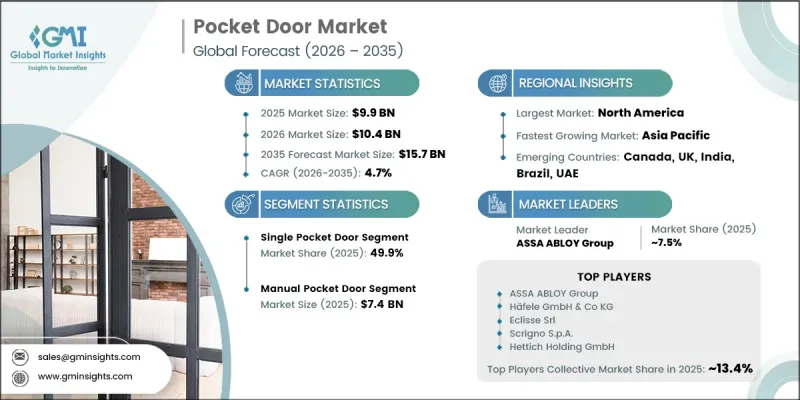
全球住宅和商業建築項目中對節省空間的室內門系統的日益普及,推動了市場成長。北美、歐洲和亞太地區人口稠密的都市區平均居住面積持續下降,使得高效的空間利用成為至關重要的設計考量,這也是推動需求成長的關鍵因素。因此,為了在保持美觀的同時最大限度地利用可用占地面積,隱藏式滑動門正擴大被納入現代建築佈局中。對靈活室內佈局日益成長的需求,以及維修和改造投資的增加,持續推動市場擴張。此外,人們對高階門解決方案(包括更大尺寸和更先進的系統,這些都能提升安裝價值)的偏好也為產業發展提供了助力。在醫療保健、飯店和綜合用途開發等商業領域,由於高效空間規劃和合理的室內設計至關重要,市場需求仍然穩定。同時,成熟住宅市場的維修項目正在創造新的機遇,這些機會獨立於新建項目,從而支撐著全球隱藏式滑動門產業的長期成長。
| 市場範圍 | |
|---|---|
| 開始年份 | 2025 |
| 預測期 | 2026-2035 |
| 上市時的市場規模 | 99億美元 |
| 預計金額 | 157億美元 |
| 複合年成長率 | 4.7% |
到2025年,單扇拉門市場規模將達到49億美元,佔市場佔有率的49.9%。這反映了其在標準住宅項目中的廣泛應用。其強大的市場地位得益於其在各種室內空間的廣泛使用,而實用功能、經濟性和高效的空間管理仍然是關鍵的購買因素。由於其能夠滿足各種住宅項目需求和預算水平,該細分市場將繼續保持最大的安裝量。
預計2025年,手動伸縮門系統市場銷售額將達74億美元,市佔率高達74.3%。其市場主導地位主要歸功於與自動產品相比,手動伸縮門安裝成本更低、操作更便利、維護需求更少。這些優勢持續支撐著其在住宅、商業和公共場所的高滲透率。在許多市場,尤其是在那些優先考慮成本效益和安裝便利性的市場,手動伸縮門系統仍然是首選,預計在整個預測期內,其強勁的需求將持續存在。
預計2025年,美國隱藏式拉門市場規模將達25億美元,市佔率高達79.5%。推動美國市場成長的主要因素包括強勁的住宅建設活動、不斷成長的房屋翻新支出以及對空間最佳化型室內佈局日益成長的需求。開放式戶型在住宅中的日益普及也進一步促進了隱藏式拉門系統的採用。此外,醫療機構、旅館和公共基礎設施項目對無障礙建築的要求不斷提高,也持續帶動著對這類解決方案的穩定需求,從而推動了全部區域的市場擴張。
目錄
第1章:調查方法和範圍
第2章執行摘要
第3章 行業洞察
- 產業生態系分析
- 供應商情況
- 利潤率
- 每個階段增加的價值
- 影響價值鏈的因素
- 影響產業的因素
- 促進因素
- 快速的都市化和日益縮小的生活空間正在推動節省空間解決方案的發展。
- 全球住宅和商業建築活動活性化
- 極簡主義和開放式室內設計越來越受歡迎。
- 對符合ADA標準和無障礙設施的解決方案的需求日益成長。
- 與智慧家庭的融合以及對電動門系統的需求
- 產業潛在風險與挑戰
- 來自穀倉門和折疊門等替代產品的激烈競爭。
- 原料價格(木材、鋁、玻璃)波動
- 中等收入國家和發展中市場消費者意識較低。
- 安裝公司技術水準的差異導致了安裝結果的差異。
- 機會
- 市場對隔音和隔熱隱藏式拉門系統的需求日益成長
- 微型公寓和緊湊型城市住宅的蓬勃發展正在創造結構性需求。
- 商業建築中防火隱藏式拉門的普及應用日益廣泛
- 創新研發符合綠建築標準的環保和可回收材料。
- 新興市場尚未開發的需求
- 促進因素
- 成長潛力分析
- 未來市場趨勢
- 技術與創新展望
- 最新科技趨勢
- 新興技術
- 監理情勢
- 標準和合規要求
- 區域監理框架
- 認證標準
- 貿易數據分析
- 進出口量及進口額趨勢
- 主要貿易路線及關稅的影響
- 價格分析
- 對過去價格趨勢的分析
- 按玩家類型(高階/低階/大眾市場)分類的定價策略
- 人工智慧和生成式人工智慧對市場的影響
- 利用人工智慧改造現有經營模式
- 按細分市場分類的生成式人工智慧用例和部署藍圖
- 風險、限制和監管考量
- 波特的分析
- PESTLE分析
第4章 競爭情勢
- 介紹
- 企業市佔率分析
- 按地區
- 企業矩陣分析
- 主要市場公司的競爭分析
- 競爭定位矩陣
- 主要進展
- 併購
- 夥伴關係和聯盟
- 新產品發布
- 業務拓展計劃
第5章 市場估算與預測:依產品類型分類,2022-2035年
- 單口袋門
- 雙口袋門
- 單扇口袋門
第6章 市場估計與預測:依材料分類,2022-2035年
- 樹
- 玻璃
- 鋁/金屬
- 乙烯基/塑膠
- 其他材質(鋼、玻璃纖維)
第7章 市場估計與預測:依機制分類,2022-2035年
- 手動的
- 自動的
第8章 市場估算與預測:依安裝類型分類,2022-2035年
- 新建工程
- 維修和整修
第9章 市場估計與預測:依最終用途分類,2022-2035年
- 住宅
- 商業
- 產業
第10章 市場估價與預測:依通路分類,2022-2035年
- 線上
- 電子商務網站
- 公司經營的網站
- 離線
- 專賣店
- 百貨公司
- 其他
第11章 市場估價與預測:按地區分類,2022-2035年
- 北美洲
- 美國
- 加拿大
- 歐洲
- 德國
- 英國
- 法國
- 義大利
- 西班牙
- 亞太地區
- 中國
- 印度
- 日本
- 韓國
- 澳洲
- 印尼
- 馬來西亞
- 拉丁美洲
- 巴西
- 墨西哥
- 阿根廷
- 中東和非洲
- 沙烏地阿拉伯
- UAE
- 南非
第12章:公司簡介
- 世界頂尖公司
- ASSA ABLOY Group
- Eclisse Srl
- Hafele GmbH
- Johnson Hardware
- Scrigno SpA
- 該地區的領先企業
- Anderson Corporation
- Portman Doors
- JB Kind
- Ferrero Legno
- Cavity Sliders
- 新興企業
- Raydoor Inc.
- Bertolotto Porte
- LPD Doors
- Linvisibile
- Hettich Holding
The Global Pocket Door Market was valued at USD 9.9 billion in 2025 and is estimated to grow at a CAGR of 4.7% to reach USD 15.7 billion by 2035.
Market growth is supported by the increasing adoption of space-saving interior door systems across both residential and commercial construction projects worldwide. A key factor driving demand is the ongoing reduction in average living space within densely populated urban areas across North America, Europe, and Asia Pacific, making efficient space utilization a critical design consideration. As a result, pocket doors are increasingly being incorporated into modern architectural layouts to maximize usable floor area while maintaining aesthetic appeal. Rising demand for flexible interior configurations, combined with growing investments in renovation and remodeling activities, continues to support market expansion. The industry is also benefiting from increasing preference for premium door solutions, including larger-format and technologically advanced systems that contribute to higher installation values. Commercial sectors such as healthcare, hospitality, and mixed-use developments continue to generate steady demand due to the importance of efficient space planning and streamlined interior design. At the same time, renovation projects across mature housing markets are creating additional opportunities independent of new construction activity, supporting long-term growth across the global pocket door industry.
| Market Scope | |
|---|---|
| Start Year | 2025 |
| Forecast Year | 2026-2035 |
| Start Value | $9.9 Billion |
| Forecast Value | $15.7 Billion |
| CAGR | 4.7% |
The single pocket door segment accounted for USD 4.9 billion in 2025, representing 49.9% share, reflecting the widespread adoption across standard residential construction projects. Its strong market position is supported by broad usage across various interior spaces where practical functionality, affordability, and efficient space management remain key purchasing considerations. The segment continues to maintain the largest installation base due to its suitability for a wide range of residential project requirements and budget levels.
The manual pocket door systems segment generated USD 7.4 billion in 2025 and represented 74.3% share. Their dominant position is largely attributed to lower installation costs, straightforward operation, and reduced maintenance requirements compared with automated alternatives. These advantages continue to support strong adoption across residential, commercial, and institutional environments. In many markets, particularly those prioritizing cost efficiency and ease of installation, manual systems remain the preferred choice and are expected to sustain substantial demand throughout the forecast period.
United States Pocket Door Market accounted for USD 2.5 billion in 2025, representing 79.5% share. Growth in the country is being driven by robust residential construction activity, increasing renovation spending, and rising demand for space-optimized interior layouts. The growing popularity of open-concept floor plans across newly constructed homes is further contributing to the adoption of pocket door systems. Additionally, accessibility-focused building requirements across healthcare facilities, hospitality properties, and public infrastructure projects continue to create consistent demand for these solutions, supporting market expansion across the region.
Key companies operating in the global pocket door market include Hettich Holding GmbH & Co. oHG, Johnson Hardware, Hafele GmbH & Co KG, Eclisse Srl, ASSA ABLOY Group, Raydoor Inc., Linvisibile S.r.l., Ferrero Legno S.p.A., Andersen Corporation, JB Kind Ltd., Bertolotto Porte S.r.l., LPD Doors Ltd., Scrigno S.p.A., Portman Doors Ltd., and Cavity Sliders. Companies operating in the pocket door market are focusing on product innovation, portfolio diversification, and strategic partnerships to strengthen their market presence and competitive positioning. Manufacturers are investing in advanced hardware systems, premium design options, and automated door technologies to address evolving consumer preferences and increase average product value. Many companies are expanding distribution networks and strengthening relationships with architects, contractors, builders, and interior designers to improve market penetration. Investments in sustainable materials, enhanced durability, and space-efficient product designs are also becoming key competitive differentiators. In addition, businesses are pursuing acquisitions, collaborations, and regional expansion initiatives to broaden their customer base and access emerging construction markets.
Table of Contents
Chapter 1 Methodology & Scope
- 1.1 Market scope and definition
- 1.2 Research design
- 1.2.1 Research approach
- 1.2.2 Data collection methods
- 1.3 Data mining sources
- 1.3.1 Global
- 1.3.2 Regional/Country
- 1.4 Base estimates and calculations
- 1.4.1 Base year calculation
- 1.4.2 Key trends for market estimation
- 1.5 Primary research and validation
- 1.5.1 Primary sources
- 1.6 Forecast model
- 1.7 Research assumptions and limitations
Chapter 2 Executive Summary
- 2.1 Industry 360° synopsis
- 2.2 Key market trends
- 2.2.1 Regional
- 2.2.2 Product type
- 2.2.3 Material
- 2.2.4 Mechanism
- 2.2.5 Installation type
- 2.2.6 End-user
- 2.2.7 Distribution channel
Chapter 3 Industry Insights
- 3.1 Industry ecosystem analysis
- 3.1.1 Supplier landscape
- 3.1.2 Profit margin
- 3.1.3 Value addition at each stage
- 3.1.4 Factor affecting the value chain
- 3.2 Industry impact forces
- 3.2.1 Growth drivers
- 3.2.1.1 Rapid urbanization & shrinking living spaces driving space-saving solutions
- 3.2.1.2 Rising residential & commercial construction activity globally
- 3.2.1.3 Growing adoption of minimalist & open-concept interior design
- 3.2.1.4 Increasing demand for ADA-compliant & barrier-free accessibility solutions
- 3.2.1.5 Smart home integration & demand for motorized door systems
- 3.2.2 Industry pitfalls & challenges
- 3.2.2.1 Intense competition from barn doors & bifold door alternatives
- 3.2.2.2 Raw material price volatility (timber, aluminum, glass)
- 3.2.2.3 Lack of consumer awareness in middle-income & developing markets
- 3.2.2.4 Variability in installer skill levels leading to inconsistent outcomes
- 3.2.3 Opportunities
- 3.2.3.1 Rising demand for acoustic/soundproof pocket door systems
- 3.2.3.2 Micro-apartment & compact urban housing boom creating structural demand
- 3.2.3.3 Growing adoption of fire-rated pocket doors in commercial buildings
- 3.2.3.4 Eco-friendly & recycled material innovations aligning with green building codes
- 3.2.3.5 Untapped demand in emerging markets
- 3.2.1 Growth drivers
- 3.3 Growth potential analysis
- 3.4 Future market trends
- 3.5 Technology and innovation landscape
- 3.5.1 Current technological trends
- 3.5.2 Emerging technologies
- 3.6 Regulatory landscape
- 3.6.1 Standards and compliance requirements
- 3.6.2 Regional regulatory frameworks
- 3.6.3 Certification standards
- 3.7 Trade data analysis (HS Code 4418.2)
- 3.7.1 Import/export volume & value trends
- 3.7.2 Key trade corridors & tariff impact
- 3.8 Pricing analysis
- 3.8.1 Historical price trend analysis (driven by primary research)
- 3.8.2 Pricing strategy by player type (premium / value / mass market)
- 3.9 Impact of AI & generative AI on the market
- 3.9.1 AI-driven disruption of existing business models
- 3.9.2 GenAI use cases & adoption roadmap by segment
- 3.9.3 Risks, limitations & regulatory considerations
- 3.10 Porter's analysis
- 3.11 PESTEL analysis
Chapter 4 Competitive Landscape, 2025
- 4.1 Introduction
- 4.2 Company market share analysis
- 4.2.1 By Region
- 4.2.1.1 North America
- 4.2.1.2 Europe
- 4.2.1.3 Asia Pacific
- 4.2.1.4 Latin America
- 4.2.1.5 Middle East & Africa
- 4.2.1 By Region
- 4.3 Company matrix analysis
- 4.4 Competitive analysis of major market players
- 4.5 Competitive positioning matrix
- 4.6 Key developments
- 4.6.1 Mergers & acquisitions
- 4.6.2 Partnerships & collaborations
- 4.6.3 New product launches
- 4.6.4 Expansion plans
Chapter 5 Market Estimates & Forecast, By Product Type, 2022 - 2035, (USD Billion) (Million Units)
- 5.1 Key trends
- 5.2 Single pocket door
- 5.3 Double pocket door
- 5.4 Unilateral pocket door
Chapter 6 Market Estimates & Forecast, By Material, 2022 - 2035, (USD Billion) (Million Units)
- 6.1 Key trends
- 6.2 Wood
- 6.3 Glass
- 6.4 Aluminum/metal
- 6.5 Vinyl/plastic
- 6.6 Others (steel, fiberglass)
Chapter 7 Market Estimates & Forecast, By Mechanism, 2022 - 2035, (USD Billion) (Million Units)
- 7.1 Key trends
- 7.2 Manual
- 7.3 Automatic
Chapter 8 Market Estimates & Forecast, By Installation Type, 2022 - 2035, (USD Billion) (Million Units)
- 8.1 Key trends
- 8.2 New construction
- 8.3 Retrofit/renovation
Chapter 9 Market Estimates & Forecast, By End-Use, 2022 - 2035, (USD Billion) (Million Units)
- 9.1 Key trends
- 9.2 Residential
- 9.3 Commercial
- 9.4 Industrial
Chapter 10 Market Estimates & Forecast, By Distribution Channel, 2022 - 2035, (USD Billion) (Million Units)
- 10.1 Key trends
- 10.2 Online
- 10.2.1 E-commerce websites
- 10.2.2 Company-owned websites
- 10.3 Offline
- 10.3.1 Specialty stores
- 10.3.2 Departmental stores
- 10.3.3 Others
Chapter 11 Market Estimates & Forecast, By Region, 2022 - 2035, (USD Billion) (Million Units)
- 11.1 Key trends
- 11.2 North America
- 11.2.1 U.S.
- 11.2.2 Canada
- 11.3 Europe
- 11.3.1 Germany
- 11.3.2 UK
- 11.3.3 France
- 11.3.4 Italy
- 11.3.5 Spain
- 11.4 Asia Pacific
- 11.4.1 China
- 11.4.2 India
- 11.4.3 Japan
- 11.4.4 South Korea
- 11.4.5 Australia
- 11.4.6 Indonesia
- 11.4.7 Malaysia
- 11.5 Latin America
- 11.5.1 Brazil
- 11.5.2 Mexico
- 11.5.3 Argentina
- 11.6 MEA
- 11.6.1 Saudi Arabia
- 11.6.2 UAE
- 11.6.3 South Africa
Chapter 12 Company Profiles
- 12.1 Top Global Players
- 12.1.1 ASSA ABLOY Group
- 12.1.2 Eclisse Srl
- 12.1.3 Hafele GmbH
- 12.1.4 Johnson Hardware
- 12.1.5 Scrigno S.p.A.
- 12.2 Regional Champions
- 12.2.1 Anderson Corporation
- 12.2.2 Portman Doors
- 12.2.3 JB Kind
- 12.2.4 Ferrero Legno
- 12.2.5 Cavity Sliders
- 12.3 Emerging Players
- 12.3.1 Raydoor Inc.
- 12.3.2 Bertolotto Porte
- 12.3.3 LPD Doors
- 12.3.4 Linvisibile
- 12.3.5 Hettich Holding

 全球高速門市場報告:2021-2032年歷史表現及預測
 2026年全球寵物門密封條市場報告
 全球門市場規模、佔有率、趨勢和成長分析報告(2026-2034)
 行人用自動門市場商機、成長要素、產業趨勢分析及2026-2035年預測。
 金屬穀倉門市場-2026-2032年全球市場預測
 水密門(防水門)市場分析及預測(至2035年):類型、產品、技術、組件、應用、材質、製程、最終用戶、功能、安裝類型門市場:按類型、材料、機制、類別、應用和使用方式分類-全球預測,2026-2032年
 分段捲簾門市場 - 全球產業規模、佔有率、趨勢、機會、預測:按材料、隔熱材料、應用、地區和競爭格局分類,2021-2031年
 室內拉門:市場規模及預測(2021-2034 年)、全球及區域佔有率、趨勢和成長機會 - 分析範圍(按材料類型、最終用戶和地區分類)
 室內搖擺門:市場規模及預測(2021-2034 年)、全球及區域佔有率、趨勢和成長機會 - 分析範圍(按材料類型、最終用戶和地區分類)