


 |
市場調查報告書
商品編碼
2109134
2026 年至 2035 年產前和生殖基因檢測的市場機會、成長促進因素、產業趨勢和預測。Prenatal and Reproductive Genetic Testing Market Opportunity, Growth Drivers, Industry Trend Analysis, and Forecast 2026 - 2035 |
||||||

全球產前和生殖基因檢測市場預計到 2025 年將達到 78 億美元,年複合成長率為 11.2%,到 2035 年將達到 224 億美元。
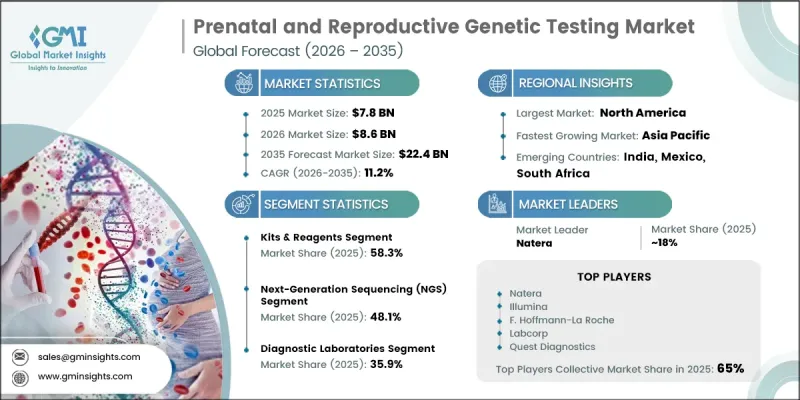
由於產前護理和生殖醫學服務整體先進基因篩檢和診斷解決方案的需求持續成長,市場正經歷顯著成長。人們對早期基因風險評估益處的認知不斷提高,加上高齡生產比例上升和遺傳疾病發病率增加,正推動全球基因檢測的普及。輔助生殖技術(ART)的擴展、分子診斷技術的進步以及先進基因組檢測平台的可及性提高,進一步促進了市場成長。醫療服務提供者正擴大將基因檢測納入常規產前護理和生殖醫學服務中,以改善臨床決策並支持個人化治療策略。此外,基因組分析技術的進步、精準醫療投入的增加以及專業診斷服務的普及,也為產業相關人員創造了機會。
| 市場範圍 | |
|---|---|
| 開始年份 | 2025 |
| 預測期 | 2026-2035 |
| 起始金額 | 78億美元 |
| 預測金額 | 224億美元 |
| 複合年成長率 | 11.2% |
預計到2025年,試劑盒及試劑細分市場將佔據58.3%的市場佔有率,並在2035年之前以11%的複合年成長率成長。該細分市場持續保持主導地位,主要得益於其在支持基因篩檢、分子診斷和檢測流程方面發揮的關鍵作用。臨床檢查室、診斷中心和醫療機構對試劑盒及試劑的穩定需求,推動了收入的持續成長和市場的持續發展。檢測準確性、流程效率和檢測性能的不斷提升,推動了先進基因檢測解決方案的普及應用。預計在整個預測期內,檢測數量的增加和基因組診斷的廣泛應用將進一步鞏固該細分市場的主導地位。
預計到2025年,診斷檢查室領域將佔35.9%的市場佔有率。隨著產前和生殖遺傳檢測日益複雜,人們對具備先進分子診斷能力的專業診斷檢查室的依賴性不斷增強。對自動化檢測、高通量基因組學技術和精準診斷平台的投資增加,正在提高檢測效率和臨床療效。隨著對準確、可靠和全面的基因分析的需求持續成長,專業診斷實驗室仍然是提供高品質檢測服務的核心。預計在預測期內,檢測基礎設施和分子診斷技術的不斷進步將進一步推動該領域的成長。
預計到2025年,北美產前和生殖基因檢測市場佔有率將達到41.2%。該地區憑藉先進的醫療基礎設施、積極採用創新基因檢測技術以及對精準醫療和基因組研究的持續投入,繼續引領市場。人們對產前基因篩檢的日益關注、專業診斷服務的普及以及有利的保險報銷政策,都將進一步推動該地區的需求成長。此外,持續的技術進步、不斷成長的醫療保健支出以及日益活躍的研究活動,預計將在整個預測期內鞏固北美的主導地位,同時為市場參與企業創造巨大的成長機會。
目錄
第1章:調查方法和範圍
第2章執行摘要
第3章 行業洞察
- 產業生態系分析
- 供應商情況
- 每個階段增加的價值
- 影響價值鏈的因素
- 影響產業的因素
- 成長促進因素
- 高齡生產及高危險妊娠人數增加
- 體外受精(IVF)和輔助生殖技術(ART)的廣泛應用
- 遺傳性和先天性疾病盛行率增加
- 基因測序技術的進步
- 產業潛在風險與挑戰
- 先進基因檢測高成本
- 倫理、法律和監管問題
- 市場機遇
- 非侵入性產前檢測(NIPT)的廣泛應用
- 擴大胚胎著床前遺傳學檢測(PGT)在體外受精(IVF)的應用
- 成長促進因素
- 成長潛力分析
- 技術與創新展望
- 最新科技趨勢
- 新興技術
- 價格分析
- 對過去價格趨勢的分析
- 價格分析:依測試類型
- 監理情勢
- 波特的分析
- PESTLE分析
- 人工智慧和生成式人工智慧對市場的影響
- 投資和資金籌措趨勢
- 未來市場趨勢
- 區域還款方案
第4章 競爭情勢
- 介紹
- 企業市佔率分析
- 北美洲
- 歐洲
- 亞太地區
- 企業矩陣分析
- 主要市場公司的競爭分析
- 競爭定位矩陣
- 主要進展
- 併購
- 夥伴關係和聯盟
- 新產品發布
- 業務拓展計劃
第5章 市場估價與預測:依產品與服務分類,2022-2035年
- 試劑盒和試劑
- 軟體服務
第6章 市場估計與預測:依檢測類型分類,2022-2035年
- 產前檢查
- 篩檢測試
- 非侵入性產前檢測(NIPT)
- 職業篩檢
- 血清篩檢
- 胎兒頸部水腫超音波檢查
- 診斷
- 絨毛膜絨毛取樣(CVS)
- 羊膜穿刺術
- 篩檢測試
- 生殖遺傳檢測
- 職業篩檢
- 胚胎著床前遺傳學檢測(PGT)
- PGT-A
- PGT-M
- PGT-SR
- 胚胎基因檢測
第7章 市場估計與預測:依技術分類,2022-2035年
- 次世代定序(NGS)
- 聚合酵素鏈鎖反應(PCR)
- 染色體微陣列分析(CMA)
- 螢光原位雜合反應(FISH)
- 其他技術
第8章 市場估計與預測:依應用領域分類,2022-2035年
- 染色體異常
- 單基因/單基因疾病
- 職業狀況評估
- 胚胎篩檢與選擇
- 其他用途
第9章 市場估計與預測:依最終用途分類,2022-2035年
- 醫院
- 診斷檢查室
- 不孕症治療診所/體外受精(IVF)中心
- 婦產科和專科診所
- 其他最終用戶
第10章 市場估價與預測:依地區分類,2022-2035年
- 北美洲
- 美國
- 加拿大
- 歐洲
- 德國
- 英國
- 法國
- 義大利
- 西班牙
- 荷蘭
- 亞太地區
- 中國
- 日本
- 印度
- 澳洲
- 韓國
- 拉丁美洲
- 巴西
- 墨西哥
- 阿根廷
- 中東和非洲
- 南非
- 沙烏地阿拉伯
- UAE
第11章:公司簡介
- BGI Genomics
- CooperSurgical
- Eurofins Scientific
- F. Hoffmann-La Roche
- Fulgent Genetics
- Genea Biomedx
- Igenomix
- Illumina
- Labcorp
- Myriad Genetics
- Natera
- Quest Diagnostics
- Revvity
- Sema4
- Thermo Fisher Scientific
The Global Prenatal and Reproductive Genetic Testing Market was valued at USD 7.8 billion in 2025 and is estimated to grow at a CAGR of 11.2% to reach USD 22.4 billion by 2035.
The market is experiencing substantial growth as demand for advanced genetic screening and diagnostic solutions continues to rise across prenatal care and reproductive health services. Increasing awareness regarding the benefits of early genetic risk assessment, coupled with the growing maternal age population and the rising incidence of inherited genetic conditions, is driving the adoption of genetic testing worldwide. Expanding utilization of assisted reproductive technologies (ART), improvements in molecular diagnostics, and the growing availability of advanced genomic testing platforms are further supporting market expansion. Healthcare providers are increasingly integrating genetic testing into routine prenatal and reproductive care to improve clinical decision-making and support personalized treatment strategies. In addition, technological advancements in genomic analysis, increasing investments in precision medicine, and expanding access to specialized diagnostic services are creating favorable opportunities for industry participants.
| Market Scope | |
|---|---|
| Start Year | 2025 |
| Forecast Year | 2026-2035 |
| Start Value | $7.8 Billion |
| Forecast Value | $22.4 Billion |
| CAGR | 11.2% |
The kits & reagents segment captured a 58.3% share in 2025 and is forecast to grow at a 11% CAGR through 2035. The segment continues to maintain its leading position due to its essential role in supporting genetic screening, molecular diagnostics, and laboratory testing workflows. Consistent demand for kits and reagents across clinical laboratories, diagnostic centers, and healthcare institutions contributes to recurring revenue generation and sustained market growth. Continuous improvements in testing accuracy, workflow efficiency, and assay performance are encouraging broader adoption of advanced genetic testing solutions. Increasing laboratory testing volumes and the growing implementation of genomic diagnostics are expected to further strengthen the segment's leadership throughout the forecast period.
The diagnostic laboratories segment held a 35.9% share in 2025. The growing complexity of prenatal and reproductive genetic testing continues to increase reliance on specialized diagnostic laboratories equipped with advanced molecular diagnostic capabilities. Expanding investments in laboratory automation, high-throughput genomic technologies, and precision diagnostic platforms are enhancing testing efficiency and improving clinical outcomes. As demand for accurate, reliable, and comprehensive genetic analysis continues to increase, specialized diagnostic laboratories remain central to delivering high-quality testing services. Ongoing advancements in laboratory infrastructure and molecular diagnostics are expected to further support growth across this segment during the forecast period.
North America Prenatal and Reproductive Genetic Testing Market recorded a 41.2% share in 2025. The region continues to lead the market due to its advanced healthcare infrastructure, strong adoption of innovative genetic testing technologies, and increasing investment in precision medicine and genomic research. Growing awareness of prenatal genetic screening, expanding access to specialized diagnostic services, and favorable reimbursement environments continue to strengthen regional demand. In addition, continuous technological advancements, increasing healthcare spending, and expanding research activities are expected to reinforce North America's leading position throughout the forecast period while creating significant growth opportunities for market participants.
Major companies operating in the global prenatal and reproductive genetic testing market include Thermo Fisher Scientific, Illumina, Labcorp, Quest Diagnostics, Eurofins Scientific, CooperSurgical, F. Hoffmann-La Roche, Revvity, BGI Genomics, Igenomix, Myriad Genetics, Fulgent Genetics, Genea Biomedx, Sema4, and Natera. Companies operating in the global prenatal and reproductive genetic testing market are focusing on continuous product innovation, expansion of genetic testing portfolios, and investment in advanced genomic technologies to strengthen their competitive position. Manufacturers are increasing research and development efforts to improve testing accuracy, reduce turnaround times, and enhance the clinical utility of genetic screening solutions. Strategic collaborations with healthcare providers, fertility clinics, diagnostic laboratories, and research institutions are helping companies expand their customer base and improve market penetration. Businesses are also strengthening laboratory capabilities, expanding geographic presence, and investing in automation and digital technologies to improve operational efficiency. Continuous emphasis on regulatory compliance, quality assurance, personalized medicine, and advanced molecular diagnostics enables companies to reinforce their market presence, enhance customer confidence, and sustain long-term growth within the global prenatal and reproductive genetic testing market.
Table of Contents
Chapter 1 Methodology and Scope
- 1.1 Research approach
- 1.2 Quality commitments
- 1.2.1 GMI AI policy & data integrity commitment
- 1.2.1.1 Source consistency protocol
- 1.2.1 GMI AI policy & data integrity commitment
- 1.3 Research trail & confidence scoring
- 1.3.1 Research trail components
- 1.3.2 Scoring components
- 1.4 Data collection
- 1.4.1 Partial list of primary sources
- 1.5 Data mining sources
- 1.5.1 Paid sources
- 1.5.1.1 Sources, by region
- 1.5.1 Paid sources
- 1.6 Base estimates and calculations
- 1.6.1 Base year calculation for any one approach
- 1.7 Forecast model
- 1.7.1 Quantified market impact analysis
- 1.7.1.1 Mathematical impact of growth parameters on forecast
- 1.7.1 Quantified market impact analysis
- 1.8 Research transparency addendum
- 1.8.1 Source attribution framework
- 1.8.2 Quality assurance metrics
- 1.8.3 Our commitment to trust
Chapter 2 Executive Summary
- 2.1 Industry 360° synopsis
- 2.2 Key market trends
- 2.2.1 Business trends
- 2.2.2 Products and services trends
- 2.2.3 Test type trends
- 2.2.4 Technology trends
- 2.2.5 Application trends
- 2.2.6 End use trends
- 2.2.7 Regional trends
- 2.3 CXO perspectives: Strategic imperatives
Chapter 3 Industry Insights
- 3.1 Industry ecosystem analysis
- 3.1.1 Supplier landscape
- 3.1.2 Value addition at each stage
- 3.1.3 Factors affecting the value chain
- 3.2 Industry impact forces
- 3.2.1 Growth drivers
- 3.2.1.1 Rising maternal age and high-risk pregnancies
- 3.2.1.2 Growing adoption of IVF and assisted reproductive technologies (ART)
- 3.2.1.3 Increasing prevalence of genetic and inherited disorders
- 3.2.1.4 Advancements in genomic sequencing technologies
- 3.2.2 Industry pitfalls and challenges
- 3.2.2.1 High cost of advanced genetic testing
- 3.2.2.2 Ethical, legal, and regulatory concerns
- 3.2.3 Market opportunities
- 3.2.3.1 Expanding adoption of non-invasive prenatal testing (NIPT)
- 3.2.3.2 Increasing use of preimplantation genetic testing (PGT) in IVF
- 3.2.1 Growth drivers
- 3.3 Growth potential analysis
- 3.4 Technological and innovation landscape
- 3.4.1 Current technological trends
- 3.4.2 Emerging technologies (Driven by Primary Research)
- 3.5 Pricing analysis (Driven by Primary Research)
- 3.5.1 Historic price trend analysis
- 3.5.2 Pricing analysis, by test type
- 3.6 Regulatory landscape (Driven by Primary Research)
- 3.6.1 North America
- 3.6.2 Europe
- 3.6.3 Asia Pacific
- 3.6.4 Latin America
- 3.6.5 MEA
- 3.7 Porter's analysis
- 3.8 PESTEL analysis
- 3.9 Impact of AI and Generative AI on the market (Driven by Primary Research)
- 3.10 Investment and funding landscape (Driven by Primary Research)
- 3.11 Future market trends (Driven by Primary Research)
- 3.12 Reimbursement scenario, by region
Chapter 4 Competitive Landscape, 2025
- 4.1 Introduction
- 4.2 Company market share analysis
- 4.2.1 North America
- 4.2.2 Europe
- 4.2.3 Asia Pacific
- 4.3 Company matrix analysis
- 4.4 Competitive analysis of major market players
- 4.5 Competitive positioning matrix
- 4.6 Key developments
- 4.6.1 Merger and acquisition
- 4.6.2 Partnership and collaboration
- 4.6.3 New product launches
- 4.6.4 Expansion plans
Chapter 5 Market Estimates and Forecast, By Products and Services, 2022 – 2035 ($ Mn)
- 5.1 Key trends
- 5.2 Kits & Reagents
- 5.3 Software & Services
Chapter 6 Market Estimates and Forecast, By Test Type, 2022 – 2035 ($ Mn)
- 6.1 Key trends
- 6.2 Prenatal tests
- 6.2.1 Screening tests
- 6.2.1.1 Non-invasive prenatal testing (NIPT)
- 6.2.1.2 Carrier screening
- 6.2.1.3 Serum screening
- 6.2.1.4 Nuchal translucency ultrasound
- 6.2.2 Diagnostic
- 6.2.2.1 Chorionic villus sampling (CVS)
- 6.2.2.2 Amniocentesis
- 6.2.1 Screening tests
- 6.3 Reproductive genetic tests
- 6.3.1 Carrier screening
- 6.3.2 Preimplantation genetic testing (PGT)
- 6.3.2.1 PGT-A
- 6.3.2.2 PGT-M
- 6.3.2.3 PGT-SR
- 6.3.3 Embryo genetic testing
Chapter 7 Market Estimates and Forecast, By Technology, 2022 – 2035 ($ Mn)
- 7.1 Key trends
- 7.2 Next-generation sequencing (NGS)
- 7.3 Polymerase chain Reaction (PCR)
- 7.4 Chromosomal microarray analysis (CMA)
- 7.5 Fluorescence in-situ hybridization (FISH)
- 7.6 Other technologies
Chapter 8 Market Estimates and Forecast, By Application, 2022 – 2035 ($ Mn)
- 8.1 Key trends
- 8.2 Chromosomal abnormalities
- 8.3 Single gene / monogenic disorders
- 8.4 Carrier status assessment
- 8.5 Embryo screening & selection
- 8.6 Other applications
Chapter 9 Market Estimates and Forecast, By End Use, 2022 – 2035 ($ Mn)
- 9.1 Key trends
- 9.2 Hospitals
- 9.3 Diagnostic laboratories
- 9.4 Fertility clinics / IVF centers
- 9.5 Maternity & specialty clinics
- 9.6 Other end users
Chapter 10 Market Estimates and Forecast, By Region, 2022 – 2035 ($ Mn)
- 10.1 Key trends
- 10.2 North America
- 10.2.1 U.S.
- 10.2.2 Canada
- 10.3 Europe
- 10.3.1 Germany
- 10.3.2 UK
- 10.3.3 France
- 10.3.4 Italy
- 10.3.5 Spain
- 10.3.6 Netherlands
- 10.4 Asia Pacific
- 10.4.1 China
- 10.4.2 Japan
- 10.4.3 India
- 10.4.4 Australia
- 10.4.5 South Korea
- 10.5 Latin America
- 10.5.1 Brazil
- 10.5.2 Mexico
- 10.5.3 Argentina
- 10.6 Middle East and Africa
- 10.6.1 South Africa
- 10.6.2 Saudi Arabia
- 10.6.3 UAE
Chapter 11 Company Profiles
- 11.1 BGI Genomics
- 11.2 CooperSurgical
- 11.3 Eurofins Scientific
- 11.4 F. Hoffmann-La Roche
- 11.5 Fulgent Genetics
- 11.6 Genea Biomedx
- 11.7 Igenomix
- 11.8 Illumina
- 11.9 Labcorp
- 11.10 Myriad Genetics
- 11.11 Natera
- 11.12 Quest Diagnostics
- 11.13 Revvity
- 11.14 Sema4
- 11.15 Thermo Fisher Scientific

 2026-2034年全球產前和新生兒基因檢測市場規模、佔有率、趨勢和成長分析報告
 生殖健康基因篩檢和檢測市場—全球及區域分析:按產品、檢測類型、遺傳疾病、技術方法、檢體類型、最終用戶和地區分類—分析與預測(2026-2036 年)產前基因檢測市場-策略分析與預測(2026-2035)
 產前和新生兒基因檢測市場分析及預測(至2035年):類型、產品類型、服務、技術、應用、最終用戶、流程、模式和階段
 2025年產前與新生兒基因檢測全球市場報告
 產前及新生兒基因檢測市場機會、成長動力、產業趨勢分析及 2025 - 2034 年預測全球產前和新生兒基因檢測市場規模(按檢測類型、應用、地區、範圍和預測)