


 |
市場調查報告書
商品編碼
2101945
預製混凝土市場機會、成長要素、產業趨勢分析及2026-2035年預測。Precast Concrete Market Opportunity, Growth Drivers, Industry Trend Analysis, and Forecast 2026 - 2035 |
||||||

全球預製混凝土市場預計到 2025 年將達到 1,417 億美元,年複合成長率為 6.6%,到 2035 年將達到 2,683 億美元。
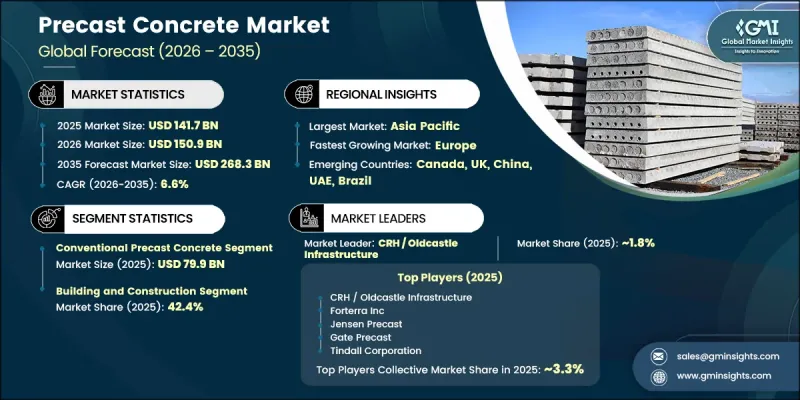
市場成長主要得益於已開發經濟體和新興經濟體在基礎建設現代化、住宅建設和工業發展方面的持續投資。對更快專案執行速度、更高施工效率和更少現場勞動力需求的日益成長的需求,正在加速預製混凝土解決方案在全球範圍內的應用。異地製造允許在場地準備工作進行的同時同步生產結構構件,與傳統施工方法相比,顯著縮短了整個專案的工期。開發商對經濟高效、高品質和標準化建築解決方案的需求,推動了模組化建築技術的普及,進一步促進了市場需求。此外,公共基礎設施、公共產業網路和商業開發投資的不斷增加,也持續支持預製混凝土產品的廣泛應用。由於工廠控制的生產流程,預製解決方案具有更高的產品一致性、更強的品管和更佳的耐久性,因此在各種建築應用中越來越受歡迎。隨著各國政府和私人開發商繼續優先考慮高效的施工方法,預計全球預製混凝土市場的長期前景在整個預測期內將保持非常樂觀。
| 市場範圍 | |
|---|---|
| 開始年份 | 2025 |
| 預測期 | 2026-2035 |
| 上市時的市場規模 | 1417億美元 |
| 預計金額 | 2683億美元 |
| 複合年成長率 | 6.6% |
預計到2025年,傳統預製混凝土市場規模將達到799億美元,並在2035年之前以6.1%的複合年成長率成長。由於其在住宅、商業、工業、交通運輸和公共產業等建築項目中的廣泛應用,該行業構成了全球預製混凝土市場的基礎。傳統預製產品憑藉其成熟的結構性能、標準化的生產流程和可靠的質量,預計將繼續保持穩定的需求。在多個終端應用領域的廣泛應用也有助於其在區域市場和各種經濟狀況下保持穩定的需求。
預計到2025年,建築與施工領域將佔據42.4%的市場佔有率,並在2035年之前保持7%的複合年成長率。預製混凝土解決方案在住宅、商業、公共和工業建設活動中的日益普及,鞏固了該領域的市場主導地位。隨著開發商優先考慮加快專案進度和提高施工效率,對高效結構系統、建築構件、地板材料解決方案、牆體系統和其他預製建築材料的需求不斷成長,進一步鞏固了該應用領域的地位。
預計2025年,美國預製混凝土市場規模將達302億美元,市佔率高達93.5%。美國憑藉其龐大的預製構件生產網路以及對交通、公共產業和公共基礎設施項目的持續投資,鞏固了其市場主導地位。公共建設支出的成長以及交通、水資源管理和公共產業基礎設施的持續發展,將繼續推動對預製混凝土構件的強勁需求。預計在整個預測期內,聯邦、州和地方政府對建設項目的持續投資將推動市場成長。
目錄
第1章:調查方法和範圍
第2章執行摘要
第3章 行業洞察
- 產業生態系分析
- 供應商情況
- 利潤率
- 每個階段增加的價值
- 影響價值鏈的因素
- 影響產業的因素
- 促進因素
- 快速施工的需求日益成長
- 模組化建築的廣泛應用
- 材料和設計方面的進步
- 產業潛在風險與挑戰
- 運輸和物流限制
- 專業領域熟練勞動力短缺
- 利率敏感度和住宅市場的週期性
- 機會
- 基礎設施現代化項目擴展
- 對資料中心和倉儲設施的需求不斷成長
- 高性能材料的進展
- 促進因素
- 成長潛力分析
- 未來市場趨勢
- 技術與創新展望
- 最新科技趨勢
- 新興技術
- 監理情勢
- 標準和合規要求
- 區域監理框架
- 認證標準
- 貿易數據分析
- 進出口量及進口額趨勢
- 主要貿易路線及關稅的影響
- 價格分析
- 對過去價格趨勢的分析
- 按業務類型(高階/低階/大眾市場)分類的定價策略
- 人工智慧和生成式人工智慧對市場的影響
- 利用人工智慧改造現有經營模式
- 按細分市場分類的生成式人工智慧用例和部署藍圖
- 風險、限制和監管考量
- 波特的分析
- PESTLE分析
第4章 競爭情勢
- 介紹
- 企業市佔率分析
- 按地區
- 企業矩陣分析
- 主要市場公司的競爭分析
- 競爭定位矩陣
- 主要進展
- 併購
- 夥伴關係和聯盟
- 新產品發布
- 業務拓展計劃
第5章 市場估算與預測:依產品類型分類,2022-2035年
- 牆板和外觀
- 建築牆板
- 結構牆板
- 樑/柱
- 地板和屋頂
- 雙齒板
- 中空板
- 倒T形光束
- 樓梯和平台
- 橋樑主樑與結構構件
- 管道、人孔和排水相關產品
- 樁和基礎構件
- 其他(擋土牆、護欄、公用設施螺栓)
第6章 市場估算與預測:依材料類型分類,2022-2035年
- 傳統預製混凝土
- 預力預製混凝土
- 纖維增強預製混凝土
- 超高強度混凝土(UHPC)
第7章 市場估計與預測:依應用領域分類,2022-2035年
- 建築/施工
- 住宅
- 獨立式住宅
- 多用戶住宅及多單元住宅
- 商業
- 辦公大樓和企業園區
- 零售和混合用途開發
- 飯店及娛樂設施
- 產業
- 倉庫和物流設施
- 製造工廠和設施
- 住宅
- 基礎設施
- 橋樑和高架道路
- 公路/高速公路
- 隧道和地下結構
- 鐵路和交通基礎設施
- 水和污水處理
- 水處理廠
- 雨水管理系統
- 污水和污水基礎設施
- 農業和農村基礎設施
- 其他
第8章 市場估計與預測:依地區分類,2022-2035年
- 北美洲
- 美國
- 加拿大
- 歐洲
- 德國
- 英國
- 法國
- 義大利
- 西班牙
- 亞太地區
- 中國
- 印度
- 日本
- 韓國
- 澳洲
- 印尼
- 馬來西亞
- 拉丁美洲
- 巴西
- 墨西哥
- 阿根廷
- 中東和非洲
- 沙烏地阿拉伯
- UAE
- 南非
第9章:公司簡介
- Global Leaders
- Oldcastle Infrastructure(CRH plc)
- Forterra, Inc.
- Jensen Precast
- Gate Precast Company
- Tindall Corporation
- 該地區的領先企業
- Wells Concrete
- Spancrete
- Knife River Corporation
- Hannibal Industries
- Fabcon Precast
- 新興企業
- Northeast Precast
- High Concrete Group
- Nitterhouse Concrete Products
- Concrete Pipe & Precast LLC
- Leesburg Concrete Company
The Global Precast Concrete Market was valued at USD 141.7 billion in 2025 and is estimated to grow at a CAGR of 6.6% to reach USD 268.3 billion by 2035.
Market growth is driven by continuous investments in infrastructure modernization, residential construction, and industrial development across both developed and emerging economies. Increasing preference for faster project execution, improved construction efficiency, and reduced on-site labor requirements is accelerating the adoption of precast concrete solutions worldwide. Off-site manufacturing allows simultaneous production of structural components while site preparation progresses, significantly shortening overall project completion timelines compared to conventional construction methods. The growing shift toward modular construction techniques is further strengthening demand, as developers seek cost-effective, high-quality, and standardized building solutions. In addition, expanding investments in public infrastructure, utility networks, and commercial developments continue to support the widespread use of precast concrete products. Factory-controlled manufacturing processes provide greater product consistency, enhanced quality control, and improved durability, making precast solutions increasingly attractive across multiple construction applications. As governments and private developers continue prioritizing efficient construction practices, the long-term outlook for the global precast concrete market remains highly favorable throughout the forecast period.
| Market Scope | |
|---|---|
| Start Year | 2025 |
| Forecast Year | 2026-2035 |
| Start Value | $141.7 Billion |
| Forecast Value | $268.3 Billion |
| CAGR | 6.6% |
The conventional precast concrete segment generated USD 79.9 billion in 2025 and is expected to grow at a CAGR of 6.1% through 2035. This segment represents the foundation of the global precast concrete market due to its broad utilization across residential, commercial, industrial, transportation, and utility construction projects. Conventional precast products continue to experience consistent demand because they offer proven structural performance, standardized manufacturing processes, and reliable quality. Their widespread application across multiple end-use sectors helps maintain stable demand across regional markets and varying economic conditions.
The building and construction segment accounted for 42.4% share in 2025 and is projected to register a CAGR of 7% through 2035. Market leadership is supported by the growing adoption of precast concrete solutions throughout residential, commercial, institutional, and industrial construction activities. Increasing demand for efficient structural systems, architectural components, flooring solutions, wall systems, and other prefabricated construction elements continues to strengthen the position of this application segment as developers prioritize faster project delivery and improved construction productivity.
United States Precast Concrete Market generated USD 30.2 billion in 2025, representing 93.5% share. The country's dominant position is supported by its extensive precast manufacturing network and ongoing investments in transportation, utility, and public infrastructure projects. Rising public construction expenditure and continued development of transportation, water management, and utility infrastructure continue to create strong demand for precast concrete components. Sustained investment across federal, state, and municipal construction programs is expected to reinforce market growth throughout the forecast period.
Major companies operating in the global precast concrete market include Spancrete, Gate Precast Company, Oldcastle Infrastructure (CRH plc), Fabcon Precast, Jensen Precast, Wells Concrete, Knife River Corporation, Northeast Precast, Forterra, Inc., Hannibal Industries, and Tindall Corporation. Companies operating in the precast concrete market are strengthening their market position through capacity expansion, manufacturing modernization, and continuous product innovation. Many producers are investing in automated production facilities to improve efficiency, maintain product quality, and increase output while reducing manufacturing costs. Strategic acquisitions, regional expansion, and partnerships with construction firms are helping companies broaden their customer base and strengthen distribution networks. Businesses are also developing customized precast solutions that support modular construction and faster project execution. Investments in sustainable manufacturing practices, low-carbon concrete technologies, and resource-efficient production methods are becoming increasingly important as environmental regulations evolve.
Table of Contents
Chapter 1 Methodology & Scope
- 1.1 Market scope and definition
- 1.2 Research design
- 1.2.1 Research approach
- 1.2.2 Data collection methods
- 1.3 Data mining sources
- 1.3.1 Global
- 1.3.2 Regional/Country
- 1.4 Base estimates and calculations
- 1.4.1 Base year calculation
- 1.4.2 Key trends for market estimation
- 1.5 Primary research and validation
- 1.5.1 Primary sources
- 1.6 Forecast model
- 1.7 Research assumptions and limitations
Chapter 2 Executive Summary
- 2.1 Industry 360° synopsis
- 2.2 Key market trends
- 2.2.1 Regional
- 2.2.2 Product type
- 2.2.3 Material type
- 2.2.4 Application
Chapter 3 Industry Insights
- 3.1 Industry ecosystem analysis
- 3.1.1 Supplier landscape
- 3.1.2 Profit margin
- 3.1.3 Value addition at each stage
- 3.1.4 Factor affecting the value chain
- 3.2 Industry impact forces
- 3.2.1 Growth drivers
- 3.2.1.1 Growing demand for fast-track construction
- 3.2.1.2 Increasing adoption of modular construction
- 3.2.1.3 Advancements in materials and design
- 3.2.2 Industry pitfalls & challenges
- 3.2.2.1 Transportation and logistics constraints
- 3.2.2.2 Skilled workforce gaps in specialized areas
- 3.2.2.3 Interest rate sensitivity & residential cyclicality
- 3.2.3 Opportunities
- 3.2.3.1 Expansion of infrastructure modernization projects
- 3.2.3.2 Rising demand for data centers and warehousing
- 3.2.3.3 Advancements in high-performance materials
- 3.2.1 Growth drivers
- 3.3 Growth potential analysis
- 3.4 Future market trends
- 3.5 Technology and innovation landscape
- 3.5.1 Current technological trends
- 3.5.2 Emerging technologies
- 3.6 Regulatory landscape
- 3.6.1 Standards and compliance requirements
- 3.6.2 Regional regulatory frameworks
- 3.6.3 Certification standards
- 3.7 Trade data analysis (HS Code 681091)
- 3.7.1 Import/export volume & value trends
- 3.7.2 Key trade corridors & tariff impact
- 3.8 Pricing analysis
- 3.8.1 Historical price trend analysis (driven by primary research)
- 3.8.2 Pricing strategy by player type (premium / value / mass market)
- 3.9 Impact of AI & generative AI on the market
- 3.9.1 AI-driven disruption of existing business models
- 3.9.2 GenAI use cases & adoption roadmap by segment
- 3.9.3 Risks, limitations & regulatory considerations
- 3.10 Porter's analysis
- 3.11 PESTEL analysis
Chapter 4 Competitive Landscape, 2025
- 4.1 Introduction
- 4.2 Company market share analysis
- 4.2.1 By Region
- 4.2.1.1 North America
- 4.2.1.2 Europe
- 4.2.1.3 Asia Pacific
- 4.2.1.4 Latin America
- 4.2.1.5 Middle East & Africa
- 4.2.1 By Region
- 4.3 Company matrix analysis
- 4.4 Competitive analysis of major market players
- 4.5 Competitive positioning matrix
- 4.6 Key developments
- 4.6.1 Mergers & acquisitions
- 4.6.2 Partnerships & collaborations
- 4.6.3 New product launches
- 4.6.4 Expansion plans
Chapter 5 Market Estimates & Forecast, By Product Type, 2022 - 2035, (USD Billion) (Million Units)
- 5.1 Key trends
- 5.2 Wall panels & facades
- 5.2.1 Architectural wall panels
- 5.2.2 Structural wall panels
- 5.3 Beams & columns
- 5.4 Floors & roofs
- 5.4.1 Double tee slabs
- 5.4.2 Hollow core slabs
- 5.4.3 Inverted tee beams
- 5.5 Staircases & landings
- 5.6 Bridge girders & elements
- 5.7 Pipes, manholes & drainage products
- 5.8 Piles & foundation elements
- 5.9 Others (retaining walls, barriers, utility vaults)
Chapter 6 Market Estimates & Forecast, By Material Type, 2022 - 2035, (USD Billion) (Million Units)
- 6.1 Key trends
- 6.2 Conventional precast concrete
- 6.3 Prestressed precast concrete
- 6.4 Fiber-reinforced precast concrete
- 6.5 Ultra-high-performance concrete (UHPC)
Chapter 7 Market Estimates & Forecast, By Application, 2022 - 2035, (USD Billion) (Million Units)
- 7.1 Key trends
- 7.2 Building & construction
- 7.2.1 Residential
- 7.2.1.1 Single-family housing
- 7.2.1.2 Multi-family & apartment buildings
- 7.2.2 Commercial
- 7.2.2.1 Office buildings & corporate campuses
- 7.2.2.2 Retail & mixed-use developments
- 7.2.2.3 Hospitality & entertainment venues
- 7.2.3 Industrial
- 7.2.3.1 Warehouses & logistics facilities
- 7.2.3.2 Manufacturing plants & facilities
- 7.2.1 Residential
- 7.3 Infrastructure
- 7.3.1 Bridges & overpasses
- 7.3.2 Roads & highways
- 7.3.3 Tunnels & underground structures
- 7.3.4 Railways & transit infrastructure
- 7.4 Water & wastewater
- 7.4.1 Water treatment facilities
- 7.4.2 Stormwater management systems
- 7.4.3 Sewage & wastewater infrastructure
- 7.5 Agricultural & rural infrastructure
- 7.6 Others
Chapter 8 Market Estimates & Forecast, By Region, 2022 - 2035, (USD Billion) (Million Units)
- 8.1 Key trends
- 8.2 North America
- 8.2.1 U.S.
- 8.2.2 Canada
- 8.3 Europe
- 8.3.1 Germany
- 8.3.2 UK
- 8.3.3 France
- 8.3.4 Italy
- 8.3.5 Spain
- 8.4 Asia Pacific
- 8.4.1 China
- 8.4.2 India
- 8.4.3 Japan
- 8.4.4 South Korea
- 8.4.5 Australia
- 8.4.6 Indonesia
- 8.4.7 Malaysia
- 8.5 Latin America
- 8.5.1 Brazil
- 8.5.2 Mexico
- 8.5.3 Argentina
- 8.6 MEA
- 8.6.1 Saudi Arabia
- 8.6.2 UAE
- 8.6.3 South Africa
Chapter 9 Company Profiles
- 9.1 Global Leaders
- 9.1.1 Oldcastle Infrastructure (CRH plc)
- 9.1.2 Forterra, Inc.
- 9.1.3 Jensen Precast
- 9.1.4 Gate Precast Company
- 9.1.5 Tindall Corporation
- 9.2 Regional Champions
- 9.2.1 Wells Concrete
- 9.2.2 Spancrete
- 9.2.3 Knife River Corporation
- 9.2.4 Hannibal Industries
- 9.2.5 Fabcon Precast
- 9.3 Emerging Players
- 9.3.1 Northeast Precast
- 9.3.2 High Concrete Group
- 9.3.3 Nitterhouse Concrete Products
- 9.3.4 Concrete Pipe & Precast LLC
- 9.3.5 Leesburg Concrete Company

 預製混凝土圍籬市場:全球市場預測,2026-2032年預製混凝土市場:2026-2032年全球市場預測(依產品類型、鋼筋類型、製造流程、結構系統類型及最終用途分類)預製混凝土建築市場:產品類型、材料類型、技術、施工類型、預製方法、最終用途-2026-2032年全球市場預測
 預製混凝土市場預測—全球產品類型、類別、施工方式、組件、最終用戶和地區分析—2034年
 預製混凝土:市場佔有率分析、產業趨勢與統計、成長預測(2026-2031)
 預製混凝土市場規模、佔有率、趨勢和預測:按類型、產品、最終用途和地區分類,2026-2034年
 預製混凝土市場:按產品、應用和地區分類
 2026-2030年全球預製混凝土市場
 全球預製混凝土市場規模、佔有率、趨勢和成長分析報告(2026-2034年)
 2026年全球預製混凝土市場報告