

 |
市場調查報告書
商品編碼
2101935
硬體安全模組市場:商業機會、成長要素、產業趨勢分析及2026-2035年預測Hardware Security Modules Market Opportunity, Growth Drivers, Industry Trend Analysis, and Forecast 2026 - 2035 |
||||||

全球硬體安全模組 (HSM) 市場預計到 2025 年將達到 17 億美元,到 2035 年將以 14.7% 的複合年成長率成長至 67 億美元。
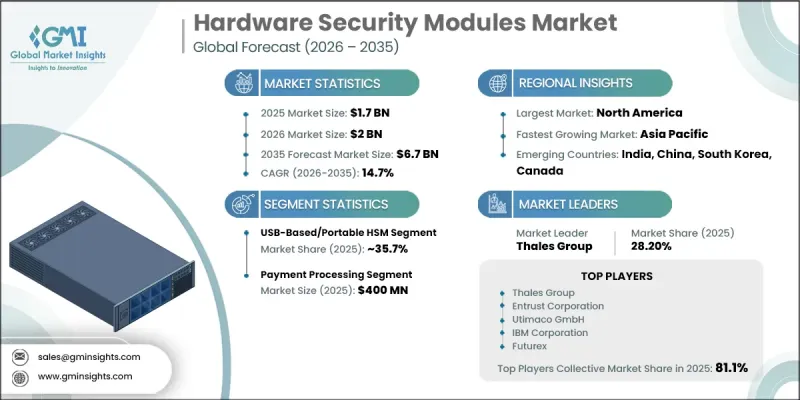
市場擴張是由多種因素共同推動的:日益頻繁的複雜網路攻擊暴露了純軟體金鑰管理方法的漏洞;以及PCI DSS v4.0、GDPR和NIS2指令等嚴格的全球法規結構。其中一個關鍵成長要素是基於雲端的「HSM即服務」解決方案的日益普及,這降低了中型企業的進入門檻,同時保持了強大的加密安全標準。銀行、醫療保健和關鍵基礎設施等行業的組織擴大部署基於硬體的「信任根」系統,以保護加密金鑰的產生、儲存和生命週期管理。網路威脅日益複雜,尤其是針對加密金鑰而非加密資料本身的攻擊,進一步凸顯了硬體隔離作為核心安全要求的重要性。此外,合規主導的安全投資和數位支付生態系統的擴展也提振了全球各產業對硬體安全模組(HSM)的長期需求。
| 市場範圍 | |
|---|---|
| 開始年份 | 2025 |
| 預測期 | 2026-2035 |
| 初始市場規模 | 17億美元 |
| 預計金額 | 67億美元 |
| 複合年成長率 | 14.7% |
預計到2025年,基於USB的可攜式HSM市場規模將達到6億美元,佔市場佔有率的35.7%,並預計在2035年之前以15%的複合年成長率成長。該細分市場之所以保持強勁勢頭,是因為其在安全認證、數位簽章流程和分散式身分識別管理工作流程中的廣泛應用,而這些領域對緊湊且便攜的安全設備有著迫切的需求。可攜式HSM在安全開發環境和企業安全架構中的日益普及,將繼續推動該細分市場在各個需要靈活加密解決方案的行業中的成長。
預計到2025年,支付處理應用市場規模將達到4億美元,並在2035年之前以15.1%的複合年成長率成長。該市場受益於對安全交易處理系統的迫切需求,這些系統能夠管理加密金鑰、身份驗證協議和支付檢驗功能。全球不斷擴展的數位支付生態系統,以及對金融交易安全性的嚴格合規要求,確保了支付基礎設施中對基於硬體的加密系統的穩定需求。
預計2025年,北美硬體安全模組(HSM)市場規模將達到5億美元,佔30%的市佔率。該地區的市場領先地位主要得益於金融機構、政府機構和雲端服務供應商的大力推廣應用。高度監管的網路安全環境持續推動各行各業部署基於硬體的加密系統,從而刺激了市場對安全加密基礎設施的長期需求和投資。
目錄
第1章:調查方法和範圍
第2章執行摘要
第3章 行業洞察
- 產業生態系分析
- 影響產業的因素
- 促進因素
- 網路安全威脅和資料外洩事件日益增多
- 雲端和混合雲端安全技術的日益普及
- 嚴格的資料保護和合法令遵循
- 數位支付的擴展和銀行業務的安全性
- 產業潛在風險與挑戰
- 較高的初始安裝和維護成本
- 與傳統IT基礎設施的複雜整合
- 市場機遇
- 後量子密碼學(PQC)應用擴展
- 對硬體安全模組即服務 (HSMaaS) 的需求不斷成長
- 促進因素
- 成長潛力分析
- 監理情勢
- 技術展望
- 最新科技趨勢
- 新興技術
- 價格趨勢分析
- 未來市場趨勢
- 專利分析
- 波特的分析
- PESTLE分析
- 人工智慧和生成式人工智慧對市場的影響
- 價值鏈分析
- 投資與資金籌措分析
- 消費者洞察
第4章 競爭情勢
- 介紹
- 企業市佔率分析:按地區分類
- 北美洲
- 歐洲
- 亞太地區
- 中東和非洲
- 拉丁美洲
- 主要進展
- 重要合作夥伴關係和合作
- 主要併購活動
- 產品創新和新產品發布
- 市場擴大策略
- 競爭定位矩陣
第5章 市場規模及預測:依類型分類,2022-2035年
- 基於區域網路/網路連線的HSM
- 基於 USB 的/可攜式HSM
- 基於PCI的/內建HSM
- 基於智慧卡的HSM
- 其他
第6章 市場規模與預測:依部署模式分類,2022-2035年
- 現場
- 基於雲端的(即服務)
- 其他
第7章 市場規模及預測:依應用領域分類,2022-2035年
- 支付處理
- 程式碼和文檔簽名
- SSL/TLS憑證管理
- 認證
- 資料庫加密
- PKI 和身分驗證資訊管理
- 應用層級加密
- 數位版權管理(DRM)
- 其他
第8章 市場規模及預測:依最終用戶產業分類,2022-2035年
- 銀行、金融服務和保險(BFSI)
- 政府/國防
- 資訊科技/通訊
- 醫療保健和生命科學
- 製造業和工業
- 能源公用事業
- 零售和消費品
- 航太/國防
- 其他
第9章 市場規模及預測:依地區分類,2022-2035年
- 北美洲
- 美國
- 加拿大
- 歐洲
- 德國
- 法國
- 英國
- 西班牙
- 義大利
- 亞太地區
- 中國
- 日本
- 韓國
- 印度
- 澳洲
- 中東和非洲
- 沙烏地阿拉伯
- UAE
- 南非
- 拉丁美洲
- 巴西
- 阿根廷
- 墨西哥
第10章:公司簡介
- Adweb Technologies
- Amazon Web Services(AWS)
- DINAMO Networks
- ellipticSecure
- Entrust Corporation
- ETAS GmbH
- Fortanix
- IBM Corporation
- Futurex
- Infineon Technologies AG
- JISA Softech Pvt. Ltd.
- Kryptoagile Solutions Pvt. Ltd.
- Microchip Technology Inc.
- Microsoft Corporation
- Nitrokey
- Securosys SA
- Spyrus
- STMicroelectronics
- Thales Group
- Utimaco GmbH
- Yubico
The Global Hardware Security Modules Market was valued at USD 1.7 billion in 2025 and is estimated to grow at a CAGR of 14.7% to reach USD 6.7 billion by 2035.
Market expansion is driven by the increasing frequency of advanced cyberattacks that expose vulnerabilities in software-only key management approaches, along with stringent global regulatory frameworks such as PCI DSS v4.0, GDPR, and the NIS2 Directive. A major growth catalyst is the rising adoption of cloud-based HSM-as-a-Service solutions, which are lowering deployment barriers for mid-sized enterprises while maintaining strong cryptographic security standards. Organizations across banking, healthcare, and critical infrastructure are increasingly adopting hardware-based root-of-trust systems to secure cryptographic key generation, storage, and lifecycle management. The growing sophistication of cyber threats, particularly attacks targeting encryption keys rather than encrypted data itself, has elevated the importance of hardware isolation as a core security requirement. Additionally, compliance-driven security investments and the expansion of digital payment ecosystems are reinforcing the long-term demand outlook for hardware security modules across global industries.
| Market Scope | |
|---|---|
| Start Year | 2025 |
| Forecast Year | 2026-2035 |
| Start Value | $1.7 Billion |
| Forecast Value | $6.7 Billion |
| CAGR | 14.7% |
The USB-based and portable HSM segment accounted for USD 600 million in 2025, representing 35.7% share, and is expected to grow at a CAGR of 15% through 2035. This segment maintains a strong position due to its widespread use in secure authentication, digital signing processes, and distributed identity management workflows where compact and portable security devices are required. Increasing integration of portable HSMs into secure development environments and enterprise security architectures continues to support segment growth across various industries requiring flexible cryptographic solutions.
The payment processing application segment was valued at USD 400 million in 2025 and is forecast to grow at a CAGR of 15.1% through 2035. This segment benefits from the critical need for secure transaction processing systems that manage encryption keys, authentication protocols, and payment verification functions. The expanding global digital payments ecosystem, combined with stringent compliance requirements for financial transaction security, ensures consistent demand for hardware-based encryption systems in payment infrastructure.
North America Hardware Security Modules Market accounted for USD 500 million in 2025, which represented 30% share. The region's dominance is supported by strong adoption across financial institutions, government organizations, and cloud service providers. A highly regulated cybersecurity environment continues to drive mandatory adoption of hardware-based encryption systems across multiple sectors, reinforcing sustained market demand and long-term investment in secure cryptographic infrastructure.
Major players operating in the global hardware security modules market include Amazon Web Services (AWS), IBM Corporation, Microsoft Corporation, Thales Group, Entrust Corporation, Utimaco GmbH, Infineon Technologies AG, STMicroelectronics, Microchip Technology Inc., Yubico, Nitrokey, Securosys SA, Futurex, Fortanix, Spyrus, Adweb Technologies, DINAMO Networks, ellipticSecure, ETAS GmbH, JISA Softech Pvt. Ltd., and Kryptoagile Solutions Pvt. Ltd. Companies operating in the hardware security modules market are strengthening their market position through continuous innovation in cloud-integrated HSM solutions and scalable cryptographic architectures. Vendors are focusing on hybrid deployment models that combine on-premises security with HSM-as-a-Service offerings to meet diverse enterprise requirements. Significant investments in research and development are enabling improvements in encryption performance, compliance readiness, and key lifecycle automation. Strategic partnerships with cloud service providers and cybersecurity firms are expanding global distribution capabilities and accelerating enterprise adoption. Companies are also enhancing product interoperability across multi-cloud environments to support digital transformation initiatives.
Table of Contents
Chapter 1 Methodology & Scope
- 1.1 Research approach
- 1.2 Quality commitments
- 1.2.1 GMI AI policy & data integrity commitment
- 1.2.1.1 Source consistency protocol
- 1.2.1 GMI AI policy & data integrity commitment
- 1.3 Research trail & confidence scoring
- 1.3.1 Research trail components
- 1.3.2 Scoring components
- 1.4 Data collection
- 1.4.1 Partial list of primary sources
- 1.5 Data mining sources
- 1.5.1 Paid sources
- 1.5.1.1 Sources, by region
- 1.5.1 Paid sources
- 1.6 Base estimates and calculations
- 1.6.1 Base year calculation for any one approach
- 1.7 Market estimates & forecasts parameters
- 1.8 Forecast model
- 1.8.1 Quantified market impact analysis
- 1.8.1.1 Mathematical impact of growth parameters on forecast
- 1.8.1 Quantified market impact analysis
- 1.9 Research transparency addendum
- 1.9.1 Source attribution framework
- 1.9.2 Quality assurance metrics
- 1.9.3 Our commitment to trust
- 1.10 Market definitions
Chapter 2 Executive Summary
- 2.1 Industry synopsis, 2022 - 2035
- 2.1.1 Type trends
- 2.1.2 Deployment Mode trends
- 2.1.3 Application trends
- 2.1.4 End-user Industry trends
- 2.1.5 Regional trends
Chapter 3 Industry Insights
- 3.1 Industry ecosystem analysis
- 3.2 Industry impact forces
- 3.2.1 Growth drivers
- 3.2.1.1 Rising Cybersecurity Threats and Data Breaches
- 3.2.1.2 Growing Adoption of Cloud and Hybrid Cloud Security
- 3.2.1.3 Stringent Data Protection and Compliance Regulation
- 3.2.1.4 Expansion of Digital Payments and Banking Security
- 3.2.2 Industry pitfalls and challenges
- 3.2.2.1 High Initial Deployment and Maintenance Cost
- 3.2.2.2 Complex Integration with Legacy IT Infrastructure
- 3.2.3 Market opportunities
- 3.2.3.1 Expansion of Post-Quantum Cryptography (PQC) Adoption
- 3.2.3.2 Increasing Demand for HSM-as-a-Service (HSMaaS)
- 3.2.1 Growth drivers
- 3.3 Growth potential analysis
- 3.4 Regulatory landscape (Driven by primary research)
- 3.4.1 North America
- 3.4.2 Europe
- 3.4.3 Asia Pacific
- 3.4.4 Latin America
- 3.4.5 MEA
- 3.5 Technology landscape
- 3.5.1 Current technological trends
- 3.5.2 Emerging technologies
- 3.6 Pricing trend analysis (Driven by primary research)
- 3.7 Future market trends
- 3.8 Patent analysis
- 3.9 Porter's analysis
- 3.10 PESTEL analysis
- 3.11 Impact of AI and Generative AI on the market (Driven by primary research)
- 3.12 Value chain analysis (Driven by primary research)
- 3.13 Investment & funding analysis (Driven by primary research)
- 3.14 Consumer insights (Driven by primary research)
Chapter 4 Competitive Landscape, 2025
- 4.1 Introduction
- 4.2 Company market share analysis, by region, 2025
- 4.2.1 North America
- 4.2.2 Europe
- 4.2.3 Asia Pacific
- 4.2.4 Middle East & Africa
- 4.2.5 Latin America
- 4.3 Key developments
- 4.3.1 Key partnerships & collaborations
- 4.3.2 Major M&A activities
- 4.3.3 Product innovations & launches
- 4.3.4 Market expansion strategies
- 4.4 Competitive positioning matrix
Chapter 5 Market Size and Forecast, By Type, 2022 - 2035 (USD Million)
- 5.1 Key trends
- 5.2 LAN-Based/Network-Attached HSM
- 5.3 USB-Based/Portable HSM
- 5.4 PCI-Based/Internal HSM
- 5.5 Smart Card-based HSM
- 5.6 Others
Chapter 6 Market Size and Forecast, By Deployment Mode, 2022 - 2035 (USD Million)
- 6.1 Key trends
- 6.2 On-Premises
- 6.3 Cloud-Based (as-a-Service)
- 6.4 Others
Chapter 7 Market Size and Forecast, By Application, 2022 - 2035 (USD Million)
- 7.1 Key trends
- 7.2 Payment Processing
- 7.3 Code & Document Signing
- 7.4 SSL/TLS Certificate Management
- 7.5 Authentication
- 7.6 Database Encryption
- 7.7 PKI & Credential Management
- 7.8 Application-level Encryption
- 7.9 Digital Rights Management (DRM)
- 7.10 Others
Chapter 8 Market Size and Forecast, By End-user Industry, 2022 - 2035 (USD Million)
- 8.1 Banking, Financial Services, and Insurance (BFSI)
- 8.2 Government and Defense
- 8.3 IT & Telecommunications
- 8.4 Healthcare & Life Sciences
- 8.5 Manufacturing & Industrial
- 8.6 Energy & Utilities
- 8.7 Retail & Consumer Goods
- 8.8 Aerospace & Defense
- 8.9 Others
Chapter 9 Market Size and Forecast, By Region, 2022 - 2035 (USD Million)
- 9.1 Key trends
- 9.2 North America
- 9.2.1 U.S.
- 9.2.2 Canada
- 9.3 Europe
- 9.3.1 Germany
- 9.3.2 France
- 9.3.3 UK
- 9.3.4 Spain
- 9.3.5 Italy
- 9.4 Asia Pacific
- 9.4.1 China
- 9.4.2 Japan
- 9.4.3 South Korea
- 9.4.4 India
- 9.4.5 Australia
- 9.5 Middle East & Africa
- 9.5.1 Saudi Arabia
- 9.5.2 UAE
- 9.5.3 South Africa
- 9.6 Latin America
- 9.6.1 Brazil
- 9.6.2 Argentina
- 9.6.3 Mexico
Chapter 10 Company Profiles
- 10.1 Adweb Technologies
- 10.2 Amazon Web Services (AWS)
- 10.3 DINAMO Networks
- 10.4 ellipticSecure
- 10.5 Entrust Corporation
- 10.6 ETAS GmbH
- 10.7 Fortanix
- 10.8 IBM Corporation
- 10.9 Futurex
- 10.10 Infineon Technologies AG
- 10.11 JISA Softech Pvt. Ltd.
- 10.12 Kryptoagile Solutions Pvt. Ltd.
- 10.13 Microchip Technology Inc.
- 10.14 Microsoft Corporation
- 10.15 Nitrokey
- 10.16 Securosys SA
- 10.17 Spyrus
- 10.18 STMicroelectronics
- 10.19 Thales Group
- 10.20 Utimaco GmbH
- 10.21 Yubico

 硬體安全模組市場-2026-2032年全球市場預測
 全球硬體安全模組市場:市場規模、佔有率、趨勢和成長分析(2026-2034)
 全球硬體安全模組市場:按類型、技術、部署模式、組織規模、應用、產業和地區分類-預測至2032年硬體安全模組市場:策略洞察與預測(2026-2031 年)
 HSM供應商:認證狀態與PQC合規狀態硬體安全模組硬體安全模組市場數據概覽:2026年第二季度
 硬體安全模組市場規模、佔有率和趨勢分析報告:按類型、部署模式、應用、最終用途、地區和細分市場預測(2026-2033 年)
 硬體安全模組:市場佔有率分析、產業趨勢與統計、成長預測(2026-2031)
 2026年量子安全硬體安全模組全球市場報告