

 |
市場調查報告書
商品編碼
2101905
不織布嬰兒尿布市場機會、成長要素、產業趨勢分析及2026-2035年預測。Nonwoven Baby Diaper Market Opportunity, Growth Drivers, Industry Trend Analysis, and Forecast 2026 - 2035 |
||||||

全球不織布嬰兒尿布市場預計到 2025 年將達到 250 億美元,到 2035 年將以 5% 的複合年成長率成長至 409 億美元。
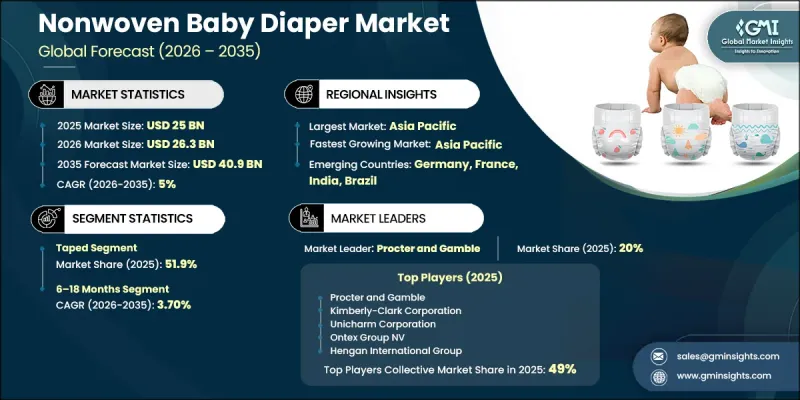
市場成長由兩個並行的結構性因素所驅動。一方面,亞太地區、拉丁美洲和撒哈拉以南非洲地區嬰兒數量和可支配收入的成長帶動了整體消費量的成長。另一方面,成熟經濟體正穩步推動優質化,專注於皮膚健康、舒適度和環保材料的創新提升了產品價值,並在人口成長放緩的情況下實現了永續的收入成長。在市場滲透率仍在發展的新興經濟體,出生率與尿布消費量之間的相關性尤其顯著,人口成長直接促進了消費量的成長。同時,消費者對便利性和衛生標準的不斷提高也推動了產品的持續升級,從而增強了該品類在全球市場的長期穩定性。
| 市場範圍 | |
|---|---|
| 開始年份 | 2025 |
| 預測期 | 2026-2035 |
| 上市時的市場規模 | 250億美元 |
| 預測金額 | 409億美元 |
| 複合年成長率 | 5% |
預計到2025年,膠帶式尿布將佔據51.9%的市場佔有率,2026年至2035年的複合年成長率預計為3.30%。此細分市場持續維持主導地位,主要得益於其對新生兒和嬰幼兒的高度適用性。其優點在於可調節的固定系統,能夠實現個人化貼合,並有效防止滲漏。此外,傳統零售通路中豐富的產品種類也持續推動市場成長,而看護者對產品的熟悉程度和既定的購買習慣也顯著影響他們的購買決策。
預計到2025年,6-18個月年齡層的尿布市佔率將達到38.7%,並在2035年之前以3.70%的複合年成長率成長。這段時期是尿布使用高峰期,隨著兒童運動技能的發展,他們對尿布的吸水性、舒適性和防漏性等性能要求也日益提高。該年齡層的尿布既有膠帶式,也有拉拉褲式,產品性能、認證和價格等方面的競爭異常激烈。
預計到2025年,北美不織布嬰兒尿布市場佔有率將達到19%,並在2035年之前以5.50%的複合年成長率成長,這主要得益於消費者對高階衛生用品的強勁需求以及電子商務的日益普及。美國是該地區消費的領頭羊,這得益於其成熟的零售生態系統以及訂閱式購買模式的日益普及,這些模式確保了穩定的家庭供應。
目錄
第1章:調查方法
第2章執行摘要
第3章 行業洞察
- 產業生態系分析
- 影響價值鏈的因素
- 利潤率分析
- 中斷
- 未來展望
- 製造商
- 中斷
- 供應商情況
- 主要新聞和舉措
- 技術與創新展望
- 監理情勢
- 對產業的影響
- 促進因素
- 產業潛在風險與挑戰
- 機會
- 波特的分析
- PESTLE分析
- 價格分析
- 2019-2024年歷史價格趨勢分析
- 定價策略:按業務類型分類
- 貿易數據分析
- 進出口量及進口額趨勢
- 主要貿易路線及關稅的影響
- 人工智慧和生成式人工智慧對市場的影響
- 利用人工智慧改造現有經營模式
- 按細分市場分類的生成式人工智慧用例和部署藍圖
- 風險、限制和監管考量
- 目前分銷基礎設施和通路滲透情況
- 按地區與業態(現代零售與傳統零售)分類的通路覆蓋率
- 缺乏最後一公里基礎設施和不斷變化的管道
第4章 競爭情勢
- 介紹
- 企業市佔率分析
- 競爭定位矩陣
- 戰略展望矩陣
- 主要市場公司的競爭分析
- 主要進展
- 併購
- 夥伴關係和聯盟
- 新產品發布
- 業務拓展計劃
第5章 市場估計與預測:依類型分類,2022-2035年
- 一次性的
- 可重複使用的
第6章 市場估計與預測:依類別分類,2022-2035年
- 褲型
- 磁帶類型
第7章 市場估價與預測:依尿布尺寸分類,2022-2035年
- 小號/特小號
- 中型的
- 大的
- 特大號
第8章 市場估價與預測:依包裝尺寸分類,2022-2035年
- 0-20 件
- 20-40件
- 40-60 件
- 60歲或以上
第9章 市場估計與預測:依吸收程度分類,2022-2035年
- 低的
- 高的
第10章 市場估計與預測:依年齡層別分類,2022-2035年
- 0-6個月
- 6-18個月
- 18-24個月
- 2歲以上
第11章 市場估價與預測:依價格分類,2022-2035年
- 低的
- 中等的
- 高的
第12章 市場估計與預測:依通路分類,2022-2035年
- 線上
- 電子商務網站
- 我們的網站
- 離線
- 大賣場和超級市場
- 專賣店
- 藥局/藥局
- 其他零售店
第13章 市場估計與預測:依地區分類,2022-2035年
- 北美洲
- 美國
- 加拿大
- 歐洲
- 德國
- 英國
- 法國
- 義大利
- 西班牙
- 亞太地區
- 中國
- 印度
- 日本
- 韓國
- 澳洲
- 拉丁美洲
- 巴西
- 墨西哥
- 阿根廷
- 中東和非洲
- UAE
- 沙烏地阿拉伯
- 南非
第14章:公司簡介
- 世界公司
- Procter & Gamble
- Kimberly-Clark Corporation
- Unicharm Corporation
- Kao Corporation
- Essity AB
- Ontex Group NV
- Hengan International Group
- 本地公司
- Hayat Kimya
- Fine Hygienic Holding(FHH)
- Nobel Hygiene Pvt. Ltd.
- Daio Paper Corporation
- TZMO SA
- First Quality Enterprises
- Attindas Hygiene Partners(AHP)
- Drylock Technologies NV
- 新興企業
- Grupo PI Mabe
- Chiaus(Fujian Chiaus Industrial)
- Softys
- Abena A/S
- The Honest Company
- Delipap Oy
The Global Nonwoven Baby Diaper Market was valued at USD 25 billion in 2025 and is estimated to grow at a CAGR of 5% to reach USD 40.9 billion by 2035.
Market growth is shaped by two parallel structural drivers. On one side, expanding infant populations and rising disposable incomes across Asia Pacific, Latin America, and sub-Saharan Africa are increasing overall consumption volumes. On the other side, mature economies are witnessing steady premiumization, where innovation focused on skin health, comfort, and eco-friendly materials is supporting higher product value and sustained revenue growth despite slower demographic expansion. The link between birth rates and diaper consumption remains particularly strong in emerging economies where market penetration is still developing, making demographic growth a direct contributor to volume expansion. At the same time, evolving consumer expectations around convenience and hygiene standards are encouraging continuous product upgrades, reinforcing long-term category stability across global markets.
| Market Scope | |
|---|---|
| Start Year | 2025 |
| Forecast Year | 2026-2035 |
| Start Value | $25 Billion |
| Forecast Value | $40.9 Billion |
| CAGR | 5% |
Taped diapers accounted for 51.9% share in 2025, with a projected CAGR of 3.30% from 2026 to 2035. This segment maintains leadership due to its strong suitability for newborns and younger infants, where adjustable fastening systems provide improved fit control and leak protection. It continues to benefit from strong availability across traditional retail formats, where caregiver familiarity and established purchasing habits strongly influence buying decisions.
The 6 to 18 months age group segment held 38.7% share in 2025 and is projected to grow at a CAGR of 3.70% through 2035. This stage reflects peak diaper usage intensity, where mobility increases and performance expectations such as absorbency, comfort, and leakage prevention become more critical. Both taped and pant-style diapers serve this segment, with strong competition based on product performance, certifications, and affordability.
North America Nonwoven Baby Diaper Market accounted for 19% share in 2025 and is expected to grow at a CAGR of 5.50% through 2035, driven by strong demand for premium hygiene products and expanding e-commerce penetration. The United States leads regional consumption, supported by well-established retail ecosystems and rising adoption of subscription-based purchasing models that ensure consistent household supply.
Major companies operating in the global nonwoven baby diaper industry include Procter & Gamble, Kimberly-Clark Corporation, Unicharm Corporation, Kao Corporation, Hengan International Group, Oji Holdings Corporation, Daio Paper Corporation, Pigeon Corporation, DSG International (Thailand) PCL, Chiaus (Fujian Chiaus Industrial Development Co.), Anpers Industries Sdn. Bhd., Fujian Panda Diaper Co., Ltd., Fujian Leo Paper (Liao Paper) Co., Ltd., Foshan HuiYingLe Sanitary Products Co., Ltd., New Yifa Group Co., Ltd., NTPM Holdings Berhad, Nobel Hygiene Pvt. Ltd., Taisun Vietnam Co., Ltd., Swara Baby Products Pvt. Ltd., Uniclan Healthcare Pvt. Ltd., and Wipro Consumer Care & Lighting. Companies operating in the nonwoven baby diaper market are focusing on strengthening their competitive position through continuous product innovation centered on enhanced absorbency, skin-friendly materials, and breathable nonwoven fabrics. Manufacturers are investing in sustainable diaper solutions using biodegradable and plant-based materials to meet rising environmental expectations. Expansion of premium product lines targeting urban consumers is also a key strategy, supported by advanced leakage protection and comfort technologies. Market players are strengthening distribution through e-commerce platforms, subscription-based delivery models, and organized retail partnerships to improve accessibility and repeat purchases.
Table of Contents
Chapter 1 Research Methodology
- 1.1 Research approach
- 1.2 Quality Commitments
- 1.2.1 GMI AI policy & data integrity commitment
- 1.2.1.1 Source consistency protocol
- 1.2.1 GMI AI policy & data integrity commitment
- 1.3 Research Trail & Confidence Scoring
- 1.3.1 Research Trail Components
- 1.3.2 Scoring Components
- 1.4 Data Collection
- 1.4.1 Partial list of primary sources
- 1.5 Data mining sources
- 1.5.1 Paid sources
- 1.5.1.1 Sources, by region
- 1.5.1 Paid sources
- 1.6 Base estimates and calculations
- 1.6.1 Base year calculation for any one approach
- 1.7 Forecast model
- 1.7.1 Quantified market impact analysis
- 1.7.1.1 Mathematical impact of growth parameters on forecast
- 1.7.1 Quantified market impact analysis
- 1.8 Research transparency addendum
- 1.8.1 Source attribution framework
- 1.8.2 Quality assurance metrics
- 1.8.3 Our commitment to trust
Chapter 2 Executive Summary
- 2.1 Industry 360° synopsis, 2022 - 2035
- 2.2 Key market trends
- 2.2.1 Regional
- 2.2.2 Type
- 2.2.3 Category
- 2.2.4 Diaper Size
- 2.2.5 Pack Size
- 2.2.6 Absorption Level
- 2.2.7 Age Group
- 2.2.8 Price
- 2.2.9 Distribution Channel
Chapter 3 Industry Insights
- 3.1 Industry ecosystem analysis
- 3.1.1 Factor affecting the value chain
- 3.1.2 Profit margin analysis
- 3.1.3 Disruptions
- 3.1.4 Future outlook
- 3.1.5 Manufacturers
- 3.1.6 Distributors
- 3.2 Supplier landscape
- 3.3 Key news & initiatives
- 3.4 Technology & Innovation Landscape
- 3.5 Regulatory landscape
- 3.6 Impact on forces
- 3.6.1 Growth drivers
- 3.6.2 Industry pitfalls & challenges
- 3.6.3 Opportunities
- 3.7 Porter's analysis
- 3.8 PESTEL analysis
- 3.9 Pricing analysis (driven by primary research)
- 3.9.1 Historical Price Trend Analysis, 2019-2024 (Driven by Primary Research)
- 3.9.2 Pricing Strategy by Player Type (Driven by Primary Research)
- 3.10 Trade data analysis (driven by paid database)
- 3.10.1 Import/Export Volume & Value Trends (Driven by Primary Research)
- 3.10.2 Key Trade Corridors & Tariff Impact (Driven by Primary Research)
- 3.11 Impact of AI & Generative AI on the Market
- 3.11.1 AI-Driven Disruption of Existing Business Models
- 3.11.2 GenAI Use Cases & Adoption Roadmap by Segment
- 3.11.3 Risks, Limitations & Regulatory Considerations
- 3.12 Distribution Infrastructure & Channel Penetration Landscape (Driven by Primary Research)
- 3.12.1 Channel Coverage by Region & Format (Modern vs. Traditional Trade) (Driven by Primary Research)
- 3.12.2 Last-Mile Infrastructure Gaps & Emerging Channel Shifts (Driven by Primary Research)
Chapter 4 Competitive Landscape, 2025
- 4.1 Introduction
- 4.2 Company market share analysis
- 4.3 Competitive positioning matrix
- 4.4 Strategic outlook matrix
- 4.5 Competitive analysis of major market players
- 4.6 Key developments
- 4.6.1 Mergers & acquisitions
- 4.6.2 Partnerships & collaborations
- 4.6.3 New product launches
- 4.6.4 Expansion plans
Chapter 5 Market Estimates and Forecast, By type, 2022 - 2035 (USD Billion, Thousand Units)
- 5.1 Key trends
- 5.2 Disposable
- 5.3 Reusable
Chapter 6 Market Estimates and Forecast, By Category, 2022 - 2035 (USD Billion, Thousand Units)
- 6.1 Key trends
- 6.2 Pant
- 6.3 Taped
Chapter 7 Market Estimates and Forecast, By Diaper Size, 2022 - 2035(USD Billion, Thousand Units)
- 7.1 Key trends
- 7.2 Small/Extra small
- 7.3 Medium
- 7.4 Large
- 7.5 Extra large
Chapter 8 Market Estimates and Forecast, By Pack Size, 2022 - 2035 (USD Billion, Thousand Units)
- 8.1 Key trends
- 8.2 0-20 count
- 8.3 20-40 count
- 8.4 40-60 count
- 8.5 Above 60 count
Chapter 9 Market Estimates and Forecast, By Absorption Level, 2022 - 2035 (USD Billion, Thousand Units)
- 9.1 Key trends
- 9.2 Low
- 9.3 High
Chapter 10 Market Estimates and Forecast, By Age Group, 2022 - 2035 (USD Billion, Thousand Units)
- 10.1 Key trends
- 10.2 0-6 months
- 10.3 6-18 months
- 10.4 18-24 months
- 10.5 Above 2 years
Chapter 11 Market Estimates and Forecast, By Price, 2022 - 2035 (USD Billion, Thousand Units)
- 11.1 Key trends
- 11.2 Low
- 11.3 Medium
- 11.4 High
Chapter 12 Market Estimates and Forecast, By Distribution Channel, 2022 - 2035 (USD Billion, Thousand Units)
- 12.1 Key trends
- 12.2 Online
- 12.2.1 E-Commerce website
- 12.2.2 Company's website
- 12.3 Offline
- 12.3.1 Hypermarkets & supermarkets
- 12.3.2 Specialty store
- 12.3.3 Pharmacies/Drug stores
- 12.3.4 Other retail stores
Chapter 13 Market Estimates & Forecast, By Region, 2022 - 2035, (USD Billion, Thousand Units)
- 13.1 Key trends
- 13.2 North America
- 13.2.1 U.S.
- 13.2.2 Canada
- 13.3 Europe
- 13.3.1 Germany
- 13.3.2 U.K.
- 13.3.3 France
- 13.3.4 Italy
- 13.3.5 Spain
- 13.4 Asia Pacific
- 13.4.1 China
- 13.4.2 India
- 13.4.3 Japan
- 13.4.4 South Korea
- 13.4.5 Australia
- 13.5 Latin America
- 13.5.1 Brazil
- 13.5.2 Mexico
- 13.5.3 Argentina
- 13.6 MEA
- 13.6.1 UAE
- 13.6.2 Saudi Arabia
- 13.6.3 South Africa
Chapter 14 Company Profiles
- 14.1 Global players
- 14.1.1 Procter & Gamble
- 14.1.2 Kimberly-Clark Corporation
- 14.1.3 Unicharm Corporation
- 14.1.4 Kao Corporation
- 14.1.5 Essity AB
- 14.1.6 Ontex Group NV
- 14.1.7 Hengan International Group
- 14.2 Regional players
- 14.2.1 Hayat Kimya
- 14.2.2 Fine Hygienic Holding (FHH)
- 14.2.3 Nobel Hygiene Pvt. Ltd.
- 14.2.4 Daio Paper Corporation
- 14.2.5 TZMO SA
- 14.2.6 First Quality Enterprises
- 14.2.7 Attindas Hygiene Partners (AHP)
- 14.2.8 Drylock Technologies NV
- 14.3 Emerging players
- 14.3.1 Grupo P.I. Mabe
- 14.3.2 Chiaus (Fujian Chiaus Industrial)
- 14.3.3 Softys
- 14.3.4 Abena A/S
- 14.3.5 The Honest Company
- 14.3.6 Delipap Oy

 全球布尿布市場規模、佔有率、成長、全球產業分析、區域趨勢及2026年至2034年預測。嬰兒布尿布市場規模、佔有率、成長、全球產業分析、區域趨勢及2026年至2034年預測。
 嬰兒尿布市場:按類型、類別、形狀、材料、包裝尺寸、最終用戶和分銷管道分類-2026-2032年全球市場預測
 2026-2030年全球嬰兒尿布市場
 2026-2030年全球嬰兒尿布桶市場
 嬰兒尿布市場報告:趨勢、預測與競爭分析(至2035年)
 布尿布市場規模、佔有率和成長分析:按產品類型、材料類型、尺寸類型、分銷管道、最終用戶和地區分類-2026-2033年產業預測
 嬰兒尿布市場:依產品類型、風格、銷售管道及地區分類布尿布市場:按類型、材料、銷售管道和最終用戶分類-2026-2032年全球市場預測全球一次性及永續嬰兒尿布市場規模、佔有率、趨勢及成長分析報告(2026-2034)