


 |
市場調查報告書
商品編碼
2101875
發泡包裝市場:商業機會、成長要素、產業趨勢分析及2026-2035年預測Foam Packaging Market Opportunity, Growth Drivers, Industry Trend Analysis, and Forecast 2026 - 2035 |
||||||

全球發泡包裝市場預計到 2025 年將達到 201 億美元,到 2035 年將以 6% 的複合年成長率成長至 356 億美元。
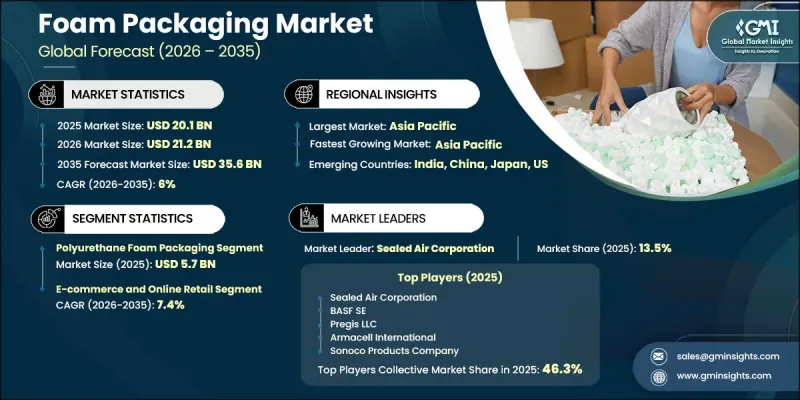
這一成長主要得益於線上零售的快速擴張,這顯著增加了小包裹遞送中對防護和隔熱包裝材料的需求。同時,全球醫療和食品配送通路中對溫度敏感型商品的需求不斷成長,也推動了高性能隔熱解決方案的需求。對發泡聚苯乙烯材料的監管限制迫使企業重新評估生產策略,並加速向可回收、生物基和工程發泡材等替代材料的轉型。發泡包裝在整個物流網路中繼續發揮保護易碎產品和生鮮產品的關鍵作用,提供緩衝、減震和熱穩定性。都市化進程的加速和直接面對消費者的供應鏈模式的轉變,進一步擴大了泡棉包裝在各行各業的應用。然而,針對一次性塑膠發泡製品的環保法規正在推動材料創新和產品重新設計,並專注於整個價值鏈的永續性。
| 市場範圍 | |
|---|---|
| 開始年份 | 2025 |
| 預測期 | 2026-2035 |
| 初始市場規模 | 201億美元 |
| 預測金額 | 356億美元 |
| 複合年成長率 | 6% |
聚氨酯泡棉包裝市場銷售額達57億美元,市佔率為28.3%,這主要得益於其在緩衝、隔熱和客製化模塑包裝等領域的廣泛應用。聚氨酯泡棉密度範圍廣,設計靈活,因此用途廣泛,從輕型防護包裝到高精度工業應用都有涉及。儘管某些發泡材料的監管壓力日益增加,但市場需求仍然強勁。
預計到2025年,電子商務和線上零售市場規模將達到68億美元。這一成長反映了小包裹處理量的增加以及對保護性包裝需求的成長,尤其是對於電子產品、個人保健產品和生鮮食品等高價值貨物的保護性包裝。由於發泡材保護系統具有良好的緩衝性能和可靠性,能夠有效減少運輸過程中的損壞,因此在履約配送中廣泛應用。
預計2025年,北美發泡包裝市場規模將達到53億美元,到2035年將達到91億美元,年複合成長率為5.7%。美國佔據了該地區需求的大部分,這得益於其高度發展的電子商務物流網路以及大規模的醫藥和零售分銷系統。
目錄
第1章:調查方法和範圍
第2章執行摘要
第3章 行業洞察
- 產業生態系分析
- 影響產業的因素
- 促進因素
- 電子商務和小包裹遞送服務的擴展
- 食品和飲料行業的需求不斷成長
- 擴大醫藥和醫療保健物流
- 工業和電子製造業的擴張
- 產業潛在風險與挑戰
- 對發泡塑膠的嚴格環境法規
- 石化原料價格波動
- 市場機遇
- 開發生物基和可回收發泡包裝解決方案
- 低溫運輸和醫藥物流需求不斷增加。
- 促進因素
- 成長潛力分析
- 監理情勢
- 技術展望
- 最新科技趨勢
- 新興技術
- 價格趨勢分析
- 未來市場趨勢
- 專利分析
- 波特的分析
- PESTLE分析
- 人工智慧和生成式人工智慧對市場的影響
- 價值鏈分析
- 投資與資金籌措分析
- 消費者洞察
第4章 競爭情勢
- 介紹
- 企業市佔率分析:按地區分類
- 北美洲
- 歐洲
- 亞太地區
- 中東和非洲
- 拉丁美洲
- 主要進展
- 重要合作夥伴關係和合作
- 主要併購活動
- 產品創新和新產品發布
- 市場擴大策略
- 競爭定位矩陣
第5章 市場規模及預測:依材料類型分類,2022-2035年
- 聚氨酯(PU)泡棉包裝
- 聚苯乙烯發泡包裝
- 發泡聚苯乙烯(EPS)
- 擠塑聚苯乙烯(XPS)
- 聚乙烯(PE)發泡包裝材料
- 聚丙烯(PP)發泡包裝材料
- 生物基永續發泡包裝材料
- 基於PLA的發泡體
- 澱粉基發泡體
- 菌絲體和新型生物材料
- 含有再生材料的發泡體
- 其他特殊發泡體
第6章 市場規模及預測:依包裝形式分類,2022-2035年
- 緩衝材料和縫隙填充材
- 模壓發泡內襯
- 保溫容器和箱子
- 托盤和翻蓋
- 餐飲服務業的杯子、盤子和產品
- 收納袋和袖套
第7章 市場規模及預測:依最終用戶產業分類,2022-2035年
- 電子商務與線上零售
- 食品飲料業
- 電子電器設備
- 藥品和醫療保健
- 車
- 工業和製造業
- 消費品和零售
- 其他
第8章 市場規模及預測:依地區分類,2022-2035年
- 北美洲
- 美國
- 加拿大
- 歐洲
- 德國
- 法國
- 英國
- 荷蘭
- 西班牙
- 義大利
- 亞太地區
- 中國
- 日本
- 韓國
- 印度
- 澳洲
- 中東和非洲
- 沙烏地阿拉伯
- UAE
- 南非
- 拉丁美洲
- 巴西
- 阿根廷
- 墨西哥
第9章:公司簡介
- Sealed Air Corporation
- BASF SE
- Pregis LLC
- Armacell International
- Sonoco Products Company
- Storopack Hans Reichenecker GmbH
- Zotefoams PLC
- Rogers Corporation
- UFP Technologies
- Recticel NV/SA
- Foam Fabricators Inc.
- Wisconsin Foam Products
- Polyfoam Corporation
- Nomaco
- FoamPartner Group
- Sekisui Alveo
- Kaneka Belgium NV
- Furukawa Electric
- Plastazote
- Cellpack Packaging
- JSP Corporation
- Toray Plastics
- Jiangsu Zhongda New Material Group
- Dongguan City Lvheng Foam Plastic
- Supreme Industries
The Global Foam Packaging Market was valued at USD 20.1 billion in 2025 and is estimated to grow at a CAGR of 6% to reach USD 35.6 billion by 2035.
Growth is driven by the rapid expansion of online retail, which has significantly increased demand for protective and insulated packaging formats used in parcel delivery. At the same time, rising global consumption of temperature-sensitive goods in healthcare and food delivery channels is reinforcing the need for high-performance insulation solutions. Regulatory restrictions on expanded polystyrene-based materials are reshaping production strategies and accelerating the transition toward recyclable, bio-based, and engineered foam alternatives. Foam packaging continues to play a critical role in safeguarding fragile and perishable products, offering cushioning, shock absorption, and thermal stability across logistics networks. Increasing urbanization and the shift toward direct-to-consumer supply chains are further strengthening adoption across multiple industries. However, environmental regulations targeting single-use plastic foam products are encouraging material innovation and sustainability-focused product redesigns across the value chain.
| Market Scope | |
|---|---|
| Start Year | 2025 |
| Forecast Year | 2026-2035 |
| Start Value | $20.1 Billion |
| Forecast Value | $35.6 Billion |
| CAGR | 6% |
The polyurethane foam packaging segment generated USD 5.7 billion, accounting for 28.3% share, supported by its adaptability across cushioning, insulation, and custom-molded packaging applications. Its ability to be engineered across a wide density range enables use in both lightweight protective packaging and high-precision industrial applications, ensuring continued demand despite increasing regulatory pressure on certain foam-based materials.
The e-commerce and online retail segment reached USD 6.8 billion in 2025. This growth reflects rising parcel volumes and increasing demand for protective packaging in high-value shipments, particularly across electronics, personal care products, and perishable goods. Foam-based protective systems remain widely adopted in fulfillment operations due to their cushioning efficiency and reliability in reducing transit damage.
North America Foam Packaging Market captured USD 5.3 billion in 2025 and is projected to reach USD 9.1 billion by 2035, expanding at a CAGR of 5.7%. The United States accounts for the majority of regional demand, supported by highly developed e-commerce logistics networks and large-scale pharmaceutical and retail distribution systems.
Major players operating in the global foam packaging industry include Sealed Air Corporation, BASF SE, Pregis LLC, Armacell International, Sonoco Products Company, Zotefoams PLC, Rogers Corporation, Storopack Hans Reichenecker GmbH, UFP Technologies, Recticel NV/SA, JSP Corporation, and Kaneka Corporation, along with Kaneka Belgium NV. Companies in the foam packaging market are prioritizing material innovation to develop recyclable and bio-based alternatives that comply with tightening environmental regulations. Many players are expanding production capabilities for advanced polyurethane and engineered foam solutions to meet rising demand from e-commerce and cold chain logistics. Strategic partnerships with logistics providers and retailers are helping improve integration into supply chains. Firms are also investing in lightweight and high-performance packaging designs that reduce material usage while maintaining protection standards. Geographic expansion into fast-growing emerging markets is supporting revenue diversification.
Table of Contents
Chapter 1 Methodology & Scope
- 1.1 Research approach
- 1.2 Quality commitments
- 1.2.1 GMI AI policy & data integrity commitment
- 1.2.1.1 Source consistency protocol
- 1.2.1 GMI AI policy & data integrity commitment
- 1.3 Research trail & confidence scoring
- 1.3.1 Research trail components
- 1.3.2 Scoring components
- 1.4 Data collection
- 1.4.1 Partial list of primary sources
- 1.5 Data mining sources
- 1.5.1 Paid sources
- 1.5.1.1 Sources, by region
- 1.5.1 Paid sources
- 1.6 Base estimates and calculations
- 1.6.1 Base year calculation for any one approach
- 1.7 Market estimates & forecasts parameters
- 1.8 Forecast model
- 1.8.1 Quantified market impact analysis
- 1.8.1.1 Mathematical impact of growth parameters on forecast
- 1.8.1 Quantified market impact analysis
- 1.9 Research transparency addendum
- 1.9.1 Source attribution framework
- 1.9.2 Quality assurance metrics
- 1.9.3 Our commitment to trust
- 1.10 Market definitions
Chapter 2 Executive Summary
- 2.1 Industry synopsis, 2022 - 2035
- 2.1.1 Material Type trends
- 2.1.2 Packaging Format trends
- 2.1.3 End-User Industry trends
- 2.1.4 Regional trends
Chapter 3 Industry Insights
- 3.1 Industry ecosystem analysis
- 3.2 Industry impact forces
- 3.2.1 Growth drivers
- 3.2.1.1 Expansion of E-commerce and Parcel Delivery Services
- 3.2.1.2 Rising Demand from Food & Beverage Industry
- 3.2.1.3 Growing Pharmaceutical and Healthcare Logistics
- 3.2.1.4 Increasing Industrial and Electronics Manufacturing
- 3.2.2 Industry pitfalls and challenges
- 3.2.2.1 Stringent Environmental Regulations on Plastic Foam
- 3.2.2.2 Volatility in Petrochemical Raw Material Prices
- 3.2.3 Market opportunities
- 3.2.3.1 Development of Bio-based and Recyclable Foam Packaging Solutions
- 3.2.3.2 Growing Demand from Cold Chain and Pharmaceutical Logistics
- 3.2.1 Growth drivers
- 3.3 Growth potential analysis
- 3.4 Regulatory landscape (Driven by primary research)
- 3.4.1 North America
- 3.4.2 Europe
- 3.4.3 Asia Pacific
- 3.4.4 Latin America
- 3.4.5 MEA
- 3.5 Technology landscape
- 3.5.1 Current technological trends
- 3.5.2 Emerging technologies
- 3.6 Pricing trend analysis (Driven by primary research)
- 3.7 Future market trends
- 3.8 Patent analysis
- 3.9 Porter's analysis
- 3.10 PESTEL analysis
- 3.11 Impact of AI and Generative AI on the market (Driven by primary research)
- 3.12 Value chain analysis (Driven by primary research)
- 3.13 Investment & funding analysis (Driven by primary research)
- 3.14 Consumer insights (Driven by primary research)
Chapter 4 Competitive Landscape, 2025
- 4.1 Introduction
- 4.2 Company market share analysis, by region, 2025
- 4.2.1 North America
- 4.2.2 Europe
- 4.2.3 Asia Pacific
- 4.2.4 Middle East & Africa
- 4.2.5 Latin America
- 4.3 Key developments
- 4.3.1 Key partnerships & collaborations
- 4.3.2 Major M&A activities
- 4.3.3 Product innovations & launches
- 4.3.4 Market expansion strategies
- 4.4 Competitive positioning matrix
Chapter 5 Market Size and Forecast, By Material Type, 2022 - 2035 (USD Million & Kilo Tons)
- 5.1 Key trends
- 5.2 Polyurethane (PU) Foam Packaging
- 5.3 Polystyrene Foam Packaging
- 5.3.1 Expanded Polystyrene (EPS)
- 5.3.2 Extruded Polystyrene (XPS)
- 5.4 Polyethylene (PE) Foam Packaging
- 5.5 Polypropylene (PP) Foam Packaging
- 5.6 Bio-based and Sustainable Foam Packaging
- 5.6.1 PLA-based foams
- 5.6.2 Starch-based foams
- 5.6.3 Mycelium and novel bio-materials
- 5.6.4 Recycled content foams
- 5.7 Other Specialty Foams
Chapter 6 Market Size and Forecast, By Packaging format, 2022 - 2035 (USD Million & Kilo Tons)
- 6.1 Key trends
- 6.2 Cushioning and Void Fill
- 6.3 Molded Foam Inserts
- 6.4 Insulated Containers and Boxes
- 6.5 Trays and Clamshells
- 6.6 Cups, Plates, and Foodservice Items
- 6.7 Pouches and Sleeves
Chapter 7 Market Size and Forecast, By End-user industry, 2022 - 2035 (USD Million & Kilo Tons)
- 7.1 Key trends
- 7.2 E-commerce and Online Retail
- 7.3 Food and Beverage Industry
- 7.4 Electronics and Electrical Equipment
- 7.5 Pharmaceutical and Healthcare
- 7.6 Automotive
- 7.7 Industrial and Manufacturing
- 7.8 Consumer Goods and Retail
- 7.9 Others
Chapter 8 Market Size and Forecast, By Region, 2022 - 2035 (USD Million & Kilo Tons)
- 8.1 Key trends
- 8.2 North America
- 8.2.1 U.S.
- 8.2.2 Canada
- 8.3 Europe
- 8.3.1 Germany
- 8.3.2 France
- 8.3.3 UK
- 8.3.4 Netherlands
- 8.3.5 Spain
- 8.3.6 Italy
- 8.4 Asia Pacific
- 8.4.1 China
- 8.4.2 Japan
- 8.4.3 South Korea
- 8.4.4 India
- 8.4.5 Australia
- 8.5 Middle East & Africa
- 8.5.1 Saudi Arabia
- 8.5.2 UAE
- 8.5.3 South Africa
- 8.6 Latin America
- 8.6.1 Brazil
- 8.6.2 Argentina
- 8.6.3 Mexico
Chapter 9 Company Profiles
- 9.1 Sealed Air Corporation
- 9.2 BASF SE
- 9.3 Pregis LLC
- 9.4 Armacell International
- 9.5 Sonoco Products Company
- 9.6 Storopack Hans Reichenecker GmbH
- 9.7 Zotefoams PLC
- 9.8 Rogers Corporation
- 9.9 UFP Technologies
- 9.10 Recticel NV/SA
- 9.11 Foam Fabricators Inc.
- 9.12 Wisconsin Foam Products
- 9.13 Polyfoam Corporation
- 9.14 Nomaco
- 9.15 FoamPartner Group
- 9.16 Sekisui Alveo
- 9.17 Kaneka Belgium NV
- 9.18 Furukawa Electric
- 9.19 Plastazote
- 9.20 Cellpack Packaging
- 9.21 JSP Corporation
- 9.22 Toray Plastics
- 9.23 Jiangsu Zhongda New Material Group
- 9.24 Dongguan City Lvheng Foam Plastic
- 9.25 Supreme Industries

 包裝發泡材市場-2026-2032年全球市場預測ESD泡棉包裝市場:按類型、材料、形狀和應用分類-2026-2032年全球市場預測
 包裝泡棉市場預測至2034年-按結構類型、材料類型、服務類型、最終用戶和地區分類的全球分析
 全球泡棉包裝市場:市場規模、需求與預測(2034 年)
 包裝發泡材市場規模、佔有率、成長率及全球市場分析:按類型、應用和地區的洞察,2026-2034年預測全球發泡包裝市場規模、佔有率、趨勢和成長分析報告(2026-2034年)
 包裝發泡材市場規模、佔有率和成長分析(按材料類型、產品類型、最終用途、應用和地區分類)-2026-2033年產業預測柔性泡棉包裝市場規模、佔有率、成長及全球產業分析:按類型、應用和地區劃分的洞察,以及2024-2032年預測
 包裝泡棉市場-全球產業規模、佔有率、趨勢、機會和預測,按類型(軟性泡棉、硬質泡棉)、按服務類型(食品服務、保護性包裝)、按地區和競爭情況細分,2020-2030 年2032 年發泡保護包裝市場預測:按材料、設備類型、緩衝等級、應用、最終用戶和地區進行的全球分析