

 |
市場調查報告書
商品編碼
2101632
2026 年至 2035 年振動式、旋轉式和甩刀式割草機市場的商業機會、成長要素、產業趨勢和預測。Oscillating, Rotary and Flail Mowers Market Opportunity, Growth Drivers, Industry Trend Analysis, and Forecast 2026 - 2035 |
||||||

預計到 2025 年,全球振動式、旋轉式和甩刀式割草機市場規模將達到 62 億美元,年複合成長率為 4.4%,到 2035 年將達到 93 億美元。
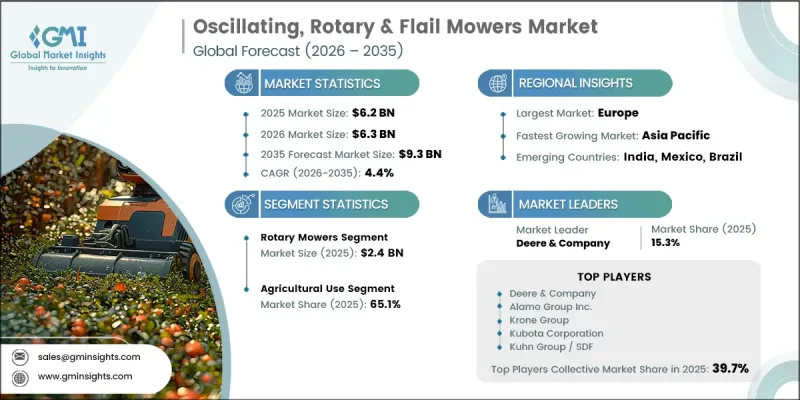
該市場透過支持農業、市政和工業領域的高效土地管理,持續推動農業機械化和植被管理。由於割草設備對於維護高產量農田、商業景觀、交通走廊和公共空間至關重要,因此其需求穩定。隨著人們越來越重視營運效率、勞動力最佳化和改進土地管理方法,先進割草設備在已開發市場和新興市場的應用都在不斷成長。機器耐用性、割草性能、燃油效率和自動化技術的持續改進進一步推動了市場擴張。設備製造商也正在推出能夠提高生產力並降低維護負擔和營運成本的解決方案。農業現代化投資的增加、商業景觀美化活動的擴展以及基礎設施維護計劃的成長,持續為該行業創造有利的成長機會。在持續的技術創新和穩定的替換需求支撐下,預計全球擺動式、旋轉式和甩刀式割草機市場將在整個預測期內保持穩定成長。
| 市場範圍 | |
|---|---|
| 開始年份 | 2025 |
| 預測期 | 2026-2035 |
| 初始市場規模 | 62億美元 |
| 預計金額 | 93億美元 |
| 複合年成長率 | 4.4% |
振動式、旋轉式和甩刀割草機市場由三大割草機技術所構成,分別滿足農業和植被管理領域多樣化的作業需求。振動式割草機因其精準的切割性能和在收割過程中保持作物品質而廣受認可。旋轉式割草機用途廣泛,適用於農地管理、商業景觀美化、市政維護和一般植被管理。甩刀式割灌機在需要強大切割能力和長期運作可靠性的嚴苛環境中表現出色,例如管理過度生長的植被、路邊維護和土地清理。這些技術共同為全球市場上的眾多終端應用提供支援。
預計到2025年,旋轉式割草機市場銷售額將達24億美元。其強大的市場地位得益於廣泛的應用領域,包括農業、商業景觀美化、體育設施、市政維護和植被管理。隨著產品不斷創新、自動化能力不斷提升以及對多功能割草設備的需求日益成長,預計該細分市場將保持主導地位至2035年。製造商們正持續致力於提升旋轉式割草機的性能,提高效率、耐用性、割草精度和操作便利性,以滿足不斷變化的客戶需求。
預計到2025年,農業應用領域將佔據65.1%的市場。市場成長主要得益於對乾草生產、飼料收割、牧場管理和農地日常維護等高效設備的持續需求。農業機械化程度的提高、畜牧業規模的擴大以及對現代化農業設備投資的增加,正推動全球農業市場對先進收割解決方案的需求持續成長。
預計2025年,美國擺動式、旋轉式和甩刀式割草機市場規模將達18億美元。強勁的農業機械需求、不斷擴大的商業植被管理活動以及持續的基礎設施維護投資正在推動美國市場的成長。該地區也受益於農業管理的現代化、市政維護項目的擴展以及對商業園林綠化設備的持續投資。同時,在農業投資增加、工業發展擴張以及對高效植被管理設備需求不斷成長的推動下,墨西哥預計將成為北美地區成長率最高的國家。
目錄
第1章:調查方法和範圍
第2章執行摘要
第3章 行業洞察
- 產業生態系分析
- 相關人員總體圖
- 割草機製造價值鏈中的相互依存關係與影響流
- 價值鏈分析
- 按階段分類的價值鏈
- 各階段的利潤率結構
- 零件供應商在割草機價值鏈中的地位
- 價值獲取機制:OEM 與售後市場
- 整合趨勢:OEM廠商內部生產與外部零件採購
- 供應鏈分析
- 主要原料(鋼鐵、合金、工程材料)及來源
- 關鍵部件(軸承、齒輪箱、刀具組件)供應基地
- 供應鏈集中風險
- 區域物流和配送基礎設施
- 影響產業的因素
- 促進因素
- 產業潛在風險與挑戰
- 機會
- 成長潛力分析
- 未來市場趨勢
- 技術與創新展望
- 最新科技趨勢
- 新興技術
- 價格分析
- 以割草機類型(擺動式、旋轉式和甩刀式)分析過去的價格趨勢
- 按OEM層級分類的定價策略(全球領導者、區域冠軍、價值市場創造者)
- 組件級定價:割草機材料清單。
- 原廠配件和售後配件之間的價格差異
- 監理情勢
- 全球農業機械安全標準法規概述
- 歐盟:歐盟機械指令(2006/42/EC)和修訂後的機械條例(EU 2023/1230),特別關注歐洲地區
- 歐盟通用農業政策(CAP):機械化與永續性需求-聚焦歐洲
- 北美:農業機械符合 ASABE 和 OSHA 標準
- 東南亞:以泰國、越南和印尼為例,探討各國具體的農業機械化政策框架
- 印度:農業機械法律規範與BIS標準(以印度為例)
- 貿易數據分析
- 按HS編碼分類的農業割草機進出口量與值趨勢
- 主要貿易路線及關稅的影響
- 歐洲向東南亞的設備出口流動
- 北美雙邊貿易
- 東南亞地區內割草機交易(重點關注東南亞地區)
- 波特的分析
- PESTLE分析
- 人工智慧和生成式人工智慧對市場的影響
- 人工智慧驅動農業機械製造現有經營模式的變革。
- 割草機 OEM 細分市場生成式 AI 的應用案例和部署藍圖(包括設計最佳化、預測性維護和零件生命週期 AI)
- 人工智慧在農業機械領域的風險、限制與監管考量
- 生產能力和生產情況
- 按地區和主要OEM製造商分類的製造能力
- 運轉率和擴張計劃
第4章 競爭情勢
- 介紹
- 企業市佔率分析
- 按地區
- 企業矩陣分析
- 主要市場公司的競爭分析
- 競爭定位矩陣
- 主要進展
- 併購
- 夥伴關係和聯盟
- 新產品發布
- 業務拓展計劃
第5章 市場估價與預測:依割草技術分類 2022-2035 年
- 振動式割草機
- 圓盤式割草機
- 滾筒式割草機
- 鐮刀式/指形割草機
- 旋轉式割草機
- 割草機
第6章 市場估算與預測:依驅動系統分類 2022-2035 年
- PTO驅動器(曳引機安裝式)
- 自推進式
- 自動駕駛和機器人
第7章 市場估計與預測:依應用領域分類 2022-2035 年
- 農業用途
- 乾草和青貯飼料的生產
- 牧場和草地管理
- 作物殘茬管理
- 地方政府和公共設施的使用
- 道路和高速公路養護
- 公園、運動草坪、休閒區
- 工業和道路權部門
第8章 市場估算與預測:依通路分類,2022-2035年
- 直接的
- 間接
第9章 市場估計與預測:依地區分類,2022-2035年
- 北美洲
- 美國
- 加拿大
- 歐洲
- 英國
- 德國
- 法國
- 義大利
- 西班牙
- 亞太地區
- 中國
- 印度
- 日本
- 韓國
- 澳洲
- 拉丁美洲
- 巴西
- 墨西哥
- 中東和非洲
- 沙烏地阿拉伯
- UAE
- 南非
第10章:公司簡介
- 世界公司
- Kuhn Group
- AGCO Corporation
- CNH Industrial
- Deere & Company(John Deere)
- Claas
- Krone
- Kubota Corporation
- Regional Player
- Pottinger Landtechnik
- Maschio Gaspardo
- SaMASZ
- BCS Group
- Alamo Group Inc.
- ELHO Oy
- Trimax Mowing Systems
- Niche/Specialist Players
- Muthing GmbH
- Ducker Group
- Hymach Srl
- Dragone Srl
- Orsi Group Srl
- Seppi MSpA
- Ferri Srl
The Global Oscillating, Rotary & Flail Mowers Market was valued at USD 6.2 billion in 2025 and is estimated to grow at a CAGR of 4.4% to reach USD 9.3 billion by 2035.
The market continues to help in agricultural mechanization and vegetation management by supporting efficient land maintenance across agricultural, municipal, and industrial applications. Demand remains stable because mowing equipment is an essential requirement for maintaining productive farmland, commercial landscapes, transportation corridors, and public spaces. Increasing emphasis on operational efficiency, labor optimization, and improved land management practices is encouraging the adoption of advanced mowing equipment across both developed and emerging markets. Continuous improvements in machine durability, cutting performance, fuel efficiency, and automation technologies are further supporting market expansion. Equipment manufacturers are also introducing solutions that improve productivity while reducing maintenance requirements and operating costs. Growing investments in agricultural modernization, expanding commercial landscaping activities, and increasing infrastructure maintenance programs continue to create favorable growth opportunities for the industry. Supported by ongoing technological innovation and consistent replacement demand, the global oscillating, rotary & flail mowers market is expected to maintain steady growth throughout the forecast period.
| Market Scope | |
|---|---|
| Start Year | 2025 |
| Forecast Year | 2026-2035 |
| Start Value | $6.2 Billion |
| Forecast Value | $9.3 Billion |
| CAGR | 4.4% |
The oscillating, rotary & flail mowers market is shaped by three primary mower technologies that address different operational requirements across agriculture and vegetation management. Oscillating mowers are widely recognized for delivering precise cutting performance while helping preserve crop quality during harvesting operations. Rotary mowers offer exceptional versatility, making them suitable for agricultural land management, commercial landscaping, municipal maintenance, and general vegetation control. Flail mowers provide efficient performance in demanding environments where heavy vegetation management, roadside maintenance, and land clearing require robust cutting capability and long-term operational reliability. Together, these technologies continue to support a broad range of end-use applications across global markets.
The rotary mower segment generated USD 2.4 billion in 2025. Its strong market position is supported by broad application across agriculture, commercial landscaping, sports facilities, municipal maintenance, and vegetation management. Continuous product innovation, expanding automation capabilities, and increasing demand for versatile mowing equipment are expected to sustain the segment's leadership through 2035. Manufacturers continue to enhance rotary mower performance by improving efficiency, durability, cutting precision, and ease of operation to meet evolving customer requirements.
The agricultural application segment accounted for 65.1% share in 2025. Market growth is supported by the continued need for efficient equipment used in hay production, forage harvesting, pasture management, and general agricultural land maintenance. Increasing agricultural mechanization, expanding livestock production, and rising investments in modern farming equipment continue to strengthen demand for advanced mowing solutions across global agricultural markets.
United States Oscillating, Rotary & Flail Mowers Market reached USD 1.8 billion in 2025. Strong demand for agricultural equipment, expanding commercial vegetation management activities, and ongoing investment in infrastructure maintenance continue to support market growth across the country. The region also benefits from increasing modernization of agricultural operations, expanding municipal maintenance programs, and continued investment in commercial landscaping equipment. Meanwhile, Mexico is projected to record the fastest growth within North America, supported by rising agricultural investment, expanding industrial development, and increasing demand for efficient vegetation management equipment.
Major companies operating in the global oscillating, rotary & flail mowers market include Kuhn Group, AGCO Corporation, CNH Industrial, Deere & Company (John Deere), Claas, Krone, Kubota Corporation, Pottinger Landtechnik, Maschio Gaspardo, SaMASZ, BCS Group, Alamo Group Inc., ELHO Oy, Trimax Mowing Systems, Muthing GmbH, Ducker Group, Hymach S.r.l., Dragone S.r.l., Orsi Group S.r.l., Seppi M. S.p.A., and Ferri S.r.l. Companies operating in the oscillating, rotary & flail mowers market are strengthening their market position through continuous product innovation, technology advancement, and expansion of their equipment portfolios. Manufacturers are investing in research and development to improve cutting efficiency, machine durability, fuel economy, and automation capabilities while addressing evolving customer requirements. Strategic partnerships, acquisitions, and expanded dealer and distribution networks are enabling companies to increase market reach and strengthen customer engagement. Businesses are also focusing on precision agriculture integration, smart equipment features, and enhanced after-sales support to improve customer satisfaction and long-term loyalty.
Table of Contents
Chapter 1 Methodology & Scope
- 1.1 Market scope and definition
- 1.2 Research design
- 1.2.1 Research approach
- 1.2.2 Data collection methods
- 1.3 Data mining sources
- 1.3.1 Global
- 1.3.2 Regional
- 1.4 Base estimates and calculations
- 1.4.1 Base year calculation
- 1.4.2 Key trends for market estimation
- 1.5 Primary research and validation
- 1.5.1 Primary sources
- 1.6 Forecast model
- 1.7 Research assumptions and limitations
Chapter 2 Executive Summary
- 2.1 Industry 360° synopsis
- 2.2 Key market trends
- 2.2.1 Regional
- 2.2.2 Mowing Technology
- 2.2.3 Drive System
- 2.2.4 Application
- 2.2.5 Distribution channel
Chapter 3 Industry Insights
- 3.1 Industry ecosystem analysis
- 3.1.1 Full stakeholder map
- 3.1.2 Interdependencies and influence flows across the mower manufacturing value chain
- 3.2 Value chain analysis
- 3.2.1 Stage-by-stage value chain
- 3.2.2 Profit margin structure at each stage
- 3.2.3 Component supplier positioning within the mower value chain
- 3.2.4 Value capture dynamics: OEM versus aftermarket
- 3.2.5 Integration trends: OEM in-sourcing versus outsourced component procurement
- 3.3 Supply chain analysis
- 3.3.1 Key raw material inputs (steel, alloys, engineered materials) and sourcing origins
- 3.3.2 Critical component supply nodes (bearings, gearboxes, cutter assemblies)
- 3.3.3 Supply chain concentration risks
- 3.3.4 Logistics and distribution infrastructure by region
- 3.4 Industry impact forces
- 3.4.1 Growth drivers
- 3.4.2 Industry pitfalls & challenges
- 3.4.3 Opportunities
- 3.5 Growth potential analysis
- 3.6 Future market trends
- 3.7 Technology and innovation landscape
- 3.7.1 Current technological trends
- 3.7.2 Emerging technologies
- 3.8 Pricing analysis (driven by primary research)
- 3.8.1 Historical price trend analysis by mower type (oscillating, rotary, flail)
- 3.8.2 Pricing strategy by OEM tier (global leader, regional champion, value-market producer)
- 3.8.3 Component-level pricing: bearing and wear part cost as a percentage of mower bill of materials
- 3.8.4 OEM versus aftermarket price differentials
- 3.9 Regulatory landscape
- 3.9.1 Global regulatory overview covering agricultural machinery safety standards
- 3.9.2 European Union: EU machinery directive (2006/42/EC) and revised machinery regulation (EU 2023/1230), with a focus on Europe
- 3.9.3 EU common agricultural policy (CAP): mechanisation and sustainability mandates, with a focus on Europe
- 3.9.4 North America: ASABE standards and OSHA compliance for agricultural equipment
- 3.9.5 Southeast Asia: country-level agricultural mechanisation policy frameworks with focus on Thailand, Vietnam, and Indonesia
- 3.9.6 India: agricultural equipment regulatory framework and BIS standards, with a focus on India
- 3.10 Trade data analysis
- 3.10.1 Import and export volume and value trends for agricultural mowing equipment by HS code
- 3.10.2 Key trade corridors and tariff impact
- 3.10.2.1 Europe-to-Southeast Asia equipment export flows
- 3.10.2.2 North America bilateral trade
- 3.10.2.3 Southeast Asia intra-regional trade in mowing equipment, with a focus on Southeast Asia
- 3.11 Porter's analysis
- 3.12 PESTEL analysis
- 3.13 Impact of AI and generative AI on the market
- 3.13.1 AI-driven disruption of existing business models in agricultural equipment manufacturing
- 3.13.2 Generative AI use cases and adoption roadmap by mower OEM segment, including design optimisation, predictive maintenance, and component lifecycle AI
- 3.13.3 Risks, limitations, and regulatory considerations for AI in agricultural machinery
- 3.14 Capacity and production landscape (driven by primary research)
- 3.14.1 Installed manufacturing capacity by region and key OEM producer
- 3.14.2 Capacity utilization rates and expansion pipelines
Chapter 4 Competitive Landscape, 2025
- 4.1 Introduction
- 4.2 Company market share analysis
- 4.2.1 By region
- 4.2.1.1 North America
- 4.2.1.2 Europe
- 4.2.1.3 Asia Pacific
- 4.2.1.4 Latin America
- 4.2.1.5 Middle East and Africa
- 4.2.1 By region
- 4.3 Company matrix analysis
- 4.4 Competitive analysis of major market players
- 4.5 Competitive positioning matrix
- 4.6 Key developments
- 4.6.1 Mergers & acquisitions
- 4.6.2 Partnerships & collaborations
- 4.6.3 New product launches
- 4.6.4 Expansion plans
Chapter 5 Market Estimates & Forecast, By Mowing Technology 2022-2035, (USD Billion) (Thousand Units)
- 5.1 Key trends
- 5.2 Oscillating Mowers
- 5.2.1 Disc Mowers
- 5.2.2 Drum Mowers
- 5.2.3 Sickle Bar / Finger Bar Mowers
- 5.3 Rotary Mowers
- 5.4 Flail Mowers
Chapter 6 Market Estimates & Forecast, By Drive System 2022-2035, (USD Billion) (Thousand Units)
- 6.1 Key trends
- 6.2 PTO-Driven (Tractor-Mounted)
- 6.3 Self-Propelled
- 6.4 Autonomous & Robotic
Chapter 7 Market Estimates & Forecast, By Application 2022-2035, (USD Billion) (Thousand Units)
- 7.1 Key trends
- 7.2 Agricultural Use
- 7.2.1 Hay & Silage Production
- 7.2.2 Pasture & Grassland Management
- 7.2.3 Crop Residue Management
- 7.3 Municipal & Amenity Use
- 7.3.1 Roadside & Highway Maintenance
- 7.3.2 Parks, Sports Turf & Recreational Areas
- 7.4 Industrial & Right-of-Way
Chapter 8 Market Estimates & Forecast, By Distribution channel, 2022-2035, (USD Billion) (Thousand Units)
- 8.1 Key trends
- 8.2 Direct
- 8.3 Indirect
Chapter 9 Market Estimates & Forecast, By Region, 2022-2035, (USD Billion) (Thousand Units)
- 9.1 Key trends
- 9.2 North America
- 9.2.1 U.S.
- 9.2.2 Canada
- 9.3 Europe
- 9.3.1 UK
- 9.3.2 Germany
- 9.3.3 France
- 9.3.4 Italy
- 9.3.5 Spain
- 9.4 Asia Pacific
- 9.4.1 China
- 9.4.2 India
- 9.4.3 Japan
- 9.4.4 South Korea
- 9.4.5 Australia
- 9.5 Latin America
- 9.5.1 Brazil
- 9.5.2 Mexico
- 9.6 MEA
- 9.6.1 Saudi Arabia
- 9.6.2 UAE
- 9.6.3 South Africa
Chapter 10 Company Profiles
- 10.1 Global Players
- 10.1.1 Kuhn Group
- 10.1.2 AGCO Corporation
- 10.1.3 CNH Industrial
- 10.1.4 Deere & Company (John Deere)
- 10.1.5 Claas
- 10.1.6 Krone
- 10.1.7 Kubota Corporation
- 10.2 Regional Player
- 10.2.1 Pottinger Landtechnik
- 10.2.2 Maschio Gaspardo
- 10.2.3 SaMASZ
- 10.2.4 BCS Group
- 10.2.5 Alamo Group Inc.
- 10.2.6 ELHO Oy
- 10.2.7 Trimax Mowing Systems
- 10.3 Niche/Specialist Players
- 10.3.1 Muthing GmbH
- 10.3.2 Ducker Group
- 10.3.3 Hymach S.r.l.
- 10.3.4 Dragone S.r.l.
- 10.3.5 Orsi Group S.r.l.
- 10.3.6 Seppi M. S.p.A.
- 10.3.7 Ferri S.r.l.


