


 |
市場調查報告書
商品編碼
2101601
2026 年至 2035 年雙酚替代品的市場機會、成長要素、產業趨勢與預測。Bisphenol Replacements Market Opportunity, Growth Drivers, Industry Trend Analysis, and Forecast 2026 - 2035 |
||||||

全球雙酚替代品市場預計到 2025 年將達到 39 億美元,年複合成長率為 8.3%,到 2035 年將達到 86 億美元。
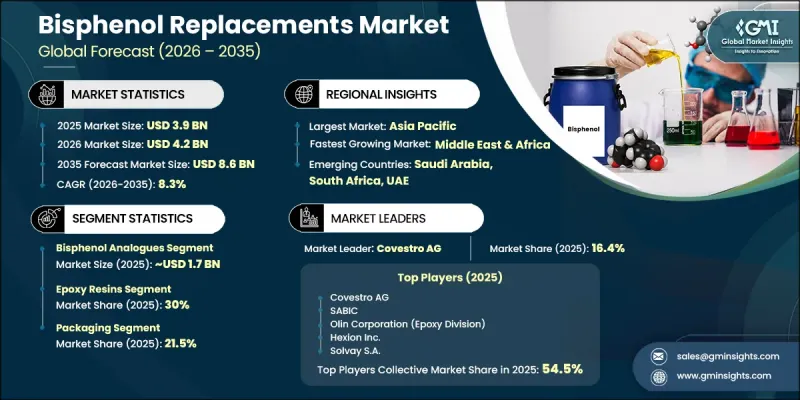
隨著製造商加速向更安全、更永續的替代材料轉型,雙酚替代品市場正在經歷一場變革。各種替代技術的需求趨勢持續演變,其採用率因應用需求、監管趨勢和性能預期而異。在直接材料替代仍然是最實用、最具成本效益的解決方案的應用領域,雙酚類似物保持著強大的市場地位。同時,隨著各行業優先考慮能夠提供長期可靠性和符合法規要求的高性能材料,非雙酚合成替代品也正獲得更廣泛的認可。生物基替代技術也日益受到關注,因為製造商正在尋求符合永續性計劃和不斷發展的環境標準的可再生解決方案。市場擴張的促進因素包括:包裝、電子、電動車和工業製造領域對先進材料投資的增加,以及對傳統雙酚化合物日益嚴格的監管。生物基原料供應的改善和持續的產品創新正在進一步推動下一代雙酚替代品在全球市場的商業化。
| 市場範圍 | |
|---|---|
| 開始年份 | 2025 |
| 預測期 | 2026-2035 |
| 初始市場規模 | 39億美元 |
| 預測金額 | 86億美元 |
| 複合年成長率 | 8.3% |
隨著監管要求推動採用更安全的化學替代品,以及各行業尋求性能更佳、長期可靠性更高的材料,雙酚替代品市場持續擴張。合規主導的需求降低了製造商的不確定性,並鼓勵其投資擴大產能。同時,先進製造商日益成長的需求推動了對高性能非雙酚合成材料的需求,而可再生原料開發的穩步進展正在加速創新生物基替代技術的商業化進程。
雙酚類似物市場預計到2025年將佔據44%的市場佔有率,市場規模達到17億美元,到2035年將以15.6%的複合年成長率成長。此細分市場佔據主導地位,得益於其與傳統雙酚基材料優異的結構相容性,使製造商能夠以最小的配方調整實現產品過渡。這種相容性持續推動著雙酚類似物在那些既要維持現有生產流程和材料性能,又要降低生產成本的應用領域的普及。
預計到2025年,包裝產業將佔據21.5%的市場。隨著製造商擴大採用不含雙酚A(BPA)的材料以滿足不斷變化的食品接觸產品監管要求,包裝仍然是BPA的主要應用領域。持續改進整體包裝材料的配方,正在為軟包裝和硬包裝應用中的雙酚替代技術創造穩定的需求,從而支撐市場的長期成長。
到2025年,北美雙酚替代品市佔率將達到24%。該地區市場的特點是監管合規要求嚴格,且持續投資於更安全的材料配方。在美國,不含雙酚A(BPA)的塗料和包裝材料的廣泛應用仍然是推動該地區需求的主要因素。同時,在加拿大,市場重點仍然是與食品接觸產品和醫療產品相關的受監管應用。墨西哥正在崛起成為一個重要的成長市場,這得益於工業製造業活動的擴張,從而增加了汽車、電子和更廣泛的製造供應鏈中對不含雙酚A材料的需求。
目錄
第1章:調查方法和範圍
第2章執行摘要
第3章 行業洞察
- 產業生態系分析
- 供應商情況
- 利潤率
- 每個階段增加的價值
- 影響價值鏈的因素
- 中斷
- 影響產業的因素
- 促進因素
- 產業潛在風險與挑戰
- 市場機遇
- 成長潛力分析
- 監理情勢
- 波特的分析
- PESTLE分析
- 價格趨勢
- 按地區
- 依原料類型
- 未來市場趨勢
- 技術與創新展望
- 最新科技趨勢
- 新興技術
- 專利趨勢
- 貿易統計
- 主要進口國
- 主要出口國
- 永續性和環境方面
- 永續計劃
- 減少廢棄物策略
- 生產中的能源效率
- 具有環保意識的舉措
- 考慮碳足跡
第4章 競爭情勢
- 介紹
- 企業市佔率分析
- 按地區
- 北美洲
- 歐洲
- 亞太地區
- LATAM
- 中東和非洲
- 按地區
- 主要市場公司的競爭分析
- 競爭定位矩陣
- 主要進展
- 併購
- 夥伴關係和聯盟
- 新產品發布
- 業務拓展計劃
第5章 市場估算與預測:依替代產品類型分類,2022-2035年
- 雙酚化合物
- 雙酚S(BPS)
- 雙酚F(BPF)
- 雙酚E(BPE)
- 其他雙酚化合物(BPAF、BPB、BPZ、BPAP)
- 除雙酚類產品以外的合成替代品
- 脂環族環氧樹脂
- 酚醛環氧樹脂
- 縮水甘油胺環氧樹脂
- 丙烯酸樹脂和其他不含雙酚的合成替代品
- 生物基替代品
- 植物油衍生的替代品(環氧化大豆油、亞麻仁油)
- 木質素衍生物替代品
- 甘油和醣類衍生物替代品(生物基縮水甘油醚)
- 其他生物基替代品(腰果酚、松香、香草醛、單寧酸基)
第6章 市場估計與預測:依應用領域分類,2022-2035年
- 環氧樹脂
- 液態環氧樹脂體系
- 固體和粉末環氧樹脂體系
- 水性環氧樹脂體系
- 聚碳酸酯和工程樹脂
- 硬質聚碳酸酯的替代樹脂
- 聚醚碸(PES)和高性能工程聚合物的應用
- 熱敏紙和墨水顯影劑
- POS(銷售點)收據紙
- 標籤、吊牌和票據紙
- 塗料和油漆
- 食品和飲料罐的內襯和外襯
- 工業防護塗層(防腐蝕、管道和鋼筋)
- 建築和裝飾塗料
- 黏合劑和密封劑
- 結構性黏著劑(汽車、建築)
- 用於組裝和層壓的黏合劑
- 複合材料和層壓板
- 纖維增強複合材料(玻璃纖維和碳纖維)
- 用於電氣和電子應用的層壓板(PCB、CCL)
- 阻燃劑
- 其他用途
- 聚氨酯體系
- 牙科和醫用樹脂
- 不飽和聚酯樹脂
第7章 市場估計與預測:依最終用途產業分類,2022-2035年
- 包裝
- 食品和飲料包裝(罐頭、硬質容器、食品接觸薄膜)
- 工業和特殊包裝
- 電子與電機工程
- 家用電子電器(智慧型手機、筆記型電腦、穿戴式裝置)
- 工業電子和PCB製造
- 汽車和運輸業
- 乘用車(內燃機汽車和電池式電動車)
- 商用車輛和重型運輸車輛
- 醫療保健和醫療設備
- 醫療設備外殼和手術器械
- 牙科應用(窩溝封閉劑、修復材料)
- 藥品包裝及給藥裝置
- 建築和基礎設施
- 管道和鋼筋塗層
- 結構性黏著劑、地板材料和防水材料
- 消費品
- 水瓶、食品容器、廚具
- 嬰兒和幼兒用品
- 航太/國防
- 其他終端用戶產業
- 風力發電(渦輪葉片用樹脂)
- 船舶(油漆/複合材料)
- 紙張/印刷
第8章 市場估計與預測:依地區分類,2022-2035年
- 北美洲
- 美國
- 加拿大
- 歐洲
- 德國
- 英國
- 法國
- 西班牙
- 義大利
- 其他歐洲國家
- 亞太地區
- 中國
- 印度
- 日本
- 澳洲
- 韓國
- 其他亞太國家
- 拉丁美洲
- 巴西
- 墨西哥
- 阿根廷
- 其他拉丁美洲國家
- 中東和非洲
- 沙烏地阿拉伯
- 南非
- UAE
- 其他中東和非洲國家
第9章:公司簡介
- Covestro AG
- SABIC
- Olin Corporation(Epoxy Division)
- Hexion Inc.
- Solvay SA
- BASF SE
- Mitsubishi Chemical Group Corporation
- LG Chem
- Mitsui Chemicals Inc.
- Nan Ya Plastics Corporation
- NICCA Chemical Co., Ltd.
- Specific Polymers SAS
- Nagase ChemteX Corporation
- UPM Biochemicals
- Jiangsu Aolunda High-Tech Industry Co., Ltd.
The Global Bisphenol Replacements Market was valued at USD 3.9 billion in 2025 and is estimated to grow at a CAGR of 8.3% to reach USD 8.6 billion by 2035.
The bisphenol replacements market is undergoing a transformation as manufacturers increasingly shift toward safer and more sustainable material alternatives. Demand patterns continue to evolve across different replacement technologies, with adoption rates varying based on application requirements, regulatory developments, and performance expectations. Bisphenol analogues continue to maintain a strong market presence in applications where direct material replacement remains the most practical and cost-effective solution. At the same time, non-bisphenol synthetic alternatives are gaining wider acceptance as industries prioritize high-performance materials capable of delivering long-term reliability and regulatory compliance. Bio-based replacement technologies are also attracting increasing attention as manufacturers seek renewable solutions that align with sustainability initiatives and changing environmental standards. Market expansion is being supported by stricter regulations governing conventional bisphenol compounds, along with increasing investments in advanced materials used across packaging, electronics, electric mobility, and industrial manufacturing. Improvements in bio-based raw material availability and continuous product innovation are further supporting the commercialization of next-generation bisphenol replacement solutions across global markets.
| Market Scope | |
|---|---|
| Start Year | 2025 |
| Forecast Year | 2026-2035 |
| Start Value | $3.9 Billion |
| Forecast Value | $8.6 Billion |
| CAGR | 8.3% |
The bisphenol replacements market continues to expand as regulatory requirements encourage the adoption of safer chemical alternatives while industries pursue materials that deliver improved performance and long-term reliability. Compliance-driven demand is reducing uncertainty for manufacturers and encouraging investments in production capacity. At the same time, growing requirements from advanced manufacturing industries are strengthening demand for high-performance non-bisphenol synthetic materials, while continued progress in renewable feedstock development is accelerating the commercialization of innovative bio-based replacement technologies.
The bisphenol analogues segment accounted for 44% share in 2025, representing USD 1.7 billion, and is projected to grow at a CAGR of 15.6% through 2035. Their leading market position is supported by strong structural compatibility with conventional bisphenol materials, allowing manufacturers to transition with minimal formulation adjustments. This compatibility continues to encourage adoption in applications where maintaining established manufacturing processes and material performance remains a key priority while controlling production costs.
The packaging segment represented 21.5% share in 2025. Packaging continues to be a major application area as manufacturers increasingly adopt BPA-free materials to comply with evolving regulatory requirements governing food-contact products. Ongoing reformulation efforts across packaging materials continue to generate stable demand for bisphenol replacement technologies in both flexible and rigid packaging applications, supporting long-term market growth.
North America Bisphenol Replacements Market accounted for 24% share in 2025. The regional market is characterized by strong regulatory compliance requirements and continued investments in safer material formulations. The United States remains the primary contributor to regional demand through widespread adoption of BPA-free coatings and packaging materials, while Canada continues to emphasize regulated applications involving food-contact and healthcare-related products. Mexico is emerging as an important growth market, supported by expanding industrial manufacturing activities that are increasing demand for BPA-free materials across automotive, electronics, and broader manufacturing supply chains.
Major companies operating in the global bisphenol replacements market include BASF SE, Covestro AG, SABIC, Hexion Inc., Mitsubishi Chemical Group Corporation, Solvay S.A., Olin Corporation (Epoxy Division), Mitsui Chemicals Inc., LG Chem, Nan Ya Plastics Corporation, UPM Biochemicals, NICCA Chemical Co., Ltd., Nagase ChemteX Corporation, Jiangsu Aolunda High-Tech Industry Co., Ltd., and Specific Polymers SAS. Companies operating in the bisphenol replacements market are strengthening their competitive positions through continuous product innovation, investments in sustainable chemistries, and expansion of advanced material portfolios. Manufacturers are increasing research and development efforts to improve product performance, regulatory compliance, and environmental sustainability while supporting changing customer requirements. Strategic collaborations with downstream manufacturers and industrial partners are helping companies accelerate commercialization and broaden market reach. Businesses are also expanding manufacturing capacity and strengthening supply chain capabilities to ensure reliable product availability across global markets.
Table of Contents
Chapter 1 Methodology & Scope
- 1.1 Research approach
- 1.2 Quality Commitments
- 1.2.1 GMI AI policy & data integrity commitment
- 1.2.1.1 Source consistency protocol
- 1.2.1 GMI AI policy & data integrity commitment
- 1.3 Research Trail & Confidence Scoring
- 1.3.1 Research Trail Components
- 1.3.2 Scoring Components
- 1.4 Data Collection
- 1.4.1 Partial list of primary sources
- 1.5 Data mining sources
- 1.5.1 Paid sources
- 1.5.1.1 Sources, by Region
- 1.5.1 Paid sources
- 1.6 Base estimates and calculations
- 1.6.1 Base Year Calculation for One Approach
- 1.7 Forecast model
- 1.7.1 Quantified market impact analysis
- 1.7.1.1 Mathematical impact of growth parameters on forecast
- 1.7.1 Quantified market impact analysis
- 1.8 Research transparency addendum
- 1.8.1 Source attribution framework
- 1.8.2 Quality assurance metrics
- 1.8.3 Our commitment to trust
Chapter 2 Executive Summary
- 2.1 Industry 360° synopsis
- 2.2 Key market trends
- 2.2.1 Regional
- 2.2.2 Replacement Type
- 2.2.3 Application
- 2.2.4 End-Use Industry
Chapter 3 Industry Insights
- 3.1 Industry ecosystem analysis
- 3.1.1 Supplier landscape
- 3.1.2 Profit margin
- 3.1.3 Value addition at each stage
- 3.1.4 Factor affecting the value chain
- 3.1.5 Disruptions
- 3.2 Industry impact forces
- 3.2.1 Growth drivers
- 3.2.2 Industry pitfalls and challenges
- 3.2.3 Market opportunities
- 3.3 Growth potential analysis
- 3.4 Regulatory landscape
- 3.4.1 North America
- 3.4.2 Europe
- 3.4.3 Asia Pacific
- 3.4.4 Latin America
- 3.4.5 Middle East & Africa
- 3.5 Porter's analysis
- 3.6 PESTEL analysis
- 3.7 Price trends
- 3.7.1 By region
- 3.7.2 By feedstock type
- 3.8 Future market trends
- 3.9 Technology and innovation landscape
- 3.9.1 Current technological trends
- 3.9.2 Emerging technologies
- 3.10 Patent Landscape
- 3.11 Trade statistics (HS code)
- 3.11.1 Major importing countries
- 3.11.2 Major exporting countries
- 3.12 Sustainability and environmental aspects
- 3.12.1 Sustainable practices
- 3.12.2 Waste reduction strategies
- 3.12.3 Energy efficiency in production
- 3.12.4 Eco-friendly initiatives
- 3.13 Carbon footprint consideration
Chapter 4 Competitive Landscape, 2025
- 4.1 Introduction
- 4.2 Company market share analysis
- 4.2.1 By region
- 4.2.1.1 North America
- 4.2.1.2 Europe
- 4.2.1.3 Asia Pacific
- 4.2.1.4 LATAM
- 4.2.1.5 MEA
- 4.2.1 By region
- 4.3 Competitive analysis of major market players
- 4.4 Competitive positioning matrix
- 4.5 Key developments
- 4.5.1 Mergers & acquisitions
- 4.5.2 Partnerships & collaborations
- 4.5.3 New Product Launches
- 4.5.4 Expansion Plans
Chapter 5 Market Estimates and Forecast, By Replacement Type, 2022-2035 (USD Billion) (Kilo Tons)
- 5.1 Key trends
- 5.2 Bisphenol Analogues
- 5.2.1 Bisphenol S (BPS)
- 5.2.2 Bisphenol F (BPF)
- 5.2.3 Bisphenol E (BPE)
- 5.2.4 Other Bisphenol Analogues (BPAF, BPB, BPZ, BPAP)
- 5.3 Non-Bisphenol Synthetic Alternatives
- 5.3.1 Cycloaliphatic Epoxy Resins
- 5.3.2 Novolac Epoxy Resins
- 5.3.3 Glycidylamine Epoxy Resins
- 5.3.4 Acrylic & Other Non-Bisphenol Synthetic Alternatives
- 5.4 Bio-Based Alternatives
- 5.4.1 Vegetable Oil-Derived Alternatives (Epoxidized Soybean Oil, Linseed Oil)
- 5.4.2 Lignin-Derived Alternatives
- 5.4.3 Glycerol & Sugar-Derived Alternatives (Bio-Glycidyl Ethers)
- 5.4.4 Other Bio-Based Alternatives (Cardanol, Rosin, Vanillin, Tannic Acid-Based)
Chapter 6 Market Estimates and Forecast, By Application, 2022-2035 (USD Billion) (Kilo Tons)
- 6.1 Key trends
- 6.2 Epoxy Resins
- 6.2.1 Liquid Epoxy Systems
- 6.2.2 Solid & Powder Epoxy Systems
- 6.2.3 Waterborne Epoxy Systems
- 6.3 Polycarbonate & Engineering Resins
- 6.3.1 Rigid Polycarbonate Substitute Resins
- 6.3.2 Polyethersulfone (PES) & High-Performance Engineering Polymer Applications
- 6.4 Thermal Paper & Ink Developers
- 6.4.1 Point-of-Sale (POS) Receipt Paper
- 6.4.2 Labels, Tags & Ticket Paper
- 6.5 Coatings & Paints
- 6.5.1 Food & Beverage Can Linings (Internal & External)
- 6.5.2 Industrial Protective Coatings (Anti-Corrosion, Pipe & Rebar)
- 6.5.3 Architectural & Decorative Coatings
- 6.6 Adhesives & Sealants
- 6.6.1 Structural Adhesives (Automotive, Construction)
- 6.6.2 Assembly & Lamination Adhesives
- 6.7 Composites & Laminates
- 6.7.1 Fiber-Reinforced Composites (Glass Fiber & Carbon Fiber)
- 6.7.2 Electrical & Electronic Laminates (PCB, CCL)
- 6.8 Flame Retardants
- 6.9 Other Applications
- 6.9.1 Polyurethane Systems
- 6.9.2 Dental & Medical Resins
- 6.9.3 Unsaturated Polyester Resins
Chapter 7 Market Estimates and Forecast, By End-Use Industry, 2022-2035 (USD Billion) (Kilo Tons)
- 7.1 Key trends
- 7.2 Packaging
- 7.2.1 Food & Beverage Packaging (Cans, Rigid Containers, Food-Contact Films)
- 7.2.2 Industrial & Specialty Packaging
- 7.3 Electronics & Electrical
- 7.3.1 Consumer Electronics (Smartphones, Laptops, Wearables)
- 7.3.2 Industrial Electronics & PCB Manufacturing
- 7.4 Automotive & Transportation
- 7.4.1 Passenger Vehicles (ICE & Battery Electric Vehicles)
- 7.4.2 Commercial Vehicles & Heavy Transportation
- 7.5 Healthcare & Medical Devices
- 7.5.1 Medical Device Housings & Surgical Instruments
- 7.5.2 Dental Applications (Sealants, Restorative Materials)
- 7.5.3 Pharmaceutical Packaging & Drug Delivery Devices
- 7.6 Construction & Infrastructure
- 7.6.1 Pipe & Rebar Coatings
- 7.6.2 Structural Adhesives, Flooring & Waterproofing
- 7.7 Consumer Goods
- 7.7.1 Water Bottles, Food Containers & Kitchenware
- 7.7.2 Baby & Infant Products
- 7.8 Aerospace & Defense
- 7.9 Other End-Use Industries
- 7.9.1 Wind Energy (Turbine Blade Resins)
- 7.9.2 Marine (Coatings & Composites)
- 7.9.3 Paper & Printing
Chapter 8 Market Estimates and Forecast, By Region, 2022-2035 (USD Billion) (Kilo Tons)
- 8.1 Key trends
- 8.2 North America
- 8.2.1 U.S.
- 8.2.2 Canada
- 8.3 Europe
- 8.3.1 Germany
- 8.3.2 UK
- 8.3.3 France
- 8.3.4 Spain
- 8.3.5 Italy
- 8.3.6 Rest of Europe
- 8.4 Asia Pacific
- 8.4.1 China
- 8.4.2 India
- 8.4.3 Japan
- 8.4.4 Australia
- 8.4.5 South Korea
- 8.4.6 Rest of Asia Pacific
- 8.5 Latin America
- 8.5.1 Brazil
- 8.5.2 Mexico
- 8.5.3 Argentina
- 8.5.4 Rest of Latin America
- 8.6 Middle East and Africa
- 8.6.1 Saudi Arabia
- 8.6.2 South Africa
- 8.6.3 UAE
- 8.6.4 Rest of Middle East and Africa
Chapter 9 Company Profiles
- 9.1 Covestro AG
- 9.2 SABIC
- 9.3 Olin Corporation (Epoxy Division)
- 9.4 Hexion Inc.
- 9.5 Solvay S.A.
- 9.6 BASF SE
- 9.7 Mitsubishi Chemical Group Corporation
- 9.8 LG Chem
- 9.9 Mitsui Chemicals Inc.
- 9.10 Nan Ya Plastics Corporation
- 9.11 NICCA Chemical Co., Ltd.
- 9.12 Specific Polymers SAS
- 9.13 Nagase ChemteX Corporation
- 9.14 UPM Biochemicals
- 9.15 Jiangsu Aolunda High-Tech Industry Co., Ltd.

 雙酚替代品全球市場規模、佔有率、趨勢和成長分析報告(2026-2034)
 雙酚A市場-2026-2032年全球市場預測
 雙酚A(BPA):市場佔有率分析、行業趨勢和統計數據、成長預測(2026-2031年)
 雙酚A市場:按應用和地區分類雙酚S市場:依產品類型、劑型、應用、終端用戶產業及通路分類-2026-2032年全球預測熱塑性4,4-聯苯酚市場:依產品形式、製造流程、聚合物等級、最終用途產業和分銷通路分類 - 全球預測(2026-2032年)
 雙酚 A 市場報告:趨勢、預測和競爭分析(至 2031 年)
 雙酚 A 全球市場分析:工廠產能、產量、利用率、需求和供應、最終用戶行業、銷售渠道、區域需求、公司份額、對外貿易 (2015-2032)