

 |
市場調查報告書
商品編碼
2101587
C4 稻米工程市場機會、成長要素、產業趨勢分析及2026-2035年預測C4 Rice Engineering Market Opportunity, Growth Drivers, Industry Trend Analysis, and Forecast 2026 - 2035 |
||||||

全球 C4 水稻工程市場預計到 2025 年將達到 2,060 萬美元,年複合成長率為 10.1%,到 2035 年將達到 5,480 萬美元。
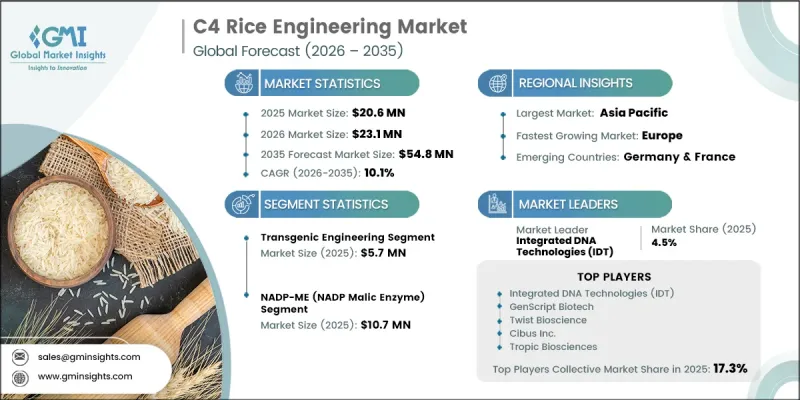
隨著光合作用工程、基因編輯和合成生物學的進步,稻米市場正蓬勃發展,為提高稻米產量和加強全球糧食安全創造了新的機會。應對氣候變遷帶來的農業挑戰和不斷成長的糧食需求的壓力日益增大,促使研究人員和機構探索超越傳統作物改良方法的先進途徑。由於傳統水稻育種技術已接近其生產力極限,因此人們對C4代謝途徑工程作為提高作物效率的潛在解決方案的興趣日益濃厚。分子生物學工具的最新進展使得基因改造更加精準,並加快了研發步伐。先進的克隆平台、合成轉錄技術和改進的啟動子系統支持更精確的細胞特異性和多基因表現策略,為未來C4型水稻的研發奠定了堅實的基礎。
| 市場規模 | |
|---|---|
| 開始年份 | 2025 |
| 預測期 | 2026-2035 |
| 上市時的市場規模 | 2060萬美元 |
| 預計金額 | 5480萬美元 |
| 複合年成長率 | 10.1% |
預計到2025年,基因改造工程技術領域將佔據28%的市場佔有率,達到570萬美元。該領域之所以能保持主導地位,是因為其在檢驗水稻中C4代謝途徑組分的整合和表達方面發揮著至關重要的作用。基因工程促進了關鍵C4相關酵素的導入,包括碳酸酐酶、磷酸烯醇式丙酮酸羧化酶(PEPC)、蘋果酸去氫酶(MDH)、NADP-蘋果酸酶(NADP-ME)和丙酮酸正磷酸二激酶(PPDK)。 2021年,研究人員成功地利用單一基因構建體整合了所有這五種C4酶,這標誌著代謝途徑工程研究的一個重要里程碑。
NADP-ME(NADP-蘋果酸酶)途徑佔52%的市場佔有率,預計到2025年市場規模將達到1,070萬美元。其強勁的市場地位與其被視為C4水稻研究項目中的優先工程改造模型密切相關。 NADP-ME途徑天然存在於玉米和高粱等作物中,與其他C4途徑的變體相比,它具有更完善的生化框架。其廣泛的研究基礎為先進的酶表徵、啟動子資源和代謝建模能力提供了支持,從而助力水稻代謝途徑改造舉措。
預計2025年,北美C4水稻基因工程市場將佔據24%的市場佔有率,達到495萬美元。美國是該地區市場成長的主要驅動力,這得益於活躍的學術研究、對農業生物技術的投入以及對先進作物改良計畫的持續支持。該地區擁有廣泛的研究網路、機構間的合作以及支持C4水稻基因工程技術進步的資金籌措機制。
目錄
第1章:調查方法和範圍
第2章執行摘要
第3章 行業洞察
- 產業生態系分析
- 供應商情況
- 利潤率
- 每個階段增加的價值
- 影響價值鏈的因素
- 中斷
- 影響產業的因素
- 促進因素
- 產業潛在風險與挑戰
- 市場機遇
- 成長潛力分析
- 監理情勢
- 波特的分析
- PESTLE分析
- 價格趨勢
- 按地區
- 透過技術
- 未來市場趨勢
- 技術與創新展望
- 最新科技趨勢
- 新興技術
- 專利趨勢
- 貿易統計
- 主要進口國
- 主要出口國
- 永續性和環境方面
- 永續計劃
- 減少廢棄物策略
- 生產中的能源效率
- 具有環保意識的舉措
第4章 競爭情勢
- 介紹
- 企業市佔率分析
- 按地區
- 北美洲
- 歐洲
- 亞太地區
- LATAM
- 中東和非洲
- 按地區
- 企業矩陣分析
- 主要市場公司的競爭分析
- 競爭定位矩陣
- 主要進展
- 併購
- 夥伴關係和聯盟
- 新產品發布
- 業務拓展計劃
第5章 市場估算與預測:依工程技術分類,2022年至2035年
- 基因工程
- 基因編輯
- 合成生物學和模組化克隆
- 表現型和解剖學工程
- 生物資訊與計算科學
第6章 市場估計與預測:依C4路徑分類,2022年至2035年
- NADP-ME
- NAD-ME
- PCK
- 單細胞C4
第7章 市場估計與預測:依應用領域分類,2022年至2035年
- 產量提升
- 用水效率
- 應對氣候變遷的能力
- 氮利用效率
- 糧食安全計劃
第8章 市場估算與預測:依最終使用者分類,2022年至2035年
- 公共國際研究機構
- 農業生物技術公司
- 種子企業與植物育種者
- CRO 和生物技術服務
第9章 市場估計與預測:依地區分類,2022年至2035年
- 北美洲
- 美國
- 加拿大
- 歐洲
- 德國
- 英國
- 法國
- 西班牙
- 義大利
- 其他歐洲國家
- 亞太地區
- 中國
- 印度
- 日本
- 澳洲
- 韓國
- 其他亞太國家
- 拉丁美洲
- 巴西
- 墨西哥
- 阿根廷
- 其他拉丁美洲國家
- 中東和非洲
- 沙烏地阿拉伯
- 南非
- UAE
- 其他中東和非洲國家
第10章:公司簡介
- Integrated DNA Technologies(IDT)
- GenScript Biotech
- Twist Bioscience
- Cibus Inc.
- Tropic Biosciences
- Wimi Biotechnology Co., Ltd.
- Pairwise Plants
- KeyGene
- Camena Bioscience
- Madeinplant
- Constructive Bio
- GeneNeer Ltd.
- Hudson River Biotechnology
- Elo Life Systems
The Global C4 Rice Engineering Market was valued at USD 20.6 million in 2025 and is estimated to grow at a CAGR of 10.1% to reach USD 54.8 million by 2035.
The market is gaining momentum as advancements in photosynthesis engineering, gene editing, and synthetic biology create new opportunities to improve rice productivity and strengthen global food security. Increasing pressure to address climate-related agricultural challenges and rising food demand is encouraging researchers and organizations to explore advanced approaches beyond conventional crop improvement methods. Traditional rice breeding techniques are approaching productivity limitations, creating greater interest in C4 pathway engineering as a potential solution for enhancing crop efficiency. Recent progress in molecular biology tools has accelerated development timelines by enabling more precise genetic modifications. Advanced cloning platforms, synthetic transcription technologies, and improved promoter systems are supporting more accurate cell-specific and multi-gene expression strategies, strengthening the foundation for future C4 rice development.
| Market Scope | |
|---|---|
| Start Year | 2025 |
| Forecast Year | 2026-2035 |
| Start Value | $20.6 Million |
| Forecast Value | $54.8 Million |
| CAGR | 10.1% |
The transgenic engineering technology segment held 28% share in 2025 and reaching USD 5.7 million. The segment maintains a leading position due to its essential role in validating the integration and expression of C4 pathway components in rice plants. Transgenic approaches have supported the introduction of key C4-related enzymes, including carbonic anhydrase, phosphoenolpyruvate carboxylase (PEPC), malate dehydrogenase (MDH), NADP-malic enzyme (NADP-ME), and pyruvate orthophosphate dikinase (PPDK). A major advancement was achieved in 2021 when researchers successfully incorporated all five C4 enzymes through a single genetic construct, representing an important milestone in pathway engineering efforts.
The NADP-ME (NADP Malic Enzyme) pathway segment accounted for 52% share, generating USD 10.7 million in 2025. This strong position is linked to the pathway's importance as a preferred engineering model within C4 rice research programs. The NADP-ME pathway, naturally observed in crops such as maize and sorghum, offers a well-established biochemical framework compared with other C4 pathway variations. Its extensive research base provides access to advanced enzyme characterization, promoter resources, and metabolic modeling capabilities, supporting its application in rice pathway modification initiatives.
North America C4 Rice Engineering Market accounted for 24% share in 2025, reaching USD 4.95. The United States represents the leading contributor to regional market growth due to strong academic research activity, agricultural biotechnology initiatives, and continued support for advanced crop improvement programs. The region benefits from extensive research networks, institutional collaborations, and funding mechanisms that support the advancement of C4 rice engineering technologies.
Major players operating in the global C4 rice engineering market include: GenScript Biotech, Cibus Inc., Integrated DNA Technologies (IDT), Tropic Biosciences, and Twist Bioscience. Companies operating in the C4 rice engineering market are strengthening their market presence by investing in advanced biotechnology platforms, expanding research collaborations, and developing innovative genetic engineering solutions. Key strategies include improving gene editing capabilities, enhancing synthetic biology expertise, and forming partnerships with academic institutions and agricultural research organizations to accelerate technology development. Companies are also focusing on expanding their molecular biology service offerings, improving research efficiency, and supporting large-scale crop improvement programs.
Table of Contents
Chapter 1 Methodology & Scope
- 1.1 Research approach
- 1.2 Quality Commitments
- 1.2.1 GMI AI policy & data integrity commitment
- 1.2.1.1 Source consistency protocol
- 1.2.1 GMI AI policy & data integrity commitment
- 1.3 Research Trail & Confidence Scoring
- 1.3.1 Research Trail Components
- 1.3.2 Scoring Components
- 1.4 Data Collection
- 1.4.1 Partial list of primary sources
- 1.5 Data mining sources
- 1.5.1 Paid sources
- 1.5.1.1 Sources, by region
- 1.5.1 Paid sources
- 1.6 Base estimates and calculations
- 1.6.1 Base year calculation for any one approach
- 1.7 Forecast model
- 1.7.1 Quantified market impact analysis
- 1.7.1.1 Mathematical impact of growth parameters on forecast
- 1.7.1 Quantified market impact analysis
- 1.8 Research transparency addendum
- 1.8.1 Source attribution framework
- 1.8.2 Quality assurance metrics
- 1.8.3 Our commitment to trust
Chapter 2 Executive Summary
- 2.1 Industry 360° synopsis
- 2.2 Key market trends
- 2.2.1 Regional
- 2.2.2 By Engineering Technology
- 2.2.3 By C4 Pathway
- 2.2.4 By Application
- 2.2.5 By End User
- 2.3 TAM Analysis, 2026 2035
- 2.4 CXO perspectives: Strategic imperatives
Chapter 3 Industry Insights
- 3.1 Industry ecosystem analysis
- 3.1.1 Supplier landscape
- 3.1.2 Profit margin
- 3.1.3 Value addition at each stage
- 3.1.4 Factor affecting the value chain
- 3.1.5 Disruptions
- 3.2 Industry impact forces
- 3.2.1 Growth drivers
- 3.2.2 Industry pitfalls and challenges
- 3.2.3 Market opportunities
- 3.3 Growth potential analysis
- 3.4 Regulatory landscape
- 3.4.1 North America
- 3.4.2 Europe
- 3.4.3 Asia Pacific
- 3.4.4 Latin America
- 3.4.5 Middle East & Africa
- 3.5 Porter’s analysis
- 3.6 PESTEL analysis
- 3.7 Price trends
- 3.7.1 By region
- 3.7.2 By technology
- 3.8 Future market trends
- 3.9 Technology and Innovation landscape
- 3.9.1 Current technological trends
- 3.9.2 Emerging technologies
- 3.10 Patent Landscape
- 3.11 Trade statistics (HS code)
- 3.11.1 Major importing countries
- 3.11.2 Major exporting countries
- 3.12 Sustainability and environmental aspects
- 3.12.1 Sustainable practices
- 3.12.2 Waste reduction strategies
- 3.12.3 Energy efficiency in production
- 3.12.4 Eco friendly initiatives
Chapter 4 Competitive Landscape, 2025
- 4.1 Introduction
- 4.2 Company market share analysis
- 4.2.1 By region
- 4.2.1.1 North America
- 4.2.1.2 Europe
- 4.2.1.3 Asia Pacific
- 4.2.1.4 LATAM
- 4.2.1.5 MEA
- 4.2.1 By region
- 4.3 Company matrix analysis
- 4.4 Competitive analysis of major market players
- 4.5 Competitive positioning matrix
- 4.6 Key developments
- 4.6.1 Mergers & acquisitions
- 4.6.2 Partnerships & collaborations
- 4.6.3 New Product Launches
- 4.6.4 Expansion Plans
Chapter 5 Market Estimates and Forecast, By Engineering Technology, 2022 to 2035 (USD Million) (Tons)
- 5.1 Key trends
- 5.2 Transgenic Engineering
- 5.3 Gene Editing
- 5.4 Synthetic Biology & Modular Cloning
- 5.5 Phenotypic & Anatomical Engineering
- 5.6 Bioinformatics & Computational
Chapter 6 Market Estimates and Forecast, By C4 Pathway, 2022 to 2035 (USD Million) (Tons)
- 6.1 Key trends
- 6.2 NADP-ME
- 6.3 NAD-ME
- 6.4 PCK
- 6.5 Single-Cell C4
Chapter 7 Market Estimates and Forecast, By Application, 2022 to 2035 (USD Million) (Tons)
- 7.1 Key trends
- 7.2 Yield Enhancement
- 7.3 Water-Use Efficiency
- 7.4 Climate Resilience
- 7.5 Nitrogen-Use Efficiency
- 7.6 Food Security Programs
Chapter 8 Market Estimates and Forecast, By End-User, 2022 to 2035 (USD Million) (Tons)
- 8.1 Key trends
- 8.2 Public International Research Institutions
- 8.3 Agri-Biotech Companies
- 8.4 Seed Companies & Breeders
- 8.5 CROs & Biotech Services
Chapter 9 Market Estimates and Forecast, By Region, 2022 to 2035 (USD Million) (Tons)
- 9.1 Key trends
- 9.2 North America
- 9.2.1 U.S.
- 9.2.2 Canada
- 9.3 Europe
- 9.3.1 Germany
- 9.3.2 UK
- 9.3.3 France
- 9.3.4 Spain
- 9.3.5 Italy
- 9.3.6 Rest of Europe
- 9.4 Asia Pacific
- 9.4.1 China
- 9.4.2 India
- 9.4.3 Japan
- 9.4.4 Australia
- 9.4.5 South Korea
- 9.4.6 Rest of Asia Pacific
- 9.5 Latin America
- 9.5.1 Brazil
- 9.5.2 Mexico
- 9.5.3 Argentina
- 9.5.4 Rest of Latin America
- 9.6 Middle East and Africa
- 9.6.1 Saudi Arabia
- 9.6.2 South Africa
- 9.6.3 UAE
- 9.6.4 Rest of Middle East and Africa
Chapter 10 Company Profiles
- 10.1 Integrated DNA Technologies (IDT)
- 10.2 GenScript Biotech
- 10.3 Twist Bioscience
- 10.4 Cibus Inc.
- 10.5 Tropic Biosciences
- 10.6 Wimi Biotechnology Co., Ltd.
- 10.7 Pairwise Plants
- 10.8 KeyGene
- 10.9 Camena Bioscience
- 10.10 Madeinplant
- 10.11 Constructive Bio
- 10.12 GeneNeer Ltd.
- 10.13 Hudson River Biotechnology
- 10.14 Elo Life Systems


