


 |
市場調查報告書
商品編碼
2101575
產孢益生菌市場機會、成長要素、產業趨勢分析及2026-2035年預測。Spore-Based Probiotics Market Opportunity, Growth Drivers, Industry Trend Analysis, and Forecast 2026 - 2035 |
||||||

預計到 2025 年,全球產孢益生菌市場價值將達到 29.8 億美元,並以 9.4% 的複合年成長率成長,到 2035 年將達到 74.8 億美元。
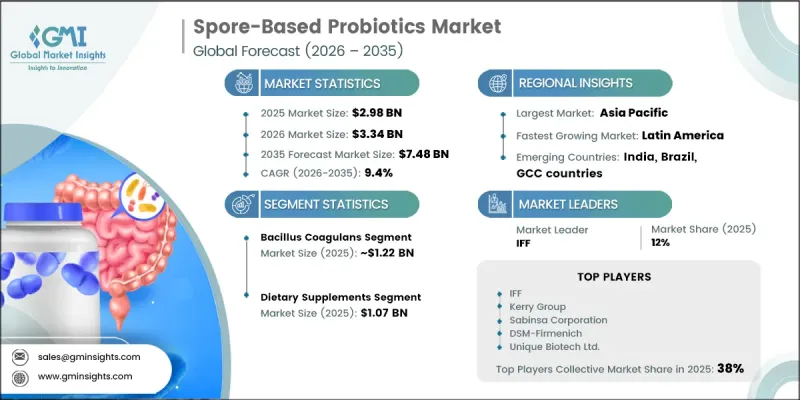
隨著包括營養補充劑、機能性食品配方和動物營養中直接給藥的微生物製劑在內的眾多領域需求的成長,市場正以更快的速度持續擴張。這種成長主要得益於產孢益生菌菌株獨特的配方特性。這些菌株具有優異的耐熱性和耐酸性,並且可以在室溫下長期儲存。這些特性使其成為商業化生產流程的理想選擇,因為商業性生產流程需要在整個生產、運輸和儲存過程中保持產品的高穩定性。美國和歐洲完善的安全評估流程所提供的監管支援進一步促進了市場發展。這為原料的商業化創造了更有利的環境,並推動了對菌株創新、臨床研究和大規模生產能力的持續投資。同時,製造商繼續致力於開發先進的配方,以提高穩定性和吸收效率,同時滿足消費者對便利益生菌產品不斷變化的需求。雖然法律規範簡化了認證菌株的安全評估,但獲得批准的健康聲明仍然需要大量的科學證據。在全球芽孢益生菌市場中,臨床證據對於產品的長期差異化和商業化仍然至關重要。
| 市場範圍 | |
|---|---|
| 開始年份 | 2025 |
| 預測期 | 2026-2035 |
| 初始市場規模 | 29.8億美元 |
| 預測金額 | 74.8億美元 |
| 複合年成長率 | 9.4% |
凝結芽孢桿菌(Bacillus coagulans)佔41%的市場佔有率,預計到2025年銷售額將達到12.2億美元。該菌種的市場主導地位得益於其長期以來獲得的監管批准、廣泛的商業性應用以及對其在多種健康相關應用中的作用進行評估的大量科學研究。製造商和原料供應商的持續信任正推動其在各種益生菌配方中的應用不斷擴大,進一步增強其在全球市場的競爭力。
預計到2025年,膳食補充劑市場銷售額將達到10.7億美元,佔市佔率的36%。消費者對保存期限長、易於吸收的益生菌膠囊和粉末補充劑的需求持續成長。此外,製造商正致力於研發能夠最佳化益生菌在消化器官系統中存活率並保持產品整個保存期限內功效穩定的配方技術,這進一步推動了該細分市場的擴張。
預計2025年,北美產孢益生菌市場規模將達8.05億美元,市佔率27%。美國仍然是該地區最大的市場貢獻者,這得益於其成熟的益生菌補充劑產業、消費者對營養產品的強勁支出以及有利於合格益生菌菌株商業化的法規環境。持續的監管發展正在為原料生產商拓展機遇,並刺激整個行業的創新、產品多樣化和更廣泛的市場滲透。
目錄
第1章:調查方法和範圍
第2章執行摘要
第3章 行業洞察
- 產業生態系分析
- 供應商情況
- 利潤率
- 每個階段增加的價值
- 影響價值鏈的因素
- 中斷
- 影響產業的因素
- 促進因素
- 優異的熱穩定性和耐酸性使其能夠在室溫下配製。
- 全球對腸道健康和預防保健的需求日益成長
- 禁止使用AGP將加速動物飼料和水產養殖業的AGP應用。
- 產業潛在風險與挑戰
- 涵蓋分散的、多司法管轄區的法律規範
- 與證明療效相關的高昂臨床試驗成本
- 市場機遇
- LBP 的監管途徑正在加速醫藥級市場的發展。
- 擴大功能性烘焙產品和飲料的營養強化範圍。
- 促進因素
- 成長潛力分析
- 監理情勢
- 波特的分析
- PESTLE分析
- 技術與創新展望
- 最新科技趨勢
- 新興技術
- 價格趨勢
- 按地區
- 按股票類型
- 未來市場趨勢
- 專利趨勢
- 貿易統計
- 主要進口國
- 主要出口國
- 永續性和環境方面
- 永續計劃
- 減少廢棄物策略
- 生產中的能源效率
- 具有環保意識的舉措
- 考慮碳足跡
第4章 競爭情勢
- 介紹
- 企業市佔率分析
- 按地區
- 北美洲
- 歐洲
- 亞太地區
- LATAM
- 中東和非洲
- 按地區
- 企業矩陣分析
- 主要市場公司的競爭分析
- 競爭定位矩陣
- 主要進展
- 併購
- 夥伴關係和聯盟
- 新產品發布
- 業務拓展計劃
第5章 市場估計與預測:依股票類型分類,2022-2035年
- Bacillus coagulans
- Bacillus subtilis
- Bacillus clausii
- Bacillus licheniformis
- 多種菌株混合
- 其他(新興股票)
第6章 市場估計與預測:依應用領域分類,2022-2035年
- 營養補充品
- 功能性食品和飲料
- 飼料和水產養殖
- 藥物與臨床營養
- 其他
第7章 市場估計與預測:依劑型分類,2022-2035年
- 膠囊和軟膠囊
- 藥片
- 粉末
- 軟糖咀嚼片
- 液體和滴
- 其他
第8章 市場估計與預測:依地區分類,2022-2035年
- 北美洲
- 美國
- 加拿大
- 歐洲
- 德國
- 英國
- 法國
- 西班牙
- 義大利
- 其他歐洲國家
- 亞太地區
- 中國
- 印度
- 日本
- 澳洲
- 韓國
- 其他亞太國家
- 拉丁美洲
- 巴西
- 墨西哥
- 阿根廷
- 其他拉丁美洲國家
- 中東和非洲
- 沙烏地阿拉伯
- 南非
- UAE
- 其他中東和非洲國家
第9章:公司簡介
- IFF
- DSM-Firmenich
- Kerry Group
- Lallemand Inc.
- Sabinsa Corporation
- Novonesis
- Sanzyme Biologics
- Unique Biotech Ltd.
- Wecare Probiotics
- ILDONG Bioscience
- Kaneka Probiotics
- Sporegen Limited
- Chambio Co., Ltd.
- Deerland Probiotics & Enzymes
The Global Spore-Based Probiotics Market was valued at USD 2.98 billion in 2025 and is estimated to grow at a CAGR of 9.4% to reach USD 7.48 billion by 2035.
Market expansion continues to accelerate as demand rises across dietary supplements, functional food formulations, and direct-fed microbial applications in animal nutrition. Growth is supported by the unique formulation characteristics of spore-forming probiotic strains, which provide superior resistance to heat, acidic environments, and extended shelf storage under ambient conditions. These attributes make them well suited for commercial manufacturing processes that require greater product stability throughout production, transportation, and storage. Regulatory support has further strengthened market development through established safety assessment pathways in the United States and Europe, creating a more favorable environment for ingredient commercialization and encouraging continued investment in strain innovation, clinical research, and large-scale production capabilities. At the same time, manufacturers remain focused on developing advanced formulations that improve stability and delivery efficiency while meeting evolving consumer demand for convenient probiotic products. Although regulatory frameworks have simplified safety evaluations for qualified strains, obtaining authorized health claims still requires extensive scientific substantiation, making clinical evidence essential for long-term product differentiation and commercialization in the global spore-based probiotics market.
| Market Scope | |
|---|---|
| Start Year | 2025 |
| Forecast Year | 2026-2035 |
| Start Value | $2.98 Billion |
| Forecast Value | $7.48 Billion |
| CAGR | 9.4% |
The Bacillus coagulans segment held 41% share, generating USD 1.22 billion in 2025. Its market leadership is supported by a long-established regulatory acceptance profile, broad commercial utilization, and an extensive body of scientific research evaluating its role across multiple health-related applications. Continued confidence from manufacturers and ingredient suppliers has strengthened its adoption across a wide range of probiotic formulations, reinforcing its competitive position within the global market.
The dietary supplements segment generated USD 1.07 billion in 2025, representing 36% share. Demand continues to increase as consumers seek shelf-stable probiotic supplements available in capsule and powder formats that offer reliable storage characteristics and improved gastrointestinal delivery. Manufacturers are also emphasizing formulation technologies that optimize probiotic survival in the digestive system while maintaining consistent potency throughout the product's shelf life, further supporting segment expansion.
North America Spore-Based Probiotics Market captured 27% share in 2025, reaching USD 805 million. The United States remained the region's largest contributor, supported by a well-established probiotic supplement industry, strong consumer spending on nutritional products, and a favorable regulatory environment that continues to facilitate commercialization opportunities for qualified probiotic strains. Ongoing regulatory developments have expanded opportunities for ingredient manufacturers while encouraging innovation, product diversification, and broader market participation throughout the industry.
Major participants operating in the global spore-based probiotics market include IFF, DSM-Firmenich, Sabinsa Corporation, Unique Biotech Ltd., Sanzyme Biologics, Wecare Probiotics Co. Ltd., ILDONG Bioscience, Kerry Group, Chambio Co. Ltd., Probiotical S.p.A., Sporegen Limited, Microbiome Labs, and Deerland Probiotics & Enzymes. Companies operating in the spore-based probiotics market continue to strengthen their competitive position by investing in research and development to expand proprietary strain portfolios and improve formulation performance. Many manufacturers prioritize product innovation through advanced delivery technologies that enhance stability, shelf life, and targeted gastrointestinal release. Strategic collaborations with ingredient suppliers, contract manufacturers, and distribution partners help broaden commercial reach across dietary supplements, functional foods, and animal nutrition applications. Businesses are also expanding production capacity to support growing global demand while improving supply chain efficiency. Regulatory compliance, quality certifications, and continuous clinical validation remain key priorities for building customer confidence and supporting product differentiation.
Table of Contents
Chapter 1 Methodology & Scope
- 1.1 Market scope and definition
- 1.2 Research design
- 1.2.1 Research approach
- 1.2.2 Data collection methods
- 1.3 Data mining sources
- 1.3.1 Global
- 1.3.2 Regional/Country
- 1.4 Base estimates and calculations
- 1.4.1 Base year calculation
- 1.4.2 Key trends for market estimation
- 1.5 Primary research and validation
- 1.5.1 Primary sources
- 1.6 Forecast model
- 1.7 Research assumptions and limitations
Chapter 2 Executive Summary
- 2.1 Industry 360° synopsis
- 2.2 Key market trends
- 2.2.1 Active Ingredient
- 2.2.2 Crop Type
- 2.2.3 Form
- 2.2.4 Application
- 2.2.5 Regional
- 2.3 TAM Analysis, 2026-2035
- 2.4 CXO perspectives: Strategic imperatives
- 2.5 Future outlook and strategic recommendations
Chapter 3 Industry Insights
- 3.1 Industry ecosystem analysis
- 3.1.1 Supplier landscape
- 3.1.2 Profit margin
- 3.1.3 Value addition at each stage
- 3.1.4 Factor affecting the value chain
- 3.1.5 Disruptions
- 3.2 Industry impact forces
- 3.2.1 Growth drivers
- 3.2.1.1 Superior Thermal & Acid Stability Enabling Ambient-Temperature Formulation
- 3.2.1.2 Rising Global Gut Health & Preventive Wellness Demand
- 3.2.1.3 AGP Bans Accelerating Animal Feed & Aquaculture Adoption
- 3.2.2 Industry pitfalls and challenges
- 3.2.2.1 Fragmented Multi-Jurisdictional Regulatory Frameworks
- 3.2.2.2 High Clinical Trial Costs for Efficacy Substantiation
- 3.2.3 Market opportunities
- 3.2.3.1 LBP regulatory pathway opening pharmaceutical-grade market
- 3.2.3.2 Functional bakery and beverage fortification expansion
- 3.2.1 Growth drivers
- 3.3 Growth potential analysis
- 3.4 Regulatory landscape
- 3.4.1 North America
- 3.4.2 Europe
- 3.4.3 Asia Pacific
- 3.4.4 Latin America
- 3.4.5 Middle East & Africa
- 3.5 Porter's analysis
- 3.6 PESTEL analysis
- 3.7 Technology and innovation landscape
- 3.7.1 Current technological trends
- 3.7.2 Emerging technologies
- 3.8 Price trends
- 3.8.1 By region
- 3.8.2 By Strain Type
- 3.9 Future market trends
- 3.10 Patent landscape
- 3.11 Trade statistics (HS code)
- 3.11.1 Major importing countries
- 3.11.2 Major exporting countries
- 3.12 Sustainability and environmental aspects
- 3.12.1 Sustainable practices
- 3.12.2 Waste reduction strategies
- 3.12.3 Energy efficiency in production
- 3.12.4 Eco-friendly initiatives
- 3.13 Carbon footprint consideration
Chapter 4 Competitive Landscape, 2025
- 4.1 Introduction
- 4.2 Company market share analysis
- 4.2.1 By region
- 4.2.1.1 North America
- 4.2.1.2 Europe
- 4.2.1.3 Asia Pacific
- 4.2.1.4 LATAM
- 4.2.1.5 MEA
- 4.2.1 By region
- 4.3 Company matrix analysis
- 4.4 Competitive analysis of major market players
- 4.5 Competitive positioning matrix
- 4.6 Key developments
- 4.6.1 Mergers & acquisitions
- 4.6.2 Partnerships & collaborations
- 4.6.3 New product launches
- 4.6.4 Expansion plans
Chapter 5 Market Estimates and Forecast, By Strain Type, 2022-2035 (USD Million) (Kilo Tons)
- 5.1 Key trends
- 5.2 Bacillus coagulans
- 5.3 Bacillus subtilis
- 5.4 Bacillus clausii
- 5.5 Bacillus licheniformis
- 5.6 Multi-Strain Blends
- 5.7 Others (Emerging Strains)
Chapter 6 Market Estimates and Forecast, By Application, 2022-2035 (USD Million) (Kilo Tons)
- 6.1 Key trends
- 6.2 Dietary Supplements
- 6.3 Functional Food & Beverages
- 6.4 Animal Feed & Aquaculture
- 6.5 Pharmaceuticals & Clinical Nutrition
- 6.6 Others
Chapter 7 Market Estimates and Forecast, By Dosage Form, 2022-2035 (USD Million) (Kilo Tons)
- 7.1 Key trends
- 7.2 Capsules & Softgels
- 7.3 Tablets
- 7.4 Powders
- 7.5 Gummies & Chews
- 7.6 Liquids & Drops
- 7.7 Others
Chapter 8 Market Estimates and Forecast, By Region, 2022-2035 (USD Million) (Kilo Tons)
- 8.1 Key trends
- 8.2 North America
- 8.2.1 U.S.
- 8.2.2 Canada
- 8.3 Europe
- 8.3.1 Germany
- 8.3.2 UK
- 8.3.3 France
- 8.3.4 Spain
- 8.3.5 Italy
- 8.3.6 Rest of Europe
- 8.4 Asia Pacific
- 8.4.1 China
- 8.4.2 India
- 8.4.3 Japan
- 8.4.4 Australia
- 8.4.5 South Korea
- 8.4.6 Rest of Asia Pacific
- 8.5 Latin America
- 8.5.1 Brazil
- 8.5.2 Mexico
- 8.5.3 Argentina
- 8.5.4 Rest of Latin America
- 8.6 Middle East and Africa
- 8.6.1 Saudi Arabia
- 8.6.2 South Africa
- 8.6.3 UAE
- 8.6.4 Rest of Middle East and Africa
Chapter 9 Company Profiles
- 9.1 IFF
- 9.2 DSM-Firmenich
- 9.3 Kerry Group
- 9.4 Lallemand Inc.
- 9.5 Sabinsa Corporation
- 9.6 Novonesis
- 9.7 Sanzyme Biologics
- 9.8 Unique Biotech Ltd.
- 9.9 Wecare Probiotics
- 9.10 ILDONG Bioscience
- 9.11 Kaneka Probiotics
- 9.12 Sporegen Limited
- 9.13 Chambio Co., Ltd.
- 9.14 Deerland Probiotics & Enzymes

 2026-2034年全球芽孢益生菌市場規模、佔有率、趨勢和成長分析報告
 發酵食品和益生菌市場預測至2034年:按產品類型、原料、分銷管道、應用和地區分類的全球分析益生菌乳類飲料市場預測至2034年-按產品類型、通路、配方、包裝、最終用戶和地區分類的全球分析
 益生菌飲料市場:依產品、包裝、通路和地區分類
 全球益生菌市場下一代益生菌市場:按菌株、應用和地區分類的規模、佔有率、前景和機會分析(2025-2032 年)益生菌市場:按類型、應用、成分和地區分類醫用益生菌市場:依成分類型、通路和地區分類
 益生菌飲料市場報告:趨勢、預測和競爭分析(至2035年)嗜酸乳桿菌益生菌市場:依形態、應用、通路和地區分類。