


 |
市場調查報告書
商品編碼
2101561
氫氣管道材料市場:商業機會、成長要素、產業趨勢分析及2026-2035年預測Hydrogen Pipeline Materials Market Opportunity, Growth Drivers, Industry Trend Analysis, and Forecast 2026 - 2035 |
||||||

全球氫氣管道材料市場預計到 2025 年將達到 37 億美元,並以 13.1% 的複合年成長率成長,到 2035 年將達到 128 億美元。
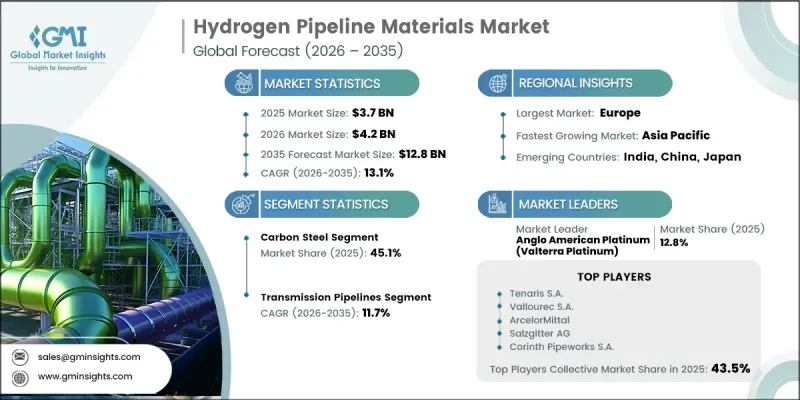
這一成長主要受氫氣生產項目擴張、專用運輸網路需求增加以及氫相關應用材料要求日益嚴格等因素驅動。由於氫氣運輸需要材料具備更強的抗氫腐蝕性能,因此該市場的發展趨勢與傳統管材有所不同。隨著對認證材料、先進製造流程和可靠基礎設施解決方案的日益關注,供應商正在推動專用管道材料的研發。政府主導的清潔能源舉措以及在主要氫氣生產和消費區域的基礎設施投資也在加速計畫開發,並增加對認證材料的需求。隨著氫氣網路的不斷擴展,擁有強大技術能力和認證專長的製造商有望在這個新興市場中獲得更強的競爭優勢。
| 市場範圍 | |
|---|---|
| 開始年份 | 2025 |
| 預測期 | 2026-2035 |
| 初始市場規模 | 37億美元 |
| 預測金額 | 128億美元 |
| 複合年成長率 | 13.1% |
截至2025年,碳鋼市佔率將達到45.1%。該細分市場憑藉其在管道基礎設施中的廣泛應用、成熟的製造能力、成本優勢以及滿足大規模生產需求的能力,持續保持主導地位。與高成本的合金替代品相比,碳鋼產品性能均衡、供應充足且經濟高效,因此持續受到市場青睞。在該細分市場中,專為氫氣應用設計的專用管線解決方案的重要性日益凸顯,因為管線開發商越來越重視材料的可靠性和長期運作性能。
預計到2025年,運輸管道業務將佔據41.7%的市場佔有率,並在2035年之前以11.7%的複合年成長率成長。該業務板塊受益於大規模氫氣運輸基礎設施投資的增加,這些基礎設施旨在連接生產設施、工業用戶和分銷網路。由於運行條件嚴苛,包括高壓輸送要求、對使用壽命的預期以及連續運行的要求,運輸系統對材料性能提出了很高的要求。這些技術因素正在推動對能夠確保氫氣管道可靠運作的高品質鋼材和合金材料的需求。
預計到2025年,北美氫氣管道材料市場將佔據顯著佔有率,這主要得益於政府舉措、基礎設施建設資金投入以及人們對氫能系統日益成長的興趣。不斷擴大的氫氣基礎設施項目催生了對輸送網路、生產設施和分銷系統所用專用管道材料的需求。隨著工程的推進,材料選擇的要求越來越注重耐久性、安全性以及是否符合既定的工程標準。預計對氫氣基礎設施建設投資的增加將增強該地區對先進管道材料的需求,從而為能夠提供合格解決方案的製造商創造新的商機。
目錄
第1章:調查方法和範圍
第2章執行摘要
第3章 行業洞察
- 產業生態系分析
- 供應商情況
- 利潤率
- 每個階段增加的價值
- 影響價值鏈的因素
- 中斷
- 影響產業的因素
- 促進因素
- 加大對氫能基礎設施的投資
- 對清潔能源的需求日益成長
- 跨境氫能網路的擴展
- 產業潛在風險與挑戰
- 氫脆會影響材料的耐久性。
- 高昂的初始設定和維護成本
- 市場機遇
- 先進管道合金的研發
- 綠色氫氣生產項目增加
- 現有天然氣管道維修
- 促進因素
- 成長潛力分析
- 監理情勢
- 波特的分析
- PESTLE分析
- 技術與創新展望
- 最新科技趨勢
- 新興技術
- 價格趨勢
- 按地區
- 材料類型
- 未來市場趨勢
- 專利趨勢
- 貿易統計
- 主要進口國
- 主要出口國
- 永續性和環境方面
- 永續計劃
- 減少廢棄物策略
- 生產中的能源效率
- 具有環保意識的舉措
- 考慮碳足跡
第4章 競爭情勢
- 介紹
- 企業市佔率分析
- 按地區
- 北美洲
- 歐洲
- 亞太地區
- LATAM
- 中東和非洲
- 按地區
- 企業矩陣分析
- 主要市場公司的競爭分析
- 競爭定位矩陣
- 主要進展
- 併購
- 夥伴關係和聯盟
- 新產品發布
- 業務拓展計劃
第5章 市場估算與預測:依材料類型分類,2022-2035年
- 碳鋼
- 奧氏體不銹鋼
- 鎳合金和高性能合金
- 鋁及鋁合金
- 聚合物和複合材料
- 其他
第6章 市場估計與預測:依應用領域分類,2022-2035年
- 運輸管道
- 輸配管道
- 儲存管道
- 工業和工藝管道
- 其他
第7章 市場估計與預測:依最終用戶分類,2022-2035年
- 石油和天然氣
- 化工/石油化工
- 發電
- 交通運輸與出行
- 工業製造
- 其他
第8章 市場估計與預測:依地區分類,2022-2035年
- 北美洲
- 美國
- 加拿大
- 歐洲
- 德國
- 英國
- 法國
- 西班牙
- 義大利
- 其他歐洲國家
- 亞太地區
- 中國
- 印度
- 日本
- 澳洲
- 韓國
- 其他亞太國家
- 拉丁美洲
- 巴西
- 墨西哥
- 阿根廷
- 其他拉丁美洲國家
- 中東和非洲
- 沙烏地阿拉伯
- 南非
- UAE
- 其他中東和非洲國家
第9章:公司簡介
- Tenaris SA
- Vallourec SA
- ArcelorMittal
- Salzgitter AG
- Borealis AG
- Jindal SAW Ltd.
- JFE Steel Corporation
- POSCO
- Corinth Pipeworks SA
- Baosteel Group(China Baowu Steel Group)
- Strohm BV
- Soluforce BV
The Global Hydrogen Pipeline Materials Market was valued at USD 3.7 billion in 2025 and is estimated to grow at a CAGR of 13.1% to reach USD 12.8 billion by 2035.
Growth is supported by the rising development of hydrogen production projects, increasing demand for dedicated transportation networks, and the establishment of stricter material requirements for hydrogen-related applications. The market is evolving differently from traditional pipeline material sectors because hydrogen transportation requires materials with enhanced resistance to performance challenges associated with hydrogen exposure. Growing focus on certified materials, advanced manufacturing processes, and reliable infrastructure solutions is encouraging suppliers to develop specialized pipeline materials. Government-backed clean energy initiatives and infrastructure investments across major hydrogen-producing and consuming regions are also accelerating project development and increasing demand for qualified materials. As hydrogen networks continue to expand, manufacturers with proven technical capabilities and certification expertise are expected to gain stronger competitive advantages in this emerging market.
| Market Scope | |
|---|---|
| Start Year | 2025 |
| Forecast Year | 2026-2035 |
| Start Value | $3.7 Billion |
| Forecast Value | $12.8 Billion |
| CAGR | 13.1% |
The carbon steel segment held 45.1% share in 2025. The segment maintains its leadership position due to its widespread use in pipeline infrastructure, established manufacturing capabilities, cost advantages, and suitability for large-scale fabrication requirements. Carbon steel products continue to attract demand because of their balance between performance, availability, and economic efficiency compared with higher-cost alloy alternatives. Within this segment, specialized linepipe solutions designed for hydrogen applications are gaining importance as pipeline developers increasingly prioritize material reliability and long-term operational performance.
The transmission pipelines segment held 41.7% share in 2025 growing at 11.7% CAGR through 2035. This segment is benefiting from increasing investment in large-scale hydrogen transportation infrastructure designed to connect production facilities with industrial users and distribution networks. Transmission systems require advanced material performance due to demanding operational conditions, including high-pressure transportation requirements, extended service life expectations, and continuous operation requirements. These technical factors are increasing demand for high-quality steel and alloy materials capable of supporting reliable hydrogen pipeline performance.
North America Hydrogen Pipeline Materials Market captured significant share in 2025 supported by government initiatives, infrastructure funding, and growing interest in hydrogen-based energy systems. Expanding hydrogen infrastructure projects are creating demand for specialized pipeline materials used across transportation networks, production facilities, and distribution systems. As project development progresses, material selection requirements are becoming increasingly focused on durability, safety, and compliance with established engineering standards. Growing investments in hydrogen infrastructure development are expected to strengthen regional demand for advanced pipeline materials and create new opportunities for manufacturers capable of supplying qualified solutions.
Major companies operating in the global hydrogen pipeline materials industry include ArcelorMittal, Tenaris S.A., Vallourec S.A., JFE Steel Corporation, Salzgitter AG, Borealis AG, POSCO, Jindal SAW Ltd., Corinth Pipeworks S.A., and Baosteel Group (China Baowu Steel Group). Companies operating in the hydrogen pipeline materials market are strengthening their market position by expanding production capabilities, investing in research and development, and developing materials specifically designed for hydrogen transportation requirements. Manufacturers are focusing on improving product certification, enhancing material performance, and creating advanced steel and alloy solutions to meet evolving industry standards. Strategic collaborations with pipeline developers, energy companies, and infrastructure stakeholders are helping businesses improve market access and strengthen project participation. Companies are also increasing investments in testing capabilities, manufacturing technologies, and quality assurance systems to improve customer confidence.
Table of Contents
Chapter 1 Methodology & Scope
- 1.1 Market scope and definition
- 1.2 Research design
- 1.2.1 Research approach
- 1.2.2 Data collection methods
- 1.3 Data mining sources
- 1.3.1 Global
- 1.3.2 Regional/Country
- 1.4 Base estimates and calculations
- 1.4.1 Base year calculation
- 1.4.2 Key trends for market estimation
- 1.5 Primary research and validation
- 1.5.1 Primary sources
- 1.6 Forecast model
- 1.7 Research assumptions and limitations
Chapter 2 Executive Summary
- 2.1 Industry 360° synopsis
- 2.2 Key market trends
- 2.2.1 Material Type
- 2.2.2 Application
- 2.2.3 End User
- 2.2.4 Regional
- 2.3 TAM Analysis, 2026-2035
- 2.4 CXO perspectives: Strategic imperatives
- 2.5 Future outlook and strategic recommendations
Chapter 3 Industry Insights
- 3.1 Industry ecosystem analysis
- 3.1.1 Supplier landscape
- 3.1.2 Profit margin
- 3.1.3 Value addition at each stage
- 3.1.4 Factor affecting the value chain
- 3.1.5 Disruptions
- 3.2 Industry impact forces
- 3.2.1 Growth drivers
- 3.2.1.1 Growing investments in hydrogen infrastructure
- 3.2.1.2 Rising demand for clean energy
- 3.2.1.3 Expansion of cross-border hydrogen networks
- 3.2.2 Industry pitfalls and challenges
- 3.2.2.1 Hydrogen embrittlement affecting material durability
- 3.2.2.2 High installation and maintenance costs
- 3.2.3 Market opportunities
- 3.2.3.1 Development of advanced pipeline alloys
- 3.2.3.2 Increasing green hydrogen production projects
- 3.2.3.3 Retrofitting existing natural gas pipelines
- 3.2.1 Growth drivers
- 3.3 Growth potential analysis
- 3.4 Regulatory landscape
- 3.4.1 North America
- 3.4.2 Europe
- 3.4.3 Asia Pacific
- 3.4.4 Latin America
- 3.4.5 Middle East & Africa
- 3.5 Porter's analysis
- 3.6 PESTEL analysis
- 3.7 Technology and innovation landscape
- 3.7.1 Current technological trends
- 3.7.2 Emerging technologies
- 3.8 Price trends
- 3.8.1 By region
- 3.8.2 By Material Type
- 3.9 Future market trends
- 3.10 Patent landscape
- 3.11 Trade statistics (HS code)
- 3.11.1 Major importing countries
- 3.11.2 Major exporting countries
- 3.12 Sustainability and environmental aspects
- 3.12.1 Sustainable practices
- 3.12.2 Waste reduction strategies
- 3.12.3 Energy efficiency in production
- 3.12.4 Eco-friendly initiatives
- 3.13 Carbon footprint consideration
Chapter 4 Competitive Landscape, 2025
- 4.1 Introduction
- 4.2 Company market share analysis
- 4.2.1 By region
- 4.2.1.1 North America
- 4.2.1.2 Europe
- 4.2.1.3 Asia Pacific
- 4.2.1.4 LATAM
- 4.2.1.5 MEA
- 4.2.1 By region
- 4.3 Company matrix analysis
- 4.4 Competitive analysis of major market players
- 4.5 Competitive positioning matrix
- 4.6 Key developments
- 4.6.1 Mergers & acquisitions
- 4.6.2 Partnerships & collaborations
- 4.6.3 New product launches
- 4.6.4 Expansion plans
Chapter 5 Market Estimates and Forecast, By Material Type, 2022-2035 (USD Million)
- 5.1 Key trends
- 5.2 Carbon Steel
- 5.3 Austenitic Stainless Steel
- 5.4 Nickel Alloys & High-Performance Alloys
- 5.5 Aluminum & Aluminum Alloys
- 5.6 Polymer & Composite Materials
- 5.7 Others
Chapter 6 Market Estimates and Forecast, By Application, 2022-2035 (USD Million)
- 6.1 Key trends
- 6.2 Transmission Pipelines
- 6.3 Distribution Pipelines
- 6.4 Storage Pipelines
- 6.5 Industrial & Process Piping
- 6.6 Others
Chapter 7 Market Estimates and Forecast, By End User, 2022-2035 (USD Million)
- 7.1 Key trends
- 7.2 Oil & Gas
- 7.3 Chemical & Petrochemical
- 7.4 Power Generation
- 7.5 Transportation & Mobility
- 7.6 Industrial Manufacturing
- 7.7 Others
Chapter 8 Market Estimates and Forecast, By Region, 2022-2035 (USD Million)
- 8.1 Key trends
- 8.2 North America
- 8.2.1 U.S.
- 8.2.2 Canada
- 8.3 Europe
- 8.3.1 Germany
- 8.3.2 UK
- 8.3.3 France
- 8.3.4 Spain
- 8.3.5 Italy
- 8.3.6 Rest of Europe
- 8.4 Asia Pacific
- 8.4.1 China
- 8.4.2 India
- 8.4.3 Japan
- 8.4.4 Australia
- 8.4.5 South Korea
- 8.4.6 Rest of Asia Pacific
- 8.5 Latin America
- 8.5.1 Brazil
- 8.5.2 Mexico
- 8.5.3 Argentina
- 8.5.4 Rest of Latin America
- 8.6 Middle East and Africa
- 8.6.1 Saudi Arabia
- 8.6.2 South Africa
- 8.6.3 UAE
- 8.6.4 Rest of Middle East and Africa
Chapter 9 Company Profiles
- 9.1 Tenaris S.A.
- 9.2 Vallourec S.A.
- 9.3 ArcelorMittal
- 9.4 Salzgitter AG
- 9.5 Borealis AG
- 9.6 Jindal SAW Ltd.
- 9.7 JFE Steel Corporation
- 9.8 POSCO
- 9.9 Corinth Pipeworks S.A.
- 9.10 Baosteel Group (China Baowu Steel Group)
- 9.11 Strohm B.V.
- 9.12 Soluforce B.V.

 氫氣管道運輸市場預測至2034年:按管道類型、應用和區域分類的全球分析全球氫氣管道市場預測至2034年—按管道類型、基礎設施、氫氣類型、壓力等級、材質、網路類型、應用、最終用戶和地區分類的全球分析
 2026-2030年全球氫氣管道監測系統市場
 2026年全球氫氣運輸管市場報告
 氫氣管道市場:2026-2032年全球市場預測(按管道類型、材料、壓力等級、直徑範圍和最終用途分類)
 全球氫氣管道市場規模、佔有率、趨勢和成長分析報告(2026-2034年)全球氫氣管道市場:市場規模、佔有率、成長率、產業分析、依類型、應用和地區劃分的分析以及未來預測(2026-2034)
 氫氣管道市場規模、佔有率和成長分析(按類型、狀態、長度和地區分類)-2026-2033年產業預測
 2025年全球氫氣管道市場
 氫氣管道市場機會、成長動力、產業趨勢分析及2025-2035年預測