

 |
市場調查報告書
商品編碼
2083380
智慧門鈴市場機會、成長促進因素、產業趨勢分析及2026-2035年預測Smart Doorbell Market Opportunity, Growth Drivers, Industry Trend Analysis, and Forecast 2026 - 2035 |
||||||

全球智慧門鈴市場預計到 2025 年將達到 80 億美元,到 2035 年將以 13% 的複合年成長率成長,達到 282 億美元。
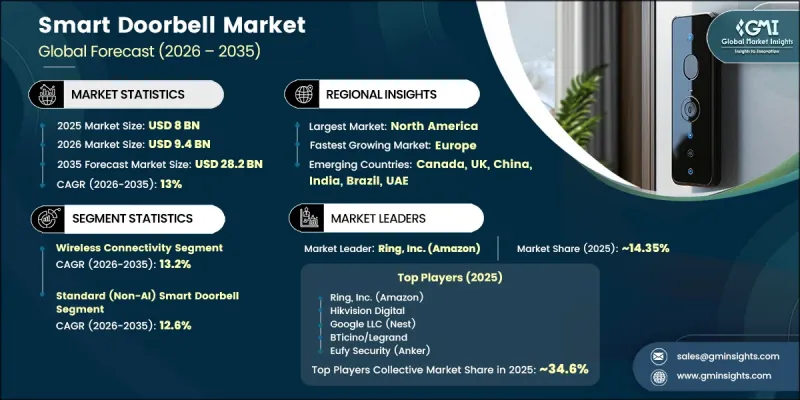
市場擴張的驅動力來自住宅安防解決方案投資的增加、連網家庭生態系統的日益普及,以及網路購物快速成長帶來的包裹追蹤技術持續需求。已開發國家和開發中國家的長期結構性需求均推動了該行業的蓬勃發展,人工智慧的進步、無縫無線部署以及設備間互通性,都促進了消費群的不斷擴大。硬體成本的降低,以及亞太、拉丁美洲、中東和非洲地區寬頻接取的普及,正在消除傳統普及障礙,加速市場滲透。因此,智慧門鈴正成為連網家庭安防產業中最具韌性的產品類別之一。人工智慧和機器學習的引入,已將設備功能從簡單的運動通知提升至高階情境察覺。現代平台能夠識別各種物件類型、識別熟悉的人員,並根據風險等級對通知進行優先排序,從而顯著提高準確性,同時減少不必要的警報。這些技術進步進一步提升了智慧門鈴系統的價值提案,並持續支撐著市場的長期成長。
| 市場範圍 | |
|---|---|
| 開始年份 | 2025 |
| 預測期 | 2026-2035 |
| 起始金額 | 80億美元 |
| 預測金額 | 282億美元 |
| 複合年成長率 | 13% |
預計到2025年,無線連接市場規模將達到48億美元。該市場持續保持強勁成長勢頭,因為它與包括居住者、智慧多用戶住宅營運商在內的關鍵客戶群的需求高度契合。無線解決方案主要由支援Wi-Fi的裝置組成,Wi-Fi仍然是主要的連接方式,儘管在固定寬頻存取有限的地區,蜂窩網路連接模式也越來越受歡迎。無線智慧門鈴因其安裝簡單、部署柔軟性,仍是消費者的首選。
預計到2025年,「標準(非人工智慧)智慧門鈴」市佔率將達到54.6%,並在2035年之前以12.6%的複合年成長率成長。此類別包含具備影像監控、雙向通話、行動偵測以及本地或雲端儲存等基本功能的產品,但不包含具備高階人工智慧視覺分析功能的產品。由於價格實惠,且受到注重性價比、尋求可靠家庭安全功能的消費者的廣泛支持,該類別保持著主導地位。市場需求仍然強勁,尤其是在首次購買者和新興經濟體的消費者中,成本績效的產品持續推動銷售成長。
北美智慧門鈴市場佔據42.8%的市場佔有率,預計到2025年將達到約34億美元。高市場滲透率、對住宅安防技術的廣泛認知以及連網家庭設備的高普及率,持續鞏固該地區的主導地位。消費者對監控送貨狀態、增強住宅安全以及將智慧設備整合到統一的家居生態系統中的需求,仍然是全部區域需求的主要驅動力。
目錄
第1章:調查方法和範圍
第2章執行摘要
第3章 行業洞察
- 產業生態系分析
- 供應商情況
- 利潤率
- 每個階段增加的價值
- 影響價值鏈的因素
- 影響產業的因素
- 成長促進因素
- 人工智慧與機器學習的融合
- Matter協議與智慧家庭平台的整合
- 消費者對影像安防的需求日益成長
- 產業潛在風險與挑戰
- 隱私和資料安全問題
- 高昂的訂閱費用和消費者對定期收費的抗拒情緒
- 生態系間的互通性和平台碎片化
- 機會
- 訂閱服務的成長
- 多用戶住宅和商業設施的實施情況
- 開發節能無線解決方案
- 成長促進因素
- 成長潛力分析
- 未來市場趨勢
- 技術與創新展望
- 最新科技趨勢
- 新興技術
- 監理情勢
- 標準和合規要求
- 區域監理框架
- 認證標準
- 貿易數據分析
- 進出口量及進口額趨勢
- 主要貿易路線及關稅的影響
- 價格分析
- 對過去價格趨勢的分析
- 按業務類型(高階/低階/大眾市場)分類的定價策略
- 人工智慧和生成式人工智慧對市場的影響
- 利用人工智慧改造現有經營模式
- 按細分市場分類的生成式人工智慧用例和部署藍圖
- 風險、限制和監管考量
- 波特的分析
- PESTLE分析
第4章 競爭情勢
- 介紹
- 企業市佔率分析
- 按地區
- 企業矩陣分析
- 主要市場公司的競爭分析
- 競爭定位矩陣
- 主要進展
- 併購
- 夥伴關係和聯盟
- 新產品發布
- 業務拓展計劃
第5章 市場估算與預測:依產品類型分類,2022-2035年
- 視訊智慧門鈴
- 包括雲端儲存
- 使用小型資料庫
- 非影像智慧門鈴
第6章 市場估計與預測:依性別分類的互聯互通情況,2022-2035年
- 有線
- 無線的
- 支援Wi-Fi(2.4GHz和雙頻5GHz)
- 電池供電的無線設備
- 多重通訊協定(相容於 Wi-Fi + 藍牙 + Zigbee/Matter)
第7章 市場估計與預測:依技術分類,2022-2035年
- 人工智慧智慧門鈴
- 臉部辨識和人員偵測
- 包裹和遞送檢測
- 可自訂的檢測區域和智慧警報
- 基於雷達的存在檢測
- 標準(非人工智慧)智慧門鈴
第8章 市場估算與預測:依決議分類,2022-2035年
- HD(720p)
- 全高清 (1080p)
- Ultra HD/4K
第9章 市場估計與預測:依最終用途分類,2022-2035年
- 住宅
- 獨立式住宅
- 公寓多用戶住宅
- 商業
- 中小企業
- 公司/大型商業設施
第10章 市場估價與預測:依通路分類,2022-2035年
- 線上
- 電子商務網站
- 公司網站
- 離線
- 大型零售商(沃爾瑪、家得寶、百思買、好市多)
- 家用電器商店
- 通訊/網際網路服務供應商套餐(AT&T、Comcast、Verizon智慧家庭套餐)
第11章 市場估價與預測:按地區分類,2022-2035年
- 北美洲
- 美國
- 加拿大
- 歐洲
- 德國
- 英國
- 法國
- 義大利
- 西班牙
- 亞太地區
- 中國
- 印度
- 日本
- 韓國
- 澳洲
- 印尼
- 馬來西亞
- 拉丁美洲
- 巴西
- 墨西哥
- 阿根廷
- 中東和非洲
- 沙烏地阿拉伯
- UAE
- 南非
第12章:公司簡介
- 世界公司
- Ring, Inc.(Amazon)
- Google LLC(Nest)
- Arlo Technologies, Inc.
- Eufy Security(Anker Innovations)
- Vivint Smart Home
- 該地區的領先企業
- SkyBell Technologies
- SimpliSafe, Inc.
- Xiaomi Corporation
- Aiphone Co., Ltd.
- EZVIZ Inc.
- 新興企業
- Netatmo(Legrand)
- Amcrest Technologies
- Remo+(RemoBell)
- Lorex Technology
- Imou(Dahua Technology)
The Global Smart Doorbell Market generated USD 8 billion in 2025 and is estimated to grow at a CAGR of 13% to reach USD 28.2 billion by 2035.
Market expansion is fueled by rising investments in residential security solutions, growing adoption of connected home ecosystems, and sustained demand for parcel monitoring technologies driven by the rapid growth of online shopping. The industry is benefiting from long-term structural demand across both developed and developing economies as advancements in artificial intelligence, seamless wireless deployment, and enhanced device interoperability continue to expand the consumer base. Declining hardware costs combined with broader broadband availability across Asia Pacific, Latin America, and the Middle East & Africa are reducing historical barriers to adoption and accelerating market penetration. As a result, smart doorbells are emerging as one of the most resilient categories within the connected home security industry. The incorporation of AI and machine learning has transformed device functionality from basic motion alerts to advanced situational awareness. Modern platforms can identify different object types, recognize familiar individuals, and prioritize notifications based on risk levels, significantly improving accuracy while reducing unnecessary alerts. These technological advancements continue to strengthen the value proposition of smart doorbell systems and support long-term market growth.
| Market Scope | |
|---|---|
| Start Year | 2025 |
| Forecast Year | 2026-2035 |
| Start Value | $8 Billion |
| Forecast Value | $28.2 Billion |
| CAGR | 13% |
The wireless connectivity segment accounted for USD 4.8 billion share in 2025. The segment continues to experience strong momentum because it aligns closely with the preferences of key customer groups, including renters, first-time smart home users, and operators of multi-unit residential properties. Wireless solutions primarily consist of Wi-Fi-enabled devices, which remain the leading connectivity option, while cellular-connected models are gaining traction in locations where fixed broadband availability remains limited. The convenience of installation and flexibility of deployment continue to make wireless smart doorbells the preferred choice among consumers.
The Standard (Non-AI) Smart Doorbell segment represented 54.6% share in 2025 and is anticipated to grow at a CAGR of 12.6% through 2035. This category includes products equipped with essential capabilities such as video surveillance, two-way communication, motion sensing, and local or cloud-based storage without advanced AI-powered visual analytics. The segment maintains a dominant position due to its affordability and broad appeal among cost-conscious consumers seeking reliable home security functionality. Demand remains particularly strong among first-time buyers and customers in emerging economies where value-oriented products continue to drive volume sales.
North America Smart Doorbell Market held a 42.8% share, equivalent to approximately generating USD 3.4 billion in 2025. Strong market penetration, widespread awareness of residential security technologies, and high adoption of connected home devices continue to support regional leadership. Consumer interest in monitoring deliveries, enhancing property security, and integrating smart devices into unified home ecosystems remains a major factor driving demand throughout the region.
Key companies operating in the global smart doorbell market include Xiaomi Corporation, Arlo Technologies, Inc., Google LLC (Nest), Ring, Inc. (Amazon), SimpliSafe, Inc., EZVIZ Inc., Aiphone Co., Ltd., Eufy Security (Anker Innovations), Vivint Smart Home, SkyBell Technologies, Netatmo (Legrand), Remo+ (RemoBell), Amcrest Technologies, Imou (Dahua Technology), and Lorex Technology. Companies operating in the smart doorbell market are focusing on several strategic initiatives to strengthen their competitive position and expand market share. Product innovation remains a primary focus, with manufacturers integrating artificial intelligence, enhanced video resolution, advanced analytics, and seamless smart home compatibility into their offerings. Strategic partnerships with smart home platform providers, telecom operators, and security service companies are helping brands broaden distribution channels and improve ecosystem integration. Many companies are investing heavily in research and development to improve battery performance, cybersecurity, cloud services, and user experience. Expansion into emerging markets through localized pricing strategies and region-specific product portfolios is also gaining importance.
Table of Contents
Chapter 1 Methodology & Scope
- 1.1 Market scope and definition
- 1.2 Research design
- 1.2.1 Research approach
- 1.2.2 Data collection methods
- 1.3 Data mining sources
- 1.3.1 Global
- 1.3.2 Regional/Country
- 1.4 Base estimates and calculations
- 1.4.1 Base year calculation
- 1.4.2 Key trends for market estimation
- 1.5 Primary research and validation
- 1.5.1 Primary sources
- 1.6 Forecast model
- 1.7 Research assumptions and limitations
Chapter 2 Executive Summary
- 2.1 Industry 360° synopsis
- 2.2 Key market trends
- 2.2.1 Regional
- 2.2.2 Product type
- 2.2.3 Connectivity
- 2.2.4 Technology
- 2.2.5 Resolution
- 2.2.6 End use
- 2.2.7 Distribution channel
Chapter 3 Industry Insights
- 3.1 Industry ecosystem analysis
- 3.1.1 Supplier landscape
- 3.1.2 Profit margin
- 3.1.3 Value addition at each stage
- 3.1.4 Factor affecting the value chain
- 3.2 Industry impact forces
- 3.2.1 Growth drivers
- 3.2.1.1 AI and machine learning integration
- 3.2.1.2 Matter protocol and smart home platform integration
- 3.2.1.3 Growing consumer demand for video security
- 3.2.2 Industry pitfalls & challenges
- 3.2.2.1 Privacy and data security concerns
- 3.2.2.2 High subscription costs and consumer resistance to recurring fees
- 3.2.2.3 Interoperability and platform fragmentation across ecosystems
- 3.2.3 Opportunities
- 3.2.3.1 Growth of subscription-based services
- 3.2.3.2 Adoption in multi-dwelling and commercial spaces
- 3.2.3.3 Development of energy-efficient and wireless solutions
- 3.2.1 Growth drivers
- 3.3 Growth potential analysis
- 3.4 Future market trends
- 3.5 Technology and innovation landscape
- 3.5.1 Current technological trends
- 3.5.2 Emerging technologies
- 3.6 Regulatory landscape
- 3.6.1 Standards and compliance requirements
- 3.6.2 Regional regulatory frameworks
- 3.6.3 Certification standards
- 3.7 Trade data analysis (HS Code 8531.80)
- 3.7.1 Import/export volume & value trends
- 3.7.2 Key trade corridors & tariff impact
- 3.8 Pricing analysis
- 3.8.1 Historical price trend analysis (driven by primary research)
- 3.8.2 Pricing strategy by player type (premium / value / mass market)
- 3.9 Impact of AI & generative AI on the market
- 3.9.1 AI-driven disruption of existing business models
- 3.9.2 GenAI use cases & adoption roadmap by segment
- 3.9.3 Risks, limitations & regulatory considerations
- 3.10 Porter's analysis
- 3.11 PESTEL analysis
Chapter 4 Competitive Landscape, 2025
- 4.1 Introduction
- 4.2 Company market share analysis
- 4.2.1 By Region
- 4.2.1.1 North America
- 4.2.1.2 Europe
- 4.2.1.3 Asia Pacific
- 4.2.1.4 Latin America
- 4.2.1.5 Middle East & Africa
- 4.2.1 By Region
- 4.3 Company matrix analysis
- 4.4 Competitive analysis of major market players
- 4.5 Competitive positioning matrix
- 4.6 Key developments
- 4.6.1 Mergers & acquisitions
- 4.6.2 Partnerships & collaborations
- 4.6.3 New product launches
- 4.6.4 Expansion plans
Chapter 5 Market Estimates & Forecast, By Product Type, 2022 - 2035, (USD Billion) (Million Units)
- 5.1 Key trends
- 5.2 Video smart doorbell
- 5.2.1 With cloud storage
- 5.2.2 With local storage
- 5.3 Non-video smart doorbell
Chapter 6 Market Estimates & Forecast, By Connectivity, 2022 - 2035, (USD Billion) (Million Units)
- 6.1 Key trends
- 6.2 Wired
- 6.3 Wireless
- 6.3.1 Wi-Fi enabled (2.4GHz and Dual-Band 5GHz)
- 6.3.2 Battery-powered wireless
- 6.3.3 Multi-Protocol (Wi-Fi + Bluetooth + Zigbee / Matter-Compatible)
Chapter 7 Market Estimates & Forecast, By Technology, 2022 - 2035, (USD Billion) (Million Units)
- 7.1 Key trends
- 7.2 AI-enabled smart doorbell
- 7.2.1 Facial recognition and person detection
- 7.2.2 Package and delivery detection
- 7.2.3 Motion zone customization and intelligent alerts
- 7.2.4 Radar-based presence detection
- 7.3 Standard (Non-AI) smart doorbell
Chapter 8 Market Estimates & Forecast, By Resolution, 2022 - 2035, (USD Billion) (Million Units)
- 8.1 Key trends
- 8.2 HD (720p)
- 8.3 Full HD (1080p)
- 8.4 Ultra HD / 4K
Chapter 9 Market Estimates & Forecast, By End-Use, 2022 - 2035, (USD Billion) (Million Units)
- 9.1 Key trends
- 9.2 Residential
- 9.2.1 Single-family homes
- 9.2.2 Multi-family / apartment buildings
- 9.3 Commercial
- 9.3.1 Small & medium businesses (SMBs)
- 9.3.2 Enterprise / large commercial installations
Chapter 10 Market Estimates & Forecast, By Distribution Channel, 2022 - 2035, (USD Billion) (Million Units)
- 10.1 Key trends
- 10.2 Online
- 10.2.1 E-commerce website
- 10.2.2 Company owned website
- 10.3 Offline
- 10.3.1 Big-box retail (Walmart, home depot, best buy, Costco)
- 10.3.2 Specialty electronics stores
- 10.3.3 Telecom / ISP bundles (AT&T, comcast, Verizon smart home packages)
Chapter 11 Market Estimates & Forecast, By Region, 2022 - 2035, (USD Billion) (Million Units)
- 11.1 Key trends
- 11.2 North America
- 11.2.1 U.S.
- 11.2.2 Canada
- 11.3 Europe
- 11.3.1 Germany
- 11.3.2 UK
- 11.3.3 France
- 11.3.4 Italy
- 11.3.5 Spain
- 11.4 Asia Pacific
- 11.4.1 China
- 11.4.2 India
- 11.4.3 Japan
- 11.4.4 South Korea
- 11.4.5 Australia
- 11.4.6 Indonesia
- 11.4.7 Malaysia
- 11.5 Latin America
- 11.5.1 Brazil
- 11.5.2 Mexico
- 11.5.3 Argentina
- 11.6 MEA
- 11.6.1 Saudi Arabia
- 11.6.2 UAE
- 11.6.3 South Africa
Chapter 12 Company Profiles
- 12.1 Global Players
- 12.1.1 Ring, Inc. (Amazon)
- 12.1.2 Google LLC (Nest)
- 12.1.3 Arlo Technologies, Inc.
- 12.1.4 Eufy Security (Anker Innovations)
- 12.1.5 Vivint Smart Home
- 12.2 Regional Champions
- 12.2.1 SkyBell Technologies
- 12.2.2 SimpliSafe, Inc.
- 12.2.3 Xiaomi Corporation
- 12.2.4 Aiphone Co., Ltd.
- 12.2.5 EZVIZ Inc.
- 12.3 Emerging Players
- 12.3.1 Netatmo (Legrand)
- 12.3.2 Amcrest Technologies
- 12.3.3 Remo+ (RemoBell)
- 12.3.4 Lorex Technology
- 12.3.5 Imou (Dahua Technology)


