


 |
市場調查報告書
商品編碼
2083343
BPA 和 BPS 無毒罐頭塗料市場的成長機會、成長要素、產業趨勢以及 2026-2035 年的預測。BPA-Free and BPS-Free Can Coatings Market Opportunity, Growth Drivers, Industry Trend Analysis, and Forecast 2026 - 2035 |
||||||

預計到 2025 年,全球不含 BPA 和 BPS 的罐頭塗層市場規模將達到 6.43 億美元,年複合成長率為 7.4%,到 2035 年將達到 13.2 億美元。
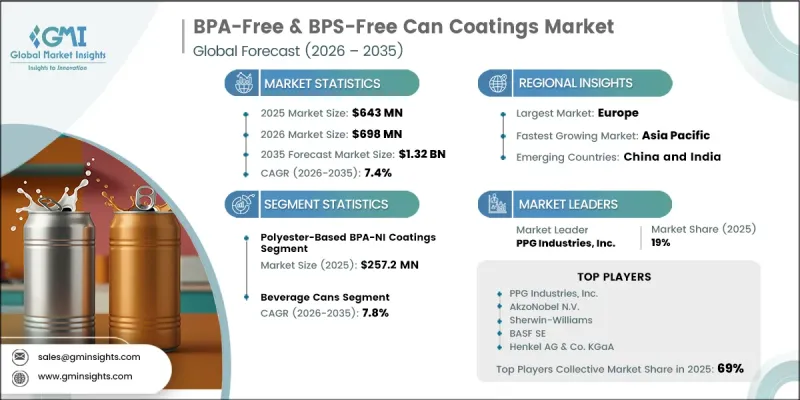
隨著金屬包裝產業日益轉向不含雙酚類材料的替代塗層技術,該產業正經歷重大變革。推動這一成長的因素包括:食品接觸材料監管要求的日益嚴格、安全標準的不斷完善,以及品牌所有者對經認證的無雙酚包裝解決方案的偏好日益成長。整個包裝價值鏈上的製造商都在加速改進產品,以滿足不斷變化的合規要求和消費者對更安全包裝材料的需求。無雙酚A (BPA) 和無雙酚S (BPS) 的罐頭塗層市場也受益於塗層化學的持續進步,這些進步在提高性能的同時,也滿足了日益嚴格的監管要求。成熟的塗層技術憑藉其久經考驗的永續性和可製造性,繼續保持著強勁的市場地位,而新興配方技術則因其環境友好性、更高的永續性和更優異的應用性能而迅速崛起。圍繞雙酚類材料的監管不確定性,進一步推動了全球供應鏈對替代塗層解決方案的積極投資。隨著食品和飲料包裝製造商繼續優先考慮合規性、永續性和產品安全,預計在整個預測期內,對不含 BPA 和不含 BPS 的罐頭塗層的需求將保持強勁。
| 市場範圍 | |
|---|---|
| 開始年份 | 2025 |
| 預測期 | 2026-2035 |
| 上市時的市場規模 | 6.43億美元 |
| 預測金額 | 13.2億美元 |
| 複合年成長率 | 7.4% |
2025年,聚酯基BPA-NI塗層市場規模達2.572億美元。預計到2035年,該細分市場將以8.2%的複合年成長率成長。其持續主導地位歸功於合規性、完善的生產基礎設施以及在金屬包裝應用中久經考驗的性能。該技術正被監管市場廣泛接受,成為傳統塗層系統的替代方案,使製造商能夠在不影響營運效率的前提下滿足不斷變化的合規要求。預計該技術的持續應用將在整個預測期內進一步鞏固該細分市場的主導地位。
預計到2025年,飲料罐市場將佔55.1%的市場佔有率,市場規模達3.543億美元。這一成長主要得益於金屬飲料包裝需求的不斷成長以及對無雙酚塗層技術的持續推廣。飲料包裝產業的採用率尤其強勁,因為該產業高度重視法規遵從性、產品安全和消費者信心。隨著製造商繼續優先考慮永續且合規的包裝解決方案,預計對用於飲料罐的先進塗層系統的需求將保持強勁。
到2025年,北美不含雙酚A (BPA) 和雙酚S (BPS) 的罐頭塗層市場將佔據28.9%的市場佔有率,市場規模將達到1.858億美元。預計該地區市場在預測期內將以7%的複合年成長率成長。這一成長得益於成熟的金屬包裝行業、強力的法律規範以及替代塗層技術的日益普及。美國憑藉其強大的罐頭製造基礎設施和對食品接觸材料安全性的日益重視,繼續保持該地區最大的市場佔有率。預計未來幾年,對包裝創新和合規性產品開發的持續投入將支撐北美市場的穩定成長。
目錄
第1章:調查方法和範圍
第2章執行摘要
第3章 行業洞察
- 產業生態系分析
- 供應商情況
- 利潤率
- 每個階段增加的價值
- 影響價值鏈的因素
- 中斷
- 影響產業的因素
- 促進因素
- 產業潛在風險與挑戰
- 市場機遇
- 成長潛力分析
- 監理情勢
- 波特的分析
- PESTLE分析
- 價格趨勢
- 按地區
- 透過技術
- 未來市場趨勢
- 技術與創新展望
- 最新科技趨勢
- 新興技術
- 專利趨勢
- 貿易統計
- 主要進口國
- 主要出口國
- 永續性和環境方面
- 永續計劃
- 減少廢棄物策略
- 生產中的能源效率
- 具有環保意識的舉措
第4章 競爭情勢
- 介紹
- 企業市佔率分析
- 按地區
- 北美洲
- 歐洲
- 亞太地區
- LATAM
- 中東和非洲
- 按地區
- 企業矩陣分析
- 主要市場公司的競爭分析
- 競爭定位矩陣
- 主要進展
- 併購
- 夥伴關係和聯盟
- 新產品發布
- 業務拓展計劃
第5章 市場估算與預測:依樹脂類型分類,2022年至2035年
- 壓克力顏料
- 水性丙烯酸
- 溶劑型丙烯酸
- 聚酯基塗料(不含雙酚A)
- 熱塑性聚酯
- 熱固性聚酯
- 聚烯塗層
- 均聚烯
- 共聚物聚烯
- 不含雙酚A的環氧塗層
- 植物來源/生物源環氧樹脂
- 不含 BADGE 的合成環氧樹脂(BPA-NI 環氧樹脂)
- 有機溶膠塗料(不含BPS的改良產品)
- 生物基和新興塗料
- UV/EB固化生物基塗料
- 其他新型聚合物體系
第6章 市場估計與預測:依應用領域分類,2022年至2035年
- 飲料罐
- 碳酸飲料(碳酸飲料、啤酒、硬蘇打水、能量飲料)
- 非碳酸飲料(果汁、純水、即飲茶和咖啡)
- 食品罐頭
- 已調理食品和加工食品
- 湯汁
- 蔬菜和水果
- 乳製品和嬰幼兒食品
- 氣霧罐
- 化妝品和個人護理氣霧劑(香水、護髮、護膚)
- 工業及家用氣霧劑
- 醫用氣霧劑(吸入器和外用噴霧器)
- 蓋子與封口裝置
- 飲料罐蓋(易開蓋、標準蓋)
- 食品罐頭蓋和旋蓋
- 工業罐
- 化學品和潤滑劑罐
- 油漆和黏合劑
第7章 市場估算與預測:依塗層分類,2022年至2035年
- 內塗(罐內襯-主要食品接觸面)
- 外牆塗料(裝飾、品牌推廣、環保)
- 罐底和罐蓋塗層(罐底和罐蓋 - 食品接觸面)
- 側縫噴塗(三片式罐體的焊接縫)
第8章 市場估算與預測:依製劑技術分類,2022年至2035年
- 水溶液
- 溶劑型
- 粉末塗裝
- UV/EB固化型
第9章 市場估算與預測:依最終用途分類,2022年至2035年
- 食品/飲料
- 個人護理化妝品
- 製藥
- 產業
第10章 市場估價與預測:依地區分類,2022年至2035年
- 北美洲
- 美國
- 加拿大
- 歐洲
- 德國
- 英國
- 法國
- 西班牙
- 義大利
- 其他歐洲國家
- 亞太地區
- 中國
- 印度
- 日本
- 澳洲
- 韓國
- 其他亞太國家
- 拉丁美洲
- 巴西
- 墨西哥
- 阿根廷
- 其他拉丁美洲國家
- 中東和非洲
- 沙烏地阿拉伯
- 南非
- UAE
- 其他中東和非洲國家
第11章:公司簡介
- PPG Industries, Inc.
- AkzoNobel NV
- Sherwin-Williams
- BASF SE
- Henkel AG & Co. KGaA
- Axalta Coating Systems
- Kansai Paint Co., Ltd.
- artience Co., Ltd.
- VPL Coatings GmbH & Co. KG
- TIGER Coatings GmbH & Co. KG
The Global BPA-Free & BPS-Free Can Coatings Market was valued at USD 643 million in 2025 and is estimated to grow at a CAGR of 7.4% to reach USD 1.32 billion by 2035.
The market is undergoing a significant transformation as the metal packaging industry increasingly shifts toward alternative coating technologies that eliminate the use of bisphenol-based substances. Growth is being driven by tightening regulatory requirements governing food-contact materials, evolving safety standards, and a growing preference among brand owners for verified bisphenol-free packaging solutions. Manufacturers throughout the packaging value chain are accelerating product reformulation efforts to align with changing compliance expectations and consumer demand for safer packaging materials. The BPA-Free & BPS-Free Can Coatings market is also benefiting from ongoing advancements in coating chemistry, which are improving performance while meeting increasingly stringent regulatory requirements. Established coating technologies continue to maintain a strong presence due to their proven reliability and manufacturing compatibility, while emerging formulations are gaining momentum because of their environmental profile, improved sustainability characteristics, and enhanced application performance. Regulatory uncertainty surrounding bisphenol-based materials is further encouraging proactive investment in alternative coating solutions across global supply chains. As food and beverage packaging producers continue to prioritize compliance, sustainability, and product safety, demand for BPA-Free & BPS-Free can coatings is expected to remain strong throughout the forecast period.
| Market Scope | |
|---|---|
| Start Year | 2025 |
| Forecast Year | 2026-2035 |
| Start Value | $643 Million |
| Forecast Value | $1.32 Billion |
| CAGR | 7.4% |
The polyester-based BPA-NI coatings segment reached USD 257.2 million in 2025. The segment is anticipated to grow at a CAGR of 8.2% through 2035. Its continued leadership is attributed to a combination of regulatory compliance, established production infrastructure, and proven performance characteristics across metal packaging applications. The technology has become a widely accepted replacement for traditional coating systems in regulated markets, enabling manufacturers to meet evolving compliance requirements without compromising operational efficiency. Continued adoption is expected to reinforce the segment's dominant position throughout the forecast period.
The beverage cans segment accounted for 55.1% share in 2025, equivalent to USD 354.3 million. Growth is supported by increasing demand for metal beverage packaging and the continued transition toward bisphenol-free coating technologies. Adoption rates within beverage packaging remain particularly strong due to the industry's focus on regulatory compliance, product safety, and consumer confidence. As manufacturers continue to prioritize sustainable and compliant packaging solutions, demand for advanced coating systems in beverage can applications is expected to remain robust.
North America BPA-Free & BPS-Free Can Coatings Market accounted for 28.9% share in 2025, generating USD 185.8 million. The regional market is projected to expand at a CAGR of 7% during the forecast period. Growth is being supported by a well-established metal packaging industry, strong regulatory oversight, and increasing adoption of alternative coating technologies. The United States continues to represent the largest market within the region due to its substantial can manufacturing infrastructure and growing emphasis on food-contact material safety. Continued investments in packaging innovation and compliance-driven product development are expected to support steady growth across North America over the coming years.
Major companies operating in the Global BPA-Free & BPS-Free Can Coatings market include PPG Industries, Inc., AkzoNobel N.V., Sherwin-Williams, BASF SE, and Henkel AG & Co. KGaA. Companies operating in the BPA-Free & BPS-Free Can Coatings market are focusing on product innovation, regulatory compliance, and sustainability initiatives to strengthen their competitive position. Significant investments in research and development are being directed toward the creation of high-performance coating technologies that meet evolving food-contact regulations while delivering superior durability and protection. Manufacturers are also expanding their portfolios with advanced resin systems and environmentally responsible formulations to address growing customer demand for safer packaging solutions. Strategic partnerships with packaging producers, food and beverage brands, and supply chain stakeholders are helping companies accelerate product adoption and strengthen market reach.
Table of Contents
Chapter 1 Methodology & Scope
- 1.1 Research approach
- 1.2 Quality Commitments
- 1.2.1 GMI AI policy & data integrity commitment
- 1.2.1.1 Source consistency protocol
- 1.2.1 GMI AI policy & data integrity commitment
- 1.3 Research Trail & Confidence Scoring
- 1.3.1 Research Trail Components
- 1.3.2 Scoring Components
- 1.4 Data Collection
- 1.4.1 Partial list of primary sources
- 1.5 Data mining sources
- 1.5.1 Paid sources
- 1.5.1.1 Sources, by region
- 1.5.1 Paid sources
- 1.6 Base estimates and calculations
- 1.6.1 Base year calculation for any one approach
- 1.7 Forecast model
- 1.7.1 Quantified market impact analysis
- 1.7.1.1 Mathematical impact of growth parameters on forecast
- 1.7.1 Quantified market impact analysis
- 1.8 Research transparency addendum
- 1.8.1 Source attribution framework
- 1.8.2 Quality assurance metrics
- 1.8.3 Our commitment to trust
Chapter 2 Executive Summary
- 2.1 Industry 360° synopsis
- 2.2 Key market trends
- 2.2.1 Regional
- 2.2.2 By Resin Chemistry
- 2.2.3 By Application
- 2.2.4 By Coating Layer
- 2.2.5 By Formulation Technology
- 2.2.6 By End-Use
- 2.3 TAM Analysis, 2026 2035
- 2.4 CXO perspectives: Strategic imperatives
Chapter 3 Industry Insights
- 3.1 Industry ecosystem analysis
- 3.1.1 Supplier landscape
- 3.1.2 Profit margin
- 3.1.3 Value addition at each stage
- 3.1.4 Factor affecting the value chain
- 3.1.5 Disruptions
- 3.2 Industry impact forces
- 3.2.1 Growth drivers
- 3.2.2 Industry pitfalls and challenges
- 3.2.3 Market opportunities
- 3.3 Growth potential analysis
- 3.4 Regulatory landscape
- 3.4.1 North America
- 3.4.2 Europe
- 3.4.3 Asia Pacific
- 3.4.4 Latin America
- 3.4.5 Middle East & Africa
- 3.5 Porter's analysis
- 3.6 PESTEL analysis
- 3.7 Price trends
- 3.7.1 By region
- 3.7.2 By technology
- 3.8 Future market trends
- 3.9 Technology and Innovation landscape
- 3.9.1 Current technological trends
- 3.9.2 Emerging technologies
- 3.10 Patent Landscape
- 3.11 Trade statistics (HS code)
- 3.11.1 Major importing countries
- 3.11.2 Major exporting countries
- 3.12 Sustainability and environmental aspects
- 3.12.1 Sustainable practices
- 3.12.2 Waste reduction strategies
- 3.12.3 Energy efficiency in production
- 3.12.4 Eco-friendly initiatives
Chapter 4 Competitive Landscape, 2025
- 4.1 Introduction
- 4.2 Company market share analysis
- 4.2.1 By region
- 4.2.1.1 North America
- 4.2.1.2 Europe
- 4.2.1.3 Asia Pacific
- 4.2.1.4 LATAM
- 4.2.1.5 MEA
- 4.2.1 By region
- 4.3 Company matrix analysis
- 4.4 Competitive analysis of major market players
- 4.5 Competitive positioning matrix
- 4.6 Key developments
- 4.6.1 Mergers & acquisitions
- 4.6.2 Partnerships & collaborations
- 4.6.3 New Product Launches
- 4.6.4 Expansion Plans
Chapter 5 Market Estimates and Forecast, By Resin Chemistry, 2022 to 2035 (USD Million) (Tons)
- 5.1 Key trends
- 5.2 Acrylic-Based Coatings
- 5.2.1 Waterborne Acrylic
- 5.2.2 Solvent-Borne Acrylic
- 5.3 Polyester-Based Coatings (BPA-NI)
- 5.3.1 Thermoplastic Polyester
- 5.3.2 Thermosetting Polyester
- 5.4 Polyolefin-Based Coatings
- 5.4.1 Homopolymer Polyolefin
- 5.4.2 Copolymer Polyolefin
- 5.5 Non-BPA Epoxy Coatings
- 5.5.1 Plant-Based / Bio-Derived Epoxy
- 5.5.2 BADGE-Free Synthetic Epoxy (BPA-NI Epoxy)
- 5.6 Organosol Coatings (BPS-Free Reformulations)
- 5.7 Bio-Based & Emerging Coatings
- 5.7.1 UV/EB-Curable Bio-Based Coatings
- 5.7.2 Other Novel Polymer Systems
Chapter 6 Market Estimates and Forecast, By Application, 2022 to 2035 (USD Million) (Tons)
- 6.1 Key trends
- 6.2 Beverage Cans
- 6.2.1 Carbonated Beverages (CSDs, Beer, Hard Seltzer, Energy Drinks)
- 6.2.2 Non-Carbonated Beverages (Juice, Still Water, RTD Tea & Coffee)
- 6.3 Food Cans
- 6.3.1 Ready Meals & Processed Foods
- 6.3.2 Soups & Broths
- 6.3.3 Vegetables & Fruits
- 6.3.4 Dairy & Infant Nutrition
- 6.4 Aerosol Cans
- 6.4.1 Cosmetic & Personal Care Aerosol (Fragrances, Haircare, Skincare)
- 6.4.2 Industrial & Household Aerosol
- 6.4.3 Pharmaceutical Aerosol (Inhalers & Topical Dispensers)
- 6.5 Caps & Closures
- 6.5.1 Beverage Can Ends (Easy-Open Ends, Standard Ends)
- 6.5.2 Food Can Lids & Twist-Off Closures
- 6.6 Industrial Cans
- 6.6.1 Chemical & Lubricant Cans
- 6.6.2 Paint & Adhesive Cans
Chapter 7 Market Estimates and Forecast, By Coating Layer, 2022 to 2035 (USD Million) (Tons)
- 7.1 Key trends
- 7.2 Interior Coating (Can Liner - Primary Food-Contact Surface)
- 7.3 Exterior Coating (Decoration, Branding & Environmental Protection)
- 7.4 End / Closure Coating (Can End & Lid - Food-Contact Surface)
- 7.5 Side-Seam Spray Coating (3-Piece Can Welded Seam Coverage)
Chapter 8 Market Estimates and Forecast, By Formulation Technology, 2022 to 2035 (USD Million) (Tons)
- 8.1 Key trends
- 8.2 Waterborne
- 8.3 Solvent-Borne
- 8.4 Powder Coating
- 8.5 UV/EB-Curable
Chapter 9 Market Estimates and Forecast, By End-Use, 2022 to 2035 (USD Million) (Tons)
- 9.1 Key trends
- 9.2 Food & Beverage
- 9.3 Personal Care & Cosmetics
- 9.4 Pharmaceutical
- 9.5 Industrial
Chapter 10 Market Estimates and Forecast, By Region, 2022 to 2035 (USD Million) (Tons)
- 10.1 Key trends
- 10.2 North America
- 10.2.1 U.S.
- 10.2.2 Canada
- 10.3 Europe
- 10.3.1 Germany
- 10.3.2 UK
- 10.3.3 France
- 10.3.4 Spain
- 10.3.5 Italy
- 10.3.6 Rest of Europe
- 10.4 Asia Pacific
- 10.4.1 China
- 10.4.2 India
- 10.4.3 Japan
- 10.4.4 Australia
- 10.4.5 South Korea
- 10.4.6 Rest of Asia Pacific
- 10.5 Latin America
- 10.5.1 Brazil
- 10.5.2 Mexico
- 10.5.3 Argentina
- 10.5.4 Rest of Latin America
- 10.6 Middle East and Africa
- 10.6.1 Saudi Arabia
- 10.6.2 South Africa
- 10.6.3 UAE
- 10.6.4 Rest of Middle East and Africa
Chapter 11 Company Profiles
- 11.1 PPG Industries, Inc.
- 11.2 AkzoNobel N.V.
- 11.3 Sherwin-Williams
- 11.4 BASF SE
- 11.5 Henkel AG & Co. KGaA
- 11.6 Axalta Coating Systems
- 11.7 Kansai Paint Co., Ltd.
- 11.8 artience Co., Ltd.
- 11.9 VPL Coatings GmbH & Co. KG
- 11.10 TIGER Coatings GmbH & Co. KG

 越南金屬罐包裝:市場佔有率分析、產業趨勢與統計及成長預測(2026-2031)
 馬口鐵包裝市場分析及至2035年預測:類型、產品、技術、應用、材料類型、製程、最終用戶、功能
 複合罐市場:2026-2032年全球市場預測(按材料、產品類型、產能、製造流程、阻隔類型、塗層類型、瓶蓋類型和最終用途分類)
 全球罐裝包裝市場:市場規模、佔有率、趨勢和成長分析(2026-2034)
 2026年全球罐頭食品市場研究報告2026-2034年全球馬口鐵包裝市場規模、佔有率、趨勢及成長分析報告全球複合紙罐市場規模、佔有率、趨勢和成長分析報告(2026-2034年)不含雙酚A的易拉罐市場:依材質、罐體尺寸、塗層類型、最終用途及通路分類-2026-2032年全球預測
 複合罐市場-全球產業規模、佔有率、趨勢、機會及預測(按封蓋類型、生產類型、罐體直徑、最終用戶、地區和競爭格局分類,2021-2031年)
 罐裝包裝市場規模、佔有率和成長分析(按罐型、罐形、產業和地區分類)-2026-2033年產業預測