


 |
市場調查報告書
商品編碼
2125488
越南金屬罐包裝:市場佔有率分析、產業趨勢與統計及成長預測(2026-2031)Vietnam Metal Can Packaging - Market Share Analysis, Industry Trends & Statistics, Growth Forecasts (2026 - 2031) |
||||||

※ 本網頁內容可能與最新版本有所差異。詳細情況請與我們聯繫。
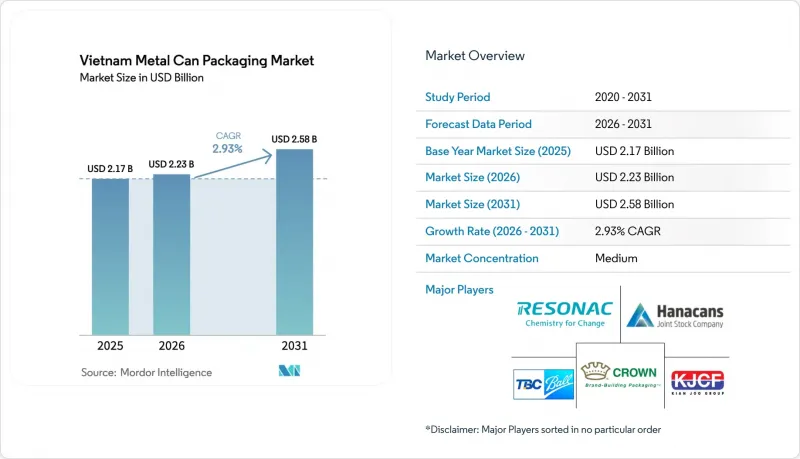
據 Mordor Intelligence 稱,2025 年越南金屬罐包裝市場價值為 21.7 億美元,預計到 2031 年將從 2026 年的 22.3 億美元成長至 25.8 億美元,預測期(2026-2031 年)複合年成長率為 2.93%。
本報告材料類型(鋁、鋼)、罐體結構(兩片式、三片式、一體式氣霧罐)、容量和尺寸(250毫升以下、250-500毫升、500-1000毫升、1000毫升以上)、製造程序(拉拔成型、拉拔飲料、工業再拉拔成型、其他市場再拉拔)、其他設備(細分市場再拉拔)。市場預測以美元計價。
越南金屬罐包裝市場趨勢及洞察
便利商店食品和飲料需求不斷成長
快速的都市化正在改變食品雜貨的購買趨勢,導致對單份包裝的需求不斷成長。 2024年,食品加工業成長7.4%,達793億美元;軟性飲料消費量達46.58億公升,年增4.8%。越南主要企業如Vinamilk在2024年第二季的銷售額累計11.85兆越南盾(約4.78億美元),進一步印證了市場對保存期限長、分量可控包裝的需求。雖然250-500毫升的容量範圍已佔據主導地位,但由於電子商務的普及和人們生活方式的改變,250毫升以下的罐裝飲料正以最高的複合年成長率成長。高階即飲能量飲料和含酒精氣泡水進一步拓展了應用範圍,並推動了越南黃金罐包裝市場的成長。
高回收率和對永續性的承諾
越南的擴大生產者責任制(EPR)法規定,自2024年1月起,鋁的最低迴收率必須達到22%。喜力越南公司在2024年的一項試點計畫中處理了850噸廢舊易拉罐,而皇冠控股的目標是到2030年實現92%的飲料罐回收率。這些措施有助於降低原料成本,確保再生鋁的穩定供應,並提升品牌信譽,使越南在金屬罐包裝市場中,相對於其軟質塑膠競爭對手,擁有明顯的永續性優勢。
來自軟質塑膠和紙質容器的競爭加劇。
據稱,紙質利樂包裝「Tetra Ricart」比易拉罐可減少85%的碳排放,並已於2024年底在Dveco Son La工廠投產。 SCG斥資2,730萬美元收購Starprint Vietnam,加速了輕質紙質包裝解決方案的推廣應用。目前,約有4,000家塑膠企業將39%的產能用於包裝,導致價格壓力日益加劇。雖然輕量化在電商領域至關重要,但易拉罐在碳封存、防篡改和高階質感方面仍然具有優勢,並繼續支撐著越南金屬罐包裝市場的核心需求。
細分市場分析
到2025年,鋁將佔越南金屬罐包裝市場佔有率的70.02%,這得益於當年實施的22%的回收配額。隨著醫藥和個人護理品牌對高純度阻隔性的日益重視,預計到2031年,越南鋁製金屬罐包裝市場將以4.21%的複合年成長率成長。國內計劃在林同省擴大礬土提煉鋁的規模,預計未來供應穩定的同時,減少運輸相關的排放。
在某些領域,鋼材的剛性和成本優勢尤其顯著,因此鋼材仍佔據著重要地位,尤其是在容量超過1000毫升的大容量食品罐領域。和發集團自有的熱軋鋼板有助於降低交付價格,但鋼材的重量卻阻礙了長途物流運輸。隨著品牌所有者承諾實現碳中和,鋁材成熟的閉合迴路回收特性持續蠶食鋼材的需求,進一步鞏固了越南金屬罐包裝市場的成長動能。
2025年,採用高速拉拔成型(D&I)生產線和照片級印刷技術的兩片式罐將佔據越南金屬罐包裝市場52.78%的佔有率。持續的減重技術使得罐壁更薄而不影響強度,從而降低了單位金屬用量和運輸成本。隨著飲料產量的成長和全通路零售的興起,越南兩片式罐金屬罐包裝市場規模預計將進一步擴大。
預計到2031年,一體式氣霧劑容器的複合年成長率將達到5.61%,主要得益於個人護理和藥品噴霧產品對無縫壁抗壓性能的需求。 CANPACK的Quadromix快速生產技術能夠支援季節性促銷活動,並提升商店展示效果。雖然三片式容器仍用於體積較大的食品包裝,但投資於能夠最大限度延長運轉率並提升圖形柔軟性的高柔軟性兩片式生產線正逐漸成為主流。
其他好處
- Excel格式的市場預測(ME)表
- 3個月的分析師支持
目錄
第1章:引言
- 研究假設和市場定義
- 調查範圍
第2章:調查方法
第3章執行摘要
第4章 市場狀況
- 市場概覽
- 市場促進因素
- 便利商店食品和飲料需求不斷成長
- 高回收率和對永續性的承諾
- 現代零售網路與電子商務網路的擴張
- 透過擴大國內熱軋鋼板(HRC)產能來改善原料供應。
- 閉合迴路飲料罐回收示範項目
- 政府為支持相關產業而提供的外國直接投資(FDI)獎勵措施
- 市場限制因素
- 來自軟質塑膠和紙質容器的競爭加劇。
- 金屬價格波動與新的貿易關稅/CBAM
- 國內軋延能力不足。
- 由於都市區物流瓶頸,最後一公里配送成本不斷上漲。
- 產業價值鏈分析
- 監理情勢
- 技術展望
- 波特五力分析
- 宏觀經濟因素對市場的影響
第5章 市場規模與成長預測
- 依材料類型
- 鋁
- 鋼
- 可結構
- 2 件
- 3 件
- 單體氣霧劑
- 按容量/尺寸
- 250毫升或以下
- 250~500mL
- 500~1,000mL
- 超過1000毫升
- 透過製造程序
- 拉拔和熨燙 (D&I)
- 繪製與重繪 (DRD)
- 衝擊擠壓
- 按最終用戶行業分類
- 食物
- 飲料
- 個人護理和化妝品
- 製藥
- 油漆和工業化學品
- 汽車用液體和潤滑劑
- 其他
第6章 競爭情勢
- 市場集中度
- 策略趨勢
- 市佔率分析
- 公司簡介
- TBC-Ball Beverage Can Vietnam Ltd(Ball Corporation)
- Resonac Holdings Corporation
- Hanacans Joint Stock Company
- Kian Joo Can (Vietnam) Co. Ltd (Kian Joo Can Factory Berhad)
- Crown Beverage Cans Vietnam Ltd(Crown Holdings Inc.)
- Can-Pack Vietnam Co. Ltd(Can-Pack SA)
- Vietnam Baosteel Can Co. Ltd(Baosteel Group Corp.)
- Royal Can Industries Company Ltd
- Superior Multi-Packaging Limited(新加坡)
- Nam Viet Packaging Manufacturing Co. Ltd
- My Chau Printing & Packaging Corp.
- Rexam Beverage Can Vietnam(Ardagh Group SA)
- Daiwa Can Company Vietnam Ltd
- Crown Asia Pacific Holdings Ltd-Danang Plant
- Alucon Public Company Ltd-Vietnam Rep. Office
- Thai Containers Group-Vietnam Metal Unit
- Dai Thien Loc Corporation(steel can-sheet supplier)
- Hoa Phat Steel Sheet Co. Ltd
- Novelis Asia(equity recycling affiliate)
- VNSteel Can Stock Division
第7章 市場機會與未來展望
According to Mordor Intelligence, the Vietnam metal can packaging market size was valued at USD 2.17 billion in 2025 and estimated to grow from USD 2.23 billion in 2026 to reach USD 2.58 billion by 2031, at a CAGR of 2.93% during the forecast period (2026-2031).
This report is Segmented by Material Type (Aluminium, and Steel), Can Structure (Two-Piece, Three-Piece, and Monobloc Aerosol), Capacity/Size (<=250 Ml, 250-500 Ml, 500-1, 000 Ml, >1, 000 Ml), Manufacturing Process (Drawn and Ironed, Drawn and Redrawn, and Impact Extrusion), and End-User Industry (Food, Beverage, and More). The Market Forecasts are Provided in Terms of Value (USD).
Vietnam Metal Can Packaging Market Trends and Insights
Growing Demand for Convenience Food and Beverages
Rapid urbanization is transforming grocery baskets and boosting single-serve formats. The food-processing sector expanded 7.4% in 2024 to USD 79.3 billion, and soft-drink consumption hit 4.658 billion liters, a 4.8% year-over-year increase. Domestic leaders such as Vinamilk posted Q2 2024 revenue of VND 11,850 billion (USD 478 million), reaffirming demand for shelf-stable, portion-controlled packages. The 250-500 ml range already dominates, yet <=250 ml cans record the fastest CAGR due to e-commerce and on-the-go lifestyles. Premium ready-to-drink energy beverages and alcoholic seltzers further widen the application base, sustaining volume growth for the Vietnam metal can packaging market.
High Recycling Rates and Sustainability Commitments
Vietnam's Extended Producer Responsibility law enforces a minimum 22% aluminum recycling rate from January 2024. HEINEKEN Vietnam processed 850 tonnes of used cans in its 2024 pilot, while Crown Holdings targets a 92% beverage-can collection rate by 2030. These initiatives cut raw-material costs, unlock secondary-aluminum feedstock and burnish brand credentials, giving the Vietnam metal can packaging market a clear sustainability advantage over flexible plastic competitors.
Rising Competition from Flexible Plastic and Paper Formats
Paper-based Tetra Recart claims 85% lower emissions than cans and began domestic runs at Doveco Sơn La in late 2024. SCG's USD 27.3 million purchase of Starprint Vietnam accelerates lightweight paper solutions. Nearly 4,000 plastic firms allocate 39% of capacity to packaging, exerting pricing pressure. Weight savings matter for e-commerce, yet cans still excel in carbonation retention, tamper evidence and premium cues, sustaining core demand for the Vietnam metal can packaging market.
Other drivers and restraints analyzed in the detailed report include:
- Expansion of Modern Retail and E-Commerce Networks
- Domestic HRC Capacity Expansion Improving Input Supply
- Metal Price Volatility and Emerging Trade Tariffs/CBAM
For complete list of drivers and restraints, kindly check the Table Of Contents.
Segment Analysis
Aluminum captured 70.02% of the Vietnam metal can packaging market share in 2025, a lead cemented by the 22% recycling quota that came into force the same year. The Vietnam metal can packaging market size for aluminum-based formats is projected to expand at a 4.21% CAGR through 2031 as pharmaceutical and personal-care brands prioritize high-purity barriers. Domestic plans to expand bauxite-to-aluminum refining at Lam Dong promise future supply security while cutting freight emissions.
Steel retains a foothold in large-volume food cans where rigidity and cost advantages prevail, especially above 1,000 ml. Hoa Phat's in-house HRC drives down delivered prices, but the metal's heavier weight handicaps long-distance logistics. As brand owners pledge carbon neutrality, aluminum's proven closed-loop recyclability keeps siphoning demand from steel, reinforcing the Vietnam metal can packaging market growth trajectory.
Two-piece cans accounted for 52.78% of the Vietnam metal can packaging market in 2025 thanks to high-speed D&I lines and photo-quality printing. Continuous lightweighting shrinks wall gauges without sacrificing strength, lowering per-unit metal use and freight costs. The Vietnam metal can packaging market size for two-piece formats will increase in tandem with beverage output and omnichannel retail growth.
Monobloc aerosol containers exhibit a 5.61% CAGR to 2031, propelled by personal-care and pharma spray products that demand seamless walls for pressure resistance. CANPACK's Quadromix short-run technology enables seasonal promotions, improving shelf visibility. While three-piece bodies serve bulky food packs, investments tilt toward flexible two-piece lines that maximize uptime and graphics flexibility.
Complete Report Scope:
- By Material Type
- Aluminium
- Steel
- By Can Structure
- Two-Piece
- Three-Piece
- Monobloc Aerosol
- By Capacity / Size
- <=250 ml
- 250-500 ml
- 500-1,000 ml
- >1,000 ml
- By Manufacturing Process
- Drawn and Ironed (D&I)
- Drawn and Redrawn (DRD)
- Impact Extrusion
- By End-User Industry
- Food
- Beverage
- Personal Care and Cosmetics
- Pharmaceuticals
- Paints and Industrial Chemicals
- Automotive Fluids and Lubricants
- Other End-User Industry
List of Companies Covered in this Report:
- TBC-Ball Beverage Can Vietnam Ltd (Ball Corporation)
- Resonac Holdings Corporation
- Hanacans Joint Stock Company
- Kian Joo Can (Vietnam) Co. Ltd (Kian Joo Can Factory Berhad)
- Crown Beverage Cans Vietnam Ltd (Crown Holdings Inc.)
- Can-Pack Vietnam Co. Ltd (Can-Pack SA)
- Vietnam Baosteel Can Co. Ltd (Baosteel Group Corp.)
- Royal Can Industries Company Ltd
- Superior Multi-Packaging Limited (Singapore)
- Nam Viet Packaging Manufacturing Co. Ltd
- My Chau Printing & Packaging Corp.
- Rexam Beverage Can Vietnam (Ardagh Group S.A.)
- Daiwa Can Company Vietnam Ltd
- Crown Asia Pacific Holdings Ltd - Danang Plant
- Alucon Public Company Ltd - Vietnam Rep. Office
- Thai Containers Group - Vietnam Metal Unit
- Dai Thien Loc Corporation (steel can-sheet supplier)
- Hoa Phat Steel Sheet Co. Ltd
- Novelis Asia (equity recycling affiliate)
- VNSteel Can Stock Division
Additional Benefits:
- The market estimate (ME) sheet in Excel format
- 3 months of analyst support
TABLE OF CONTENTS
1 INTRODUCTION
- 1.1 Study Assumptions and Market Definition
- 1.2 Scope of the Study
2 RESEARCH METHODOLOGY
3 EXECUTIVE SUMMARY
4 MARKET LANDSCAPE
- 4.1 Market Overview
- 4.2 Market Drivers
- 4.2.1 Growing demand for convenience food and beverages
- 4.2.2 High recycling rates and sustainability commitments
- 4.2.3 Expansion of modern retail and e-commerce networks
- 4.2.4 Domestic HRC capacity expansion improving input supply
- 4.2.5 Closed-loop beverage-can recycling pilots
- 4.2.6 Government FDI incentives for supporting industries
- 4.3 Market Restraints
- 4.3.1 Rising competition from flexible plastic and paper formats
- 4.3.2 Metal price volatility and emerging trade tariffs/CBAM
- 4.3.3 Limited domestic rolling capacity for can-sheet quality
- 4.3.4 Urban logistics bottlenecks raising last-mile costs
- 4.4 Industry Value Chain Analysis
- 4.5 Regulatory Landscape
- 4.6 Technological Outlook
- 4.7 Porter's Five Forces Analysis
- 4.7.1 Bargaining Power of Suppliers
- 4.7.2 Bargaining Power of Buyers
- 4.7.3 Threat of New Entrants
- 4.7.4 Threat of Substitute Products
- 4.7.5 Intensity of Competitive Rivalry
- 4.8 The Impact of Macroeconomic Factors on the Market
5 MARKET SIZE AND GROWTH FORECASTS (VALUE)
- 5.1 By Material Type
- 5.1.1 Aluminium
- 5.1.2 Steel
- 5.2 By Can Structure
- 5.2.1 Two-Piece
- 5.2.2 Three-Piece
- 5.2.3 Monobloc Aerosol
- 5.3 By Capacity / Size
- 5.3.1 <=250 ml
- 5.3.2 250-500 ml
- 5.3.3 500-1,000 ml
- 5.3.4 >1,000 ml
- 5.4 By Manufacturing Process
- 5.4.1 Drawn and Ironed (D&I)
- 5.4.2 Drawn and Redrawn (DRD)
- 5.4.3 Impact Extrusion
- 5.5 By End-User Industry
- 5.5.1 Food
- 5.5.2 Beverage
- 5.5.3 Personal Care and Cosmetics
- 5.5.4 Pharmaceuticals
- 5.5.5 Paints and Industrial Chemicals
- 5.5.6 Automotive Fluids and Lubricants
- 5.5.7 Other End-User Industry
6 COMPETITIVE LANDSCAPE
- 6.1 Market Concentration
- 6.2 Strategic Moves
- 6.3 Market Share Analysis
- 6.4 Company Profiles (includes Global Level Overview, Market Level Overview, Core Segments, Financials as available, Strategic Information, Market Rank/Share for key companies, Products and Services, and Recent Developments)
- 6.4.1 TBC-Ball Beverage Can Vietnam Ltd (Ball Corporation)
- 6.4.2 Resonac Holdings Corporation
- 6.4.3 Hanacans Joint Stock Company
- 6.4.4 Kian Joo Can (Vietnam) Co. Ltd (Kian Joo Can Factory Berhad)
- 6.4.5 Crown Beverage Cans Vietnam Ltd (Crown Holdings Inc.)
- 6.4.6 Can-Pack Vietnam Co. Ltd (Can-Pack SA)
- 6.4.7 Vietnam Baosteel Can Co. Ltd (Baosteel Group Corp.)
- 6.4.8 Royal Can Industries Company Ltd
- 6.4.9 Superior Multi-Packaging Limited (Singapore)
- 6.4.10 Nam Viet Packaging Manufacturing Co. Ltd
- 6.4.11 My Chau Printing & Packaging Corp.
- 6.4.12 Rexam Beverage Can Vietnam (Ardagh Group S.A.)
- 6.4.13 Daiwa Can Company Vietnam Ltd
- 6.4.14 Crown Asia Pacific Holdings Ltd - Danang Plant
- 6.4.15 Alucon Public Company Ltd - Vietnam Rep. Office
- 6.4.16 Thai Containers Group - Vietnam Metal Unit
- 6.4.17 Dai Thien Loc Corporation (steel can-sheet supplier)
- 6.4.18 Hoa Phat Steel Sheet Co. Ltd
- 6.4.19 Novelis Asia (equity recycling affiliate)
- 6.4.20 VNSteel Can Stock Division
7 MARKET OPPORTUNITIES AND FUTURE OUTLOOK
- 7.1 White-space and Unmet-need Assessment

 馬口鐵包裝市場分析及至2035年預測:類型、產品、技術、應用、材料類型、製程、最終用戶、功能
 複合罐市場:2026-2032年全球市場預測(按材料、產品類型、產能、製造流程、阻隔類型、塗層類型、瓶蓋類型和最終用途分類)
 BPA 和 BPS 無毒罐頭塗料市場的成長機會、成長要素、產業趨勢以及 2026-2035 年的預測。
 全球罐裝包裝市場:市場規模、佔有率、趨勢和成長分析(2026-2034)
 2026年全球罐頭食品市場研究報告2026-2034年全球馬口鐵包裝市場規模、佔有率、趨勢及成長分析報告全球複合紙罐市場規模、佔有率、趨勢和成長分析報告(2026-2034年)不含雙酚A的易拉罐市場:依材質、罐體尺寸、塗層類型、最終用途及通路分類-2026-2032年全球預測
 複合罐市場-全球產業規模、佔有率、趨勢、機會及預測(按封蓋類型、生產類型、罐體直徑、最終用戶、地區和競爭格局分類,2021-2031年)
 罐裝包裝市場規模、佔有率和成長分析(按罐型、罐形、產業和地區分類)-2026-2033年產業預測