

 |
市場調查報告書
商品編碼
2083340
健康服務市場機會、成長要素、產業趨勢分析及2026-2035年預測Wellness Services Market Opportunity, Growth Drivers, Industry Trend Analysis, and Forecast 2026 - 2035 |
||||||

全球健康服務市場預計到 2025 年將達到 3.6 兆美元,並預計以 7.9% 的複合年成長率成長,到 2035 年將達到 7.7 兆美元。
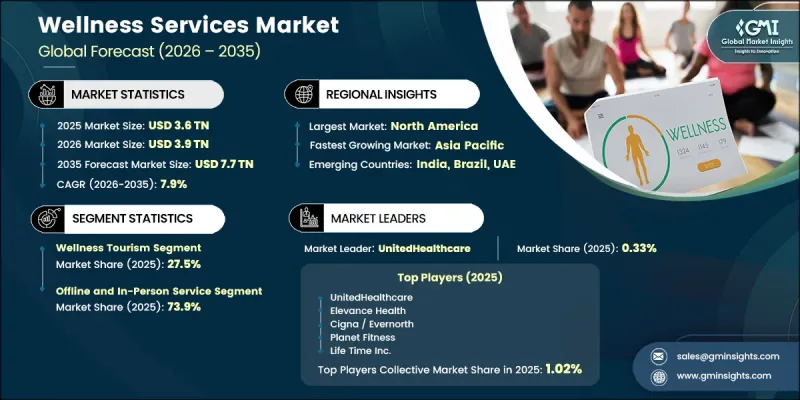
市場成長的驅動力來自於已開發經濟體和新興經濟體對預防醫學、心理健康和以生活方式為導向的健康管理日益成長的興趣。數位健康解決方案、企業主導的健康計劃以及消費者在健康體驗方面不斷成長的支出,共同建立了更廣泛、更多元化的需求結構,推動著產業的重大變革。如今,健康服務已遠遠超越了傳統的健身中心和水療中心,涵蓋了營養諮詢、心理健康項目、以健康為導向的住宅開發以及以長壽為重點的醫療保健服務等領域。可預防慢性病的盛行率上升促使人們更加關注積極的健康管理,而消費者態度的轉變也讓他們將健康支出視為長期投資,而不僅僅是可自由裁量權支配的支出。預計這種結構性轉變將在預測期內為整體市場成長率貢獻1.5%至2%。此外,主要經濟體的企業正在增加對員工健康計畫的投資,因為員工健康持續為提高生產力、敬業度和員工留任率帶來可衡量的益處。這些因素預計將推動全球健康服務市場整體的持續長期成長。
| 市場範圍 | |
|---|---|
| 開始年份 | 2025 |
| 預測期 | 2026-2035 |
| 初始市場規模 | 3.6兆美元 |
| 預測金額 | 7.7兆美元 |
| 複合年成長率 | 7.9% |
健康服務目前佔據27.5%的市場佔有率,預計到2035年將以7.5%的複合年成長率成長。這一細分市場的成長主要得益於高收入者對健康型旅行體驗日益成長的需求,以及多個地區健康型旅行基礎設施的持續發展。此外,人們越來越偏好融合放鬆、預防保健和生活方式提升的身臨其境型健康體驗,這也持續推動著該領域的消費成長。
到2025年,線下和麵對面服務將佔據73.9%的市場佔有率。該細分市場佔據主導地位的主要原因是,許多主流的健康服務,例如健身項目、養生度假、傳統物理治療服務和水療護理,都以體驗為導向。消費者擴大透過虛擬平台將健康活動融入日常生活,從而逐漸轉向更靈活的服務模式。儘管如此,實體養生中心仍然佔據重要地位,因為它們注重高階體驗、個人化服務和包容性的健康環境。
預計到2025年,北美健康服務市佔率將達到33.2%,並繼續維持其最大區域市場的地位,到2035年將維持7.6%的複合年成長率。美國憑藉著高度發展的企業健康生態系統和強勁的消費者健康服務支出,持續引領區域市場需求。雇主主導的健康計劃、人們對預防性醫療保健意識的提高以及綜合健康項目的廣泛應用,都將繼續推動全部區域的市場擴張。預計在整個預測期內,對身心健康和生活方式健康解決方案的持續投入將進一步鞏固北美市場的主導地位。
目錄
第1章:調查方法和範圍
第2章執行摘要
第3章 行業洞察
- 產業生態系分析
- 供應商情況
- 利潤率
- 每個階段增加的價值
- 影響價值鏈的因素
- 影響產業的因素
- 促進因素
- 消費者健康意識的提高與預防醫學的興起
- 員工生產力提升推動企業健康支出增加
- 數位平台的廣泛應用將使擴充性健康服務的提供成為可能。
- 全球人口老化推動了人們對長壽和恢復性健康的需求不斷成長。
- 產業潛在風險與挑戰
- 高階健康服務的高成本阻礙了它們向大眾市場的滲透。
- 各地區缺乏標準化的法規結構
- 機會
- 基因組學、穿戴式裝置和人工智慧驅動的個人化健康
- 新興市場尚未開發的需求
- 促進因素
- 成長潛力分析
- 監理框架
- 標準和合規要求
- 區域監理框架
- 認證標準
- 關鍵市場趨勢與顛覆性因素
- 技術與創新展望
- 當前趨勢
- 新進展
- 價格分析
- 對過去價格趨勢的分析
- 按業務類型分類的定價策略(溢價/價值/成本加成)
- 未來市場趨勢
- 人工智慧和生成式人工智慧對市場的影響
- 利用人工智慧改造現有經營模式
- 按細分市場分類的生成式人工智慧用例和部署藍圖
- 風險、限制和監管考量
- 波特的分析
- PESTLE分析
- 服務交付能力和提供者基礎設施
- 區域醫療服務提供者網路密度和覆蓋範圍
- 供給能力缺口與目標需求不匹配
- 進入市場的基礎設施投資需求
第4章 競爭情勢
- 介紹
- 企業市佔率分析
- 按地區
- 北美洲
- 歐洲
- 亞太地區
- 中東和非洲
- 拉丁美洲
- 按地區
- 企業矩陣分析
- 主要市場公司的競爭分析
- 競爭定位矩陣
- 主要進展
- 併購
- 夥伴關係和聯盟
- 新產品發布
- 業務拓展計劃
第5章 市場估計與預測:依類型分類,2022-2035年
- 個人護理及美容
- 營養與體重管理
- 體育活動和健身
- 健康旅遊
- 預防醫學和個人化醫療
- 傳統醫學與補充醫學
- 健康地產
- 心理健康
- 水療服務
- 溫泉和熱療
- 職場健康
第6章 市場估計與預測:依定價模式分類,2022-2035年
- 加值服務
- 價格實惠的服務/低價服務
- 訂閱式服務
- 按需計量收費服務
第7章 市場估計與預測:依最終用戶分類,2022-2035年
- 主要趨勢
- 個人消費者
- 企業客戶
- 醫療機構和醫療保健組織
- 飯店、健康和度假村營運商
- 其他
第8章 市場估算與預測:依交付管道分類,2022-2035年
- 線上/數位服務
- 健康行動應用程式
- 線上醫療諮詢和治療課程
- 人工智慧驅動的健康指導平台
- 健康服務項目的電子商務平台
- 線下/現場服務
- 健康中心及水療中心
- 企業內部健康計劃
- 傳統輔助醫學診所
- 融合健康理念的飯店設施
- 混合交付模式
第9章 市場估計與預測:依地區分類,2022-2035年
- 北美洲
- 美國
- 加拿大
- 歐洲
- 英國
- 德國
- 法國
- 義大利
- 西班牙
- 亞太地區
- 中國
- 印度
- 日本
- 韓國
- 澳洲
- 拉丁美洲
- 巴西
- 墨西哥
- 阿根廷
- 中東和非洲
- 南非
- 沙烏地阿拉伯
- UAE
第10章:公司簡介
- 世界公司
- Amway Corp.
- Business Overview
- Financial Data
- Product Landscape
- Strategic Outlook
- SWOT Analysis
- Anytime Fitness
- Banyan Group
- ComPsych
- Planet Fitness
- Six Senses
- TELUS Health
- UnitedHealthcare
- Amway Corp.
- 本地公司
- Canyon Ranch
- Chiva-Som International
- Cigna/Evernorth
- Elevance Health
- Life Time Inc.
- Vitality Group(Discovery)
- 新興企業
- Clinique La Prairie
- Equinox Group
- Lyra Health
- Noom Inc.
- Restore Hyper Wellness
- Spring Health
- Wellhub
The Global Wellness Services Market was valued at USD 3.6 trillion in 2025 and is estimated to grow at a CAGR of 7.9% to reach USD 7.7 trillion by 2035.
Market growth is supported by the increasing emphasis on preventive healthcare, mental wellness, and lifestyle-oriented health management across both developed and emerging economies. The industry is experiencing a significant transformation as digital health solutions, employer-sponsored wellness initiatives, and growing consumer spending on health-focused experiences collectively create a broader and more diversified demand landscape. Wellness services now extend far beyond traditional fitness centers and spa offerings, encompassing areas such as nutritional counseling, mental wellness programs, wellness-oriented residential developments, and longevity-focused healthcare services. Rising prevalence of preventable chronic health conditions has intensified the focus on proactive health management, while evolving consumer perceptions have positioned wellness expenditures as long-term investments rather than discretionary spending. This structural shift is expected to contribute between 1.5% and 2% to the market's overall growth rate throughout the forecast period. In addition, organizations across major economies are increasing investments in employee wellness programs as workforce health continues to demonstrate measurable benefits in productivity, engagement, and employee retention. These factors are expected to sustain long-term expansion across the global wellness services landscape.
| Market Scope | |
|---|---|
| Start Year | 2025 |
| Forecast Year | 2026-2035 |
| Start Value | $3.6 Trillion |
| Forecast Value | $7.7 Trillion |
| CAGR | 7.9% |
The wellness services accounted for 27.5% share and is projected to grow at a CAGR of 7.5% through 2035. Strong demand for health-focused travel experiences among affluent consumers, combined with the continued development of wellness-oriented travel infrastructure across multiple regions, is supporting segment growth. The increasing preference for immersive wellness experiences that combine relaxation, preventive care, and lifestyle enhancement continues to drive spending within this category.
The offline and in-person service delivery segment held 73.9% share in 2025. The leadership of this segment is largely attributed to the experience-driven nature of key wellness offerings, including fitness programs, wellness retreats, traditional therapeutic services, and spa treatments. Consumers are increasingly integrating wellness activities into their daily routines through virtual platforms, resulting in a gradual shift toward more flexible service delivery formats. Despite this transition, physical wellness facilities continue to remain highly relevant by emphasizing premium experiences, personalized services, and comprehensive wellness environments.
North America Wellness Services Market accounted for 33.2% share in 2025 and is expected to register a CAGR of 7.6% through 2035, maintaining its position as the largest regional market. The United States continues to lead regional demand, supported by a highly developed corporate wellness ecosystem and strong consumer spending on health and well-being services. Employer-sponsored wellness initiatives, growing awareness of preventive healthcare, and widespread adoption of integrated wellness programs continue to support market expansion across the region. Increasing investments in physical, mental, and lifestyle wellness solutions are expected to further strengthen North America's leadership position throughout the forecast period.
Key companies operating in the global wellness services market include Wellhub, Equinox Group, Elevance Health, TELUS Health, Banyan Group, UnitedHealthcare, Planet Fitness, Lyra Health, Cigna/Evernorth, ComPsych, Noom Inc., Chiva-Som International, Life Time Inc., Restore Hyper Wellness, Amway Corp., Spring Health, Vitality Group (Discovery), Canyon Ranch, Six Senses, Clinique La Prairie, and Anytime Fitness. Companies operating in the wellness services market are focusing on a combination of expansion, innovation, and customer engagement strategies to strengthen their market position. Leading providers are investing heavily in digital wellness platforms, virtual care services, and personalized health solutions powered by data analytics and artificial intelligence. Strategic partnerships with employers, healthcare organizations, insurers, and technology providers are helping companies broaden their customer reach and enhance service offerings.
Table of Contents
Chapter 1 Methodology & Scope
- 1.1 Research approach
- 1.2 Quality Commitments
- 1.2.1 GMI AI policy & data integrity commitment
- 1.2.1.1 Source consistency protocol
- 1.2.1 GMI AI policy & data integrity commitment
- 1.3 Research Trail & Confidence Scoring
- 1.3.1 Research Trail Components
- 1.3.2 Scoring Components
- 1.4 Data Collection
- 1.4.1 Partial list of primary sources
- 1.5 Data mining sources
- 1.5.1 Paid sources
- 1.5.1.1 Sources, by region
- 1.5.1 Paid sources
- 1.6 Base estimates and calculations
- 1.6.1 Base year calculation for any one approach
- 1.7 Forecast model
- 1.7.1 Quantified market impact analysis
- 1.7.1.1 Mathematical impact of growth parameters on forecast
- 1.7.1 Quantified market impact analysis
- 1.8 Research transparency addendum
- 1.8.1 Source attribution framework
- 1.8.2 Quality assurance metrics
- 1.8.3 Our commitment to trust
Chapter 2 Executive Summary
- 2.1 Industry 360° synopsis, 2022 - 2035
- 2.2 Key market trends
- 2.2.1 Region
- 2.2.2 Service Type
- 2.2.3 Pricing Model
- 2.2.4 End Users
- 2.2.5 Delivery Channels
Chapter 3 Industry Insights
- 3.1 Industry ecosystem analysis
- 3.1.1 Supplier landscape
- 3.1.2 Profit margin
- 3.1.3 Value addition at each stage
- 3.1.4 Factor affecting the value chain
- 3.2 Industry impact forces
- 3.2.1 Growth drivers
- 3.2.1.1 Rising consumer health consciousness & shift toward preventive healthcare
- 3.2.1.2 Growing corporate wellness expenditure driven by employee productivity
- 3.2.1.3 Digital platform proliferation enabling scalable wellness service delivery
- 3.2.1.4 Aging global population increasing demand for longevity & restorative wellness
- 3.2.2 Industry pitfalls & challenges
- 3.2.2.1 High cost of premium wellness services limiting mass-market penetration
- 3.2.2.2 Absence of standardized regulatory frameworks across geographies
- 3.2.3 Opportunities
- 3.2.3.1 Personalized wellness powered by genomics, wearables & AI
- 3.2.3.2 Untapped demand in emerging markets
- 3.2.1 Growth drivers
- 3.3 Growth potential analysis
- 3.4 Regulatory framework
- 3.4.1 Standards & compliance requirements
- 3.4.2 Regional regulatory frameworks
- 3.4.3 Certification standards
- 3.5 Major market trends and disruptions
- 3.6 Technology/innovation landscape
- 3.6.1 Current trends
- 3.6.2 Emerging trends
- 3.7 Pricing Analysis (driven by primary research)
- 3.7.1 Historical price trend analysis (driven by primary research)
- 3.7.2 Pricing strategy by player type (premium / value / cost- plus) (driven by primary research)
- 3.8 Future market trends
- 3.9 Impact of AI & Generative AI on the Market
- 3.9.1 AI- driven disruption of existing business models
- 3.9.2 Gen-AI use cases & adoption roadmap by segment
- 3.9.3 Risks, limitations & regulatory considerations
- 3.10 Porter’s analysis
- 3.11 PESTEL analysis
- 3.12 Service delivery capacity & provider infrastructure (driven by primary research)
- 3.12.1 Provider network density & coverage by region (driven by primary research)
- 3.12.2 Capacity gaps & addressable demand mismatch (driven by primary research)
- 3.12.3 Infrastructure investment requirements for market entry
Chapter 4 Competitive Landscape, 2025
- 4.1 Introduction
- 4.2 Company market share analysis
- 4.2.1 By Region
- 4.2.1.1 North America
- 4.2.1.2 Europe
- 4.2.1.3 Asia Pacific
- 4.2.1.4 Middle East and Africa
- 4.2.1.5 Latin America
- 4.2.1 By Region
- 4.3 Company matrix analysis
- 4.4 Competitive analysis of major market players
- 4.5 Competitive positioning matrix
- 4.6 Key developments
- 4.6.1 Mergers & acquisitions
- 4.6.2 Partnerships & collaborations
- 4.6.3 New product launches
- 4.6.4 Expansion plans
Chapter 5 Market Estimates & Forecast, By Type, 2022-2035 (USD Trillion)
- 5.1 Key trends
- 5.2 Personal care & beauty
- 5.3 Nutrition & weight management
- 5.4 Physical activity & fitness
- 5.5 Wellness tourism
- 5.6 Preventive & personalized health
- 5.7 Traditional & complementary medicine
- 5.8 Wellness real estate
- 5.9 Mental wellness
- 5.10 Spa services
- 5.11 Springs & thermal therapy
- 5.12 Workplace wellness
Chapter 6 Market Estimates & Forecast, By Pricing Model, 2022-2035 (USD Trillion)
- 6.1 Key trends
- 6.2 Premium services
- 6.3 Affordable/budget services
- 6.4 Subscription-based services
- 6.5 Pay-per-use services
Chapter 7 Market Estimates & Forecast, By End-User, 2022-2035 (USD Trillion)
- 7.1 Key Trends
- 7.2 Individual Consumers
- 7.3 Corporate Clients
- 7.4 Medical & Healthcare Institutions
- 7.5 Hospitality & Wellness Resort Operators
- 7.6 Others
Chapter 8 Market Estimates & Forecast, By Delivery Channel, 2022-2035 (USD Trillion)
- 8.1 Key trends
- 8.2 Online / digital services
- 8.2.1 Wellness mobile applications
- 8.2.2 Virtual consultations & therapy sessions
- 8.2.3 AI-powered wellness coaching platforms
- 8.2.4 E-commerce platforms for wellness services & programs
- 8.3 Offline / in-person services
- 8.3.1 Brick-and-mortar wellness centers & spas
- 8.3.2 On-site corporate wellness programs
- 8.3.3 Traditional clinics for complementary medicine
- 8.3.4 Wellness-integrated hospitality venues
- 8.4 Hybrid delivery models
Chapter 9 Market Estimates & Forecast, By Region, 2022-2035 (USD Trillion)
- 9.1 Key trends
- 9.2 North America
- 9.2.1 U.S.
- 9.2.2 Canada
- 9.3 Europe
- 9.3.1 UK
- 9.3.2 Germany
- 9.3.3 France
- 9.3.4 Italy
- 9.3.5 Spain
- 9.4 Asia Pacific
- 9.4.1 China
- 9.4.2 India
- 9.4.3 Japan
- 9.4.4 South Korea
- 9.4.5 Australia
- 9.5 Latin America
- 9.5.1 Brazil
- 9.5.2 Mexico
- 9.5.3 Argentina
- 9.6 MEA
- 9.6.1 South Africa
- 9.6.2 Saudi Arabia
- 9.6.3 UAE
Chapter 10 Company Profiles
- 10.1 Global Companies
- 10.1.1 Amway Corp.
- 10.1.1.1 Business Overview
- 10.1.1.2 Financial Data
- 10.1.1.3 Product Landscape
- 10.1.1.4 Strategic Outlook
- 10.1.1.5 SWOT Analysis
- 10.1.2 Anytime Fitness
- 10.1.3 Banyan Group
- 10.1.4 ComPsych
- 10.1.5 Planet Fitness
- 10.1.6 Six Senses
- 10.1.7 TELUS Health
- 10.1.8 UnitedHealthcare
- 10.1.1 Amway Corp.
- 10.2 Regional Companies
- 10.2.1 Canyon Ranch
- 10.2.2 Chiva-Som International
- 10.2.3 Cigna / Evernorth
- 10.2.4 Elevance Health
- 10.2.5 Life Time Inc.
- 10.2.6 Vitality Group (Discovery)
- 10.3 Emerging Companies
- 10.3.1 Clinique La Prairie
- 10.3.2 Equinox Group
- 10.3.3 Lyra Health
- 10.3.4 Noom Inc.
- 10.3.5 Restore Hyper Wellness
- 10.3.6 Spring Health
- 10.3.7 Wellhub

 健康與保健市場規模、佔有率、成長、全球產業分析、區域趨勢以及2026年至2034年的預測全球溫泉水療及健康市場規模、佔有率、趨勢及成長分析報告(2026-2034年)
 線上健康與保健市場規模、佔有率和成長分析:按平台服務、收入來源、設備相容性、目標消費者和地區分類-產業預測,2026-2033年
 老年人健康與保健市場規模、佔有率和成長分析:按產業、產品形式、分銷管道和地區分類-2026-2033年產業預測
 2034年全球心理健康消費品市場預測-按產品、健康重點領域、技術、通路和最終用戶分類的全球分析金融健康與員工福利金融科技市場預測至2034年-全球分析(按組件、部署模式、組織類型、福利類型、應用、最終用戶和地區分類)
 溫泉養生市場機會、成長要素、產業趨勢分析及2026-2035年預測。冥想和心理健康應用程式市場預測至2034年——按產品、定價模式、平台、部署模式、年齡層、最終用戶和地區分類的全球分析壓力緩解和心理健康專案市場預測至2034年-全球分析(按專案類型、服務類型、交付方式、技術、應用、最終用戶和地區分類)快速消費品市場預測:行動健康生活方式展望(至2034年)-全球分析(按產品類型、配方、包裝、消費者需求、分銷管道、應用、認證、最終用戶和地區分類)