

 |
市場調查報告書
商品編碼
2061385
溫泉養生市場機會、成長要素、產業趨勢分析及2026-2035年預測。Thermal Spa and Wellness Market Opportunity, Growth Drivers, Industry Trend Analysis, and Forecast 2026 - 2035 |
||||||

2025年全球水療和健康市場價值為782億美元,預計將以9.1%的複合年成長率成長,到2035年達到1881億美元。
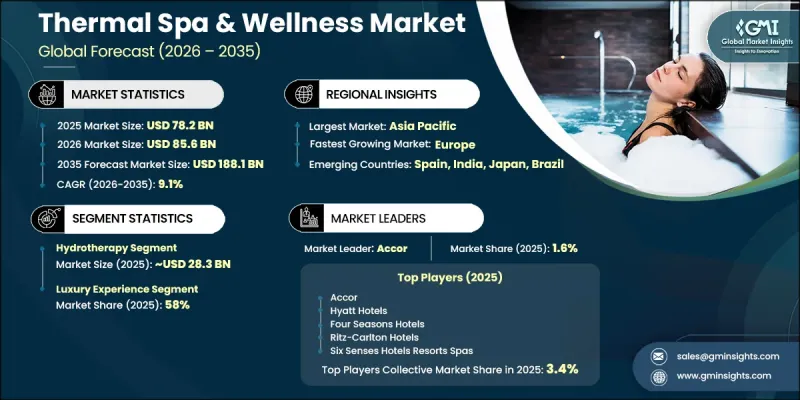
隨著醫療保健的重點從以治療為中心的護理轉向預防保健和長期健康管理,水療和健康產業正在經歷重大變革。這些設施正從傳統的沐浴場所發展成為融合高階飯店服務和預防保健服務的綜合健康生態系統,投資者也加大對先進水療和健康設施的投資。消費者對長壽、減壓、再生療法和整體健康的日益關注,顯著推動了全球市場需求。隨著各國政府和私人機構持續在主要水療目的地大規模投資基礎建設,健康旅遊也蓬勃發展。消費者對身心健康的日益重視進一步促進了產業的擴張。此外,水療使用者的年齡結構也在發生變化,越來越多的年輕專業開始將水療和健康體驗融入日常生活,以應對壓力、疲勞和職業倦怠。現代水療和健康設施不再被視為老年人的專屬場所。隨著消費者偏好的改變,這些設施正被定位為更廣泛客戶的高階生活方式和健康體驗。
| 市場範圍 | |
|---|---|
| 開始年份 | 2025 |
| 預測期 | 2026-2035 |
| 上市時的市場規模 | 782億美元 |
| 預測金額 | 1881億美元 |
| 複合年成長率 | 9.1% |
與傳統住宿設施相比,養生旅遊持續保持良好發展勢頭,吸引了來自公共和私營部門的大量投資。許多國家正將養生旅遊納入其長期經濟發展策略,全部區域的基礎建設現代化也如火如荼地進行。投資者、住宿設施業者和養生服務提供者之間的合作,正在打造融合療癒體驗與個人化健康服務的先進養生環境。此外,消費者對療癒旅行體驗、預防性療法和以健康為中心的休閒活動的日益偏好,也推動了全球市場的持續成長。
預計到2025年,水處理產業將創造283億美元的產值,到2035年將達到685億美元。由於富含礦物質的溫泉水俱有顯著的療效,水處理仍然是最廣泛採用的健康療法之一。水是調節體溫和吸收礦物質的有效介質,因此水療是肌肉放鬆、身體恢復和整體健康提升的理想選擇。消費者對天然健康療法和物理治療護理日益成長的偏好,進一步推動了全球溫泉療養中心水療服務的擴張。
到2025年,奢華體驗領域將佔據58%的市場。高階養生設施持續吸引追求個人化養生體驗、私人空間、精緻建築設計和專業養生方案的富裕消費者。奢華水療養生設施越來越注重為賓客提供專屬體驗、特色設施和客製化養生方案,旨在支持賓客實現整體健康目標。此外,為了在競爭激烈的市場中脫穎而出,奢華養生設施也強調營造寧靜的環境、限制賓客數量、提供個人化餐飲體驗和以健康為中心的飯店服務。
預計到2025年,美國溫泉和養生市場將佔據88.4%的市場。美國市場對提供各種先進養生服務和理療的豪華養生度假村、目的地水療中心和高階溫泉養生設施的需求仍然強勁。美國市場受益於消費者在養生旅遊方面的強勁支出、對預防性醫療保健解決方案日益成長的興趣,以及旨在促進身體康復、壓力管理和整體生活方式健康的綜合養生項目的日益普及。對豪華酒店和養生基礎設施的加大投資也顯著推動了全部區域的市場成長。
目錄
第1章:調查方法和範圍
第2章執行摘要
第3章 行業洞察
- 產業生態系分析
- 供應商情況
- 利潤率
- 每個階段增加的價值
- 影響價值鏈的因素
- 影響產業的因素
- 促進因素
- 人口老化和注重健康的消費行為
- 人們越來越關注健康和保健
- 健康旅遊日益普及
- 產業潛在風險與挑戰
- 高昂的營運和維護成本
- 季節性和位置依賴性
- 機會
- 技術進步與個性化
- 與預防和醫療保健領域的合作
- 促進因素
- 成長潛力分析
- 監理框架
- 關鍵市場趨勢與顛覆性因素
- 技術與創新展望
- 當前趨勢
- 新進展
- 價格分析
- 對過去價格趨勢的分析
- 依球員類型分類的定價策略(高級球員、超值球員、成本加成球員)
- 未來市場趨勢
- 人工智慧和生成式人工智慧對市場的影響
- 利用人工智慧改造現有經營模式
- 按細分市場分類的生成式人工智慧用例和部署藍圖
- 風險、限制和監管考量
- 波特的分析
- PESTLE分析
- 服務交付能力和提供者基礎設施
- 區域醫療服務提供者網路密度和覆蓋範圍
- 供給能力缺口與可用需求不匹配
第4章 競爭情勢
- 介紹
- 企業市佔率分析
- 按地區
- 企業矩陣分析
- 主要市場公司的競爭分析
- 競爭定位矩陣
- 主要進展
- 併購
- 夥伴關係和聯盟
- 新產品發布
- 業務拓展計劃
第5章 市場估計與預測:依治療類型分類,2022-2035年
- 治療方法
- 芳香療法
- 按摩療法
- 泥浴及泥敷
- 臉部和皮膚護理
- 其他(身體護理等)
第6章 市場估價與預測:依設施類型分類,2022-2035年
- 溫泉設施
- 天然溫泉
- 溫泉池
- 溫泉浴
- 健康度假村及飯店
- 豪華養生度假村
- 精品養生飯店
- 健康靜修
- 醫療健康中心
- 水療設施
- 物理治療和復健中心
- 戒毒中心
第7章 市場估計與預測:依年齡層別分類,2022-2035年
- 19歲以下
- 19-35歲
- 36-50歲
- 超過50歲
第8章 市場估算與預測:依顧客偏好,2022-2035年
- 奢華體驗
- 經濟實惠的體驗
第9章 市場估計與預測:依消費者區隔市場分類,2022-2035年
- 男性
- 女士
第10章 市場估價與預測:依地區分類,2022-2035年
- 北美洲
- 美國
- 加拿大
- 歐洲
- 英國
- 德國
- 法國
- 義大利
- 西班牙
- 俄羅斯
- 亞太地區
- 中國
- 印度
- 日本
- 韓國
- 澳洲
- 拉丁美洲
- 巴西
- 墨西哥
- 中東和非洲
- UAE
- 沙烏地阿拉伯
- 南非
第11章:公司簡介
- 世界公司
- Accor
- Aman Resorts
- Blue Lagoon
- Four Seasons Hotels
- Hyatt Hotels
- Kempinski Hotels
- Mandarin Oriental Hotel Group
- Ritz-Carlton Hotels
- Six Senses Hotels Resorts Spas
- 當地公司
- Brenners Park-Hotel and Spa
- Canyon Ranch
- Champneys Health Resorts
- Kannewischer
- Thermae Bath Spa
- 新興企業
- Chenot
- Chiva-Som International Health Resort
- Clinique La Prairie
- COMO Hotels and Resorts
- Kamalaya Wellness Sanctuary
- Lanserhof
- SHA Wellness Clinic
The Global Thermal Spa & Wellness Market was valued at USD 78.2 billion in 2025 and is estimated to grow at a CAGR of 9.1% to reach USD 188.1 billion by 2035.
The thermal spa and wellness industry is undergoing substantial transformation as healthcare priorities continue shifting from treatment-focused care toward preventive wellness and long-term health management. Investors are increasingly channeling capital into advanced thermal wellness destinations as these facilities evolve beyond traditional bathing centers into integrated wellness ecosystems that combine luxury hospitality with preventive healthcare services. The growing consumer focus on longevity, stress reduction, recovery therapies, and holistic wellness is significantly accelerating market demand worldwide. Wellness tourism is also gaining momentum as governments and private organizations continue investing in large-scale infrastructure development across major thermal tourism destinations. Rising consumer awareness regarding physical and mental well-being is further strengthening industry expansion. Additionally, younger professionals are increasingly embracing thermal wellness experiences to address lifestyle stress, fatigue, and burnout, reshaping the demographic profile of spa visitors. Modern thermal wellness properties are no longer viewed as destinations limited to older populations, as evolving consumer preferences are positioning these facilities as premium lifestyle and wellness experiences for a broader customer base.
| Market Scope | |
|---|---|
| Start Year | 2025 |
| Forecast Year | 2026-2035 |
| Start Value | $78.2 Billion |
| Forecast Value | $188.1 Billion |
| CAGR | 9.1% |
The increasing financial performance of thermal mineral spring destinations compared to conventional hospitality establishments continues to attract substantial public and private sector investments. Several economies are promoting wellness tourism as part of long-term economic development strategies, driving infrastructure modernization across key thermal tourism regions. Collaboration between investors, hospitality operators, and wellness providers is enabling the development of advanced wellness environments that combine therapeutic experiences with personalized health services. Growing consumer preference for restorative travel experiences, preventive therapies, and wellness-focused leisure activities is also supporting sustained market growth globally.
The hydrotherapy segment generated USD 28.3 billion in 2025 and is anticipated to reach USD 68.5 billion by 2035. Hydrotherapy continues to remain one of the most widely adopted wellness treatments due to the therapeutic benefits associated with mineral-rich thermal water applications. Water serves as an effective medium for thermoregulation and mineral absorption, making hydrotherapy a preferred solution for muscle relaxation, physical recovery, and overall wellness enhancement. The growing consumer preference for natural wellness therapies and therapeutic treatments is further contributing to the increasing adoption of hydrotherapy services across thermal wellness facilities worldwide.
The luxury experience segment accounted for 58% share in 2025. Premium wellness destinations continue to attract affluent consumers seeking personalized wellness experiences, privacy, architectural sophistication, and professional wellness programs. High-end thermal wellness facilities are increasingly focusing on curated guest experiences, exclusive amenities, and customized wellness solutions designed to support holistic health goals. Luxury wellness properties are also emphasizing peaceful environments, limited guest access, personalized dining experiences, and wellness-focused hospitality services to differentiate themselves within the competitive market landscape.
United States Thermal Spa & Wellness Market held an 88.4% share in 2025. The country continues to witness strong demand for luxury wellness resorts, destination spas, and premium thermal wellness facilities offering a broad range of advanced wellness services and therapeutic treatments. The U.S. market benefits from strong consumer spending on wellness tourism, rising interest in preventive healthcare solutions, and the growing popularity of integrated wellness programs designed to improve physical recovery, stress management, and overall lifestyle wellness. Expanding investment in luxury hospitality and wellness-focused infrastructure is also contributing significantly to market expansion across the region.
Major companies operating in the Global Thermal Spa & Wellness Market include Accor, Mandarin Oriental Hotel Group, Hyatt Hotels, Aman Resorts, Canyon Ranch, Six Senses Hotels Resorts Spas, Kempinski Hotels, Four Seasons Hotels, Chiva-Som International Health Resort, Thermae Bath Spa, Clinique La Prairie, Kamalaya Wellness Sanctuary, Chenot, COMOH Hotels and Resorts, SHA Wellness Clinic, Brenners Park-Hotel and Spa, Blue Lagoon, Champneys Health Resorts, Kannewischer, and Ritz-Carlton Hotels. Companies operating in the thermal spa & wellness market are focusing on expanding luxury wellness offerings, integrating preventive healthcare services, and enhancing personalized guest experiences to strengthen their market position. Businesses are increasingly investing in advanced wellness infrastructure, premium hospitality facilities, and therapeutic treatment innovations to attract high-value consumers. Strategic partnerships with healthcare professionals, wellness experts, and hospitality brands are helping companies deliver integrated wellness solutions tailored to evolving consumer preferences. Many operators are also prioritizing digital wellness platforms, customized wellness programs, and data-driven guest engagement strategies to improve customer retention and brand loyalty.
Table of Contents
Chapter 1 Methodology & Scope
- 1.1 Research approach
- 1.2 Quality Commitments
- 1.2.1 GMI AI policy & data integrity commitment
- 1.2.1.1 Source consistency protocol
- 1.2.1 GMI AI policy & data integrity commitment
- 1.3 Research Trail & Confidence Scoring
- 1.3.1 Research Trail Components
- 1.3.2 Scoring Components
- 1.4 Data Collection
- 1.4.1 Partial list of primary sources
- 1.5 Data mining sources
- 1.5.1 Paid sources
- 1.5.1.1 Sources, by region
- 1.5.1 Paid sources
- 1.6 Base estimates and calculations
- 1.6.1 Base year calculation for any one approach
- 1.7 Forecast model
- 1.7.1 Quantified market impact analysis
- 1.7.1.1 Mathematical impact of growth parameters on forecast
- 1.7.1 Quantified market impact analysis
- 1.8 Research transparency addendum
- 1.8.1 Source attribution framework
- 1.8.2 Quality assurance metrics
- 1.9 Our commitment to trust
Chapter 2 Executive Summary
- 2.1 Industry 360° synopsis
- 2.2 Key market trends
- 2.2.1 Regional
- 2.2.2 Treatment Type
- 2.2.3 Facility Type
- 2.2.4 Age Group
- 2.2.5 Customer Preference
- 2.2.6 Consumer Group
Chapter 3 Industry Insights
- 3.1 Industry ecosystem analysis
- 3.1.1 Supplier landscape
- 3.1.2 Profit margin
- 3.1.3 Value addition at each stage
- 3.1.4 Factor affecting the value chain
- 3.2 Industry impact forces
- 3.2.1 Growth drivers
- 3.2.1.1 Demographic aging and health-conscious consumer behavior
- 3.2.1.2 Increasing health and wellness awareness
- 3.2.1.3 Rising popularity of wellness tourism
- 3.2.2 Industry pitfalls & challenges
- 3.2.2.1 High operational & maintenance costs
- 3.2.2.2 Seasonality & location dependency
- 3.2.3 Opportunities
- 3.2.3.1 Technological enhancements & personalization
- 3.2.3.2 Integration with preventive & medical wellness
- 3.2.1 Growth drivers
- 3.3 Growth potential analysis
- 3.4 Regulatory framework
- 3.5 Major market trends and disruptions
- 3.6 Technology/innovation landscape
- 3.6.1 Current trends
- 3.6.2 Emerging trends
- 3.7 Pricing Analysis (driven by primary research)
- 3.7.1 Historical price trend analysis (driven by primary research)
- 3.7.2 Pricing strategy by player type (premium / value / cost-plus) (driven by primary research)
- 3.8 Future market trends
- 3.9 Impact of AI & Generative AI on the Market
- 3.9.1 AI-driven disruption of existing business models
- 3.9.2 Gen-AI use cases & adoption roadmap by segment
- 3.9.3 Risks, limitations & regulatory considerations
- 3.10 Porter's analysis
- 3.11 PESTEL analysis
- 3.12 Service delivery capacity & provider infrastructure (driven by primary research)
- 3.12.1 Provider network density & coverage by region (driven by primary research)
- 3.12.2 Capacity gaps & addressable demand mismatch (driven by primary research)
Chapter 4 Competitive landscape, 2025
- 4.1 Introduction
- 4.2 Company market share analysis
- 4.2.1 By region
- 4.2.1.1 North America
- 4.2.1.2 Europe
- 4.2.1.3 Asia Pacific
- 4.2.1.4 Latin America
- 4.2.1.5 Middle East and Africa
- 4.2.1 By region
- 4.3 Company matrix analysis
- 4.4 Competitive analysis of major market players
- 4.5 Competitive positioning matrix
- 4.6 Key developments
- 4.6.1 Mergers & acquisitions
- 4.6.2 Partnerships & collaborations
- 4.6.3 New product launches
- 4.6.4 Expansion plans
Chapter 5 Market Estimates & Forecast, By Treatment Type, 2022-2035 (USD Billion)
- 5.1 Key trends
- 5.2 Hydrotherapy
- 5.3 Aromatherapy
- 5.4 Massage therapy
- 5.5 Mud baths and wraps
- 5.6 Facial and skin treatments
- 5.7 Others (body treatments, etc.)
Chapter 6 Market Estimates & Forecast, By Facility Type, 2022-2035 (USD Billion)
- 6.1 Key trends
- 6.2 Thermal spas
- 6.2.1 Natural hot springs
- 6.2.2 Thermal pools
- 6.2.3 Thermal bathhouses
- 6.3 Wellness resorts & hotels
- 6.3.1 Luxury wellness resorts
- 6.3.2 Boutique wellness hotels
- 6.3.3 Wellness retreats
- 6.4 Medical wellness centers
- 6.4.1 Hydrotherapy facilities
- 6.4.2 Physiotherapy and rehabilitation centers
- 6.4.3 Detox centers
Chapter 7 Market Estimates & Forecast, By Age Group, 2022-2035 (USD Billion)
- 7.1 Key trends
- 7.2 Below 19
- 7.3 19 to 35
- 7.4 36 to 50
- 7.5 Above 50
Chapter 8 Market Estimates & Forecast, By Customer Preference, 2022-2035 (USD Billion)
- 8.1 Key trends
- 8.2 Luxury experience
- 8.3 Budget-friendly experience
Chapter 9 Market Estimates & Forecast, By Consumer Group, 2022-2035 (USD Billion)
- 9.1 Key trends
- 9.2 Men
- 9.3 Women
Chapter 10 Market Estimates & Forecast, By Region, 2022-2035 (USD Billion)
- 10.1 Key trends
- 10.2 North America
- 10.2.1 U.S.
- 10.2.2 Canada
- 10.3 Europe
- 10.3.1 UK
- 10.3.2 Germany
- 10.3.3 France
- 10.3.4 Italy
- 10.3.5 Spain
- 10.3.6 Russia
- 10.4 Asia Pacific
- 10.4.1 China
- 10.4.2 India
- 10.4.3 Japan
- 10.4.4 South Korea
- 10.4.5 Australia
- 10.5 Latin America
- 10.5.1 Brazil
- 10.5.2 Mexico
- 10.6 MEA
- 10.6.1 UAE
- 10.6.2 Saudi Arabia
- 10.6.3 South Africa
Chapter 11 Company Profiles
- 11.1 Global Companies
- 11.1.1 Accor
- 11.1.2 Aman Resorts
- 11.1.3 Blue Lagoon
- 11.1.4 Four Seasons Hotels
- 11.1.5 Hyatt Hotels
- 11.1.6 Kempinski Hotels
- 11.1.7 Mandarin Oriental Hotel Group
- 11.1.8 Ritz-Carlton Hotels
- 11.1.9 Six Senses Hotels Resorts Spas
- 11.2 Regional Companies
- 11.2.1 Brenners Park-Hotel and Spa
- 11.2.2 Canyon Ranch
- 11.2.3 Champneys Health Resorts
- 11.2.4 Kannewischer
- 11.2.5 Thermae Bath Spa
- 11.3 Emerging Companies
- 11.3.1 Chenot
- 11.3.2 Chiva-Som International Health Resort
- 11.3.3 Clinique La Prairie
- 11.3.4 COMO Hotels and Resorts
- 11.3.5 Kamalaya Wellness Sanctuary
- 11.3.6 Lanserhof
- 11.3.7 SHA Wellness Clinic

 健康與保健市場規模、佔有率、成長、全球產業分析、區域趨勢以及2026年至2034年的預測全球溫泉水療及健康市場規模、佔有率、趨勢及成長分析報告(2026-2034年)
 線上健康與保健市場規模、佔有率和成長分析:按平台服務、收入來源、設備相容性、目標消費者和地區分類-產業預測,2026-2033年
 老年人健康與保健市場規模、佔有率和成長分析:按產業、產品形式、分銷管道和地區分類-2026-2033年產業預測
 健康服務市場機會、成長要素、產業趨勢分析及2026-2035年預測
 2034年全球心理健康消費品市場預測-按產品、健康重點領域、技術、通路和最終用戶分類的全球分析金融健康與員工福利金融科技市場預測至2034年-全球分析(按組件、部署模式、組織類型、福利類型、應用、最終用戶和地區分類)冥想和心理健康應用程式市場預測至2034年——按產品、定價模式、平台、部署模式、年齡層、最終用戶和地區分類的全球分析壓力緩解和心理健康專案市場預測至2034年-全球分析(按專案類型、服務類型、交付方式、技術、應用、最終用戶和地區分類)快速消費品市場預測:行動健康生活方式展望(至2034年)-全球分析(按產品類型、配方、包裝、消費者需求、分銷管道、應用、認證、最終用戶和地區分類)