


 |
市場調查報告書
商品編碼
2083307
住宅非金屬電氣導管市場機會、成長要素、產業趨勢分析及預測(2026-2035 年)。Residential Non-Metal Electrical Conduit Market Opportunity, Growth Drivers, Industry Trend Analysis, and Forecast 2026 - 2035 |
||||||

全球住宅非金屬電線導管市場預計到 2025 年將達到 13 億美元,年複合成長率為 6.4%,到 2035 年將達到 25 億美元。
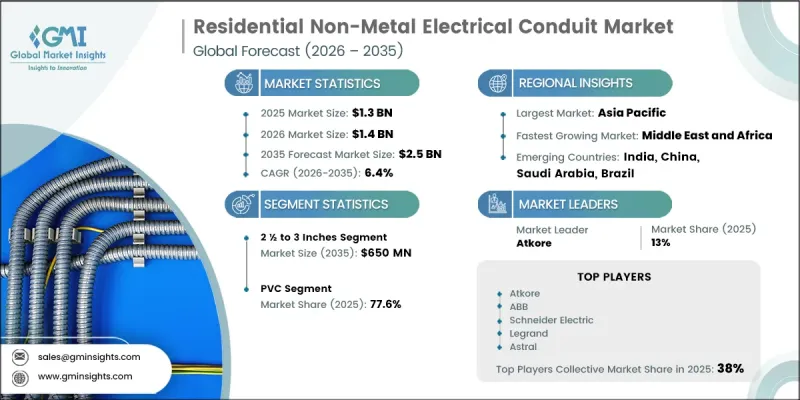
受快速都市化、住宅建設增加以及對現代電氣基礎設施投資擴大所推動的持續需求的驅動,市場正經歷穩步成長。人們對節能建築和永續建築實踐的日益關注,推動了輕質、耐用且經濟高效的管道材料在住宅應用中的使用。建築規範的修訂和更嚴格的電氣安全要求進一步促進了市場成長,而住宅可再生能源系統的日益普及也為先進的管道解決方案創造了新的機會。與傳統材料相比,非金屬電線導管具有更優異的耐腐蝕性、易於安裝和長期耐用性,因此越來越受到住宅和開發商的青睞。此外,人們對環保建材的日益關注以及住宅中先進電氣系統的日益普及也對市場產生了積極影響。隨著智慧住宅基礎設施的不斷擴展和新興經濟體新住宅開發的加速,預計在整個預測期內,對可靠的非金屬導管系統的需求將保持強勁。
| 市場範圍 | |
|---|---|
| 開始年份 | 2025 |
| 預測期 | 2026-2035 |
| 上市時的市場規模 | 13億美元 |
| 預計金額 | 25億美元 |
| 複合年成長率 | 6.4% |
在非金屬導線管市場,對能夠應對日益複雜的住宅佈線網路的剛性導線管系統的需求不斷成長。現代住宅中先進電氣基礎設施的日益普及推動了非軟性導線管解決方案的應用。同時,關於電氣安全、防火和抗紫外線性能的更嚴格法規也進一步擴大了PVC基非金屬導線管系統的應用範圍。除了住宅建設活動的擴張,對能源效率和永續住宅發展的日益重視也推動了新建項目中對可靠電氣導管解決方案的持續成長需求。
預計到2035年,2 1/2-3吋規格的導管市場規模將達到6.5億美元。由於住宅項目不斷擴張,需要能夠容納大規模電氣裝置的導管系統,因此對該規格導管的需求正在成長。與傳統金屬導管相比,這些規格的導管具有成本效益高、安裝簡單、柔軟性強等優點,因此仍然是一個極具吸引力的選擇。預計在整個預測期內,節能住宅投資的增加和住宅電網的擴張將進一步推動對該規格導管的需求成長。
預計到2025年,PVC管材市佔率將達到77.6%,到2035年市場規模將達到18億美元。 PVC材料憑藉其價格實惠、輕盈、耐腐蝕和使用壽命長等優點,持續佔據市場主導地位。城市發展的推進、住宅建設活動的活性化以及對節能住宅日益成長的需求,都進一步推動了PVC管材的普及。此外,PVC管材易於安裝、維護成本低、耐環境性能優異,使其成為住宅電氣基礎設施的首選材料。現代住宅電氣系統的不斷擴展也促進了PVC管材解決方案的需求成長。
美國住宅非金屬電線導管市場預計到2025年將達到1.941億美元,並在2035年之前以5.6%的複合年成長率成長。市場成長的促進因素包括住宅建設活動的活性化、節能型電氣系統的日益普及以及對柔軟性耐腐蝕導管產品需求的不斷成長。此外,修訂後的建築法規更重視電氣安全、永續性和最新的建築標準,這進一步加速了美國住宅開發中非金屬導管系統的應用。
目錄
第1章:調查方法和範圍
第2章執行摘要
第3章 行業洞察
- 產業生態系分析
- 監理情勢
- 影響產業的因素
- 促進因素
- 產業潛在風險與挑戰
- 成長潛力分析
- 波特的分析
- PESTLE分析
- 非金屬電線導管的成本結構分析
- 貿易數據分析
- 進出口額趨勢
- 主要貿易路線及關稅的影響
- 新機會和趨勢
- 投資分析及未來展望
第4章 競爭情勢
- 介紹
- 企業市佔率分析:按地區分類
- 北美洲
- 歐洲
- 亞太地區
- 中東和非洲
- 拉丁美洲
- 競爭定位矩陣
- 主要進展
- 併購
- 夥伴關係和聯盟
- 新產品發布
- 業務拓展計劃及資金籌措
第5章 市場規模及預測:以交易量計算,2022-2035年
- 1/2 到 1 英寸
- 1 1/4 至 2 英寸
- 2 1/2 至 3 英寸
- 3-4英寸
- 5-6英寸
- 其他
第6章 市場規模及預測:依配置分類,2022-2035年
- PVC
- 增強型熱固性樹脂(RTRC/FRE)
- 剛性非金屬(RNC)
- 非金屬電氣管(耳鼻喉科)
第7章 市場規模及預測:依地區分類,2022-2035年
- 北美洲
- 美國
- 加拿大
- 墨西哥
- 歐洲
- 法國
- 德國
- 義大利
- 英國
- 俄羅斯
- 亞太地區
- 中國
- 印度
- 日本
- 韓國
- 澳洲
- 中東和非洲
- 沙烏地阿拉伯
- UAE
- 卡達
- 南非
- 拉丁美洲
- 巴西
- 阿根廷
第8章:公司簡介
- ABB
- ALVA Manufacturing
- Anamet Electrical
- ASTRAL
- Atkore
- Bahra Electric
- Champion Fiberglass
- CANTEX
- Electri-Flex
- Guangdong Ctube Industry
- Hubbell
- HellermannTyton
- IPEX Electrical
- Iplex Pipelines
- Legrand
- Schneider Electric
- Sundeep Electricals
- TOYO INDUSTRY LAO FACTORY
- Vinidex
- Wienerberger
The Global Residential Non-Metal Electrical Conduit Market was valued at USD 1.3 billion in 2025 and is estimated to grow at a CAGR of 6.4% to reach USD 2.5 billion by 2035.
The market is experiencing steady expansion as rapid urbanization, increasing residential construction, and growing investments in modern electrical infrastructure continue to drive demand. Rising emphasis on energy-efficient buildings and sustainable construction practices is encouraging the use of lightweight, durable, and cost-effective conduit materials in residential applications. Updated building codes and stricter electrical safety requirements are further supporting market growth, while the growing integration of renewable energy systems into homes is creating additional opportunities for advanced conduit solutions. Homeowners and developers are increasingly selecting non-metal electrical conduits because they offer corrosion resistance, ease of installation, and long-term durability compared with conventional alternatives. The market is also benefiting from rising awareness of environmentally friendly construction materials and the increasing adoption of advanced electrical systems in residential properties. As smart residential infrastructure continues to expand and new housing developments accelerate across emerging economies, demand for reliable non-metal conduit systems is expected to remain strong throughout the forecast period.
| Market Scope | |
|---|---|
| Start Year | 2025 |
| Forecast Year | 2026-2035 |
| Start Value | $1.3 Billion |
| Forecast Value | $2.5 Billion |
| CAGR | 6.4% |
The residential non-metal electrical conduit market is also witnessing rising demand for rigid conduit systems capable of supporting increasingly sophisticated residential wiring networks. The growing installation of advanced electrical infrastructure in modern homes is contributing to the adoption of non-flexible conduit solutions. At the same time, stricter regulations related to electrical safety, fire protection, and ultraviolet resistance are encouraging wider use of PVC-based non-metal conduit systems. Expanding residential construction activity, combined with greater emphasis on energy conservation and sustainable housing development, continues to increase the requirement for dependable electrical conduit solutions in new building projects.
The 21/2 to 3 trade-size segment is projected to reach USD 650 million by 2035. Demand for this category is increasing due to the expansion of residential construction projects that require conduit systems capable of supporting larger electrical installations. These conduit sizes remain attractive because they offer cost efficiency, installation convenience, and greater flexibility than conventional metal alternatives. Growing investment in energy-efficient housing and expanding residential electrical networks are further strengthening segment demand throughout the forecast period.
The PVC segment accounted for 77.6% share in 2025 and is expected to reach USD 1.8 billion by 2035. The material continues to dominate due to its affordability, lightweight design, corrosion resistance, and long service life. Increasing urban development, higher residential construction activity, and growing demand for energy-efficient housing continue to support PVC adoption. In addition, its straightforward installation, low maintenance requirements, and strong environmental durability make it a preferred material for residential electrical infrastructure. The continued expansion of modern residential electrical systems is also contributing to greater demand for PVC conduit solutions.
U.S. Residential Non-Metal Electrical Conduit Market generated USD 194.1 million in 2025 and is anticipated to grow at a CAGR of 5.6% through 2035. Market growth is supported by increasing residential construction activity, rising adoption of energy-efficient electrical systems, and growing demand for flexible, corrosion-resistant conduit products. Updated building regulations emphasizing electrical safety, sustainability, and modern construction standards continue to accelerate the adoption of non-metal conduit systems across residential developments throughout the country.
Major companies operating in the global residential non-metal electrical conduit market include ABB, ALVA Manufacturing, Anamet Electrical, ASTRAL, Atkore, Bahra Electric, Champion Fiberglass, CANTEX, Electri-Flex, Guangdong Ctube Industry, Hubbell, HellermannTyton, IPEX Electrical, Iplex Pipelines, Legrand, Schneider Electric, Sundeep Electricals, TOYO INDUSTRY LAO FACTORY, Vinidex, and Wienerberger. Companies operating in the residential non-metal electrical conduit market are strengthening their market presence by expanding manufacturing capacity, introducing innovative conduit materials, and enhancing product durability to meet evolving residential construction requirements. Manufacturers are investing in research and development to improve product performance, simplify installation, and comply with increasingly stringent electrical safety and sustainability standards. Strategic collaborations with construction companies, electrical distributors, and infrastructure developers are helping companies expand their customer base and improve market penetration. Businesses are also broadening their product portfolios with advanced PVC and other non-metal conduit solutions designed for modern residential electrical systems.
Table of Contents
Chapter 1 Methodology & Scope
- 1.1 Research approach
- 1.2 Quality commitment
- 1.2.1 GMI AI policy & data integrity commitment
- 1.2.1.1 Source consistency protocol
- 1.2.1 GMI AI policy & data integrity commitment
- 1.3 Research Trail & Confidence Scoring
- 1.3.1 Research Trail Components
- 1.3.2 Scoring Components
- 1.4 Data Collection
- 1.4.1 Partial list of primary sources
- 1.5 Data mining sources
- 1.5.1 Paid sources
- 1.5.1.1 Sources, by region
- 1.5.1 Paid sources
- 1.6 Base estimates and calculations
- 1.6.1 Base year calculation for any one approach
- 1.7 Forecast model
- 1.8 Research transparency addendum
- 1.8.1 Source attribution framework
- 1.8.2 Quality assurance metrics
- 1.8.3 Our commitment to trust
- 1.8.3.1 Market definitions
Chapter 2 Executive Summary
- 2.1 Industry synopsis, 2022 - 2035
- 2.2 Business trends
- 2.3 Trade size trends
- 2.4 Configuration trends
- 2.5 Regional trends
Chapter 3 Industry Insights
- 3.1 Industry ecosystem analysis
- 3.2 Regulatory landscape
- 3.3 Industry impact forces
- 3.3.1 Growth drivers
- 3.3.2 Industry pitfalls & challenges
- 3.4 Growth potential analysis
- 3.5 Porter's analysis
- 3.5.1 Bargaining power of suppliers
- 3.5.2 Bargaining power of buyers
- 3.5.3 Threat of new entrants
- 3.5.4 Threat of substitutes
- 3.6 PESTEL analysis
- 3.7 Cost structure analysis of non metal electrical conduits
- 3.8 Trade data analysis (Driven by Primary Research)
- 3.8.1 Import/export value trends (Driven by Primary Research)
- 3.8.2 Key trade corridors & tariff impact (Driven by Primary Research)
- 3.9 Emerging opportunities & trends
- 3.10 Investment analysis & future outlook
Chapter 4 Competitive Landscape, 2026
- 4.1 Introduction
- 4.2 Company market share analysis, by region, 2025
- 4.2.1 North America
- 4.2.2 Europe
- 4.2.3 Asia Pacific
- 4.2.4 Middle East & Africa
- 4.2.5 Latin America
- 4.3 Competitive positioning matrix
- 4.4 Key Developments
- 4.4.1 Mergers & acquisitions
- 4.4.2 Partnerships & collaborations
- 4.4.3 New product launches
- 4.4.4 Expansion plans and funding
Chapter 5 Market Size and Forecast, By Trade Size, 2022 - 2035 (USD Million)
- 5.1 Key trends
- 5.2 1/2 to 1 inch
- 5.3 1 1/4 to 2 inches
- 5.4 2 1/2 to 3 inches
- 5.5 3 to 4 inches
- 5.6 5 to 6 inches
- 5.7 Others
Chapter 6 Market Size and Forecast, By Configuration, 2022 - 2035 (USD Million)
- 6.1 Key trends
- 6.2 PVC
- 6.3 Reinforced Thermosetting Resin (RTRC/FRE)
- 6.4 Rigid Non-Metallic (RNC)
- 6.5 Electrical Non-Metallic Tubing (ENT)
Chapter 7 Market Size and Forecast, By Region, 2022 - 2035 (USD Million)
- 7.1 Key trends
- 7.2 North America
- 7.2.1 U.S.
- 7.2.2 Canada
- 7.2.3 Mexico
- 7.3 Europe
- 7.3.1 France
- 7.3.2 Germany
- 7.3.3 Italy
- 7.3.4 UK
- 7.3.5 Russia
- 7.4 Asia Pacific
- 7.4.1 China
- 7.4.2 India
- 7.4.3 Japan
- 7.4.4 South Korea
- 7.4.5 Australia
- 7.5 Middle East & Africa
- 7.5.1 Saudi Arabia
- 7.5.2 UAE
- 7.5.3 Qatar
- 7.5.4 South Africa
- 7.6 Latin America
- 7.6.1 Brazil
- 7.6.2 Argentina
Chapter 8 Company Profiles
- 8.1 ABB
- 8.2 ALVA Manufacturing
- 8.3 Anamet Electrical
- 8.4 ASTRAL
- 8.5 Atkore
- 8.6 Bahra Electric
- 8.7 Champion Fiberglass
- 8.8 CANTEX
- 8.9 Electri-Flex
- 8.10 Guangdong Ctube Industry
- 8.11 Hubbell
- 8.12 HellermannTyton
- 8.13 IPEX Electrical
- 8.14 Iplex Pipelines
- 8.15 Legrand
- 8.16 Schneider Electric
- 8.17 Sundeep Electricals
- 8.18 TOYO INDUSTRY LAO FACTORY
- 8.19 Vinidex
- 8.20 Wienerberger

 編織屏蔽電纜市場報告:趨勢、預測和競爭分析(至2035年)
 混合電纜市場規模、佔有率、成長、全球產業分析、區域趨勢及2026-2034年預測
 公用事業規模非金屬導線管市場機會、成長促進因素、產業趨勢分析及 2026-2035 年預測。
 壓接端子:市場佔有率分析、產業趨勢與統計、成長預測(2026-2031 年)
 電纜及配件市場:2026-2032年全球市場預測(依電纜類型、材質、電壓等級、安裝類型、最終用戶產業及通路分類)
 非金屬電氣導管市場規模、佔有率和成長分析:按產品類型、導管尺寸、應用、最終用戶產業、安裝類型、分銷管道和地區分類-2026-2033年產業預測
 電纜及附件市場預測至2034年-按電壓、功率範圍、最終用戶及地區分類的全球分析大電流電連接器市場報告:趨勢、預測與競爭分析(至2035年)
 塑膠導管市場報告:按類型、材料、產業和地區分類,2026-2034年磁性數據電纜市場報告:趨勢、預測和競爭分析(至2035年)