

 |
市場調查報告書
商品編碼
2083303
從 2026 年到 2035 年,租賃時尚服務的市場機會、成長促進因素、產業趨勢和預測。Rental Fashion Service Market Opportunity, Growth Drivers, Industry Trend Analysis, and Forecast 2026 - 2035 |
||||||

全球服裝租賃服務市場預計到 2025 年將達到 26 億美元,預計到 2035 年將達到 81 億美元,年複合成長率為 11.7%。
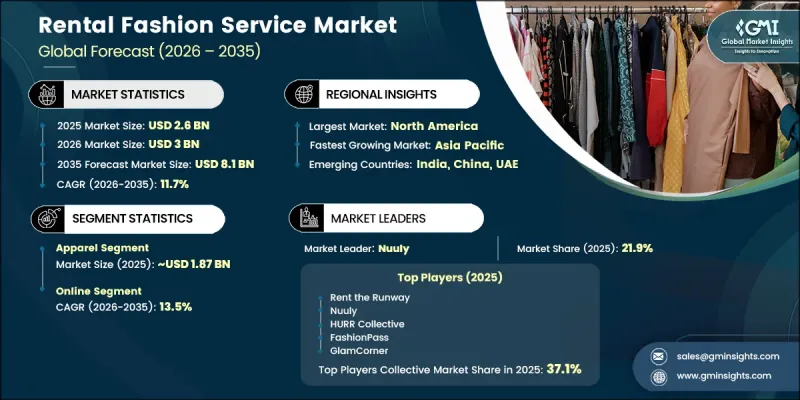
市場成長的驅動力來自消費者對具成本效益高品質時尚產品日益成長的需求、永續消費意識的增強,以及全球主要地區數位租賃平台的快速擴張。隨著消費者從傳統的基於所有權的購買模式轉向基於使用量的時尚消費模式,該行業正經歷著重大變革。這種轉變使用戶能夠擁有更多樣化的衣櫥,同時減少整體服裝支出,並支持永續性目標。人們對紡織品廢棄物和時尚產業環境影響的日益關注,進一步加速了對延長服裝使用壽命、提高資源利用效率的租賃服務的需求。數位商務、個人化建議引擎、訂閱管理系統和庫存最佳化工具等方面的技術進步,正在改善客戶體驗並增強平台的擴充性。此外,物流基礎設施和履約網路的進步,使租賃時尚營運商能夠更有效率地擴張,同時降低地理擴張所需的資本投入。這些因素持續支撐著租賃時尚服務市場的長期成長。
| 市場範圍 | |
|---|---|
| 開始年份 | 2025 |
| 預測期 | 2026-2035 |
| 起始金額 | 26億美元 |
| 預測金額 | 81億美元 |
| 複合年成長率 | 11.7% |
預計到2025年,服裝業市場規模將達到18.7億美元,佔市場佔有率的72%。其主導地位得益於租賃平台提供的豐富多樣的服飾品類,滿足了消費者多樣化的偏好和使用情境。租賃服裝在多個時尚領域的廣泛應用持續推動著強勁的需求,使其成為市場中收入最高的類別。隨著消費者在時尚選擇上對柔軟性、經濟性和永續性的需求日益成長,預計服裝業將在預測期內保持其主導地位。
預計到2025年,線上通路將佔據62%的市場佔有率,這主要得益於行動商務的普及、便利的訂閱管理功能以及能夠提升客戶參與的先進數位發現工具。數位平台正日益提供高度個人化的購物體驗,從而提高客戶維繫並促進定期訂閱的普及。隨著電子商務技術和數位用戶體驗的不斷發展,預計未來幾年線上通路的市場地位將進一步鞏固。
北美時尚租賃服務市場佔38.05%的市場佔有率,銷售額達9.85億美元。該地區受益於消費者對永續時尚的高度關注、訂閱服務的積極普及以及數位商務平台的廣泛應用。租賃經營模式的持續創新、消費者對便利性日益成長的需求以及對循環經濟計劃的日益重視,預計將在預測期內推動市場持續擴張。
目錄
第1章:調查方法和範圍
第2章執行摘要
第3章 行業洞察
- 產業生態系分析
- 供應鏈分析
- 庫存採購模式(自有庫存、寄售、品牌合作)
- 逆向物流與退貨管理
- 服裝清潔、檢查和回收網路
- 包裝和永續性合規性
- 影響產業的因素
- 市場促進因素
- 千禧世代和 Z 世代消費者越來越傾向於「使用而非擁有」。
- 永續發展意識的提高和循環經濟的發展勢頭
- 以實惠的價格享受奢侈設計師成本績效
- 數位平台的激增和行動優先的消費行為
- 社交電商和網紅主導的租賃發現
- 市場限制因素
- 高昂的營運和物流成本(清潔、運輸、倉儲)
- 消費者對二手服飾的衛生認知與偏見
- 庫存摺舊、品質下降和生命週期挑戰。
- 租賃物流中的環境悖論(運輸過程中的排放氣體、清潔過程中使用的化學物質)
- 市場機遇
- 奢侈品和設計師品牌租賃市場的擴張
- B2B時尚租賃服務(品牌重塑、媒體宣傳、造型設計)存在尚未開發的需求
- 利用人工智慧驅動的個人化服務來客戶維繫
- 拓展亞太和中東等新興市場
- 整合租賃和零售業務,以及該品牌的 D2C 策略。
- 市場促進因素
- 成長潛力分析
- 技術與創新展望
- 人工智慧和機器學習在庫存管理和個人化的應用
- 利用RFID和物聯網技術進行服飾追蹤
- 虛擬試穿與擴增實境(AR)的融合
- 區塊鏈用於來源和真實性檢驗
- 監理框架
- 關於共享經濟和平台法律責任的區域法規
- 租賃交易中的消費者保護標準
- 紡織廢棄物和循環經濟政策(歐盟紡織戰略、美國環保署 (EPA) 指南)
- 租賃服裝的衛生和安全標準
- 關鍵市場趨勢與顛覆性因素
- 未來市場趨勢
- 價格分析
- 2019-2024年歷史價格趨勢分析
- 按業務類型分類的定價策略(溢價/價值/成本加成)
- 主要平台訂閱層級基準測試
- 按使用場景分類的最終使用者人口統計特徵和價格敏感度
- 貿易數據分析
- 租賃供應鏈中時尚商品進出口量和價值的趨勢
- 主要貿易走廊和關稅對跨境庫存採購的影響
- 人工智慧和生成式人工智慧對市場的影響
- 利用人工智慧改造現有租賃經營模式(需求預測、動態定價)
- GENAI 在租賃領域的應用範例和實施藍圖(虛擬造型、聊天機器人支援、內容生成)
- 人工智慧在時尚租賃行業實施的風險、限制和監管考慮。
- 投資與資金籌措分析
- 創業投資與私募股權發展趨勢(2019-2024)
- 重要的資金籌措輪次和公司估值
- 併購和策略性資產剝離
- 主要公司在公開市場的表現
- 波特的分析
- PESTLE分析
第4章 競爭情勢
- 介紹
- 企業市佔率分析
- 按地區
- 企業矩陣分析
- 主要市場公司的競爭分析
- 競爭定位矩陣
- 主要進展
- 併購
- 夥伴關係和聯盟
- 新產品發布
- 業務拓展計劃
第5章 市場估價與預測:依租賃模式分類,2022-2035年
- 主要趨勢
- 訂閱式租賃
- 每月計劃
- 季度計劃
- 年度計劃
- 無限次換衣/輪換衣櫥模式
- 一次性租賃/活動租賃
- 婚禮和新娘租賃
- 正式活動和盛會的租賃
- 可用於舉辦公司活動和會議的場地租賃
- 節慶活動及季節性活動的租賃
- 點對點 (P2P) 租賃
- 市場平台(點對點)
- 基於社區和影響者主導的P2P模式
- 企業/B2B租賃
- 時尚造型公司和媒體製作公司
- 品牌推廣和行銷活動的租賃
- 飯店及豪華飯店配套設施計劃
第6章 市場估算與預測:依產品類型,2022-2035年
- 主要趨勢
- 服飾
- 正裝(西裝、燕尾服、晚罩衣)
- 休閒裝(日常服裝、工作服)
- 民族與傳統服裝
- 運動服及休閒
- 外套(大衣、夾克)
- 孕婦裝
- 新娘及婚禮服飾
- 配件和珠寶
- 設計師手提包與手拿包
- 精美珠寶和個性飾品
- 腕錶和手錶
- 圍巾、皮帶和小飾品
- 鞋類
- 設計師高跟鞋和正裝鞋
- 靴子和個性鞋類
- 運動鞋和休閒鞋
第7章 市場估計與預測:依最終用戶分類,2022-2035年
- 女士
- 特殊場合與活動(婚禮、盛會、派對)的服裝
- 工作服和商務服輪換穿著
- 奢華與設計師通道
- 男性
- 正裝及西裝租賃
- 婚禮及活動
- 休閒裝輪換
- 孩子們
- 特殊場合/節慶服裝
- 學校活動和特殊儀式服裝
第8章 市場估算與預測:依通路分類,2022-2035年
- 線上電子商務
- 品牌經營的行動應用程式
- 品牌官方網站和數位商店
- 第三方市場平台
- 線下/商店
- 獨立實體店面租賃精品店
- 與百貨公司和多品牌零售商建立合作關係
- 快閃租賃工作室和體驗式商店
第9章 市場估計與預測:依地區分類,2022-2035年
- 北美洲
- 美國
- 加拿大
- 歐洲
- 德國
- 英國
- 法國
- 義大利
- 西班牙
- 亞太地區
- 中國
- 印度
- 日本
- 韓國
- 澳洲
- 拉丁美洲
- 巴西
- 墨西哥
- 阿根廷
- 中東和非洲
- UAE
- 沙烏地阿拉伯
- 南非
第10章:公司簡介
- Nuuly
- Rent the Runway
- BY ROTATION
- FashionPass
- GlamCorner
- HURR Collective
- Vivrelle
- Flyrobe(Rent It Bae)
- MyWardrobe HQ
- Armoire
- Wearr
- Rotaro
- BNTO
- Pickle
- The Volte
- Hirestreet
- Kleiderei
- Front Row
- Switch
- Stage 3
- MsParis
- LENA the Fashion Library
- ReLi Norge
- Lizee
The Global Rental Fashion Service Market was valued at USD 2.6 billion in 2025 and is estimated to grow at a CAGR of 11.7% to reach USD 8.1 billion by 2035.
Market growth is driven by rising consumer interest in cost-effective access to premium fashion, increasing awareness of sustainable consumption practices, and the rapid expansion of digital rental platforms across major global regions. The industry is undergoing a notable transformation as consumers shift away from traditional ownership-based purchasing toward access-oriented fashion consumption. This transition enables users to enjoy greater wardrobe variety while reducing overall apparel expenditure and supporting sustainability objectives. Growing concerns regarding textile waste and the environmental impact of the fashion industry are further accelerating demand for rental services that extend garment life cycles and promote resource efficiency. Technological advancements in digital commerce, personalized recommendation engines, subscription management systems, and inventory optimization tools have improved customer experiences and strengthened platform scalability. In addition, advancements in logistics infrastructure and fulfillment networks are enabling rental fashion providers to expand operations more efficiently while reducing the capital requirements associated with geographic growth. These factors continue to support the long-term expansion of the Rental Fashion Service Market.
| Market Scope | |
|---|---|
| Start Year | 2025 |
| Forecast Year | 2026-2035 |
| Start Value | $2.6 Billion |
| Forecast Value | $8.1 Billion |
| CAGR | 11.7% |
The apparel segment accounted for USD 1.87 billion in 2025, representing 72% share. Its dominant position is supported by the wide variety of apparel categories available through rental platforms, serving diverse consumer preferences and usage occasions. The broad applicability of rental apparel across multiple fashion segments continues to drive strong demand, making it the largest revenue-generating category within the market. As consumers increasingly seek flexibility, affordability, and sustainability in fashion choices, the apparel segment is expected to maintain its leadership position throughout the forecast period.
The online segment held 62% share in 2025, driven by widespread adoption of mobile commerce, seamless subscription management capabilities, and advanced digital discovery tools that enhance customer engagement. Digital platforms are increasingly delivering highly personalized shopping experiences, improving customer retention and encouraging recurring subscription activity. The continued evolution of e-commerce technologies and digital user experiences is expected to further strengthen the online segment's market position over the coming years.
North America Rental Fashion Service Market held a 38.05% share, generating USD 985 million. The region benefits from high consumer awareness of sustainable fashion, strong adoption of subscription-based services, and widespread acceptance of digital commerce platforms. Continued innovation in rental business models, growing consumer demand for convenience, and increasing interest in circular economy initiatives are expected to support ongoing market expansion throughout the forecast period.
Major companies operating in the Global Rental Fashion Service Market include HURR Collective, Rent the Runway, FashionPass, Vivrelle, BY ROTATION, GlamCorner, Nuuly, Armoire, Rotaro, Flyrobe, MyWardrobe, Pickle, Wearr, and BNTO. Companies operating in the Rental Fashion Service Market are focusing on digital innovation, subscription model enhancement, and strategic partnerships to strengthen their competitive position. Investments in artificial intelligence, data analytics, and personalized recommendation technologies are helping providers improve customer engagement and optimize inventory utilization. Many companies are expanding product assortments and introducing flexible membership plans to attract a broader consumer base and increase recurring revenue. Strategic collaborations with fashion brands, retailers, and logistics providers are enabling market participants to improve service quality and expand geographic reach. Businesses are also investing in advanced fulfillment capabilities, garment care technologies, and sustainability initiatives to enhance operational efficiency and customer satisfaction.
Table of Contents
Chapter 1 Methodology & Scope
- 1.1 Research approach
- 1.2 Quality Commitments
- 1.2.1 GMI AI policy & data integrity commitment
- 1.2.1.1 Source consistency protocol
- 1.2.1 GMI AI policy & data integrity commitment
- 1.3 Research Trail & Confidence Scoring
- 1.3.1 Research Trail Components
- 1.3.2 Scoring Components
- 1.4 Data Collection
- 1.4.1 Partial list of primary sources
- 1.5 Data mining sources
- 1.5.1 Paid sources
- 1.5.1.1 Sources, by region
- 1.5.1 Paid sources
- 1.6 Base estimates and calculations
- 1.6.1 Base year calculation for any one approach
- 1.7 Forecast model
- 1.7.1 Quantified market impact analysis
- 1.7.1.1 Mathematical impact of growth parameters on forecast
- 1.7.1 Quantified market impact analysis
- 1.8 Research transparency addendum
- 1.8.1 Source attribution framework
- 1.8.2 Quality assurance metrics
- 1.8.2.1 Our commitment to trust
Chapter 2 Executive Summary
- 2.1 Industry 360° synopsis, 2022 - 2035
- 2.2 Key market trends
- 2.2.1 Region
- 2.2.2 Rental Model
- 2.2.3 Product Type
- 2.2.4 End-user
- 2.2.5 Distribution Channel
Chapter 3 Industry Insights
- 3.1 Industry ecosystem analysis
- 3.2 Supply chain analysis
- 3.2.1 inventory acquisition models (owned vs. Consigned vs. Branded partnerships)
- 3.2.2 Reverse logistics & returns management
- 3.2.3 Garment cleaning, inspection & reconditioning networks
- 3.2.4 Packaging & sustainability compliance
- 3.3 Industry impact forces
- 3.3.1 Market drivers
- 3.3.1.1 rising consumer preference for access-over-ownership among millennials & gen z
- 3.3.1.2 Growing sustainability consciousness & circular economy momentum
- 3.3.1.3 Cost-effective access to luxury & designer fashion
- 3.3.1.4 Digital platform proliferation & mobile-first consumer behavior
- 3.3.1.5 Social commerce & influencer-led rental discovery
- 3.3.2 Market restraints
- 3.3.2.1 High operational & logistics costs (cleaning, shipping, warehousing)
- 3.3.2.2 Consumer hygiene perceptions & stigma around pre-worn clothing
- 3.3.2.3 Inventory depreciation, quality degradation & lifecycle challenges
- 3.3.2.4 Environmental paradox of rental logistics (transportation emissions, cleaning chemicals)
- 3.3.3 Market opportunities
- 3.3.3.1 Expansion of luxury & designer segment rental
- 3.3.3.2 Untapped corporate & b2b fashion rental demand (brand activations, media, styling)
- 3.3.3.3 AI-powered personalization as a customer retention lever
- 3.3.3.4 Emerging market expansion Asia Pacific & Middle East
- 3.3.3.5 Integration of rental with retail & brand direct-to-consumer strategies
- 3.3.1 Market drivers
- 3.4 Growth potential analysis
- 3.5 Technology & innovation landscape
- 3.5.1 AI & machine learning in inventory management & personalization
- 3.5.2 RFID & IoT-enabled garment tracking
- 3.5.3 Virtual try-on & augmented reality integration
- 3.5.4 Blockchain for provenance & authenticity verification
- 3.6 Regulatory framework
- 3.6.1 Sharing economy & platform liability regulations by region
- 3.6.2 Consumer protection standards for rental transactions
- 3.6.3 Textile waste & circular economy policies (EU textile strategy, U.S. EPA guidelines)
- 3.6.4 Hygiene & safety standards for rented garments
- 3.7 Major market trends and disruptions
- 3.8 Future market trends
- 3.9 Pricing analysis (driven by primary research)
- 3.9.1 Historical price trend analysis (2019-2024) (driven by primary research)
- 3.9.2 Pricing strategy by player type (premium/value / cost-plus) (driven by primary research)
- 3.9.3 Subscription tier benchmarking across key platforms
- 3.9.4 Price sensitivity by end-user demographic & occasion type
- 3.10 Trade data analysis (driven by primary research)
- 3.10.1 Import/export volume & value trends for fashion goods in rental supply chains (driven by primary research)
- 3.10.2 Key trade corridors & tariff impact on cross-border inventory sourcing (driven by primary research)
- 3.11 Impact of AI & generative AI on the market
- 3.11.1 AI-driven disruption of existing rental business models (demand forecasting, dynamic pricing)
- 3.11.2 GENAI use cases & adoption roadmap by rental segment (virtual styling, chatbot support, content generation)
- 3.11.3 Risks, limitations & regulatory considerations of AI deployment in fashion rental
- 3.12 Investment & funding analysis
- 3.12.1 Venture capital & private equity activity (2019-2024)
- 3.12.2 Notable funding rounds & valuations
- 3.12.3 Mergers, acquisitions & strategic exits
- 3.12.4 Public market performance of key players
- 3.13 Porter's analysis
- 3.14 PESTEL analysis
Chapter 4 Competitive Landscape, 2025
- 4.1 Introduction
- 4.2 Company market share analysis
- 4.2.1 By Region
- 4.2.1.1 North America
- 4.2.1.2 Europe
- 4.2.1.3 Asia Pacific
- 4.2.1.4 Latin America
- 4.2.1.5 Middle East and Africa
- 4.2.1 By Region
- 4.3 Company matrix analysis
- 4.4 Competitive analysis of major market players
- 4.5 Competitive positioning matrix
- 4.6 Key developments
- 4.6.1 Mergers & acquisitions
- 4.6.2 Partnerships & collaborations
- 4.6.3 New product launches
- 4.6.4 Expansion plans
Chapter 5 Market Estimates and Forecast, By Rental Model, 2022 - 2035 (USD Billion)
- 5.1 Key Trends
- 5.2 Subscription-Based Rental
- 5.2.1 Monthly Plans
- 5.2.2 Quarterly Plans
- 5.2.3 Annual Plans
- 5.2.4 Unlimited Swap / Rotating Wardrobe Models
- 5.3 One-Time / Occasion-Based Rental
- 5.3.1 Wedding & Bridal Occasion Rental
- 5.3.2 Formal Event & Gala Rental
- 5.3.3 Corporate Event & Conference Rental
- 5.3.4 Festival & Seasonal Occasion Rental
- 5.4 Peer-To-Peer (P2P) Rental
- 5.4.1 Marketplace Platforms (Individual-To-Individual)
- 5.4.2 Community-Based & Influencer-Led P2P Models
- 5.5 Corporate / B2B Rental
- 5.5.1 Fashion Styling Houses & Media Production
- 5.5.2 Brand Activation & Marketing Event Rental
- 5.5.3 Hospitality & Luxury Hotel Amenity Programs
Chapter 6 Market Estimates and Forecast, By Product Category, 2022 - 2035 (USD Billion)
- 6.1 Key Trends
- 6.2 Apparel
- 6.2.1 Formalwear (Suits, Tuxedos, Evening Gowns)
- 6.2.2 Casualwear (Everyday Rotation, Workwear)
- 6.2.3 Ethnic & Traditional Wear
- 6.2.4 Activewear & Athleisure
- 6.2.5 Outerwear (Coats, Jackets)
- 6.2.6 Maternity Wear
- 6.2.7 Bridal & Wedding Wear
- 6.3 Accessories & Jewelry
- 6.3.1 Designer Handbags & Clutches
- 6.3.2 Fine Jewelry & Statement Pieces
- 6.3.3 Watches & Timepieces
- 6.3.4 Scarves, Belts & Small Accessories
- 6.4 Footwear
- 6.4.1 Designer Heels & Occasion Footwear
- 6.4.2 Boots & Statement Footwear
- 6.4.3 Sneakers & Casual Footwear
Chapter 7 Market Estimates and Forecast, By End User, 2022 - 2035 (USD Billion)
- 7.1 Key trends
- 7.2 Women
- 7.2.1 Occasion & Event Wear (Weddings, Galas, Parties)
- 7.2.2 Workwear & Professional Wardrobe Rotation
- 7.2.3 Luxury & Designer Access
- 7.3 Men
- 7.3.1 Formalwear & Suit Rental
- 7.3.2 Wedding & Event Attire
- 7.3.3 Casualwear Rotation
- 7.4 Children
- 7.4.1 Occasion & Festive Wear
- 7.4.2 School Event & Special Ceremony Attire
Chapter 8 Market Estimates and Forecast, By Distribution Channel, 2022 - 2035 (USD Billion)
- 8.1 Key trends
- 8.2 Online / E-Commerce
- 8.2.1 Brand-Owned Mobile Applications
- 8.2.2 Brand-Owned Websites & Digital Storefronts
- 8.2.3 Third-Party Marketplace Platforms
- 8.3 Offline / In-Store
- 8.3.1 Standalone Physical Rental Boutiques
- 8.3.2 Department Store & Multi-Brand Retail Partnerships
- 8.3.3 Pop-Up Rental Studios & Experience Stores
Chapter 9 Market Estimates & Forecast, By Region, 2022 - 2035, (USD Billion)
- 9.1 Key trends
- 9.2 North America
- 9.2.1 U.S.
- 9.2.2 Canada
- 9.3 Europe
- 9.3.1 Germany
- 9.3.2 U.K.
- 9.3.3 France
- 9.3.4 Italy
- 9.3.5 Spain
- 9.4 Asia Pacific
- 9.4.1 China
- 9.4.2 India
- 9.4.3 Japan
- 9.4.4 South Korea
- 9.4.5 Australia
- 9.5 Latin America
- 9.5.1 Brazil
- 9.5.2 Mexico
- 9.5.3 Argentina
- 9.6 MEA
- 9.6.1 UAE
- 9.6.2 Saudi Arabia
- 9.6.3 South Africa
Chapter 10 Company Profiles
- 10.1 Nuuly
- 10.2 Rent the Runway
- 10.3 BY ROTATION
- 10.4 FashionPass
- 10.5 GlamCorner
- 10.6 HURR Collective
- 10.7 Vivrelle
- 10.8 Flyrobe (Rent It Bae)
- 10.9 MyWardrobe HQ
- 10.10 Armoire
- 10.11 Wearr
- 10.12 Rotaro
- 10.13 BNTO
- 10.14 Pickle
- 10.15 The Volte
- 10.16 Hirestreet
- 10.17 Kleiderei
- 10.18 Front Row
- 10.19 Switch
- 10.20 Stage 3
- 10.21 MsParis
- 10.22 LENA the Fashion Library
- 10.23 ReLi Norge
- 10.24 Lizee

 2026-2030年全球服飾市場
 比基尼和坦克比基尼市場規模、佔有率和成長分析:按產品類型、材質、價格範圍、分銷管道、最終用戶和地區分類-2026-2033年產業預測
 服裝市場-2026-2032年全球市場預測
 全球時尚租賃市場規模、佔有率、趨勢和成長分析報告(2026-2034)
 2026-2030年全球訂製服飾市場
 男士T卹市場-全球產業規模、佔有率、趨勢、機會與預測:依產品類型、通路、地區及競爭格局分類,2021-2031年
 女性用舞蹈緊身衣市場報告:趨勢、預測與競爭分析(至2035年)
 服裝市場機會、成長要素、產業趨勢分析及2026-2035年預測2026-2034年全球羽球服飾市場規模、佔有率、趨勢與成長分析報告
 紡織服裝市場:按材料、應用、分銷管道和地區分類