


 |
市場調查報告書
商品編碼
2083302
寵物單株抗體市場:商業機會、成長要素、產業趨勢分析及2026-2035年預測Pet Monoclonal Antibodies Market Opportunity, Growth Drivers, Industry Trend Analysis, and Forecast 2026 - 2035 |
||||||

全球寵物單株抗體市場預計到 2025 年將價值 13 億美元,預計到 2035 年將以 13.8% 的複合年成長率成長至 46 億美元。
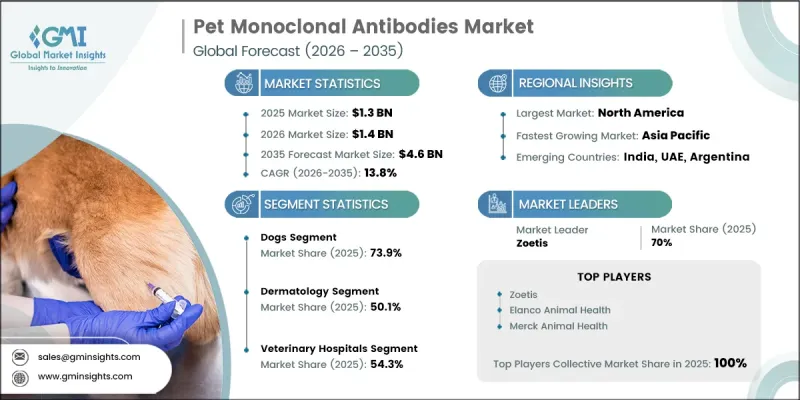
寵物單株抗體市場的成長主要得益於治療策略的轉變,即從傳統的抗發炎和疼痛管理療法轉向針對慢性動物疾病的標靶單株抗體療法。伴侶動物慢性疾病(包括皮膚病和肌肉骨骼疾病)的日益普遍,為生物製藥治療創造了穩定且持續的需求基礎。這些疾病通常需要持續的疾病管理,而非短期干預,從而推動了處方量的持續成長。已通過核准的生物製藥的商業化進一步促進了市場擴張,而正在進行的臨床開發項目則拓展了其在腫瘤學和感染疾病的潛在治療應用。寵物飼養量的增加、飼主對先進獸醫護理的投入意願以及獲得專業獸醫服務的便利性提高,也推動了市場成長。此外,獸醫基礎設施的擴建以及先進診斷和治療方案的廣泛應用,也促進了單株抗體療法的普及。總體而言,該市場反映了獸醫學的結構性轉變,朝著高度精確、長期的生物治療解決方案發展,以改善伴侶動物的臨床結果和生活品質。
| 市場範圍 | |
|---|---|
| 開始年份 | 2025 |
| 預測期 | 2026-2035 |
| 上市時的市場規模 | 13億美元 |
| 預測金額 | 46億美元 |
| 複合年成長率 | 13.8% |
預計到2025年,犬類市場將佔據73.9%的市場。這一主導地位主要歸功於單株抗體療法在犬類慢性疾病(尤其是皮膚病和疼痛相關疾病)治療中的廣泛臨床應用。犬類是生物獸醫學領域最成熟的患者群體,這得益於其廣泛的臨床應用以及在長期疾病管理方面卓越的治療效果。寵物飼主對先進治療方案的認知不斷提高,以及獸醫診斷技術的進步,使得疾病的早期發現和介入成為可能,這些因素將繼續推動犬類市場的發展。
預計到2025年,獸醫院領域將佔據54.3%的市場。這一主導地位源於對單株抗體療法的專業管理需求,此類療法通常由訓練有素的獸醫專家在臨床環境中進行操作。獸醫醫院擁有生物製藥儲存、受控處理和患者監測所需的必要基礎設施,使其成為主要的分銷和給藥管道。獸醫醫療機構擴大採用先進的治療方案,以及寵物慢性疾病專科醫療服務的日益普及,將繼續支持該領域的強勁需求。
預計到2025年,北美寵物單株抗體市佔率將達到42.8%。該地區的主導地位得益於先進的獸醫醫療保健體系、高額的寵物醫療支出以及生物製藥療法的早期應用。監管機構對獸用單株抗體核准的大力支持,促進了全部區域快速商業化和廣泛的臨床應用。完善的獸醫網路以及寵物飼主對先進治療方案日益成長的認知,進一步鞏固了該地區的市場主導地位。
目錄
第1章:調查方法和範圍
第2章執行摘要
第3章 行業洞察
- 產業生態系分析
- 影響產業的因素
- 促進因素
- 寵物慢性病發生率上升
- 加速標靶治療的進展
- 擴大研發投資和活動
- 寵物數量和消費者支出增加
- 產業潛在風險與挑戰
- 治療的不良反應
- 監管挑戰
- 市場機遇
- 新治療適應症的開發
- 開發新的行政路線
- 伴侶動物藥品經濟結構的變化
- 促進因素
- 成長潛力分析
- 技術與創新展望
- 最新科技趨勢
- 新興技術
- 價格趨勢分析
- 價格分析:按產品
- 歷史價格分析
- 監理情勢
- 波特的分析
- PESTLE分析
- 管道分析
- 未來市場趨勢
- 人工智慧和生成式人工智慧對市場的影響
- 投資與資金籌措分析
- 按國家/地區分類的寵物統計數據
- 關於安全性和耐受性的考慮
第4章 競爭情勢
- 介紹
- 企業市佔率分析
- 企業矩陣分析
- 主要市場公司的競爭分析
- 競爭定位矩陣
- 主要進展
- 併購
- 夥伴關係和聯盟
- 新產品發布
- 業務拓展計劃
第5章 市場估算與預測:依動物種類分類,2022-2035年
- 狗
- 貓
第6章 市場估計與預測:依應用領域分類,2022-2035年
- 皮膚科
- 骨關節炎
- 癌症
- 感染疾病
第7章 市場估計與預測:依最終用途分類,2022-2035年
- 動物醫院
- 動物診所
- 大學和研究機構
第8章 市場估計與預測:依地區分類,2022-2035年
- 北美洲
- 美國
- 加拿大
- 歐洲
- 德國
- 法國
- 英國
- 西班牙
- 義大利
- 荷蘭
- 亞太地區
- 中國
- 日本
- 印度
- 澳洲
- 韓國
- 拉丁美洲
- 巴西
- 墨西哥
- 阿根廷
- 中東和非洲
- 沙烏地阿拉伯
- 南非
- UAE
第9章:公司簡介
- Commercialized players
- Zoetis Inc.
- Merck Animal Health
- Elanco Animal Health
- Emerging/pipeline players
- Vetigenics
- Akston Biosciences
- MabGenesis
- Dechra Pharmaceuticals
- VETmAb Biosciences
The Global Pet Monoclonal Antibodies Market was valued at USD 1.3 billion in 2025 and is estimated to grow at a CAGR of 13.8% to reach USD 4.6 billion by 2035.
Growth in the pet monoclonal antibodies market is driven by the transition from conventional anti-inflammatory and pain management treatments toward targeted monoclonal antibody-based therapies for chronic animal health conditions. Rising prevalence of long-term disorders in companion animals, including dermatological and musculoskeletal diseases, is creating a stable and recurring demand base for biologic treatments. These conditions typically require continuous disease management rather than short-term intervention, supporting sustained prescription volumes. The commercialization of approved biologic therapies has further strengthened market expansion, while ongoing clinical development programs are broadening potential therapeutic applications in oncology and infectious disease areas. Increasing pet ownership, higher willingness among pet owners to spend on advanced veterinary care, and improved access to specialized veterinary services are also reinforcing market growth. Additionally, expanding veterinary healthcare infrastructure and rising adoption of advanced diagnostic and treatment protocols are contributing to stronger uptake of monoclonal antibody therapies. Overall, the market reflects a structural transformation in veterinary care toward high-precision, long-duration biologic treatment solutions that improve clinical outcomes and quality of life for companion animals.
| Market Scope | |
|---|---|
| Start Year | 2025 |
| Forecast Year | 2026-2035 |
| Start Value | $1.3 Billion |
| Forecast Value | $4.6 Billion |
| CAGR | 13.8% |
The dogs segment accounted for 73.9% share in 2025. This dominance is attributed to the strong clinical adoption of monoclonal antibody therapies for canine chronic conditions, particularly dermatological and pain-related disorders. Dogs represent the most established patient base for biologic veterinary treatments, supported by widespread clinical usage and strong treatment outcomes in long-term disease management. The segment continues to benefit from increasing awareness among pet owners regarding advanced therapeutic options and improved veterinary diagnostics that enable early disease detection and intervention.
The veterinary hospitals segment held a 54.3% share in 2025. This dominance is driven by the requirement for professional administration of monoclonal antibody therapies, which are typically delivered through clinical settings by trained veterinary specialists. Veterinary hospitals are equipped with the necessary infrastructure for biologic storage, controlled handling, and patient monitoring, making them the primary distribution and administration channel. The increasing integration of advanced treatment protocols within veterinary healthcare facilities continues to support strong demand in this segment, alongside rising adoption of specialty care services for chronic pet conditions.
North America Pet Monoclonal Antibodies Market held a 42.8% share in 2025. The region's leadership is supported by advanced veterinary healthcare systems, high expenditure on companion animal care, and early adoption of biologic therapies. Strong regulatory support for veterinary monoclonal antibody approvals has enabled faster commercialization and widespread clinical use across the region. The presence of well-established veterinary networks and growing awareness among pet owners regarding advanced treatment options further strengthens regional market dominance.
Major companies operating in the Global Pet Monoclonal Antibodies Market include Zoetis Inc., Elanco Animal Health, Merck & Co., Inc. (Merck Animal Health), Dechra Pharmaceuticals PLC, Vetigenics Inc., Akston Biosciences Corporation, MabGenesis LLC, and VETmAb Biosciences Ltd. Companies in the Pet Monoclonal Antibodies Market are focusing on expanding their biologic drug pipelines through intensive research and development aimed at addressing a wider range of chronic and complex animal diseases. Strategic collaborations with veterinary clinics, research institutions, and biotechnology firms are being leveraged to accelerate product development and clinical validation. Firms are investing in advanced antibody engineering platforms to improve treatment efficacy, safety, and species-specific targeting. Expansion of manufacturing capabilities and cold-chain distribution infrastructure is also being prioritized to support growing demand. In addition, companies are strengthening regulatory engagement strategies to streamline approval timelines across key global markets.
Table of Contents
Chapter 1 Methodology & Scope
- 1.1 Research approach
- 1.2 Quality commitments
- 1.2.1 GMI AI policy & data integrity commitment
- 1.2.1.1 Source consistency protocol
- 1.2.1 GMI AI policy & data integrity commitment
- 1.3 Research trail & confidence scoring
- 1.3.1 Research trail components
- 1.3.2 Scoring components
- 1.4 Data collection
- 1.4.1 Partial list of primary sources
- 1.5 Data mining sources
- 1.5.1 Paid sources
- 1.5.1.1 Sources, by region
- 1.5.1 Paid sources
- 1.6 Base estimates and calculations
- 1.6.1 Base year calculation for any one approach
- 1.7 Market estimates & forecasts parameters
- 1.8 Forecast model
- 1.8.1 Quantified market impact analysis
- 1.8.1.1 Mathematical impact of growth parameters on forecast
- 1.8.1 Quantified market impact analysis
- 1.9 Research transparency addendum
- 1.9.1 Source attribution framework
- 1.9.2 Quality assurance metrics
- 1.9.3 Our commitment to trust
Chapter 2 Executive Summary
- 2.1 Industry 3600 synopsis
- 2.1.1 Business trends
- 2.1.2 Animal trends
- 2.1.3 Application trends
- 2.1.4 End use trends
- 2.1.5 Regional trends
- 2.2 CXO perspectives: Strategic imperatives
Chapter 3 Industry Insights
- 3.1 Industry ecosystem analysis
- 3.2 Industry impact forces
- 3.2.1 Growth drivers
- 3.2.1.1 Rising prevalence of chronic disease in pets
- 3.2.1.2 Growing advancement in targeted therapies
- 3.2.1.3 Increasing R&D investment and activities
- 3.2.1.4 Growing pet ownership and spending
- 3.2.2 Industry pitfalls and challenges
- 3.2.2.1 Adverse effects of the treatment
- 3.2.2.2 Regulatory challenges
- 3.2.3 Market opportunities
- 3.2.3.1 Expansion into novel therapeutic indications
- 3.2.3.2 Development of novel administration routes
- 3.2.3.3 Shift in companion animal pharma economics
- 3.2.1 Growth drivers
- 3.3 Growth potential analysis
- 3.4 Technology and innovation landscape
- 3.4.1 Current technological trends
- 3.4.2 Emerging technologies
- 3.5 Pricing trend analysis (Driven by primary research)
- 3.5.1 Pricing analysis, by product
- 3.5.2 Historic pricing analysis
- 3.6 Regulatory landscape (Driven by primary research)
- 3.6.1 North America
- 3.6.2 Europe
- 3.6.3 Asia Pacific
- 3.6.4 Latin America
- 3.6.5 MEA
- 3.7 Porter's analysis
- 3.8 PESTEL analysis
- 3.9 Pipeline analysis (Driven by primary research)
- 3.10 Future market trends
- 3.11 Impact of AI and Generative AI on the market (Driven by primary research)
- 3.12 Investment & funding analysis (Driven by primary research)
- 3.13 Pet statistics, by country (Driven by primary research)
- 3.14 Safety and tolerability considerations
Chapter 4 Competitive Landscape, 2025
- 4.1 Introduction
- 4.2 Company market share analysis (Driven by primary research)
- 4.3 Company matrix analysis
- 4.4 Competitive analysis of major market players
- 4.5 Competitive positioning matrix
- 4.6 Key developments
- 4.6.1 Merger and acquisition
- 4.6.2 Partnership and collaboration
- 4.6.3 New product launches
- 4.6.4 Expansion plans
Chapter 5 Market Estimates and Forecast, By Animal, 2022 - 2035 ($ Mn)
- 5.1 Key trends
- 5.2 Dogs
- 5.3 Cats
Chapter 6 Market Estimates and Forecast, By Application, 2022 - 2035 ($ Mn)
- 6.1 Key trends
- 6.2 Dermatology
- 6.3 Osteoarthritis
- 6.4 Cancer
- 6.5 Infectious diseases
Chapter 7 Market Estimates and Forecast, By End Use, 2022 - 2035 ($ Mn)
- 7.1 Key trends
- 7.2 Veterinary hospitals
- 7.3 Veterinary clinics
- 7.4 Academics and research institutes
Chapter 8 Market Estimates and Forecast, By Region, 2022 - 2035 ($ Mn)
- 8.1 Key trends
- 8.2 North America
- 8.2.1 U.S.
- 8.2.2 Canada
- 8.3 Europe
- 8.3.1 Germany
- 8.3.2 France
- 8.3.3 UK
- 8.3.4 Spain
- 8.3.5 Italy
- 8.3.6 Netherlands
- 8.4 Asia Pacific
- 8.4.1 China
- 8.4.2 Japan
- 8.4.3 India
- 8.4.4 Australia
- 8.4.5 South Korea
- 8.5 Latin America
- 8.5.1 Brazil
- 8.5.2 Mexico
- 8.5.3 Argentina
- 8.6 Middle East & Africa
- 8.6.1 Saudi Arabia
- 8.6.2 South Africa
- 8.6.3 UAE
Chapter 9 Company Profiles
- 9.1 Commercialized players
- 9.1.1 Zoetis Inc.
- 9.1.2 Merck Animal Health
- 9.1.3 Elanco Animal Health
- 9.2 Emerging/pipeline players
- 9.2.1 Vetigenics
- 9.2.2 Akston Biosciences
- 9.2.3 MabGenesis
- 9.2.4 Dechra Pharmaceuticals
- 9.2.5 VETmAb Biosciences

 Ipilimumab市場規模、佔有率和成長分析:按適應症、療法、劑型、最終用戶、分銷管道和地區分類-2026-2033年產業預測
 單株抗體市場:2026-2032年全球市場預測(依產品類型、技術、原料、應用、最終用戶及通路分類)單株抗體療法市場:2026-2032年全球市場預測(按抗體類型、適應症、分子標靶、生產技術、給藥途徑、療法、最終用戶和分銷管道分類)
 用於癌症和非癌症診斷的單株抗體市場:按抗體類型、所用技術、應用、最終用戶、分銷管道和地區分類
 Pembrolizumab市場規模、佔有率、成長率、全球產業分析、區域趨勢及2026年至2034年預測。
 單株抗體合作與授權協議(2019-2026)癌症單株抗體的合作與授權協議(2016-2026 年)單株抗體療法市場:按原料、應用、分銷管道和地區分類
 單株抗體市場報告:按生產方法、原料、適應症、最終用途和地區分類(2026-2034 年)Bevacizumab全球市場規模、佔有率、趨勢和成長分析報告(2026-2034)