


 |
市場調查報告書
商品編碼
2083295
2026 年至 2035 年再生農業技術的市場機會、成長要素、產業趨勢與預測。Regenerative Agriculture Technology Market Opportunity, Growth Drivers, Industry Trend Analysis, and Forecast 2026 - 2035 |
||||||

全球再生農業技術市場預計到 2025 年將價值 29 億美元,預計到 2035 年將以 13.7% 的複合年成長率成長至 105 億美元。
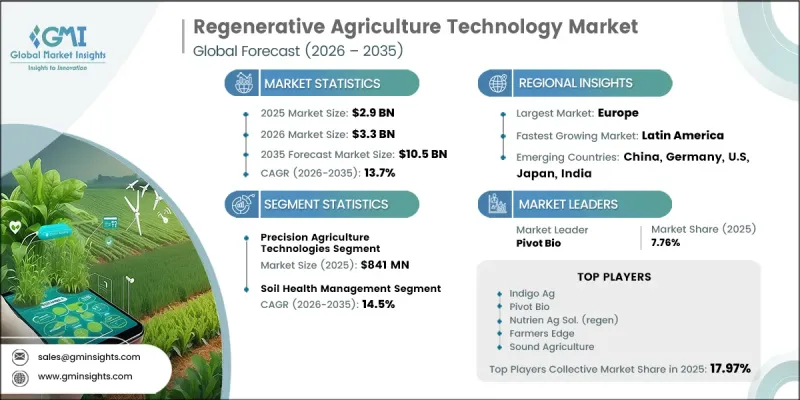
氣候變遷減緩政策的日益趨同、人工智慧(AI)驅動的農業技術的快速發展以及全球供應鏈對永續採購慣例日益成長的需求等因素,正推動著這一市場的發展。再生農業技術因其能夠提高農場生產力和資源利用效率,同時支持環境永續性,正成為更廣泛的農業技術生態系統中具有戰略意義的重要組成部分。市場應用正從試驗計畫和早期實施轉向大規模企業採購,加速其在整個農業價值鏈中的部署。這種轉變創造了一個更穩定的需求環境,減少了對農產品價格短期波動的依賴。同時,隨著企業加強對永續性和排放的承諾,對支持土壤性能監測、碳測量和農業可追溯性的技術的需求也在不斷成長。儘管預計市場將實現強勁成長,但將小規模農場轉型為數位整合再生生產模式所需的大量前期投資仍然是加速市場滲透的主要阻礙因素。
| 市場範圍 | |
|---|---|
| 開始年份 | 2025 |
| 預測期 | 2026-2035 |
| 初始市場規模 | 29億美元 |
| 預測金額 | 105億美元 |
| 複合年成長率 | 13.7% |
預計到2025年,精密農業技術領域的市佔率將達到29%。數據驅動型農業工具、自動化田間管理系統和先進作物監測解決方案的積極應用,將持續推動該領域的成長。農業生產者正擴大利用精準技術來最佳化資源利用、提高營運效率並增強永續性。隨著再生農業實踐的日益普及,對能夠實現精準決策和績效評估的技術的需求預計將保持強勁。
預計到2025年,土壤健康管理領域將佔據31.74%的市場佔有率,市場規模達9億美元。人們日益重視改善土壤品質、提高養分利用效率和提升長期農業生產力,這持續推動該應用領域的需求成長。農民和農業組織正增加對能夠提供土壤狀況有效資訊並支持永續土地管理實踐的技術的投資。土壤健康作為再生農業的基礎要素,其重要性預計將在整個預測期內保持強勁成長。
預計2025年,北美再生農業技術市場將佔據39%的市場佔有率,市場規模將達到11.31億美元。在積極採用農業技術、不斷擴大永續性措施以及增加對氣候友善農業實踐投資的推動下,北美正持續鞏固其作為再生農業解決方案領先市場的地位。此外,支持性的行業計劃、先進的數位基礎設施以及對可衡量環境效益日益成長的關注,也進一步促進了全部區域市場的成長。
目錄
第1章:調查方法和範圍
第2章執行摘要
第3章 行業洞察
- 產業生態系分析
- 供應鏈分析
- 硬體組件(感測器、無人機、連接模組)的採購
- 軟體平台開發生態系統
- 生物來源材料的供應鏈-從發酵到田間應用。
- 影響產業的因素
- 市場促進因素
- 加強企業ESG措施並強制減少範圍3排放。
- 政府對土壤健康改善計畫的補貼和政策獎勵(美國農業部的EQIP計畫、歐盟的「從農場到餐桌」計畫)
- 自願性碳市場需求的成長正在推動 MRV 技術的應用。
- 市場限制因素
- 中小農戶技術轉型初期成本高昂
- MRV 標準的差異以及排碳權檢驗的複雜性
- 市場機遇
- 數位排碳權平台和代幣化碳市場的擴張
- 人工智慧與衛星遙感探測的融合用於大規模即時現場監測
- 市場促進因素
- 成長潛力分析
- 技術與創新展望
- 監理框架
- 關鍵市場趨勢與顛覆性因素
- 未來市場趨勢
- 價格分析
- 歷史定價趨勢分析—SaaS、硬體與服務層級
- 依球員類型分類的定價策略(高級球員、超值球員、成本加成球員)
- 貿易數據分析
- 農業科技硬體和生物來源材料的進出口量和進口額趨勢
- 主要貿易路線和關稅對技術採用的影響
- 人工智慧和生成式人工智慧對市場的影響
- 利用人工智慧改造現有精密農業經營模式
- GenAI按細分領域分類的應用案例和實施藍圖(土壤建模、碳排放監測與核查、作物諮詢)
- 人工智慧在農業領域的風險、限制與監管考量
- 波特的分析
- PESTLE分析
第4章 競爭情勢
- 介紹
- 企業市佔率分析
- 按地區
- 企業矩陣分析
- 主要市場公司的競爭分析
- 競爭定位矩陣
- 主要進展
- 併購
- 夥伴關係和聯盟
- 新產品發布
- 業務拓展計劃
第5章 市場估計與預測:依技術類型分類,2022-2035年
- 精密農業技術
- 可變費率應用(VRT)系統
- GPS和野外測繪工具
- 產量監測和數據管理系統
- 遙感探測和地理資訊系統技術
- 基於無人機的影像擷取與航空測量平台
- 衛星遙感探測和頻譜成像
- 用於土地監測的地理資訊系統(GIS)
- 人工智慧和機器學習平台
- 預測性作物分析與建議引擎
- 土壤碳建模與固碳量估算工具
- 電腦視覺在作物和土壤監測的應用
- 物聯網和連網型設備
- 土壤健康感測器(濕度、養分、pH值)
- 微氣候和氣象觀測站
- 連網牲畜和放牧管理設備
- 生物來源投入技術
- 微生物接種劑的生產與供應平台
- 生物促效劑配方技術
- 生物防治劑開發平台
- 碳測量與MRV平台
- 數位化MRV軟體和溫室氣體(GHG)計算工具
- 排碳權登記發行平台
- 土壤碳分析試劑盒和現場設備
- 區塊鏈和可追溯性平台
- 供應鏈透明度和原產地追蹤
- 碳權代幣化與交易平台
- 可再生的身份驗證和標籤管理系統
第6章 市場估計與預測:依應用領域分類,2022-2035年
- 土壤健康管理
- 犁地和保護性耕作支援工具
- 覆蓋作物和作物輪作管理系統
- 土壤微生物組分析與健康監測
- 水和灌溉管理
- 精準灌溉和用水最佳化工具
- 水資源蓄積與流域監測平台
- 徑流和侵蝕控制技術系統
- 碳封存與監測
- 土壤碳固定的測量與檢驗
- 農林業中的碳和生物量監測工具
- 水產養殖中的藍碳和碳封存平台
- 作物/牲畜管理
- 最佳化再生作物輪作和間作
- 綜合放牧與林牧管理平台
- 牧場健康和牲畜影響監測系統
- 改善生物多樣性
- 農林業設計與冠層監測工具
- 用於追蹤授粉昆蟲棲息地和繪製其生態系統圖的平台
- 生物多樣性指數測量與報告系統
第7章 市場估計與預測:依最終用戶分類,2022-2035年
- 農民和生產者
- 中小農戶
- 大型商業農場和合作社
- 農產品和食品公司
- 食品製造商和消費品公司
- 農業材料供應商和經銷商
- 政府機構和非政府組織
- 各國的農業組織及農業推廣服務
- 國際發展組織和非政府組織
- 金融機構和碳市場相關人員
- 專注於ESG的投資基金和銀行
- 自願性碳市場的註冊機構和交易所
第8章 市場估計與預測:依地區分類,2022-2035年
- 北美洲
- 美國
- 加拿大
- 歐洲
- 德國
- 英國
- 法國
- 義大利
- 西班牙
- 亞太地區
- 中國
- 印度
- 日本
- 韓國
- 澳洲
- 拉丁美洲
- 巴西
- 墨西哥
- 阿根廷
- 中東和非洲
- UAE
- 沙烏地阿拉伯
- 南非
第9章:公司簡介
- Pivot Bio
- Sound Agriculture
- CropX Technologies
- Biome Makers
- Agreena
- Regrow Ag
- Nutrien Ag Solutions
- Indigo Ag
- CropIn Technology Solutions
- Klim
- InPlanet
- Boomitra
- Perennial
- Agoro Carbon Alliance
- Puna Bio
- EarthDaily Analytics
- CIBO Technologies
- xFarm Technologies
- Yard Stick PBC
- Agrology
- Ginkgo Bioworks
- Farmers Edge
The Global Regenerative Agriculture Technology Market was valued at USD 2.9 billion in 2025 and is estimated to grow at a CAGR of 13.7% to reach USD 10.5 billion by 2035.
The market is benefiting from the increasing alignment of climate-focused policies, rapid advancements in artificial intelligence-driven agricultural technologies, and growing demand for sustainable sourcing practices throughout global supply chains. Regenerative agriculture technologies are emerging as a strategically important segment within the broader agricultural technology ecosystem due to their ability to support environmental sustainability while improving farm productivity and resource efficiency. Market adoption is increasingly moving beyond pilot programs and early-stage implementation toward large-scale enterprise procurement, accelerating deployment across agricultural value chains. This transition is creating a more stable demand environment that is less dependent on short-term agricultural commodity fluctuations. At the same time, increasing corporate commitments to sustainability and emissions reduction are driving demand for technologies that support soil performance monitoring, carbon measurement, and agricultural traceability. Despite strong growth prospects, the significant upfront investment required to transition smaller farming operations toward regenerative production models integrated with digital technologies remains one of the primary factors limiting faster market penetration.
| Market Scope | |
|---|---|
| Start Year | 2025 |
| Forecast Year | 2026-2035 |
| Start Value | $2.9 Billion |
| Forecast Value | $10.5 Billion |
| CAGR | 13.7% |
The precision agriculture technologies segment held a 29% share in 2025. Strong adoption of data-driven farming tools, automated field management systems, and advanced crop monitoring solutions continues to support segment growth. Agricultural producers are increasingly utilizing precision technologies to optimize resource utilization, improve operational efficiency, and enhance sustainability outcomes. As regenerative farming practices become more widely adopted, demand for technologies that enable accurate decision-making and performance measurement is expected to remain robust.
The soil health management segment held a 31.74% share in 2025, equivalent to USD 900 million. Growing emphasis on improving soil quality, increasing nutrient efficiency, and enhancing long-term agricultural productivity continues to support demand within this application area. Farmers and agricultural organizations are increasingly investing in technologies that provide actionable insights into soil conditions and support sustainable land management practices. The importance of soil health as a foundational component of regenerative agriculture is expected to sustain strong growth throughout the forecast period.
North America Regenerative Agriculture Technology Market accounted for 39% share, generating USD 1.131 billion in 2025. Strong adoption of agricultural technology, increasing sustainability initiatives, and growing investments in climate-focused farming practices continue to position North America as a leading market for regenerative agriculture solutions. Supportive industry programs, advanced digital infrastructure, and rising interest in measurable environmental outcomes are further contributing to market growth across the region.
Key participants operating in the Global Regenerative Agriculture Technology Market include Pivot Bio, Indigo Ag, Sound Agriculture, Nutrien Ag Solutions, Farmers Edge, EarthDaily Analytics, CIBO Technologies, xFarm Technologies, CropX Technologies, Ginkgo Bioworks, Agreena, Regrow Ag, Agoro Carbon Alliance, CropIn Technology, Biome Makers, Klim, Perennial, Boomitra, InPlanet, Puna Bio, and Yard Stick PBC. Companies operating in the Regenerative Agriculture Technology Market are focusing on innovation, strategic collaborations, and platform expansion to strengthen their market position. Investments in artificial intelligence, advanced analytics, soil monitoring technologies, and carbon measurement capabilities are helping companies deliver more comprehensive solutions to agricultural stakeholders. Many market participants are establishing partnerships with growers, agribusinesses, food companies, and sustainability-focused organizations to accelerate adoption and expand market reach. Product development efforts are increasingly centered on improving data accuracy, enhancing traceability, and simplifying technology integration across farming operations.
Table of Contents
Chapter 1 Methodology & Scope
- 1.1 Research approach
- 1.2 Quality Commitments
- 1.2.1 GMI AI policy & data integrity commitment
- 1.2.1.1 Source consistency protocol
- 1.2.1 GMI AI policy & data integrity commitment
- 1.3 Research Trail & Confidence Scoring
- 1.3.1 Research Trail Components
- 1.3.2 Scoring Components
- 1.4 Data Collection
- 1.4.1 Partial list of primary sources
- 1.5 Data mining sources
- 1.5.1 Paid sources
- 1.5.1.1 Sources, by region
- 1.5.1 Paid sources
- 1.6 Base estimates and calculations
- 1.6.1 Base year calculation for any one approach
- 1.7 Forecast model
- 1.7.1 Quantified market impact analysis
- 1.7.1.1 Mathematical impact of growth parameters on forecast
- 1.7.1 Quantified market impact analysis
- 1.8 Research transparency addendum
- 1.8.1 Source attribution framework
- 1.8.2 Quality assurance metrics
- 1.8.2.1 Our commitment to trust
Chapter 2 Executive Summary
- 2.1 Industry 360° synopsis, 2022 - 2035
- 2.2 Key market trends
- 2.2.1 Region
- 2.2.2 Technology Type
- 2.2.3 Application
- 2.2.4 End-user
Chapter 3 Industry Insights
- 3.1 Industry ecosystem analysis
- 3.2 Supply chain analysis
- 3.2.1 Hardware Component Sourcing (Sensors, Drones, Connectivity Modules)
- 3.2.2 Software & Platform Development Ecosystem
- 3.2.3 Biological Input Supply Chain - Fermentation to Field
- 3.3 Industry impact forces
- 3.3.1 Market drivers
- 3.3.1.1 Rising Corporate ESG Commitments & Scope 3 Emission Reduction Mandates
- 3.3.1.2 Government Subsidies & Policy Incentives for Soil Health Programs (USDA EQIP, EU Farm to Fork)
- 3.3.1.3 Accelerating Voluntary Carbon Market Demand Driving MRV Technology Adoption
- 3.3.2 Market restraints
- 3.3.2.1 High Upfront Technology Transition Costs for Small & Medium-Scale Farmers
- 3.3.2.2 Fragmented MRV Standards & Carbon Credit Verification Complexity
- 3.3.3 Market opportunities
- 3.3.3.1 Expansion of Digital Carbon Credit Platforms & Tokenized Carbon Markets
- 3.3.3.2 Integration of AI & Satellite Remote Sensing for Real-Time Field Monitoring at Scale
- 3.3.1 Market drivers
- 3.4 Growth potential analysis
- 3.5 Technology & innovation landscape
- 3.6 Regulatory framework
- 3.7 Major market trends and disruptions
- 3.8 Future market trends
- 3.9 Pricing analysis (driven by primary research)
- 3.9.1 Historical Price Trend Analysis - SaaS, Hardware & Service Tiers (Driven by Primary Research)
- 3.9.2 Pricing Strategy by Player Type (Premium / Value / Cost-plus) (Driven by Primary Research)
- 3.10 Trade data analysis (driven by primary research)
- 3.10.1 Import/Export Volume & Value Trends - AgTech Hardware & Biological Inputs (Driven by Primary Research)
- 3.10.2 Key Trade Corridors & Tariff Impact on Technology Adoption (Driven by Primary Research)
- 3.11 Impact of AI & generative AI on the market
- 3.11.1 AI-Driven Disruption of Existing Precision Agriculture Business Models
- 3.11.2 GenAI Use Cases & Adoption Roadmap by Segment (Soil Modeling, Carbon MRV, Crop Advisory)
- 3.11.3 Risks, Limitations & Regulatory Considerations for AI in Agriculture
- 3.12 Porter's analysis
- 3.13 PESTEL analysis
Chapter 4 Competitive Landscape, 2025
- 4.1 Introduction
- 4.2 Company market share analysis
- 4.2.1 By Region
- 4.2.1.1 North America
- 4.2.1.2 Europe
- 4.2.1.3 Asia Pacific
- 4.2.1.4 Latin America
- 4.2.1.5 Middle East and Africa
- 4.2.1 By Region
- 4.3 Company matrix analysis
- 4.4 Competitive analysis of major market players
- 4.5 Competitive positioning matrix
- 4.6 Key developments
- 4.6.1 Mergers & acquisitions
- 4.6.2 Partnerships & collaborations
- 4.6.3 New product launches
- 4.6.4 Expansion plans
Chapter 5 Market Estimates and Forecast, By Technology Type, 2022 - 2035 (USD Billion) (Thousand Units)
- 5.1 Key trends
- 5.2 Precision Agriculture Technologies
- 5.2.1 Variable Rate Technology (VRT) Systems
- 5.2.2 GPS & Field Mapping Tools
- 5.2.3 Yield Monitoring & Data Management Systems
- 5.3 Remote Sensing & GIS Technologies
- 5.3.1 Drone-Based Imaging & Aerial Survey Platforms
- 5.3.2 Satellite Remote Sensing & Multispectral Imaging
- 5.3.3 Geographic Information Systems (GIS) for Land Monitoring
- 5.4 AI & Machine Learning Platforms
- 5.4.1 Predictive Crop Analytics & Recommendation Engines
- 5.4.2 Soil Carbon Modeling & Sequestration Estimation Tools
- 5.4.3 Computer Vision for Crop & Soil Monitoring
- 5.5 IoT & Connected Devices
- 5.5.1 Soil Health Sensors (Moisture, Nutrient, pH)
- 5.5.2 Microclimate & Weather Monitoring Stations
- 5.5.3 Connected Livestock & Grazing Management Devices
- 5.6 Biological Input Technologies
- 5.6.1 Microbial Inoculant Production & Delivery Platforms
- 5.6.2 Biostimulant Formulation Technologies
- 5.6.3 Biocontrol Agent Development Platforms
- 5.7 Carbon Measurement & MRV Platforms
- 5.7.1 Digital MRV Software & GHG Accounting Tools
- 5.7.2 Carbon Credit Registry & Issuance Platforms
- 5.7.3 Soil Carbon Measurement Kits & Field Devices
- 5.8 Blockchain & Traceability Platforms
- 5.8.1 Supply Chain Transparency & Provenance Tracking
- 5.8.2 Carbon Credit Tokenization & Trading Platforms
- 5.8.3 Regenerative Certification & Label Management Systems
Chapter 6 Market Estimates and Forecast, By Application, 2022 - 2035 (USD Billion) (Thousand Units)
- 6.1 Key trends
- 6.2 Soil Health Management
- 6.2.1 No-Till & Conservation Tillage Support Tools
- 6.2.2 Cover Crop & Crop Rotation Management Systems
- 6.2.3 Soil Microbiome Analysis & Health Monitoring
- 6.3 Water & Irrigation Management
- 6.3.1 Precision Irrigation & Water Use Optimization Tools
- 6.3.2 Water Retention & Watershed Monitoring Platforms
- 6.3.3 Runoff & Erosion Control Technology Systems
- 6.4 Carbon Sequestration & Monitoring
- 6.4.1 Soil Carbon Sequestration Measurement & Verification
- 6.4.2 Agroforestry Carbon & Biomass Monitoring Tools
- 6.4.3 Blue Carbon & Aquaculture Sequestration Platforms
- 6.5 Crop & Livestock Management
- 6.5.1 Regenerative Crop Rotation & Intercropping Optimization
- 6.5.2 Holistic Grazing & Silvopasture Management Platforms
- 6.5.3 Pasture Health & Animal Impact Monitoring Systems
- 6.6 Biodiversity Enhancement
- 6.6.1 Agroforestry Design & Canopy Monitoring Tools
- 6.6.2 Pollinator Habitat Tracking & Ecosystem Mapping Platforms
- 6.6.3 Biodiversity Index Measurement & Reporting Systems
Chapter 7 Market Estimates and Forecast, By End-user, 2022 - 2035 (USD Billion) (Thousand Units)
- 7.1 Key trends
- 7.2 Farmers & Growers
- 7.2.1 Small & Medium-Scale Farmers
- 7.2.2 Large-Scale Commercial Farms & Cooperatives
- 7.3 Agribusinesses & Food Companies
- 7.3.1 Food Manufacturers & CPG Companies
- 7.3.2 Agricultural Input Suppliers & Distributors
- 7.4 Government & NGOs
- 7.4.1 National Agricultural Agencies & Extension Services
- 7.4.2 International Development Organizations & NGOs
- 7.5 Financial Institutions & Carbon Market Players
- 7.5.1 ESG-Focused Investment Funds & Banks
- 7.5.2 Voluntary Carbon Market Registries & Exchanges
Chapter 8 Market Estimates & Forecast, By Region, 2022 - 2035, (USD Billion) (Thousand Units)
- 8.1 Key trends
- 8.2 North America
- 8.2.1 U.S.
- 8.2.2 Canada
- 8.3 Europe
- 8.3.1 Germany
- 8.3.2 U.K.
- 8.3.3 France
- 8.3.4 Italy
- 8.3.5 Spain
- 8.4 Asia Pacific
- 8.4.1 China
- 8.4.2 India
- 8.4.3 Japan
- 8.4.4 South Korea
- 8.4.5 Australia
- 8.5 Latin America
- 8.5.1 Brazil
- 8.5.2 Mexico
- 8.5.3 Argentina
- 8.6 MEA
- 8.6.1 UAE
- 8.6.2 Saudi Arabia
- 8.6.3 South Africa
Chapter 9 Company Profiles
- 9.1 Pivot Bio
- 9.2 Sound Agriculture
- 9.3 CropX Technologies
- 9.4 Biome Makers
- 9.5 Agreena
- 9.6 Regrow Ag
- 9.7 Nutrien Ag Solutions
- 9.8 Indigo Ag
- 9.9 CropIn Technology Solutions
- 9.10 Klim
- 9.11 InPlanet
- 9.12 Boomitra
- 9.13 Perennial
- 9.14 Agoro Carbon Alliance
- 9.15 Puna Bio
- 9.16 EarthDaily Analytics
- 9.17 CIBO Technologies
- 9.18 xFarm Technologies
- 9.19 Yard Stick PBC
- 9.20 Agrology
- 9.21 Ginkgo Bioworks
- 9.22 Farmers Edge

 室內垂直園藝市場預測至2034年—全球產品類型、組件、植物類型、技術、分銷管道、最終用戶和區域分析
 2026-2030年全球垂直農業技術市場2034年家庭室內垂直花園市場預測-全球產品類型、組件、植物類型、技術、通路、最終用戶和區域分析
 3D X光成像系統市場規模、佔有率和成長分析:按系統配置、技術類型、成像方式、應用、最終用戶和地區分類-2026-2033年產業預測
 2026-2035 年等離子體活化水用於施肥的市場機會、成長促進因素、產業趨勢分析與預測。
 2026年全球水耕營養液膜技術(NFT)系統市場報告垂直農業技術市場預測至2034年—按組件、作物類型、結構、技術、應用和區域分類的全球分析2026年全球垂直農業技術市場報告2026年全球物聯網(IoT)灌溉閥門市場報告
 非微生物生物促效劑市場:依產品類型、原料、作物類型、形態、應用方法、最終用戶、通路分類,全球預測(2026-2032年)