


 |
市場調查報告書
商品編碼
2083136
2026-2035 年等離子體活化水用於施肥的市場機會、成長促進因素、產業趨勢分析與預測。Plasma-Activated Water (PAW) for Fertilization Market Opportunity, Growth Drivers, Industry Trend Analysis, and Forecast 2026 - 2035 |
||||||

2025 年全球等離子體活化水施肥市場價值 2,450 萬美元,預計到 2035 年將達到 5.593 億美元,年複合成長率為 36.2%。
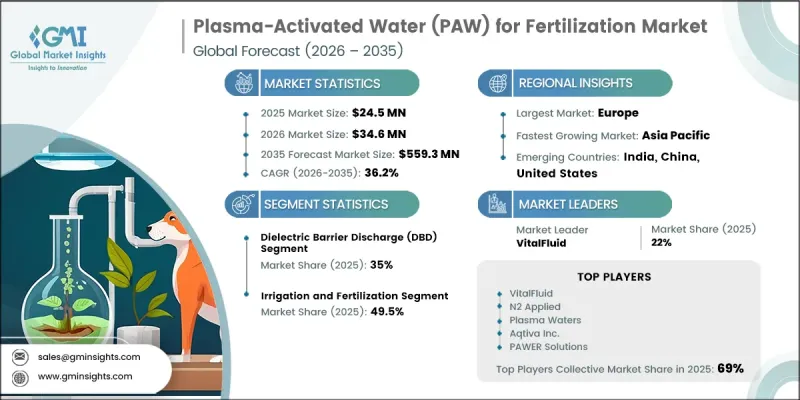
隨著農業日益向低碳、資源高效和精準的養分輸送系統轉型,等離子體活化水肥市場正在迅速擴張。這項技術之所以備受關注,是因為它利用常壓下的非熱電漿反應生成植物可吸收的氮化合物,例如硝酸鹽(NO₂)和亞硝酸鹽(NO₂),從而減少對傳統氮肥生產方式的依賴。這種轉變符合農業投入品更廣泛的脫碳目標,並支持永續性農業實踐。溫室、水耕和垂直農業系統等可控環境農業的日益普及,進一步加速了對精準施肥解決方案的需求,以確保養分輸送的穩定性並提高資源利用效率。對可追溯且無殘留的農業原料日益成長的需求,也推動了等離子體活化水肥系統的應用,尤其是在高價值作物的生產中。同時,對水資源短缺、土壤劣化和化肥價格波動的日益關注,也促使生產者探索替代的養分生產方法。等離子發生系統的技術進步及其與現代灌溉基礎設施的融合有望進一步加速全球農業應用市場的擴張。
| 市場範圍 | |
|---|---|
| 開始年份 | 2025 |
| 預測期 | 2026-2035 |
| 起始金額 | 2450萬美元 |
| 預測金額 | 5.593億美元 |
| 複合年成長率 | 36.2% |
到2025年,介質阻擋放電(DBD)系統市佔率將達到35%,並持續保持在該技術領域最大細分市場的地位。該細分市場的主導地位得益於其穩定的運作、高度擴充性的系統設計以及在農業應用領域的廣泛成功案例。基於DBD的等離子體系統透過電極間的介質層產生非熱放電,高效地產生高活性氮和氧物種。這些物種溶解在水中形成營養液,可被植物吸收。其久經考驗的可靠性和對各種農業環境的適應性,持續鞏固該細分市場的主導地位。
預計到2025年,灌溉和施肥領域將佔據49.5%的市場佔有率。這一主導地位源於等離子體活化水與現有灌溉系統的無縫整合,使生產者能夠在不顯著改變農業實踐的情況下增強或取代傳統的氮肥施用。由於其與滴灌、噴灌和循環施肥系統的兼容性,該技術已在可控和露天環境下廣泛應用,這也是市場需求的主要驅動力。
預計到2025年,北美等離子活化水肥市場將佔據35%的佔有率,這主要得益於加拿大安大略省和不列顛哥倫比亞省等地區溫室園藝產業的擴張。美國市場也在不斷發展,一方面得益於以永續作物生產為重點的研究主導舉措,另一方面得益於高價值農業領域的商業性化應用,在這些領域,精準施肥和無殘留種植的重要性日益凸顯。對先進農業技術和可控環境農業的持續投資也將繼續推動該地區市場的成長。
目錄
第1章:調查方法和範圍
第2章執行摘要
第3章 行業洞察
- 產業生態系分析
- 供應商情況
- 利潤率
- 每個階段增加的價值
- 影響價值鏈的因素
- 中斷
- 影響產業的因素
- 成長促進因素
- 產業潛在風險與挑戰
- 市場機遇
- 成長潛力分析
- 監理情勢
- 波特的分析
- PESTLE分析
- 價格趨勢
- 按地區
- 按作物類型
- 未來市場趨勢
- 技術與創新展望
- 最新科技趨勢
- 新興技術
- 專利趨勢
- 貿易統計
- 主要進口國
- 主要出口國
- 永續性和環境方面
- 永續計劃
- 減少廢棄物策略
- 生產中的能源效率
- 具有環保意識的舉措
- 考慮碳足跡
第4章 競爭情勢
- 介紹
- 企業市佔率分析
- 按地區
- 北美洲
- 歐洲
- 亞太地區
- 拉丁美洲
- 中東和非洲
- 按地區
- 企業矩陣分析
- 主要市場公司的競爭分析
- 競爭定位矩陣
- 主要進展
- 併購
- 夥伴關係和聯盟
- 新產品發布
- 業務拓展計劃
第5章 市場估算與預測:依等離子體發生技術分類,2022-2035年
- 介質阻擋放電(DBD)
- 冠狀病毒出院
- 常壓電漿噴流(APPJ)
- 微波放電
- 滑弧放電
第6章 市場估計與預測:依應用領域分類,2022-2035年
- 灌溉和施肥
- 種子處理和浸種
- 葉面噴布及植物保護
- 後處理
第7章 市場估計與預測:依最終用戶分類,2022-2035年
- 受控環境農業(CEA)
- 露天耕作
- 有機農場
- 幼苗和園藝
- 研究機構
第8章 市場估算與預測:依作物類型分類,2022-2035年
- 蔬菜
- 穀類和穀類食品
- 水果
- 其他
第9章 市場估計與預測:依地區分類,2022-2035年
- 北美洲
- 美國
- 加拿大
- 歐洲
- 德國
- 英國
- 法國
- 西班牙
- 義大利
- 其他歐洲國家
- 亞太地區
- 中國
- 印度
- 日本
- 澳洲
- 韓國
- 其他亞太國家
- 拉丁美洲
- 巴西
- 墨西哥
- 阿根廷
- 其他拉丁美洲國家
- 中東和非洲
- 沙烏地阿拉伯
- 南非
- UAE
- 其他中東和非洲國家
第10章:公司簡介
- VitalFluid
- N2 Applied
- Plasma Waters
- Aqtiva Inc.
- PAWER Solutions
- HydroPlasma.Tech
- cNTP AgriTech
- Plasma Systems
- Redhill Scientific
- Greenpath Industries
- Global Enviro
- WIADAP Plasma Tech
- US Plasma Engineering
- AJ Plasmatech
- Eddaion
The Global Plasma-Activated Water for Fertilization Market was valued at USD 24.5 million in 2025 and is estimated to grow at a CAGR of 36.2% to reach USD 559.3 million by 2035.
The plasma-activated water for fertilization market is witnessing rapid expansion as agriculture increasingly shifts toward low-carbon, resource-efficient, and precision nutrient delivery systems. The technology is gaining attention because it produces plant-available nitrogen compounds such as nitrate (NO2) and nitrite (NO2) using non-thermal plasma reactions that operate at atmospheric pressure, reducing reliance on conventional nitrogen production methods. This transition aligns with broader decarbonization goals in agricultural inputs and supports sustainability-focused farming practices. Rising adoption of controlled environment agriculture, including greenhouse cultivation, hydroponic production, and vertical farming systems, is further accelerating demand for precision fertilization solutions that ensure consistent nutrient delivery and improved resource efficiency. The growing need for traceable, residue-free agricultural inputs is also reinforcing the adoption of plasma-activated water systems, particularly in high-value crop production. At the same time, increasing concerns related to water scarcity, soil degradation, and fertilizer cost volatility are encouraging growers to explore alternative nutrient generation methods. Technological advancements in plasma generation systems and integration with modern irrigation infrastructure are expected to further strengthen market expansion across global agricultural applications.
| Market Scope | |
|---|---|
| Start Year | 2025 |
| Forecast Year | 2026-2035 |
| Start Value | $24.5 Million |
| Forecast Value | $559.3 Million |
| CAGR | 36.2% |
In 2025, the dielectric barrier discharge (DBD) systems segment accounted for 35% share, holding the largest share among technology categories. This segment leads due to its stable operating performance, scalable system design, and extensive validation in agricultural applications. DBD-based plasma systems generate non-thermal discharge through dielectric layers placed between electrodes, enabling efficient formation of reactive nitrogen and oxygen species that dissolve into water to create plant-available nutrient solutions. Its proven reliability and adaptability across different agricultural setups continue to support its dominant position.
The irrigation and fertilization segment held a 49.5% share in 2025. This dominance is driven by the seamless integration of plasma-activated water into existing irrigation systems, enabling growers to enhance or replace conventional nitrogen inputs without significant changes to agricultural practices. The compatibility with drip, sprinkler, and recirculating fertigation systems supports widespread adoption across controlled and open-field farming environments, making it a key driver of market demand.
North America Plasma-Activated Water for Fertilization Market accounted for 35% share in 2025, supported by Canada's expanding greenhouse horticulture sector in regions such as Ontario and British Columbia. The U.S. market is evolving through both research-led initiatives focused on sustainable crop production and commercial adoption in high-value agricultural segments where precision nutrient delivery and residue-free cultivation are increasingly prioritized. Growing investment in advanced agricultural technologies and controlled environment farming continues to support regional market expansion.
Major companies operating in the global plasma-activated water for fertilization industry include VitalFluid, N2 Applied, Plasma Waters, Aqtiva Inc., PAWER Solutions, HydroPlasma.Tech, cNTP AgriTech, Plasma Systems, Redhill Scientific, Greenpath Industries, Global Enviro, WIADAP Plasma Tech, US Plasma Engineering, AJ Plasmatech, and Eddaion. Companies operating in the plasma-activated water for fertilization market are strengthening their competitive position through continuous investment in plasma generation technology, system efficiency improvements, and integration with advanced irrigation infrastructure. Market participants are focusing on enhancing energy efficiency, scalability, and operational reliability to support broader adoption across commercial agriculture. Strategic collaborations with research institutions and agricultural technology providers enable faster validation and commercialization of new applications. Businesses are also expanding pilot projects and demonstration farms to increase awareness and build grower confidence in plasma-based fertilization systems.
Table of Contents
Chapter 1 Methodology & Scope
- 1.1 Market scope and definition
- 1.2 Research design
- 1.2.1 Research approach
- 1.2.2 Data collection methods
- 1.3 Data mining sources
- 1.3.1 Global
- 1.3.2 Regional/Country
- 1.4 Base estimates and calculations
- 1.4.1 Base year calculation
- 1.4.2 Key trends for market estimation
- 1.5 Primary research and validation
- 1.5.1 Primary sources
- 1.6 Forecast model
- 1.7 Research assumptions and limitations
Chapter 2 Executive Summary
- 2.1 Industry 360° synopsis
- 2.2 Key market trends
- 2.2.1 Regional
- 2.2.2 Plasma Generation Technology
- 2.2.3 Application
- 2.2.4 End-User
- 2.2.5 Crop Type
- 2.3 TAM Analysis, 2026-2035
- 2.4 CXO perspectives: Strategic imperatives
- 2.4.1 Executive decision points
Chapter 3 Industry Insights
- 3.1 Industry ecosystem analysis
- 3.1.1 Supplier landscape
- 3.1.2 Profit margin
- 3.1.3 Value addition at each stage
- 3.1.4 Factor affecting the value chain
- 3.1.5 Disruptions
- 3.2 Industry impact forces
- 3.2.1 Growth drivers
- 3.2.2 Industry pitfalls and challenges
- 3.2.3 Market opportunities
- 3.3 Growth potential analysis
- 3.4 Regulatory landscape
- 3.4.1 North America
- 3.4.2 Europe
- 3.4.3 Asia Pacific
- 3.4.4 Latin America
- 3.4.5 Middle East & Africa
- 3.5 Porter's analysis
- 3.6 PESTEL analysis
- 3.7 Price trends
- 3.7.1 By region
- 3.7.2 By crop type
- 3.8 Future market trends
- 3.9 Technology and Innovation landscape
- 3.9.1 Current technological trends
- 3.9.2 Emerging technologies
- 3.10 Patent Landscape
- 3.11 Trade statistics (HS code)
- 3.11.1 Major importing countries
- 3.11.2 Major exporting countries
- 3.12 Sustainability and environmental aspects
- 3.12.1 Sustainable practices
- 3.12.2 Waste reduction strategies
- 3.12.3 Energy efficiency in production
- 3.12.4 Eco-friendly initiatives
- 3.13 Carbon footprint consideration
Chapter 4 Competitive Landscape, 2025
- 4.1 Introduction
- 4.2 Company market share analysis
- 4.2.1 By region
- 4.2.1.1 North America
- 4.2.1.2 Europe
- 4.2.1.3 Asia Pacific
- 4.2.1.4 LATAM
- 4.2.1.5 MEA
- 4.2.1 By region
- 4.3 Company matrix analysis
- 4.4 Competitive analysis of major market players
- 4.5 Competitive positioning matrix
- 4.6 Key developments
- 4.6.1 Mergers & acquisitions
- 4.6.2 Partnerships & collaborations
- 4.6.3 New Product Launches
- 4.6.4 Expansion Plans
Chapter 5 Market Estimates and Forecast, By Plasma Generation Technology, 2022-2035 (USD Million)
- 5.1 Key trends
- 5.2 Dielectric Barrier Discharge (DBD)
- 5.3 Corona Discharge
- 5.4 Atmospheric Pressure Plasma Jets (APPJ)
- 5.5 Microwave Discharge
- 5.6 Gliding Arc Discharge
Chapter 6 Market Estimates and Forecast, By Application, 2022-2035 (USD Million)
- 6.1 Key trends
- 6.2 Irrigation & Fertilization
- 6.3 Seed Treatment & Priming
- 6.4 Foliar Application & Plant Protection
- 6.5 Post-Harvest Treatment
Chapter 7 Market Estimates and Forecast, By End-User, 2022-2035 (USD Million)
- 7.1 Key trends
- 7.2 Controlled Environment Agriculture (CEA)
- 7.3 Open-Field Agriculture
- 7.4 Organic Farms
- 7.5 Nurseries & Horticulture
- 7.6 Research Institutions
Chapter 8 Market Estimates and Forecast, By Crop Type, 2022-2035 (USD Million)
- 8.1 Key trends
- 8.2 Vegetables
- 8.3 Cereals & Grains
- 8.4 Fruits
- 8.5 Others
Chapter 9 Market Estimates and Forecast, By Region, 2022-2035 (USD Million)
- 9.1 Key trends
- 9.2 North America
- 9.2.1 U.S.
- 9.2.2 Canada
- 9.3 Europe
- 9.3.1 Germany
- 9.3.2 UK
- 9.3.3 France
- 9.3.4 Spain
- 9.3.5 Italy
- 9.3.6 Rest of Europe
- 9.4 Asia Pacific
- 9.4.1 China
- 9.4.2 India
- 9.4.3 Japan
- 9.4.4 Australia
- 9.4.5 South Korea
- 9.4.6 Rest of Asia Pacific
- 9.5 Latin America
- 9.5.1 Brazil
- 9.5.2 Mexico
- 9.5.3 Argentina
- 9.5.4 Rest of Latin America
- 9.6 Middle East and Africa
- 9.6.1 Saudi Arabia
- 9.6.2 South Africa
- 9.6.3 UAE
- 9.6.4 Rest of Middle East and Africa
Chapter 10 Company Profiles
- 10.1 VitalFluid
- 10.2 N2 Applied
- 10.3 Plasma Waters
- 10.4 Aqtiva Inc.
- 10.5 PAWER Solutions
- 10.6 HydroPlasma.Tech
- 10.7 cNTP AgriTech
- 10.8 Plasma Systems
- 10.9 Redhill Scientific
- 10.10 Greenpath Industries
- 10.11 Global Enviro
- 10.12 WIADAP Plasma Tech
- 10.13 US Plasma Engineering
- 10.14 AJ Plasmatech
- 10.15 Eddaion

 室內垂直園藝市場預測至2034年—全球產品類型、組件、植物類型、技術、分銷管道、最終用戶和區域分析
 2026-2030年全球垂直農業技術市場2034年家庭室內垂直花園市場預測-全球產品類型、組件、植物類型、技術、通路、最終用戶和區域分析
 3D X光成像系統市場規模、佔有率和成長分析:按系統配置、技術類型、成像方式、應用、最終用戶和地區分類-2026-2033年產業預測
 2026 年至 2035 年再生農業技術的市場機會、成長要素、產業趨勢與預測。
 2026年全球水耕營養液膜技術(NFT)系統市場報告垂直農業技術市場預測至2034年—按組件、作物類型、結構、技術、應用和區域分類的全球分析2026年全球垂直農業技術市場報告2026年全球物聯網(IoT)灌溉閥門市場報告
 非微生物生物促效劑市場:依產品類型、原料、作物類型、形態、應用方法、最終用戶、通路分類,全球預測(2026-2032年)