


 |
市場調查報告書
商品編碼
2083293
遠距放射學市場商機、成長要素、產業趨勢分析及2026-2035年預測Teleradiology Market Opportunity, Growth Drivers, Industry Trend Analysis, and Forecast 2026 - 2035 |
||||||

全球遠距放射診斷市場預計到 2025 年將價值 169 億美元,預計到 2035 年將達到 1,085 億美元,年複合成長率為 20.6%。
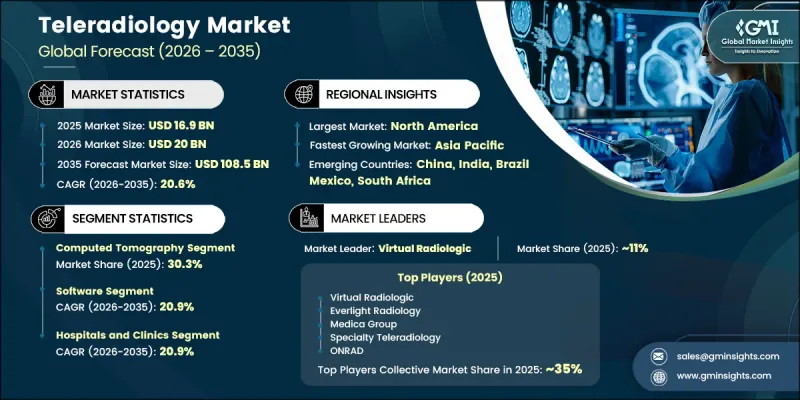
由於對更快速診斷服務的需求日益成長、醫學影像檢查需求不斷增加,以及醫療系統放射科醫生資源持續短缺,遠距放射學市場正在迅速擴張。遠距放射診斷已成為一項關鍵的醫療技術解決方案,它能夠安全地以數位方式交換醫學影像,供合格的專業人員進行遠端分析、諮詢和報告。這項技術正在改變放射科的運作方式,提高了專家解讀的可近性,提升了報告效率,並支持了持續診斷。隨著醫療機構應對不斷成長的患者數量和日益複雜的診斷需求,遠距放射學解決方案在最佳化臨床工作流程方面發揮越來越重要的作用。慢性病盛行率的上升進一步推動了市場發展,增加了對定期影像評估和監測的需求。醫療機構正在部署遠距放射學平台,以最佳化資源利用、減少診斷延誤並維持患者照護的一致性。數位醫療基礎設施、雲端技術的進步以及人工智慧 (AI) 的整合也在推動遠距放射診斷的應用,使其成為現代醫療服務體系的關鍵組成部分。
| 市場範圍 | |
|---|---|
| 開始年份 | 2025 |
| 預測期 | 2026-2035 |
| 上市時的市場規模 | 169億美元 |
| 預測金額 | 1085億美元 |
| 複合年成長率 | 20.6% |
預計到2025年,電腦斷層掃描(CT)市佔率將達到30.3%,並在2035年之前以21%的複合年成長率成長。這一細分市場的成長主要得益於關鍵診斷應用中對CT影像的日益依賴,在這些應用中,快速影像診斷至關重要。遠距放射學服務使醫療機構能夠利用遠距放射科醫生的專業知識,減少觀察結果的延遲,從而提高CT影像操作的效率。 CT技術的不斷進步,包括影像品質的提高、掃描處理速度的加快以及診斷效率的提升,進一步推動了遠端解讀服務的應用。隨著醫療系統不斷應對海量的診斷影像需求,基於CT的遠距放射學解決方案對於提高工作流程效率和獲取診斷結果變得越來越重要。
預計2026年至2035年間,軟體產業將以20.9%的複合年成長率成長。軟體解決方案透過支援影像管理、安全資料交換、工作流程協調和診斷報告流程,構成了遠端放射學基礎設施的基礎。先進影像診斷平台、整合放射學管理系統、雲端解決方案和人工智慧(AI)驅動的工作流程的日益普及,正在推動該行業的成長。醫療服務供應商正在加速數位化軟體環境轉型,以提升擴充性、可近性和營運效率。雲端架構的擴展進一步促進了市場發展,實現了醫療機構與遠距放射科醫師之間的無縫協作,從而改善了整體診斷工作流程管理。
預計到2025年,北美遠距遠距放射診斷市場佔有率將達到44.3%。該地區受益於先進的醫療基礎設施、數位成像技術的廣泛應用以及電子醫療系統的穩健實施。對持續放射診斷服務的需求不斷成長、診斷影像檢查數量的增加以及合格放射科醫生的長期短缺,正推動醫療機構採用遠端影像判讀解決方案。遠距遠端醫療的持續普及和人工智慧(AI)診斷技術的日益融合,進一步提升了全部區域遠距放射診斷服務的效率和擴充性。這些因素將持續鞏固北美在全球遠距放射診斷產業的主導地位。
目錄
第1章:調查方法和範圍
第2章執行摘要
第3章 行業洞察
- 產業生態系分析
- 影響產業的因素
- 促進因素
- 對診斷放射學服務的需求增加
- 遠端醫療正變得越來越普及。
- 影像技術的進步
- 基於雲端的遠端放射診斷平台的擴展
- 產業潛在風險與挑戰
- 資料安全和隱私問題
- 監管和法律挑戰
- 市場機遇
- 人工智慧整合的遠距放射學工作流程
- 進入放射診斷基礎設施有限的新興市場。
- 促進因素
- 成長潛力分析
- 技術與創新展望
- 監理情勢
- 未來趨勢
- 人工智慧和新一代人工智慧對市場的影響
- 價格分析
- 波特的分析
- PESTLE分析
第4章 競爭情勢
- 介紹
- 企業市佔率分析
- 企業矩陣分析
- 主要市場公司的競爭分析
- 競爭定位矩陣
- 主要進展
- 併購
- 夥伴關係和聯盟
- 新產品發布
- 業務拓展計劃
第5章 市場估算與預測:依醫療影像技術分類,2022-2035年
- X光
- 電腦斷層掃描
- 磁振造影
- 超音波
- 核醫學影像
- 乳房X光檢查
第6章 市場估計與預測:依技術分類,2022-2035年
- 基於雲端的遠端放射診斷
- 現場遠端放射診斷
第7章 市場估計與預測:依組件分類,2022-2035年
- 軟體
- 服務
第8章 市場估計與預測:依應用領域分類,2022-2035年
- 循環系統
- 神經病學
- 整形外科
- 腫瘤學
- 胃腸病學
- 其他用途
第9章 市場估計與預測:依最終用途分類,2022-2035年
- 醫院和診所
- 診斷影像中心
- 門診手術中心
- 其他最終用戶
第10章 市場估價與預測:依地區分類,2022-2035年
- 北美洲
- 美國
- 加拿大
- 歐洲
- 德國
- 英國
- 法國
- 西班牙
- 義大利
- 荷蘭
- 亞太地區
- 日本
- 中國
- 印度
- 澳洲
- 韓國
- 拉丁美洲
- 巴西
- 墨西哥
- 阿根廷
- 中東和非洲
- 南非
- 沙烏地阿拉伯
- UAE
第11章:公司簡介
- Aster Medical Imaging
- CompuMed
- Dicom Systems
- Everlight Radiology
- Experity
- GE HealthCare Technologies
- imeXHS
- Koninklijke Philips
- Medica Group
- ONRAD
- Radiology partners
- Siemens Healthineers
- Specialty Teleradiology
- Vesta Teleradiology
- Virtual Radiologic
- Vision XRay Group
The Global Teleradiology Market was valued at USD 16.9 billion in 2025 and is estimated to grow at a CAGR of 20.6% to reach USD 108.5 billion by 2035.
The market is experiencing rapid expansion due to the rising need for faster diagnostic services, increasing demand for medical imaging procedures, and ongoing challenges related to radiologist availability across healthcare systems. Teleradiology has emerged as an important healthcare technology solution by enabling the secure digital exchange of medical images for remote analysis, consultation, and reporting by qualified specialists. The technology is transforming radiology operations by improving accessibility to expert interpretation, enhancing reporting efficiency, and supporting continuous diagnostic coverage. As healthcare providers manage increasing patient volumes and more complex diagnostic requirements, remote imaging solutions are becoming increasingly valuable for optimizing clinical workflows. The growing prevalence of chronic health conditions is further contributing to market development by increasing the need for regular imaging-based evaluation and monitoring. Healthcare organizations are adopting teleradiology platforms to improve resource utilization, reduce diagnostic delays, and maintain consistent patient care. Advancements in digital healthcare infrastructure, cloud-based technologies, and artificial intelligence integration are also strengthening adoption, positioning teleradiology as a key component of modern healthcare delivery systems.
| Market Scope | |
|---|---|
| Start Year | 2025 |
| Forecast Year | 2026-2035 |
| Start Value | $16.9 Billion |
| Forecast Value | $108.5 Billion |
| CAGR | 20.6% |
The computed tomography segment accounted for 30.3% share in 2025, and is expected to grow at a CAGR of 21% through 2035. The segment's growth is supported by the increasing reliance on CT imaging for critical diagnostic applications where timely interpretation is essential. Teleradiology services allow healthcare facilities to improve the efficiency of CT imaging operations by providing access to remote radiology expertise and reducing reporting delays. The continued advancement of CT technologies, including improved image quality, faster scanning processes, and enhanced imaging efficiency, is further encouraging the adoption of remote interpretation services. As healthcare systems continue to manage growing imaging volumes, CT-based teleradiology solutions are becoming increasingly important for improving workflow performance and diagnostic accessibility.
The software segment is projected to grow at a CAGR of 20.9% between 2026 and 2035. Software solutions represent a fundamental part of the teleradiology infrastructure by supporting image management, secure data exchange, workflow coordination, and diagnostic reporting processes. Increasing adoption of advanced imaging platforms, integrated radiology management systems, cloud-based solutions, and artificial intelligence-supported workflows is contributing to segment growth. Healthcare providers are increasingly shifting toward digital software environments that improve scalability, accessibility, and operational efficiency. The expansion of cloud-based architectures is further supporting market development by enabling seamless collaboration between healthcare facilities and remote radiology professionals while improving overall diagnostic workflow management.
North America Teleradiology Market held a 44.3% share in 2025. The region benefits from advanced healthcare infrastructure, widespread adoption of digital imaging technologies, and strong implementation of electronic healthcare systems. Rising demand for continuous radiology services, increasing diagnostic imaging volumes, and ongoing shortages of qualified radiology professionals are encouraging healthcare providers to implement remote interpretation solutions. The continued growth of telehealth adoption and the increasing integration of artificial intelligence-based diagnostic technologies are further improving the efficiency and scalability of teleradiology services across the region. These factors continue to support North America's leading position within the global teleradiology industry.
Major companies operating in the global teleradiology market include Siemens Healthineers, GE HealthCare, Koninklijke Philips, Radiology Partners, Virtual Radiologic, ONRAD, Medica Group, Dicom Systems, Aster Medical Imaging, Specialty Teleradiology, Everlight Radiology, Vesta Teleradiology, CompuMed, Experity, imeXHS, and Vision XRay Group. Companies operating in the teleradiology market are adopting multiple strategies to strengthen their market position and expand their global presence. Key players are focusing on technology innovation by developing advanced imaging platforms, artificial intelligence-enabled diagnostic tools, and cloud-based solutions that improve reporting efficiency. Strategic collaborations with healthcare providers and technology companies are helping organizations enhance service capabilities and expand their customer base. Companies are also investing in scalable digital infrastructure to support remote diagnostics and improve accessibility across healthcare networks. Expansion into emerging markets, enhancement of cybersecurity capabilities, and development of integrated healthcare solutions are additional focus areas.
Table of Contents
Chapter 1 Methodology & Scope
- 1.1 Market scope and definition
- 1.2 Research approach
- 1.3 Quality commitments
- 1.3.1 GMI AI policy and data integrity commitment
- 1.3.1.1 Source consistency protocol
- 1.3.1 GMI AI policy and data integrity commitment
- 1.4 Research trail and confidence scoring
- 1.4.1 Research trail components
- 1.4.2 Scoring components
- 1.5 Data collection
- 1.5.1 Partial list of primary sources
- 1.6 Data mining sources
- 1.6.1 Paid sources
- 1.6.1.1 Sources, by region
- 1.6.1 Paid sources
- 1.7 Base estimates and calculations
- 1.7.1 Revenue share analysis
- 1.7.2 Base year calculation
- 1.8 Forecast model
- 1.9 Research transparency addendum
- 1.9.1 Source attribution framework
- 1.9.2 Quality assurance metrics
- 1.9.3 Our commitment to trust
Chapter 2 Executive Summary
- 2.1 Industry 360° synopsis
- 2.2 Key market trends
- 2.2.1 Regional trends
- 2.2.2 Imaging technique trends
- 2.2.3 Technology trends
- 2.2.4 Component trends
- 2.2.5 Application trends
- 2.2.6 End use trends
- 2.3 CXO perspectives: Strategic imperatives
Chapter 3 Industry Insights
- 3.1 Industry ecosystem analysis
- 3.2 Industry impact forces
- 3.2.1 Growth drivers
- 3.2.1.1 Increasing demand for radiology services
- 3.2.1.2 Growing adoption of telemedicine
- 3.2.1.3 Advancement in imaging technologies
- 3.2.1.4 Increasing adoption of cloud-based teleradiology platforms
- 3.2.2 Industry pitfalls & challenges
- 3.2.2.1 Data security and privacy concerns
- 3.2.2.2 Regulatory and legal issues
- 3.2.3 Market opportunities
- 3.2.3.1 AI integrated teleradiology workflows
- 3.2.3.2 Expansion into emerging markets with limited radiology infrastructure
- 3.2.1 Growth drivers
- 3.3 Growth potential analysis
- 3.4 Technology and innovation landscape
- 3.5 Regulatory landscape
- 3.5.1 North America
- 3.5.2 Europe
- 3.5.3 Asia Pacific
- 3.5.4 Latin America
- 3.5.5 MEA
- 3.6 Future trends
- 3.7 Impact of AI and Generation AI on the market
- 3.8 Pricing analysis
- 3.9 Porter's analysis
- 3.10 PESTEL analysis
Chapter 4 Competitive Landscape, 2025
- 4.1 Introduction
- 4.2 Company market share analysis
- 4.3 Company matrix analysis
- 4.4 Competitive analysis of major market players
- 4.5 Competitive positioning matrix
- 4.6 Key developments
- 4.6.1 Merger and acquisition
- 4.6.2 Partnership and collaboration
- 4.6.3 New product launches
- 4.6.4 Expansion plans
Chapter 5 Market Estimates and Forecast, By Imaging Technique, 2022 - 2035 ($ Mn)
- 5.1 Key trends
- 5.2 X-ray
- 5.3 Computed tomography
- 5.4 Magnetic resonance imaging
- 5.5 Ultrasound
- 5.6 Nuclear imaging
- 5.7 Mammography
Chapter 6 Market Estimates and Forecast, By Technology, 2022 - 2035 ($ Mn)
- 6.1 Key trends
- 6.2 Cloud-based teleradiology
- 6.3 On-premise teleradiology
Chapter 7 Market Estimates and Forecast, By Component, 2022 - 2035 ($ Mn)
- 7.1 Key trends
- 7.2 Software
- 7.3 Services
Chapter 8 Market Estimates and Forecast, By Application, 2022 - 2035 ($ Mn)
- 8.1 Key trends
- 8.2 Cardiology
- 8.3 Neurology
- 8.4 Orthopedics
- 8.5 Oncology
- 8.6 Gastroenterology
- 8.7 Other applications
Chapter 9 Market Estimates and Forecast, By End Use, 2022 - 2035 ($ Mn)
- 9.1 Key trends
- 9.2 Hospitals and clinics
- 9.3 Diagnostic imaging centers
- 9.4 Ambulatory surgical centers
- 9.5 Other end users
Chapter 10 Market Estimates and Forecast, By Region, 2022 - 2035 ($ Mn)
- 10.1 Key trends
- 10.2 North America
- 10.2.1 U.S.
- 10.2.2 Canada
- 10.3 Europe
- 10.3.1 Germany
- 10.3.2 UK
- 10.3.3 France
- 10.3.4 Spain
- 10.3.5 Italy
- 10.3.6 Netherlands
- 10.4 Asia Pacific
- 10.4.1 Japan
- 10.4.2 China
- 10.4.3 India
- 10.4.4 Australia
- 10.4.5 South Korea
- 10.5 Latin America
- 10.5.1 Brazil
- 10.5.2 Mexico
- 10.5.3 Argentina
- 10.6 Middle East and Africa
- 10.6.1 South Africa
- 10.6.2 Saudi Arabia
- 10.6.3 UAE
Chapter 11 Company Profiles
- 11.1 Aster Medical Imaging
- 11.2 CompuMed
- 11.3 Dicom Systems
- 11.4 Everlight Radiology
- 11.5 Experity
- 11.6 GE HealthCare Technologies
- 11.7 imeXHS
- 11.8 Koninklijke Philips
- 11.9 Medica Group
- 11.10 ONRAD
- 11.11 Radiology partners
- 11.12 Siemens Healthineers
- 11.13 Specialty Teleradiology
- 11.14 Vesta Teleradiology
- 11.15 Virtual Radiologic
- 11.16 Vision XRay Group

 遠距放射學醫療服務市場:依影像方式、最終用戶、經營模式和地區分類-趨勢與預測至2035年
 遠距放射診斷服務市場:2026-2032年全球市場預測(按服務類型、影像模式、部署方式、應用程式和最終用戶分類)遠距放射診斷市場:按模式、組件、部署模式、應用和最終用戶分類的全球市場預測 – 2026-2032 年智慧遠距放射診斷市場:按組件、模式、營運模式、定價模式、最終用戶和病患年齡層分類-2026-2032年全球市場預測
 遠距放射診斷服務市場規模、佔有率和成長分析:按服務類型、影像技術、部署方式、應用、最終用戶、報告準備時間和地區分類-2026-2033年產業預測
 遠距醫療影像市場-市場趨勢、競爭格局及市場預測(2034 年)
 遠距放射診斷市場規模、佔有率和成長分析:按產品類型、報告類型、應用和地區分類-2026-2033年產業預測
 遠距醫療影像市場:按產品、最終用途和地區分類
 遠距放射學市場報告:按組件、成像技術、最終用戶和地區分類(2026-2034 年)
 全球遠距放射學市場規模、佔有率、趨勢和成長分析報告(2026-2034年)