


 |
市場調查報告書
商品編碼
2083286
正面吊運機市場機會、成長促進因素、產業趨勢分析及2026-2035年預測。Reach Stacker Market Opportunity, Growth Drivers, Industry Trend Analysis, and Forecast 2026 - 2035 |
||||||

全球正面吊運機市場預計到 2025 年價值 21 億美元,預計到 2035 年將以 5.5% 的複合年成長率成長至 36 億美元。
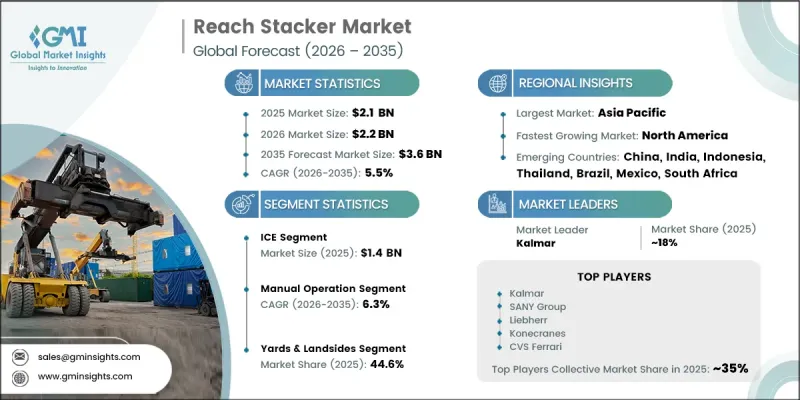
在全球貿易量持續成長的背景下,正面吊運機市場穩定擴張,港口、貨運碼頭和物流樞紐對高效率物料輸送設備的需求持續強勁。國際貿易活動的活性化,得益於經濟整合的不斷深化和跨境貨物運輸的日益頻繁,推動了對先進物料輸送解決方案的投資。此外,多式聯運系統的廣泛應用進一步提升了對能夠在鐵路、公路和海運網路之間無縫銜接貨櫃運輸設備的需求。正面吊運機透過縮短裝卸時間、最佳化堆場作業,在提高貨櫃裝卸效率方面發揮著至關重要的作用。港口擴建、物流基礎設施現代化以及對貨物處理能力的持續投資也促進了市場成長。除了貨櫃貨物量的成長,全球電子商務和供應鏈網路的快速發展也促使物流業者透過採用最新的貨櫃裝卸設備來提升營運效率。這些長期趨勢持續為正面吊運機產業在已開發市場和新興市場創造發展機會。
| 市場範圍 | |
|---|---|
| 開始年份 | 2025 |
| 預測期 | 2026-2035 |
| 起始金額 | 21億美元 |
| 預測金額 | 36億美元 |
| 複合年成長率 | 5.5% |
預計到2025年,內燃機(ICE)設備將佔據66.9%的市場佔有率,銷售額將達到14億美元。內燃機正面正面吊運機將繼續主導市場,其在嚴苛的貨櫃裝卸作業中展現了卓越的性能。憑藉其高承載能力、運作可靠性和完善的售後服務體系,正面吊成為應對複雜物流環境的理想之選。此外,燃料供應充足,即使在長時間運作中也能保證不間斷運行,這使得這些設備非常適合高強度貨櫃裝卸作業。
預計到2025年,手動操作型堆疊機將佔據63.3%的市場佔有率,並在2035年之前以6.3%的複合年成長率成長。該細分市場之所以能保持主導地位,是因為其卓越的操作性,能夠為操作員提供精準的貨櫃放置和搬運。與自動化堆高機相比,手動正面吊運機的初始投資成本更低,同時還具有高度的操作柔軟性,可以適應各種尺寸的貨櫃和裝載要求。由於其高度的適應性,手動堆高機仍然是眾多物流和貨物裝卸設施的首選解決方案。
中國正面吊運機市佔率佔全球38.8%,預估至2025年市場規模將達3億美元,2026年至2035年的複合年成長率(CAGR)為5.7%。推動該地區市場成長的主要因素包括港口基礎設施的擴建、貨櫃貨運量的成長以及先進物料輸送設備的日益普及。物流現代化、新建貨運碼頭以及對交通基礎設施的持續投資正在推動全部區域對正面吊運機的需求。政府主導的基礎建設舉措以及貨物裝卸能力的不斷提升,也進一步支撐了市場的長期擴張。
目錄
第1章:調查方法和範圍
第2章執行摘要
第3章 行業洞察
- 產業生態系分析
- 供應商情況
- 利潤率
- 每個階段增加的價值
- 影響價值鏈的因素
- 影響產業的因素
- 成長促進因素
- 產業潛在風險與挑戰
- 機會
- 成長潛力分析
- 價格波動和市場不可預測性
- 對品質保證和設備可靠性的擔憂
- 未來市場趨勢
- 技術與創新展望
- 最新科技趨勢
- 新興技術
- 價格分析
- 對過去價格趨勢的分析
- 依球員類型分類的定價策略(高級球員、超值球員、成本加成球員)
- 按產品類型和銷售量分類的平均售價
- 監理情勢
- 標準和合規要求
- 區域監理框架
- 認證標準
- 波特的分析
- PESTLE分析
- 貿易數據分析
- 進出口量及進口額趨勢
- 主要貿易路線及關稅影響(中國、歐盟、北美)
- 人工智慧和生成式人工智慧對正面吊運機市場的影響
- 利用人工智慧改造現有經營模式(預測性維護、車輛部署最佳化)
- 按細分市場分類的人工智慧產生用例和實施藍圖(自動駕駛、遠距離診斷)
- 風險、限制和監管考量
- 生產能力和生產情況
- 安裝和製造能力:按地區和主要生產商分類
- 運轉率和擴張計劃
第4章 競爭情勢
- 介紹
- 企業市佔率分析
- 按地區
- 企業矩陣分析
- 主要市場公司的競爭分析
- 競爭定位矩陣
- 主要進展
- 併購
- 夥伴關係和聯盟
- 新產品發布
- 業務拓展計劃
第5章 市場估計與預測:依促進因素分類,2022-2035年
- ICE
- 電的
- 混合
第6章 市場估計與預測:依營運區分,2022-2035年
- 手動的
- 半自動
- 自動的
第7章 市場估計與預測:依產能分類,2022-2035年
- 不到30噸
- 30-45噸
- 超過45噸
第8章 市場估計與預測:依應用領域分類,2022-2035年
- 海港和碼頭
- 院子/土地側
- 產業
第9章 市場估價與預測:依銷售管道分類,2022-2035年
- 直銷
- 間接銷售
第10章 市場估價與預測:依地區分類,2022-2035年
- 北美洲
- 美國
- 加拿大
- 歐洲
- 德國
- 英國
- 法國
- 義大利
- 西班牙
- 亞太地區
- 中國
- 日本
- 印度
- 澳洲
- 韓國
- 拉丁美洲
- 巴西
- 墨西哥
- 阿根廷
- 中東和非洲
- 南非
- 沙烏地阿拉伯
- UAE
第11章:公司簡介
- 全球主要公司
- Kalmar
- SANY Group
- Liebherr
- Konecranes
- CVS Ferrari
- Hyster-Yale Group
- XCMG
- 本地公司
- Taylor Machine Works
- Hoist Liftruck
- Svetruck
- Liftking Industries
- ZPMC(Shanghai Zhenhua Heavy Industries)
- Anhui Heli
- Hangcha Group
- Dalian Forklift(DALIFT)
- 新興企業
- Zoomlion Heavy Industry
- HD Hyundai Construction Equipment
- ACE(Action Construction Equipment)
- Bulmor Industries
- Rainbow Heavy Industries
- Combilift
The Global Reach Stacker Market was valued at USD 2.1 billion in 2025 and is estimated to grow at a CAGR of 5.5% to reach USD 3.6 billion by 2035.
The reach stacker market is expanding steadily as global trade volumes continue to increase, creating sustained demand for efficient cargo handling equipment across ports, freight terminals, and logistics hubs. Rising international trade activities, supported by ongoing economic integration and greater movement of goods across borders, are encouraging investments in advanced material handling solutions. The growing adoption of intermodal transportation systems has further strengthened the need for equipment capable of moving containers seamlessly between rail, road, and maritime networks. Reach stackers play a vital role in improving container handling efficiency by reducing loading and unloading times while optimizing storage yard operations. Continued investments in port expansion, logistics infrastructure modernization, and cargo handling capacity are also contributing to market growth. Increasing containerized freight movements, combined with the rapid expansion of global e-commerce and supply chain networks, are encouraging logistics operators to enhance operational productivity through modern container handling equipment. These long-term developments continue to create favorable opportunities for the reach stacker industry across both developed and emerging economies.
| Market Scope | |
|---|---|
| Start Year | 2025 |
| Forecast Year | 2026-2035 |
| Start Value | $2.1 Billion |
| Forecast Value | $3.6 Billion |
| CAGR | 5.5% |
The internal combustion engine (ICE) segment accounted for 66.9% share in 2025, generating USD 1.4 billion. ICE-powered reach stackers continue to dominate the market because of their proven performance in heavy-duty container handling applications. Their high lifting capacity, operational reliability, and well-established service infrastructure make them the preferred choice for demanding logistics environments. In addition, widespread fuel availability enables uninterrupted operation during extended working hours, making these machines highly suitable for intensive container handling activities.
The manual operation segment held 63.3% share in 2025 and is projected to grow at a CAGR of 6.3% through 2035. This segment maintains its leadership due to the superior control it provides operators during precise container placement and handling tasks. Manual reach stackers also offer greater operational flexibility across different container sizes and stacking requirements while maintaining lower upfront investment costs than automated alternatives. Their adaptability continues to make them the preferred solution across a broad range of logistics and cargo handling facilities.
China Reach Stacker Market accounted for 38.8% share, generating USD 300 million in 2025 and is forecast to grow at a CAGR of 5.7% between 2026 and 2035. Regional market growth is supported by expanding port infrastructure, increasing containerized cargo volumes, and greater adoption of advanced material handling equipment. Continuous investments in logistics modernization, new cargo terminals, and transportation infrastructure are strengthening demand for reach stackers across the region. Government-backed infrastructure development initiatives and ongoing improvements in freight handling capabilities are further supporting long-term market expansion.
Major companies operating in the global reach stacker market include Kalmar, Konecranes, Liebherr, SANY Group, XCMG, Zoomlion Heavy Industry, HD Hyundai Construction Equipment, Hyster-Yale Group, Hangcha Group, Anhui Heli, ACE (Action Construction Equipment), Combilift, CVS Ferrari, Bulmor Industries, Hoist Liftruck, Liftking Industries, Rainbow Heavy Industries, Svetruck, Taylor Machine Works, Dalian Forklift (DALIFT), and ZPMC (Shanghai Zhenhua Heavy Industries). Companies operating in the reach stacker market are strengthening their market position by investing in product innovation, fuel-efficient powertrains, and advanced automation technologies. Manufacturers are expanding their portfolios with higher-capacity equipment, intelligent fleet management systems, and enhanced operator safety features to meet evolving customer requirements. Many companies are also focusing on telematics integration, predictive maintenance capabilities, and digital monitoring solutions to improve equipment uptime and operational efficiency. Strategic collaborations with logistics providers, port operators, and equipment distributors are helping expand regional presence and customer reach.
Table of Contents
Chapter 1 Methodology and Scope
- 1.1 Market scope and definition
- 1.2 Research design
- 1.2.1 Research approach
- 1.2.2 Data collection methods
- 1.3 Data mining sources
- 1.3.1 Global
- 1.3.2 Regional/Country
- 1.4 Base estimates and calculations
- 1.4.1 Base year calculation
- 1.4.2 Key trends for market estimation
- 1.5 Primary research and validation
- 1.5.1 Primary sources
- 1.6 Forecast model
- 1.7 Research assumptions and limitations
Chapter 2 Executive Summary
- 2.1 Industry 360° synopsis
- 2.2 Key market trends
- 2.2.1 Regional
- 2.2.2 Propulsion
- 2.2.3 Operation
- 2.2.4 Capacity
- 2.2.5 Application
- 2.2.6 Sales Channel
Chapter 3 Industry Insights
- 3.1 Industry ecosystem analysis
- 3.1.1 Supplier landscape
- 3.1.2 Profit margin
- 3.1.3 Value addition at each stage
- 3.1.4 Factor affecting the value chain
- 3.2 Industry impact forces
- 3.2.1 Growth drivers
- 3.2.2 Industry pitfalls & challenges
- 3.2.3 Opportunities
- 3.3 Growth potential analysis
- 3.3.1 Price volatility and market unpredictability
- 3.3.2 Quality assurance and equipment reliability concerns
- 3.4 Future market trends
- 3.5 Technology and innovation landscape
- 3.5.1 Current technological trends
- 3.5.2 Emerging technologies
- 3.6 Pricing Analysis (Driven by Primary Research)
- 3.6.1 Historical Price Trend Analysis (Driven by Primary Research)
- 3.6.2 Pricing Strategy by Player Type (Premium/Value/Cost-plus) (Driven by Primary Research)
- 3.6.3 Average Selling Price by Product Type & Capacity
- 3.7 Regulatory landscape
- 3.7.1 Standards and compliance requirements
- 3.7.2 Regional regulatory frameworks
- 3.7.3 Certification standards
- 3.8 Porter's analysis
- 3.9 PESTEL analysis
- 3.10 Trade Data Analysis (Driven by Primary Research)
- 3.10.1 Import/Export Volume & Value Trends (HS Code 8428) (Driven by Primary Research)
- 3.10.2 Key Trade Corridors & Tariff Impact (China, EU, North America) (Driven by Primary Research)
- 3.11 Impact of AI & Generative AI on the Reach Stacker Market
- 3.11.1 AI-Driven Disruption of Existing Business Models (Predictive Maintenance, Fleet Optimization)
- 3.11.2 GenAI Use Cases & Adoption Roadmap by Segment (Autonomous Operations, Remote Diagnostics)
- 3.11.3 Risks, Limitations & Regulatory Considerations
- 3.12 Capacity & Production Landscape (Driven by Primary Research)
- 3.12.1 Installed Manufacturing Capacity by Region & Key Producer (Driven by Primary Research)
- 3.12.2 Capacity Utilization Rates & Expansion Pipelines (Driven by Primary Research)
Chapter 4 Competitive Landscape, 2025
- 4.1 Introduction
- 4.2 Company market share analysis
- 4.2.1 By region
- 4.2.1.1 North America
- 4.2.1.2 Europe
- 4.2.1.3 Asia Pacific
- 4.2.1.4 Latin America
- 4.2.1.5 Middle East and Africa
- 4.2.1 By region
- 4.3 Company matrix analysis
- 4.4 Competitive analysis of major market players
- 4.5 Competitive positioning matrix
- 4.6 Key developments
- 4.6.1 Mergers & acquisitions
- 4.6.2 Partnerships & collaborations
- 4.6.3 New product launches
- 4.6.4 Expansion plans
Chapter 5 Market Estimates & Forecast, By Propulsion, 2022 - 2035, (USD Billion) (Thousand Units)
- 5.1 Key trends
- 5.2 ICE
- 5.3 Electric
- 5.4 Hybrid
Chapter 6 Market Estimates & Forecast, By Operation, 2022 - 2035, (USD Billion) (Thousand Units)
- 6.1 Key trends
- 6.2 Manual
- 6.3 Semi-automated
- 6.4 Automated
Chapter 7 Market Estimates & Forecast, By Capacity, 2022 - 2035, (USD Billion) (Thousand Units)
- 7.1 Key trends
- 7.2 Below 30 tons
- 7.3 30 to 45 tons
- 7.4 Above 45 tons
Chapter 8 Market Estimates & Forecast, By Application, 2022 - 2035, (USD Billion) (Thousand Units)
- 8.1 Key trends
- 8.2 Seaports & terminals
- 8.3 Yards & landsides
- 8.4 Industrial
Chapter 9 Market Estimates & Forecast, By Sales channel, 2022 - 2035, (USD Billion) (Thousand Units)
- 9.1 Key trends
- 9.2 Direct Sales
- 9.3 Indirect Sales
Chapter 10 Market Estimates and Forecast, By Region, 2022 - 2035 (USD Billion) (Thousand Units)
- 10.1 Key trends
- 10.2 North America
- 10.2.1 U.S.
- 10.2.2 Canada
- 10.3 Europe
- 10.3.1 Germany
- 10.3.2 UK
- 10.3.3 France
- 10.3.4 Italy
- 10.3.5 Spain
- 10.4 Asia Pacific
- 10.4.1 China
- 10.4.2 Japan
- 10.4.3 India
- 10.4.4 Australia
- 10.4.5 South Korea
- 10.5 Latin America
- 10.5.1 Brazil
- 10.5.2 Mexico
- 10.5.3 Argentina
- 10.6 Middle East and Africa
- 10.6.1 South Africa
- 10.6.2 Saudi Arabia
- 10.6.3 UAE
Chapter 11 Company Profiles
- 11.1 Top Global Player
- 11.1.1 Kalmar
- 11.1.2 SANY Group
- 11.1.3 Liebherr
- 11.1.4 Konecranes
- 11.1.5 CVS Ferrari
- 11.1.6 Hyster-Yale Group
- 11.1.7 XCMG
- 11.2 Regional Player
- 11.2.1 Taylor Machine Works
- 11.2.2 Hoist Liftruck
- 11.2.3 Svetruck
- 11.2.4 Liftking Industries
- 11.2.5 ZPMC (Shanghai Zhenhua Heavy Industries)
- 11.2.6 Anhui Heli
- 11.2.7 Hangcha Group
- 11.2.8 Dalian Forklift (DALIFT)
- 11.3 Emerging Players
- 11.3.1 Zoomlion Heavy Industry
- 11.3.2 HD Hyundai Construction Equipment
- 11.3.3 ACE (Action Construction Equipment)
- 11.3.4 Bulmor Industries
- 11.3.5 Rainbow Heavy Industries
- 11.3.6 Combilift

 正面吊運機:市佔率分析、產業趨勢與統計、成長預測(2026-2031)
 正面吊運機市場 - 全球產業規模、佔有率、趨勢、機會、預測:按應用、負載容量、動力傳動系統、地區和競爭格局分類,2021-2031年
 正面吊運機市場規模、佔有率和趨勢分析報告:按負載容量、動力傳動系統、應用、地區和細分市場預測(2026-2033 年)
 正面吊運機市場:按負載能力、驅動系統、銷售收入、應用、最終用戶和地區分類。
 2026年全球正面吊運機市場報告
 2026-2030年全球正面吊運機市場
 全球正面吊運機市場規模、佔有率、趨勢及成長分析報告(2026-2034)