


 |
市場調查報告書
商品編碼
2083268
無導管胰島素幫浦市場商機、成長要素、產業趨勢分析及2026-2035年預測。Tubeless Insulin Pump Market Opportunity, Growth Drivers, Industry Trend Analysis, and Forecast 2026 - 2035 |
||||||

全球無管胰島素幫浦市場預計到 2025 年將達到 22 億美元,並將以 19.1% 的複合年成長率成長,到 2035 年達到 120 億美元。
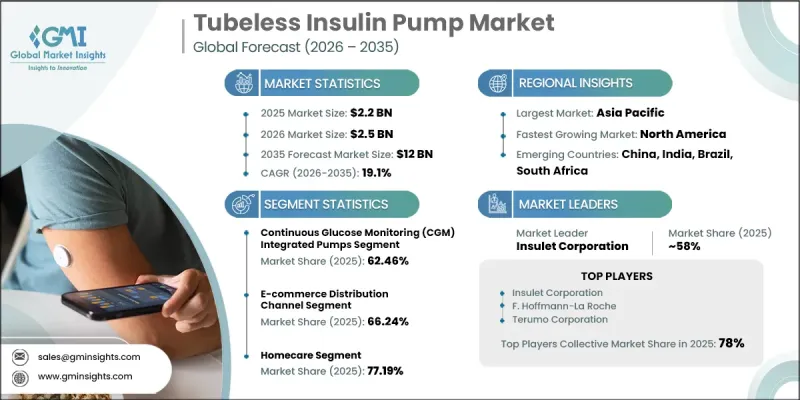
由於醫療專業人員和患者對無導管、穿戴式貼片幫浦系統的大力支持,該市場正在迅速擴張。與傳統的有線胰島素輸注方式相比,此類系統能夠改善血糖控制、提高治療順從性並提升整體生活品質。尤其是在美國和德國等主要醫療體系中,保險覆蓋範圍的擴大,以及整合了持續血糖監測 (CGM) 和無導管胰島素輸注的混合閉合迴路系統的法規核准,顯著降低了此前僅限於病患小組的成本。隨著 CGM 整合、緊湊型貼片幫浦設計以及不斷擴展的數位化糖尿病管理生態系統的融合,無導管胰島素輸注正逐漸成為 1 型和胰島素依賴型 2 型糖尿病患者門診強化胰島素治療的主流臨床標準。全球糖尿病盛行率的不斷上升持續推動著該市場的潛在需求。持續血糖監測與無導管幫浦系統的整合被廣泛認為是現代糖尿病照護領域最具影響力的進步之一,它改變了疾病的長期管理模式,並大規模改善了患者的治療效果。
| 市場範圍 | |
|---|---|
| 開始年份 | 2025 |
| 預測期 | 2026-2035 |
| 初始市場規模 | 22億美元 |
| 預測金額 | 120億美元 |
| 複合年成長率 | 19.1% |
無導管胰島素幫浦市場正受益於自動化胰島素輸注系統和智慧糖尿病管理技術的持續創新。隨著對數據驅動型醫療解決方案的依賴性不斷增強,更精準的胰島素輸注、即時血糖值監測以及用於預防低血糖的預測分析正逐步成為可能。數位健康平台的普及也促進了遠端患者監護和個人化治療方案的調整。這些進步有助於改善臨床療效、減少併發症並提高患者在糖尿病管理方面的自主性。隨著醫療系統持續重視慢性病管理的效率,全球對先進無導管胰島素輸注系統的需求預計將持續成長。
到2025年,整合CGM(持續血糖監測)功能的無導管胰島素幫浦市佔率將達到62.46%,成為領先的技術類別。這一主導地位得益於整合式自動化胰島素輸注系統卓越的臨床性能,該系統將持續血糖監測與即時胰島素劑量調整功能相結合。此外,先進的演算法驅動功能也進一步推動了該細分市場的成長,這些功能提高了治療的精準度,例如預測性血糖控制、基於活動水平的自適應胰島素劑量調整以及自動校正機制。這些創新技術已證實能夠顯著改善血糖控制結果,例如降低糖化血紅蛋白(HbA1c)水平和減少低血糖事件,從而推動了其在臨床實踐中得到廣泛應用。
預計到2025年,電子商務分銷管道將佔據66.24%的市場佔有率,這反映了醫療服務模式正持續向數位轉型。該通路是市場擴張的主要驅動力,因為它簡化了產品獲取流程,提高了供應的連續性,並支援基於訂閱的耗材配送系統。直接面向患者的配送平台使製造商能夠與用戶保持更緊密的聯繫,同時追蹤用藥依從性並提高服務效率。人們對在線購買醫療產品模式的日益偏好,也提高了營運透明度,並減少了對傳統中間分銷網路的依賴。
預計到2025年,北美無導管胰島素幫浦市佔率將達到44.2%,並在2026年至2035年間以17.3%的複合年成長率成長。該地區強勁的市場地位得益於胰島素幫浦治療的高普及率、先進的醫療基礎設施以及完善的保險報銷體系。公共和私人保險項目的補償機制使無導管胰島素幫浦技術更容易被患者接受,從而降低了經濟門檻並擴大了目標用戶群體。先進的糖尿病護理解決方案與標準治療方案的日益融合,也持續鞏固了該地區的市場領先地位。
目錄
第1章:調查方法和範圍
第2章執行摘要
第3章 行業洞察
- 產業生態系分析
- 影響產業的因素
- 促進因素
- 全球糖尿病負擔:強化胰島素治療的潛在市場不斷擴大
- 透過 CGM 整合實現自動化和混合閉合迴路胰島素給藥系統。
- 高所得市場中有利的還款政策和法律規範
- 主導偏好隱蔽、穿戴式、無導管給藥方式。
- 產業潛在風險與挑戰
- 設備和耗材高成本,阻礙了價格敏感型市場對此技術的採用。
- III類醫療設備。
- 低收入和中等收入國家糖尿病管理系統不足
- 市場機遇
- 在新興市場拓展業務
- 兒童和老年市場的成長
- 促進因素
- 成長潛力分析
- 監理情勢
- 技術展望
- 最新科技趨勢
- 新興技術
- 價格趨勢分析
- 未來市場趨勢
- 專利分析
- 波特的分析
- PESTLE分析
- 人工智慧和生成式人工智慧對市場的影響
- 價值鏈分析
- 投資與資金籌措分析
- 消費者洞察
第4章 競爭情勢
- 介紹
- 企業市佔率分析:按地區分類
- 北美洲
- 歐洲
- 亞太地區
- 中東和非洲
- 拉丁美洲
- 主要進展
- 主要夥伴關係和聯盟
- 主要併購活動
- 產品創新和新產品發布
- 市場擴大策略
- 競爭定位矩陣
第5章 市場規模及預測:依技術分類,2022-2035年
- 具有連續血糖監測(CGM)功能的泵
- 標準無內胎泵
第6章 市場規模及預測:依通路分類,2022-2035年
- 實體店面
- 電子商務
第7章 市場規模及預測:依最終用途分類,2022-2035年
- 居家照護
- 醫院和診所
- 其他最終用戶
第8章 市場規模及預測:依地區分類,2022-2035年
- 北美洲
- 美國
- 加拿大
- 歐洲
- 德國
- 法國
- 英國
- 荷蘭
- 西班牙
- 義大利
- 亞太地區
- 中國
- 日本
- 韓國
- 印度
- 澳洲
- 中東和非洲
- 沙烏地阿拉伯
- UAE
- 南非
- 拉丁美洲
- 巴西
- 阿根廷
- 墨西哥
第9章:公司簡介
- Debiotech
- EOFlow
- Insulet Corporation
- Medtrum Technologies
- MicroTech Medical
- Pharmasens
- F. Hoffmann-La Roche
- Terumo Corporation
The Global Tubeless Insulin Pump Market was valued at USD 2.2 billion in 2025 and is estimated to grow at a CAGR of 19.1% to reach USD 12 billion by 2035.
The market is expanding rapidly due to strong clinician and patient preference for tubeless, on-body patch pump systems that improve glycemic control, treatment adherence, and overall quality of life compared to traditional tethered insulin delivery methods. Increasing reimbursement support across key healthcare systems, particularly in the United States and Germany, combined with regulatory approvals for hybrid closed-loop systems that integrate continuous glucose monitoring with tubeless insulin delivery, is significantly lowering cost barriers that previously limited adoption to premium patient groups. The growing convergence of CGM integration, compact patch-based pump designs, and expanding digital diabetes management ecosystems is positioning tubeless insulin delivery as a mainstream clinical standard for ambulatory intensive insulin therapy in both Type 1 and insulin-dependent Type 2 diabetes populations. The global rise in diabetes prevalence continues to serve as the fundamental demand driver for this market. The integration of continuous glucose monitoring with tubeless pump systems is widely recognized as one of the most impactful advancements in modern diabetes care, reshaping long-term disease management approaches and improving patient outcomes at scale.
| Market Scope | |
|---|---|
| Start Year | 2025 |
| Forecast Year | 2026-2035 |
| Start Value | $2.2 Billion |
| Forecast Value | $12 Billion |
| CAGR | 19.1% |
The tubeless insulin pump market is further supported by continuous innovation in automated insulin delivery systems and smart diabetes management technologies. Increasing reliance on data-driven healthcare solutions is enabling more precise insulin dosing, real-time glucose monitoring, and improved predictive analytics for hypoglycemia prevention. Expanding adoption of digital health platforms is also enhancing remote patient monitoring and personalized therapy adjustments. These advancements are contributing to improved clinical outcomes, reduced disease complications, and greater patient independence in diabetes management. As healthcare systems continue to prioritize chronic disease management efficiency, demand for advanced tubeless insulin delivery systems is expected to strengthen globally.
The CGM-integrated tubeless pump segment accounted for 62.46% share in 2025, establishing it as the leading technology category. This dominance is driven by the strong clinical performance of integrated automated insulin delivery systems that combine continuous glucose monitoring with real-time insulin adjustment capabilities. The segment's growth is further supported by advanced algorithm-driven features that enhance treatment precision, including predictive glucose control, adaptive insulin modulation based on activity levels, and automated correction mechanisms. These innovations have demonstrated measurable improvements in glycemic outcomes, including reductions in HbA1c levels and fewer hypoglycemic events, reinforcing widespread clinical adoption across patient populations.
The e-commerce distribution channel held a 66.24% share in 2025, reflecting the increasing shift toward digital healthcare delivery models. This channel has become a key driver of market expansion due to its ability to streamline product access, improve supply continuity, and support subscription-based consumable delivery systems. Direct-to-patient distribution platforms enable manufacturers to maintain closer engagement with users while improving adherence tracking and service efficiency. The growing preference for online healthcare purchasing models is also enhancing operational transparency and reducing dependency on traditional intermediary distribution networks.
North America Tubeless Insulin Pump Market held 44.2% share in 2025 and is projected to grow at a CAGR of 17.3% during 2026-2035. The region's strong position is supported by high adoption rates of insulin pump therapies, advanced healthcare infrastructure, and well-established reimbursement systems. Coverage frameworks under public and private insurance programs have significantly improved patient access to tubeless insulin pump technologies, reducing financial barriers and expanding eligible user populations. Increasing integration of advanced diabetes care solutions into standard treatment protocols continues to reinforce regional market leadership.
Key companies operating in the Global Tubeless Insulin Pump Market include Insulet Corporation, F. Hoffmann-La Roche, Roche Diabetes Care, and Terumo Corporation. Companies operating in the tubeless insulin pump market are focusing on technological innovation, digital ecosystem expansion, and strategic healthcare partnerships to strengthen their competitive position. Continuous investment in automated insulin delivery algorithms, AI-powered glucose prediction systems, and next-generation CGM integration is enhancing product performance and clinical accuracy. Manufacturers are expanding direct-to-patient digital platforms to improve distribution efficiency and strengthen recurring revenue models. Strategic collaborations with healthcare providers and payers are supporting wider reimbursement coverage and improved patient access. Companies are also prioritizing user-centric design improvements, enhanced connectivity features, and seamless integration with mobile health applications to improve patient engagement. Expansion into emerging healthcare markets, combined with regulatory approvals and clinical validation studies, is further reinforcing long-term market positioning and accelerating global adoption of tubeless insulin pump technologies.
Table of Contents
Chapter 1 Methodology & Scope
- 1.1 Research approach
- 1.2 Quality commitments
- 1.2.1 GMI AI policy & data integrity commitment
- 1.2.1.1 Source consistency protocol
- 1.2.1 GMI AI policy & data integrity commitment
- 1.3 Research trail & confidence scoring
- 1.3.1 Research trail components
- 1.3.2 Scoring components
- 1.4 Data collection
- 1.4.1 Partial list of primary sources
- 1.5 Data mining sources
- 1.5.1 Paid sources
- 1.5.1.1 Sources, by region
- 1.5.1 Paid sources
- 1.6 Base estimates and calculations
- 1.6.1 Base year calculation for any one approach
- 1.7 Market estimates & forecasts parameters
- 1.8 Forecast model
- 1.8.1 Quantified market impact analysis
- 1.8.1.1 Mathematical impact of growth parameters on forecast
- 1.8.1 Quantified market impact analysis
- 1.9 Research transparency addendum
- 1.9.1 Source attribution framework
- 1.9.2 Quality assurance metrics
- 1.9.3 Our commitment to trust
- 1.10 Market definitions
Chapter 2 Executive Summary
- 2.1 Industry synopsis, 2022 - 2035
- 2.1.1 Business trends
- 2.1.2 Technology trends
- 2.1.3 Distribution channel trends
- 2.1.4 End use trends
- 2.1.5 Regional trends
Chapter 3 Industry Insights
- 3.1 Industry ecosystem analysis
- 3.2 Industry impact forces
- 3.2.1 Growth drivers
- 3.2.1.1 Global Diabetes Burden Expanding the Addressable Market for Intensive Insulin Delivery
- 3.2.1.2 CGM Integration Enabling Automated and Hybrid Closed-Loop Insulin Delivery Systems
- 3.2.1.3 Favourable Reimbursement Policies and Regulatory Frameworks in High-Income Markets
- 3.2.1.4 Patient-Led Preference for Discreet, Wearable, Catheter-Free Delivery Architectures
- 3.2.2 Industry pitfalls and challenges
- 3.2.2.1 High Device and Consumable Costs Limiting Adoption in Price-Sensitive Markets
- 3.2.2.2 Regulatory Complexity and Extended Approval Timelines for Class III Medical Devices
- 3.2.2.3 Limited Diabetes Management Infrastructure in Low- and Middle-Income Countries
- 3.2.3 Market opportunities
- 3.2.3.1 Expansion in Emerging Markets
- 3.2.3.2 Pediatric and Elderly Segment Growth
- 3.2.1 Growth drivers
- 3.3 Growth potential analysis
- 3.4 Regulatory landscape (Driven by primary research)
- 3.4.1 North America
- 3.4.2 Europe
- 3.4.3 Asia Pacific
- 3.4.4 Latin America
- 3.4.5 MEA
- 3.5 Technology landscape
- 3.5.1 Current technological trends
- 3.5.2 Emerging technologies
- 3.6 Pricing trend analysis (Driven by primary research)
- 3.7 Future market trends
- 3.8 Patent analysis
- 3.9 Porter's analysis
- 3.10 PESTEL analysis
- 3.11 Impact of AI and Generative AI on the market (Driven by primary research)
- 3.12 Value chain analysis (Driven by primary research)
- 3.13 Investment & funding analysis (Driven by primary research)
- 3.14 Consumer insights (Driven by primary research)
Chapter 4 Competitive Landscape, 2026
- 4.1 Introduction
- 4.2 Company market share analysis, by region, 2025
- 4.2.1 North America
- 4.2.2 Europe
- 4.2.3 Asia Pacific
- 4.2.4 Middle East & Africa
- 4.2.5 Latin America
- 4.3 Key developments
- 4.3.1 Key partnerships & collaborations
- 4.3.2 Major M&A activities
- 4.3.3 Product innovations & launches
- 4.3.4 Market expansion strategies
- 4.4 Competitive positioning matrix
Chapter 5 Market Size and Forecast, By Technology, 2022 - 2035 (USD Million)
- 5.1 Key trends
- 5.2 Continuous glucose monitoring (CGM) integrated pumps
- 5.3 Standard tubeless pumps
Chapter 6 Market Size and Forecast, By Distribution Channel, 2022 - 2035 (USD Million)
- 6.1 Key trends
- 6.2 Brick and mortar
- 6.3 E-commerce
Chapter 7 Market Size and Forecast, By End Use, 2022 - 2035 (USD Million)
- 7.1 Key trends
- 7.2 Homecare
- 7.3 Hospitals and clinics
- 7.4 Other end users
Chapter 8 Market Size and Forecast, By Region, 2022 - 2035 (USD Million)
- 8.1 Key trends
- 8.2 North America
- 8.2.1 U.S.
- 8.2.2 Canada
- 8.3 Europe
- 8.3.1 Germany
- 8.3.2 France
- 8.3.3 UK
- 8.3.4 Netherlands
- 8.3.5 Spain
- 8.3.6 Italy
- 8.4 Asia Pacific
- 8.4.1 China
- 8.4.2 Japan
- 8.4.3 South Korea
- 8.4.4 India
- 8.4.5 Australia
- 8.5 Middle East & Africa
- 8.5.1 Saudi Arabia
- 8.5.2 UAE
- 8.5.3 South Africa
- 8.6 Latin America
- 8.6.1 Brazil
- 8.6.2 Argentina
- 8.6.3 Mexico
Chapter 9 Company Profiles
- 9.1 Debiotech
- 9.2 EOFlow
- 9.3 Insulet Corporation
- 9.4 Medtrum Technologies
- 9.5 MicroTech Medical
- 9.6 Pharmasens
- 9.7 F. Hoffmann-La Roche
- 9.8 Terumo Corporation

 無導管胰島素幫浦市場:按組件、通路和地區分類
 胰島素幫浦市場:2026-2032年全球市場預測(依產品類型、給藥方式、胰島素類型、應用及通路分類)
 胰島素幫浦市場機會、成長促進因素、產業趨勢分析及2026-2035年預測。
 無導管胰島素幫浦市場規模、佔有率和成長分析:按組件、分銷管道、最終用戶和地區分類-2026-2033年產業預測
 胰島素幫浦市場規模、佔有率和趨勢分析報告:按產品、系統結構、最終用途、地區和細分市場分類(2026-2033 年)
 胰島素幫浦市場規模、佔有率和成長分析:按類型、組件、疾病、治療方法、應用、患者群體、分銷管道和地區分類-2026年至2033年產業預測
 胰島素幫浦市場報告:按產品類型、分銷管道和地區分類(2026-2034 年)
 2026年全球無導管胰島素幫浦市場報告
 胰島素幫浦市場分析及預測(至2035年):依類型、產品類型、技術、組件、應用、最終用戶、功能、安裝類型、設備及模式分類日本胰島素幫浦市場報告:按產品類型、通路和地區分類(2026-2034年)