


 |
市場調查報告書
商品編碼
2071409
胰島素幫浦市場機會、成長促進因素、產業趨勢分析及2026-2035年預測。Insulin Pump Market Opportunity, Growth Drivers, Industry Trend Analysis, and Forecast 2026 - 2035 |
||||||

全球胰島素幫浦市場預計到 2025 年價值 66 億美元,並將以 12.7% 的複合年成長率成長,到 2035 年達到 215 億美元。
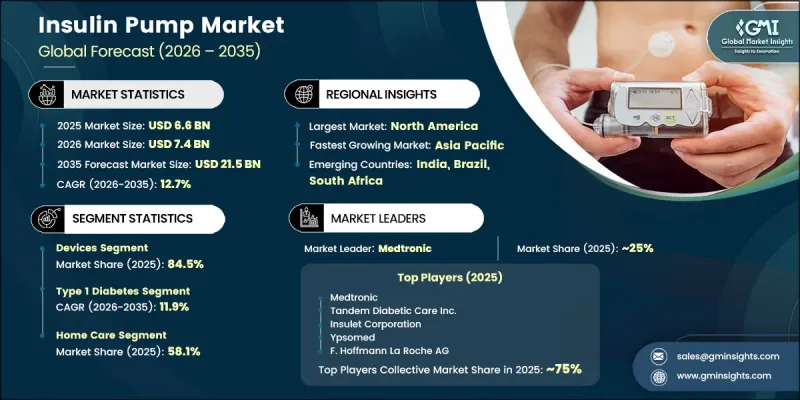
這一成長是由多種因素共同推動的,包括糖尿病盛行率的上升、自動化胰島素輸注技術的快速發展,以及北美、歐洲和部分亞太地區主要醫療保健系統保險覆蓋範圍的擴大。市場正在演變為一個高度差異化的生態系統,其競爭地位不再取決於基本的藥物輸送功能,而是取決於演算法性能、設備互通性和以用戶為中心的設計。雖然胰島素幫浦治療的主要用戶層仍然是第1型糖尿病患者,但需要強化胰島素治療的第二型糖尿病患者的使用率正在穩步上升,尤其是在保險報銷體系支持更廣泛覆蓋的地區。關鍵地區疾病盛行率的上升正以超過人口趨勢的速度推動患者總數的成長,這將推動市場的長期擴張。
| 市場範圍 | |
|---|---|
| 開始年份 | 2025 |
| 預測期 | 2026-2035 |
| 起始金額 | 66億美元 |
| 預測金額 | 215億美元 |
| 複合年成長率 | 12.7% |
預計到2025年,胰島素幫浦設備市佔率將達到84.5%,並在2035年之前以12.4%的複合年成長率成長。此類別包括傳統的管式胰島素幫浦和無管貼片式胰島素幫浦系統,其中貼片式胰島素幫浦因其舒適性、隱蔽性和易用性而得到更廣泛的應用。該細分市場的成長主要受新患者獲取和設備更換週期的驅動,用戶正在加速向具有先進數位控制功能和更好臨床性能的自動化胰島素輸注系統過渡。
預計到2025年,居家照護市佔率將達到58.1%,並在2035年之前以13%的複合年成長率成長,在整個預測期內保持主導地位。這一主導地位體現了現代胰島素幫浦技術的設計理念,即支持患者在臨床環境之外獨立使用。自動化技術的進步、直覺的介面以及持續血糖監測功能的整合,使患者能夠有效地在家中管理治療,減少對醫院管理的依賴,並促進長期門診治療。
北美胰島素幫浦市佔率佔全球42.7%,預計到2035年將以11.7%的複合年成長率成長。美國是該地區最大的市場貢獻者,這得益於第1型糖尿病患者中胰島素幫浦的高普及率以及公共和私人醫療保險計劃提供的廣泛保障。完善的保險報銷體系和先進的糖尿病管理基礎設施進一步鞏固了該地區的市場主導地位。
目錄
第1章:調查方法
第2章執行摘要
第3章 行業洞察
- 產業生態系分析
- 影響產業的因素
- 成長促進因素
- 糖尿病盛行率上升
- 胰島素幫浦的技術進步
- 醫療設備的優惠保險和報銷政策
- 醫療費用增加
- 產業潛在風險與挑戰
- 胰島素高成本
- 嚴格的政府法規
- 機會
- 人工智慧/機器學習整合和預測分析
- 進入新興市場
- 成長促進因素
- 成長潛力分析
- 監理情勢
- 2025年價格分析
- 技術與創新展望
- 最新科技趨勢
- 新興技術
- 投資情勢
- 救贖方案
- 未來市場趨勢
- 人工智慧和生成式人工智慧對市場的影響
- 波特的分析
- PESTLE分析
第4章 競爭情勢
- 介紹
- 企業矩陣分析
- 企業市佔率分析
- 世界
- 北美洲
- 歐洲
- 亞太地區
- 拉丁美洲
- 主要市場公司的競爭分析
- 競爭定位矩陣
- 主要進展
- 併購
- 夥伴關係和聯盟
- 新產品發布
- 業務拓展計劃
第5章 市場估價與預測:依產品分類,2022-2035年
- 裝置
- 傳統設備
- 管式/繫繩式
- 無內胎
- 自動胰島素輸注(AID)系統/混合閉合迴路
- 傳統設備
- 配件
- 電池
- 胰島素儲液器或藥筒
- 胰島素輸注裝置插入裝置
第6章 市場估計與預測:依適應症分類,2022-2035年
- 1型糖尿病
- 2型糖尿病
第7章 市場估計與預測:依最終用途分類,2022-2035年
- 居家醫療
- 醫院和診所
- 其他最終用戶
第8章 市場估計與預測:依地區分類,2022-2035年
- 北美洲
- 美國
- 加拿大
- 歐洲
- 德國
- 英國
- 法國
- 西班牙
- 義大利
- 荷蘭
- 亞太地區
- 中國
- 日本
- 印度
- 澳洲
- 韓國
- 拉丁美洲
- 巴西
- 墨西哥
- 阿根廷
- 中東和非洲
- 南非
- 沙烏地阿拉伯
- UAE
第9章:公司簡介
- Beta Bionics
- CeQur
- Debiotech SA
- EOFLOW
- F. Hoffmann La Roche AG
- Insulet Corporation
- Lenomed Medical
- MannKind Corporation
- Medtronic plc
- Medtrum
- MicroPort Scientific Corporation
- SOOIL
- Tandem Diabetic Care Inc.
- Terumo Corporation
- ViCentra BV
- Ypsomed
The Global Insulin Pump Market was valued at USD 6.6 billion in 2025 and is estimated to grow at a CAGR of 12.7% to reach USD 21.5 billion by 2035.
Growth is shaped by the intersection of an expanding diabetic population, rapid advancement in automated insulin delivery technologies, and increasing reimbursement coverage across major healthcare systems in North America, Europe, and parts of the Asia Pacific. The market has evolved into a highly differentiated ecosystem where competitive positioning is defined by algorithm performance, device interoperability, and user-centric design rather than basic drug delivery functionality. While Type 1 diabetes patients remain the core user base for insulin pump therapy, adoption among Type 2 diabetes patients requiring intensive insulin regimens is steadily increasing, particularly where reimbursement frameworks support broader access. Rising disease prevalence across key regions continues to expand the overall addressable population faster than demographic growth trends, reinforcing long-term market expansion.
| Market Scope | |
|---|---|
| Start Year | 2025 |
| Forecast Year | 2026-2035 |
| Start Value | $6.6 Billion |
| Forecast Value | $21.5 Billion |
| CAGR | 12.7% |
The device segment accounted for 84.5% share in 2025 and is expected to grow at a CAGR of 12.4% through 2035. This category includes both traditional tubed pumps and tubeless patch-based systems, with patch devices gaining stronger adoption due to improved comfort, discretion, and ease of use. Growth in this segment is supported by both new patient uptake and replacement cycles, as users increasingly transition toward automated insulin delivery systems with advanced digital control features and improved clinical performance.
The home care segment held a 58.1% share in 2025 and is projected to grow at a CAGR of 13% through 2035, maintaining its leading position across the forecast period. This dominance reflects the design direction of modern insulin pump technologies, which are built to support independent patient use outside clinical settings. Improved automation, intuitive interfaces, and continuous glucose integration have enabled patients to manage therapy effectively at home, reducing dependency on hospital-based administration and supporting long-term outpatient adoption.
North America Insulin Pump Market accounted for 42.7% share, growing at a CAGR of 11.7% through 2035. The United States represents the largest contributor within the region, supported by high insulin pump penetration among Type 1 diabetes patients and strong insurance coverage across public and private healthcare programs. Established reimbursement structures and advanced diabetes management infrastructure continue to reinforce regional dominance.
Major players operating in the global insulin pump market include Medtronic plc, Insulet Corporation, Tandem Diabetes Care Inc., Ypsomed, F. Hoffmann-La Roche AG, CamDiab, Terumo Corporation, ViCentra B.V., SOOIL, Debiotech S.A., Lenomed Medical, MicroPort Scientific Corporation, Beta Bionics, EOFlow, CeQur, Medtrum, and MannKind Corporation. Companies in the insulin pump market are strengthening their competitive position through continuous innovation in automated insulin delivery algorithms that improve glycemic control and reduce user intervention. They are investing heavily in connected ecosystems that integrate pumps with continuous glucose monitoring systems and mobile applications for real-time data tracking. Strategic partnerships with digital health platforms and healthcare providers are expanding patient engagement and improving treatment adherence. Manufacturers are also focusing on expanding reimbursement approvals across new geographies and diabetes segments to widen patient access. Product miniaturization and comfort-driven design improvements are being prioritized to enhance user adoption and retention.
Table of Contents
Chapter 1 Research Methodology
- 1.1 Research approach
- 1.2 Quality commitments
- 1.2.1 GMI AI policy & data integrity commitment
- 1.2.1.1 Source consistency protocol
- 1.2.1 GMI AI policy & data integrity commitment
- 1.3 Research trail & confidence scoring
- 1.3.1 Research trail components
- 1.3.2 Scoring components
- 1.4 Data collection
- 1.4.1 Partial list of primary sources
- 1.5 Data mining sources
- 1.5.1 Paid sources
- 1.5.1.1 Sources, by region
- 1.5.1 Paid sources
- 1.6 Base estimates and calculations
- 1.6.1 Base year calculation
- 1.7 Forecast model
- 1.7.1 Quantified market impact analysis
- 1.7.1.1 Mathematical impact of growth parameters on forecast
- 1.7.1 Quantified market impact analysis
- 1.8 Research transparency addendum
- 1.8.1 Source attribution framework
- 1.8.2 Quality assurance metrics
- 1.8.3 Our commitment to trust
Chapter 2 Executive Summary
- 2.1 Industry 360° synopsis
- 2.2 Key market trends
- 2.2.1 Regional trends
- 2.2.2 Product trends
- 2.2.3 Indication trends
- 2.2.4 End use trends
- 2.3 CXO perspectives: Strategic imperatives
Chapter 3 Industry Insights
- 3.1 Industry ecosystem analysis
- 3.2 Industry impact forces
- 3.2.1 Growth drivers
- 3.2.1.1 Rising Prevalence of Diabetes
- 3.2.1.2 Technological Advancements in Insulin Pumps
- 3.2.1.3 Favourable Device Insurance and Reimbursement Policies
- 3.2.1.4 Increasing Healthcare Expenditure
- 3.2.2 Industry pitfalls and challenges
- 3.2.2.1 High Cost of Insulin Pumps
- 3.2.2.2 Stringent Government Regulations
- 3.2.3 Opportunities
- 3.2.3.1 AI/ML integration and predictive analytics
- 3.2.3.2 Emerging markets expansion
- 3.2.1 Growth drivers
- 3.3 Growth potential analysis
- 3.4 Regulatory landscape
- 3.5 Pricing analysis, 2025
- 3.6 Technology and innovation landscape (Driven by Primary Research)
- 3.6.1 Current technological trends
- 3.6.2 Emerging technologies
- 3.7 Investment landscape
- 3.8 Reimbursement scenario
- 3.9 Future market trends (Driven by Primary Research)
- 3.10 Impact of AI & Generative AI on the Market (Driven by Primary Research)
- 3.11 Porter's analysis
- 3.12 PESTEL analysis
Chapter 4 Competitive Landscape, 2025
- 4.1 Introduction
- 4.2 Company matrix analysis
- 4.3 Company market share analysis (Driven by Primary Research)
- 4.3.1 Global
- 4.3.2 North America
- 4.3.3 Europe
- 4.3.4 Asia Pacific
- 4.3.5 LAMEA
- 4.4 Competitive analysis of major market players
- 4.5 Competitive positioning matrix
- 4.6 Key developments
- 4.6.1 Mergers & acquisitions
- 4.6.2 Partnerships & collaborations
- 4.6.3 New product launches
- 4.6.4 Expansion plans
Chapter 5 Market Estimates and Forecast, By Product, 2022 - 2035 ($ Mn)
- 5.1 Key trends
- 5.2 Devices
- 5.2.1 Conventional devices
- 5.2.1.1 Tubed/tethered
- 5.2.1.2 Tubeless
- 5.2.2 Automated insulin delivery (AID) system/ hybrid closed loop
- 5.2.1 Conventional devices
- 5.3 Accessories
- 5.3.1 Battery
- 5.3.2 Insulin reservoir or cartridges
- 5.3.3 Insulin set insertion devices
Chapter 6 Market Estimates and Forecast, By Indication, 2022 - 2035 ($ Mn)
- 6.1 Key trends
- 6.2 Type 1 diabetes
- 6.3 Type 2 diabetes
Chapter 7 Market Estimates and Forecast, By End Use, 2022 - 2035 ($ Mn)
- 7.1 Key trends
- 7.2 Home care
- 7.3 Hospitals and clinics
- 7.4 Other end users
Chapter 8 Market Estimates and Forecast, By Region, 2022 - 2035 ($ Mn)
- 8.1 Key trends
- 8.2 North America
- 8.2.1 U.S.
- 8.2.2 Canada
- 8.3 Europe
- 8.3.1 Germany
- 8.3.2 UK
- 8.3.3 France
- 8.3.4 Spain
- 8.3.5 Italy
- 8.3.6 Netherlands
- 8.4 Asia Pacific
- 8.4.1 China
- 8.4.2 Japan
- 8.4.3 India
- 8.4.4 Australia
- 8.4.5 South Korea
- 8.5 Latin America
- 8.5.1 Brazil
- 8.5.2 Mexico
- 8.5.3 Argentina
- 8.6 MEA
- 8.6.1 South Africa
- 8.6.2 Saudi Arabia
- 8.6.3 UAE
Chapter 9 Company Profiles
- 9.1 Beta Bionics
- 9.2 CeQur
- 9.3 Debiotech S.A.
- 9.4 EOFLOW
- 9.5 F. Hoffmann La Roche AG
- 9.6 Insulet Corporation
- 9.7 Lenomed Medical
- 9.8 MannKind Corporation
- 9.9 Medtronic plc
- 9.10 Medtrum
- 9.11 MicroPort Scientific Corporation
- 9.12 SOOIL
- 9.13 Tandem Diabetic Care Inc.
- 9.14 Terumo Corporation
- 9.15 ViCentra B.V.
- 9.16 Ypsomed

 無導管胰島素幫浦市場:按組件、通路和地區分類
 胰島素幫浦市場:2026-2032年全球市場預測(依產品類型、給藥方式、胰島素類型、應用及通路分類)
 無導管胰島素幫浦市場商機、成長要素、產業趨勢分析及2026-2035年預測。
 無導管胰島素幫浦市場規模、佔有率和成長分析:按組件、分銷管道、最終用戶和地區分類-2026-2033年產業預測
 胰島素幫浦市場規模、佔有率和趨勢分析報告:按產品、系統結構、最終用途、地區和細分市場分類(2026-2033 年)
 胰島素幫浦市場規模、佔有率和成長分析:按類型、組件、疾病、治療方法、應用、患者群體、分銷管道和地區分類-2026年至2033年產業預測
 胰島素幫浦市場報告:按產品類型、分銷管道和地區分類(2026-2034 年)
 2026年全球無導管胰島素幫浦市場報告
 胰島素幫浦市場分析及預測(至2035年):依類型、產品類型、技術、組件、應用、最終用戶、功能、安裝類型、設備及模式分類日本胰島素幫浦市場報告:按產品類型、通路和地區分類(2026-2034年)