


 |
市場調查報告書
商品編碼
2083119
木質素基木板黏合劑市場:商業機會、成長要素、產業趨勢分析及 2026-2035 年預測。Lignin-Based Wood Panel Adhesives Market Opportunity, Growth Drivers, Industry Trend Analysis, and Forecast 2026 - 2035 |
||||||

預計到 2025 年,全球木質素基木板黏合劑市場價值將達到 2.954 億美元,年複合成長率為 12.1%,到 2035 年將達到 9.005 億美元。
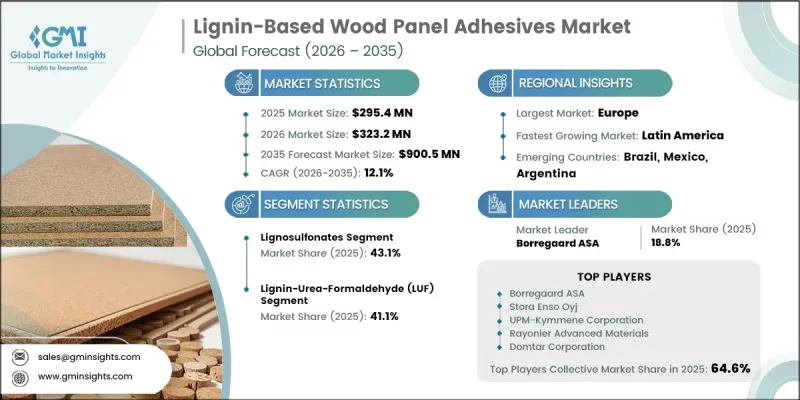
木質素基木板黏合劑市場的擴張主要受以下因素驅動:不斷變化的環境法規、日益重視的碳減排以及原料經濟的變化,這些因素正推動著企業從傳統的石油基黏合劑體系轉向其他材料。除了預期的成長率之外,木製品產業材料選擇策略的廣泛轉變也在塑造著這個市場。隨著永續性目標、監管要求和商業性可行性之間的聯繫日益緊密,製造商擴大採用生物基黏合劑技術。木質素衍生的黏合劑解決方案提供了一種切實可行的方法,既能降低或顯著降低甲醛含量,又能讓生產商在最大限度減少干擾的情況下維持現有的生產流程。此外,綠色建築標準和永續建築要求正擴大被納入商業、公共和公共基礎設施項目的採購政策中。這種轉變正在增強對含有可再生原料的材料的需求,並推動木質素基黏合劑技術在各種木板應用中的廣泛應用。
| 市場範圍 | |
|---|---|
| 開始年份 | 2025 |
| 預測期 | 2026-2035 |
| 上市時的市場規模 | 2.954億美元 |
| 預測金額 | 9.05億美元 |
| 複合年成長率 | 12.1% |
到2025年,磺酸鹽將佔據43.1%的市場。其主導地位得益於其優異的水溶性、成熟的性能以及大型生產商的穩定供應。這些木質素衍生物的分子結構與複合板製造中常用的水性樹脂配方具有極佳的相容性,使其成為黏合劑開發商和板材製造商的理想選擇。
到2025年,LUF系統市佔率將達到41.1%。配方研發和性能最佳化的持續創新正在推動其在多個木質板材製造領域和終端應用領域的普及。
預計到2025年,北美木質素基木板黏合劑市佔率將達到22%。這一區域成長主要得益於嚴格的排放標準和監管要求,這些標準和要求顯著影響了整個複合木製品行業的黏合劑選擇。以合規為導向的生產策略以及對環保建材日益成長的需求,持續為該全部區域生物基黏合劑的推廣應用創造有利條件。產業對可再生替代品的接受度不斷提高,以及對低排放產品的日益重視,預計將進一步加速北美市場的發展。
目錄
第1章:調查方法和範圍
第2章執行摘要
第3章 行業洞察
- 產業生態系分析
- 供應商情況
- 利潤率
- 每個階段增加的價值
- 影響價值鏈的因素
- 中斷
- 影響產業的因素
- 促進因素
- 產業潛在風險與挑戰
- 市場機遇
- 成長潛力分析
- 監理情勢
- 北美洲
- 歐洲
- 亞太地區
- 拉丁美洲
- 中東和非洲
- 波特的分析
- PESTLE分析
- 價格趨勢
- 按地區
- 按類型
- 未來市場趨勢
- 技術與創新展望
- 最新科技趨勢
- 新興技術
- 專利趨勢
- 貿易統計
- 主要進口國
- 主要出口國
- 永續性和環境方面
- 永續計劃
- 減少廢棄物策略
- 生產中的能源效率
- 具有環保意識的舉措
- 考慮碳足跡
第4章 競爭情勢
- 介紹
- 企業市佔率分析
- 按地區
- 北美洲
- 歐洲
- 亞太地區
- LATAM
- 中東和非洲
- 按地區
- 企業矩陣分析
- 主要市場公司的競爭分析
- 競爭定位矩陣
- 主要進展
- 併購
- 夥伴關係和聯盟
- 新產品發布
- 業務拓展計劃
第5章 市場估價與預測:依木質素原料類型分類,2022-2035年
- 硫酸鹽木質素
- 磺酸鹽
- 有機溶劑木質素
- 其他
第6章 市場估算與預測:依樹脂化合物類型分類,2022-2035年
- 木質素酚醛(LPF)
- 木質素、尿素和甲醛(LUF)
- 純木質素基(不含甲醛)
- 木質素環氧樹脂組合藥物
第7章 市場估價與預測:木板依應用領域分類,2022-2035年
- 塑合板
- 合板
- 中密度纖維板(MDF)
- 定向塑合板(OSB)
- 層積單板木材(LVL)及其他複合板製品
第8章 市場估算與預測:依最終用途產業分類,2022-2035年
- 家具製造
- 建築/建築設計
- 地板
- 包裝
- 汽車和交通運輸
- 其他
第9章 市場估計與預測:依地區分類,2022-2035年
- 北美洲
- 美國
- 加拿大
- 歐洲
- 德國
- 英國
- 法國
- 西班牙
- 義大利
- 其他歐洲國家
- 亞太地區
- 中國
- 印度
- 日本
- 澳洲
- 韓國
- 其他亞太國家
- 拉丁美洲
- 巴西
- 墨西哥
- 阿根廷
- 其他拉丁美洲國家
- 中東和非洲
- 沙烏地阿拉伯
- 南非
- UAE
- 其他中東和非洲國家
第10章:公司簡介
- Aditya Birla Chemicals
- Borregaard ASA
- Domtar Corporation
- EcoSynthetix Inc
- Fraunhofer WKI
- Green Earth Technologies
- Koskisen Oy
- Latvijas Finieris AS
- Rayonier Advanced Materials
- Roseburg Forest Products
- Stora Enso Oyj
- UPM-Kymmene Corporation
- West Fraser Timber Co Ltd
The Global Lignin-Based Wood Panel Adhesives Market was valued at USD 295.4 million in 2025 and is estimated to grow at a CAGR of 12.1% to reach USD 900.5 million by 2035.
The expansion of the Lignin-Based Wood Panel Adhesives Market is driven by evolving environmental regulations, growing emphasis on carbon reduction, and changing raw material economics that are encouraging the transition away from conventional petroleum-derived adhesive systems. Beyond the projected growth rate, the market is shaped by a broader transformation in material selection strategies across the wood products industry. Manufacturers are increasingly adopting bio-based adhesive technologies as sustainability goals, regulatory requirements, and commercial viability become more closely aligned. Lignin-derived adhesive solutions offer a practical pathway for reducing or significantly lowering formaldehyde content while allowing producers to maintain existing manufacturing processes with minimal disruption. In addition, green building standards and sustainable construction requirements are becoming increasingly integrated into procurement policies across commercial, institutional, and public infrastructure projects. This shift is strengthening demand for renewable-content materials and supporting the growing adoption of lignin-based adhesive technologies across a wide range of wood panel applications.
| Market Scope | |
|---|---|
| Start Year | 2025 |
| Forecast Year | 2026-2035 |
| Start Value | $295.4 Million |
| Forecast Value | $900.5 Million |
| CAGR | 12.1% |
The lignosulfonates segment held a 43.1% share in 2025. Their leading position is supported by strong water solubility, well-established performance characteristics, and dependable commercial availability from large-scale producers. These lignin derivatives possess molecular structures that provide excellent compatibility with water-based resin formulations commonly utilized in engineered wood manufacturing, making them a preferred option for adhesive developers and panel producers.
The LUF systems segment held a 41.1% share in 2025. Continued innovation in formulation development and performance optimization is supporting adoption across multiple wood panel manufacturing segments and end-use applications.
North America Lignin-Based Wood Panel Adhesives Market captured 22% share in 2025. Regional growth is supported by stringent emission standards and regulatory requirements that have significantly influenced adhesive selection practices throughout the composite wood products sector. Compliance-focused manufacturing strategies and increasing demand for environmentally responsible building materials continue to create favorable conditions for bio-based adhesive adoption across the region. Growing industry acceptance of renewable alternatives and greater emphasis on low-emission products are expected to further strengthen market development in North America.
Key companies operating in the Global Lignin-Based Wood Panel Adhesives Market include UPM-Kymmene Corporation, Borregaard ASA, Stora Enso Oyj., Domtar Corporation, Rayonier Advanced Materials, Koskisen Oy, Latvijas Finieris AS, EcoSynthetix Inc., West Fraser Timber Co Ltd, Roseburg Forest Products, Aditya Birla Chemicals, Fraunhofer WKI, and Green Earth Technologies. Companies active in the Lignin-Based Wood Panel Adhesives Market are focusing on product innovation, strategic partnerships, and capacity expansion to strengthen their competitive position and increase market penetration. Significant investments are being directed toward research and development initiatives aimed at improving adhesive performance, enhancing formulation efficiency, and expanding application compatibility across engineered wood products. Many market participants are collaborating with wood panel manufacturers, research institutions, and construction industry stakeholders to accelerate the commercialization and adoption of bio-based adhesive technologies. Companies are also investing in sustainable raw material sourcing, production optimization, and process scalability to improve cost competitiveness.
Table of Contents
Chapter 1 Methodology & Scope
- 1.1 Market scope and definition
- 1.2 Research design
- 1.2.1 Research approach
- 1.2.2 Data collection methods
- 1.3 Data mining sources
- 1.3.1 Global
- 1.3.2 Regional/Country
- 1.4 Base estimates and calculations
- 1.4.1 Base year calculation
- 1.4.2 Key trends for market estimation
- 1.5 Primary research and validation
- 1.5.1 Primary sources
- 1.6 Forecast model
- 1.7 Research assumptions and limitations
Chapter 2 Executive Summary
- 2.1 Industry 360° synopsis
- 2.2 Key market trends
- 2.2.1 Lignin source type
- 2.2.2 Resin formulation type
- 2.2.3 Wood panel application
- 2.2.4 End-use industry
- 2.2.5 Regional
- 2.3 TAM Analysis, 2026-2035
- 2.4 CXO perspectives: Strategic imperatives
- 2.4.1 Executive decision points
Chapter 3 Industry Insights
- 3.1 Industry ecosystem analysis
- 3.1.1 Supplier landscape
- 3.1.2 Profit margin
- 3.1.3 Value addition at each stage
- 3.1.4 Factor affecting the value chain
- 3.1.5 Disruptions
- 3.2 Industry impact forces
- 3.2.1 Growth drivers
- 3.2.2 Industry pitfalls and challenges
- 3.2.3 Market opportunities
- 3.3 Growth potential analysis
- 3.4 Regulatory landscape
- 3.4.1 North America
- 3.4.2 Europe
- 3.4.3 Asia Pacific
- 3.4.4 Latin America
- 3.4.5 Middle East & Africa
- 3.5 Porter’s analysis
- 3.6 PESTEL analysis
- 3.7 Price trends
- 3.7.1 By region
- 3.7.2 By type
- 3.8 Future market trends
- 3.9 Technology and Innovation landscape
- 3.9.1 Current technological trends
- 3.9.2 Emerging technologies
- 3.10 Patent Landscape
- 3.11 Trade statistics (HS code)
- 3.11.1 Major importing countries
- 3.11.2 Major exporting countries
- 3.12 Sustainability and environmental aspects
- 3.12.1 Sustainable practices
- 3.12.2 Waste reduction strategies
- 3.12.3 Energy efficiency in production
- 3.12.4 Eco-friendly initiatives
- 3.13 Carbon footprint consideration
Chapter 4 Competitive Landscape, 2025
- 4.1 Introduction
- 4.2 Company market share analysis
- 4.2.1 By region
- 4.2.1.1 North America
- 4.2.1.2 Europe
- 4.2.1.3 Asia Pacific
- 4.2.1.4 LATAM
- 4.2.1.5 MEA
- 4.2.1 By region
- 4.3 Company matrix analysis
- 4.4 Competitive analysis of major market players
- 4.5 Competitive positioning matrix
- 4.6 Key developments
- 4.6.1 Mergers & acquisitions
- 4.6.2 Partnerships & collaborations
- 4.6.3 New Product Launches
- 4.6.4 Expansion Plans
Chapter 5 Market Estimates and Forecast, By Lignin Source Type, 2022-2035 (USD Million) (Kilo Tons)
- 5.1 Key trends
- 5.2 Kraft lignin
- 5.3 Lignosulfonates
- 5.4 Organosolv lignin
- 5.5 Others
Chapter 6 Market Estimates and Forecast, By Resin Formulation Type, 2022-2035 (USD Million) (Kilo Tons)
- 6.1 Key trends
- 6.2 Lignin-phenol-formaldehyde (LPF)
- 6.3 Lignin-urea-formaldehyde (LUF)
- 6.4 Neat lignin-based (Formaldehyde-Free)
- 6.5 Lignin-epoxy formulations
Chapter 7 Market Estimates and Forecast, By Wood Panel Application, 2022-2035 (USD Million) (Kilo Tons)
- 7.1 Key trends
- 7.2 Particleboard
- 7.3 Plywood
- 7.4 Medium Density Fiberboard (MDF)
- 7.5 Oriented Strand Board (OSB)
- 7.6 Laminated Veneer Lumber (LVL) & Other Engineered Wood Products
Chapter 8 Market Estimates and Forecast, By End-Use Industry, 2022-2035 (USD Million) (Kilo Tons)
- 8.1 Key trends
- 8.2 Furniture manufacturing
- 8.3 Construction & building
- 8.4 Flooring
- 8.5 Packaging
- 8.6 Automotive & transportation
- 8.7 Others
Chapter 9 Market Estimates and Forecast, By Region, 2022-2035 (USD Million) (Kilo Tons)
- 9.1 Key trends
- 9.2 North America
- 9.2.1 U.S.
- 9.2.2 Canada
- 9.3 Europe
- 9.3.1 Germany
- 9.3.2 UK
- 9.3.3 France
- 9.3.4 Spain
- 9.3.5 Italy
- 9.3.6 Rest of Europe
- 9.4 Asia Pacific
- 9.4.1 China
- 9.4.2 India
- 9.4.3 Japan
- 9.4.4 Australia
- 9.4.5 South Korea
- 9.4.6 Rest of Asia Pacific
- 9.5 Latin America
- 9.5.1 Brazil
- 9.5.2 Mexico
- 9.5.3 Argentina
- 9.5.4 Rest of Latin America
- 9.6 Middle East and Africa
- 9.6.1 Saudi Arabia
- 9.6.2 South Africa
- 9.6.3 UAE
- 9.6.4 Rest of Middle East and Africa
Chapter 10 Company Profiles
- 10.1 Aditya Birla Chemicals
- 10.2 Borregaard ASA
- 10.3 Domtar Corporation
- 10.4 EcoSynthetix Inc
- 10.5 Fraunhofer WKI
- 10.6 Green Earth Technologies
- 10.7 Koskisen Oy
- 10.8 Latvijas Finieris AS
- 10.9 Rayonier Advanced Materials
- 10.10 Roseburg Forest Products
- 10.11 Stora Enso Oyj
- 10.12 UPM-Kymmene Corporation
- 10.13 West Fraser Timber Co Ltd

 木板材市場:全球市場預測,2026-2032年
 木板材市場商機、成長要素、產業趨勢分析及2026-2035年預測
 木質人造板:市場佔有率分析、產業趨勢與統計、成長預測(2026-2031)
 木基板材市場報告:按產品類型、分銷管道、應用和地區分類(2026-2034年)
 2026年全球木質人造板市場報告
 木質人造板市場規模、佔有率和成長分析(按產品、厚度、分銷管道、應用、最終用戶和地區分類)—2026-2033年產業預測
 地板木板市場-全球產業規模、佔有率、趨勢、機會及預測,細分領域,依板材類型(實木、工程木)、終端用戶(住宅、非住宅)、地區、競爭格局,2020-2030 年預測
 2032年人造板市場預測:按產品類型、木材來源、厚度、分銷管道、應用和地區進行的全球分析
 人造板市場規模、佔有率、趨勢分析報告:2025-2030 年按產品、應用、地區和細分市場預測