


 |
市場調查報告書
商品編碼
2061397
木板材市場商機、成長要素、產業趨勢分析及2026-2035年預測Wood Based Panel Market Opportunity, Growth Drivers, Industry Trend Analysis, and Forecast 2026 - 2035 |
||||||

2025年全球木板材市場價值為1,540億美元,預計到2035年將以5.1%的複合年成長率成長至2,526億美元。
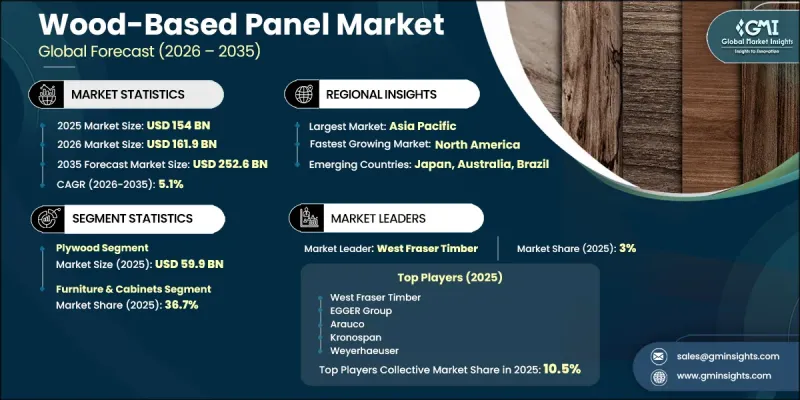
在全球建築、家具和裝修行業需求不斷成長的推動下,木板市場持續穩定擴張。與傳統實木相比,木板具有成本效益高、易於加工、品質穩定可靠等優點,因此在住宅、商業和模組化建築等領域廣受歡迎。都市化加快以及對現代室內解決方案的需求日益成長,也促進了木板產品在多個終端應用產業的廣泛應用。製造商不斷提升木板的性能,例如提高其耐久性、表面處理品質和防潮性能,使這些材料能夠應用於更廣泛的領域。此外,消費者、建築商和設計師日益增強的環保意識也顯著影響市場趨勢。對永續生產產品的需求不斷成長,促使企業採用環保的生產方式,例如使用再生木材和低排放黏合劑。這些以永續性發展為導向的措施不僅有助於製造商加強合規性,還能增強消費者信心,並支持全球市場的長期成長。
| 市場範圍 | |
|---|---|
| 開始年份 | 2025 |
| 預測期 | 2026-2035 |
| 上市時的市場規模 | 1540億美元 |
| 預測金額 | 2526億美元 |
| 複合年成長率 | 5.1% |
預計到2025年,膠合板市場規模將達到599億美元。膠合板憑藉其強度高、耐久性強、用途廣泛和成本績效高等優點,持續維持著業界主導地位。膠合板的層壓結構增強了其結構穩定性,提高了抗裂、抗撓曲和抗尺寸變形能力,使其適用於各種結構和裝飾應用。膠合板在建築項目、家具製造和室內裝飾等領域的廣泛應用,進一步鞏固了其在全球木飾面行業中的重要地位。長期耐久性和適應性仍是支撐各行業對膠合板產品強勁需求的關鍵因素。
截至2025年,家具和櫥櫃產業將佔36.7%的市場。這一強勁的需求主要源於都市生活方式的擴展以及人們對功能性強、節省空間且美觀的家具解決方案日益成長的偏好。木板因其表面光滑、品質穩定、設計柔軟性且可客製化等優點,被廣泛應用於家具和櫥櫃製造。現代住宅和商業室內設計需求的不斷成長,持續推動全球家具製造業對木板的採用。
美國木質板材市場佔77.6%的市場佔有率,預計2025年市場規模將達236億美元。北美市場的成長主要得益於住宅翻新、室內家具應用和現代建築項目的穩定需求。該地區的消費者越來越重視兼具耐用性、設計多樣性和永續生產流程的產品。為此,製造商正致力於開發採用再生木材和低排放生產技術的環保板材產品。持續的產品創新,旨在提升產品性能和表面美觀度,也幫助企業適應不斷變化的室內設計偏好,並鞏固區域市場的成長。
目錄
第1章:調查方法和範圍
第2章執行摘要
第3章 行業洞察
- 產業生態系分析
- 價值鏈分析
- 供應商情況
- 利潤率
- 每個階段增加的價值
- 影響價值鏈的因素
- 供應鏈分析
- 原料來源
- 製造和加工階段
- 分銷管道
- 供應鏈風險和依賴性
- 影響產業的因素
- 促進因素
- 產業潛在風險與挑戰
- 機會
- 成長潛力分析
- 技術與創新展望
- 最新科技趨勢
- 新興技術包括物聯網、人工智慧和自動化
- 智慧水產養殖及精密農業系統
- 循環水產養殖系統的進展
- 遠端監控和預測分析
- 價格趨勢
- 基於初步調查對過去價格趨勢的分析
- 按玩家類型分類的定價策略(包括高級定價、超值定價和成本加成定價模式)
- 區域價格波動及其主要原因
- 按設備類型分類的價格基準
- 監理情勢
- 全球法規結構(EUTR、EUDR、CARB、FSC/PEFC)
- 甲醛和揮發性有機化合物排放標準
- 德國聯邦排放法規
- ChemVOCFarbV
- 藍恩格爾生態標籤
- 全球環境基金合規性
- E0排放等級標準
- 北美洲
- 亞太地區
- 監理趨勢及未來變化,2025-2028年
- 波特的分析
- PESTLE分析
- 貿易數據分析
- 全球進出口量與進口額趨勢(2019-2024)
- 按進出口量排名的前十個國家
- 歐洲內部、亞洲與歐洲之間以及亞洲與北美之間的貿易趨勢
- 主要貿易路線及關稅的影響
- 歐洲和北美
- 中國和歐洲
- 歐洲、中東和非洲
- 對來自中國(歐盟)的合板採取反傾銷措施,以及英國脫歐後英國與歐盟之間板材分配的趨勢。
- 德國
- 全球進出口量與進口額趨勢(2019-2024)
- 人工智慧和生成式人工智慧對市場的影響
- 利用人工智慧改造現有經營模式
- 針對特定領域的生成式人工智慧應用案例和實施藍圖
- 風險、限制和監管方面的考慮因素(包括歐盟人工智慧法律對製造業的影響)
- 根據初步調查,產能和生產趨勢
- 按地區和主要生產商分類的產能(2024 年)
- 運轉率和擴張計劃
- 德國:設備產能與運轉率數據
第4章 競爭情勢
- 介紹
- 企業市佔率分析
- 按地區
- 北美洲
- 歐洲
- 德國
- 亞太地區
- 拉丁美洲
- 中東和非洲
- 按地區
- 企業矩陣分析
- 主要市場公司的競爭分析
- 競爭定位矩陣
- 主要進展
- 併購
- 夥伴關係和聯盟
- 新產品發布
- 業務拓展計劃
第5章 市場估算與預測:依產品類型分類,2022-2035年
- 中密度纖維板(MDF)
- 高密度纖維板(HDF)
- 塑合板/碎料板
- 合板
- 定向塑合板(OSB)
- 硬紙板
- 其他
第6章 市場估算與預測:依樹脂類型分類,2022-2035年
- 尿素甲醛(UF)
- 三聚氰胺甲醛(MF)
- 酚醛樹脂(PF)
- 二苯基甲烷二異氰酸酯(MDI)
- 其他
第7章 市場估算與預測:依表面處理方式分類,2022-2035年
- 未加工/未處理
- 層壓(LPL/HPL)
- 合板
- 塗層/噴漆/數位印刷
- 其他
第8章 市場估計與預測:依應用領域分類,2022-2035年
- 家具和櫥櫃
- 建築/建築設計
- 地板材料
- 包裝
- 其他
第9章 市場估算與預測,產品類型:依應用領域分類,2022-2035年
- 中密度纖維板(MDF)
- 家具和櫥櫃
- 建築/建築設計
- 地板材料
- 包裝
- 其他
- 高密度纖維板(HDF)
- 家具和櫥櫃
- 建築/建築設計
- 地板材料
- 其他
- 塑合板/碎料板
- 家具和櫥櫃
- 建築/建築設計
- 地板材料
- 包裝
- 其他
- 合板
- 家具和櫥櫃
- 建築/建築設計
- 包裝
- 其他
- 定向塑合板(OSB)
- 建築/建築設計
- 包裝
- 其他
- 硬紙板
- 家具和櫥櫃
- 建築/建築設計
- 地板材料
- 包裝
- 其他
- 其他
- 家具和櫥櫃
- 建築/建築設計
- 地板材料
- 包裝
- 其他
第10章 市場估價與預測:依地區分類,2022-2035年
- 北美洲
- 美國
- 加拿大
- 歐洲
- 德國
- 英國
- 法國
- 義大利
- 西班牙
- 亞太地區
- 中國
- 日本
- 印度
- 韓國
- 澳洲
- 拉丁美洲
- 巴西
- 墨西哥
- 中東和非洲
- 南非
- 沙烏地阿拉伯
- UAE
第11章:公司簡介
- 世界公司
- Kronospan Holdings
- Egger Group
- Swiss Krono Group
- Pfleiderer Group
- Arauco(CMPC)
- Weyerhaeuser
- West Fraser
- 該地區的領先企業
- Sonae Arauco
- Finsa Group
- Metsa Wood
- Uniboard
- PG Bison
- Homann Holzwerkstoffe
- Unilin Panels
- Niche/Specialist Players
- Kastamonu Entegre
- Woodeco
- Saviola Group
- Garnica
- Louisiana-Pacific(LP Building Solutions)
- Roseburg Forest Products
- Arbec Forest Products
The Global Wood-Based Panel Market was valued at USD 154 billion in 2025 and is estimated to grow at a CAGR of 5.1% to reach USD 252.6 billion by 2035.
The market continues to expand steadily due to rising demand from the construction, furniture, and renovation industries worldwide. Wood-based panels have become widely preferred across residential, commercial, and modular construction applications because they offer cost efficiency, ease of handling, uniform quality, and reliable performance compared to conventional solid wood materials. Growing urbanization and increasing demand for modern interior solutions are also contributing to broader product adoption across multiple end-use industries. Manufacturers are continuously enhancing panel performance by improving durability, surface finish quality, and resistance to moisture, enabling these materials to be utilized across a wider range of applications. In addition, increasing environmental awareness among consumers, builders, and designers is significantly influencing market trends. Demand for sustainably manufactured products is encouraging companies to adopt eco-friendly production methods, including the use of recycled wood materials and low-emission adhesives. These sustainability-focused initiatives are helping manufacturers strengthen regulatory compliance while also improving consumer confidence and supporting long-term market growth across global regions.
| Market Scope | |
|---|---|
| Start Year | 2025 |
| Forecast Year | 2026-2035 |
| Start Value | $154 Billion |
| Forecast Value | $252.6 Billion |
| CAGR | 5.1% |
The plywood segment generated USD 59.9 billion in 2025. Plywood continues to maintain a leading position within the industry due to its combination of strength, durability, versatility, and cost-effectiveness. The layered construction of plywood enhances structural stability and improves resistance to cracking, bending, and dimensional distortion, making it suitable for a broad range of structural and decorative applications. Its widespread use across construction projects, furniture manufacturing, and interior applications continues to reinforce its importance within the global wood-based panel industry. Long-term durability and adaptability remain key factors supporting strong demand for plywood products across multiple sectors.
The furniture and cabinets segment held 36.7% share in 2025. Strong demand from this segment is primarily driven by growing urban lifestyles and increasing preference for functional, space-efficient, and visually appealing furniture solutions. Wood-based panels are extensively utilized in furniture and cabinet manufacturing because they provide smooth surfaces, consistent quality, and flexibility in design and customization. Rising demand for modern residential and commercial interiors continues to support the adoption of wood-based panels across the furniture manufacturing industry worldwide.
U.S. Wood-Based Panel Market generated 77.6% share, generating USD 23.6 billion in 2025. Market growth across North America is being supported by stable demand from home renovation activities, interior furnishing applications, and modern construction projects. Consumers across the region increasingly prioritize products offering durability, design versatility, and sustainable manufacturing practices. In response, manufacturers are focusing on developing environmentally responsible panel products using recycled wood materials and low-emission production technologies. Continuous product innovation aimed at improving performance and surface aesthetics is also helping companies align with evolving interior design preferences and strengthen regional market growth.
Major companies operating in the Global Wood-Based Panel Market include Kronospan Holdings, Egger Group, Swiss Krono Group, Pfleiderer Group, Arauco (CMPC), Weyerhaeuser, West Fraser, Sonae Arauco, Finsa Group, Metsa Wood, Uniboard, PG Bison, Homann Holzwerkstoffe, Unilin Panels, Kastamonu Entegre, Woodeco, Saviola Group, Garnica, Louisiana-Pacific (LP Building Solutions), Roseburg Forest Products, and Arbec Forest Products. Companies operating in the wood-based panel industry are implementing several strategic initiatives to strengthen their market position and expand their global footprint. Leading manufacturers are investing in advanced production technologies to improve panel durability, surface quality, moisture resistance, and overall product performance. Many companies are also prioritizing sustainable manufacturing practices by increasing the use of recycled raw materials and low-emission adhesives to meet evolving environmental regulations and consumer preferences. Strategic expansions, acquisitions, and partnerships are helping market participants enhance production capacities and strengthen regional distribution networks. In addition, manufacturers are focusing on customized product offerings and innovative decorative finishes to align with changing interior design trends and customer expectations.
Table of Contents
Chapter 1 Methodology & Scope
- 1.1 Research approach
- 1.2 Quality Commitments
- 1.2.1 GMI AI policy & data integrity commitment
- 1.2.1.1 Source consistency protocol
- 1.2.1 GMI AI policy & data integrity commitment
- 1.3 Research Trail & Confidence Scoring
- 1.3.1 Research Trail Components
- 1.3.2 Scoring Components
- 1.4 Data Collection
- 1.4.1 Partial list of primary sources
- 1.5 Data mining sources
- 1.5.1 Paid sources
- 1.5.1.1 Sources, by region
- 1.5.1 Paid sources
- 1.6 Base estimates and calculations
- 1.6.1 Base year calculation for any one approach
- 1.7 Forecast model
- 1.7.1 Quantified market impact analysis
- 1.7.1.1 Mathematical impact of growth parameters on forecast
- 1.7.1 Quantified market impact analysis
- 1.8 Research transparency addendum
- 1.8.1 Source attribution framework
- 1.8.2 Quality assurance metrics
- 1.8.2.1 Our commitment to trust
Chapter 2 Executive Summary
- 2.1 Industry 360° synopsis
- 2.2 Key market trends
- 2.2.1 Region
- 2.2.2 Product Type
- 2.2.3 Resin Type
- 2.2.4 Surface Treatment
- 2.2.5 Application
Chapter 3 Industry Insights
- 3.1 Industry ecosystem analysis
- 3.1.1 Value chain analysis
- 3.1.2 Supplier landscape
- 3.1.3 Profit margin
- 3.1.4 Value addition at each stage
- 3.1.5 Factor affecting the value chain
- 3.2 Supply chain analysis
- 3.2.1 Raw material sources
- 3.2.2 Manufacturing and processing stages
- 3.2.3 Distribution channels
- 3.2.4 Supply chain risks and dependencies
- 3.3 Industry impact forces
- 3.3.1 Growth drivers
- 3.3.2 Industry pitfalls & challenges
- 3.3.3 Opportunities
- 3.4 Growth potential analysis
- 3.5 Technology and innovation landscape
- 3.5.1 Current technological trends
- 3.5.2 Emerging technologies including IoT, AI, and automation
- 3.5.3 Smart aquaculture and precision farming systems
- 3.5.4 Recirculating aquaculture systems advancements
- 3.5.5 Remote monitoring and predictive analytics
- 3.6 Price trends
- 3.6.1 Historical price trend analysis driven by primary research
- 3.6.2 Pricing strategy by player type including premium, value, and cost-plus approaches
- 3.6.3 Regional price variation and key drivers
- 3.6.4 Equipment type price benchmarking
- 3.7 Regulatory landscape
- 3.7.1 Global regulatory framework (EUTR, EUDR, CARB, FSC/PEFC)
- 3.7.2 Formaldehyde and VOC emission standards
- 3.7.3 Germany federal emission regulations
- 3.7.3.1 ChemVOCFarbV
- 3.7.3.2 Blauer Engel eco-label
- 3.7.3.3 GEF compliance
- 3.7.3.4 E0 emission class standards
- 3.7.3.5 North America
- 3.7.3.6 Asia Pacific
- 3.7.3.7 Regulatory trends and upcoming changes, 2025-2028
- 3.8 Porter’s analysis
- 3.9 PESTEL analysis
- 3.10 Trade data analysis (driven by paid database) (HS code: 8414.80/8421.21/8907.90/ others)
- 3.10.1 Global import and export volume and value trends, 2019-2024 (driven by primary research)
- 3.10.1.1 Top 10 exporting and importing countries by volume (HS codes 4410-4412)
- 3.10.1.2 Intra-European, Asia-Europe, and Asia-North America trade patterns
- 3.10.2 Key trade corridors and tariff impact (driven by primary research)
- 3.10.2.1 Europe-North America
- 3.10.2.2 China-Europe
- 3.10.2.3 Europe-MEA
- 3.10.2.4 Anti-dumping measures on Chinese plywood (EU) and post-Brexit UK-EU panel flows
- 3.10.3 Germany
- 3.10.1 Global import and export volume and value trends, 2019-2024 (driven by primary research)
- 3.11 Impact of AI and generative AI on the market
- 3.11.1 AI-driven disruption of existing business models
- 3.11.2 GenAI use cases and adoption roadmaps by segment
- 3.11.3 Risks, limitations, and regulatory considerations, including EU AI Act implications for manufacturing
- 3.12 Capacity and production landscape driven by primary research
- 3.12.1 Installed production capacity by region and key producer (2024)
- 3.12.2 Capacity utilization rates and expansion pipelines
- 3.12.3 Germany: installed capacity and utilization data
Chapter 4 Competitive Landscape, 2025
- 4.1 Introduction
- 4.2 Company market share analysis
- 4.2.1 By region
- 4.2.1.1 North America
- 4.2.1.2 Europe
- 4.2.1.2.1 Germany
- 4.2.1.3 Asia Pacific
- 4.2.1.4 Latin America
- 4.2.1.5 Middle East & Africa
- 4.2.1 By region
- 4.3 Company matrix analysis
- 4.4 Competitive analysis of major market players
- 4.5 Competitive positioning matrix
- 4.6 Key developments
- 4.6.1 Mergers & acquisitions
- 4.6.2 Partnerships & collaborations
- 4.6.3 New product launches
- 4.6.4 Expansion plans
Chapter 5 Market Estimates and Forecast, By Product Type, 2022 - 2035 (USD Billion) (Thousand Cubic Meters)
- 5.1 Key trends
- 5.2 Medium Density Fiberboard (MDF)
- 5.3 High Density Fiberboard (HDF)
- 5.4 Particleboard / Chipboard
- 5.5 Plywood
- 5.6 Oriented Strand Board (OSB)
- 5.7 Hardboard
- 5.8 Others
Chapter 6 Market Estimates & Forecast, By Resin Type, 2022-2035 (USD Billion) (Thousand Cubic Meters)
- 6.1 Key trends
- 6.2 Urea Formaldehyde (UF)
- 6.3 Melamine Formaldehyde (MF)
- 6.4 Phenol Formaldehyde (PF)
- 6.5 Methylene Diphenyl Diisocyanate (MDI)
- 6.6 Others
Chapter 7 Market Estimates & Forecast, By Surface Treatment, 2022-2035 (USD Billion) (Thousand Cubic Meters)
- 7.1 Key trends
- 7.2 Raw / Untreated
- 7.3 Laminated (LPL / HPL)
- 7.4 Veneered
- 7.5 Coated / Painted / Digitally Printed
- 7.6 Others
Chapter 8 Market Estimates & Forecast, By Application, 2022-2035 (USD Billion) (Thousand Cubic Meters)
- 8.1 Key trends
- 8.2 Furniture & Cabinets
- 8.3 Construction & Architecture
- 8.4 Flooring
- 8.5 Packaging
- 8.6 Others
Chapter 9 Market Estimates & Forecast, Product Type, By Application, 2022-2035 (USD Billion) (Thousand Cubic Meters)
- 9.1 Key trends
- 9.2 Medium Density Fiberboard (MDF)
- 9.2.1 Furniture & Cabinets
- 9.2.2 Construction & Architecture
- 9.2.3 Flooring
- 9.2.4 Packaging
- 9.2.5 Others
- 9.3 High Density Fiberboard (HDF)
- 9.3.1 Furniture & Cabinets
- 9.3.2 Construction & Architecture
- 9.3.3 Flooring
- 9.3.4 Others
- 9.4 Particleboard / Chipboard
- 9.4.1 Furniture & Cabinets
- 9.4.2 Construction & Architecture
- 9.4.3 Flooring
- 9.4.4 Packaging
- 9.4.5 Others
- 9.5 Plywood
- 9.5.1 Furniture & Cabinets
- 9.5.2 Construction & Architecture
- 9.5.3 Packaging
- 9.5.4 Others
- 9.6 Oriented Strand Board (OSB)
- 9.6.1 Construction & Architecture
- 9.6.2 Packaging
- 9.6.3 Others
- 9.7 Hardboard
- 9.7.1 Furniture & Cabinets
- 9.7.2 Construction & Architecture
- 9.7.3 Flooring
- 9.7.4 Packaging
- 9.7.5 Others
- 9.8 Others
- 9.8.1 Furniture & Cabinets
- 9.8.2 Construction & Architecture
- 9.8.3 Flooring
- 9.8.4 Packaging
- 9.8.5 Others
Chapter 10 Market Estimates & Forecast, By Region, 2022 - 2035, (USD Billion) (Thousand Cubic Meters)
- 10.1 Key trends
- 10.2 North America
- 10.2.1 U.S.
- 10.2.2 Canada
- 10.3 Europe
- 10.3.1 Germany
- 10.3.2 UK
- 10.3.3 France
- 10.3.4 Italy
- 10.3.5 Spain
- 10.4 Asia Pacific
- 10.4.1 China
- 10.4.2 Japan
- 10.4.3 India
- 10.4.4 South Korea
- 10.4.5 Australia
- 10.5 Latin America
- 10.5.1 Brazil
- 10.5.2 Mexico
- 10.6 MEA
- 10.6.1 South Africa
- 10.6.2 Saudi Arabia
- 10.6.3 UAE
Chapter 11 Company Profiles (Business Overview, Financial Data, Product Landscape, Strategic Outlook, SWOT Analysis)
- 11.1 Global Players
- 11.1.1 Kronospan Holdings
- 11.1.2 Egger Group
- 11.1.3 Swiss Krono Group
- 11.1.4 Pfleiderer Group
- 11.1.5 Arauco (CMPC)
- 11.1.6 Weyerhaeuser
- 11.1.7 West Fraser
- 11.2 Regional Champions
- 11.2.1 Sonae Arauco
- 11.2.2 Finsa Group
- 11.2.3 Metsa Wood
- 11.2.4 Uniboard
- 11.2.5 PG Bison
- 11.2.6 Homann Holzwerkstoffe
- 11.2.7 Unilin Panels
- 11.3 Niche/Specialist Players
- 11.3.1 Kastamonu Entegre
- 11.3.2 Woodeco
- 11.3.3 Saviola Group
- 11.3.4 Garnica
- 11.3.5 Louisiana-Pacific (LP Building Solutions)
- 11.3.6 Roseburg Forest Products
- 11.3.7 Arbec Forest Products

 木板材市場:全球市場預測,2026-2032年
 木質素基木板黏合劑市場:商業機會、成長要素、產業趨勢分析及 2026-2035 年預測。
 木質人造板:市場佔有率分析、產業趨勢與統計、成長預測(2026-2031)
 木基板材市場報告:按產品類型、分銷管道、應用和地區分類(2026-2034年)
 2026年全球木質人造板市場報告
 木質人造板市場規模、佔有率和成長分析(按產品、厚度、分銷管道、應用、最終用戶和地區分類)—2026-2033年產業預測
 地板木板市場-全球產業規模、佔有率、趨勢、機會及預測,細分領域,依板材類型(實木、工程木)、終端用戶(住宅、非住宅)、地區、競爭格局,2020-2030 年預測
 2032年人造板市場預測:按產品類型、木材來源、厚度、分銷管道、應用和地區進行的全球分析
 人造板市場規模、佔有率、趨勢分析報告:2025-2030 年按產品、應用、地區和細分市場預測