

 |
市場調查報告書
商品編碼
2083115
生物分解濕紙巾市場:商業機會、成長要素、產業趨勢分析及2026-2035年預測Biodegradable Wet Wipes Market Opportunity, Growth Drivers, Industry Trend Analysis, and Forecast 2026 - 2035 |
||||||

據估計,2025 年全球可生物分解濕紙巾市場價值為 28 億美元,預計到 2035 年將以 7% 的複合年成長率成長至 56 億美元。
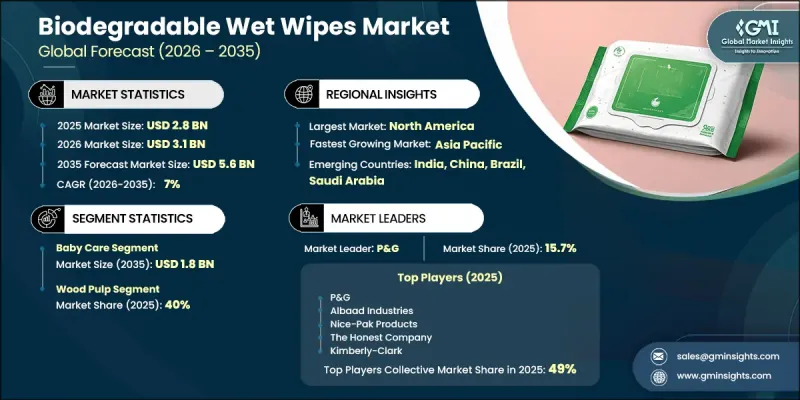
市場成長的促進因素包括:消費者對永續個人護理解決方案的需求不斷成長;人們對傳統濕紙巾相關環境問題的認知日益提高;以及可生物分解替代品在多個終端應用領域得到更廣泛的應用。為了滿足不斷變化的消費者期望和監管要求,製造商正在加速向可再生植物來源材料和可堆肥不織布轉型。永續性已成為市場的關鍵差異化因素,尤其是在個人護理和嬰兒護理領域,消費者積極尋求能夠體現環保責任並減少生態影響的產品。隨著消費者越來越偏好經過認證的環保產品,各大品牌正在投資開發可生物分解產品,並將其定位為高級產品。雖然由於特殊的原料、認證要求和生產流程的改變,可生物分解濕紙巾的製造成本通常較高,但隨著環保責任在購買決策中變得越來越重要,消費者的需求仍在持續成長。預計這些趨勢將在整個預測期內支撐市場的持續擴張。
| 市場範圍 | |
|---|---|
| 開始年份 | 2025 |
| 預測期 | 2026-2035 |
| 上市時的市場規模 | 28億美元 |
| 預計金額 | 56億美元 |
| 複合年成長率 | 7% |
嬰兒護理產業佔35%的市場佔有率,預計到2025年銷售額將達到9.84億美元。該行業持續保持領先地位,主要得益於消費者對溫和、無化學添加且環保的衛生解決方案的強烈偏好。父母們越來越重視產品的安全性、永續性和質量,這也推動了可生物分解擦拭巾在嬰兒護理領域的廣泛應用。
預計到2025年,木漿和再生纖維素材料市場將佔據40%的市場佔有率,銷售額將達到11億美元。這些材料憑藉其卓越的性能和成本效益,在家庭清潔產品、自有品牌產品和成本績效型個人護理應用領域佔據著穩固的地位。此外,消費者對優質可生物分解濕紙巾的需求也推動了先進纖維素基材料的廣泛應用,這些材料滿足了消費者對高品質、永續產品(具有卓越的柔軟性、耐用性和環境友善性)的期望。
預計2025年,北美可生物分解擦拭巾市場規模將達到7.76億美元。這一強勁的市場成長得益於消費者永續性意識的提高、環保衛生用品供應的日益豐富以及對環保零售通路投資的增加。此外,促進永續消費品普及的監管趨勢也推動了市場擴張,同時,製造商也不斷完善產品系列,以滿足不斷變化的環境和消費者期望。
目錄
第1章:調查方法和範圍
第2章執行摘要
第3章 行業洞察
- 產業生態系分析
- 供應鏈分析
- 主要原料產地
- 供應鏈風險-地理集中度與價格波動
- 2025年及以後關稅措施實施後,近岸外包與供應商多元化的發展趨勢
- 影響產業的因素
- 市場促進因素
- 歐盟一次性塑膠指令和英國塑膠擦拭巾禁令
- 消費者環保意識的增強正在推動個人護理和嬰兒護理產品的優質化。
- 新冠疫情後,人們衛生意識的提高推動了攜帶式濕紙巾持續高需求。
- 由於永續發展舉措,零售商和自有品牌正在增加可生物分解產品的貨架空間。
- 市場限制因素
- 生物分解材料比傳統合成纖維擦拭巾貴 15-25%,這阻礙了它們進入大眾市場。
- 國際認證標準的差異增加了合規負擔,並延長了產品上市時間。
- 市場機遇
- 自有品牌在生態和天然零售通路的引入正在加速,為白牌OEM 生產創造了機會。
- 飯店、餐飲服務和醫療保健產業對經認證的可生物分解擦拭巾存在尚未開發的機構需求。
- 寵物護理擦拭巾因其與可生物分解基材的兼容性,正在成為一個具有高成長潛力的利基市場。
- 市場促進因素
- 成長潛力分析
- 技術與創新展望
- 用於可生物分解基材的水針水纏結技術
- 氣流成網不織布技術
- Lyocell纖維閉合迴路纖維加工(天絲、威能)
- 生物可分解熔噴纖維和PLA纖維的進展
- 不含活性成分和防腐劑的配方創新
- 監理框架
- 歐盟一次性塑膠(SUP)指令-濕紙巾的相關規定和附表
- 英國環境保護(含塑膠濕紙巾)條例 2025
- INDA/EDANA GD4 可沖散性用品指南及「可沖散 (FTF)」認證
- EN13432 和 ASTM D6400 標準涉及生物分解性和可堆肥性。
- 美國農業部生物優先計劃和OK堆肥/奧地利TUV認證
- 亞太和拉丁美洲的新監管趨勢
- 關鍵市場趨勢與顛覆性因素
- 未來市場趨勢
- 價格分析
- 2019-2024年歷史價格趨勢分析
- 依球員類型分類的定價策略(高級球員、超值球員、成本加成球員)
- 按細分市場分類的可生物分解濕紙巾和傳統濕紙巾的價格溢價
- 貿易數據分析
- 可生物分解不織布基材及成品擦拭巾的進出口量及進口額趨勢
- 主要貿易路線及關稅影響(美中貿易、歐盟與亞洲貿易、歐盟內部貿易)
- 人工智慧和生成式人工智慧對市場的影響
- 利用人工智慧改造現有經營模式(預測需求計畫、自動化品管)
- GENAI 各細分領域的應用案例與實施藍圖(配方設計、合規文件創建、消費者教育)
- 風險、限制與監管考量(人工智慧在聲明檢驗的應用、綠色清洗風險)
- 投資與資金籌措分析
- 製造業產能資本投資趨勢
- 併購活動與策略收購模式
- 按公司規模分類的研發支出基準
- 波特的分析
- PESTLE分析
第4章 競爭情勢
- 介紹
- 企業市佔率分析
- 按地區
- 企業矩陣分析
- 主要市場公司的競爭分析
- 競爭定位矩陣
- 主要進展
- 併購
- 夥伴關係和聯盟
- 新產品發布
- 業務拓展計劃
第5章 市場估算與預測:依產品類型分類,2022-2035年
- 主要趨勢
- 嬰兒護理濕紙巾
- 換尿布/嬰兒屁股濕紙巾
- 全身及沐浴用濕紙巾
- 個人護理和衛生擦拭巾
- 臉部及卸妝濕擦拭巾
- 手部和身體擦拭巾
- 女性用及嬌嫩部位專用濕紙巾
- 家用表面清潔擦拭巾
- 多用途清潔擦拭巾
- 廚房及食品安全消毒濕擦拭巾
- 浴室清潔擦拭巾
- 醫療保健和醫用濕擦拭巾
- 用於清潔患者皮膚和創傷護理擦拭巾
- 失禁護理擦拭巾
- 醫院表面消毒濕擦拭巾
- 工業/商用擦拭巾
- 適用於餐飲服務及旅館業的擦拭巾
- 用於清潔商業設施的擦拭巾
- 寵物護理濕紙巾
- 寵物毛髮清潔濕擦拭巾
- 足部和耳部清潔濕擦拭巾
第6章 市場估算與預測:依材料與基板類型分類,2022-2035年
- 主要趨勢
- 棉花衍生
- 100% 天然棉
- 棉混紡織物(棉+木漿,棉+Lyocell纖維)
- 竹纖維底座
- 竹基粘膠纖維
- 竹纖維衍生的Lyocell纖維(閉合迴路製程)
- 木漿和再生纖維素(黏膠/Lyocell纖維)
- 木漿氣流成網
- 黏膠纖維(源自木材)
- Lyocell纖維(源自木材,例如天絲/維洛斯)
- 生物基合成替代材料(PLA)
- 聚乳酸(PLA)-源自玉米澱粉
- 聚乳酸(PLA)-源自甘蔗
- 天然纖維混合複合材料
- 竹漿+木漿混合物
- 棉+Lyocell纖維混紡
- 亞麻/粘膠纖維及其他多種纖維混紡
第7章 市場估計與預測:依可沖散性分類,2022-2035年
- 可水洗濕紙巾
- 經認證可直接沖洗(FFTF)。
- 符合印度/愛達荷州 GD4 標準
- 「可沖入馬桶」的標籤未經認證。
- 不能沖入馬桶的濕紙巾
- 可堆肥(經認證可用於工業堆肥)
- 經認證可用於家庭堆肥。
- 掩埋中的生物分解性(無需認證即可堆肥)
第8章 市場估算與預測:依最終用途分類,2022-2035年
- 住宅
- 新建工程
- 維修和改造
- 商業
- 飯店餐飲業(飯店、度假村、餐廳)
- 辦公大樓
- 零售和混合用途開發
- 醫療機構
第9章 市場估價與預測:依通路分類,2022-2035年
- 主要趨勢
- 超級市場和大賣場
- 線上零售(電子商務和D2C平台)
- 電商平台(亞馬遜、沃爾瑪、天貓)
- 品牌D2C訂閱/補充裝模式
- 藥局/藥局
- 特色/生態/天然食品店
- 便利商店和其他
第10章 市場估價與預測:依地區分類,2022-2035年
- 主要趨勢
- 北美洲
- 美國
- 加拿大
- 歐洲
- 德國
- 英國
- 法國
- 義大利
- 西班牙
- 亞太地區
- 中國
- 印度
- 日本
- 韓國
- 澳洲
- 拉丁美洲
- 巴西
- 墨西哥
- 阿根廷
- 中東和非洲
- UAE
- 沙烏地阿拉伯
- 南非
第11章:公司簡介
- 世界公司
- Procter & Gamble Co
- KimberlyClark Corporation
- NicePak Products, Inc.
- Albaad Industries(Massuot Yitzhak, Israel)
- Rockline Industries
- Essity AB
- Unicharm Corporation
- Ontex Group NV
- Abena A/S
- Ecowipes Sp. z oo
- The Clorox Company
- Eurowipes(ANJAC Group)
- LILLYDOO GmbH
- 本地公司
- Hengan International Group Co., Ltd.
- Vinda International Holdings Limited
- Natracare
- Naty AB
- Seventh Generation, Inc.
- 新興企業
- WaterWipes
- The Honest Company, Inc.
- Coterie
- Jackson Reece Ltd.
The Global Biodegradable Wet Wipes Market was valued at USD 2.8 billion in 2025 and is estimated to grow at a CAGR of 7% to reach USD 5.6 billion by 2035.
Market growth is supported by rising demand for sustainable personal care solutions, increasing awareness of environmental concerns associated with conventional wipes, and the growing adoption of biodegradable alternatives across multiple end-use categories. Manufacturers are increasingly transitioning toward renewable, plant-derived materials and compostable nonwoven substrates to meet evolving consumer expectations and regulatory requirements. Sustainability has become a key differentiating factor in the market, particularly within personal hygiene and baby care applications, where consumers are actively seeking products with verified environmental credentials and reduced ecological impact. Growing preference for certified eco-friendly products is encouraging brands to invest in biodegradable product development and premium product positioning. Although biodegradable wet wipes generally involve higher manufacturing costs due to specialized raw materials, certification requirements, and modified production processes, consumer demand continues to strengthen as environmental responsibility becomes a more influential purchasing factor. These trends are expected to support sustained market expansion throughout the forecast period.
| Market Scope | |
|---|---|
| Start Year | 2025 |
| Forecast Year | 2026-2035 |
| Start Value | $2.8 Billion |
| Forecast Value | $5.6 Billion |
| CAGR | 7% |
The baby care segment held a 35% share, generating USD 984 million in 2025. Continued leadership within this category is driven by strong consumer preference for gentle, chemical-free, skin-friendly, and environmentally conscious hygiene solutions. Parents are increasingly prioritizing product safety, sustainability, and quality, contributing to the growing adoption of biodegradable wipes across the baby care sector.
The wood pulp and regenerated cellulose materials segment accounted for 40% share, generating USD 1.1 billion in 2025. These materials maintain a strong position across household cleaning products, private-label offerings, and value-oriented personal care applications due to their favorable performance characteristics and cost efficiency. Demand for premium biodegradable wipes is also supporting increased use of advanced cellulose-based materials that provide enhanced softness, durability, and environmental compatibility while meeting consumer expectations for high-quality sustainable products.
North America Biodegradable Wet Wipes Market generated USD 776 million in 2025. Strong market growth is driven by increasing consumer awareness of sustainability issues, expanding availability of environmentally friendly hygiene products, and growing investments in eco-focused retail distribution channels. Regulatory developments encouraging the adoption of sustainable consumer products are also contributing to market expansion, while manufacturers continue to strengthen product portfolios to address evolving environmental and consumer expectations.
Major participants operating in the global biodegradable wet wipes market include The Clorox Company, Nice-Pak Products, Inc., Kimberly-Clark Corporation, Essity AB, Procter & Gamble Co., Rockline Industries, Albaad Industries, Ontex Group NV, Unicharm Corporation, Ecowipes Sp. z o.o., Abena A/S, Eurowipes (ANJAC Group), LILLYDOO GmbH, Vinda International Holdings Limited, Hengan International Group Co., Ltd., Natracare, Naty AB, Seventh, WaterWipes, The Honest Company, Inc., Coterie, and Jackson Reece Ltd. Companies operating in the biodegradable wet wipes market are adopting several strategic initiatives to strengthen their market position and expand their customer base. Product innovation remains a major focus, with manufacturers investing in advanced biodegradable materials, plant-based fibers, and sustainable formulations to meet changing consumer preferences. Many companies are expanding their portfolios with premium eco-friendly products that emphasize environmental responsibility and product performance. Strategic partnerships, acquisitions, and collaborations are also being utilized to enhance manufacturing capabilities and improve market reach. Investments in sustainable packaging, supply chain optimization, and environmentally responsible production processes continue to gain importance.
Table of Contents
Chapter 1 Methodology & Scope
- 1.1 Research approach
- 1.2 Quality Commitments
- 1.2.1 GMI AI policy & data integrity commitment
- 1.2.1.1 Source consistency protocol
- 1.2.1 GMI AI policy & data integrity commitment
- 1.3 Research Trail & Confidence Scoring
- 1.3.1 Research Trail Components
- 1.3.2 Scoring Components
- 1.4 Data Collection
- 1.4.1 Partial list of primary sources
- 1.5 Data mining sources
- 1.5.1 Paid sources
- 1.5.1.1 Sources, by region
- 1.5.1 Paid sources
- 1.6 Base estimates and calculations
- 1.6.1 Base year calculation for any one approach
- 1.7 Forecast model
- 1.7.1 Quantified market impact analysis
- 1.7.1.1 Mathematical impact of growth parameters on forecast
- 1.7.1 Quantified market impact analysis
- 1.8 Research transparency addendum
- 1.8.1 Source attribution framework
- 1.8.2 Quality assurance metrics
- 1.8.2.1 Our commitment to trust
Chapter 2 Executive Summary
- 2.1 Industry 360° synopsis, 2022 - 2035
- 2.2 Key market trends
- 2.2.1 Region
- 2.2.2 Product type
- 2.2.3 Material and substrate type
- 2.2.4 Flushability
- 2.2.5 Distribution channel
Chapter 3 Industry Insights
- 3.1 Industry ecosystem analysis
- 3.2 Supply chain analysis
- 3.2.1 Key Raw Material Sourcing Geography
- 3.2.2 Supply Chain Risks - Geographic Concentration & Price Volatility
- 3.2.3 Nearshoring & Supplier Diversification Trends Post-2025 Tariffs
- 3.3 Industry impact forces
- 3.3.1 Market drivers
- 3.3.1.1 EU single-use plastics directive & UK plastic wipes ban
- 3.3.1.2 Rising consumer environmental awareness driving premiumization of personal care & baby care routines
- 3.3.1.3 Post-COVID hygiene consciousness sustaining elevated demand for on-the-go wipes
- 3.3.1.4 Retailer & private label sustainability commitments expanding shelf space for biodegradable SKUS
- 3.3.2 Market restraints
- 3.3.2.1 15-25% cost premium of biodegradable substrates vs. conventional synthetic fiber wipes constraining mass market penetration
- 3.3.2.2 Fragmented international certification standards increasing compliance burden & time to market
- 3.3.3 Market opportunities
- 3.3.3.1 Accelerating private-label adoption in eco & natural retail channels, creating white-label OEM manufacturing opportunity
- 3.3.3.2 Untapped institutional demand in hospitality, food service & healthcare for certified biodegradable wipes
- 3.3.3.3 Pet care wipes are emerging with a high growth niche with favorable biodegradable substrate alignment
- 3.3.1 Market drivers
- 3.4 Growth potential analysis
- 3.5 Technology & innovation landscape
- 3.5.1 Spun lace Hydroentanglement Technology for Biodegradable Substrates
- 3.5.2 Air laid Nonwoven Technology
- 3.5.3 Lyocell Closed Loop Fiber Processing (Tencel, Veocel)
- 3.5.4 Biodegradable Melt Blown & PLA Fiber Advances
- 3.5.5 Active Ingredient & Preservative Free Formulation Innovation
- 3.6 Regulatory framework
- 3.6.1 EU Single Use Plastics (SUP) Directive - Wipes Provisions & Timeline
- 3.6.2 UK Environmental Protection (Wet Wipes Containing Plastic) Regulations 2025
- 3.6.3 INDA/EDANA GD4 Flushability Guidelines & Fine to Flush (FTF) Certification
- 3.6.4 EN13432 & ASTM D6400 Biodegradability & Composability Standards
- 3.6.5 USDA Bio Preferred Program & OK Compost / TUV AUSTRIA Certification
- 3.6.6 Emerging Regulations - Asia Pacific & Latin America
- 3.7 Major market trends and disruptions
- 3.8 Future market trends
- 3.9 Pricing analysis (driven by primary research)
- 3.9.1 Historical price trend analysis (2019-2024) (driven by primary research)
- 3.9.2 Pricing strategy by player type (premium/value/cost-plus) (driven by primary research)
- 3.9.3 Price premium of biodegradable vs. Conventional wet wipes by segment (driven by primary research)
- 3.10 Trade data analysis (driven by primary research)
- 3.10.1 Import/export volume & value trends - biodegradable nonwoven substrates & finished wipes (driven by primary research)
- 3.10.2 Key trade corridors & tariff impact (US-China, EU-Asia, intra-EU) (driven by primary research)
- 3.11 Impact of AI & generative AI on the market
- 3.11.1 AI-driven disruption of existing business models (predictive demand planning, automated quality control)
- 3.11.2 GENAI use cases & adoption roadmap by segment (formulation design, compliance documentation, consumer education)
- 3.11.3 Risks, limitations & regulatory considerations (AI in claims validation, greenwashing risk)
- 3.12 Investment & funding analysis
- 3.12.1 Capital Investment Trends in Manufacturing Capacity
- 3.12.2 M&A Activity & Strategic Acquisition Patterns
- 3.12.3 R&D Expenditure Benchmarks by Company Tier
- 3.13 Porter's analysis
- 3.14 PESTEL analysis
Chapter 4 Competitive Landscape, 2025
- 4.1 Introduction
- 4.2 Company market share analysis
- 4.2.1 By Region
- 4.2.1.1 North America
- 4.2.1.2 Europe
- 4.2.1.3 Asia Pacific
- 4.2.1.4 Latin America
- 4.2.1.5 Middle East and Africa
- 4.2.1 By Region
- 4.3 Company matrix analysis
- 4.4 Competitive analysis of major market players
- 4.5 Competitive positioning matrix
- 4.6 Key developments
- 4.6.1 Mergers & acquisitions
- 4.6.2 Partnerships & collaborations
- 4.6.3 New product launches
- 4.6.4 Expansion plans
Chapter 5 Market Estimates and Forecast, By Product type, 2022 - 2035 (USD Billion) (Thousand Units)
- 5.1 Key Trends
- 5.2 Baby Care Wipes
- 5.2.1 Diapering & Bottom Wipes
- 5.2.2 Full-Body & Bath Wipes
- 5.2.3 Personal Care & Hygiene Wipes
- 5.2.4 Facial & Makeup Remover Wipes
- 5.3 Hand & Body Wipes
- 5.3.1 Feminine & Intimate Hygiene Wipes
- 5.3.2 Household & Surface Cleaning Wipes
- 5.3.3 Multi-Surface Cleaning Wipes
- 5.3.4 Kitchen & Food-Safe Disinfectant Wipes
- 5.4 Bathroom Cleaning Wipes
- 5.4.1 Healthcare & Medical Wipes
- 5.4.2 Patient Skin Prep & Wound Care Wipes
- 5.4.3 Incontinence Management Wipes
- 5.4.4 Hospital Surface Sanitization Wipes
- 5.5 Industrial & Institutional Wipes
- 5.5.1 Food Service & Hospitality Wipes
- 5.5.2 Commercial Facility & Janitorial Wipes
- 5.6 Pet Care Wipes
- 5.6.1 Grooming & Coat Cleaning Wipes
- 5.6.2 Paw & Ear Cleaning Wipes
Chapter 6 Market Estimates and Forecast, By Material and Substrate Type, 2022 - 2035 (USD Billion) (Thousand Units)
- 6.1 Key Trends
- 6.2 Cotton-Based
- 6.2.1 100% Natural Cotton
- 6.2.2 Cotton Blends (Cotton + Wood Pulp, Cotton + Lyocell)
- 6.3 Bamboo Fiber-Based
- 6.3.1 Bamboo Viscose
- 6.3.2 Bamboo Lyocell (Closed-Loop Process)
- 6.4 Wood Pulp & Regenerated Cellulose (Viscose/Lyocell)
- 6.4.1 Wood Pulp Air-Laid
- 6.4.2 Viscose (Wood-Derived)
- 6.4.3 Lyocell (Wood-Derived, E.G., Tencel/Veloce)
- 6.5 Biobased Synthetic Alternatives (PLA)
- 6.5.1 Polylactic Acid (PLA)- Corn Starch Derived
- 6.5.2 Polylactic Acid (PLA) - Sugarcane-Derived
- 6.6 Blended Natural Fiber Composites
- 6.6.1 Bamboo + Wood Pulp Blends
- 6.6.2 Cotton + Lyocell Blends
- 6.6.3 Flax/Viscose & Other Multifiber Blends
Chapter 7 Market Estimates and Forecast, By Flushability, 2022 - 2035 (USD Billion) (Thousand Units)
- 7.1 Key trends
- 7.2 Flushable wipes
- 7.2.1 Fine to flush (FFTF) certified
- 7.2.2 Inda/Edana gd4 compliant
- 7.2.3 Noncertified flushable claims
- 7.3 Non flushable wipes
- 7.3.1 Compostable (industrial composting certified)
- 7.3.2 Home compostable certified
- 7.3.3 Landfill biodegradable (noncertified compostable)
Chapter 8 Market Estimates and Forecast, By End Use, 2022 - 2035 (USD Billion) (Thousand Units)
- 8.1 Key trends
- 8.2 Residential
- 8.2.1 New Construction
- 8.2.2 Renovation & Replacement
- 8.3 Commercial
- 8.3.1 Hospitality (Hotels, Resorts, Restaurants)
- 8.3.2 Office Buildings
- 8.3.3 Retail & Mixed-use Developments
- 8.3.4 Healthcare Facilities
Chapter 9 Market Estimates and Forecast, By Distribution Channel, 2022 - 2035 (USD Billion) (Thousand Units)
- 9.1 Key Trends
- 9.2 Supermarkets & Hypermarkets
- 9.3 Online Retail (Ecommerce & D2c Platforms)
- 9.3.1 Marketplace Platforms (Amazon, Walmart.Com, Tmall)
- 9.3.2 Brand D2c Subscription & Refill Models
- 9.4 Pharmacies & Drug Stores
- 9.5 Specialty & Eco/Natural Product Stores
- 9.6 Convenience Stores & Others
Chapter 10 Market Estimates & Forecast, By Region, 2022 - 2035, (USD Billion) (Thousand Units)
- 10.1 Key Trends
- 10.2 North America
- 10.2.1 U.S.
- 10.2.2 Canada
- 10.3 Europe
- 10.3.1 Germany
- 10.3.2 U.K.
- 10.3.3 France
- 10.3.4 Italy
- 10.3.5 Spain
- 10.4 Asia Pacific
- 10.4.1 China
- 10.4.2 India
- 10.4.3 Japan
- 10.4.4 South Korea
- 10.4.5 Australia
- 10.5 Latin America
- 10.5.1 Brazil
- 10.5.2 Mexico
- 10.5.3 Argentina
- 10.6 MEA
- 10.6.1 UAE
- 10.6.2 Saudi Arabia
- 10.6.3 South Africa
Chapter 11 Company Profiles
- 11.1 Global Companies
- 11.1.1 Procter & Gamble Co
- 11.1.2 KimberlyClark Corporation
- 11.1.3 NicePak Products, Inc.
- 11.1.4 Albaad Industries (Massuot Yitzhak, Israel)
- 11.1.5 Rockline Industries
- 11.1.6 Essity AB
- 11.1.7 Unicharm Corporation
- 11.1.8 Ontex Group NV
- 11.1.9 Abena A/S
- 11.1.10 Ecowipes Sp. z o.o.
- 11.1.11 The Clorox Company
- 11.1.12 Eurowipes (ANJAC Group)
- 11.1.13 LILLYDOO GmbH
- 11.2 Regional Companies
- 11.2.1 Hengan International Group Co., Ltd.
- 11.2.2 Vinda International Holdings Limited
- 11.2.3 Natracare
- 11.2.4 Naty AB
- 11.2.5 Seventh Generation, Inc.
- 11.3 Emerging Companies
- 11.3.1 WaterWipes
- 11.3.2 The Honest Company, Inc.
- 11.3.3 Coterie
- 11.3.4 Jackson Reece Ltd.

 清潔、擦洗和擦拭市場—2026-2032年全球市場預測不織布擦拭巾市場-2026-2032年全球市場預測濕紙巾市場-2026-2032年全球市場預測擦拭巾市場:2026-2032年全球市場預測(依產品種類、材料類型、用途、最終用途及通路分類)
 2026 年至 2035 年可閃濕擦拭巾的市場機會、成長促進因素、產業趨勢分析與預測。
 擦拭巾市場-全球產業規模、佔有率、趨勢、機會和預測:按產品類型、銷售管道、地區和競爭格局分類,2021-2031年
 砂布市場:依產品類型、材料類型、最終用戶和地區分類。
 濕紙巾市場規模、佔有率、成長及全球產業分析:按類型和應用分類,區域洞察及2026-2034年預測濕紙巾市場機會、成長要素、產業趨勢分析及2026年至2035年預測純水可沖洗擦拭巾市場:按產品類型、材料、包裝類型、價格範圍、最終用戶和分銷管道分類,全球預測(2026-2032年)