


 |
市場調查報告書
商品編碼
2083089
碳負排放肥料市場機會、成長要素、產業趨勢分析及2026-2035年預測。Carbon-Negative Fertilizers (Biochar-Based) Market Opportunity, Growth Drivers, Industry Trend Analysis, and Forecast 2026 - 2035 |
||||||

全球碳負肥(生物炭基)市場預計到 2025 年價值 33 億美元,預計到 2035 年將以 16.6% 的複合年成長率成長至 184 億美元。
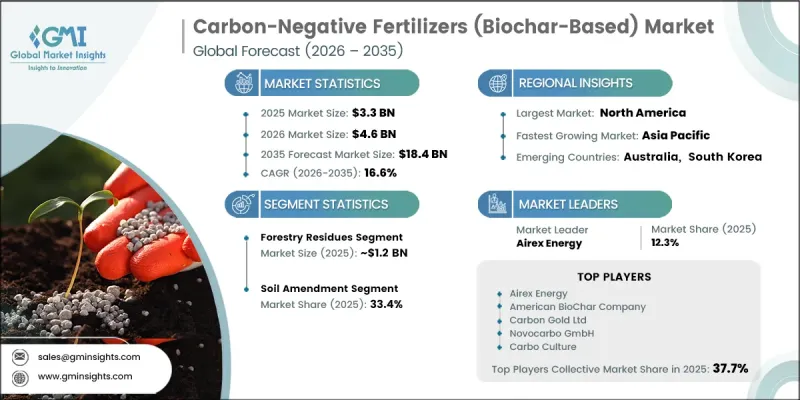
碳負排放肥料(生物炭基肥料)市場的成長得益於先進農業技術的融合、有利的碳管理政策以及主要農業經濟體對再生農業方法的日益普及。隨著碳計量和認證法律規範的不斷完善,生物炭基肥料不僅因其農業化學效益而備受認可,也因其對長期碳封存目標的貢獻而日益受到重視。對環境友善農業生產日益成長的需求以及對永續供應鏈的關注進一步推動了市場接受度。食品、飼料和能源產業正日益尋求符合碳減排目標的農業投入品,這為生物炭基產品創造了新的商機。同時,該產業也面臨與大規模生產相關的營運挑戰,包括巨額資本投資、高能耗加工、原料管理以及嚴格的品質保證標準。儘管存在這些挑戰,但對氣候智慧型農業和可衡量的碳減排成果的日益關注仍在持續推動全球市場的發展勢頭。
| 市場範圍 | |
|---|---|
| 開始年份 | 2025 |
| 預測期 | 2026-2035 |
| 初始市場規模 | 33億美元 |
| 預計金額 | 184億美元 |
| 複合年成長率 | 16.6% |
林業衍生原料佔了36.2%的市場佔有率,預計到2025年銷售額將達到12億美元。該細分市場的主導地位歸功於其能夠生產性能優異、高度穩定的富碳生物炭。經濟實惠的生質能資源及其適合大規模加工的特性,推動了生物炭商業性化生產的持續強勁成長。
至2025年,土壤改良領域將佔33.4%的市佔率。生物炭基肥料因其具有提高土壤保水性、維持土壤平衡、促進有益生物活性和提高養分利用效率等特性,繼續被廣泛用於土壤改良。這些性能優勢正推動著致力於提高土壤生產力和實現長期土地管理目標的農業企業採用生物炭。
預計到2025年,北美碳負排放肥料(生物炭基肥料)市佔率將達到48.8%。該地區受益於強大的商業生產商網路、完善的排碳權體係以及對永續農業舉措的大力支持。政府支持的保護項目和環境永續性措施持續推動農業領域的應用。經濟效益顯著的排碳權機會進一步提升了市場成長潛力,而生物炭基產品日益融入標準農業實踐,則反映出該地區市場發展已進入成熟階段。
目錄
第1章:調查方法和範圍
第2章執行摘要
第3章 行業洞察
- 產業生態系分析
- 供應商情況
- 利潤率
- 每個階段增加的價值
- 影響價值鏈的因素
- 中斷
- 影響產業的因素
- 促進因素
- 對碳負排放農業解決方案的需求日益成長
- 擴大政府對碳封存技術的獎勵
- 提高有機食品產量和永續農業實踐
- 產業潛在風險與挑戰
- 高昂的生產和零售成本阻礙了其廣泛應用。
- 由於原料和製作流程。
- 市場機遇
- 進入新興農業市場
- 開發一種含有生物炭的緩效性肥料
- 促進因素
- 成長潛力分析
- 監理情勢
- 波特的分析
- PESTLE分析
- 價格趨勢
- 按地區
- 依原料類型
- 未來市場趨勢
- 技術與創新展望
- 最新科技趨勢
- 新興技術
- 專利趨勢
- 貿易統計
- 主要進口國
- 主要出口國
- 永續性和環境方面
- 永續計劃
- 減少廢棄物策略
- 生產中的能源效率
- 具有環保意識的舉措
- 考慮碳足跡
第4章 競爭情勢
- 介紹
- 企業市佔率分析
- 按地區
- 北美洲
- 歐洲
- 亞太地區
- LATAM
- 中東和非洲
- 按地區
- 主要市場公司的競爭分析
- 競爭定位矩陣
- 主要進展
- 併購
- 夥伴關係和聯盟
- 新產品發布
- 業務拓展計劃
第5章 市場估算與預測:依原料類型分類,2022-2035年
- 農業廢棄物
- 林業剩餘物
- 牲畜糞便
- 有機城市廢棄物
- 工業生質能
第6章 市場估計與預測:依應用領域分類,2022-2035年
- 土壤改良劑
- 提高作物營養水平
- 二氧化碳分離
- 廢棄物管理
第7章 市場估計與預測:依作物類型分類,2022-2035年
- 穀類和穀類食品
- 小麥
- 米
- 玉米
- 大麥
- 水果和蔬菜
- 水果作物
- 蔬菜作物
- 漿果種植
- 油籽
- 大豆
- 菜籽
- 向日葵
- 園藝作物
- 其他
第8章 市場估計與預測:依地區分類,2022-2035年
- 北美洲
- 美國
- 加拿大
- 歐洲
- 德國
- 英國
- 法國
- 西班牙
- 義大利
- 其他歐洲國家
- 亞太地區
- 中國
- 印度
- 日本
- 澳洲
- 韓國
- 其他亞太國家
- 拉丁美洲
- 巴西
- 墨西哥
- 阿根廷
- 其他拉丁美洲國家
- 中東和非洲
- 沙烏地阿拉伯
- 南非
- UAE
- 其他中東和非洲國家
第9章:公司簡介
- Airex Energy
- American BioChar Company
- Applied Carbon
- Arsta Eco Pvt Ltd
- Biochar Industries
- Biochar Ireland
- Black Owl Biochar
- Carbo Culture
- Carbofex Ltd
- Carbon Gold Ltd
- NetZero
- Novocarbo GmbH
- Pacific Biochar
- Sonnenerde GmbH
- Takachar
The Global Carbon-Negative Fertilizers (Biochar-Based) Market was valued at USD 3.3 billion in 2025 and is estimated to grow at a CAGR of 16.6% to reach USD 18.4 billion by 2035.
Growth in the Carbon-Negative Fertilizers (Biochar-Based) Market is supported by the convergence of advanced agricultural technologies, favorable carbon management policies, and the increasing adoption of regenerative farming practices across major agricultural economies. As regulatory frameworks for carbon accounting and certification continue to evolve, biochar-based fertilizers are gaining recognition not only for their agronomic benefits but also for their contribution to long-term carbon sequestration objectives. Rising demand for environmentally responsible agricultural production and expanding interest in sustainable supply chains are further strengthening market adoption. Food, feed, and energy-related industries are increasingly seeking agricultural inputs that align with carbon reduction goals, creating new commercial opportunities for biochar-based products. At the same time, the industry faces operational challenges associated with large-scale production, including substantial capital investment requirements, energy-intensive processing, feedstock management, and stringent quality assurance standards. Despite these factors, growing emphasis on climate-smart agriculture and measurable carbon reduction outcomes continues to support strong market momentum worldwide.
| Market Scope | |
|---|---|
| Start Year | 2025 |
| Forecast Year | 2026-2035 |
| Start Value | $3.3 Billion |
| Forecast Value | $18.4 Billion |
| CAGR | 16.6% |
The forestry-derived feedstocks segment held a 36.2% share, generating USD 1.2 billion in 2025. Its leadership position is attributed to the ability to produce highly stable carbon-rich biochar with favorable performance characteristics. The availability of cost-effective biomass resources and their suitability for large-scale processing continue to support strong adoption within commercial biochar production operations.
The soil amendment segment captured 33.4% share in 2025. Biochar-based fertilizers continue to be widely utilized for soil enhancement purposes due to their ability to improve moisture retention, support balanced soil conditions, encourage beneficial biological activity, and increase nutrient accessibility. These performance benefits have contributed to widespread adoption across agricultural operations focused on improving soil productivity and long-term land management outcomes.
North America Carbon-Negative Fertilizers (Biochar-Based) Market held 48.8% share in 2025. The region benefits from a strong presence of commercial producers, established carbon credit ecosystems, and significant institutional support for sustainable agricultural initiatives. Government-backed conservation programs and environmental sustainability efforts continue to encourage adoption across the agricultural sector. The availability of economically attractive carbon credit opportunities further enhances market growth potential, while increasing integration of biochar-based products into standard farming practices reflects the region's advanced stage of market development.
Key participants operating in the Global Carbon-Negative Fertilizers (Biochar-Based) Market include Carbon Gold Ltd, Airex Energy, American BioChar Company, Applied Carbon, Arsta Eco Pvt Ltd, Biochar Industries, Carbo Culture, Biochar Ireland, Black Owl Biochar, Carbofex Ltd, NetZero, Novocarbo GmbH, Pacific Biochar, Sonnenerde GmbH, and Takachar. Companies active in the Carbon-Negative Fertilizers (Biochar-Based) Market are pursuing a range of strategies to strengthen their market position and expand commercial opportunities. A major focus remains on increasing production capacity and improving process efficiency to reduce manufacturing costs and support large-scale deployment. Many market participants are investing in advanced biochar technologies, feedstock optimization, and product innovation to enhance performance and meet evolving customer requirements. Strategic partnerships with agricultural organizations, carbon credit developers, and sustainability-focused stakeholders are helping companies expand market reach and accelerate adoption. Businesses are also emphasizing carbon certification, traceability systems, and environmental validation programs to strengthen product credibility.
Table of Contents
Chapter 1 Methodology & Scope
- 1.1 Research approach
- 1.2 Quality Commitments
- 1.2.1 GMI AI policy & data integrity commitment
- 1.2.1.1 Source consistency protocol
- 1.2.1 GMI AI policy & data integrity commitment
- 1.3 Research Trail & Confidence Scoring
- 1.3.1 Research Trail Components
- 1.3.2 Scoring Components
- 1.4 Data Collection
- 1.4.1 Partial list of primary sources
- 1.5 Data mining sources
- 1.5.1 Paid sources
- 1.5.1.1 Sources, by region
- 1.5.1 Paid sources
- 1.6 Base estimates and calculations
- 1.6.1 Base year calculation for any one approach
- 1.7 Forecast model
- 1.7.1 Quantified market impact analysis
- 1.7.1.1 Mathematical impact of growth parameters on forecast
- 1.7.1 Quantified market impact analysis
- 1.8 Research transparency addendum
- 1.8.1 Source attribution framework
- 1.8.2 Quality assurance metrics
- 1.8.3 Our commitment to trust
Chapter 2 Executive Summary
- 2.1 Industry 360° synopsis
- 2.2 Key market trends
- 2.2.1 Regional
- 2.2.2 Feedstock type
- 2.2.3 Application
- 2.2.4 Crop type
Chapter 3 Industry Insights
- 3.1 Industry ecosystem analysis
- 3.1.1 Supplier landscape
- 3.1.2 Profit margin
- 3.1.3 Value addition at each stage
- 3.1.4 Factor affecting the value chain
- 3.1.5 Disruptions
- 3.2 Industry impact forces
- 3.2.1 Growth drivers
- 3.2.1.1 Growing demand for carbon-negative agriculture solutions
- 3.2.1.2 Increasing government incentives for carbon sequestration technologies
- 3.2.1.3 Rising organic food production & sustainable farming practices
- 3.2.2 Industry pitfalls and challenges
- 3.2.2.1 High production & retail costs limiting adoption
- 3.2.2.2 Product inconsistency due to variable feedstock & processing
- 3.2.3 Market opportunities
- 3.2.3.1 Expansion into emerging agricultural markets
- 3.2.3.2 Development of biochar-enhanced controlled-release fertilizers
- 3.2.1 Growth drivers
- 3.3 Growth potential analysis
- 3.4 Regulatory landscape
- 3.4.1 North America
- 3.4.2 Europe
- 3.4.3 Asia Pacific
- 3.4.4 Latin America
- 3.4.5 Middle East & Africa
- 3.5 Porter's analysis
- 3.6 PESTEL analysis
- 3.7 Price trends
- 3.7.1 By region
- 3.7.2 By feedstock type
- 3.8 Future market trends
- 3.9 Technology and innovation landscape
- 3.9.1 Current technological trends
- 3.9.2 Emerging technologies
- 3.10 Patent Landscape
- 3.11 Trade statistics (HS code)
- 3.11.1 Major importing countries
- 3.11.2 Major exporting countries
- 3.12 Sustainability and environmental aspects
- 3.12.1 Sustainable practices
- 3.12.2 Waste reduction strategies
- 3.12.3 Energy efficiency in production
- 3.12.4 Eco-friendly initiatives
- 3.13 Carbon footprint consideration
Chapter 4 Competitive Landscape, 2025
- 4.1 Introduction
- 4.2 Company market share analysis
- 4.2.1 By region
- 4.2.1.1 North America
- 4.2.1.2 Europe
- 4.2.1.3 Asia Pacific
- 4.2.1.4 LATAM
- 4.2.1.5 MEA
- 4.2.1 By region
- 4.3 Competitive analysis of major market players
- 4.4 Competitive positioning matrix
- 4.5 Key developments
- 4.5.1 Mergers & acquisitions
- 4.5.2 Partnerships & collaborations
- 4.5.3 New Product Launches
- 4.5.4 Expansion Plans
Chapter 5 Market Estimates and Forecast, By Feedstock Type, 2022-2035 (USD Billion) (Kilo Tons)
- 5.1 Key trends
- 5.2 Agricultural waste
- 5.3 Forestry residues
- 5.4 Animal manure
- 5.5 Organic municipal waste
- 5.6 Industrial biomass
Chapter 6 Market Estimates and Forecast, By Application, 2022-2035 (USD Billion) (Kilo Tons)
- 6.1 Key trends
- 6.2 Soil amendment
- 6.3 Crop nutrient enhancement
- 6.4 Carbon sequestration
- 6.5 Waste management
Chapter 7 Market Estimates and Forecast, By Crop Type, 2022-2035 (USD Billion) (Kilo Tons)
- 7.1 Key trends
- 7.2 Cereals & grains
- 7.2.1 Wheat
- 7.2.2 Rice
- 7.2.3 Corn
- 7.2.4 Barley
- 7.3 Fruits & vegetables
- 7.3.1 Orchard crops
- 7.3.2 Vegetable crops
- 7.3.3 Berry cultivation
- 7.4 Oilseeds
- 7.4.1 Soybean
- 7.4.2 Canola
- 7.4.3 Sunflower
- 7.5 Horticulture crops
- 7.6 Others
Chapter 8 Market Estimates and Forecast, By Region, 2022-2035 (USD Billion) (Kilo Tons)
- 8.1 Key trends
- 8.2 North America
- 8.2.1 U.S.
- 8.2.2 Canada
- 8.3 Europe
- 8.3.1 Germany
- 8.3.2 UK
- 8.3.3 France
- 8.3.4 Spain
- 8.3.5 Italy
- 8.3.6 Rest of Europe
- 8.4 Asia Pacific
- 8.4.1 China
- 8.4.2 India
- 8.4.3 Japan
- 8.4.4 Australia
- 8.4.5 South Korea
- 8.4.6 Rest of Asia Pacific
- 8.5 Latin America
- 8.5.1 Brazil
- 8.5.2 Mexico
- 8.5.3 Argentina
- 8.5.4 Rest of Latin America
- 8.6 Middle East and Africa
- 8.6.1 Saudi Arabia
- 8.6.2 South Africa
- 8.6.3 UAE
- 8.6.4 Rest of Middle East and Africa
Chapter 9 Company Profiles
- 9.1 Airex Energy
- 9.2 American BioChar Company
- 9.3 Applied Carbon
- 9.4 Arsta Eco Pvt Ltd
- 9.5 Biochar Industries
- 9.6 Biochar Ireland
- 9.7 Black Owl Biochar
- 9.8 Carbo Culture
- 9.9 Carbofex Ltd
- 9.10 Carbon Gold Ltd
- 9.11 NetZero
- 9.12 Novocarbo GmbH
- 9.13 Pacific Biochar
- 9.14 Sonnenerde GmbH
- 9.15 Takachar

 炭市場-2026-2032年全球市場預測
 木炭市場規模、佔有率和趨勢分析報告:按產品、應用、地區和細分市場預測(2026-2033 年)
 煤球市場-全球產業規模、佔有率、趨勢、機會、預測:組成、應用、區域及競爭格局(2021-2031年)
 2026年全球椰子木炭燒烤煤球市場報告
 木炭壓塊市場:依產品類型、原料、應用、通路和地區分類
 木炭:市場佔有率分析、行業趨勢和統計數據、成長預測(2026-2031)2026年全球燒烤木炭市場報告木炭煤球市場-全球產業規模、佔有率、趨勢、機會、預測:按類型、應用、等級、分銷管道、地區和競爭格局分類,2021-2031年酒桶市場 - 全球產業規模、佔有率、趨勢、機會、預測:按類型、應用、地區和競爭格局分類,2021-2031年全球全天然燒烤木炭市場:依產品類型、原料、包裝、應用及通路分類,2026-2032年預測