


 |
市場調查報告書
商品編碼
2083074
涵蓋作物播種機的市場機會、成長要素、產業趨勢分析及 2026-2035 年預測。Cover Crop Seeders Market Opportunity, Growth Drivers, Industry Trend Analysis, and Forecast 2026 - 2035 |
||||||

預計到 2025 年,全球覆蓋作物播種機市場價值將達到 6.029 億美元,年複合成長率為 5.4%,到 2035 年將達到 10.3 億美元。
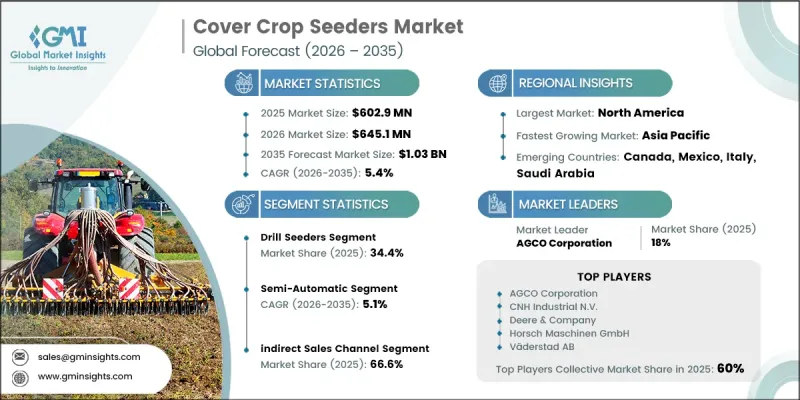
全球覆蓋作物播種機市場的成長主要得益於對機械化土壤健康管理解決方案的持續需求,尤其是在北美和歐洲。現代農業實踐正穩步從集約化犁地和單一作物種植轉向綜合土壤管理系統,使得覆蓋作物種植成為商業農業中日益重要的組成部分。政府的支持性政策、以保護為重點的農業項目以及越來越多的科學證據強調了土壤健康的長期益處,這些因素持續推動對專用播種設備的投資。此外,不斷變化的環境法規和自願性碳排放舉措已使覆蓋作物種植從一種有限的耕作方式轉變為一種被廣泛採用的永續農業方法。已開發農業市場勞動力短缺和人事費用上升進一步加速了機械化播種技術的應用。隨著種植者尋求提高作業效率、降低生產成本並保持穩定的田間產量,預計在整個預測期內,對先進覆蓋作物播種機的需求將保持強勁。
| 市場範圍 | |
|---|---|
| 開始年份 | 2025 |
| 預測期 | 2026-2035 |
| 上市時的市場規模 | 6.029億美元 |
| 預計金額 | 10.3億美元 |
| 複合年成長率 | 5.4% |
到2025年,條播機將佔據34.4%的市場。這類機器旨在犁地和犁地中以一致的深度播種,從而促進種子與土壤的最佳接觸,並提高作物出苗率。它們能夠實現均勻的播種效果,因此成為大規模商業農業的首選,因為在大規模商業農業中,播種精度、工作效率和作物出苗率對於最大限度地提高生產力至關重要。
預計到2025年,半自動播種機市佔率將達到49.6%,並在2035年之前以5.1%的複合年成長率成長。半自動播種系統可自動完成種子稱重、播種深度控制和地塊管理等關鍵播種功能,同時允許操作人員自主導航田間作業並做出操作決策。此細分市場提供豐富的設備選擇,從配備標準播種量控制的基本型曳引機式播種機,到整合GPS並相容於精密農業技術的先進系統,在自動化程度、操作柔軟性和經濟性之間實現了有效平衡。
預計到2025年,北美覆蓋作物播種機市佔率將達到31%,並在2026年至2035年間以5.4%的複合年成長率成長。區域需求持續受到以保護為重點的農業舉措、財政獎勵計劃以及永續農業實踐日益普及的支撐。政府主導的土壤保護和養分管理計畫不斷鼓勵農民投資購買覆蓋作物播種設備,同時,人們對長期土壤生產力和環境保護意識的提高也進一步促進了全部區域的市場成長。
目錄
第1章:調查方法和範圍
第2章執行摘要
第3章 行業洞察
- 產業生態系分析
- 供應商情況
- 利潤率
- 每個階段增加的價值
- 影響價值鏈的因素
- 影響產業的因素
- 促進因素
- 永續農業正變得越來越普及。
- 農業部門人手不足
- 精密農業的擴展
- 產業潛在風險與挑戰
- 高初始資本投入
- 業務複雜性
- 機會
- 技術創新
- 與多功能設備整合
- 促進因素
- 成長潛力分析
- 監理框架
- 美國農業部自然資源保護局涵蓋作物計畫要求和支付結構(北美)
- 歐盟綠色交易和通用農業政策(CAP)下強制使用覆蓋作物(歐洲)
- 有關土壤健康和水質的區域和國家法規
- 區域設備安全標準和認證要求
- 價格分析
- 2022-2025年歷史價格趨勢分析
- 依球員類型分類的定價策略(高級球員、超值球員、成本加成球員)
- 按產品類型和自動化程度分類的價格基準。
- 租賃/租約費用趨勢與直接購買價格的比較
- 貿易數據分析
- 進出口量及進口額趨勢
- 主要貿易路線及關稅的影響
- 人工智慧和生成式人工智慧對市場的影響
- 利用人工智慧改造現有經營模式
- 按細分市場分類的生成式人工智慧用例和部署藍圖
- 關於人工智慧驅動的種子系統的風險、限制和監管考慮因素。
- 生產能力和生產情況
- 按地區和主要生產商分類的已安裝製造能力
- 運轉率和擴張計劃
第4章 競爭情勢
- 介紹
- 企業市佔率分析
- 按地區
- 企業矩陣分析
- 主要市場公司的競爭分析
- 競爭定位矩陣
- 主要進展
- 併購
- 夥伴關係和聯盟
- 新產品發布
- 業務拓展計劃
第5章 市場估算與預測:依產品類型分類,2022-2035年
- 鑽孔播種機
- 氣動式播種機
- 撒播式播種機
- 播種機間系統
- 空中/無人機播種機
第6章 市場估價與預測:依安裝類型分類,2022-2035年
- 聯結機式
- 牽引式/拖曳式
- 自推進式
- 整合工作設備
- 聯合收割機懸掛式
- 手持式/步行式
- 無人機/空中作業平台
第7章 市場估算與預測:依塗層類型分類,2022-2035年
- 未塗層/原料
- 不含 PFAS 的陶瓷塗層
- 搪瓷塗層(瓷器/玻璃)
- 硬質陽極氧化表面處理
- 鑽石增強型(不含 PFAS)
- 鈦增強(不含 PFAS)
- 其他(等離子/混合環保塗層、生物基表面處理)
第8章 市場估算與預測:依自動化類別分類,2022-2035年
- 手動的
- 半自動
- 自動的
第9章 市場估算與預測:依覆蓋作物類型分類,2022-2035年
- 豆科覆蓋作物
- 穀類和草本覆蓋作物
- 十字花科覆蓋作物
- 混合/多種品種混合物
- 其他植物(蕎麥、田菁、高粱、蘇丹草)
第10章 市場估價與預測:依最終用戶分類,2022-2035年
- 農民
- 農業承包商
- 機構用戶
第11章 市場估價與預測:依通路分類,2022-2035年
- 直銷
- 間接銷售
第12章 市場估計與預測:依地區分類,2022-2035年
- 北美洲
- 美國
- 加拿大
- 歐洲
- 德國
- 英國
- 法國
- 義大利
- 西班牙
- 亞太地區
- 中國
- 日本
- 印度
- 澳洲
- 韓國
- 拉丁美洲
- 巴西
- 墨西哥
- 阿根廷
- 中東和非洲
- 南非
- 沙烏地阿拉伯
- UAE
第13章:公司簡介
- 世界公司
- AGCO Corporation
- Deere & Company
- CNH Industrial NV
- Horsch Maschinen GmbH
- Amazonen-Werke H. Dreyer SE & Co. KG
- KUHN Group SA
- Kubota Corporation
- 本地公司
- APV Technische Produkte GmbH
- Einbock GmbH
- Pottinger Landtechnik GmbH
- Vaderstad AB
- Claydon Agri Ltd
- LEMKEN GmbH & Co. KG
- Vredo BV
- 新興企業
- XAG Co., Ltd.
- SZ DJI Technology Co., Ltd.
- Montag Manufacturing, Inc.
- Hiniker Company
- Hylio
- BEDNAR Farm Machinery
- CLR Systems
The Global Cover Crop Seeders Market was valued at USD 602.9 million in 2025 and is estimated to grow at a CAGR of 5.4% to reach USD 1.03 billion by 2035.
Growth in the global cover crop seeders market is driven by sustained demand for mechanized soil health management solutions, particularly across North America and Europe. Modern agricultural practices are steadily shifting away from intensive tillage and single-crop production toward integrated soil management systems, making cover cropping an increasingly important component of commercial farming. Supportive government policies, conservation-focused agricultural programs, and expanding scientific evidence highlighting the long-term benefits of soil health continue to encourage investments in specialized seeding equipment. In addition, evolving environmental regulations and voluntary carbon initiatives have transformed cover cropping from a limited agronomic practice into a widely adopted approach for sustainable farming. Labor shortages and rising labor costs across developed agricultural markets have further accelerated the adoption of mechanized seeding technologies. As producers seek to improve operational efficiency, reduce production costs, and maintain consistent field performance, demand for advanced cover crop seeders is expected to remain strong throughout the forecast period.
| Market Scope | |
|---|---|
| Start Year | 2025 |
| Forecast Year | 2026-2035 |
| Start Value | $602.9 Million |
| Forecast Value | $1.03 Billion |
| CAGR | 5.4% |
The drill seeders segment accounted for 34.4% share in 2025. These machines are designed to place seeds at consistent depths in both prepared and untilled fields, supporting optimal seed-to-soil contact and improving crop establishment. Their ability to deliver uniform planting performance has made them the preferred choice for large-scale commercial farming operations where planting accuracy, operational efficiency, and crop establishment are essential for maximizing productivity.
The semi-automatic segment 49.6% share in 2025 and is projected to grow at a CAGR of 5.1% through 2035. Semi-automatic systems automate key planting functions such as seed metering, depth control, and section management while allowing operators to maintain control over field navigation and operational decisions. The segment offers a wide range of equipment options, from basic tractor-mounted models with standard rate control to advanced systems featuring GPS integration and compatibility with precision agriculture technologies, providing an effective balance between automation, operational flexibility, and affordability.
North America Cover Crop Seeders Market accounted for 31% share in 2025 and is expected to grow at a CAGR of 5.4% during 2026-2035. Regional demand continues to be supported by conservation-focused agricultural initiatives, financial incentive programs, and increasing adoption of sustainable farming practices. Government-backed programs promoting soil conservation and nutrient management continue to encourage farmers to invest in cover crop establishment equipment, while growing awareness of long-term soil productivity and environmental stewardship further supports market growth throughout the region.
Major companies operating in the global cover crop seeders market include Deere & Company, AGCO Corporation, CNH Industrial N.V., Horsch Maschinen GmbH, and Vaderstad AB. Companies operating in the cover crop seeders market are strengthening their competitive position by investing in precision agriculture technologies, expanding product portfolios, and improving equipment efficiency. Manufacturers continue to develop advanced seeding systems with enhanced planting accuracy, GPS integration, automated rate control, and compatibility with digital farm management platforms. Strategic partnerships with agricultural dealers, distributors, and technology providers are helping companies expand their market reach and improve customer support. Businesses are also increasing investments in research and development to introduce durable, high-performance equipment that addresses evolving soil conservation and sustainable farming requirements.
Table of Contents
Chapter 1 Methodology and Scope
- 1.1 Market scope and definition
- 1.2 Research design
- 1.2.1 Research approach
- 1.2.2 Data collection methods
- 1.3 Data mining sources
- 1.3.1 Global
- 1.3.2 Regional/Country
- 1.4 Base estimates and calculations
- 1.4.1 Base year calculation
- 1.4.2 Key trends for market estimation
- 1.5 Primary research and validation
- 1.5.1 Primary sources
- 1.6 Forecast model
- 1.7 Research assumptions and limitations
Chapter 2 Executive Summary
- 2.1 Industry 360° synopsis
- 2.2 Key market trends
- 2.2.1 Regional
- 2.2.2 Product type
- 2.2.3 Mounting type
- 2.2.4 Automation
- 2.2.5 Cover crop species
- 2.2.6 End user
- 2.2.7 Distribution channel
Chapter 3 Industry Insights
- 3.1 Industry ecosystem analysis
- 3.1.1 Supplier landscape
- 3.1.2 Profit margin
- 3.1.3 Value addition at each stage
- 3.1.4 Factor affecting the value chain
- 3.2 Industry impact forces
- 3.2.1 Growth drivers
- 3.2.1.1 Rising adoption of sustainable agriculture
- 3.2.1.2 Labor shortage in agriculture
- 3.2.1.3 Expansion of precision agriculture
- 3.2.2 Industry pitfalls & challenges
- 3.2.2.1 High initial capital investment
- 3.2.2.2 Operational complexity
- 3.2.3 Opportunities
- 3.2.3.1 Technological innovation
- 3.2.3.2 Integration with multi-functional equipment
- 3.2.1 Growth drivers
- 3.3 Growth potential analysis
- 3.4 Regulatory framework
- 3.4.1 USDA NRCS cover crop program requirements & payment structures (North America)
- 3.4.2 EU green deal & common agricultural policy (CAP) cover crop mandates (Europe)
- 3.4.3 Regional & national soil health & water quality regulations
- 3.4.4 Equipment safety standards & certification requirements by region
- 3.5 Pricing analysis (driven by primary research)
- 3.5.1 Historical price trend analysis (2022-2025)
- 3.5.2 Pricing strategy by player type (premium / value / cost-plus)
- 3.5.3 Price benchmarking by product type & automation level
- 3.5.4 Rental & leasing rate trends vs. Outright purchase pricing
- 3.6 Trade data analysis (driven by paid database)
- 3.6.1 Import/export volume & value trends
- 3.6.2 Key trade corridors & tariff impact
- 3.7 Impact of AI & generative AI on the market
- 3.7.1 AI-driven disruption of existing business models
- 3.7.2 GenAI use cases & adoption roadmap by segment
- 3.7.3 Risks, limitations & regulatory considerations for AI enabled seeding systems
- 3.8 Capacity & production landscape (driven by primary research)
- 3.8.1 Installed manufacturing capacity by region & key producer
- 3.8.2 Capacity utilization rates & expansion pipelines
Chapter 4 Competitive Landscape, 2025
- 4.1 Introduction
- 4.2 Company market share analysis
- 4.2.1 By region
- 4.2.1.1 North America
- 4.2.1.2 Europe
- 4.2.1.3 Asia Pacific
- 4.2.1.4 Latin America
- 4.2.1.5 Middle East and Africa
- 4.2.1 By region
- 4.3 Company matrix analysis
- 4.4 Competitive analysis of major market players
- 4.5 Competitive positioning matrix
- 4.6 Key developments
- 4.6.1 Mergers & acquisitions
- 4.6.2 Partnerships & collaborations
- 4.6.3 New product launches
- 4.6.4 Expansion plans
Chapter 5 Market Estimates and Forecast, By Product Type, 2022 - 2035 (USD Million) (Thousand Units)
- 5.1 Key trends
- 5.2 Drill seeders
- 5.3 Air/pneumatic seeders
- 5.4 Broadcast seeders
- 5.5 Interrow/interseeder systems
- 5.6 Aerial/drone seeders
Chapter 6 Market Estimates and Forecast, By Mounting Type, 2022 - 2035 (USD Million) (Thousand Units)
- 6.1 Key trends
- 6.2 Tractor-mounted
- 6.3 Pull-type/trailed
- 6.4 Self-propelled
- 6.5 Implement-integrated
- 6.6 Combine-mounted
- 6.7 Handheld/walk-behind
- 6.8 UAV/aerial platform
Chapter 7 Market Estimates and Forecast, By Coating Type, 2022 - 2035 (USD Million) (Thousand Units)
- 7.1 Key trends
- 7.2 Uncoated / bare
- 7.3 PFAS-free ceramic coating
- 7.4 Enamel coating (porcelain / vitreous)
- 7.5 Hard-anodized surface finish
- 7.6 Diamond-reinforced (PFAS-free)
- 7.7 Titanium-reinforced (PFAS-free)
- 7.8 Others (plasma/hybrid eco-coatings, bio-based surface treatments)
Chapter 8 Market Estimates and Forecast, By Automation, 2022 - 2035 (USD Million) (Thousand Units)
- 8.1 Key trends
- 8.2 Manual
- 8.3 Semi-Automatic
- 8.4 Automatic
Chapter 9 Market Estimates and Forecast, By Cover Crop Species, 2022 - 2035 (USD Million) (Thousand Units)
- 9.1 Key trends
- 9.2 Leguminous cover crops
- 9.3 Cereal & grass cover crops
- 9.4 Brassica cover crops
- 9.5 Mixed/multi-species blends
- 9.6 Others (buckwheat, phacelia, sorghum-sudangrass)
Chapter 10 Market Estimates and Forecast, By End User, 2022 - 2035 (USD Million) (Thousand Units)
- 10.1 Key trends
- 10.2 Farmers
- 10.3 Agricultural contractors
- 10.4 Institutional users
Chapter 11 Market Estimates and Forecast, By Distribution Channel, 2022 - 2035 (USD Million) (Thousand Units)
- 11.1 Key trends
- 11.2 Direct sales
- 11.3 Indirect sales
Chapter 12 Market Estimates and Forecast, By Region, 2022 - 2035 (USD Million) (Thousand Units)
- 12.1 Key trends
- 12.2 North America
- 12.2.1 U.S.
- 12.2.2 Canada
- 12.3 Europe
- 12.3.1 Germany
- 12.3.2 UK
- 12.3.3 France
- 12.3.4 Italy
- 12.3.5 Spain
- 12.4 Asia Pacific
- 12.4.1 China
- 12.4.2 Japan
- 12.4.3 India
- 12.4.4 Australia
- 12.4.5 South Korea
- 12.5 Latin America
- 12.5.1 Brazil
- 12.5.2 Mexico
- 12.5.3 Argentina
- 12.6 Middle East and Africa
- 12.6.1 South Africa
- 12.6.2 Saudi Arabia
- 12.6.3 UAE
Chapter 13 Company Profiles
- 13.1 Global players
- 13.1.1 AGCO Corporation
- 13.1.2 Deere & Company
- 13.1.3 CNH Industrial N.V.
- 13.1.4 Horsch Maschinen GmbH
- 13.1.5 Amazonen-Werke H. Dreyer SE & Co. KG
- 13.1.6 KUHN Group SA
- 13.1.7 Kubota Corporation
- 13.2 Regional players
- 13.2.1 APV Technische Produkte GmbH
- 13.2.2 Einbock GmbH
- 13.2.3 Pottinger Landtechnik GmbH
- 13.2.4 Vaderstad AB
- 13.2.5 Claydon Agri Ltd
- 13.2.6 LEMKEN GmbH & Co. KG
- 13.2.7 Vredo BV
- 13.3 Emerging players
- 13.3.1 XAG Co., Ltd.
- 13.3.2 SZ DJI Technology Co., Ltd.
- 13.3.3 Montag Manufacturing, Inc.
- 13.3.4 Hiniker Company
- 13.3.5 Hylio
- 13.3.6 BEDNAR Farm Machinery
- 13.3.7 CLR Systems

 2034年全球抗旱種子市場預測-按作物類型、性狀類型、技術、種子類型、通路、應用、最終用戶和地區分類的分析全球包衣作物種子市場預測(至2034年):按種子類型、品種、農業系統、作物整合、應用、最終用戶、分銷管道和地區分類的分析
 涵蓋作物種子混合物市場分析及預測(至2035年):按類型、產品類型、應用、最終用戶、技術、實施類型、服務、組件和材料類型
 涵蓋作物市場-全球產業規模、佔有率、趨勢、機會、預測:按類型、應用、地區和競爭格局分類,2021-2031年全球耐鹽作物市場:預測(至2032年)-按作物類型、性狀類型、種子類型、技術、應用和地區進行分析2032 年涵蓋作物市場預測:按類型、農場類型、功能、時間段、應用、最終用戶和地區進行的全球分析
 抗旱種子品種市場機會、成長動力、產業趨勢分析及 2025 - 2034 年預測
 全球覆蓋作物種子混合物市場涵蓋作物種子品種市場機會、成長動力、產業趨勢分析及 2025 - 2034 年預測
 歐洲涵蓋作物種子市場規模及預測 2021-2031、區域佔有率、趨勢和成長機會分析報告範圍:按品種和國家