


 |
市場調查報告書
商品編碼
2083062
利用昆蟲共生進行作物保護:市場機會、成長要素、產業趨勢分析及 2026-2035 年預測。Crop Protection from Insect Symbionts Market Opportunity, Growth Drivers, Industry Trend Analysis, and Forecast 2026 - 2035 |
||||||

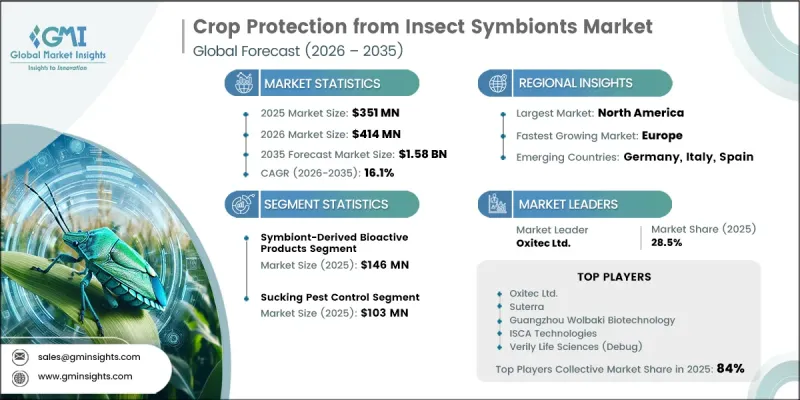
預計到 2025 年,全球昆蟲作物保護市場價值將達到 3.51 億美元,並預計以 16.1% 的複合年成長率成長,到 2035 年達到 15.8 億美元。
隨著農民擴大採用生物防治技術來提高作物產量並減少對傳統化學殺蟲劑的依賴,基於昆蟲的作物保護市場正在迅速擴張。對合成農作物保護產品的監管日益嚴格,加上對永續農業實踐的需求不斷成長,持續為生物來源解決方案創造了有利環境。微生物研究、基因工程和生物技術的進步正在加速創新共生平台的開發和商業化,使企業能夠部署更具針對性和環境友善的農作物保護產品。擴大田間檢驗、增強農民信心以及擴大商業性部署進一步推動了全部區域的市場成長。此外,基於共生的技術具有顯著優勢,可以幫助農民滿足日益嚴格的殘留標準,同時支持綜合蟲害管理方案和永續農業實踐。隨著法律規範的不斷完善和對無殘留作物保護解決方案的需求不斷成長,製造商正在加強對研發、產品開發和商業化活動的投入,以在全球農業領域推廣基於昆蟲共生的技術。
| 市場範圍 | |
|---|---|
| 開始年份 | 2025 |
| 預測期 | 2026-2035 |
| 初始市場規模 | 3.51億美元 |
| 預測金額 | 15.8億美元 |
| 複合年成長率 | 16.1% |
到2025年,生物來源生物活性產品市場規模將達到1.46億美元,佔市場佔有率的41.6%。該細分市場保持主導地位,主要得益於生物來源農作物保護產品的商業性化程度不斷提高、分銷網路日益完善以及在關鍵農業市場法規核准的不斷擴大。持續的產品創新和對環保病蟲害防治方案日益成長的需求,進一步鞏固了該細分市場的強勁市場地位。
預計到2025年,吸汁害蟲防治領域的銷售額將達到1.03億美元,市佔率為29.3%。針對作物害蟲的生物防治方案的積極應用,持續推動水果、蔬菜和穀物生產領域這一細分市場的成長。國內外農業市場日益重視減少作物損失、維持產品品質以及遵守嚴格的殘留物標準,這進一步增強了對生物來源汁害蟲生物防治方案的需求。
到2025年,北美蟲害防治市場規模將達到1.11億美元。美國仍將佔據該地區最大的市場佔有率,而加拿大則受益於高價值農業生產系統中永續作物保護技術的日益普及,實現了穩步成長。
目錄
第1章:調查方法和範圍
第2章執行摘要
第3章 行業洞察
- 產業生態系分析
- 供應商情況
- 利潤率
- 每個階段增加的價值
- 影響價值鏈的因素
- 中斷
- 影響產業的因素
- 促進因素
- 產業潛在風險與挑戰
- 市場機遇
- 成長潛力分析
- 監理情勢
- 波特的分析
- PESTLE分析
- 價格趨勢
- 按地區
- 依產品類型
- 未來市場趨勢
- 技術與創新展望
- 最新科技趨勢
- 新興技術
- 專利趨勢
- 貿易統計
- 主要進口國
- 主要出口國
- 永續性和環境方面
- 永續計劃
- 減少廢棄物策略
- 生產中的能源效率
- 具有環保意識的舉措
- 考慮碳足跡
第4章 競爭情勢
- 介紹
- 企業市佔率分析
- 按地區
- 北美洲
- 歐洲
- 亞太地區
- LATAM
- 中東和非洲
- 按地區
- 企業矩陣分析
- 主要市場公司的競爭分析
- 競爭定位矩陣
- 主要進展
- 併購
- 夥伴關係和聯盟
- 新產品發布
- 業務拓展計劃
第5章 市場估算與預測:依產品類型分類,2022-2035年
- 活共生體產品
- 釋放感染沃爾巴克氏體的昆蟲
- 直接共生體生物防治配方
- 腸道益生菌製劑
- 工程共生體產品
- CRISPR/Cas9 修飾的共生產品
- 共生體介導的RNAi(SMR)遞送系統
- 基於旁基因改造的害蟲防治效應產品
- 源自共生體的生物活性產品
- 信息素和聚集訊息化合物配方
- 共生體衍生的毒素和抗菌化合物
- 揮發性引誘劑和誘餌配方
- 共生體破壞劑
- 基於抗生素的共生體破壞劑
- 針對酵母樣共生體(YLS)的抗真菌藥物
- 基於雙股RNA的共生體-宿主交互作用抑制劑
第6章 市場估算與預測:依作物類型分類,2022-2035年
- 穀類和穀類食品
- 米
- 玉米
- 小麥和其他穀物
- 水果和蔬菜
- 水果
- 蔬菜
- 油籽/豆類
- 大豆/豆類
- 其他油籽和豆類
- 特種作物和工業作物
- 棉布
- 甘蔗
- 馬鈴薯
- 其他
第7章 市場估計與預測:依應用領域分類,2022-2035年
- 防治吸食樹液的害蟲
- 蚜蟲防治
- 白粉蝨防治
- 葉蟬和飛蝨的防治
- 粉蚧和蚜蟲的防治
- 囓齒類害蟲的防治
- 毛蟲和鱗翅目害蟲的防治
- 甲蟲和象鼻蟲的防治
- 蝗蟲和直翅目害蟲的防治
- 雙翅目和實蠅科蠅類害蟲防治
- 東方果蠅和地中海果蠅的防治
- 黑腹果蠅的管理
- 其他雙翅目作物害蟲的防治
- 防治由媒介傳播的植物病害
- 水稻病毒病防治
- 木薯和熱帶作物的病毒控制
- 貝戈莫病毒和其他雙生病毒科疾病的管理
- 倉儲貨物的蟲害防治
- 穀類和分枝甲蟲的防治
- 煙草象甲和儲藏煙草害蟲的防治
第8章 市場估計與預測:依地區分類,2022-2035年
- 北美洲
- 美國
- 加拿大
- 歐洲
- 德國
- 英國
- 法國
- 西班牙
- 義大利
- 其他歐洲國家
- 亞太地區
- 中國
- 印度
- 日本
- 澳洲
- 韓國
- 其他亞太國家
- 拉丁美洲
- 巴西
- 墨西哥
- 阿根廷
- 其他拉丁美洲國家
- 中東和非洲
- 沙烏地阿拉伯
- 南非
- UAE
- 其他中東和非洲國家
第9章:公司簡介
- Guangzhou Wolbaki Biotechnology Co., Ltd.
- Oxitec Ltd.
- Verily Life Sciences LLC(Debug Program)
- ISCA Technologies, Inc.
- Suterra LLC
- MosquitoMate, Inc.
- icipe
- Koppert Biological Systems
- Andermatt Biocontrol AG
- Biobest Group NV
- AgBiome, Inc.
- Marrone Bio Innovations(Bioceres Crop Solutions)
- Indigo Agriculture
- Vestaron Corporation
The Global Crop Protection from Insect Symbionts Market was valued at USD 351 million in 2025 and is estimated to grow at a CAGR of 16.1% to reach USD 1.58 billion by 2035.
The crop protection from insect symbionts market is witnessing rapid expansion as agricultural producers increasingly adopt biological pest management technologies to improve crop productivity while reducing dependence on conventional chemical insecticides. Growing regulatory restrictions on synthetic crop protection products, combined with rising demand for sustainable farming practices, continue to create favorable conditions for biologically derived pest control solutions. Advances in microbial research, genetic engineering, and biotechnology are accelerating the development and commercialization of innovative symbiont-based platforms, enabling companies to introduce more targeted and environmentally responsible crop protection products. Expanding field validation, increasing grower confidence, and wider commercial deployment are further supporting market growth across major agricultural regions. Symbiont-based technologies also offer significant advantages by helping producers meet increasingly stringent residue standards while supporting integrated pest management programs and sustainable agricultural practices. As regulatory frameworks continue to evolve and demand for residue-free crop protection solutions increases, manufacturers are strengthening investments in research, product development, and commercialization activities to expand the adoption of insect symbiont-based technologies throughout the global agricultural sector.
| Market Scope | |
|---|---|
| Start Year | 2025 |
| Forecast Year | 2026-2035 |
| Start Value | $351 Million |
| Forecast Value | $1.58 Billion |
| CAGR | 16.1% |
In 2025, the symbiont-derived bioactive products segment accounted for USD 146 million, representing 41.6% share. The segment maintains its leadership due to the increasing commercial availability of biologically derived crop protection products, established distribution networks, and expanding regulatory acceptance across key agricultural markets. Continuous product innovation and growing demand for environmentally responsible pest management solutions continue to reinforce the segment's strong market position.
The sucking pest control segment generated USD 103 million, accounting for 29.3% share in 2025. Strong adoption of biological pest management solutions targeting crop-damaging insects continues to support segment growth across fruit, vegetable, and cereal production. Increasing focus on minimizing crop losses, maintaining product quality, and complying with strict residue requirements in domestic and international agricultural markets further strengthens demand for biologically based sucking pest control solutions.
North America Crop Protection from Insect Symbionts Market generated USD 111 million in 2025. The United States continues to account for the largest share of regional demand, while Canada is experiencing steady growth supported by increasing adoption of sustainable crop protection technologies across high-value agricultural production systems.
Major companies operating in the global crop protection from insect symbionts market include Guangzhou Wolbaki Biotechnology Co., Ltd., Oxitec Ltd., Verily Life Sciences LLC, ISCA Technologies, Inc., Suterra LLC, MosquitoMate, Inc., icipe, Koppert Biological Systems, Andermatt Biocontrol AG, Biobest Group NV, AgBiome, Inc., Marrone Bio Innovations (Bioceres Crop Solutions), Indigo Agriculture, and Vestaron Corporation. Companies operating in the global crop protection from insect symbionts market are strengthening their competitive position through continuous investment in biotechnology research, product innovation, and commercialization of biologically based crop protection solutions. Industry participants are expanding research partnerships, increasing field validation programs, and accelerating regulatory approvals to broaden product availability across key agricultural markets. Businesses are also focusing on improving product performance, scalability, and manufacturing capabilities to support growing global demand. Strategic collaborations with agricultural distributors, research organizations, and farming communities help companies expand market reach while increasing customer awareness and adoption.
Table of Contents
Chapter 1 Methodology & Scope
- 1.1 Research approach
- 1.2 Quality Commitments
- 1.2.1 GMI AI policy & data integrity commitment
- 1.2.1.1 Source consistency protocol
- 1.2.1 GMI AI policy & data integrity commitment
- 1.3 Research Trail & Confidence Scoring
- 1.3.1 Research Trail Components
- 1.3.2 Scoring Components
- 1.4 Data Collection
- 1.4.1 Partial list of primary sources
- 1.5 Data mining sources
- 1.5.1 Paid sources
- 1.5.1.1 Sources, by region
- 1.5.1 Paid sources
- 1.6 Base estimates and calculations
- 1.6.1 Base year calculation for any one approach
- 1.7 Forecast model
- 1.7.1 Quantified market impact analysis
- 1.7.1.1 Mathematical impact of growth parameters on forecast
- 1.7.1 Quantified market impact analysis
- 1.8 Research transparency addendum
- 1.8.1 Source attribution framework
- 1.8.2 Quality assurance metrics
- 1.8.3 Our commitment to trust
Chapter 2 Executive Summary
- 2.1 Industry 360° synopsis
- 2.2 Key market trends
- 2.2.1 Regional
- 2.2.2 Product Type
- 2.2.3 Crop Type
- 2.2.4 Application
- 2.3 TAM Analysis, 2026-2035
- 2.4 CXO perspectives: Strategic imperatives
Chapter 3 Industry Insights
- 3.1 Industry ecosystem analysis
- 3.1.1 Supplier landscape
- 3.1.2 Profit margin
- 3.1.3 Value addition at each stage
- 3.1.4 Factor affecting the value chain
- 3.1.5 Disruptions
- 3.2 Industry impact forces
- 3.2.1 Growth drivers
- 3.2.2 Industry pitfalls and challenges
- 3.2.3 Market opportunities
- 3.3 Growth potential analysis
- 3.4 Regulatory landscape
- 3.4.1 North America
- 3.4.2 Europe
- 3.4.3 Asia Pacific
- 3.4.4 Latin America
- 3.4.5 Middle East & Africa
- 3.5 Porter's analysis
- 3.6 PESTEL analysis
- 3.7 Price trends
- 3.7.1 By region
- 3.7.2 By product type
- 3.8 Future market trends
- 3.9 Technology and Innovation landscape
- 3.9.1 Current technological trends
- 3.9.2 Emerging technologies
- 3.10 Patent Landscape
- 3.11 Trade statistics (HS code)
- 3.11.1 Major importing countries
- 3.11.2 Major exporting countries
- 3.12 Sustainability and environmental aspects
- 3.12.1 Sustainable practices
- 3.12.2 Waste reduction strategies
- 3.12.3 Energy efficiency in production
- 3.12.4 Eco-friendly initiatives
- 3.13 Carbon footprint consideration
Chapter 4 Competitive Landscape, 2025
- 4.1 Introduction
- 4.2 Company market share analysis
- 4.2.1 By region
- 4.2.1.1 North America
- 4.2.1.2 Europe
- 4.2.1.3 Asia Pacific
- 4.2.1.4 LATAM
- 4.2.1.5 MEA
- 4.2.1 By region
- 4.3 Company matrix analysis
- 4.4 Competitive analysis of major market players
- 4.5 Competitive positioning matrix
- 4.6 Key developments
- 4.6.1 Mergers & acquisitions
- 4.6.2 Partnerships & collaborations
- 4.6.3 New Product Launches
- 4.6.4 Expansion Plans
Chapter 5 Market Estimates and Forecast, By Product Type, 2022-2035 (USD Million)
- 5.1 Key trends
- 5.2 Live Symbiont Products
- 5.2.1 Wolbachia-Infected Insect Releases
- 5.2.2 Direct Symbiont Biocontrol Formulations
- 5.2.3 Gut Probiotic Formulations
- 5.3 Engineered Symbiont Products
- 5.3.1 CRISPR/Cas9-Modified Symbiont Products
- 5.3.2 Symbiont-Mediated RNAi (SMR) Delivery Systems
- 5.3.3 Paratransgenesis-Based Anti-Pest Effector Products
- 5.4 Symbiont-Derived Bioactive Products
- 5.4.1 Pheromone & Aggregation Semiochemical Formulations
- 5.4.2 Symbiont-Derived Toxin & Antimicrobial Compounds
- 5.4.3 Volatile Attractant & Lure Formulations
- 5.5 Symbiont-Disruption Agents
- 5.5.1 Antibiotic-Based Symbiont Disruptors
- 5.5.2 Antifungal Agents Targeting Yeast-Like Symbionts (YLS)
- 5.5.3 dsRNA-Based Symbiont-Host Interaction Disruptors
Chapter 6 Market Estimates and Forecast, By Crop Type, 2022-2035 (USD Million)
- 6.1 Key trends
- 6.2 Cereals & Grains
- 6.2.1 Rice
- 6.2.2 Maize
- 6.2.3 Wheat & Other Cereals
- 6.3 Fruits & Vegetables
- 6.3.1 Fruits
- 6.3.2 Vegetables
- 6.4 Oilseeds & Pulses
- 6.4.1 Soybean & Bean
- 6.4.2 Other Oilseeds & Pulses
- 6.5 Specialty & Industrial Crops
- 6.5.1 Cotton
- 6.5.2 Sugarcane
- 6.5.3 Potato
- 6.6 Others
Chapter 7 Market Estimates and Forecast, By Application, 2022-2035 (USD Million)
- 7.1 Key trends
- 7.2 Sucking Pest Control
- 7.2.1 Aphid Management
- 7.2.2 Whitefly Management
- 7.2.3 Planthopper & Leafhopper Management
- 7.2.4 Mealybug & Psyllid Management
- 7.3 Chewing Pest Control
- 7.3.1 Caterpillar & Lepidopteran Pest Management
- 7.3.2 Coleopteran & Weevil Management
- 7.3.3 Locust & Orthopteran Management
- 7.4 Dipteran & Tephritid Pest Control
- 7.4.1 Oriental & Mediterranean Fruit Fly Management
- 7.4.2 Spotted Wing Drosophila Management
- 7.4.3 Other Dipteran Crop Pest Management
- 7.5 Vector-Borne Plant Disease Management
- 7.5.1 Rice Virus Disease Management
- 7.5.2 Cassava & Tropical Crop Virus Management
- 7.5.3 Begomovirus & Other Geminivirid Disease Management
- 7.6 Stored Product Pest Control
- 7.6.1 Grain Weevil & Bruchid Beetle Management
- 7.6.2 Cigarette Beetle & Stored Tobacco Pest Management
Chapter 8 Market Estimates and Forecast, By Region, 2022-2035 (USD Million)
- 8.1 Key trends
- 8.2 North America
- 8.2.1 U.S.
- 8.2.2 Canada
- 8.3 Europe
- 8.3.1 Germany
- 8.3.2 UK
- 8.3.3 France
- 8.3.4 Spain
- 8.3.5 Italy
- 8.3.6 Rest of Europe
- 8.4 Asia Pacific
- 8.4.1 China
- 8.4.2 India
- 8.4.3 Japan
- 8.4.4 Australia
- 8.4.5 South Korea
- 8.4.6 Rest of Asia Pacific
- 8.5 Latin America
- 8.5.1 Brazil
- 8.5.2 Mexico
- 8.5.3 Argentina
- 8.5.4 Rest of Latin America
- 8.6 Middle East and Africa
- 8.6.1 Saudi Arabia
- 8.6.2 South Africa
- 8.6.3 UAE
- 8.6.4 Rest of Middle East and Africa
Chapter 9 Company Profiles
- 9.1 Guangzhou Wolbaki Biotechnology Co., Ltd.
- 9.2 Oxitec Ltd.
- 9.3 Verily Life Sciences LLC (Debug Program)
- 9.4 ISCA Technologies, Inc.
- 9.5 Suterra LLC
- 9.6 MosquitoMate, Inc.
- 9.7 icipe
- 9.8 Koppert Biological Systems
- 9.9 Andermatt Biocontrol AG
- 9.10 Biobest Group NV
- 9.11 AgBiome, Inc.
- 9.12 Marrone Bio Innovations (Bioceres Crop Solutions)
- 9.13 Indigo Agriculture
- 9.14 Vestaron Corporation

 全球胜肽類作物保護市場規模、佔有率、趨勢和成長分析報告(2026-2034)
 糧食殺蟲劑市場:2026-2032年全球市場預測(按產品類型、穀物類型、配方、害蟲類型、施用方法和最終用戶分類)
 2026 年至 2035 年肽類作物保護的市場機會、成長要素、產業趨勢和預測。
 2026年全球閉合迴路保護物流市場報告功能性作物護理市場:依產品類型、作物類型、應用方法、配方和技術分類-2026-2032年全球市場預測穀物和穀類作物保護市場:按類型、配方、作物類型、應用、分銷管道分類,全球預測(2026-2032)美國作物保護產業主要經銷商:策略市場分析
 穀物保護劑市場-全球產業規模、佔有率、趨勢、機會、預測:防治方法、目標害蟲、穀物類型、地區及競爭格局(2021-2031年)全球生物作物保護市場:機會與策略展望(至2034年)
 全球生物作物保護市場:2032 年預測 - 按產品類型、種類、形式、來源、作物類型、應用和地區進行分析